
An Effective Hybrid Transactional Memory System with Strong

An Effective Hybrid Transactional Memory System with Strong Isolation Guarantees Minh, Trautmann, Chung, Mc. Donald, Bronson, Casper, Kozyrakis, Olukotun Presented by Cynthia Sturton 5/5/08
Outline • Software Transactional Memory • Hardware Transactional Memory • Sig. TM
Software Transactional Memory • Lazy versioning – Global version clock – Write set buffer • Lazy conflict detection – Lock associated with every word in memory – Bloom filter to maintain write set
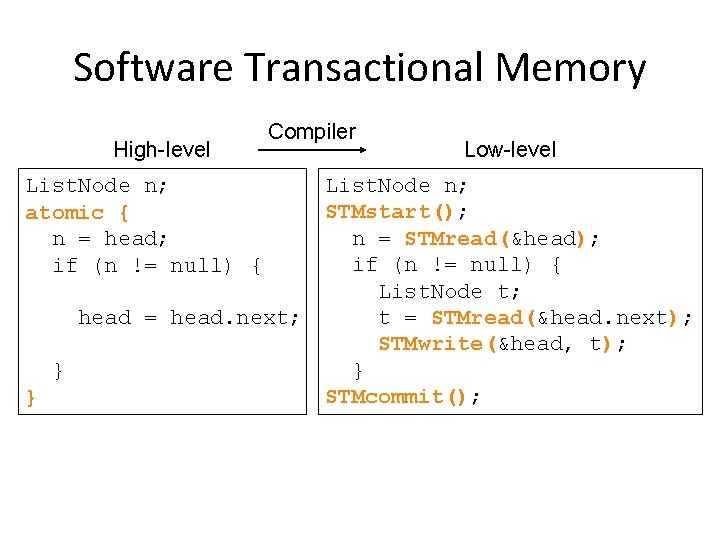
Software Transactional Memory High-level Compiler List. Node n; atomic { n = head; if (n != null) { head = head. next; } } Low-level List. Node n; STMstart(); n = STMread(&head); if (n != null) { List. Node t; t = STMread(&head. next); STMwrite(&head, t); } STMcommit();

Software Transactional Memory - Start • Checkpoint current execution environment • Read global version clock value into RV
Software Transactional Memory – Read • Check if in write set • Check for conflicts with committed or committing transactions – Abort! • Insert address into read set (FIFO) • Load word from memory, return value to user
Software Transactional Memory Write • Check for conflict from committed or committing transactions – Abort! • Insert address in Bloom filter for write set • Insert address and data in write set
Software Transactional Memory Commit • Acquire locks for write set • Atomically increment global clock • Validate items in read set ** Transaction Validated ** • Copy write set values to memory • Release locks on write sets
Correctness in STM • Strong Isolation – Data races – Privatization code • Read sets not validated until commit
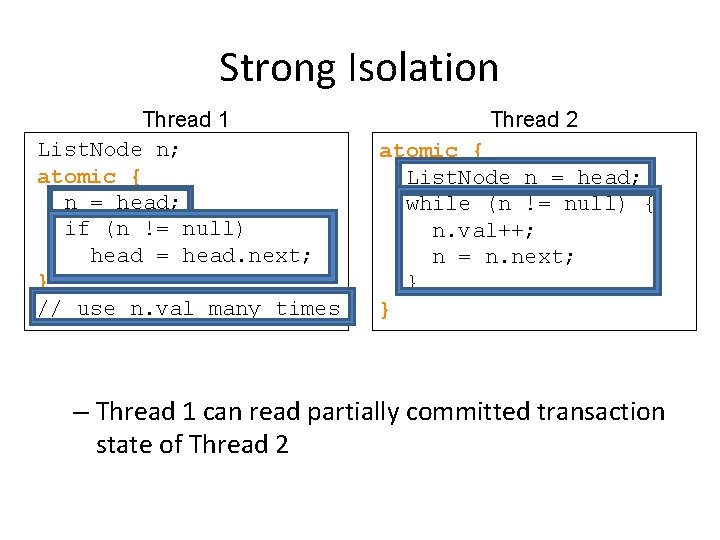
Strong Isolation Thread 1 List. Node n; atomic { n = head; if (n != null) head = head. next; } // use n. val many times Thread 2 atomic { List. Node n = head; while (n != null) { n. val++; n = n. next; } } – Thread 1 can read partially committed transaction state of Thread 2
Hardware Transactional Memory • Lazy versioning – Write set buffered in cache – W and R bits added to cache line hardware • Eager conflict detection (reads & writes) – Cache coherency messages
Hardware Transactional Memory Start • Register checkpoint done by hardware
Hardware Transactional Memory Read • Cache hit: – Set R bit if W bit isn’t already set • Cache miss: – Request line in shared state – Set R bit
Hardware Transactional Memory Write • Cache miss: – Request line in shared state • Cache hit: – If data is modified write back to underlying memory • Write to cache and set W bit
Hardware Transactional Memory Commit • Acquire commit lock • Acquire exclusive state on all lines in write set ** Transaction Validated ** • Reset W and R bits • Release commit lock • Modified data in cache can be read by others
Hardware Transactional Memory – Conflict Detection • Conflict: – Process receives exclusive request for data in read set – Process receives any request for data in write set • Generated by committing or non-transactional process • Software abort handler invoked – Invalidate all cache lines in R and W set – Restore register checkpoint • Forward progress – validated transaction cannot abort • No starvation – starving transactions acquire commit lock at outset
Sig. TM • Hardware – Software transactional memory hybrid • Eager conflict detection (on read set) – Hardware signature (Bloom filter) • Lazy versioning – Write set buffer in SW • Strong isolation guarantees
Sig. TM - Start • Take a checkpoint • Enable read set signature lookups for exclusive coherence requests
Sig. TM - Read • Check if address is in write set • Insert address into read set signature • Read word from memory
Sig. TM - Write • Add address to write signature • Update address and value in software write set
Sig. TM - Commit • Enable coherence lookups in write set for all requests • Acquire exclusive access for every address in write set • Enable NACKs for requests in write set ** Transaction validated ** • Reset read set signature • Store values from write set to memory • Reset write set signature • Disable NACKing
Sig. TM vs. STM • Read barriers accelerated with read set signature • No locking or timestamps • Commit accelerated – Two traversals of write set – No read set validation • Early conflict detection – False positives with read or write signatures?
Sig. TM vs. HTM • No hardware cache modification • Flexible • Nested transactions
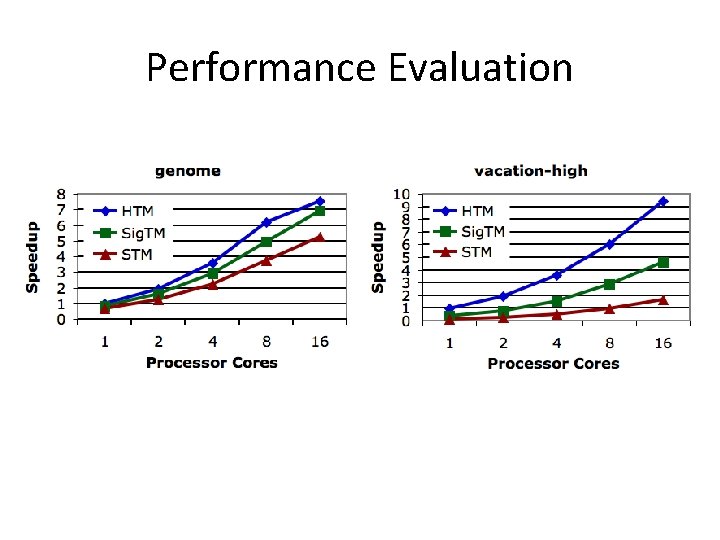
Performance Evaluation
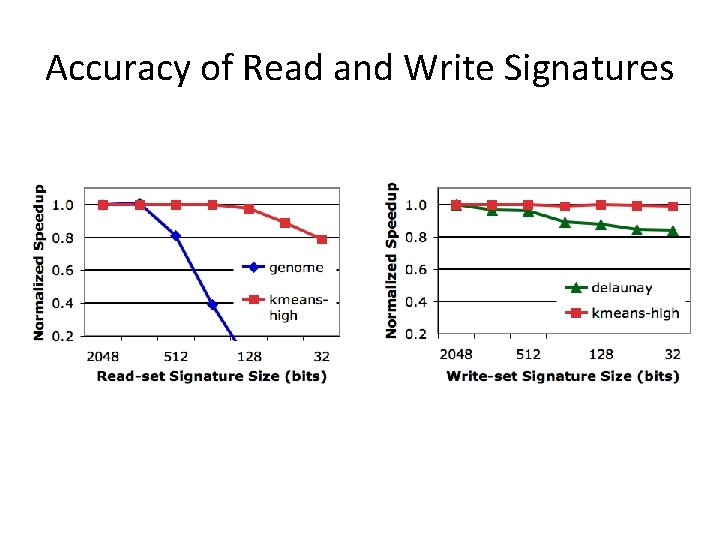
Accuracy of Read and Write Signatures
Sig. TM
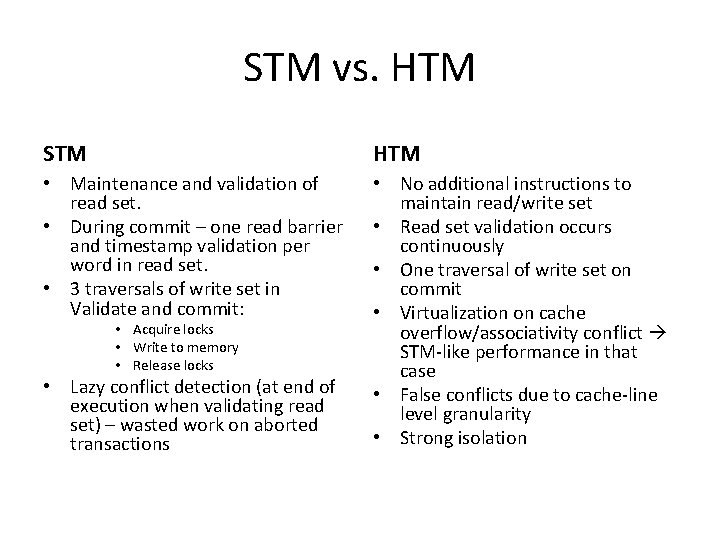
STM vs. HTM STM HTM • Maintenance and validation of read set. • During commit – one read barrier and timestamp validation per word in read set. • 3 traversals of write set in Validate and commit: • No additional instructions to maintain read/write set • Read set validation occurs continuously • One traversal of write set on commit • Virtualization on cache overflow/associativity conflict STM-like performance in that case • False conflicts due to cache-line level granularity • Strong isolation • Acquire locks • Write to memory • Release locks • Lazy conflict detection (at end of execution when validating read set) – wasted work on aborted transactions
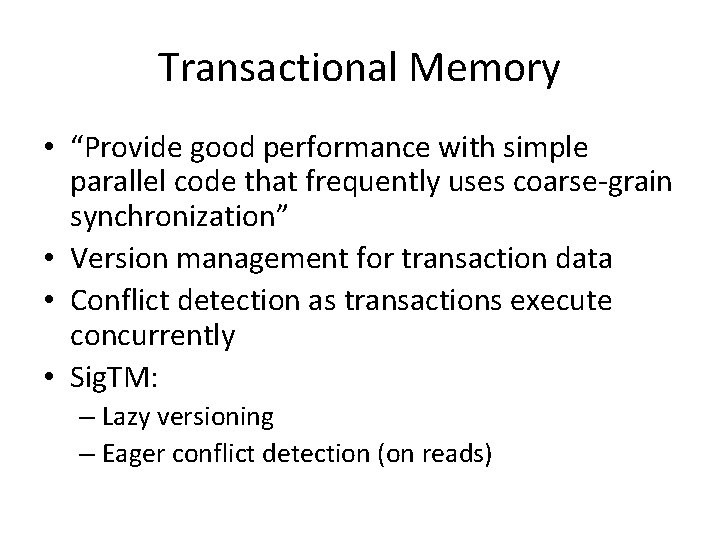
Transactional Memory • “Provide good performance with simple parallel code that frequently uses coarse-grain synchronization” • Version management for transaction data • Conflict detection as transactions execute concurrently • Sig. TM: – Lazy versioning – Eager conflict detection (on reads)
- Slides: 28