
An Dementia Behaviours that Challenge Liz Champion Lead
An Dementia Behaviours that Challenge. Liz Champion Lead Nurse for Dementia Care Maidstone and Tunbridge Wells NHS Trust Liz. champion@nhs. net 01892 633738 dy ou rs
Aims of the session • • • Identify cognitive and non-cognitive symptoms. Identify behaviours that challenge. Identify triggers for behaviours. VERA To identify what delirium is and how this can affect behaviours.

Cognitive Symptoms • Problems relating to thinking or memory. • Planning and organising. • Making a cup of tea; preparing a meal; going to the shops. • Forgetfulness. • Forgetting appointments; Losing things around the house. • Language. • Complex actions • Buttoning a shirt; Using a knife and fork; difficulty dressing. • Recognition – sight, sound, touch. • Sight – recognising family; Sound – Hearing the phone; Touch – Getting into a hot bath; • Agnosia – inability to interpret information from the sensory system.

Non-cognitive symptoms These refer to the behavioural and psychological symptoms of dementia (BPSD). • Psychotic symptoms – - Delusions – fixed false belief. Hallucinations – experience of something that is not really there. Auditory – hearing Olfactory – smell Visual – sight Gustatory – Taste Tactile. • Emotional symptoms - Apathy – withdrawal; loss of interest; absence of emotion. Depression – low mood; poor motivation; poor appetite; problems sleeping. Anxiety – Restlessness; Irritability; Muscle tension; Fears; rapid breathing; chest tightness.

Behaviours that Challenge • Agitation – restlessness; irritability; pacing up and down. • Aggression - Verbal – swearing; screaming; shouting; making threats. - Physical – hitting; punching; scratching; biting. • Wandering • Disinhibition – indecent exposure; obscene language; inappropriate touching; racial comments. • Sleep disturbance – difficulty falling asleep; waking often; excessive daytime napping; sleep reversal. • Eating problems – preference for sweet foods; reduced or increased appetite; reluctance to drink; attempts to eat inedible substances.

Triggers for Challenging Behaviours The early recognition of triggers that precede BPSD (behavioural and psychological symptoms of dementia) are crucial. If identified, the development of simple interventions and nursing plans to address the early symptoms can help prevent the symptoms from developing at all. (Alzheimer's Society 2012) • Unfamiliar environment and people. • Hunger. • Pain. • Boredom. • Loss of inhibitions and decreased awareness of appropriate behaviour. • Feeling frightened. • Feeling humiliated. • Feeling frustrated. • Wanting the toilet.

Managing Challenging behaviour • • • Distraction – divert attention – change subject. - go for a walk. Engagement – involve in activity – look at family photos - singing - playing games. Communication – verbal and non-verbal – eye contact - speak clearly and slowly - Simple sentences. - Offer comfort. Appropriate Approach – calmly face person in non-threatening way. - Explain what you are about to do, before you do it. - Reassuring manner. - Listen to concerns. Seek help – refer to colleagues, families or carers for extra support.
Validate; Empathise; Reassure; Activity (VERA) • • Differing realities / validation. Do not argue or contradict or give misleading information. Don’t be scared to talk to the patient about their life experiences. Validate - I can see you are upset / frightened, how can I help? Empathise - You look upset – is there anything I can do to help? Reassure - My name is XXXX – I am here to help you. Activity - Where did you meet xxxx? Encourage discussion about their loved ones. Look at pictures etc. A patients reality is based at a different time to the present. They may think they are only thirty years old and so their partners and children will be younger. • Small acts of kindness go a long way. • Build rapport though kindness and compassion. • Visual clues can help to calm patients.

Behavioural Charts • • • Assists in identifying triggers, that may have an impact on behaviour. What prompted the incident? Reaction of the person. Action taken. Result of action. • Always review the charts every 24 hours to identify any trends to assist in relieving symptoms and providing person-centred care
Delirium • This is a medical emergency. • NICE definition of delirium: ‘Delirium is when someone becomes acutely confused because of a physical problem or a change in environment. ’ • What can cause delirium? • • Urine or chest infection; high temperature; side effects of drugs e. g. pain killers and steroids; Dehydration; major surgery; brain injury; terminal illness; constipation. Always consider that a patient may not be at their baseline level of functioning. Is very serious and it is important to recognise it and identify the cause as soon as possible. Can be hypoacute and hyperacute. • Should be assessed using the Short CAM (Confusion Assessment Method). • •
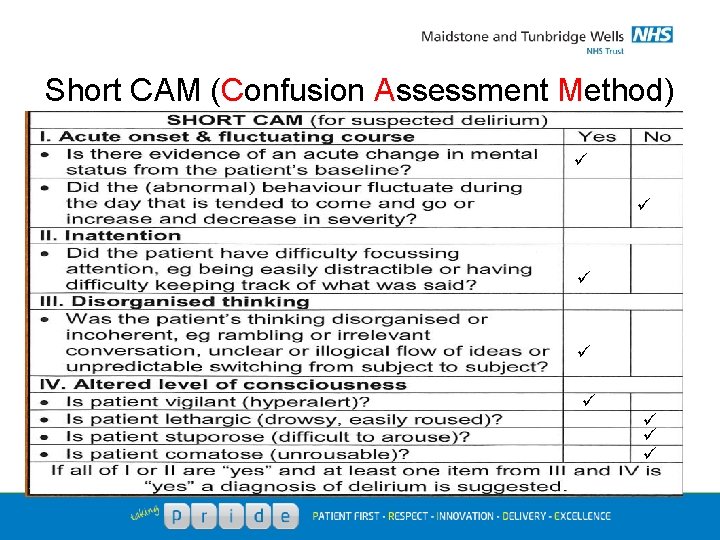
Short CAM (Confusion Assessment Method)
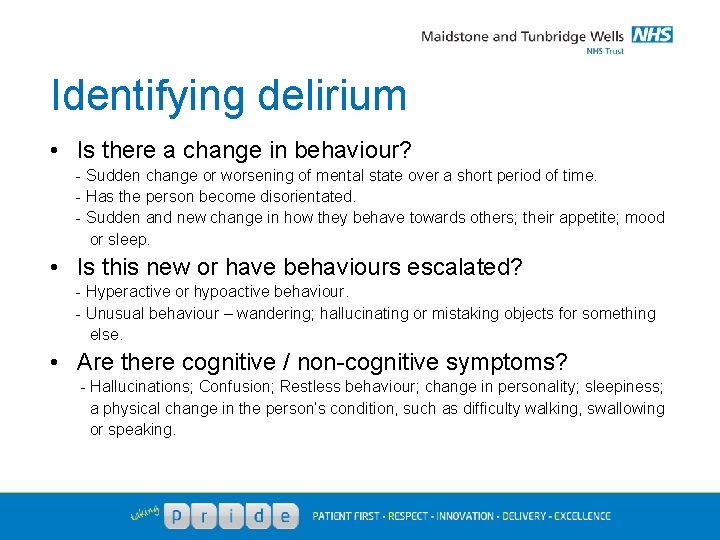
Identifying delirium • Is there a change in behaviour? - Sudden change or worsening of mental state over a short period of time. - Has the person become disorientated. - Sudden and new change in how they behave towards others; their appetite; mood or sleep. • Is this new or have behaviours escalated? - Hyperactive or hypoactive behaviour. - Unusual behaviour – wandering; hallucinating or mistaking objects for something else. • Are there cognitive / non-cognitive symptoms? - Hallucinations; Confusion; Restless behaviour; change in personality; sleepiness; a physical change in the person’s condition, such as difficulty walking, swallowing or speaking.
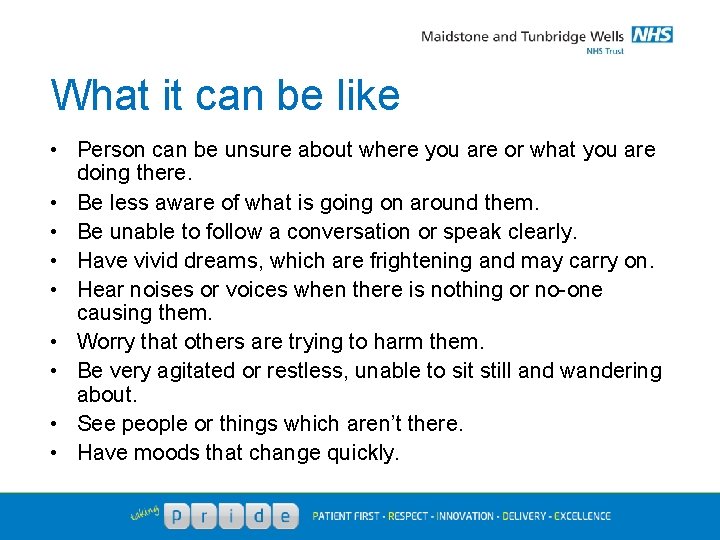
What it can be like • Person can be unsure about where you are or what you are doing there. • Be less aware of what is going on around them. • Be unable to follow a conversation or speak clearly. • Have vivid dreams, which are frightening and may carry on. • Hear noises or voices when there is nothing or no-one causing them. • Worry that others are trying to harm them. • Be very agitated or restless, unable to sit still and wandering about. • See people or things which aren’t there. • Have moods that change quickly.
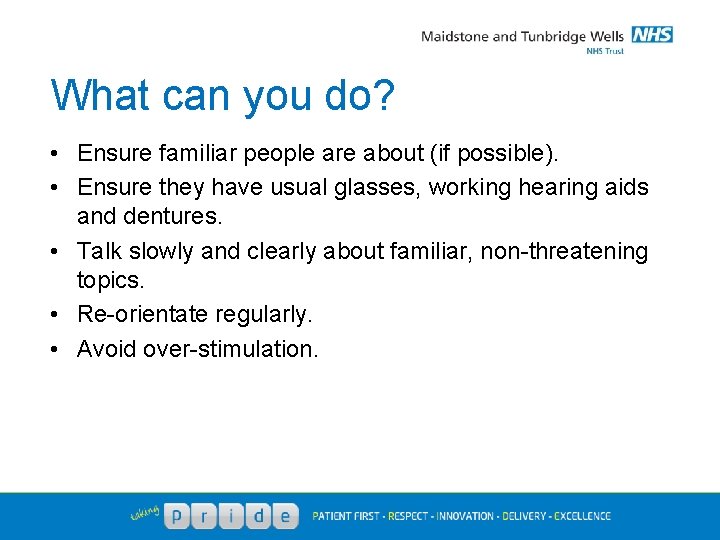
What can you do? • Ensure familiar people are about (if possible). • Ensure they have usual glasses, working hearing aids and dentures. • Talk slowly and clearly about familiar, non-threatening topics. • Re-orientate regularly. • Avoid over-stimulation.
Delirium • Gets better when the cause is treated. • Can take several days or weeks, and may be longer for people with dementia (3 months). • Can re-occur whilst still resolving. • If had delirium before, more prone to getting it again. • Can be confused for dementia or worsening of dementia.
Any Questions?
- Slides: 16