
An brief intro to small ruminants John Thompson
An brief intro to small ruminants John Thompson Extension Agent VCE Fluvanna jthomp 75@vt. edu; 591 -1950 Adapted from: SUSAN SCHOENIAN Sheep & Goat Specialist Western Maryland Research & Education Center sschoen@umd. edu – www. sheepandgoat. com
Charlottesville Ordinance! Sec. 4 -2. Definitions. Miniature goat means a goat weighing less than one hundred (100) pounds, commonly known as pygmy, dwarf or miniature goats. Sec. 4 -8. Fowl at large. It shall be unlawful for any person to permit any chickens, ducks, geese, pigeons or other fowl belonging to him to go at large in the city; except, that homing pigeons may be released for return to their cote without violating this section (11 -20 -06(2))
2 -3 Sec. 4 -9. Keeping hogs, goats and sheep. (a) No hogs, goats (other than miniature goats) or sheep shall be kept in the city except for immediate shipment or slaughter. (b) Miniature goats may be kept within any residential zoning district in the city, subject to the following:
3 of 3 (1) Males must be neutered; (2) Goats must be dehorned; (3) No more than three (3) miniature goats may be kept at the same time on the same property, except that nursing off-spring may be kept on the property until the age of twelve (12) weeks, and shall not be included in the number of goats allowed.
Presentation topics Introduction Sheep and goat enterprises Info to raise sheep/goats
Classification of farm livestock By their digestive systems Monogastric Ruminant Hind-gut fermenter ◦ Simple stomach ◦ Pigs and poultry (and people) ◦ Cud-chewing ◦ 4 compartment stomach. - Cows, sheep, and goats ◦ Pseudo-ruminant (3 compartment stomach) - Alpacas and llamas ◦ Fermentation occurs in the caecum and/or large intestine ◦ Horses and rabbits
Why raise sheep and/or goats? Economic ◦ Profit ◦ Tax advantages Lifestyle Self-sufficiency produce own food, fiber Landscape management
Pros and cons: PROS Less acreage required Less investment Ease of handling Multi-purpose Reproductive efficiency Grazing behavior Niche demand for products Complement other farm enterprises
Pros and cons: CONS Small industry. Lack of infrastructure. Lack of mainstream demand for products. Fencing requirements. Labor requirements. Predator risk.
Sheep vs. goats More similarities than differences Similar production practices and inputs. Same diseases. Similar niche and ethnic demand for products. Similar constraints to production: the 3 P’s. ◦ Prices ◦ Predators ◦ Parasites
Differences Grazer Prefer forbs Graze close to ground Grow faster Produce better milk More genetic diversity Strong flocking instinct and group mentality Traditional enterprise SHEEP Browser Prefer shrubs Top-down grazer Grow slow Produce more milk Less genetic diversity Curious and independent New and growing industry GOATS
Sheep and goat enterprises Meat Dairy Fiber Landscape management Agri-tourism
Dairy production Primary income is from the sale of milk, cheese, and/or other dairy products. In Virginia, operation must be certified grade A to sell food products. Usually requires own product development and marketing.
What do you need to raise sheep and goats? Feed Fencing Housing and shelter Feeders Watering system Labor
Feed resource The largest cost associated with raising livestock is feed. Pasture and browse Hay Grain Alternative feedstuffs
Fencing Purpose ◦ To keep livestock contained ◦ To keep predators out ◦ To control grazing and manage livestock Three kinds 1. Perimeter or boundary 2. Interior or cross 3. Heavy use areas
Perimeter fencing Your first line of defense against predators. � Multi-strand, hightensile, electric. � Woven wire with extra barbed and electric offset wires. � Barbed � Adapt wire existing fences.
Interior fencing For rotational grazing and animal management. Permanent Semi-permanent Temporary, electric ◦ Smooth wire ◦ Polywire, tape, or rope ◦ Electric netting
Heavy use areas Outdoor lots Holding areas Working corrals Net wire Metal gates Solid panels Livestock panels Non-electric
Housing and shelter Purpose Needs vary by ◦ ◦ ◦ Animal management Isolation area Feed storage Equipment storage Human comfort ◦ Climate ◦ Production system ◦ Timing of lambing and kidding ◦ Availability of natural shelter. ◦ Personal preference
Do grazing animals require shelter? Maybe not, but if they have access to it, they will usually use it. They “appreciate” protection from bad weather.
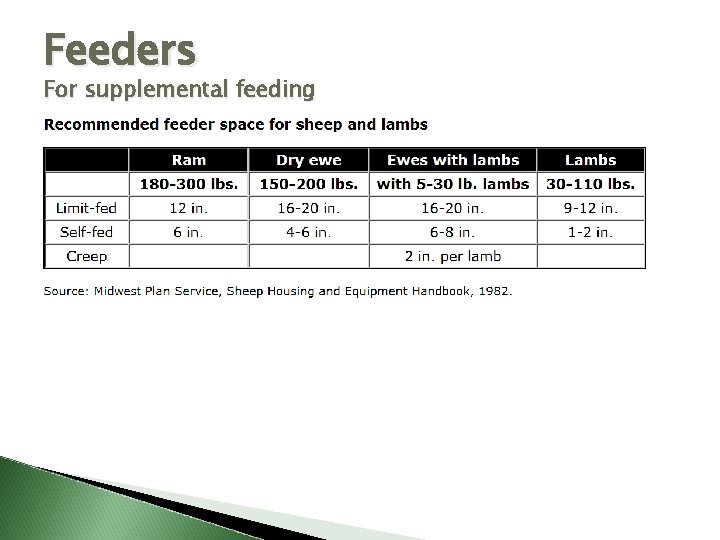
Feeders For supplemental feeding
Storage Feed and equipment Ample feed storage protects your investment in feed and allows you to make bulk purchases. Annual hay requirements Hay storage ◦ ¼ to ⅓ ton per animal ◦ 180 to 240 ft 3 per ton Uncovered hay deteriorates rapidly in quality.
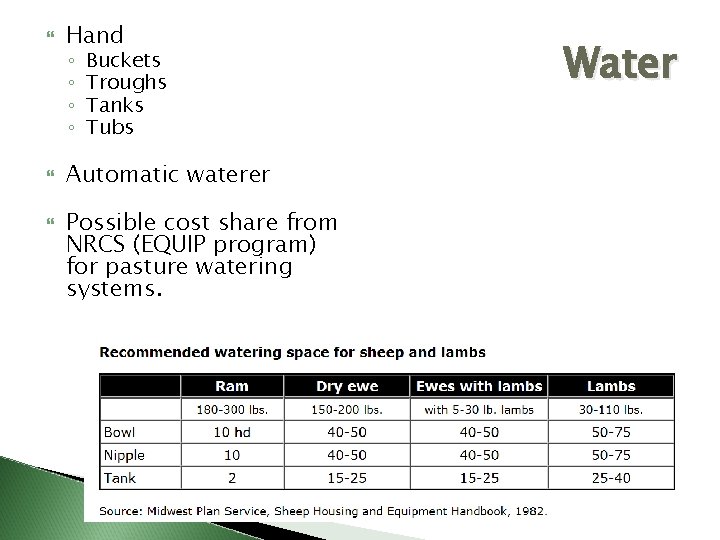
Hand Automatic waterer ◦ ◦ Buckets Troughs Tanks Tubs Possible cost share from NRCS (EQUIP program) for pasture watering systems. Water
Labor Daily care of animals Twice daily milking Annual shearing Pasture management Lambing and kidding Parasite control Hoof trimming
Dairy goat breeds ADGA recognized ◦ Swiss Saanen Alpine Toggenburg Oberhasli Alpine ◦ Nubian ◦ La Mancha ◦ Nigerian Dwarf Other ◦ Sable (colored Saanens) ◦ Golden Guernsey ◦ Mini dairy goats Toggenbur g Nubian Oberhasli La Mancha
Mini goat breeds Pygmy (meat) Nigerian Dwarf (dairy) Kinder Pygmy x Nubian Mini Silky Myotonic x Nigerian Dwarf ? Mini dairy goats Nigerian Dwarf x standard dairy Pygmy Nigerian Dwarf
Getting started Get pastures and facilities ready before buying your first sheep or goats. Start small and gradually increase size of herd. Start with healthy animals. ◦ Ewe lambs/doelings vs. mature females. Ram and buck? !
Sources of breeding stock � Reputable breeders � Dispersal sales � Performance and production sales � Consignment sales � Local salebarn � Free
- Slides: 29