
An Axiomatic Theory of NonBayesian Social Learning Ali
An Axiomatic Theory of Non-Bayesian Social Learning Ali Jadbabaie JR East Professor of Engineering Massachusetts Institute of Technology With: Pooya Molavi (MIT Economics) Alireza Tahbaz-Salehi (Kellogg School, Northwestern) Amin Rahimian (MIT IDSS) Research Supported by: Vannevar Bush Fellowship, ARO MURI W 911 NF-12 -1 -0509, AFOSR MURI FA 9550 -10 -1 -0567, ONR MURI N 00014 -08 -1 -0747, ONR MURI N 00014 -08 -1 -0696, ARO MURI W 911 NF-05 -1 -0381, ONR YIP N 00014 -04 -1 -0467, AFOSR FA 9550 -13 -1 -0097
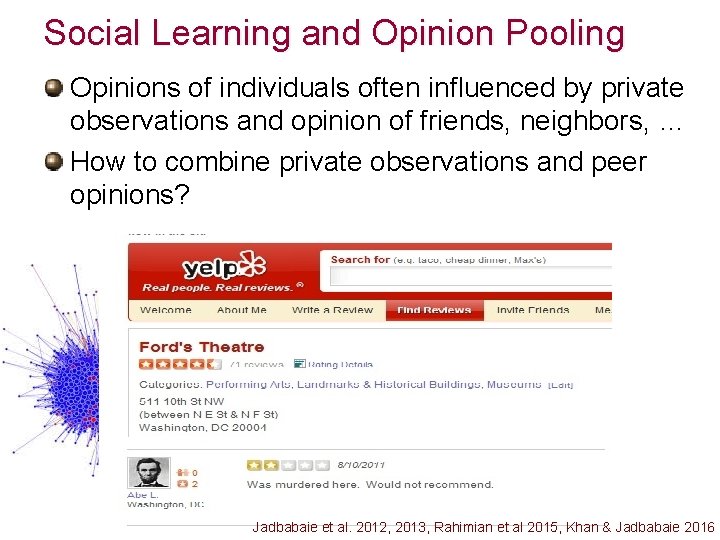
Social Learning and Opinion Pooling Opinions of individuals often influenced by private observations and opinion of friends, neighbors, … How to combine private observations and peer opinions? Jadbabaie et al. 2012, 2013, Rahimian et al 2015, Khan & Jadbabaie 2016

Rational vs. Rule of Thumb Learning Rules How to combine private observations and peer opinions? • Bayesian Savage ‘ 54, Aumann ’ 76, Borkar & Varaiya 82, Gale & Kariv ‘ 03, Rosenberg et al. ‘ 09, Acemoglu et al. 2011, Mossel & Tamuz ’ 15, ’ 16, Jadbabaie et al. 2017 • Non Bayesian: De. Groot’ 74, De Marzo et al. 2003, Golub & Jackson 2010, Jadbabaie et al. 2012 -14, Molavi et al. 2017

Combining Probabilistic Opinions Stone’ 61, De. Finetti ‘ 70, De. Groot 74, Aumann ’ 76 Bacharach ’ 70, ’ 78, Wagner ‘ 81, French ‘ 81, Lehrer 83, List ’ 10 -’ 15, …
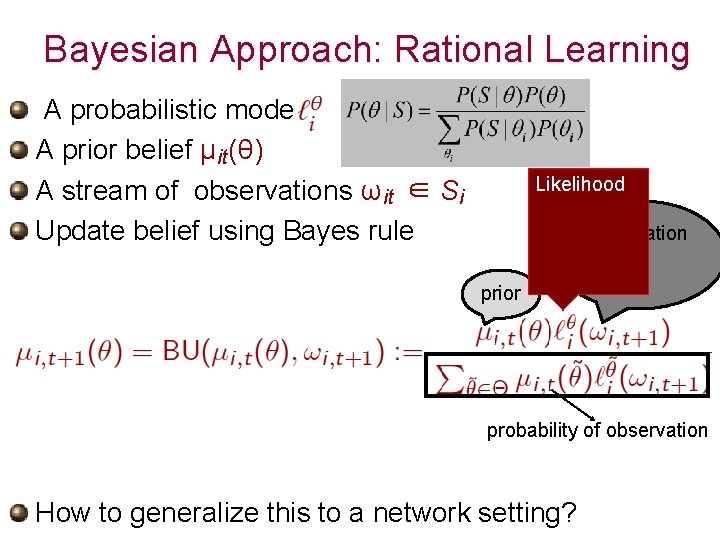
Bayesian Approach: Rational Learning A probabilistic model A prior belief µit (θ) A stream of observations ωit ∈ Si Update belief using Bayes rule Likelihood observation prior probability of observation How to generalize this to a network setting?

Bayesian Learning in Networks Agents need to infer the signal that neighbors observed that lead to their reported beliefs. Neighbors’ beliefs are influenced by their private observations and their neighbors’ beliefs A Bayesian agent needs to disentangle the influence of neighbors’ beliefs and private signals A complicated inferential task Behavioral experiments have shown that the amount of computation required is beyond cognitive capacity of humans, but what is the computational complexity?
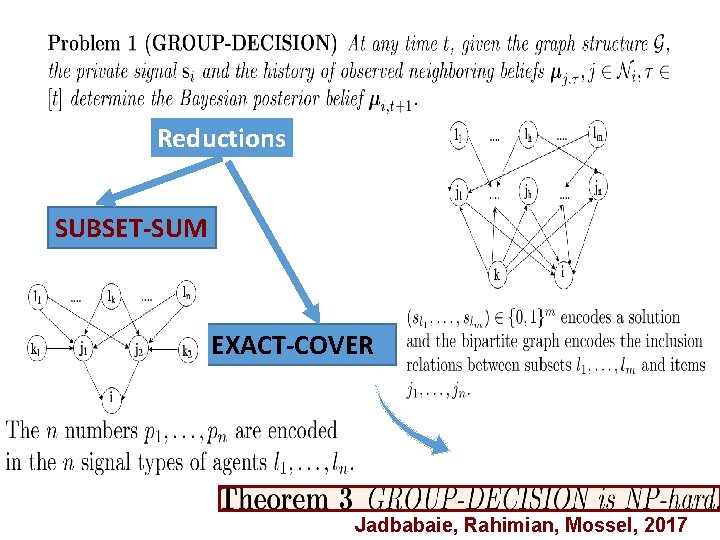
Reductions SUBSET-SUM EXACT-COVER Jadbabaie, Rahimian, Mossel, 2017
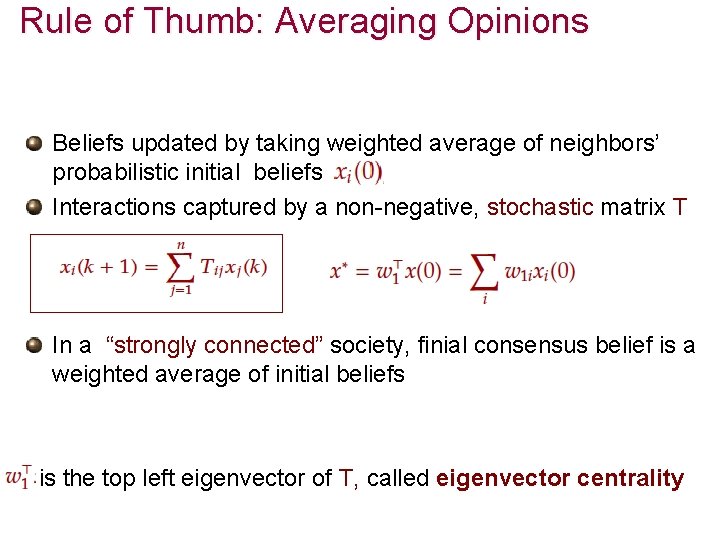
Rule of Thumb: Averaging Opinions Beliefs updated by taking weighted average of neighbors’ probabilistic initial beliefs Interactions captured by a non-negative, stochastic matrix T In a “strongly connected” society, finial consensus belief is a weighted average of initial beliefs is the top left eigenvector of T, called eigenvector centrality
Is Consensus Value the Right Value? Opinions are weighed by node’s importance in the network, not “information content” Update suffers from redundancy neglect (Eyster & Rabin 2014): If two nodes have same info from same source, their information is weighed twice! When nodes are not overtly influential, and as network grows, averaging ‘works’ (Golub & Jackson 2010) How do we allow for arrival of new observations? How should we inject more rationality into the model? Idea: combine Bayesian update with De. Groot Jadbabaie. Molavi, , Sandroni, Tahbaz-Salehi, Games and Economic Behavior, 2012
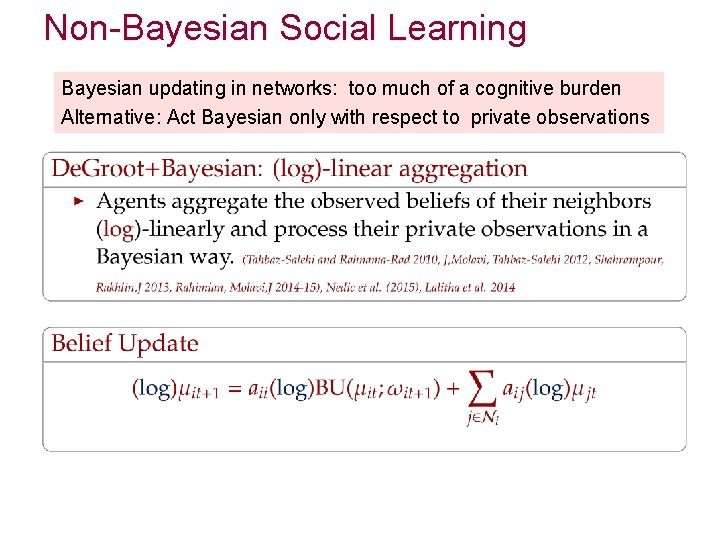
Non-Bayesian Social Learning Bayesian updating in networks: too much of a cognitive burden Alternative: Act Bayesian only with respect to private observations
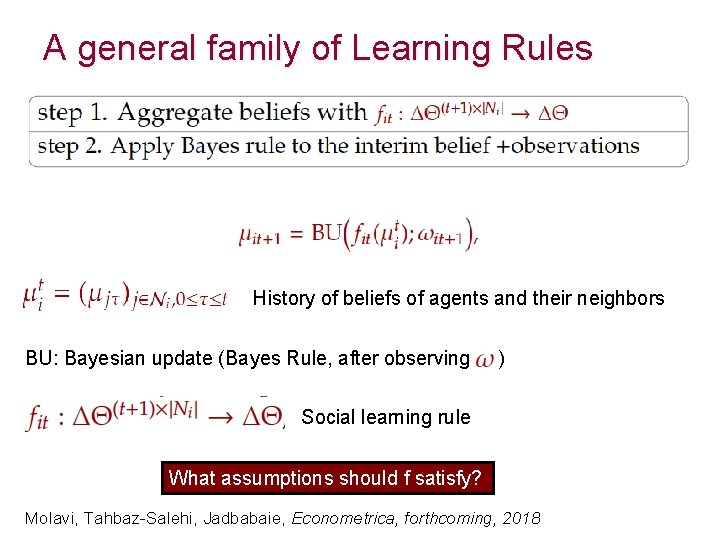
A general family of Learning Rules History of beliefs of agents and their neighbors BU: Bayesian update (Bayes Rule, after observing ) Social learning rule What assumptions should f satisfy? Molavi, Tahbaz-Salehi, Jadbabaie, Econometrica, forthcoming, 2018
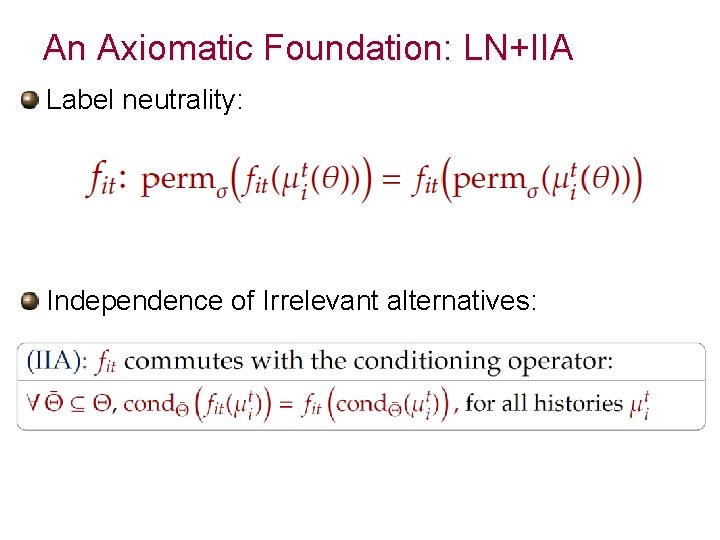
An Axiomatic Foundation: LN+IIA Label neutrality: Independence of Irrelevant alternatives:
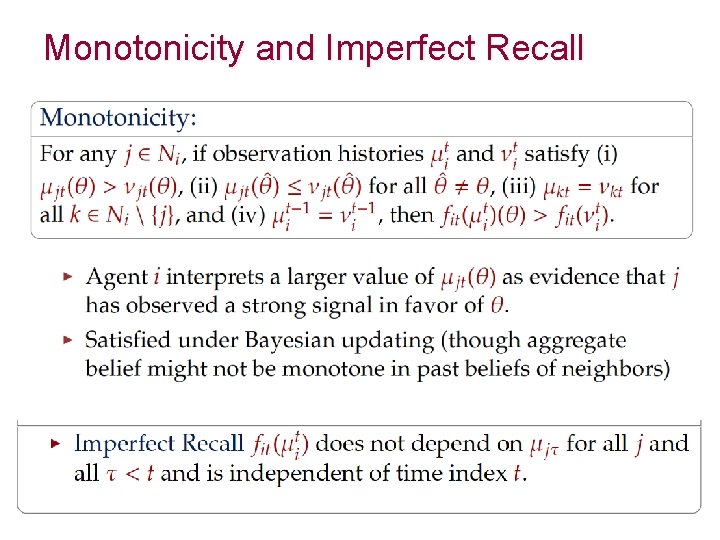
Monotonicity and Imperfect Recall
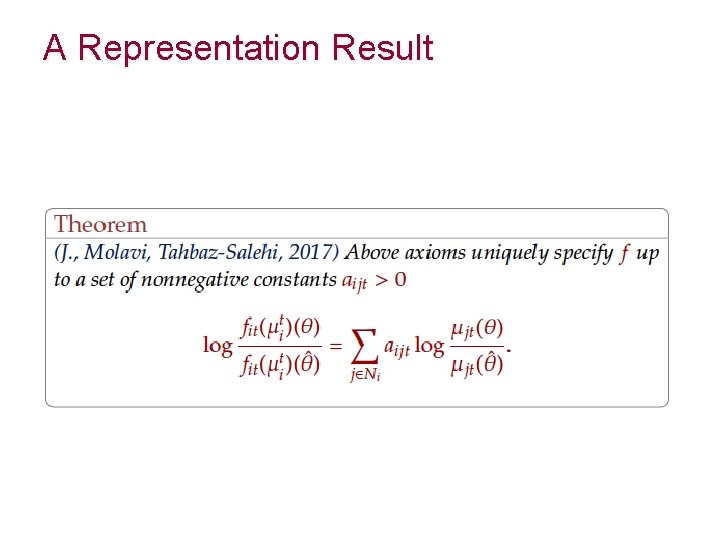
A Representation Result
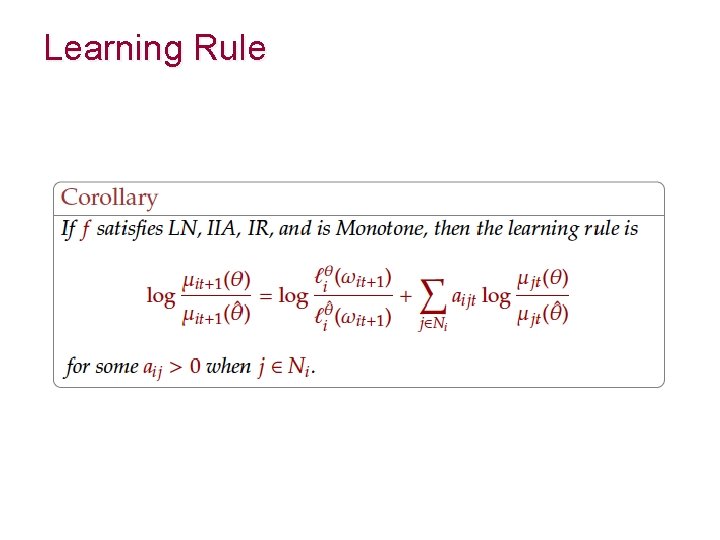
Learning Rule
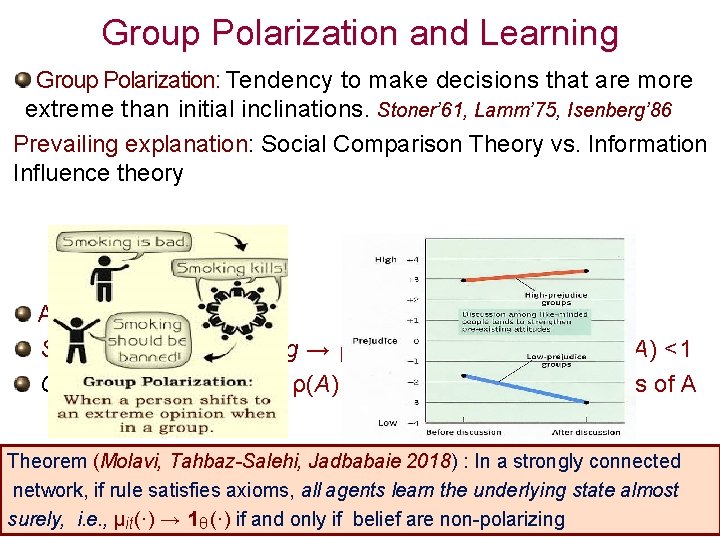
Group Polarization and Learning Group Polarization: Tendency to make decisions that are more extreme than initial inclinations. Stoner’ 61, Lamm’ 75, Isenberg’ 86 Prevailing explanation: Social Comparison Theory vs. Information Influence theory A =[aij] Network matrix Strictly group polarizing → ρ(A) > 1, depolarizing → ρ(A) <1 Group non-polarizing: ρ(A) = 1, ρ(A) = Spectral radius of A Theorem (Molavi, Tahbaz-Salehi, Jadbabaie 2018) : In a strongly connected network, if rule satisfies axioms, all agents learn the underlying state almost surely, i. e. , µit (·) → 1θ (·) if and only if belief are non-polarizing
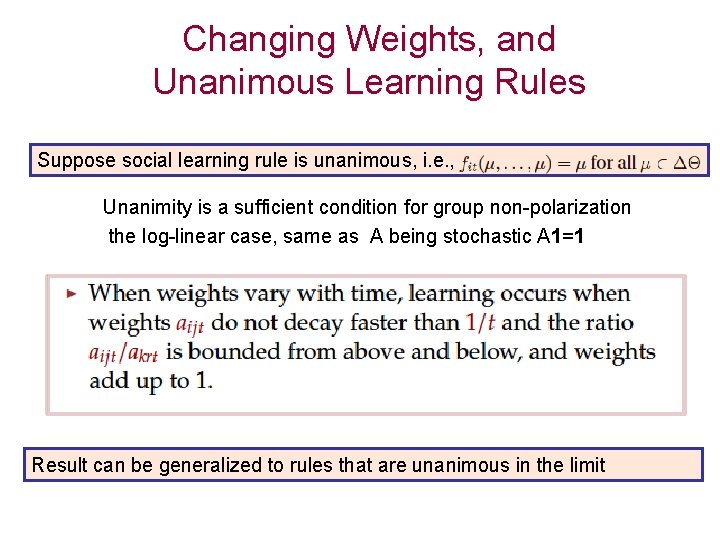
Changing Weights, and Unanimous Learning Rules Suppose social learning rule is unanimous, i. e. , Unanimity is a sufficient condition for group non-polarization the log-linear case, same as A being stochastic A 1=1 Result can be generalized to rules that are unanimous in the limit
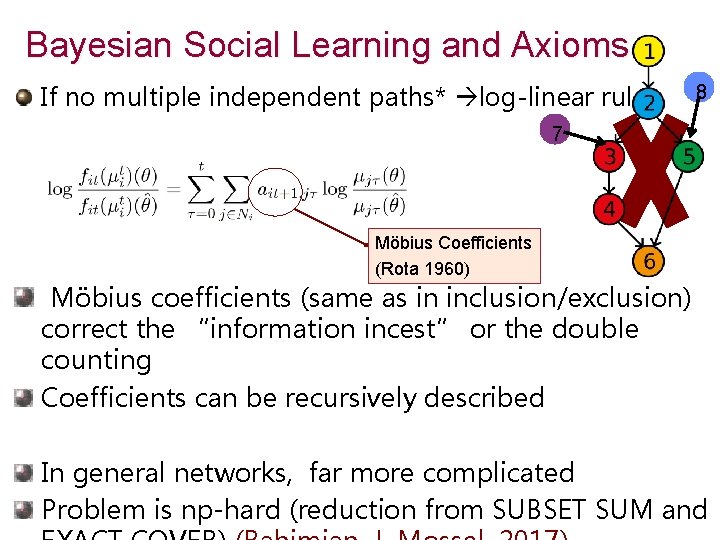
Bayesian Social Learning and Axioms If no multiple independent paths* log-linear rule 8 7 7 Möbius Coefficients (Rota 1960) Möbius coefficients (same as in inclusion/exclusion) correct the “information incest” or the double counting Coefficients can be recursively described In general networks, far more complicated Problem is np-hard (reduction from SUBSET SUM and
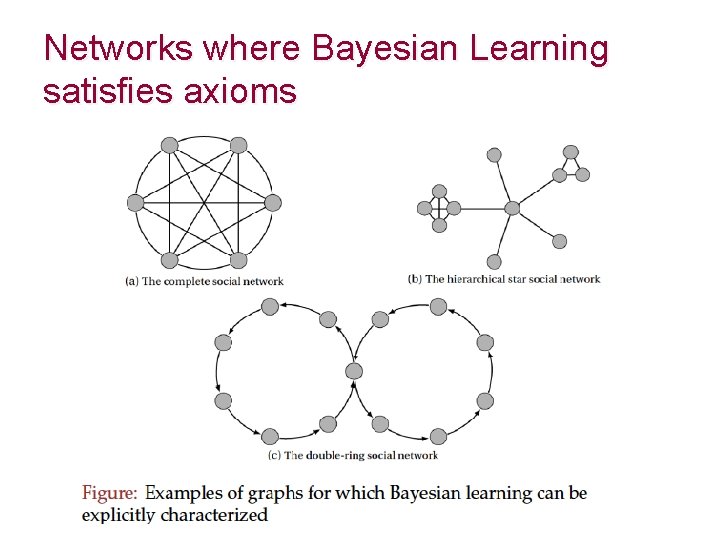
Networks where Bayesian Learning satisfies axioms
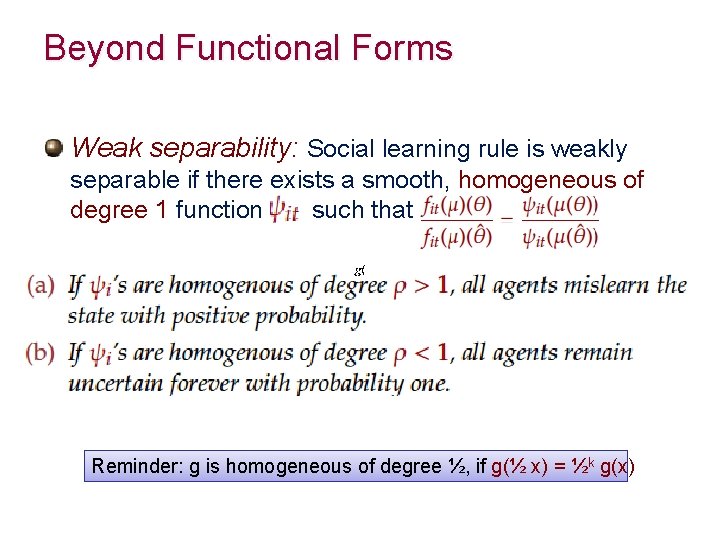
Beyond Functional Forms Weak separability: Social learning rule is weakly separable if there exists a smooth, homogeneous of degree 1 function such that Reminder: g is homogeneous of degree ½, if g(½ x) = ½k g(x)
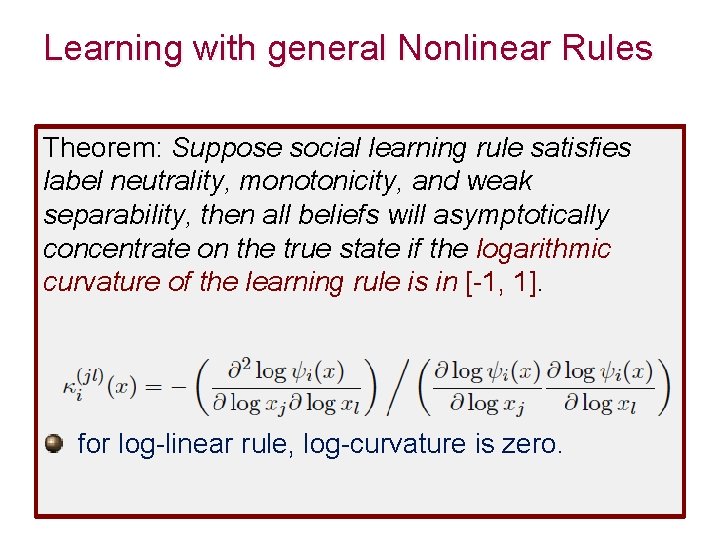
Learning with general Nonlinear Rules Theorem: Suppose social learning rule satisfies label neutrality, monotonicity, and weak separability, then all beliefs will asymptotically concentrate on the true state if the logarithmic curvature of the learning rule is in [-1, 1]. for log-linear rule, log-curvature is zero.
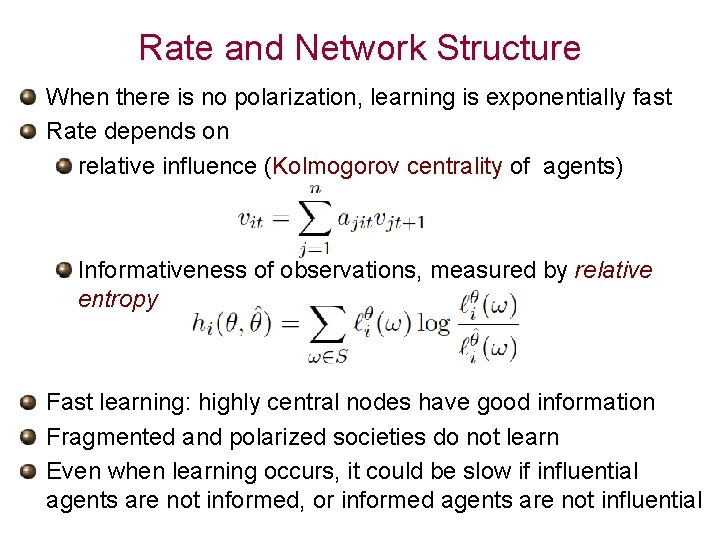
Rate and Network Structure When there is no polarization, learning is exponentially fast Rate depends on relative influence (Kolmogorov centrality of agents) Informativeness of observations, measured by relative entropy Fast learning: highly central nodes have good information Fragmented and polarized societies do not learn Even when learning occurs, it could be slow if influential agents are not informed, or informed agents are not influential
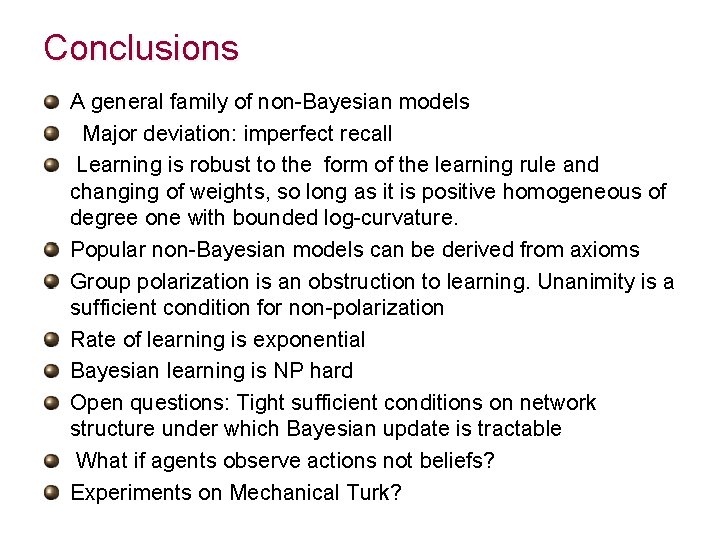
Conclusions A general family of non-Bayesian models Major deviation: imperfect recall Learning is robust to the form of the learning rule and changing of weights, so long as it is positive homogeneous of degree one with bounded log-curvature. Popular non-Bayesian models can be derived from axioms Group polarization is an obstruction to learning. Unanimity is a sufficient condition for non-polarization Rate of learning is exponential Bayesian learning is NP hard Open questions: Tight sufficient conditions on network structure under which Bayesian update is tractable What if agents observe actions not beliefs? Experiments on Mechanical Turk?
- Slides: 23