
An Automated Microbial Detection System for Monitoring Water
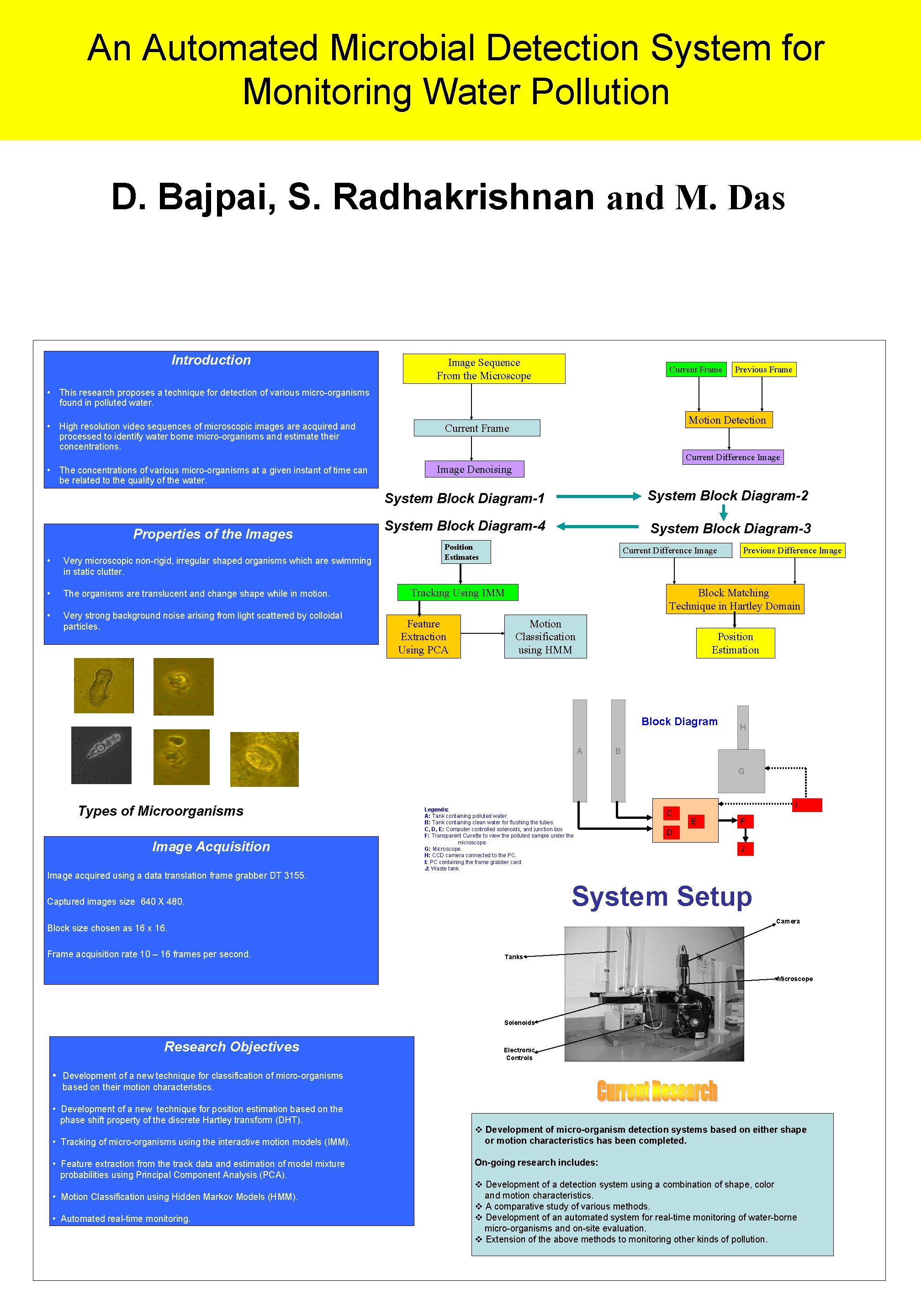
An Automated Microbial Detection System for Monitoring Water Pollution D. Bajpai, S. Radhakrishnan and M. Das Introduction Image Sequence From the Microscope Current Frame Previous Frame • This research proposes a technique for detection of various micro-organisms found in polluted water. • High resolution video sequences of microscopic images are acquired and processed to identify water borne micro-organisms and estimate their concentrations. Motion Detection Current Frame Current Difference Image • The concentrations of various micro-organisms at a given instant of time can be related to the quality of the water. Properties of the Images • Very microscopic non-rigid, irregular shaped organisms which are swimming in static clutter. • The organisms are translucent and change shape while in motion. • Very strong background noise arising from light scattered by colloidal particles. Image Denoising System Block Diagram-1 System Block Diagram-2 System Block Diagram-4 System Block Diagram-3 Position Estimates Current Difference Image Tracking Using IMM Feature Extraction Using PCA Previous Difference Image Block Matching Technique in Hartley Domain Motion Classification using HMM Position Estimation Block Diagram A H B G Types of Microorganisms Image Acquisition Image acquired using a data translation frame grabber DT 3155. Legends: A: Tank containing polluted water. B: Tank containing clean water for flushing the tubes. C, D, E: Computer controlled solenoids, and junction box F: Transparent Cuvette to view the polluted sample under the microscope. G: Microscope. H: CCD camera connected to the PC. I: PC containing the frame grabber card. J: Waste tank. E F D J System Setup Captured images size 640 X 480. Camera Block size chosen as 16 x 16. Frame acquisition rate 10 – 16 frames per second. C I Tanks Microscope Solenoids Research Objectives Electronic Controls • Development of a new technique for classification of micro-organisms based on their motion characteristics. • Development of a new technique for position estimation based on the phase shift property of the discrete Hartley transform (DHT). • Tracking of micro-organisms using the interactive motion models (IMM). • Feature extraction from the track data and estimation of model mixture probabilities using Principal Component Analysis (PCA). • Motion Classification using Hidden Markov Models (HMM). • Automated real-time monitoring. v Development of micro-organism detection systems based on either shape or motion characteristics has been completed. On-going research includes: v Development of a detection system using a combination of shape, color and motion characteristics. v A comparative study of various methods. v Development of an automated system for real-time monitoring of water-borne micro-organisms and on-site evaluation. v Extension of the above methods to monitoring other kinds of pollution.
- Slides: 1