
An Audit on the Appropriateness of Antibiotic Prescribing
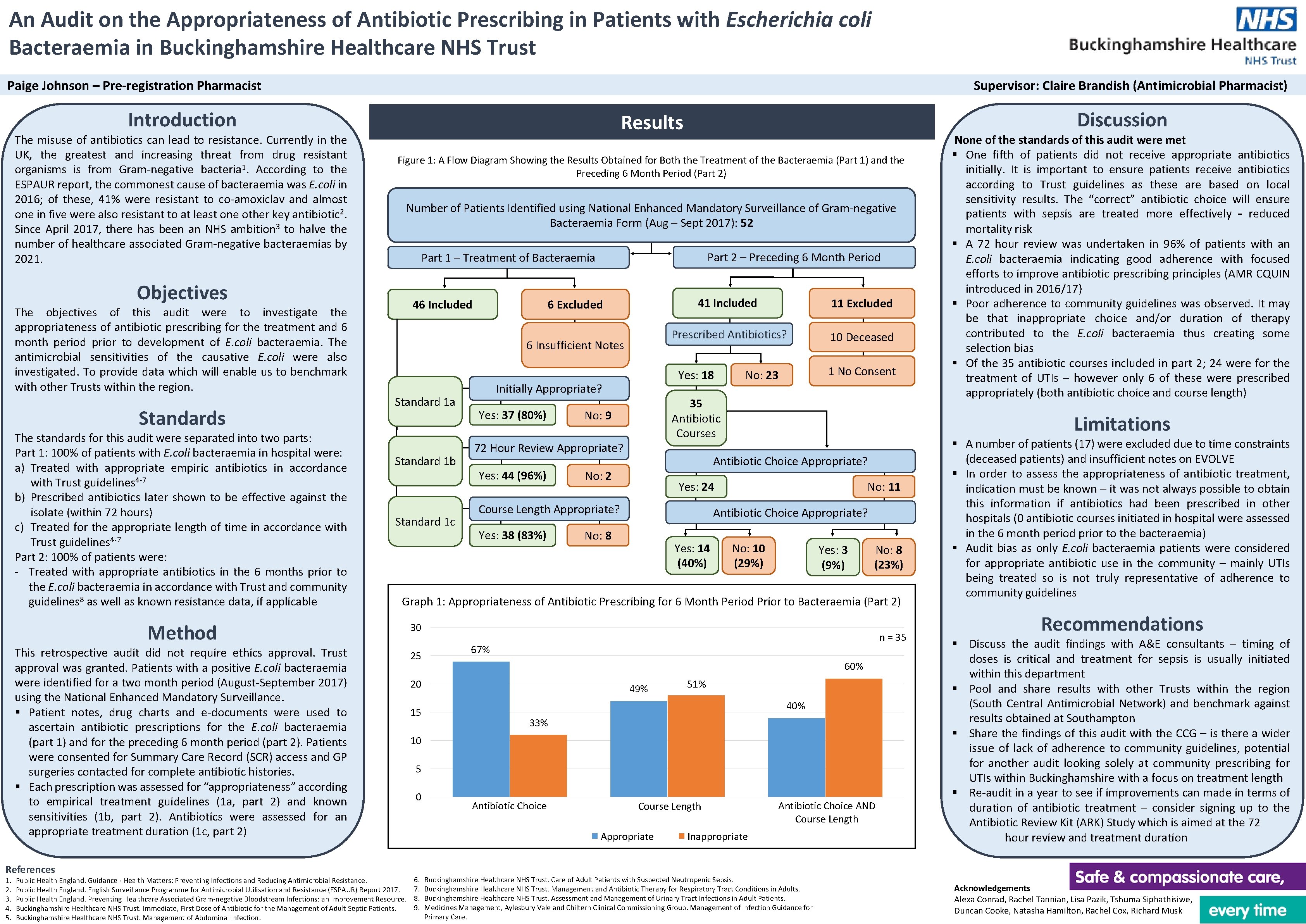
An Audit on the Appropriateness of Antibiotic Prescribing in Patients with Escherichia coli Bacteraemia in Buckinghamshire Healthcare NHS Trust Paige Johnson – Pre-registration Pharmacist Supervisor: Claire Brandish (Antimicrobial Pharmacist) Introduction The misuse of antibiotics can lead to resistance. Currently in the UK, the greatest and increasing threat from drug resistant organisms is from Gram-negative bacteria 1. According to the ESPAUR report, the commonest cause of bacteraemia was E. coli in 2016; of these, 41% were resistant to co-amoxiclav and almost one in five were also resistant to at least one other key antibiotic 2. Since April 2017, there has been an NHS ambition 3 to halve the number of healthcare associated Gram-negative bacteraemias by 2021. Figure 1: A Flow Diagram Showing the Results Obtained for Both the Treatment of the Bacteraemia (Part 1) and the Preceding 6 Month Period (Part 2) Number of Patients Identified using National Enhanced Mandatory Surveillance of Gram-negative Bacteraemia Form (Aug – Sept 2017): 52 Standards The standards for this audit were separated into two parts: Part 1: 100% of patients with E. coli bacteraemia in hospital were: a) Treated with appropriate empiric antibiotics in accordance with Trust guidelines 4 -7 b) Prescribed antibiotics later shown to be effective against the isolate (within 72 hours) c) Treated for the appropriate length of time in accordance with Trust guidelines 4 -7 Part 2: 100% of patients were: - Treated with appropriate antibiotics in the 6 months prior to the E. coli bacteraemia in accordance with Trust and community guidelines 8 as well as known resistance data, if applicable 46 Included Standard 1 a Standard 1 b Standard 1 c Prescribed Antibiotics? 10 Deceased No: 9 No: 2 No: 11 Yes: 24 Antibiotic Choice Appropriate? No: 8 Yes: 14 (40%) No: 10 (29%) Yes: 3 (9%) No: 8 (23%) Public Health England. Guidance - Health Matters: Preventing Infections and Reducing Antimicrobial Resistance. Public Health England. English Surveillance Programme for Antimicrobial Utilisation and Resistance (ESPAUR) Report 2017. Public Health England. Preventing Healthcare Associated Gram-negative Bloodstream Infections: an Improvement Resource. Buckinghamshire Healthcare NHS Trust. Immediate, First Dose of Antibiotic for the Management of Adult Septic Patients. Buckinghamshire Healthcare NHS Trust. Management of Abdominal Infection. 30 25 n = 35 67% 60% 20 15 49% 51% 40% 33% 10 5 0 Antibiotic Choice Course Length Appropriate 6. 7. 8. 9. None of the standards of this audit were met § One fifth of patients did not receive appropriate antibiotics initially. It is important to ensure patients receive antibiotics according to Trust guidelines as these are based on local sensitivity results. The “correct” antibiotic choice will ensure patients with sepsis are treated more effectively – reduced mortality risk § A 72 hour review was undertaken in 96% of patients with an E. coli bacteraemia indicating good adherence with focused efforts to improve antibiotic prescribing principles (AMR CQUIN introduced in 2016/17) § Poor adherence to community guidelines was observed. It may be that inappropriate choice and/or duration of therapy contributed to the E. coli bacteraemia thus creating some selection bias § Of the 35 antibiotic courses included in part 2; 24 were for the treatment of UTIs – however only 6 of these were prescribed appropriately (both antibiotic choice and course length) Limitations Antibiotic Choice Appropriate? Course Length Appropriate? Yes: 38 (83%) 1 No Consent No: 23 35 Antibiotic Courses 72 Hour Review Appropriate? Yes: 44 (96%) 11 Excluded Yes: 18 Initially Appropriate? Yes: 37 (80%) 41 Included Graph 1: Appropriateness of Antibiotic Prescribing for 6 Month Period Prior to Bacteraemia (Part 2) This retrospective audit did not require ethics approval. Trust approval was granted. Patients with a positive E. coli bacteraemia were identified for a two month period (August-September 2017) using the National Enhanced Mandatory Surveillance. § Patient notes, drug charts and e-documents were used to ascertain antibiotic prescriptions for the E. coli bacteraemia (part 1) and for the preceding 6 month period (part 2). Patients were consented for Summary Care Record (SCR) access and GP surgeries contacted for complete antibiotic histories. § Each prescription was assessed for “appropriateness” according to empirical treatment guidelines (1 a, part 2) and known sensitivities (1 b, part 2). Antibiotics were assessed for an appropriate treatment duration (1 c, part 2) 1. 2. 3. 4. 5. 6 Excluded 6 Insufficient Notes Method References Part 2 – Preceding 6 Month Period Part 1 – Treatment of Bacteraemia Objectives The objectives of this audit were to investigate the appropriateness of antibiotic prescribing for the treatment and 6 month period prior to development of E. coli bacteraemia. The antimicrobial sensitivities of the causative E. coli were also investigated. To provide data which will enable us to benchmark with other Trusts within the region. Discussion Results Antibiotic Choice AND Course Length Inappropriate Buckinghamshire Healthcare NHS Trust. Care of Adult Patients with Suspected Neutropenic Sepsis. Buckinghamshire Healthcare NHS Trust. Management and Antibiotic Therapy for Respiratory Tract Conditions in Adults. Buckinghamshire Healthcare NHS Trust. Assessment and Management of Urinary Tract Infections in Adult Patients. Medicines Management, Aylesbury Vale and Chiltern Clinical Commissioning Group. Management of Infection Guidance for Primary Care. § A number of patients (17) were excluded due to time constraints (deceased patients) and insufficient notes on EVOLVE § In order to assess the appropriateness of antibiotic treatment, indication must be known – it was not always possible to obtain this information if antibiotics had been prescribed in other hospitals (0 antibiotic courses initiated in hospital were assessed in the 6 month period prior to the bacteraemia) § Audit bias as only E. coli bacteraemia patients were considered for appropriate antibiotic use in the community – mainly UTIs being treated so is not truly representative of adherence to community guidelines Recommendations § Discuss the audit findings with A&E consultants – timing of doses is critical and treatment for sepsis is usually initiated within this department § Pool and share results with other Trusts within the region (South Central Antimicrobial Network) and benchmark against results obtained at Southampton § Share the findings of this audit with the CCG – is there a wider issue of lack of adherence to community guidelines, potential for another audit looking solely at community prescribing for UTIs within Buckinghamshire with a focus on treatment length § Re-audit in a year to see if improvements can made in terms of duration of antibiotic treatment – consider signing up to the Antibiotic Review Kit (ARK) Study which is aimed at the 72 hour review and treatment duration Acknowledgements Alexa Conrad, Rachel Tannian, Lisa Pazik, Tshuma Siphathisiwe, Duncan Cooke, Natasha Hamilton, Rachel Cox, Richard Musk
- Slides: 1