
An Assessment of Simple Continuous Simulation Modelling Approaches




- Slides: 23
An Assessment of Simple Continuous Simulation Modelling Approaches for Design Flood Estimation in South Africa SANCIAHS 19 th Symposium Nkululeko A. Mabila Supervisors: Prof J. C Smithers and Mr T. J Rowe 1
Overview § Introduction § Literature Review § Problem Statement and Hypothesis § Aims and Objectives § Model Selection § Methodology § Initial Results § Conclusions and Recommendations § Where to from here 2
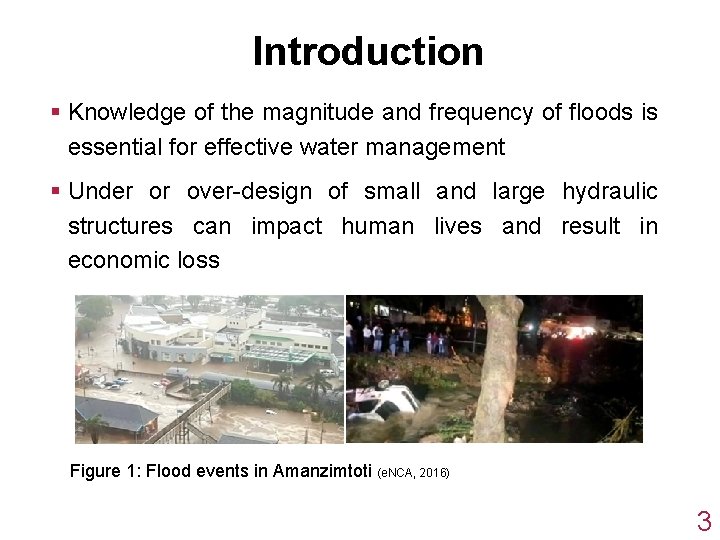
Introduction § Knowledge of the magnitude and frequency of floods is essential for effective water management § Under or over-design of small and large hydraulic structures can impact human lives and result in economic loss Figure 1: Flood events in Amanzimtoti (e. NCA, 2016) 3
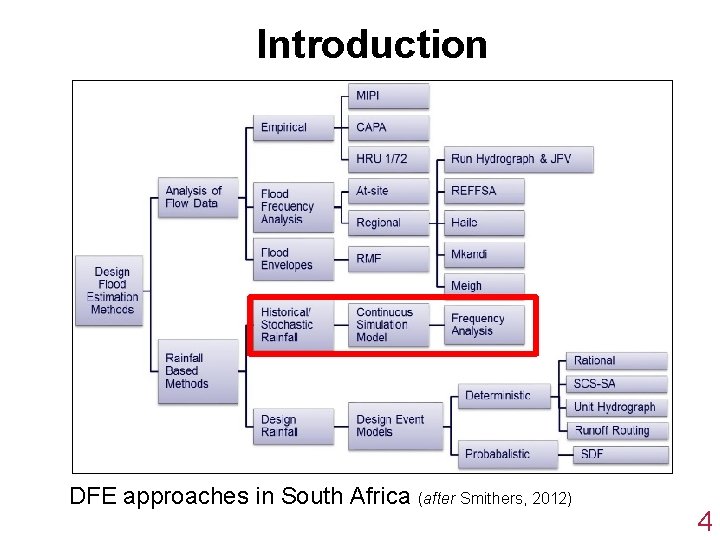
Introduction DFE approaches in South Africa (after Smithers, 2012) 4
Literature Review § In South Africa, the complex and parameter intensive ACRU CS model (Schulze, 1995) has been applied for DFE in several case studies (Smithers et al. , 1997; Smithers et al. , 2001; Smithers et al. , 2007; Smithers et al. , 2013) § Other international studies and developments (Australia, UK, USA, Italy and France) § The debate over simple and complex rainfall-runoff models has been highlighted in many reviews (Nash and Sutcliffe, 1970; Hooper et al. , 1988; Jakeman et al. , 1990; Beven, 1993; Jakeman and Hornberger, 1994; Boughton and Droop, 2003; Dye and Croke, 2003). § Complex models: (Beven, 1993; Dye and Croke, 2003) § many parameters § data demanding § requires expertise and more time for model set up, data gathering and formatting 5
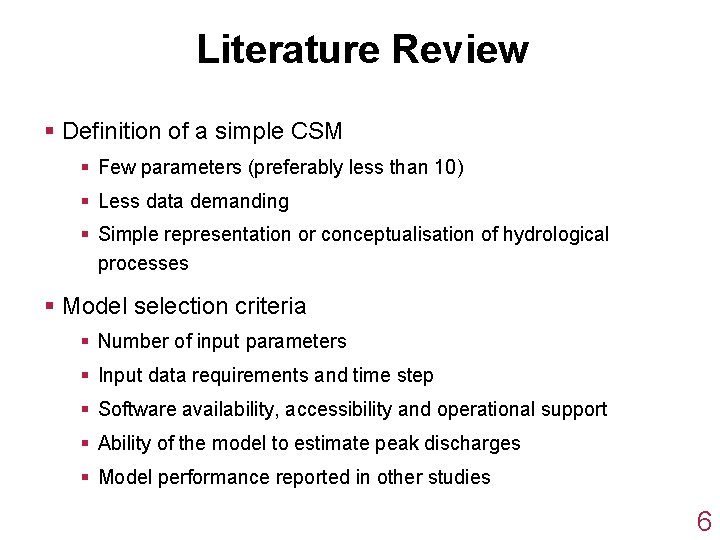
Literature Review § Definition of a simple CSM § Few parameters (preferably less than 10) § Less data demanding § Simple representation or conceptualisation of hydrological processes § Model selection criteria § Number of input parameters § Input data requirements and time step § Software availability, accessibility and operational support § Ability of the model to estimate peak discharges § Model performance reported in other studies 6
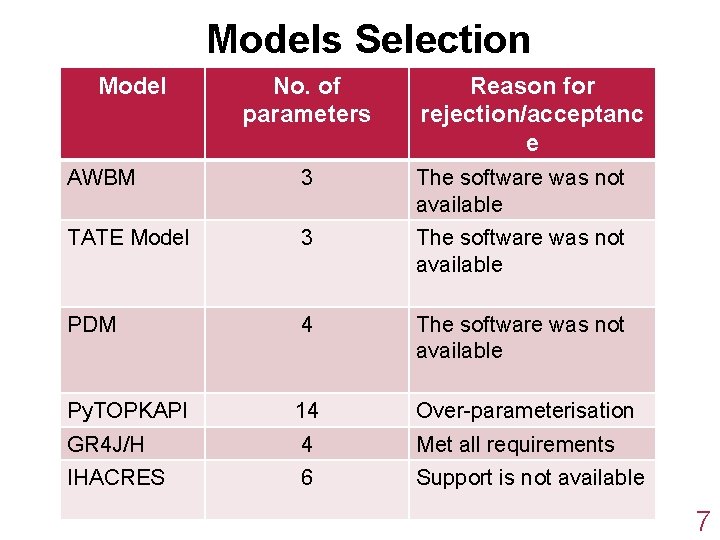
Models Selection Model No. of parameters Reason for rejection/acceptanc e AWBM 3 The software was not available TATE Model 3 The software was not available PDM 4 The software was not available Py. TOPKAPI 14 Over-parameterisation GR 4 J/H 4 Met all requirements IHACRES 6 Support is not available 7
Problem Statement § SA DFE approaches are outdated and thus NFSP Initiated (Smithers et al. , 2016) § Complex models are data intensive, time consuming and require expertise to operate § Therefore, there is a need to evaluate the use and performance of simple CS models for DFE in SA 8
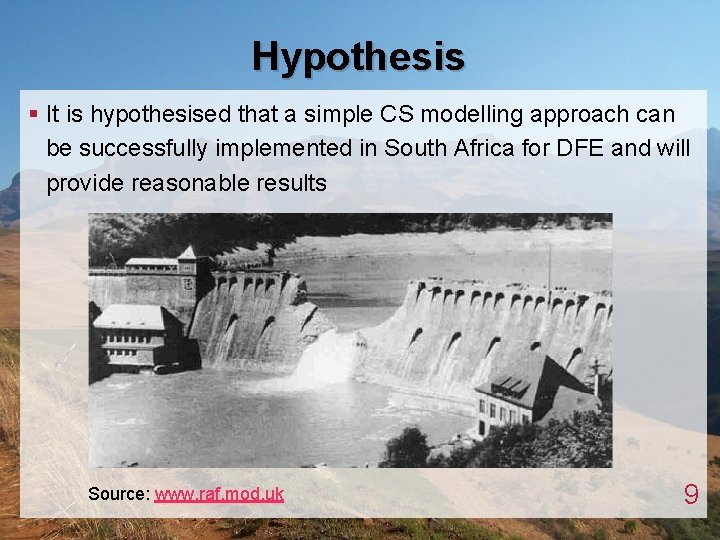
Hypothesis § It is hypothesised that a simple CS modelling approach can be successfully implemented in South Africa for DFE and will provide reasonable results Source: www. raf. mod. uk 9
Aim and Objectives § The aim of this project is to assess the performance of selected simple CSM approaches for DFE in South Africa § To achieve this aim, the following objectives need to be met: § Review simple CS models from local and international literature and select one or more models for assessment § Catchment selection § Calibrate and undertake a verification study in the selected catchments § Assess the ability of the model to estimate the observed FFC § Compare the result of the simple model(s) with the complex ACRU model § Conclude on the feasibility of using simple CSM approaches for DFE in South Africa 10
Assessing the ability of the GR 4 J/H model to simulate flows and design floods 11
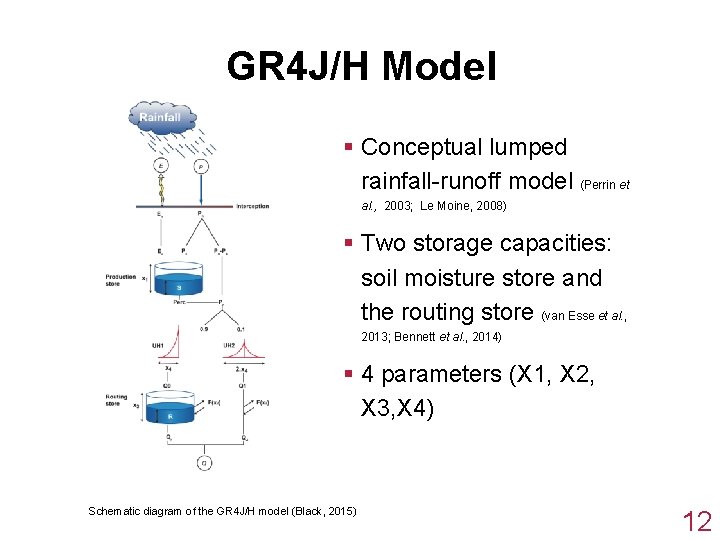
GR 4 J/H Model § Conceptual lumped rainfall-runoff model (Perrin et al. , 2003; Le Moine, 2008) § Two storage capacities: soil moisture store and the routing store (van Esse et al. , 2013; Bennett et al. , 2014) § 4 parameters (X 1, X 2, X 3, X 4) Schematic diagram of the GR 4 J/H model (Black, 2015) 12
Methodology § Tested on § 0. 736 km 2 Lambreschtsbos B catchment from the Western Cape (1972 -1979) § 0. 96 km 2 Cathedral Peak IV catchment in KZN (1949 -1982) § The model was run at the daily and hourly time step § Calibration was performed through 3 scenarios: § Scenario 1: Calibration to full records § Scenario 2: Calibration to a subset of the record (preferably a wet period) § Scenario 3: Calibration to larger events in the record using the 90 th percentile threshold 13
Methodology (continued) § GEV distribution fitted The Annual Maximum Series of the observed and simulated series § The model’s performance was evaluated using the Nash-Sutcliffe Efficiency and the use of graphs 14
Initial Daily Results 15
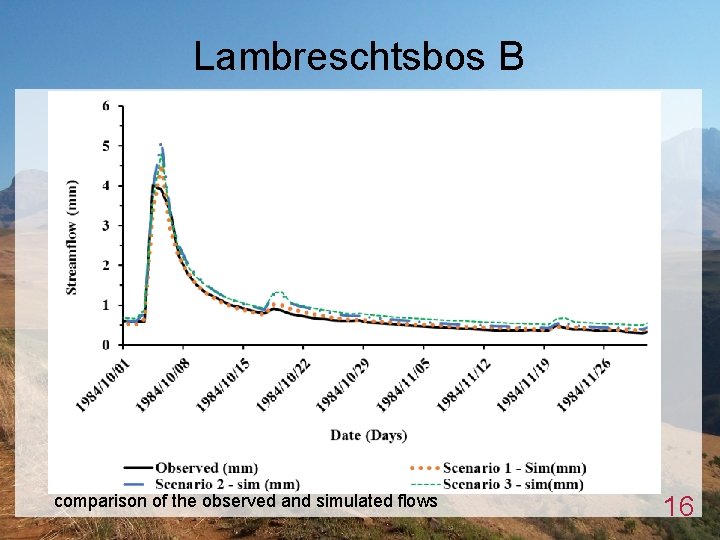
Lambreschtsbos B comparison of the observed and simulated flows 16
Cathedral Peak IV comparison of the observed and simulated flows 17
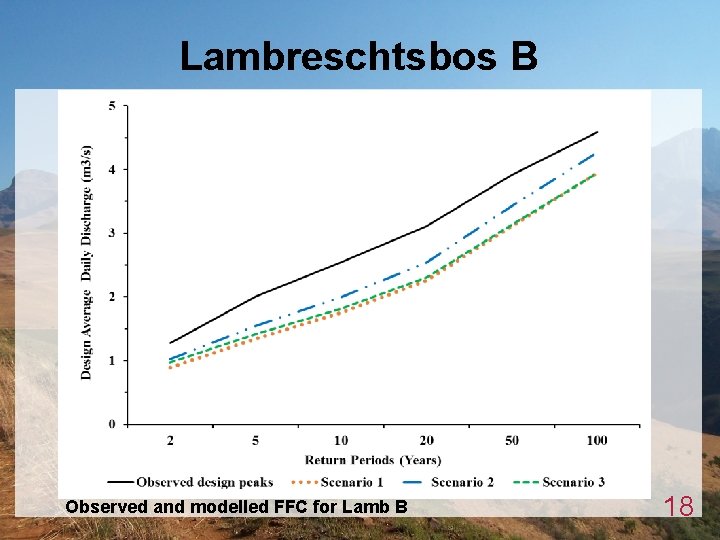
Lambreschtsbos B Observed and modelled FFC for Lamb B 18
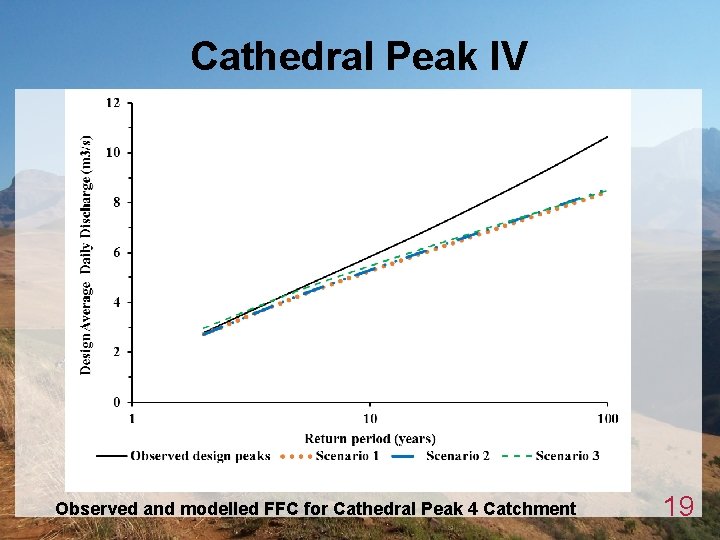
Cathedral Peak IV Observed and modelled FFC for Cathedral Peak 4 Catchment 19
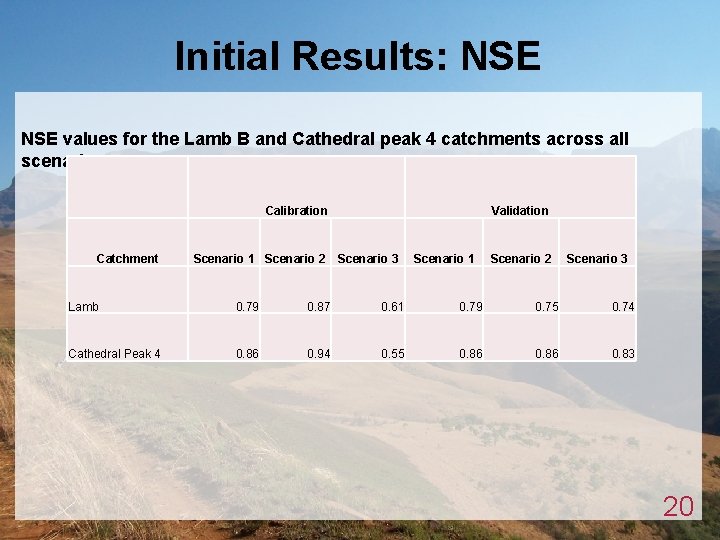
Initial Results: NSE values for the Lamb B and Cathedral peak 4 catchments across all scenarios Calibration Catchment Scenario 1 Scenario 2 Validation Scenario 3 Scenario 1 Scenario 2 Scenario 3 Lamb 0. 79 0. 87 0. 61 0. 79 0. 75 0. 74 Cathedral Peak 4 0. 86 0. 94 0. 55 0. 86 0. 83 20
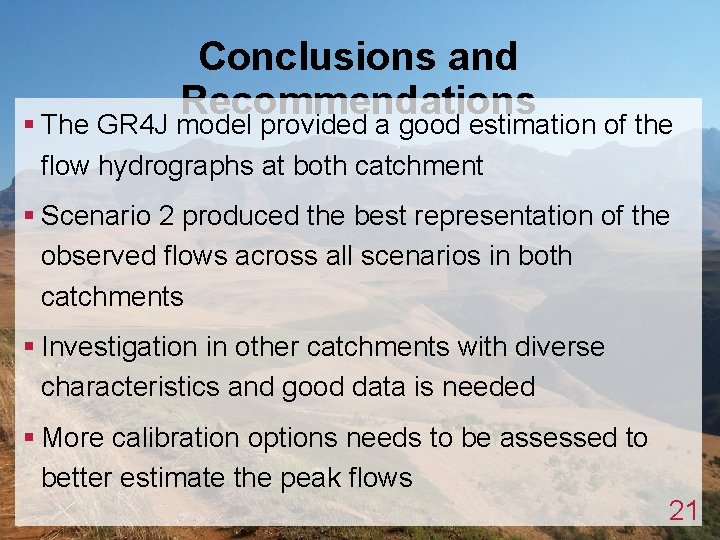
Conclusions and Recommendations § The GR 4 J model provided a good estimation of the flow hydrographs at both catchment § Scenario 2 produced the best representation of the observed flows across all scenarios in both catchments § Investigation in other catchments with diverse characteristics and good data is needed § More calibration options needs to be assessed to better estimate the peak flows 21
Where to from here § Evaluate the ability of the model at the sub-daily (hourly) timestep § Test the model with long records of daily data § Compare the daily results with those from the ACRU model § Conclude on the feasibility of the GR 4 J/H model for DFE in SA and advise the NFSP 22
ACKNOWLEDGEMENTS § My supervisor Prof. J. C. Smithers is gratefully thanked for his assistance, valuable comments and guidance throughout the research § My co-supervisor Mr. T. J. Rowe is highly appreciated for his encouragement, technical advice and supervision with climate data, Arc. GIS and modelling components § Mr D. Clark is appreciated for his technical assistance and models acquisition § The Air. GR team for their assistance with the GR 4 j/H model set up § Dr B Croke for providing information and clearance for the IHACRES model 23