
An Arithmatic Progression is a list of numbers

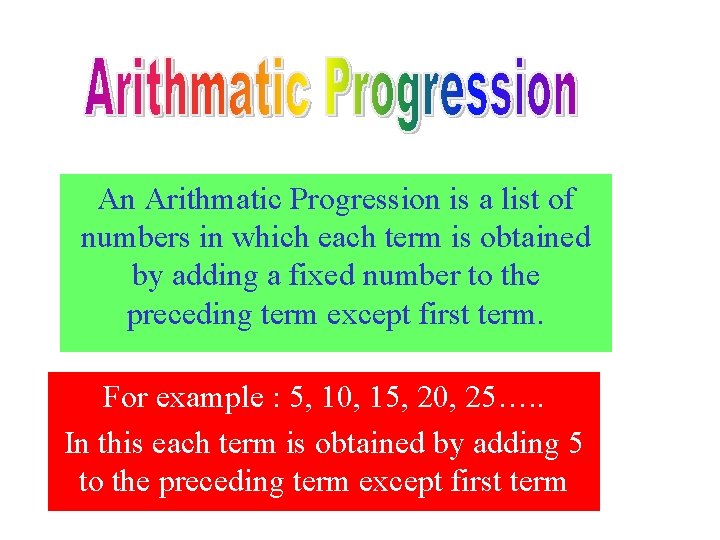
An Arithmatic Progression is a list of numbers in which each term is obtained by adding a fixed number to the preceding term except first term. For example : 5, 10, 15, 20, 25…. . In this each term is obtained by adding 5 to the preceding term except first term
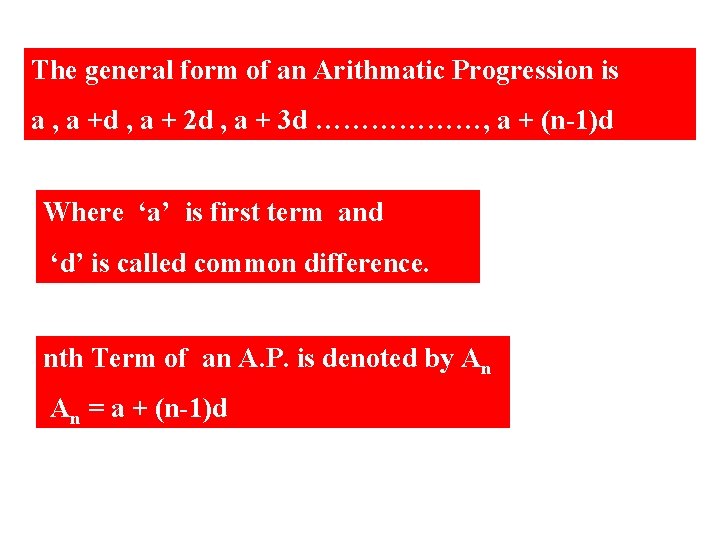
The general form of an Arithmatic Progression is a , a +d , a + 2 d , a + 3 d ………………, a + (n-1)d Where ‘a’ is first term and ‘d’ is called common difference. nth Term of an A. P. is denoted by An An = a + (n-1)d
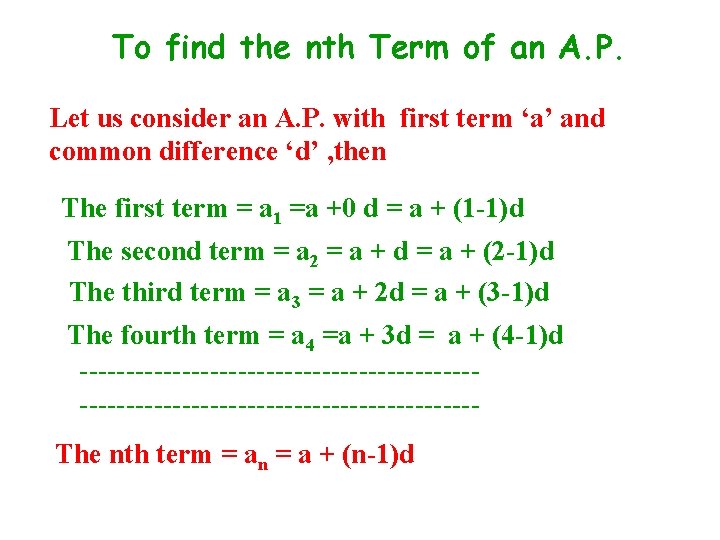
To find the nth Term of an A. P. Let us consider an A. P. with first term ‘a’ and common difference ‘d’ , then The first term = a 1 =a +0 d = a + (1 -1)d The second term = a 2 = a + d = a + (2 -1)d The third term = a 3 = a + 2 d = a + (3 -1)d The fourth term = a 4 =a + 3 d = a + (4 -1)d ------------------------------------------The nth term = an = a + (n-1)d
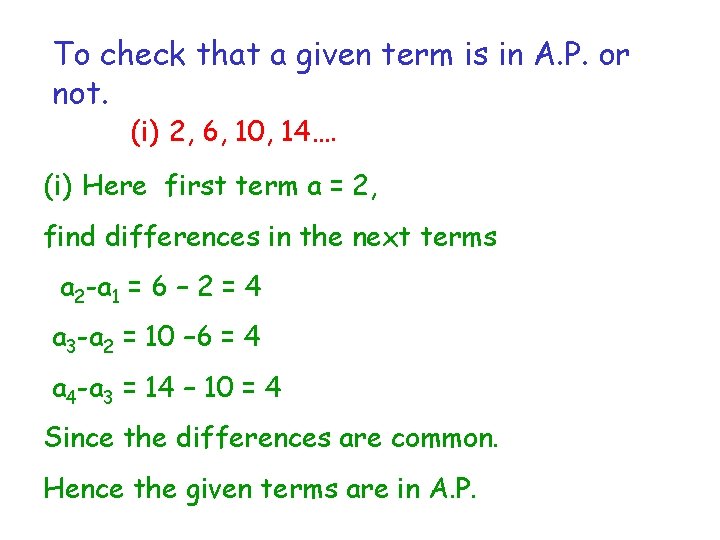
To check that a given term is in A. P. or not. (i) 2, 6, 10, 14…. (i) Here first term a = 2, find differences in the next terms a 2 -a 1 = 6 – 2 = 4 a 3 -a 2 = 10 – 6 = 4 a 4 -a 3 = 14 – 10 = 4 Since the differences are common. Hence the given terms are in A. P.
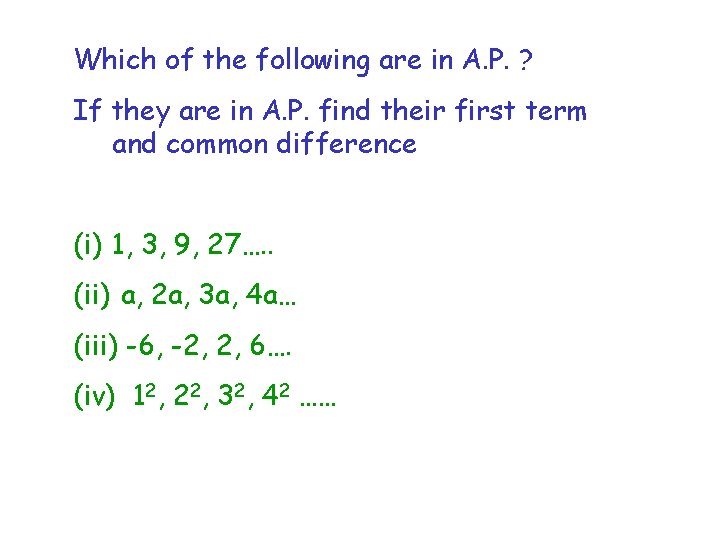
Which of the following are in A. P. ? If they are in A. P. find their first term and common difference (i) 1, 3, 9, 27…. . (ii) a, 2 a, 3 a, 4 a… (iii) -6, -2, 2, 6…. (iv) 12, 22, 32, 42 ……
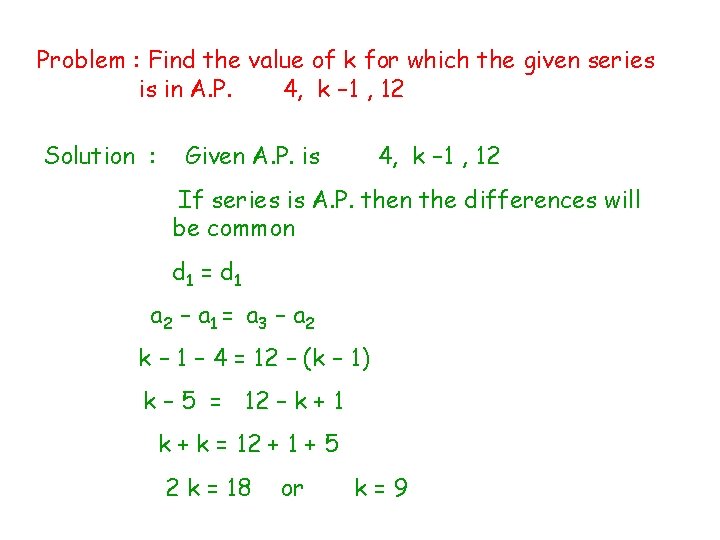
Problem : Find the value of k for which the given series is in A. P. 4, k – 1 , 12 Solution : Given A. P. is 4, k – 1 , 12 If series is A. P. then the differences will be common d 1 = d 1 a 2 – a 1 = a 3 – a 2 k – 1 – 4 = 12 – (k – 1) k – 5 = 12 – k + 1 k + k = 12 + 1 + 5 2 k = 18 or k=9
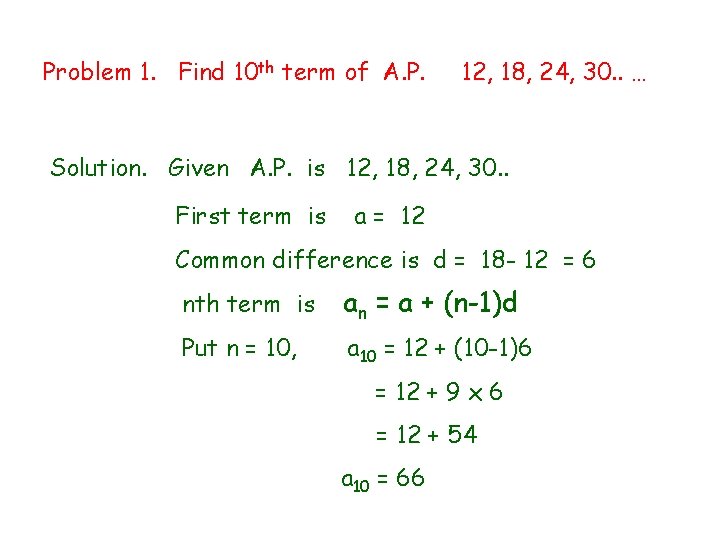
Problem 1. Find 10 th term of A. P. 12, 18, 24, 30. . … Solution. Given A. P. is 12, 18, 24, 30. . First term is a = 12 Common difference is d = 18 - 12 = 6 nth term is an = a + (n-1)d Put n = 10, a 10 = 12 + (10 -1)6 = 12 + 9 x 6 = 12 + 54 a 10 = 66
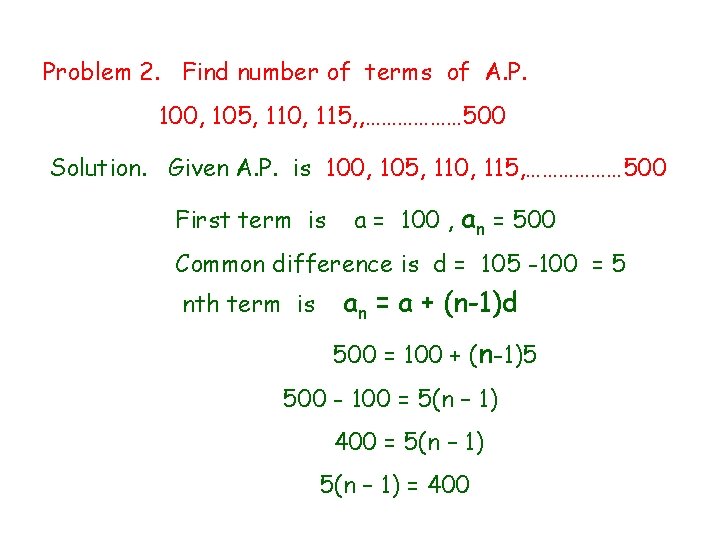
Problem 2. Find number of terms of A. P. 100, 105, 110, 115, , ……………… 500 Solution. Given A. P. is 100, 105, 110, 115, ……………… 500 First term is a = 100 , an = 500 Common difference is d = 105 -100 = 5 nth term is an = a + (n-1)d 500 = 100 + (n-1)5 500 - 100 = 5(n – 1) 400 = 5(n – 1) = 400
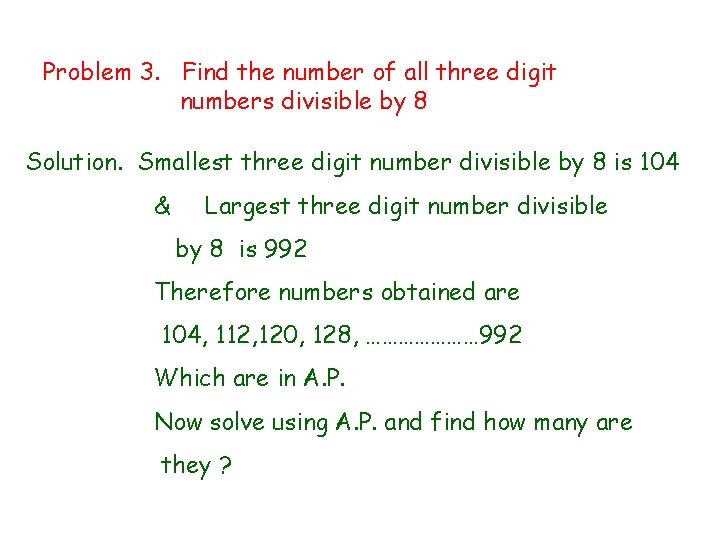
Problem 3. Find the number of all three digit numbers divisible by 8 Solution. Smallest three digit number divisible by 8 is 104 & Largest three digit number divisible by 8 is 992 Therefore numbers obtained are 104, 112, 120, 128, ………………… 992 Which are in A. P. Now solve using A. P. and find how many are they ?
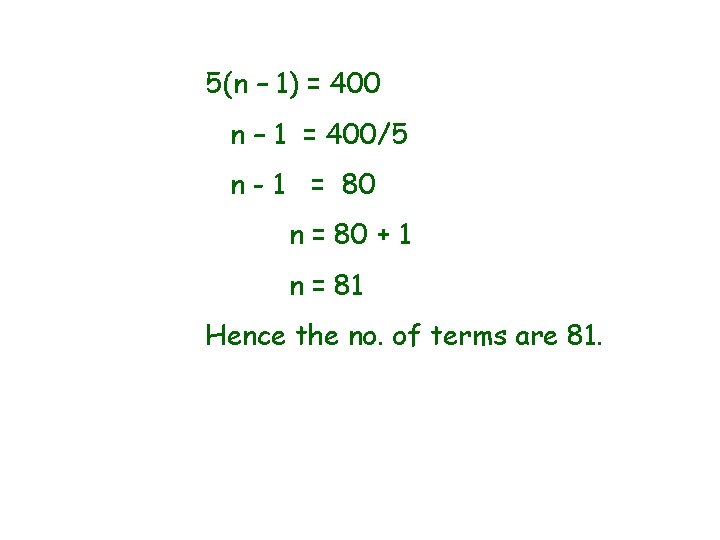
5(n – 1) = 400 n – 1 = 400/5 n - 1 = 80 n = 80 + 1 n = 81 Hence the no. of terms are 81.

Let us solve some problems based on Arithmatic Progression 1. Find 50 th term of A. P. 5, 10, 15, 20… 2. Find first three terms of an A. P. whose 3 rd term is 10 and 6 th term is 19. 3. Find number of terms of an A. P. 3, 6, 9, ………………. . 99.
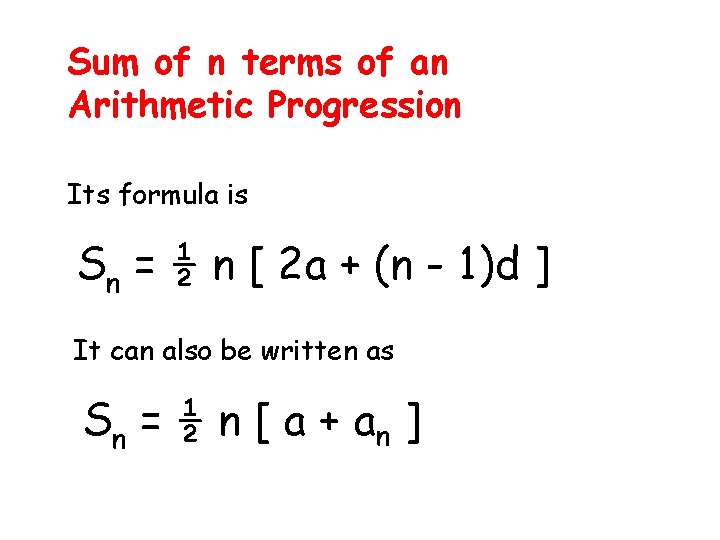
Sum of n terms of an Arithmetic Progression Its formula is Sn = ½ n [ 2 a + (n - 1)d ] It can also be written as Sn = ½ n [ a + a n ]
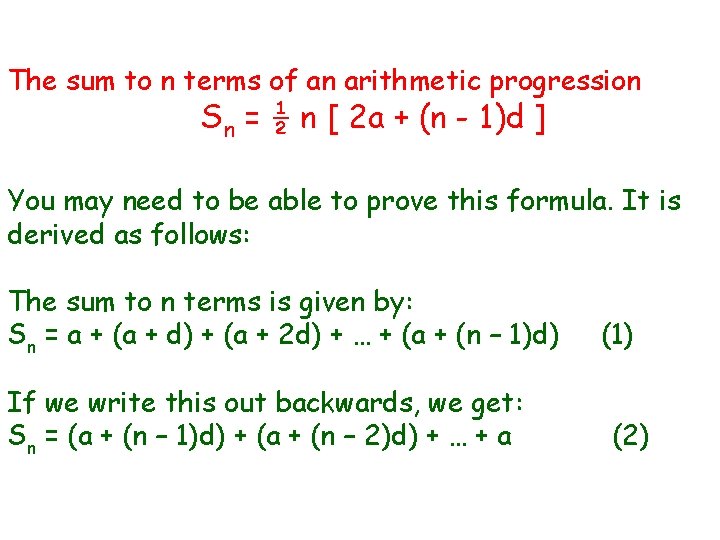
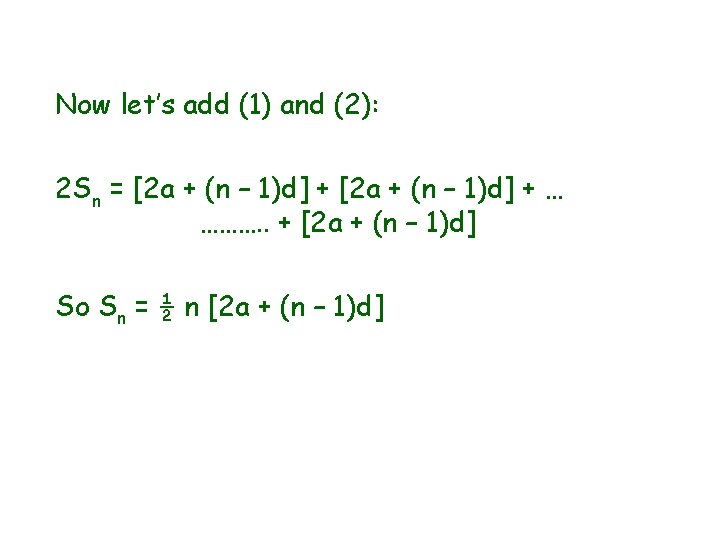
The sum to n terms of an arithmetic progression Sn = ½ n [ 2 a + (n - 1)d ] You may need to be able to prove this formula. It is derived as follows: The sum to n terms is given by: Sn = a + (a + d) + (a + 2 d) + … + (a + (n – 1)d) If we write this out backwards, we get: Sn = (a + (n – 1)d) + (a + (n – 2)d) + … + a (1) (2)
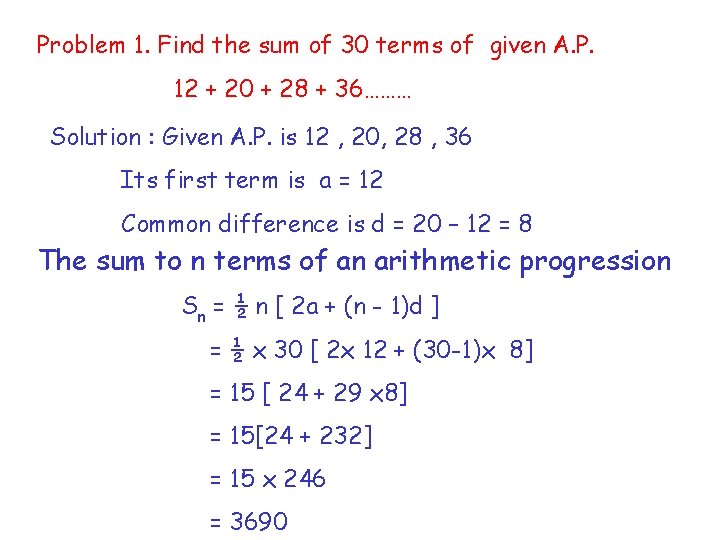
Problem 1. Find the sum of 30 terms of given A. P. 12 + 20 + 28 + 36……… Solution : Given A. P. is 12 , 20, 28 , 36 Its first term is a = 12 Common difference is d = 20 – 12 = 8 The sum to n terms of an arithmetic progression Sn = ½ n [ 2 a + (n - 1)d ] = ½ x 30 [ 2 x 12 + (30 -1)x 8] = 15 [ 24 + 29 x 8] = 15[24 + 232] = 15 x 246 = 3690
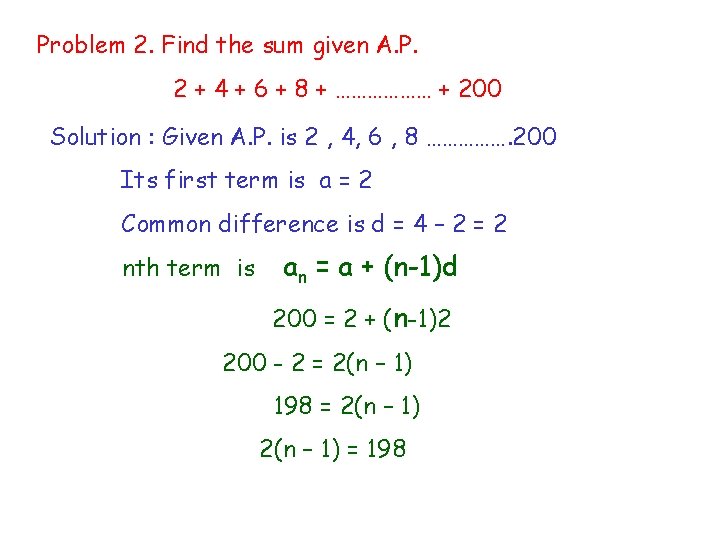
Problem 2. Find the sum given A. P. 2 + 4 + 6 + 8 + ……………… + 200 Solution : Given A. P. is 2 , 4, 6 , 8 ……………. 200 Its first term is a = 2 Common difference is d = 4 – 2 = 2 nth term is an = a + (n-1)d 200 = 2 + (n-1)2 200 - 2 = 2(n – 1) 198 = 2(n – 1) = 198
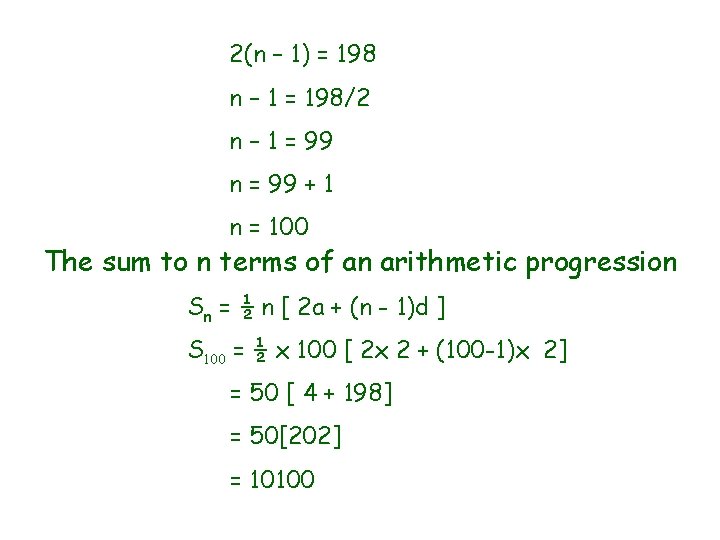
2(n – 1) = 198 n – 1 = 198/2 n – 1 = 99 n = 99 + 1 n = 100 The sum to n terms of an arithmetic progression Sn = ½ n [ 2 a + (n - 1)d ] S 100 = ½ x 100 [ 2 x 2 + (100 -1)x 2] = 50 [ 4 + 198] = 50[202] = 10100
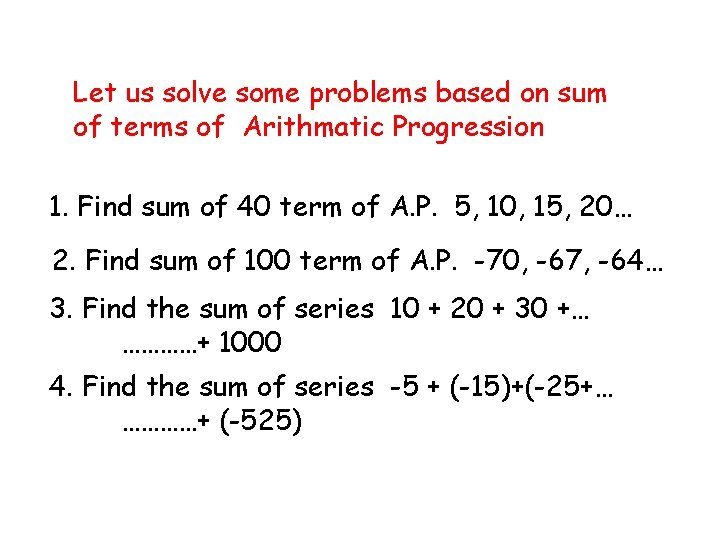
Let us solve some problems based on sum of terms of Arithmatic Progression 1. Find sum of 40 term of A. P. 5, 10, 15, 20… 2. Find sum of 100 term of A. P. -70, -67, -64… 3. Find the sum of series 10 + 20 + 30 +… …………+ 1000 4. Find the sum of series -5 + (-15)+(-25+… …………+ (-525)
- Slides: 19