
An approach to Intelligent Information Fusion in Sensor
- Slides: 24
An approach to Intelligent Information Fusion in Sensor Saturated Urban Environments Charalampos Doulaverakis Centre for Research and Technology Hellas Informatics and Telematics Institute EISIC 2011, 12 September 2011
EISIC 2011 Presentation outline Introduction n System architecture n Low-level fusion capabilities n High-level fusion capabilities n Implementation and use cases n Conclusions n Informatics and Telematics Institute 2
EISIC 2011 Introduction n Today, large scale employments of sensor applications ¨ Urban n n area Wiki. City, City. Sense, Google Latitude Materialization of concepts like ¨ M 2 M, Internet of Things Informatics and Telematics Institute 3
EISIC 2011 Introduction n n Sensor applications could also be used for critical urban security surveillance Difficulties ¨ ¨ n Multiple distributed heterogeneous components Sensor processing Signal processing Automation Other approaches Either do not accommodate A/V processing or are cumbersome ¨ Use Semantic Web but do not provide full framework ¨ Informatics and Telematics Institute 4
EISIC 2011 Urban security surveillance environments n Sensor saturated environments ¨ Difficult n Densely populated areas ¨ Difficult n to manage and observe discovery of important events Multiple processing algorithms ¨ Methods n to manage the data they produce Variety of sensor modalities ¨ Data heterogeneity Informatics and Telematics Institute 5
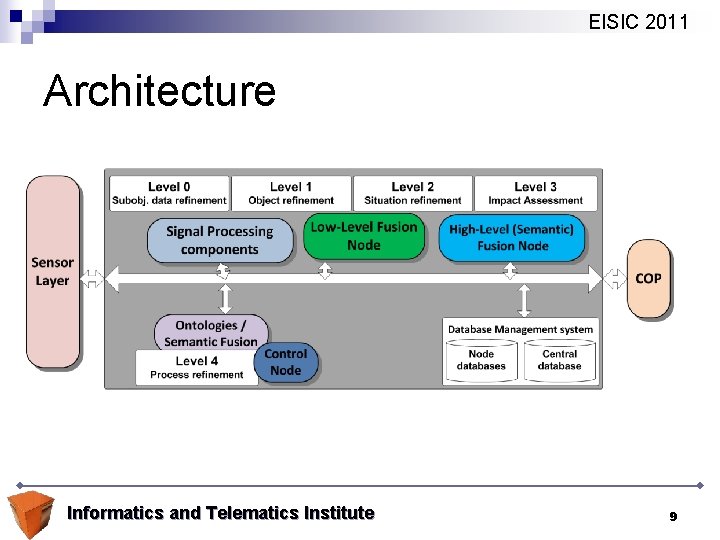
EISIC 2011 Our approach Comprises a multi-level fusion system, at all JDL levels n Seamlessly blends ontologies with lowlevel information databases n Combines semantic web middleware with sensor networks middleware n Informatics and Telematics Institute 6
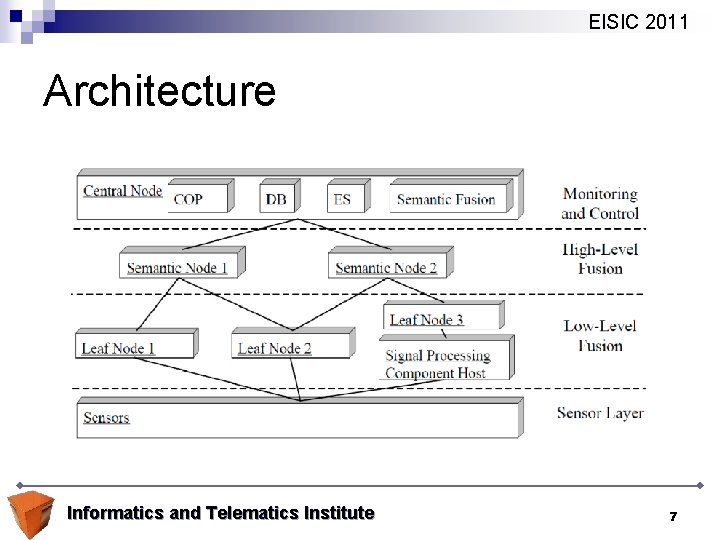
EISIC 2011 Architecture Informatics and Telematics Institute 7
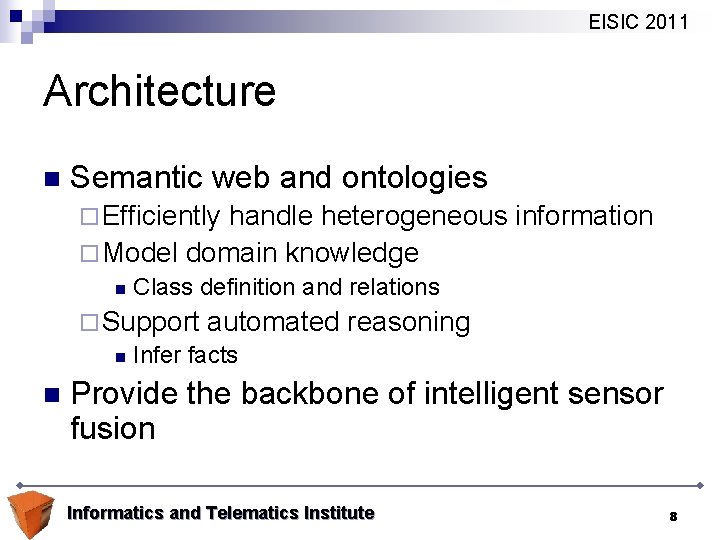
EISIC 2011 Architecture n Semantic web and ontologies ¨ Efficiently handle heterogeneous information ¨ Model domain knowledge n Class definition and relations ¨ Support automated n Infer facts n reasoning Provide the backbone of intelligent sensor fusion Informatics and Telematics Institute 8
EISIC 2011 Architecture Informatics and Telematics Institute 9
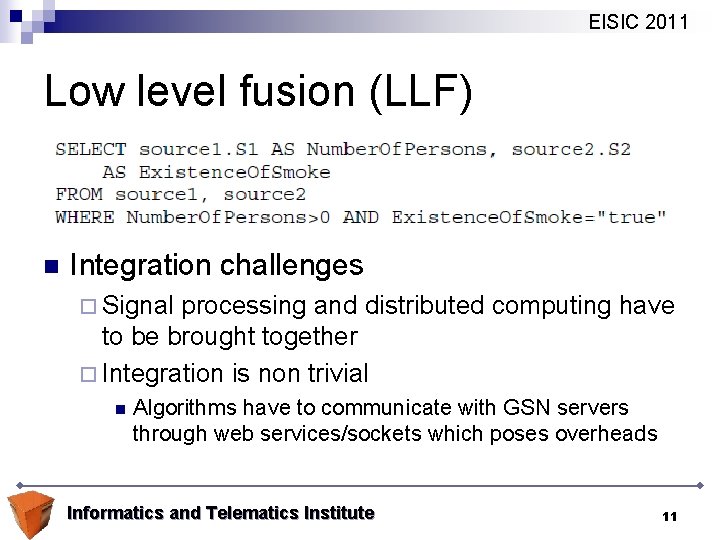
EISIC 2011 Low level fusion (LLF) n Enabled through Global Sensor Network, GSN ¨ Java based ¨ Introduces “virtual sensors” ¨ Supports information collection and integration n Supports LLF through an SQL-like language Informatics and Telematics Institute 10
EISIC 2011 Low level fusion (LLF) n Integration challenges ¨ Signal processing and distributed computing have to be brought together ¨ Integration is non trivial n Algorithms have to communicate with GSN servers through web services/sockets which poses overheads Informatics and Telematics Institute 11
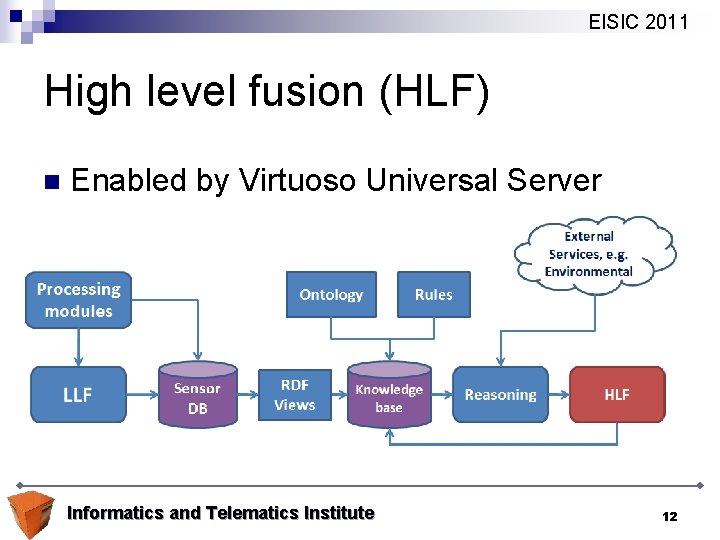
EISIC 2011 High level fusion (HLF) n Enabled by Virtuoso Universal Server Informatics and Telematics Institute 12
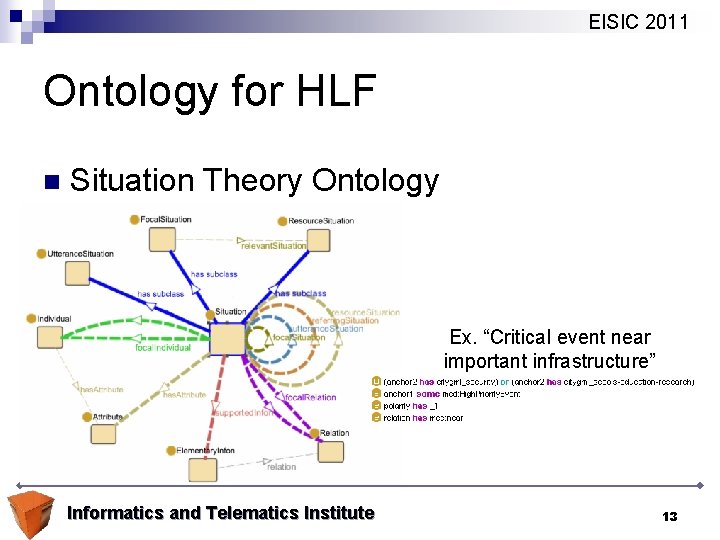
EISIC 2011 Ontology for HLF n Situation Theory Ontology Ex. “Critical event near important infrastructure” Informatics and Telematics Institute 13
EISIC 2011 Mapping data to RDF n n 2 ways of mapping relational data to RDF Push method ¨ n Pull method ¨ n Data are semantically annotated as soon as they are generated. Implemented by each virtual sensor alone Data are associated to ontological entities. Implemented at a central high level node and runs through a scheduler Additional data that come from external services are also mapped to RDF ¨ e. g. Environmental Service Informatics and Telematics Institute 14
EISIC 2011 Reasoning n Use of ¨ Class/subclass reasoning ¨ Owl: same. As ¨ Further extended by rules First 2 are supported by Virtuoso n Rules are supported by Jena n Both can be used on the same framework n Informatics and Telematics Institute 15
EISIC 2011 Reasoning n Dataset volume issue ¨ Continuous sensor feeds produce large amounts of data ¨ Tackled through the use of time frames n n Dealing with RDF quads In the case of integration of systems that use ontologies, ontology mapping has to be defined Informatics and Telematics Institute 16
EISIC 2011 Implementation n 2 sensor processing modules are integrated ¨ Body tracker generates number of persons present in a scene ¨ Smoke detector detects smoke particles Informatics and Telematics Institute 17
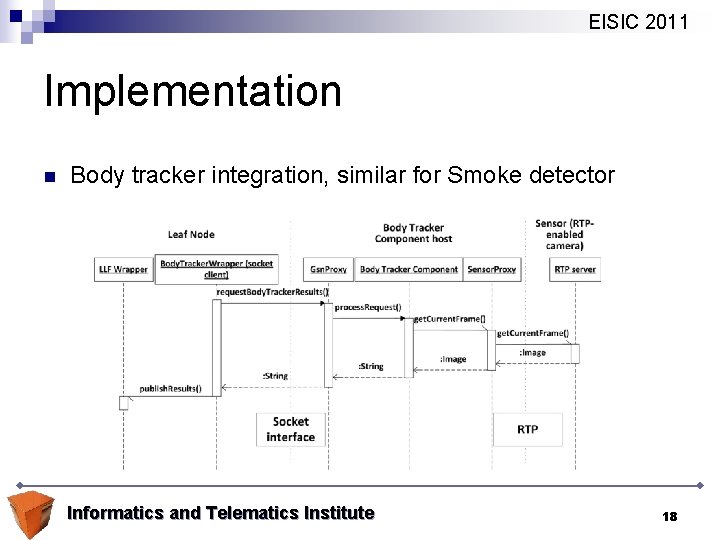
EISIC 2011 Implementation n Body tracker integration, similar for Smoke detector Informatics and Telematics Institute 18
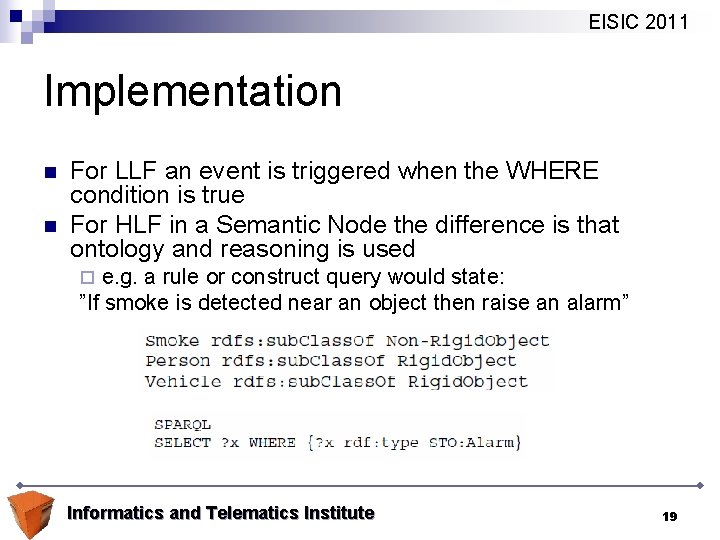
EISIC 2011 Implementation n n For LLF an event is triggered when the WHERE condition is true For HLF in a Semantic Node the difference is that ontology and reasoning is used e. g. a rule or construct query would state: ”If smoke is detected near an object then raise an alarm” ¨ Informatics and Telematics Institute 19
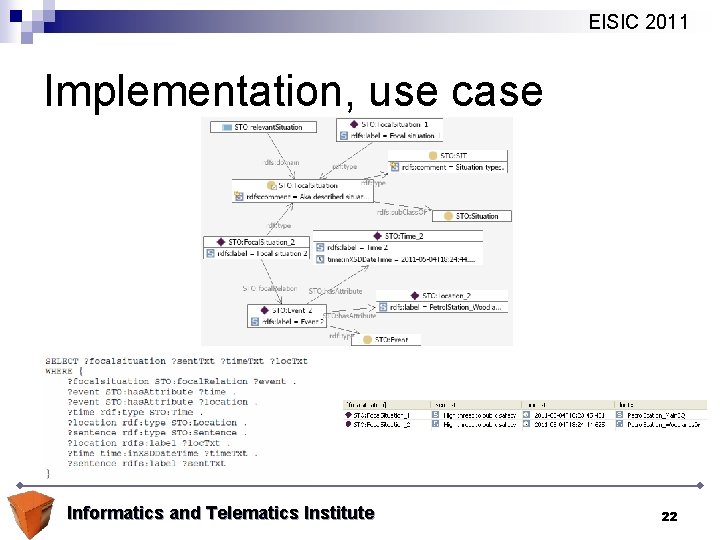
EISIC 2011 Implementation, use case n Scenario where Environmental Service is deployed ¨ ¨ ¨ n Different levels of criticality ¨ ¨ n Gives data for locations, queried in real time Enables geospatial inference Data from low level processing are used for higher level decisions Smoke near petrol station is a critical situation Smoke event related to a celebration is not critical All above are associated with a security agenda to infer threat level Informatics and Telematics Institute 20
EISIC 2011 Implementation, use case n Process ¨ Sensor processing data are mapped to RDF (smoke detection, body tracker) ¨ Environmental Service is called real time to give location of events, cameras -> mapped to RDF ¨ Reasoner associates events with criticality factor Informatics and Telematics Institute 21
EISIC 2011 Implementation, use case Informatics and Telematics Institute 22
EISIC 2011 Conclusions n n We presented a framework for intelligent information fusion in sensor networks Deal with all aspects above sensor layer ¨ ¨ ¨ n n Perception modules integration Communication of the perception modules with GSN Low level fusion High level fusion with integration of semantic description of information Communication with external services Situation assessment and alert generation Generic framework that can be applied to other domains Future work ¨ Deal with probabilistic reasoning n Resolution of conflicts and deal with missing detections Informatics and Telematics Institute 23
EISIC 2011 Thank you for your attention CERTH/ITI http: //mklab. iti. gr Informatics and Telematics Institute 24