
An Approach to Guideline Implementation With GEM Richard

- Slides: 25
An Approach to Guideline Implementation With GEM Richard N. Shiffman, MD, MCIS, Abha Agrawal, MD, Peter Gershkovich, MD, Aniruddha Deshpande, MD Center for Medical Informatics Yale University School of Medicine New Haven, Connecticut USA
Overview n n n GEM – the Guideline Elements Model Implementation Issues 3 Tasks in Implementation n Knowledge extraction Knowledge customization Knowledge integration
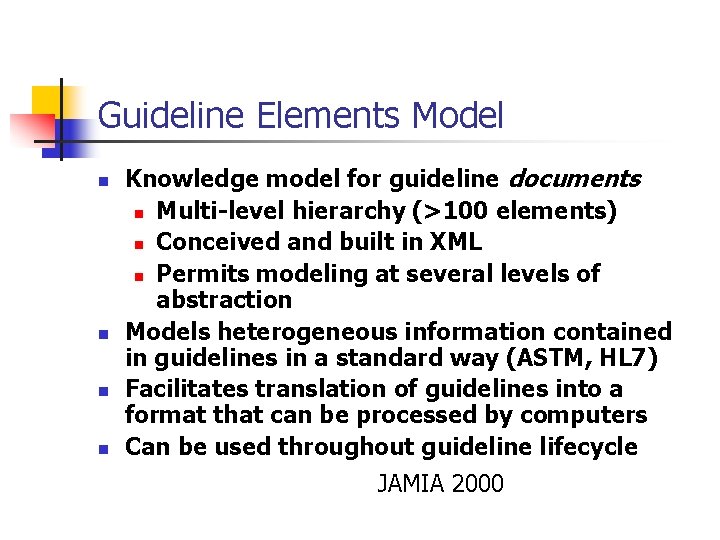
Guideline Elements Model n n Knowledge model for guideline documents n Multi-level hierarchy (>100 elements) n Conceived and built in XML n Permits modeling at several levels of abstraction Models heterogeneous information contained in guidelines in a standard way (ASTM, HL 7) Facilitates translation of guidelines into a format that can be processed by computers Can be used throughout guideline lifecycle JAMIA 2000
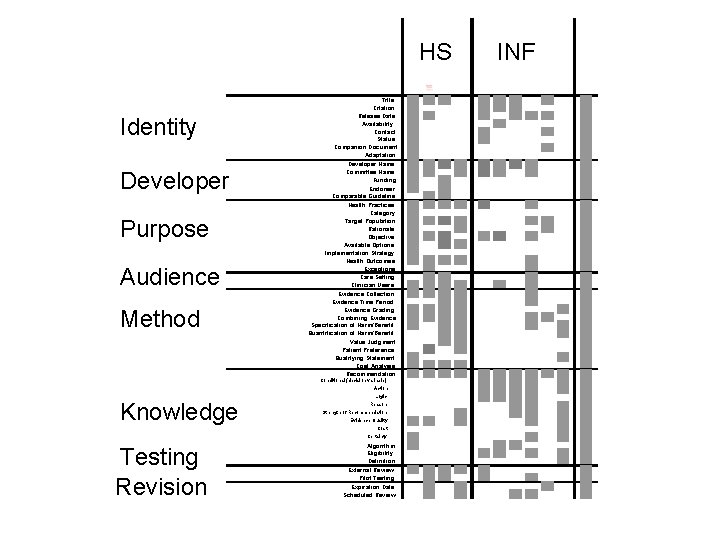
HS Identity Developer Purpose Audience Method Knowledge Testing Revision INF Title Citation Release Date Availability Contact Status Companion Document Adaptation Developer Name Committee Name Funding Endorser Comparable Guideline Health Practices Category Target Population Rationale Objective Available Options Implementation Strategy Health Outcomes Exceptions Care Setting Clinician Users Evidence Collection Evidence Time Period Evidence Grading Combining Evidence Specification of Harm/Benefit Quantification of Harm/Benefit Value Judgment Patient Preference Qualifying Statement Cost Analysis Recommendation Conditional (decision variable) . Action . Logic . Reason . Strength of Recommendation . Evidence Quality . Cost . Certainty . Algorithm Eligibility Definition External Review Pilot Testing Expiration Date Scheduled Review . .
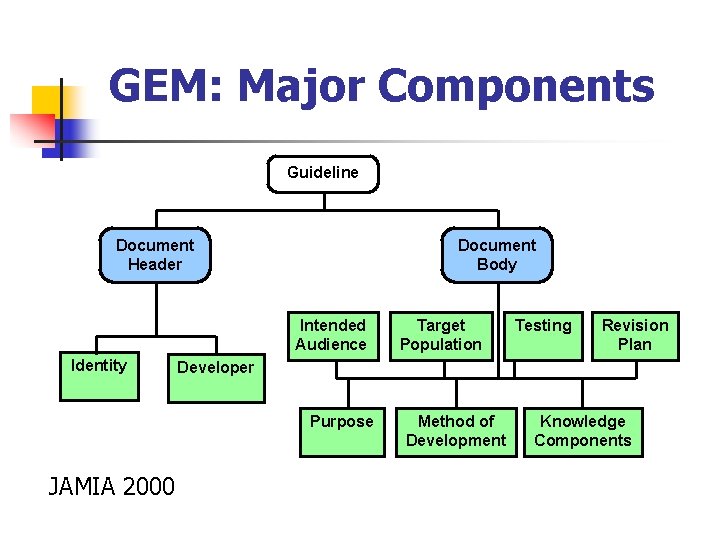
GEM: Major Components Guideline Document Header Document Body Intended Audience Identity Testing Revision Plan Developer Purpose JAMIA 2000 Target Population Method of Development Knowledge Components
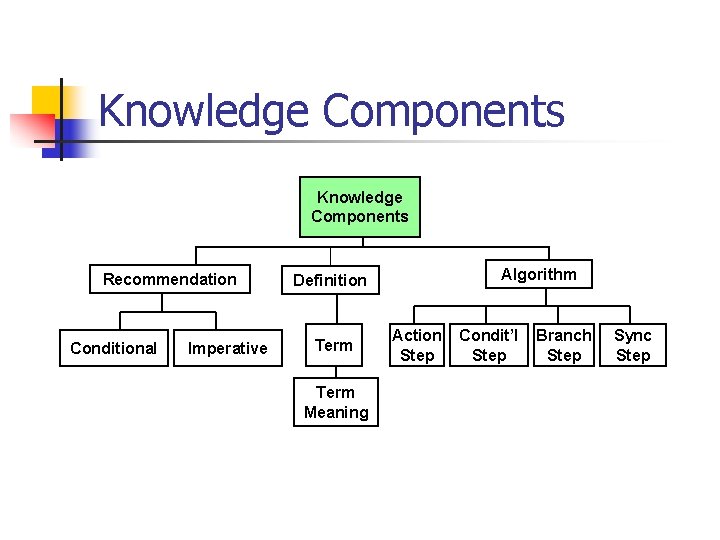
Knowledge Components Recommendation Conditional Imperative Algorithm Definition Term Meaning Action Step Condit’l Step Branch Step Sync Step
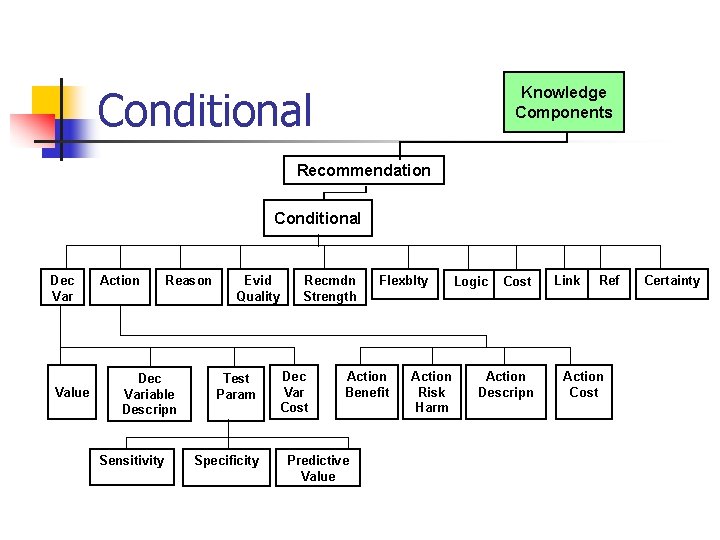
Conditional Knowledge Components Recommendation Conditional Dec Var Value Action Reason Dec Variable Descripn Sensitivity Evid Quality Test Param Specificity Recmdn Strength Dec Var Cost Flexblty Action Benefit Predictive Value Action Risk Harm Logic Cost Action Descripn Link Ref Action Cost Certainty
Guideline Implementation n Creation of strategies, systems, and tools to operationalize the knowledge and recommendations set forth by guideline developers Aim is to change behavior Implementation differs from dissemination
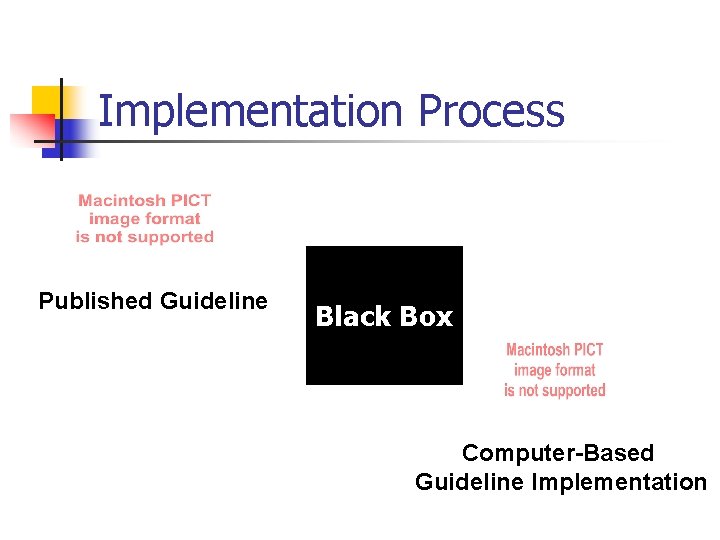
Implementation Process Published Guideline Black Box Computer-Based Guideline Implementation
What goes on in the black box? n 3 sets of activities n n Knowledge extraction Knowledge customization Knowledge integration GEM tools and solutions
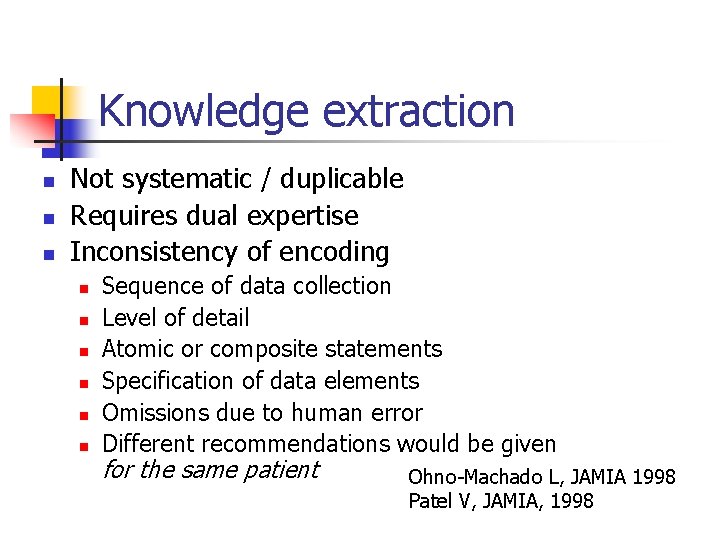
Knowledge extraction n Not systematic / duplicable Requires dual expertise Inconsistency of encoding n n n Sequence of data collection Level of detail Atomic or composite statements Specification of data elements Omissions due to human error Different recommendations would be given for the same patient Ohno-Machado L, JAMIA 1998 Patel V, JAMIA, 1998
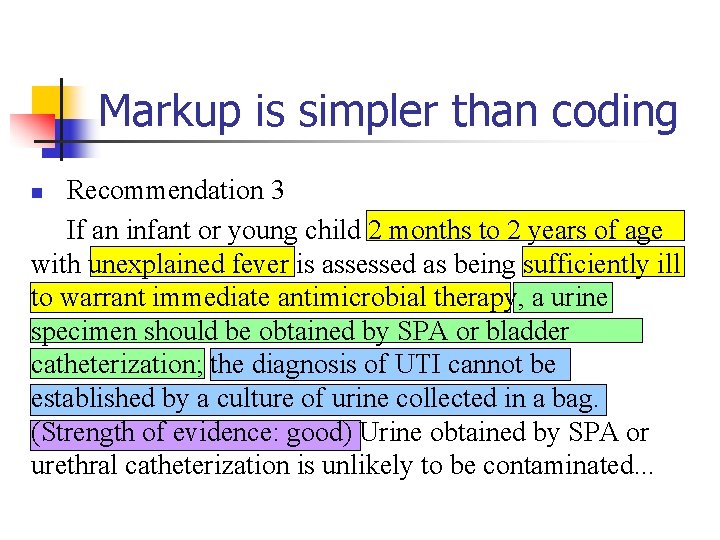
Markup is simpler than coding Recommendation 3 If an infant or young child 2 months to 2 years of age with unexplained fever is assessed as being sufficiently ill to warrant immediate antimicrobial therapy, a urine specimen should be obtained by SPA or bladder catheterization; the diagnosis of UTI cannot be established by a culture of urine collected in a bag. (Strength of evidence: good) Urine obtained by SPA or urethral catheterization is unlikely to be contaminated. . . n
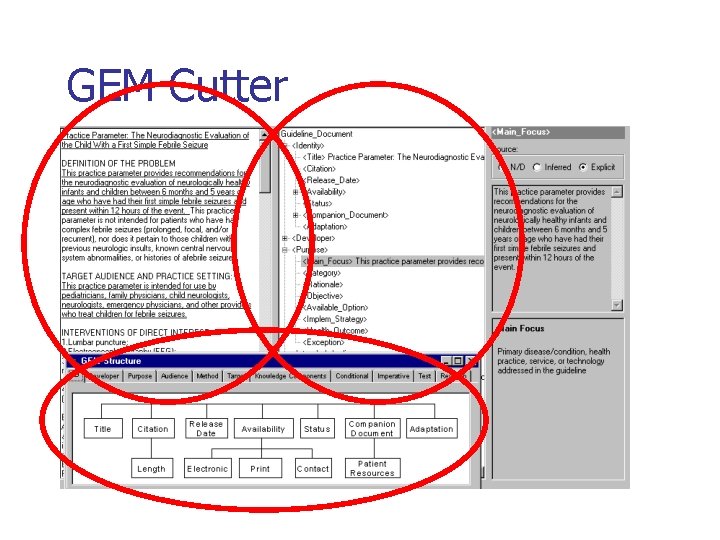
GEM Cutter
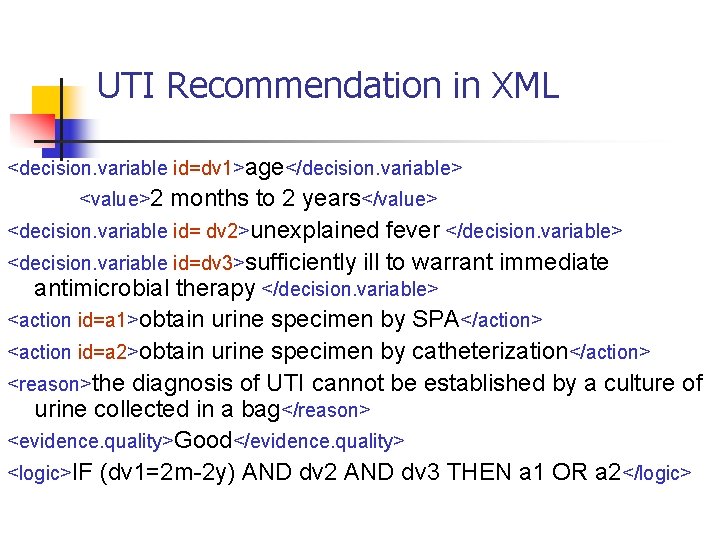
UTI Recommendation in XML <decision. variable id=dv 1>age</decision. variable> <value>2 months to 2 years</value> <decision. variable id= dv 2>unexplained fever </decision. variable> <decision. variable id=dv 3>sufficiently ill to warrant immediate antimicrobial therapy </decision. variable> <action id=a 1>obtain urine specimen by SPA</action> <action id=a 2>obtain urine specimen by catheterization</action> <reason>the diagnosis of UTI cannot be established by a culture of urine collected in a bag</reason> <evidence. quality>Good</evidence. quality> <logic>IF (dv 1=2 m-2 y) AND dv 2 AND dv 3 THEN a 1 OR a 2</logic>
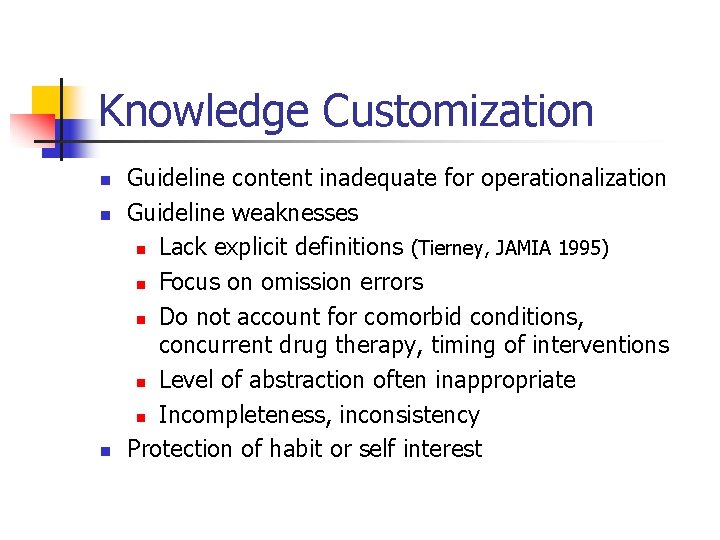
Knowledge Customization n Guideline content inadequate for operationalization Guideline weaknesses n Lack explicit definitions (Tierney, JAMIA 1995) n Focus on omission errors n Do not account for comorbid conditions, concurrent drug therapy, timing of interventions n Level of abstraction often inappropriate n Incompleteness, inconsistency Protection of habit or self interest
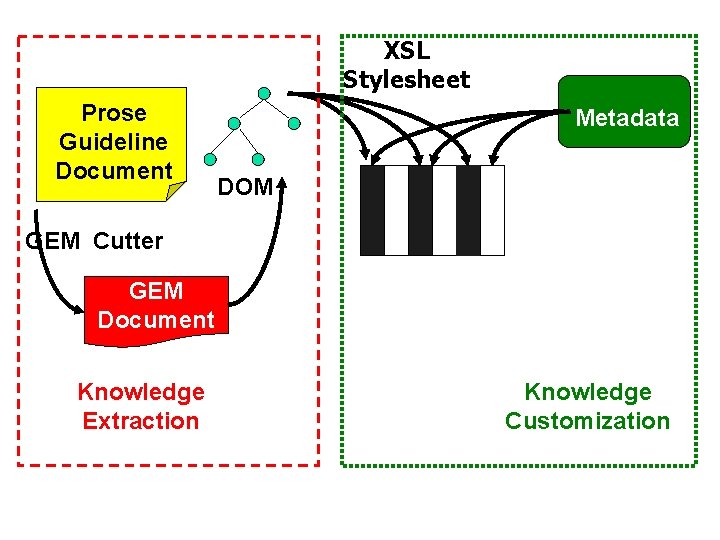
XSL Stylesheet Prose Guideline Document Metadata DOM GEM Cutter GEM Document Knowledge Extraction Logician ER Knowledge Customization
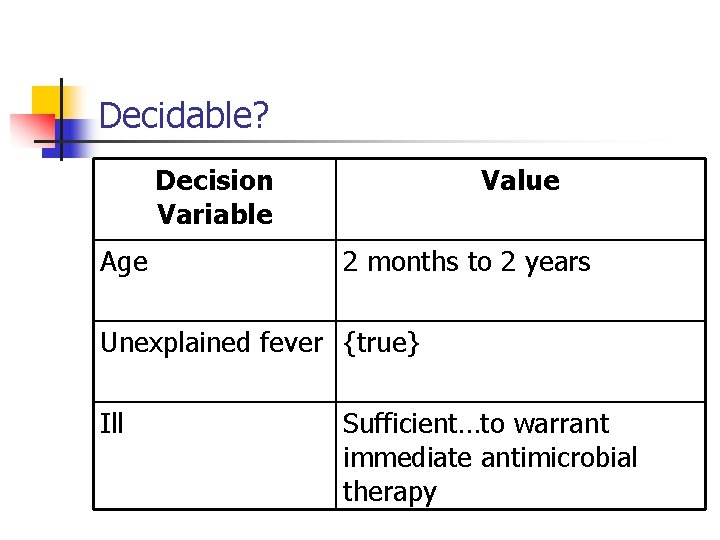
Decidable? Decision Variable Age Value 2 months to 2 years Unexplained fever {true} Ill Sufficient…to warrant immediate antimicrobial therapy
Element “source” attribute n n n Explicit Inferred Selection from controlled vocabulary (NGC)
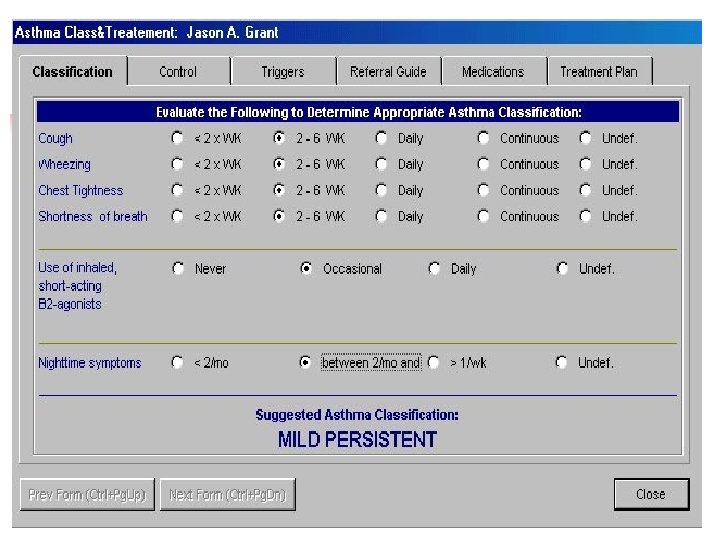
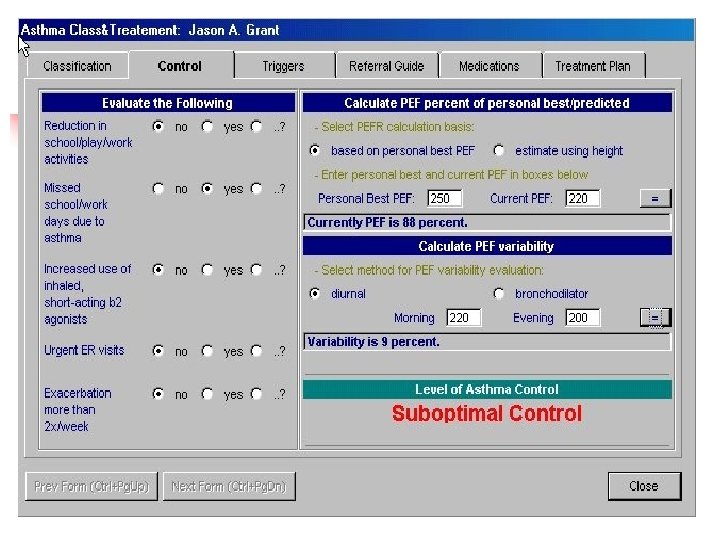
Knowledge integration n n Support local workflow Source of information Codes / vocabularies User interface
Knowledge Integration Activities n n n Decide mode of delivery for advice n Prescriptive n Critiquing Set bounds based on evidence quality, recommendation strength Incorporate patient preference
Provide Services for Information Management n n Documentation Recommendation Explanation Registration n n Communication Calculation Presentation Aggregation Shiffman, et al. , JAMIA 1999
In conclusion… n GEM documents can serve as portable knowledge repositories for decision support systems. n Knowledge extraction n Knowledge customization n Knowledge integration
http: // ycmi. med. yale. edu richard. shiffman@yale. edu