
An Approach For Spirometry and DLCO Interpretation DL



- Slides: 9
An Approach For Spirometry and DLCO Interpretation
DL, CO INTERPRETATION Interpreting the DL, CO, in conjunction with spirometry and lung volumes assessment, may assist in diagnosing the underlying disease.
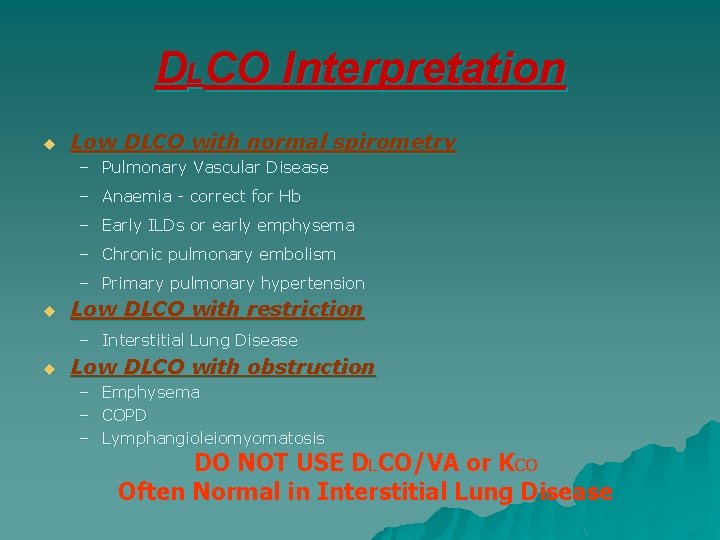
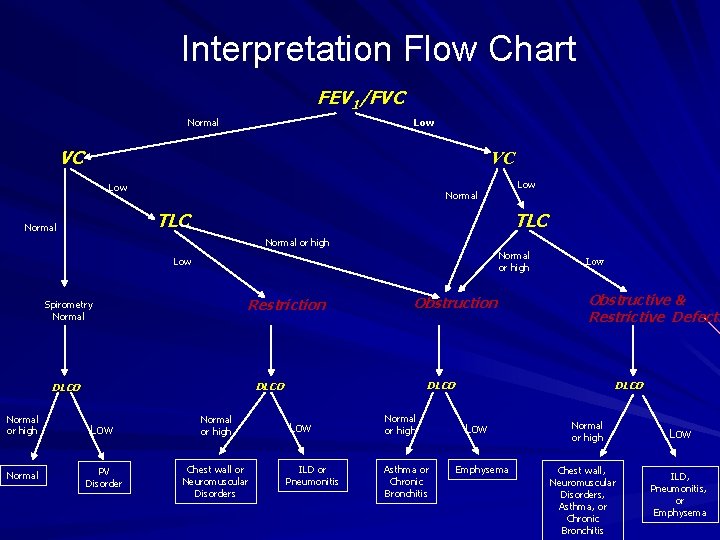
DLCO Interpretation u Low DLCO with normal spirometry – Pulmonary Vascular Disease – Anaemia - correct for Hb – Early ILDs or early emphysema – Chronic pulmonary embolism – Primary pulmonary hypertension u Low DLCO with restriction – Interstitial Lung Disease u Low DLCO with obstruction – Emphysema – COPD – Lymphangioleiomyomatosis DO NOT USE DLCO/VA or KCO Often Normal in Interstitial Lung Disease
Possible Causes* of High DLCo u Intrapulmonary Haemorrhage u Asthma u Obesity ? ? ? *DLCO is not always high in these patients
u Adjustments of DL, CO for changes in haemoglobin and carboxyhaemoglobin are important, especially in situations where patients are being monitored for possible drug toxicity, and where haemoglobin is subject to large shifts (e. g. chemotherapy for cancer).
u Adjusting DL, CO for lung volume using DL, CO/VA or DL, CO/TLC is controversial. u Conceptually, a loss of DL, CO that is much less than a loss of volume (low DL, CO but high DL, CO/VA) might suggest an extraparenchymal abnormality, such as a pneumonectomy or chest wall restriction. u whereas, a loss of DL, CO that is much greater than a loss of volume (low DL, CO and low DL, CO/VA) might suggest parenchymal abnormalities.
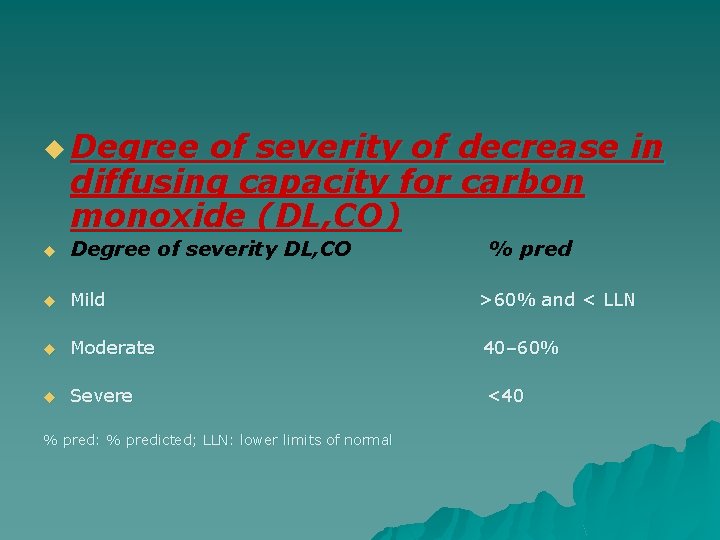
u Degree of severity of decrease in diffusing capacity for carbon monoxide (DL, CO) u Degree of severity DL, CO u Mild >60% and < LLN u Moderate 40– 60% u Severe <40 % pred: % predicted; LLN: lower limits of normal % pred
Interpretation Flow Chart FEV 1/FVC Normal Low VC VC Low Normal TLC Normal or high Low Restriction Spirometry Normal Low PV Disorder Normal or high Chest wall or Neuromuscular Disorders Obstructive & Restrictive Defects DLCO Normal or high Obstruction Low ILD or Pneumonitis Normal or high Asthma or Chronic Bronchitis DLCO Low Emphysema Normal or high Chest wall, Neuromuscular Disorders, Asthma, or Chronic Bronchitis Low ILD, Pneumonitis, or Emphysema
Assignment of severity for lung volume disorders volume mild VC 70 -90% 50 -70% <50% Rest. Obst. 70 -80% 60 -70% <60% 120 -130% 130 -150% >150% Rest. Obst. 55 -65% 45 -55% <45% 135 -150% 150 -250% >250% Rest. Obst. 55 -65% 45 -55% <45% 135 -150% 150 -200% >200% TLC RV FRC moderate severe