
An ApplicationSpecific Protocol Architecture for Wireless Microsensor Networks
- Slides: 43
An Application-Specific Protocol Architecture for Wireless Microsensor Networks By: W. Heinzelman, A. Chandrakasan & H. Balakrishnan A review prepared for CEG 790 By: Patrick Flaherty 12/26/2021 1
Presentation Outline n What is a Wireless Sensor Network? n Why are Protocols for Self-Organizing an issue? n The proposed “Low-energy adaptive clustering hierarchy” (LEACH) protocol n n Concept Algorithms n Analysis and simulation of LEACH n Conclusions 12/26/2021 2
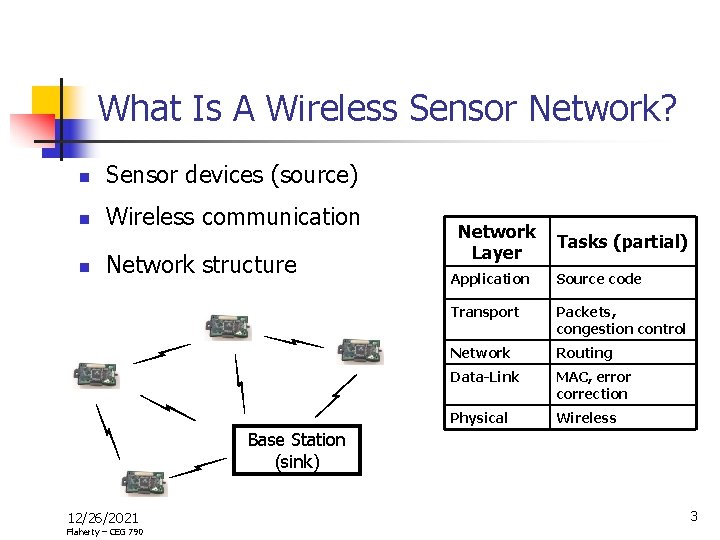
What Is A Wireless Sensor Network? n Sensor devices (source) n Wireless communication n Network structure Network Layer Tasks (partial) Application Source code Transport Packets, congestion control Network Routing Data-Link MAC, error correction Physical Wireless Base Station (sink) 12/26/2021 Flaherty – CEG 790 3
Wireless Sensor Networks n n 10’s to 1, 000’s of wireless sensors placed into an environment May be put into structures where truckloads of cabling would be required to connect to the data collection point (e. g. , Golden Gate Bridge) May be placed in a natural environment to monitor wildlife (e. g. , study relationship between weather conditions and animal behavior) May be used in hostile environments to detect movement of opponents 12/26/2021 Flaherty – CEG 790 4
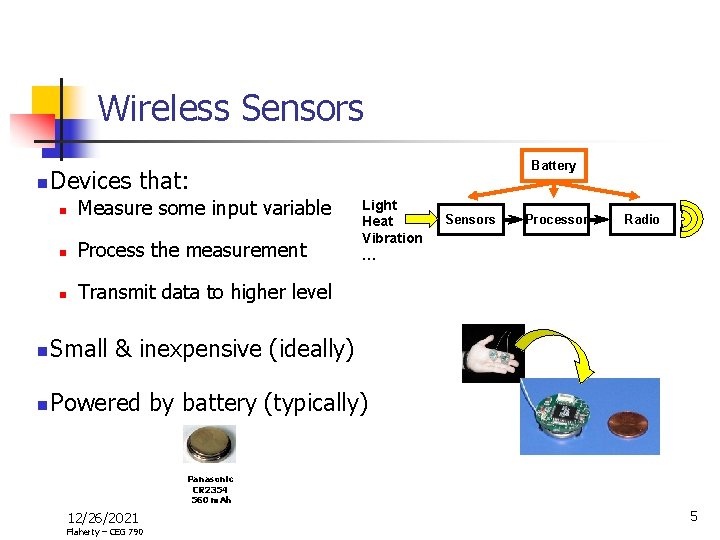
Wireless Sensors n Battery Devices that: n Measure some input variable n Process the measurement n Transmit data to higher level Light Heat Vibration … n Small & inexpensive (ideally) n Powered by battery (typically) Sensors Processor Radio Panasonic CR 2354 560 m. Ah 12/26/2021 Flaherty – CEG 790 5
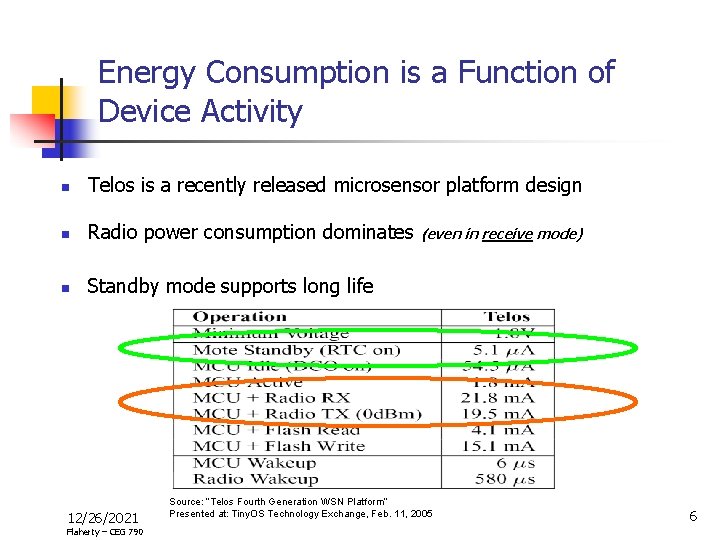
Energy Consumption is a Function of Device Activity n Telos is a recently released microsensor platform design n Radio power consumption dominates n Standby mode supports long life 12/26/2021 Flaherty – CEG 790 (even in receive mode) Source: “Telos Fourth Generation WSN Platform” Presented at: Tiny. OS Technology Exchange, Feb. 11, 2005 6
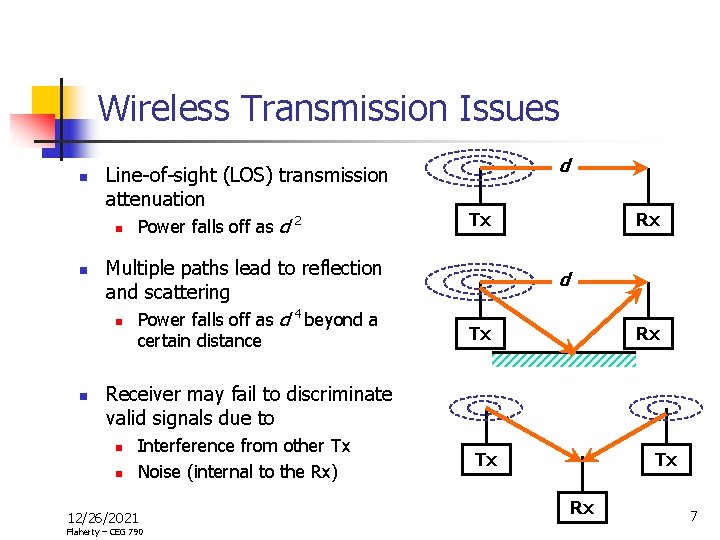
Wireless Transmission Issues n n Line-of-sight (LOS) transmission attenuation 2 n Power falls off as d Multiple paths lead to reflection and scattering 4 n Power falls off as d beyond a certain distance n d Tx Rx Receiver may fail to discriminate valid signals due to n n Interference from other Tx Noise (internal to the Rx) 12/26/2021 Flaherty – CEG 790 Tx Tx Rx 7
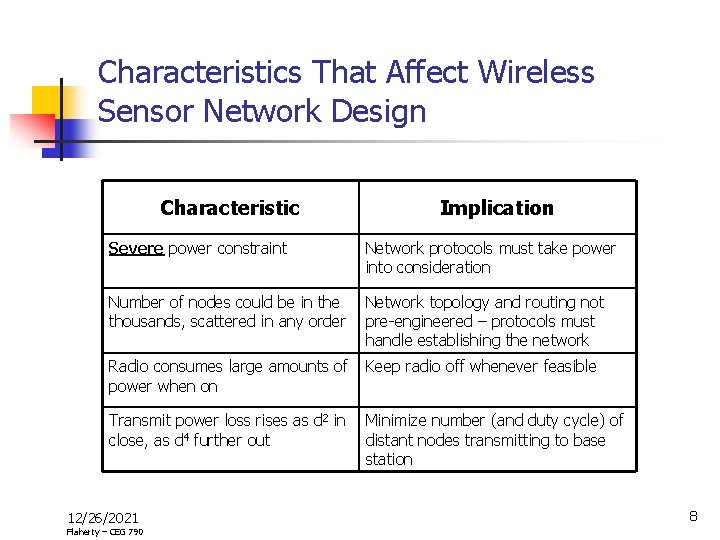
Characteristics That Affect Wireless Sensor Network Design Characteristic Implication Severe power constraint Network protocols must take power into consideration Number of nodes could be in the thousands, scattered in any order Network topology and routing not pre-engineered – protocols must handle establishing the network Radio consumes large amounts of power when on Keep radio off whenever feasible Transmit power loss rises as d 2 in close, as d 4 further out Minimize number (and duty cycle) of distant nodes transmitting to base station 12/26/2021 Flaherty – CEG 790 8
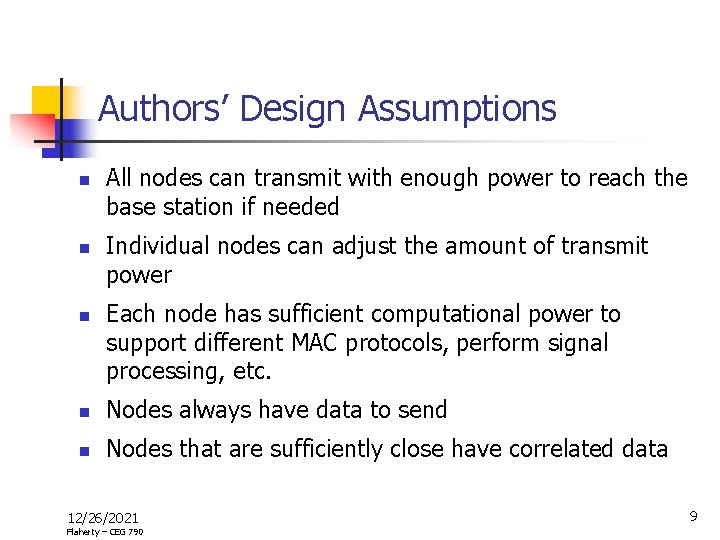
Authors’ Design Assumptions n n n All nodes can transmit with enough power to reach the base station if needed Individual nodes can adjust the amount of transmit power Each node has sufficient computational power to support different MAC protocols, perform signal processing, etc. n Nodes always have data to send n Nodes that are sufficiently close have correlated data 12/26/2021 Flaherty – CEG 790 9
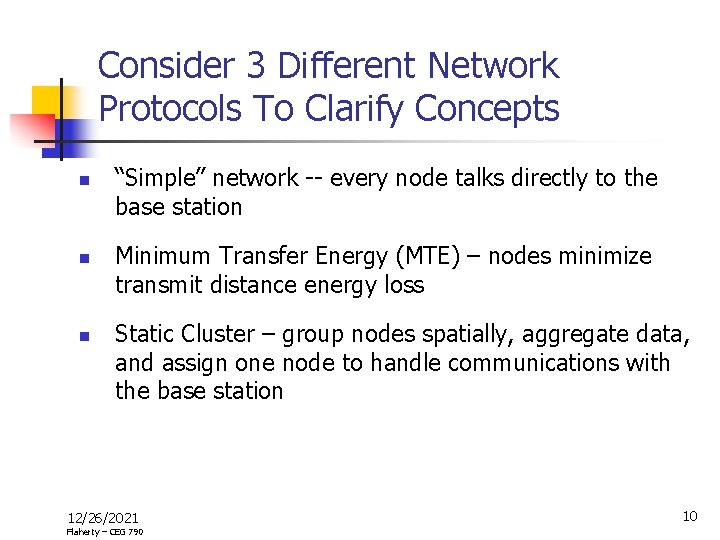
Consider 3 Different Network Protocols To Clarify Concepts n n n “Simple” network -- every node talks directly to the base station Minimum Transfer Energy (MTE) – nodes minimize transmit distance energy loss Static Cluster – group nodes spatially, aggregate data, and assign one node to handle communications with the base station 12/26/2021 Flaherty – CEG 790 10
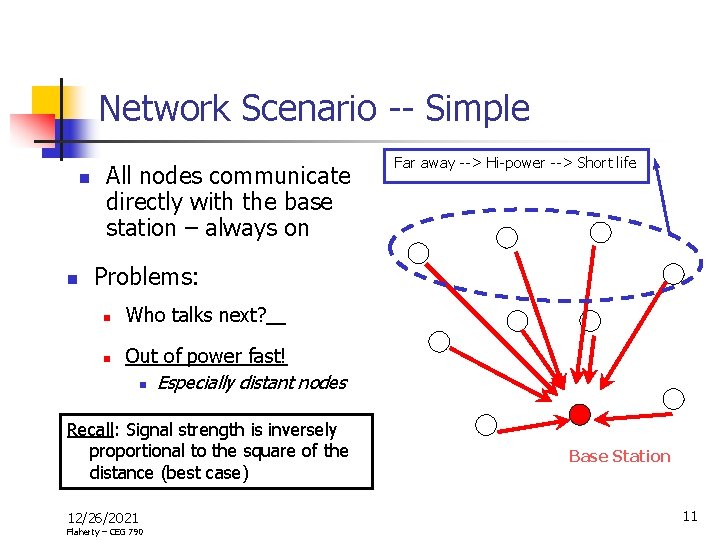
Network Scenario -- Simple n n All nodes communicate directly with the base station – always on Far away --> Hi-power --> Short life Problems: n n Who talks next? Out of power fast! n Especially distant nodes Recall: Signal strength is inversely proportional to the square of the distance (best case) 12/26/2021 Flaherty – CEG 790 Base Station 11
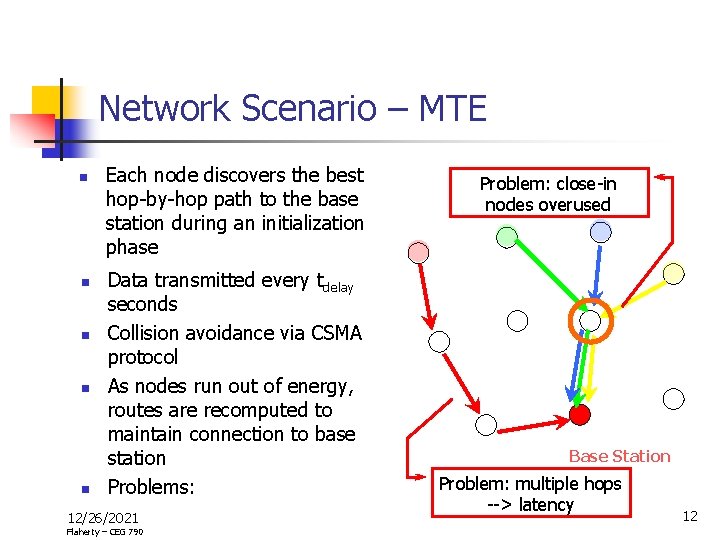
Network Scenario – MTE n n n Each node discovers the best hop-by-hop path to the base station during an initialization phase Data transmitted every tdelay seconds Collision avoidance via CSMA protocol As nodes run out of energy, routes are recomputed to maintain connection to base station Problems: 12/26/2021 Flaherty – CEG 790 Problem: close-in nodes overused Base Station Problem: multiple hops --> latency 12
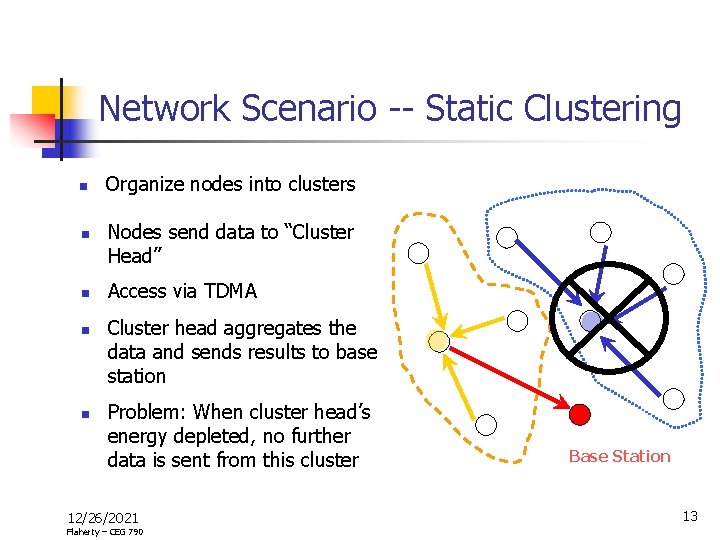
Network Scenario -- Static Clustering n n n Organize nodes into clusters Nodes send data to “Cluster Head” Access via TDMA Cluster head aggregates the data and sends results to base station Problem: When cluster head’s energy depleted, no further data is sent from this cluster 12/26/2021 Flaherty – CEG 790 Base Station 13
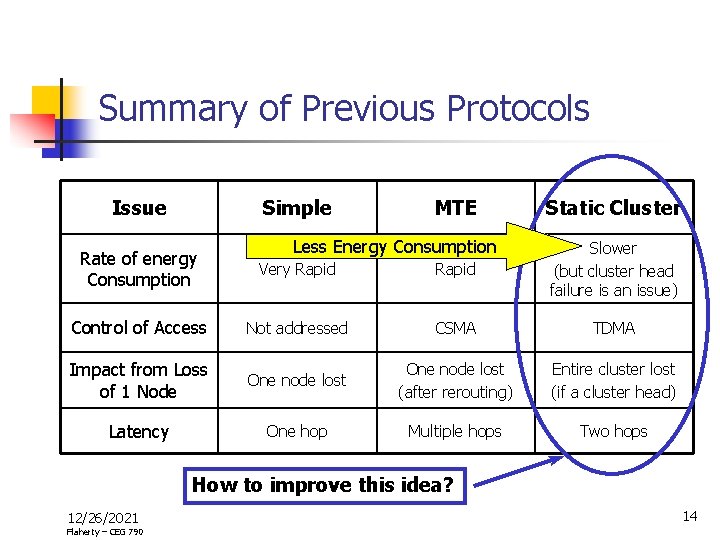
Summary of Previous Protocols Issue Simple MTE Less Energy Consumption Static Cluster Rate of energy Consumption Very Rapid Slower (but cluster head failure is an issue) Control of Access Not addressed CSMA TDMA Impact from Loss of 1 Node One node lost (after rerouting) Entire cluster lost (if a cluster head) Latency One hop Multiple hops Two hops How to improve this idea? 12/26/2021 Flaherty – CEG 790 14
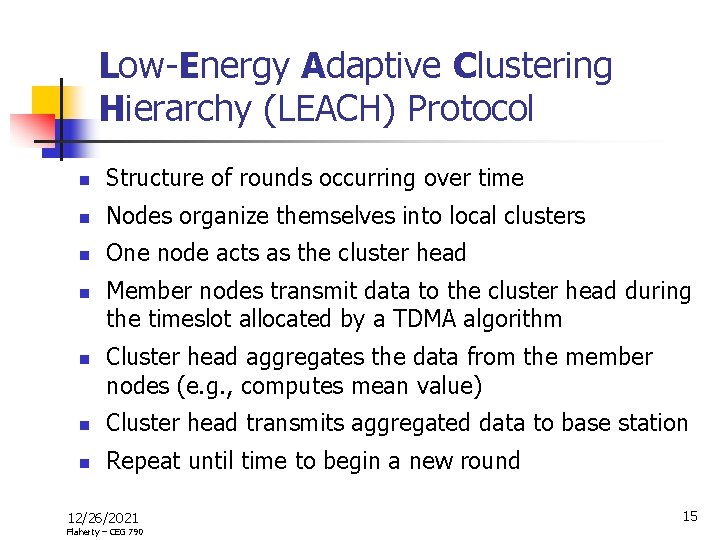
Low-Energy Adaptive Clustering Hierarchy (LEACH) Protocol n Structure of rounds occurring over time n Nodes organize themselves into local clusters n One node acts as the cluster head n n Member nodes transmit data to the cluster head during the timeslot allocated by a TDMA algorithm Cluster head aggregates the data from the member nodes (e. g. , computes mean value) n Cluster head transmits aggregated data to base station n Repeat until time to begin a new round 12/26/2021 Flaherty – CEG 790 15
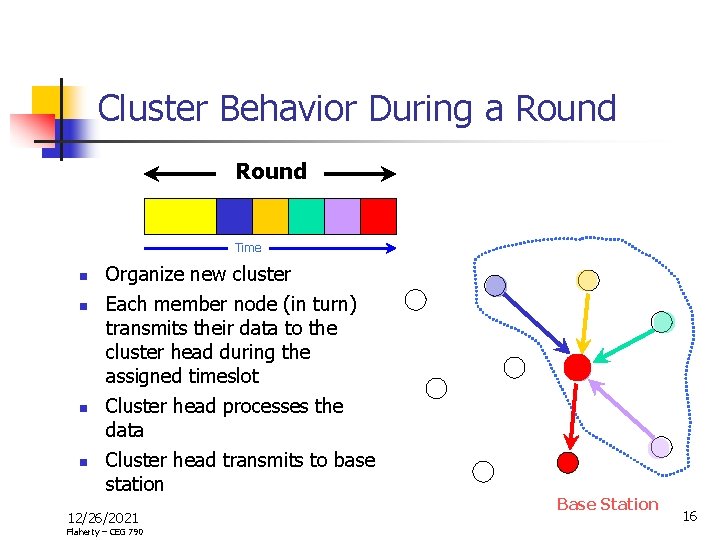
Cluster Behavior During a Round Time n n Organize new cluster Each member node (in turn) transmits their data to the cluster head during the assigned timeslot Cluster head processes the data Cluster head transmits to base station 12/26/2021 Flaherty – CEG 790 Base Station 16
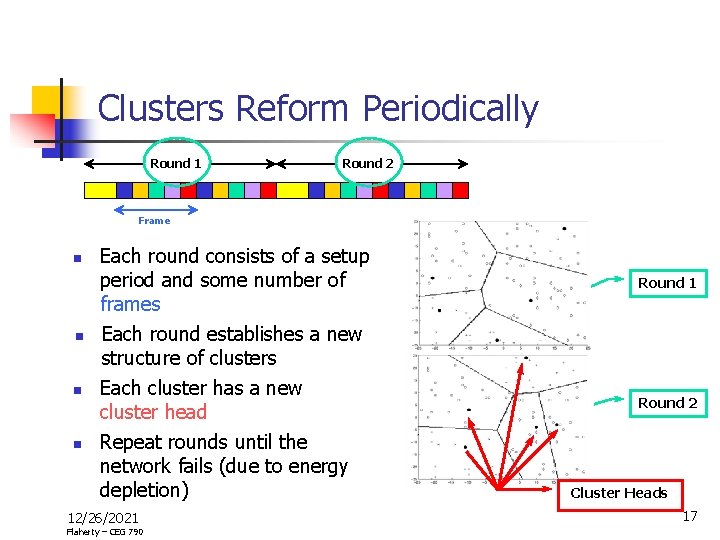
Clusters Reform Periodically Round 1 Round 2 … … Round n Frame n n Each round consists of a setup period and some number of frames Each round establishes a new structure of clusters Each cluster has a new cluster head Repeat rounds until the network fails (due to energy depletion) 12/26/2021 Flaherty – CEG 790 Round 1 Round 2 Cluster Heads 17
Now For Some Details n Cluster head selection algorithms n Cluster formation algorithm n Steady-state phase n Alternate scheme LAECH-C 12/26/2021 Flaherty – CEG 790 18
Cluster Head Selection Algorithms n n Need: distributed Algorithms Desired results n n n Case 1: n n n Specified number of cluster heads formed for each round Cluster head duties rotated among nodes so as to evenly draw power from the nodes over time (no overly-utilized nodes) Nodes begin with equal energy All nodes transmit data during each frame Case 2: n n Nodes begin with unequal energy, and/or Nodes transmit “upon event” 12/26/2021 Flaherty – CEG 790 19
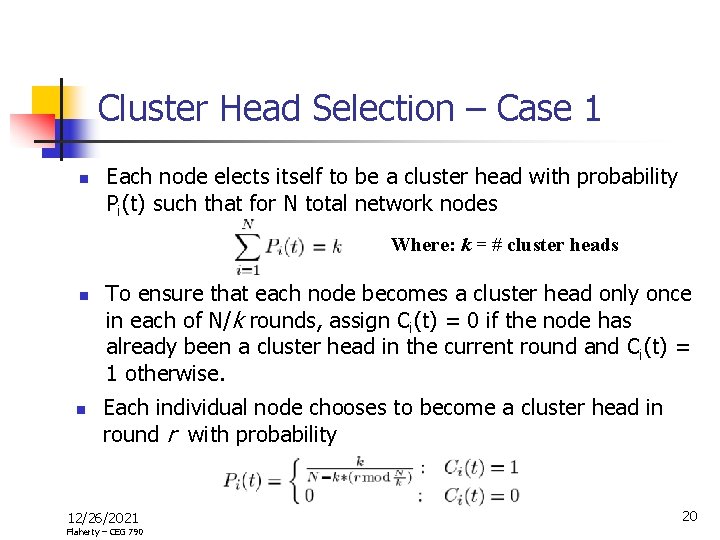
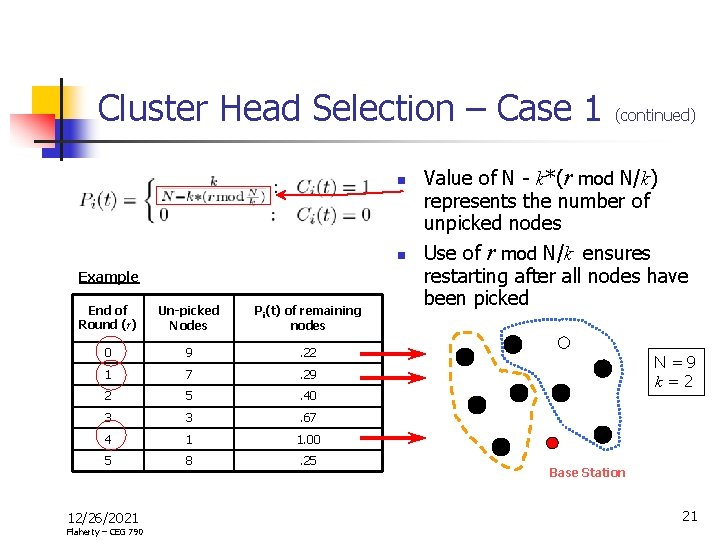
Cluster Head Selection – Case 1 n Each node elects itself to be a cluster head with probability Pi(t) such that for N total network nodes Where: k = # cluster heads n n To ensure that each node becomes a cluster head only once in each of N/k rounds, assign Ci(t) = 0 if the node has already been a cluster head in the current round and Ci(t) = 1 otherwise. Each individual node chooses to become a cluster head in round r with probability 12/26/2021 Flaherty – CEG 790 20
Cluster Head Selection – Case 1 n n Example End of Round (r) Un-picked Nodes Pi(t) of remaining nodes 0 9 . 22 1 7 . 29 2 5 . 40 3 3 . 67 4 1 1. 00 5 8 . 25 12/26/2021 Flaherty – CEG 790 (continued) Value of N - k*(r mod N/k) represents the number of unpicked nodes Use of r mod N/k ensures restarting after all nodes have been picked N=9 k=2 Base Station 21
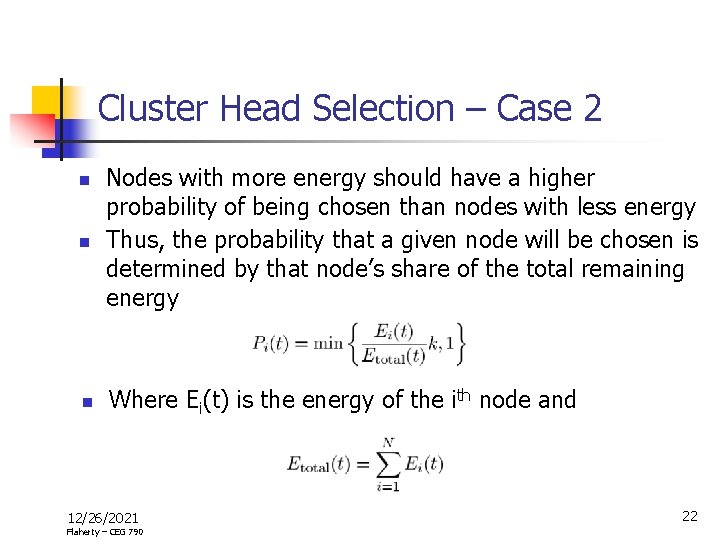
Cluster Head Selection – Case 2 n Nodes with more energy should have a higher probability of being chosen than nodes with less energy Thus, the probability that a given node will be chosen is determined by that node’s share of the total remaining energy n Where Ei(t) is the energy of the ith node and n 12/26/2021 Flaherty – CEG 790 22
Cluster Head Selection – Case 2 n n n (continued) Notice that this algorithm requires each node to know (or have an estimate for) the value of Etotal(t) To know the exact value would take time and consume energy As an estimate we could compute the average energy of each node in a given cluster and multiply by N n n Nodes report current energy to cluster head Cluster head computes estimated Etotal(t) and returns the value to all nodes in the cluster 12/26/2021 Flaherty – CEG 790 23
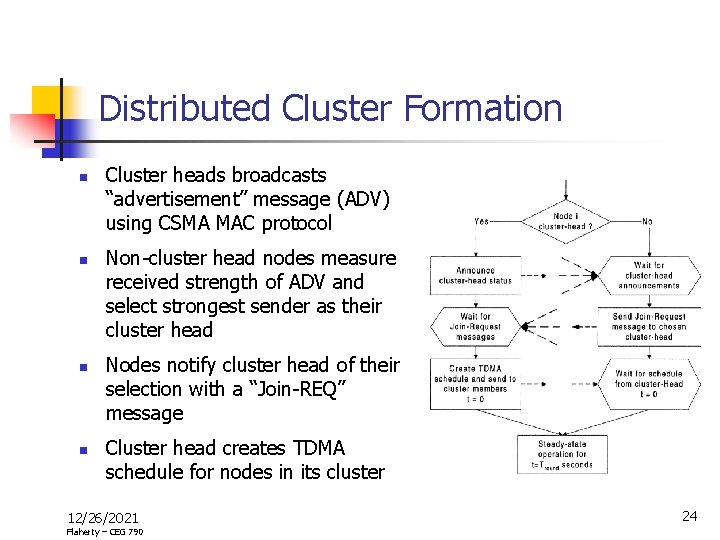
Distributed Cluster Formation n n Cluster heads broadcasts “advertisement” message (ADV) using CSMA MAC protocol Non-cluster head nodes measure received strength of ADV and select strongest sender as their cluster head Nodes notify cluster head of their selection with a “Join-REQ” message Cluster head creates TDMA schedule for nodes in its cluster 12/26/2021 Flaherty – CEG 790 24
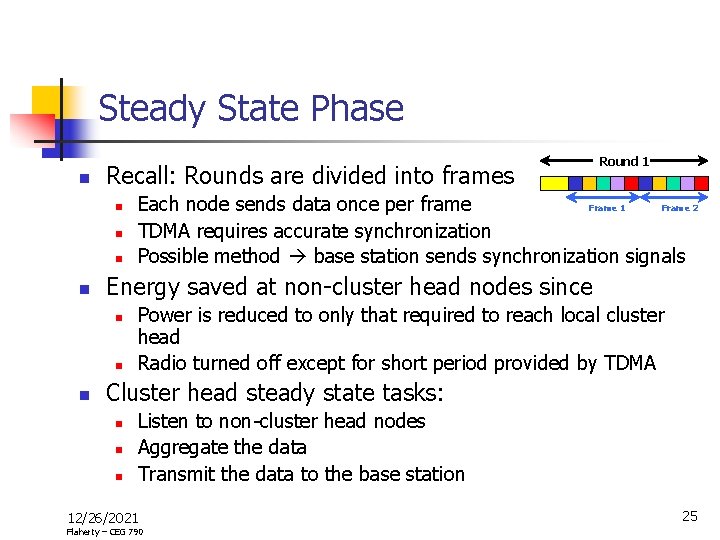
Steady State Phase n Recall: Rounds are divided into frames n n Frame 1 Frame 2 Each node sends data once per frame TDMA requires accurate synchronization Possible method base station sends synchronization signals Energy saved at non-cluster head nodes since n n n Round 1 Power is reduced to only that required to reach local cluster head Radio turned off except for short period provided by TDMA Cluster head steady state tasks: n n n Listen to non-cluster head nodes Aggregate the data Transmit the data to the base station 12/26/2021 Flaherty – CEG 790 25
Steady State Phase n n Transmissions must succeed even though other nodes and cluster heads are broadcasting LEACH uses Direct-Sequence Spread Spectrum (DSSS) n n n (continued) Each cluster uses a unique spreading code Chosen from a pre-defined list With enough spreading, potentially interfering signals can be filtered out during de-correlation Easier to implement than dynamically assigned frequency bands Difficulty is need for tight timing synchronization How does DSSS work? (Not addressed in this paper) 12/26/2021 Flaherty – CEG 790 26
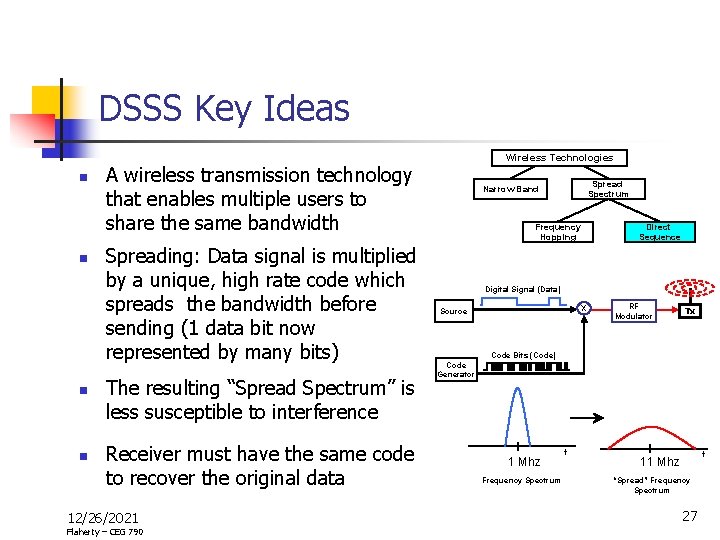
DSSS Key Ideas n n Wireless Technologies A wireless transmission technology that enables multiple users to share the same bandwidth Spreading: Data signal is multiplied by a unique, high rate code which spreads the bandwidth before sending (1 data bit now represented by many bits) The resulting “Spread Spectrum” is less susceptible to interference Receiver must have the same code to recover the original data 12/26/2021 Flaherty – CEG 790 Spread Spectrum Narrow Band Frequency Hopping Direct Sequence Digital Signal (Data) X Source RF Modulator Tx Code Bits (Code) Code Generator 1 Mhz Frequency Spectrum f f 11 Mhz “Spread” Frequency Spectrum 27
LEACH-C -- A Variation of LEACH n n n Idea: using a central control algorithm may produce better clusterings Each node sends location information and energy level to the base station Base station: n n n Eliminates low energy nodes from consideration Finds k optimal clusters (since this is NP-hard, uses the “Simulated annealing algorithm” ) Goal is to minimize the total sum of squared distances between non-cluster heads and the nearest cluster head 12/26/2021 Flaherty – CEG 790 28
Performance Analysis n n n Simulate the performance of four protocols (Static Clustering, MTE, LEACH, & LEACH-C) How? n Set up the simulation n Find the optimal number of clusters n Compare the protocols’ energy consumption performance Conclusions 12/26/2021 Flaherty – CEG 790 29
Simulation of Protocol Performance n n n Analytical model of even moderately-sized realistic networks is “difficult” Authors used the network simulator “ns“ Comparison of performance over four metrics n n System lifetime Energy dissipation Amount of data transferred Latency 12/26/2021 Flaherty – CEG 790 30
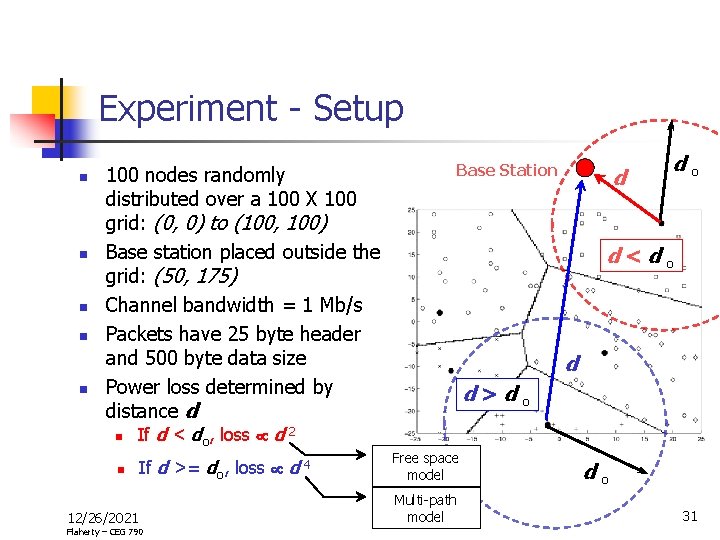
Experiment - Setup n n n Base Station 100 nodes randomly distributed over a 100 X 100 grid: (0, 0) to (100, 100) Base station placed outside the grid: (50, 175) Channel bandwidth = 1 Mb/s Packets have 25 byte header and 500 byte data size Power loss determined by distance d 2 n If d < do, loss µ d n 12/26/2021 If d >= do, loss µ d 4 Flaherty – CEG 790 d do d<do d d>do Free space model Multi-path model do 31
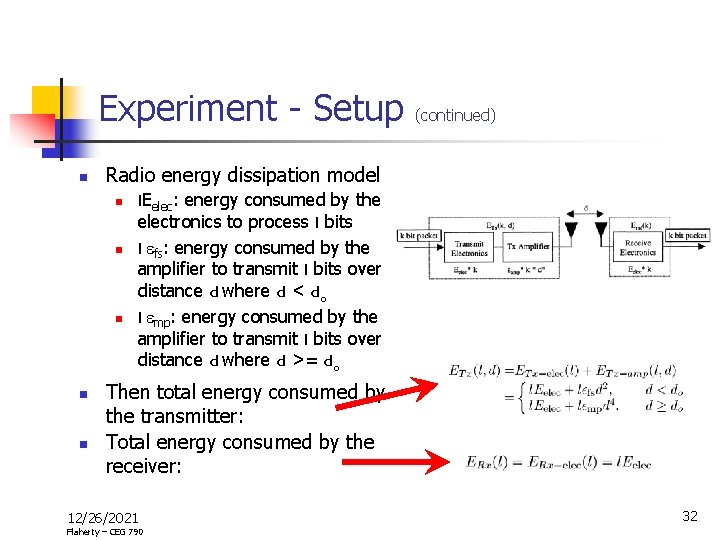
Experiment - Setup n Radio energy dissipation model n n n (continued) l. Eelec: energy consumed by the electronics to process l bits l efs: energy consumed by the amplifier to transmit l bits over distance d where d < do l emp: energy consumed by the amplifier to transmit l bits over distance d where d >= do Then total energy consumed by the transmitter: Total energy consumed by the receiver: 12/26/2021 Flaherty – CEG 790 32
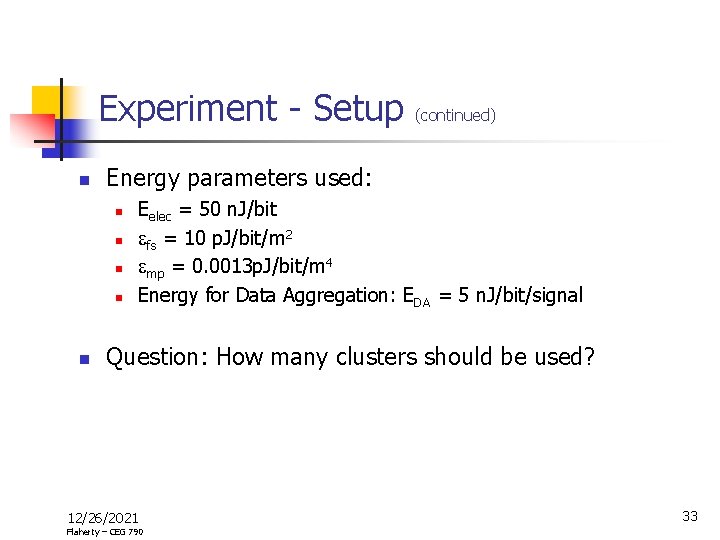
Experiment - Setup n Energy parameters used: n n n (continued) Eelec = 50 n. J/bit efs = 10 p. J/bit/m 2 emp = 0. 0013 p. J/bit/m 4 Energy for Data Aggregation: EDA = 5 n. J/bit/signal Question: How many clusters should be used? 12/26/2021 Flaherty – CEG 790 33
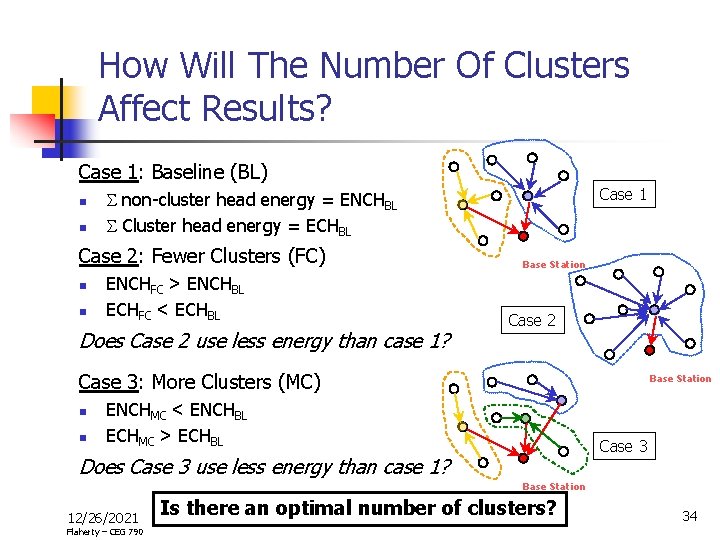
How Will The Number Of Clusters Affect Results? Case 1: Baseline (BL) n n Case 2: Fewer Clusters (FC) n n Case 1 S non-cluster head energy = ENCHBL S Cluster head energy = ECHBL ENCHFC > ENCHBL ECHFC < ECHBL Does Case 2 use less energy than case 1? Base Station Case 2 Case 3: More Clusters (MC) n n Base Station ENCHMC < ENCHBL ECHMC > ECHBL Case 3 Does Case 3 use less energy than case 1? Base Station 12/26/2021 Flaherty – CEG 790 Is there an optimal number of clusters? 34
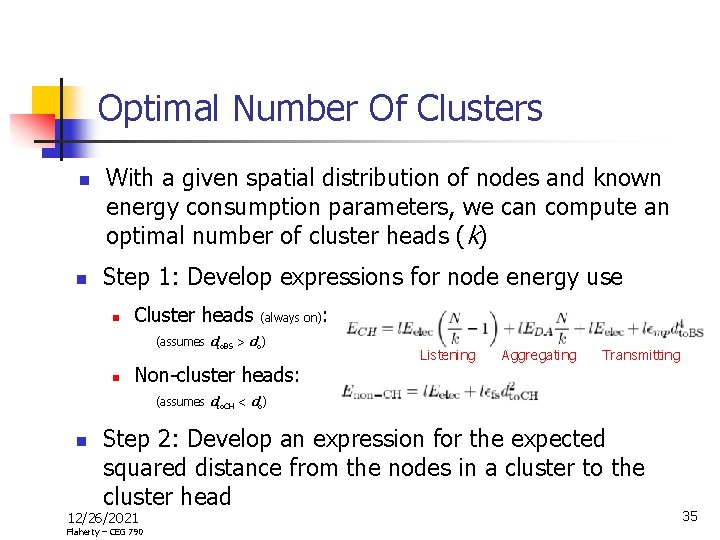
Optimal Number Of Clusters n n With a given spatial distribution of nodes and known energy consumption parameters, we can compute an optimal number of cluster heads (k) Step 1: Develop expressions for node energy use n Cluster heads (always on) (assumes dto. BS > do) n Non-cluster heads: : Listening Aggregating Transmitting (assumes dto. CH < do) n Step 2: Develop an expression for the expected squared distance from the nodes in a cluster to the cluster head 12/26/2021 Flaherty – CEG 790 35
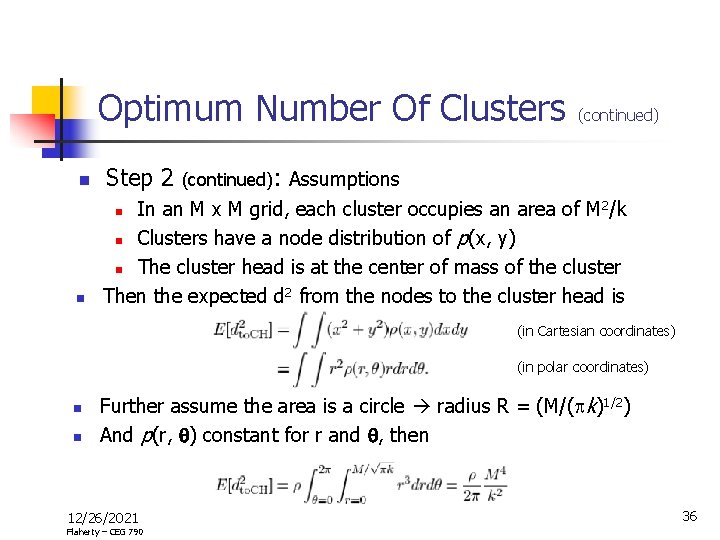
Optimum Number Of Clusters (continued) n Step 2 (continued): Assumptions n In an M x M grid, each cluster occupies an area of M 2/k n Clusters have a node distribution of p(x, y) n The cluster head is at the center of mass of the cluster Then the expected d 2 from the nodes to the cluster head is n (in Cartesian coordinates) (in polar coordinates) n n Further assume the area is a circle radius R = (M/(pk)1/2) And p(r, q) constant for r and q, then 12/26/2021 Flaherty – CEG 790 36
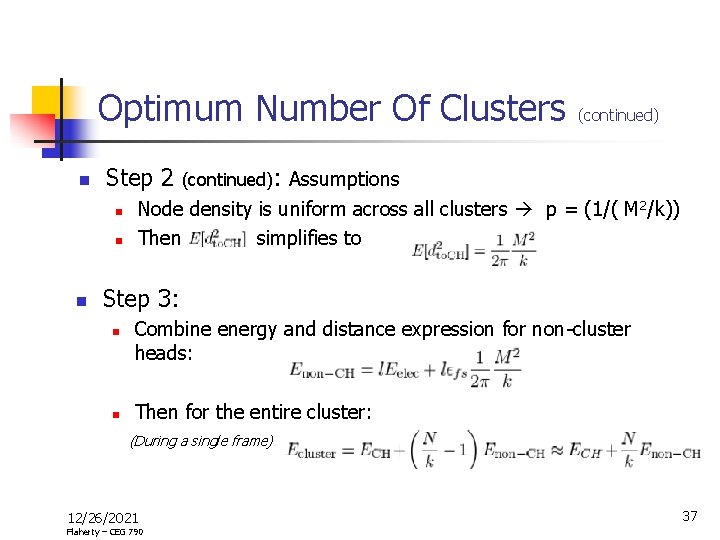
Optimum Number Of Clusters n Step 2 n n n (continued): Assumptions Node density is uniform across all clusters p = (1/( M 2/k)) Then simplifies to Step 3: n n Combine energy and distance expression for non-cluster heads: Then for the entire cluster: (During a single frame) 12/26/2021 Flaherty – CEG 790 37
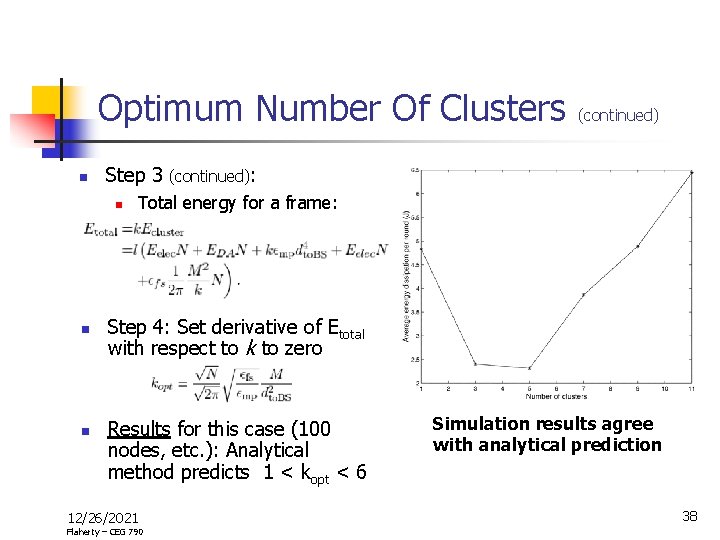
Optimum Number Of Clusters n Step 3 n n n (continued): Total energy for a frame: Step 4: Set derivative of Etotal with respect to k to zero Results for this case (100 nodes, etc. ): Analytical method predicts 1 < kopt < 6 12/26/2021 Flaherty – CEG 790 Simulation results agree with analytical prediction 38
Comparison of Algorithms n Each node was given 2 Joules of energy n n This is equivalent to a 5 volt device @ 20 m. A for 20 s Parameters tracked during simulations n n n (def: J = W·s) Rate at which data packets were transferred to the BS Energy required to get the data to the BS What is not in the simulation n No static energy loss (e. g. , RTC energy use) Energy for CSMA is ignored ( CSMA energy use in MTE is understated) Energy expended during cluster organization (not mentioned in the paper) 12/26/2021 Flaherty – CEG 790 39
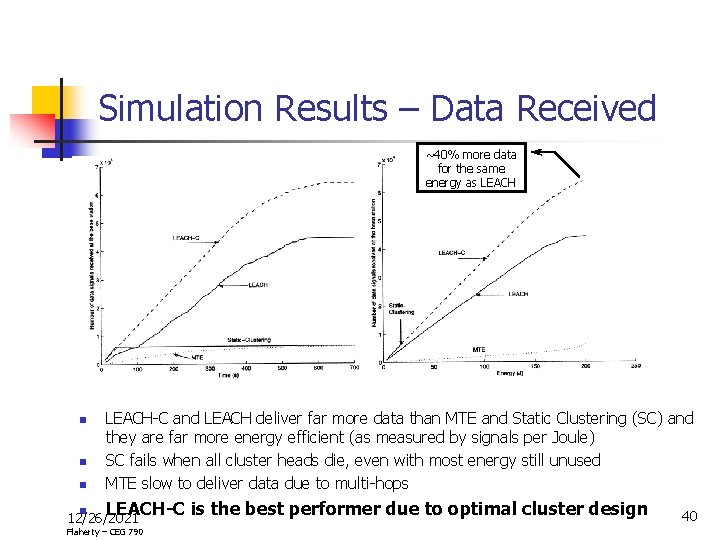
Simulation Results – Data Received ~40% more data for the same energy as LEACH n LEACH-C and LEACH deliver far more data than MTE and Static Clustering (SC) and they are far more energy efficient (as measured by signals per Joule) SC fails when all cluster heads die, even with most energy still unused MTE slow to deliver data due to multi-hops n LEACH-C is the best performer due to optimal cluster design n n 12/26/2021 Flaherty – CEG 790 40
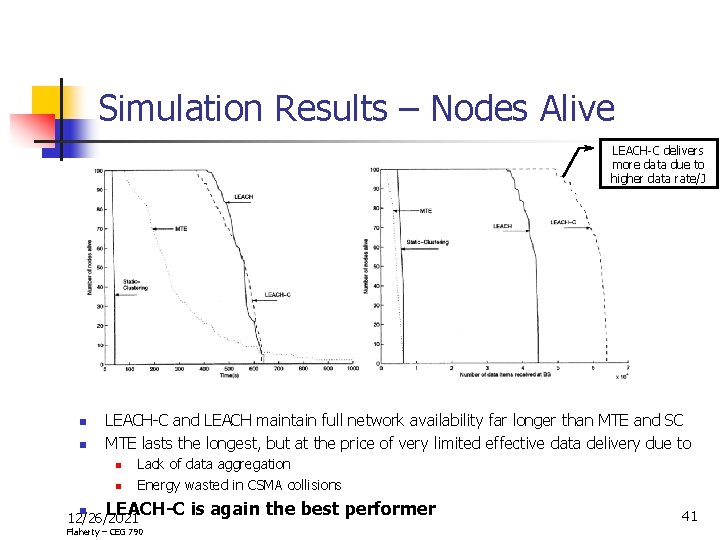
Simulation Results – Nodes Alive LEACH-C delivers more data due to higher data rate/J n n LEACH-C and LEACH maintain full network availability far longer than MTE and SC MTE lasts the longest, but at the price of very limited effective data delivery due to n n n Lack of data aggregation Energy wasted in CSMA collisions LEACH-C is again the best performer 12/26/2021 Flaherty – CEG 790 41
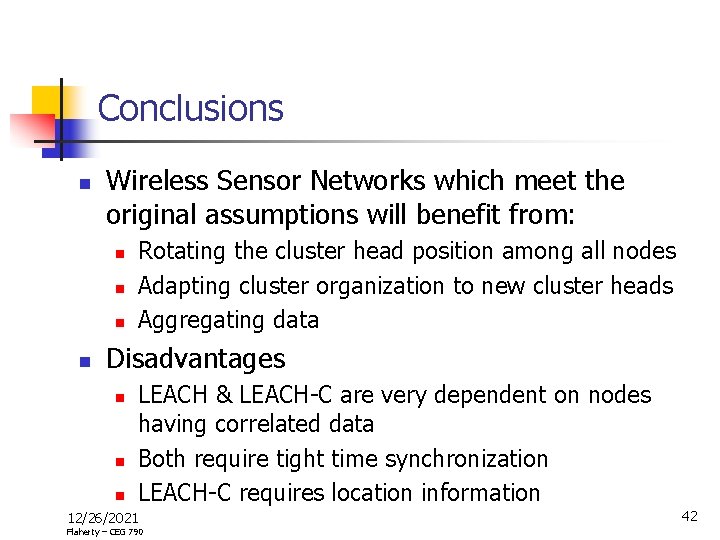
Conclusions n Wireless Sensor Networks which meet the original assumptions will benefit from: n n Rotating the cluster head position among all nodes Adapting cluster organization to new cluster heads Aggregating data Disadvantages n n n LEACH & LEACH-C are very dependent on nodes having correlated data Both require tight time synchronization LEACH-C requires location information 12/26/2021 Flaherty – CEG 790 42
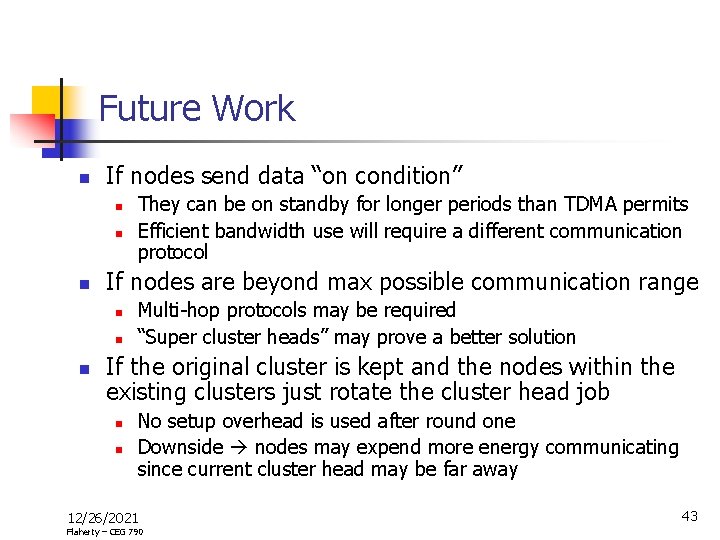
Future Work n If nodes send data “on condition” n n n If nodes are beyond max possible communication range n n n They can be on standby for longer periods than TDMA permits Efficient bandwidth use will require a different communication protocol Multi-hop protocols may be required “Super cluster heads” may prove a better solution If the original cluster is kept and the nodes within the existing clusters just rotate the cluster head job n n No setup overhead is used after round one Downside nodes may expend more energy communicating since current cluster head may be far away 12/26/2021 Flaherty – CEG 790 43