
An application of the choicebased conjoint analysis to
An application of the choice-based conjoint analysis to study wine consumers and the role of sustainability communication Giovanni Sogari 1, 2, Gnel Gabrielyan 2*, Cristina Mora 1 and Davide Menozzi 1 1 Department of Food and Drug, University of Parma 2 Dyson School of Applied Economics and Management, Cornell University *Presenting author American Association of Wine Economists Conference 10 -14 June, 2018 - Ithaca, USA
Outline State of the Art Objectives and Design of the Research IMMAGINE Key Results Conclusions Limitations and Ongoing Research IMMAGINE
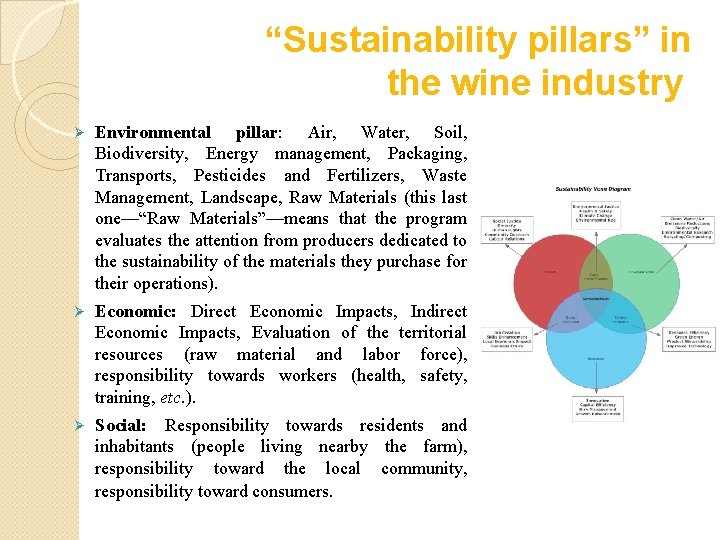
“Sustainability pillars” in the wine industry Ø Environmental pillar: Air, Water, Soil, Biodiversity, Energy management, Packaging, Transports, Pesticides and Fertilizers, Waste Management, Landscape, Raw Materials (this last one—“Raw Materials”—means that the program evaluates the attention from producers dedicated to the sustainability of the materials they purchase for their operations). Ø Economic: Direct Economic Impacts, Indirect Economic Impacts, Evaluation of the territorial resources (raw material and labor force), responsibility towards workers (health, safety, training, etc. ). Ø Social: Responsibility towards residents and inhabitants (people living nearby the farm), responsibility toward the local community, responsibility toward consumers.
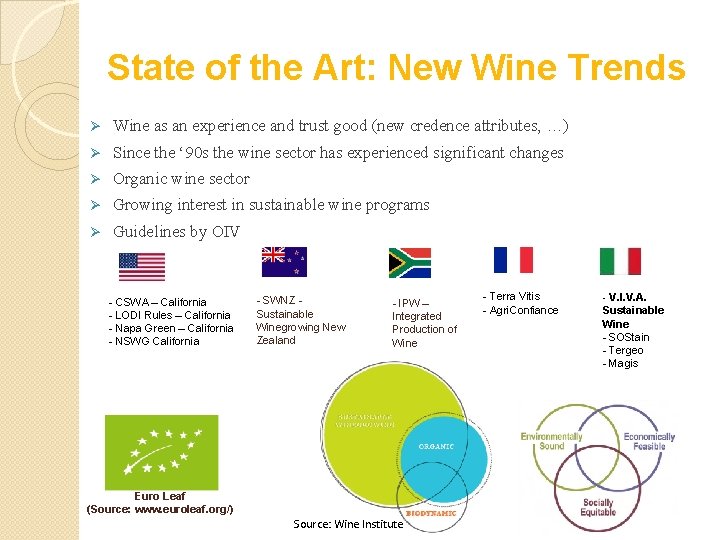
State of the Art: New Wine Trends Ø Wine as an experience and trust good (new credence attributes, …) Ø Since the ‘ 90 s the wine sector has experienced significant changes Ø Organic wine sector Ø Growing interest in sustainable wine programs Ø Guidelines by OIV - CSWA – California - LODI Rules – California - Napa Green – California - NSWG California - SWNZ - Sustainable Winegrowing New Zealand - IPW – Integrated Production of Wine Euro Leaf (Source: www. euroleaf. org/) Source: Wine Institute - Terra Vitis - Agri. Confiance - V. I. V. A. Sustainable Wine - SOStain - Tergeo - Magis
Sustainability programs in Italy Sustainability has become a key issue for the Italian wine industry: Ø Ø Ø Ø Ø V. I. V. A. (“Valutazione dell’Impatto della Vitivinicoltura sull’Ambiente”) Sustainable Wine Tergeo Magis SOStain New Green Revolution (Montefalco 2015) ECO-Prowine Ita. Ca/Gea. Vite Vino Libero Organic wine Vin. Natur Source: Corbo et al. , 2014
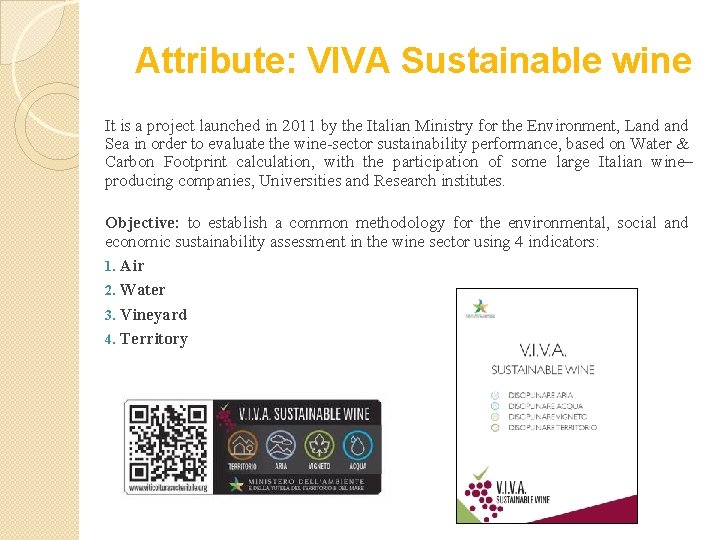
Attribute: VIVA Sustainable wine It is a project launched in 2011 by the Italian Ministry for the Environment, Land Sea in order to evaluate the wine-sector sustainability performance, based on Water & Carbon Footprint calculation, with the participation of some large Italian wine– producing companies, Universities and Research institutes. Objective: to establish a common methodology for the environmental, social and economic sustainability assessment in the wine sector using 4 indicators: 1. Air 2. Water 3. Vineyard 4. Territory
Ø State of the Art: Consumers and Sustainable Attribute Sustainability competes with other quality indications during wine purchase (price, type of wine, brand, origin) (Fearne et al. , 2009) Ø Millennial Generation: more attention toward new attributes (environmental and ethical) (Pomarici and Vecchio, 2013) Ø Positive and increasing appreciation of the idea of "sustainable winemaking", but low/misleading knowledge (Zucca et al. , 2009) Ø Confusion/Skepticism about the complex systems of sustainable claims (Forbes et al. , 2009) as well as Willingness to Pay (Delmas et al. , 2008) Important role of sustainable certification label (increase trustworthiness, “educate”, convey useful information, . . . )
Introduction to the research Ø Objective: to explore the relative importance among tradition attributes (Geographical Indication), the region (Origin/Local) and sustainability certification claim (environmental and social importance) Ø Trade-offs: evaluation not the goods per se but their attributes (RUT, 1974) using part-worth coefficients (contribution of a particular level will suggest whether a level has been more or less appreciated) and the relative importance (weight that the consumer places on each attribute) Ø Data collection: with a web-based questionnaire using SSI Web Sawtooth Software Incorporated© of 495 Italian wine drinkers (sampling by quote in terms of age, gender and geographical area)
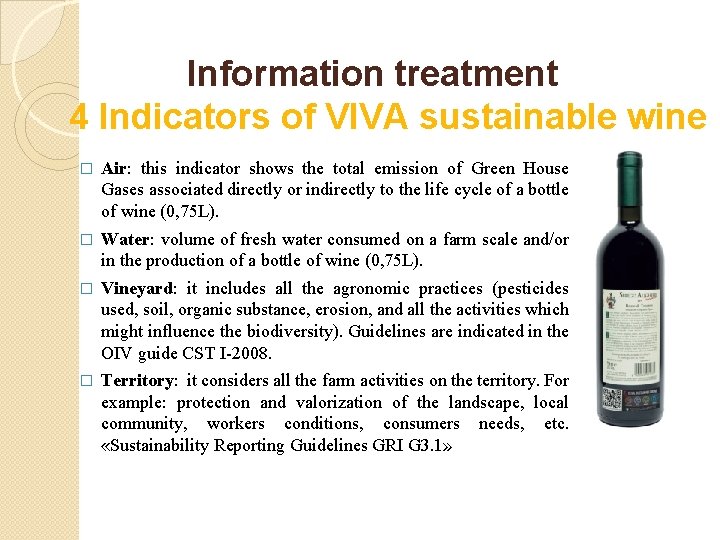
Information treatment 4 Indicators of VIVA sustainable wine � Air: this indicator shows the total emission of Green House Gases associated directly or indirectly to the life cycle of a bottle of wine (0, 75 L). � Water: volume of fresh water consumed on a farm scale and/or in the production of a bottle of wine (0, 75 L). � Vineyard: it includes all the agronomic practices (pesticides used, soil, organic substance, erosion, and all the activities which might influence the biodiversity). Guidelines are indicated in the OIV guide CST I-2008. � Territory: it considers all the farm activities on the territory. For example: protection and valorization of the landscape, local community, workers conditions, consumers needs, etc. «Sustainability Reporting Guidelines GRI G 3. 1»
Structure of the Questionnaire 1. 2. 3. 4. 5. A set of wine consumption habits patterns (how many times. . . , where. . . , price range. . . ) Importance of wine attributes A set of 8 candidate statements on sustainable wine labelling A set of socio-demographic questions Half respondents got the information about the sustainable certification
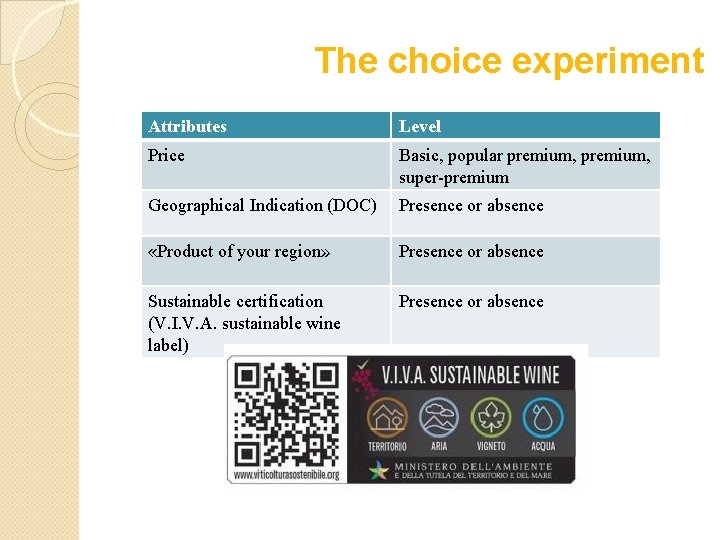
The choice experiment Attributes Level Price Basic, popular premium, super-premium Geographical Indication (DOC) Presence or absence «Product of your region» Presence or absence Sustainable certification (V. I. V. A. sustainable wine label) Presence or absence
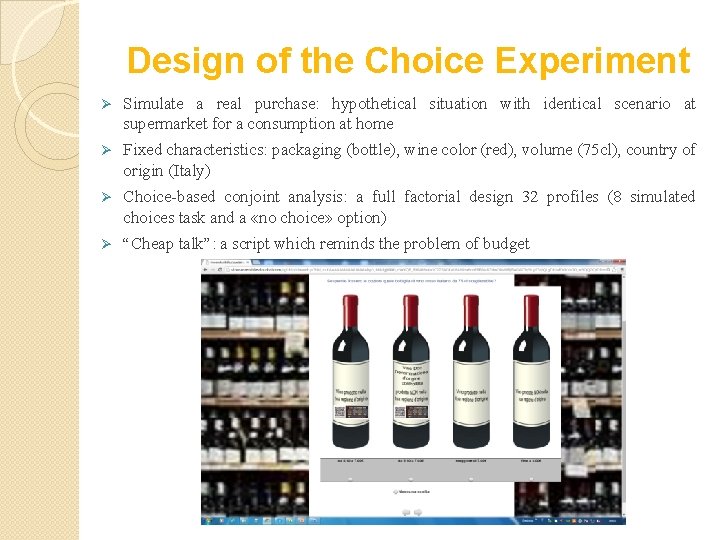
Design of the Choice Experiment Ø Simulate a real purchase: hypothetical situation with identical scenario at supermarket for a consumption at home Ø Fixed characteristics: packaging (bottle), wine color (red), volume (75 cl), country of origin (Italy) Ø Choice-based conjoint analysis: a full factorial design 32 profiles (8 simulated choices task and a «no choice» option) Ø “Cheap talk”: a script which reminds the problem of budget
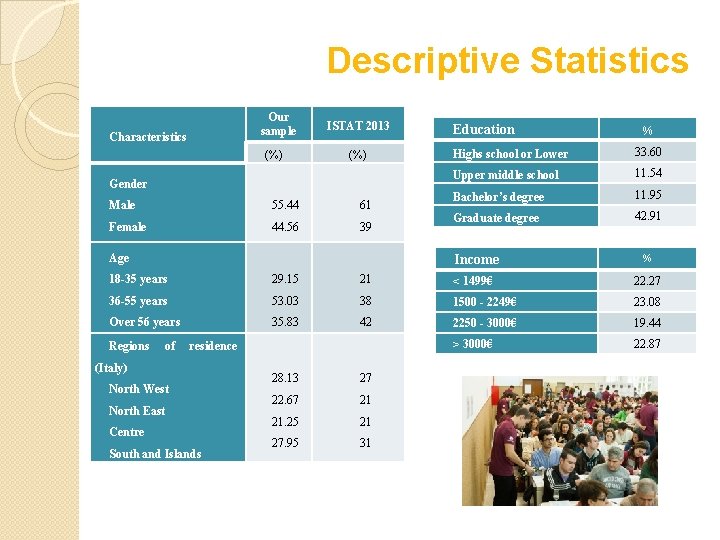
Descriptive Statistics Our sample Characteristics (%) Gender ISTAT 2013 (%) Education % Highs school or Lower 33. 60 Upper middle school 11. 54 Bachelor’s degree 11. 95 Graduate degree 42. 91 Male 55. 44 61 Female 44. 56 39 18 -35 years 29. 15 21 < 1499€ 22. 27 36 -55 years 53. 03 38 1500 - 2249€ 23. 08 Over 56 years 35. 83 42 2250 - 3000€ 19. 44 > 3000€ 22. 87 28. 13 27 22. 67 21 21. 25 21 27. 95 31 Age Regions of residence (Italy) North West North East Centre South and Islands Income %
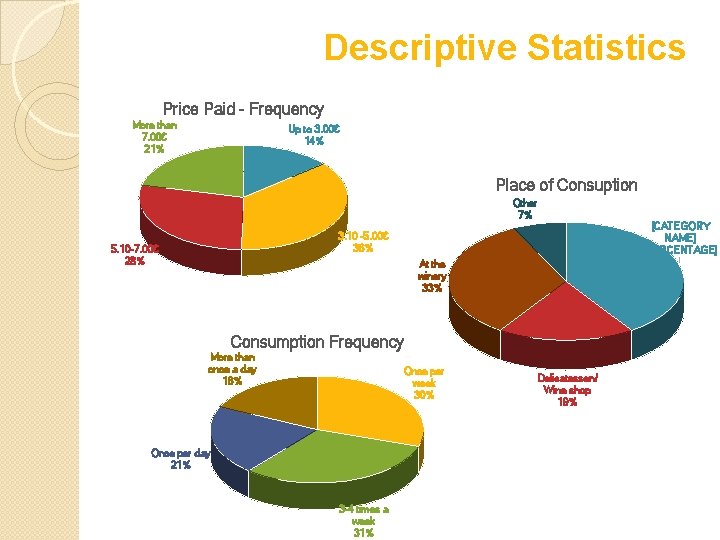
Descriptive Statistics Price Paid - Frequency More than 7. 00€ 21% Up to 3. 00€ 14% Place of Consuption Other 7% 3. 10 -5. 00€ 36% 5. 10 -7. 00€ 28% At the winery 33% Consumption Frequency More than once a day 18% Once per week 30% Once per day 21% 3 -4 times a week 31% Delicatessen/ Wine shop 19% [CATEGORY NAME] [PERCENTAGE]
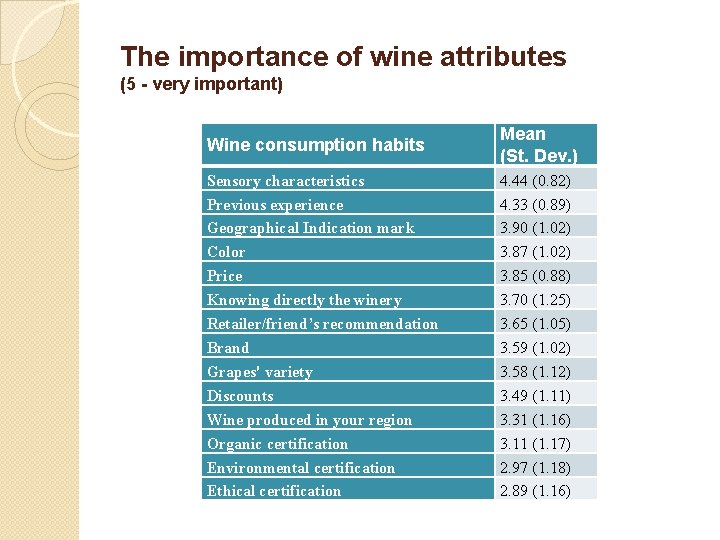
The importance of wine attributes (5 - very important) Wine consumption habits Mean (St. Dev. ) Sensory characteristics Previous experience Geographical Indication mark Color Price Knowing directly the winery Retailer/friend’s recommendation Brand Grapes' variety Discounts Wine produced in your region Organic certification Environmental certification Ethical certification 4. 44 (0. 82) 4. 33 (0. 89) 3. 90 (1. 02) 3. 87 (1. 02) 3. 85 (0. 88) 3. 70 (1. 25) 3. 65 (1. 05) 3. 59 (1. 02) 3. 58 (1. 12) 3. 49 (1. 11) 3. 31 (1. 16) 3. 11 (1. 17) 2. 97 (1. 18) 2. 89 (1. 16)
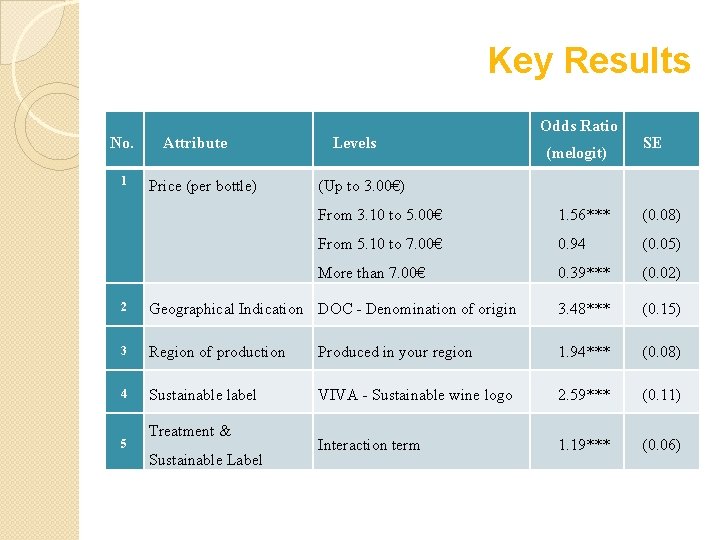
Key Results No. 1 Attribute Price (per bottle) Levels Odds Ratio (melogit) SE (Up to 3. 00€) From 3. 10 to 5. 00€ 1. 56*** (0. 08) From 5. 10 to 7. 00€ 0. 94 (0. 05) More than 7. 00€ 0. 39*** (0. 02) 2 Geographical Indication DOC - Denomination of origin 3. 48*** (0. 15) 3 Region of production Produced in your region 1. 94*** (0. 08) 4 Sustainable label VIVA - Sustainable wine logo 2. 59*** (0. 11) Interaction term 1. 19*** (0. 06) 5 Treatment & Sustainable Label
Conclusions Ø A wine which is labelled with a sustainable certification is perceived to have some specific strong environmental benefits (preserve natural resources) and socio-economic support (more transparency of the company). Ø Even if geographical indication is considered as one of the most important attributes, for a target of wine drinkers a logo indicating sustainability might be attractive. However, this positive perception might change based on the different interactions and prices Ø Additionally, the presence of these labels on the wine bottle might be useful to gain consumers’ attention and provide consumers with more information about the mission of the winery
Limitations and Ongoing Research Hypothetical questions (not actual purchase behaviour) Ø Social desirability bias Ø Currently collecting data from Spanish consumers to investigate whethere are significant cross-country differences Ø Ø Running the same experiment providing information on the meaning of the label
Thank You for Your Attention VIDEO Outline
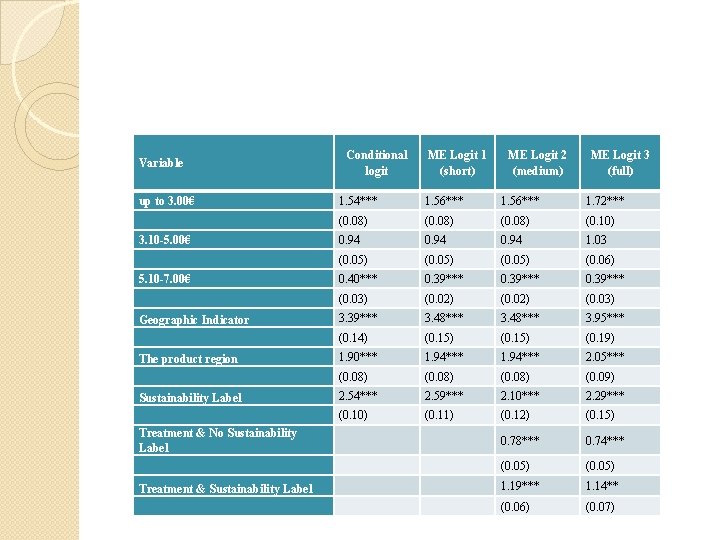
Variable up to 3. 00€ 3. 10 -5. 00€ 5. 10 -7. 00€ Geographic Indicator The product region Sustainability Label Treatment & No Sustainability Label Treatment & Sustainability Label Conditional logit ME Logit 1 (short) ME Logit 2 (medium) ME Logit 3 (full) 1. 54*** 1. 56*** 1. 72*** (0. 08) (0. 10) 0. 94 1. 03 (0. 05) (0. 06) 0. 40*** 0. 39*** (0. 03) (0. 02) (0. 03) 3. 39*** 3. 48*** 3. 95*** (0. 14) (0. 15) (0. 19) 1. 90*** 1. 94*** 2. 05*** (0. 08) (0. 09) 2. 54*** 2. 59*** 2. 10*** 2. 29*** (0. 10) (0. 11) (0. 12) (0. 15) 0. 78*** 0. 74*** (0. 05) 1. 19*** 1. 14** (0. 06) (0. 07)
Backup Slides • • • Definition of sustainable wine Key factors when choosing a wine Specific research questions Steps of designing a choice based conjoint Random Utility Theory Conjoint Analysis Statements about sustainable labelling Factors importance in choosing a wine Parameter estimates of the LR & Wt. P “Sustainability pillars” in the wine industry Attribute: VIVA Sustainable wine 4 indicators of VIVA sustainable wine Outline
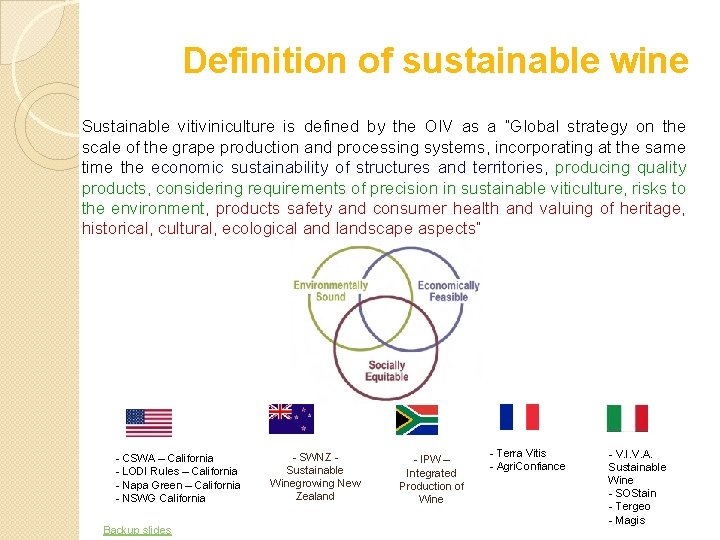
Definition of sustainable wine Sustainable vitiviniculture is defined by the OIV as a “Global strategy on the scale of the grape production and processing systems, incorporating at the same time the economic sustainability of structures and territories, producing quality products, considering requirements of precision in sustainable viticulture, risks to the environment, products safety and consumer health and valuing of heritage, historical, cultural, ecological and landscape aspects” - CSWA – California - LODI Rules – California - Napa Green – California - NSWG California Backup slides Outline - SWNZ - Sustainable Winegrowing New Zealand - IPW – Integrated Production of Wine - Terra Vitis - Agri. Confiance - V. I. V. A. Sustainable Wine - SOStain - Tergeo - Magis Outline
Key factors when choosing a wine Sustainable claims compete with other quality indications during wine purchase. 1. Price per bottle 2. Type of wine (e. g. dry/sweet) 3. Colour (red/white/rose’) 4. Grape variety 5. Which wines are on promotion 6. Information on the back label 7. Recommendations from friends/relatives 8. Country of origin 9. Brand name 10. … 16. Environmentally sustainable production process Source: Fearne et al. (2009) Backup slides
Specific research questions The central research question addressed is whether consumers have a positive perception and interest in sustainability in the wine sector. Several following subresearch questions have been investigated. For instance: Ø Ø What influences consumers during their purchasing? Do they take into consideration environmentally friendly or organic attributes? Are such indicators able to provide a more positive image of the product? Is eco-labelling a key factor to drive the purchase of environmentally friendly wine? Ø Are organic and sustainable labels perceived to be (almost) the same or do consumers distinguish between such indications? Ø Is there any price premium paid by consumers for an Italian sustainable labelling system for wine? Ø What is the trade-off between the sustainable logo and the geographical indication on a wine label? Backup slides Outline
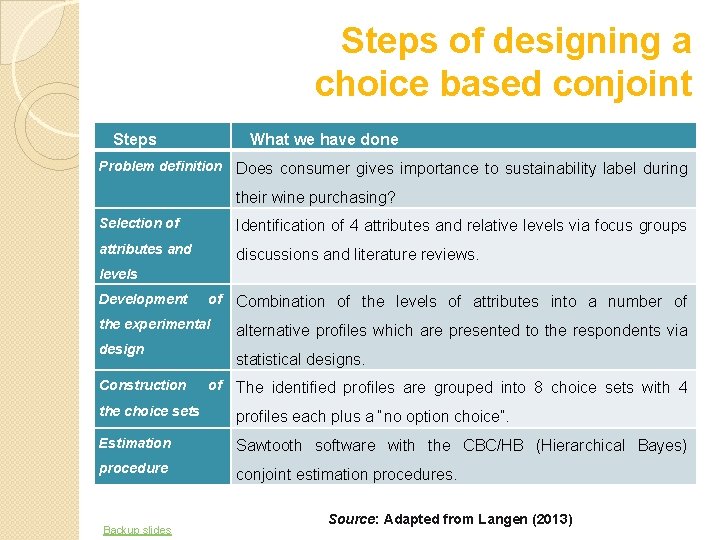
Steps of designing a choice based conjoint Steps What we have done Problem definition Does consumer gives importance to sustainability label during their wine purchasing? Selection of Identification of 4 attributes and relative levels via focus groups attributes and discussions and literature reviews. levels Development of the experimental design Construction Combination of the levels of attributes into a number of alternative profiles which are presented to the respondents via statistical designs. of The identified profiles are grouped into 8 choice sets with 4 the choice sets profiles each plus a “no option choice”. Estimation Sawtooth software with the CBC/HB (Hierarchical Bayes) procedure conjoint estimation procedures. Backup slides Source: Adapted from Langen (2013)
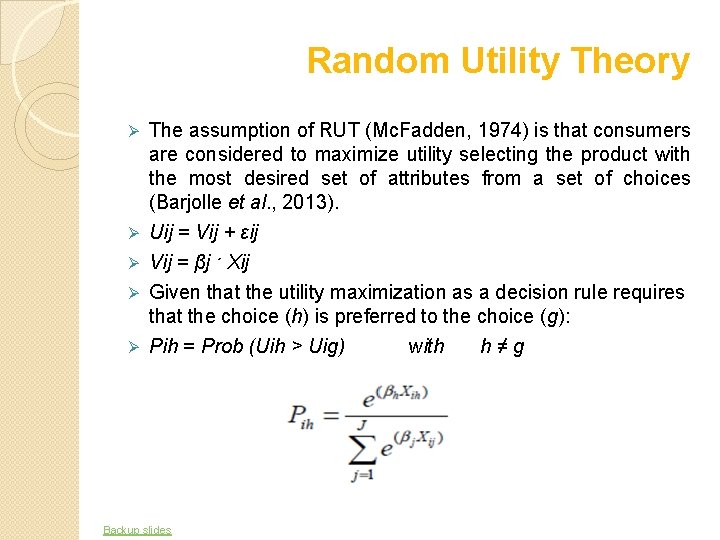
Random Utility Theory Ø Ø Ø The assumption of RUT (Mc. Fadden, 1974) is that consumers are considered to maximize utility selecting the product with the most desired set of attributes from a set of choices (Barjolle et al. , 2013). Uij = Vij + εij Vij = βj · Xij Given that the utility maximization as a decision rule requires that the choice (h) is preferred to the choice (g): Pih = Prob (Uih > Uig) with h≠g Backup slides
Conjoint Analysis Conjoint analysis, also called trade-off measurement, is a technique used when the aim is to measure the trade-off among attributes to predict hypothetical scenarios and the performance of new products or services. Ø We chose to use Choice-Based Conjoint (CBC) analysis, considered the most widely used conjoint approach, in which consumers are asked to select a product from a given set of alternatives (choice set), simulating as much as possible the actual purchasing process. In addition, the interactions among attributes are also better measured rather than the traditional CA (individually ranking or rating profiles) or the Adaptive Conjoint Analysis (Orme, 2006). Ø Backup slides
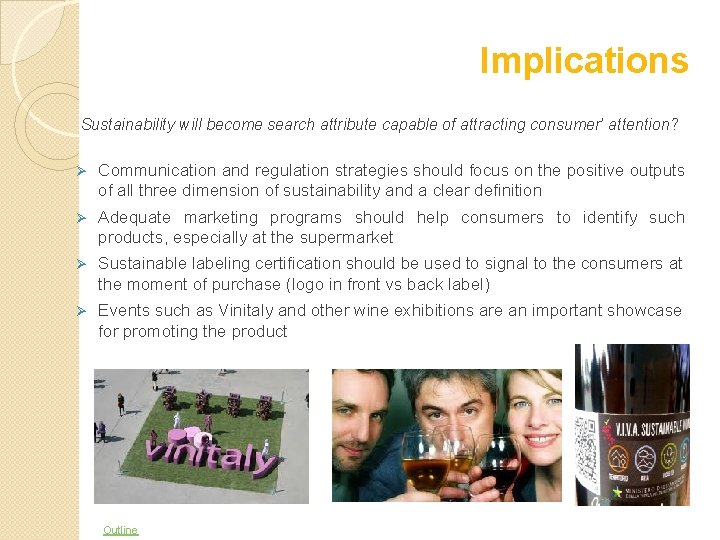
Implications Sustainability will become search attribute capable of attracting consumer’ attention? Ø Communication and regulation strategies should focus on the positive outputs of all three dimension of sustainability and a clear definition Ø Adequate marketing programs should help consumers to identify such products, especially at the supermarket Ø Sustainable labeling certification should be used to signal to the consumers at the moment of purchase (logo in front vs back label) Ø Events such as Vinitaly and other wine exhibitions are an important showcase for promoting the product Outline
- Slides: 28