
An Application of Schons Theory Of Reflective Practice
- Slides: 1
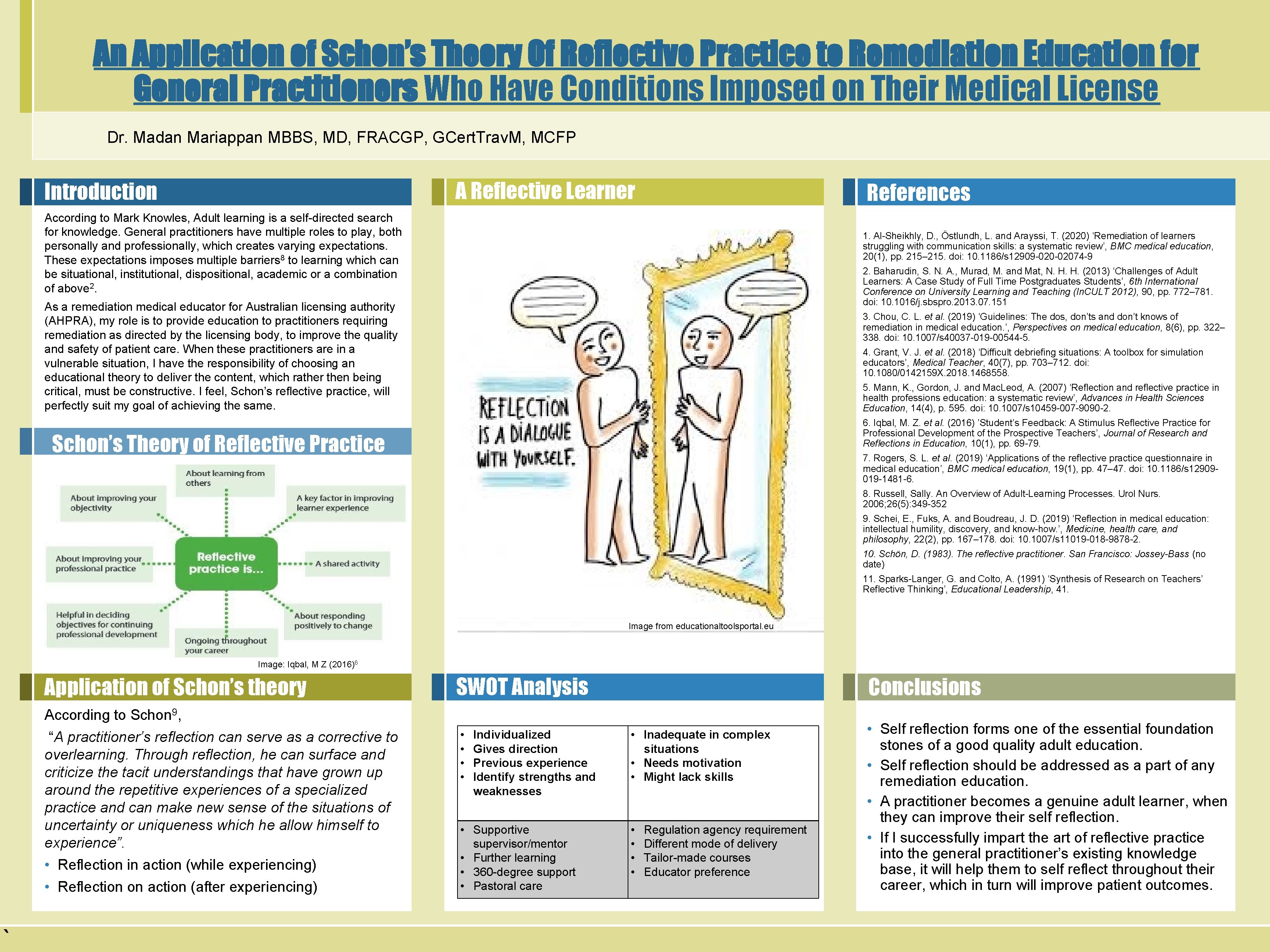
An Application of Schon’s Theory Of Reflective Practice to Remediation Education for General Practitioners Who Have Conditions Imposed on Their Medical License Dr. Madan Mariappan MBBS, MD, FRACGP, GCert. Trav. M, MCFP A Reflective Learner Introduction References According to Mark Knowles, Adult learning is a self-directed search for knowledge. General practitioners have multiple roles to play, both personally and professionally, which creates varying expectations. These expectations imposes multiple barriers 8 to learning which can be situational, institutional, dispositional, academic or a combination of above 2. 1. Al-Sheikhly, D. , Östlundh, L. and Arayssi, T. (2020) ‘Remediation of learners struggling with communication skills: a systematic review’, BMC medical education, 20(1), pp. 215– 215. doi: 10. 1186/s 12909 -02074 -9 2. Baharudin, S. N. A. , Murad, M. and Mat, N. H. H. (2013) ‘Challenges of Adult Learners: A Case Study of Full Time Postgraduates Students’, 6 th International Conference on University Learning and Teaching (In. CULT 2012), 90, pp. 772– 781. doi: 10. 1016/j. sbspro. 2013. 07. 151 As a remediation medical educator for Australian licensing authority (AHPRA), my role is to provide education to practitioners requiring remediation as directed by the licensing body, to improve the quality and safety of patient care. When these practitioners are in a vulnerable situation, I have the responsibility of choosing an educational theory to deliver the content, which rather then being critical, must be constructive. I feel, Schon’s reflective practice, will perfectly suit my goal of achieving the same. 3. Chou, C. L. et al. (2019) ‘Guidelines: The dos, don’ts and don’t knows of remediation in medical education. ’, Perspectives on medical education, 8(6), pp. 322– 338. doi: 10. 1007/s 40037 -019 -00544 -5. 4. Grant, V. J. et al. (2018) ‘Difficult debriefing situations: A toolbox for simulation educators’, Medical Teacher, 40(7), pp. 703– 712. doi: 10. 1080/0142159 X. 2018. 1468558. 5. Mann, K. , Gordon, J. and Mac. Leod, A. (2007) ‘Reflection and reflective practice in health professions education: a systematic review’, Advances in Health Sciences Education, 14(4), p. 595. doi: 10. 1007/s 10459 -007 -9090 -2. 6. Iqbal, M. Z. et al. (2016) ’Student’s Feedback: A Stimulus Reflective Practice for Professional Development of the Prospective Teachers’, Journal of Research and Reflections in Education, 10(1), pp. 69 -79. Schon’s Theory of Reflective Practice 7. Rogers, S. L. et al. (2019) ‘Applications of the reflective practice questionnaire in medical education’, BMC medical education, 19(1), pp. 47– 47. doi: 10. 1186/s 12909019 -1481 -6. 8. Russell, Sally. An Overview of Adult-Learning Processes. Urol Nurs. 2006; 26(5): 349 -352 9. Schei, E. , Fuks, A. and Boudreau, J. D. (2019) ‘Reflection in medical education: intellectual humility, discovery, and know-how. ’, Medicine, health care, and philosophy, 22(2), pp. 167– 178. doi: 10. 1007/s 11019 -018 -9878 -2. 10. Schön, D. (1983). The reflective practitioner. San Francisco: Jossey-Bass (no date) 11. Sparks-Langer, G. and Colto, A. (1991) ‘Synthesis of Research on Teachers’ Reflective Thinking’, Educational Leadership, 41. Image from educationaltoolsportal. eu Image: Iqbal, M Z (2016)6 Application of Schon’s theory According to Schon 9, “A practitioner’s reflection can serve as a corrective to overlearning. Through reflection, he can surface and criticize the tacit understandings that have grown up around the repetitive experiences of a specialized practice and can make new sense of the situations of uncertainty or uniqueness which he allow himself to experience”. • Reflection in action (while experiencing) • Reflection on action (after experiencing) ` SWOT Analysis • • Individualized Gives direction Previous experience Identify strengths and weaknesses • Supportive supervisor/mentor • Further learning • 360 -degree support • Pastoral care Conclusions • Inadequate in complex situations • Needs motivation • Might lack skills • • Regulation agency requirement Different mode of delivery Tailor-made courses Educator preference • Self reflection forms one of the essential foundation stones of a good quality adult education. • Self reflection should be addressed as a part of any remediation education. • A practitioner becomes a genuine adult learner, when they can improve their self reflection. • If I successfully impart the art of reflective practice into the general practitioner’s existing knowledge base, it will help them to self reflect throughout their career, which in turn will improve patient outcomes.