
An Analysis Pattern for Patient Treatment 1 Introduction
![References E. B. Fernandez, X. Yuan, “An Analysis pattern for Course Management” [Fer 2000]E.](https://slidetodoc.com/presentation_image_h2/7cc44ccb6ddb9da5f7963aa17f68f9c4/image-19.jpg "References E. B. Fernandez, X. Yuan, “An Analysis pattern for Course Management” [Fer 2000]E.")
- Slides: 19
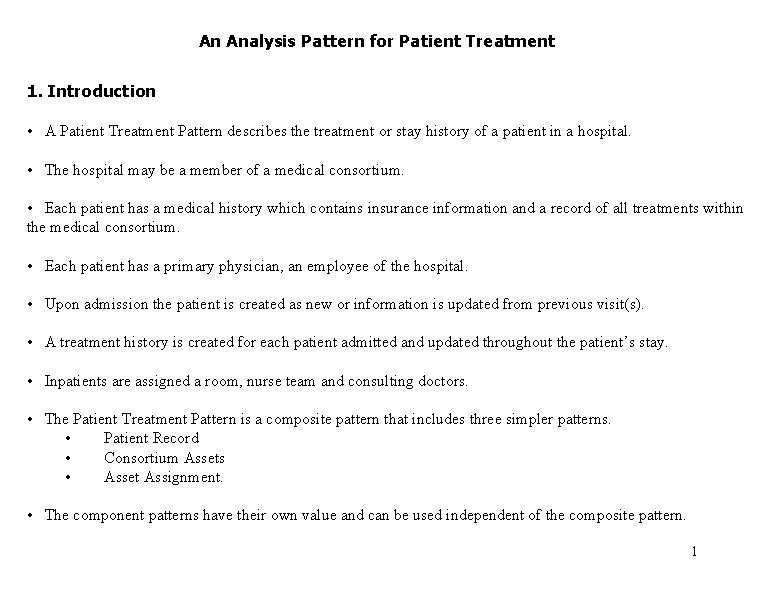
An Analysis Pattern for Patient Treatment 1. Introduction • A Patient Treatment Pattern describes the treatment or stay history of a patient in a hospital. • The hospital may be a member of a medical consortium. • Each patient has a medical history which contains insurance information and a record of all treatments within the medical consortium. • Each patient has a primary physician, an employee of the hospital. • Upon admission the patient is created as new or information is updated from previous visit(s). • A treatment history is created for each patient admitted and updated throughout the patient’s stay. • Inpatients are assigned a room, nurse team and consulting doctors. • The Patient Treatment Pattern is a composite pattern that includes three simpler patterns. • Patient Record • Consortium Assets • Asset Assignment. • The component patterns have their own value and can be used independent of the composite pattern. 1
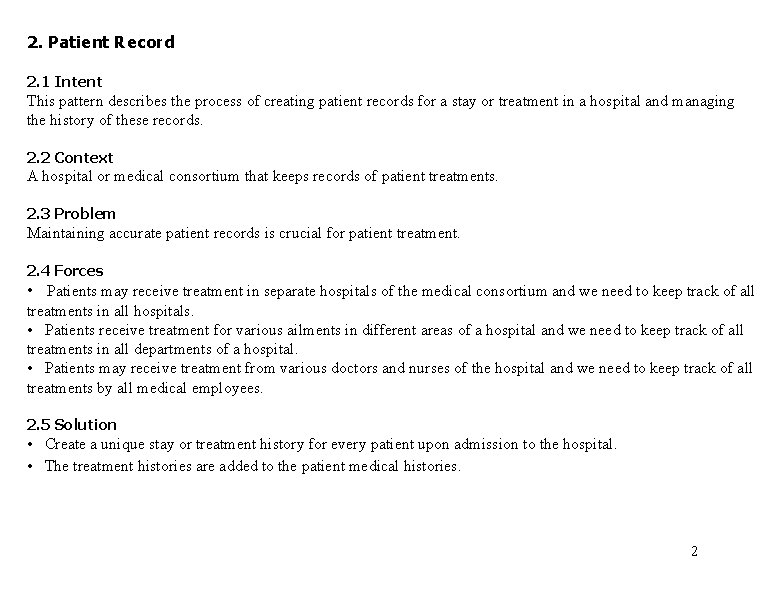
2. Patient Record 2. 1 Intent This pattern describes the process of creating patient records for a stay or treatment in a hospital and managing the history of these records. 2. 2 Context A hospital or medical consortium that keeps records of patient treatments. 2. 3 Problem Maintaining accurate patient records is crucial for patient treatment. 2. 4 Forces • Patients may receive treatment in separate hospitals of the medical consortium and we need to keep track of all treatments in all hospitals. • Patients receive treatment for various ailments in different areas of a hospital and we need to keep track of all treatments in all departments of a hospital. • Patients may receive treatment from various doctors and nurses of the hospital and we need to keep track of all treatments by all medical employees. 2. 5 Solution • Create a unique stay or treatment history for every patient upon admission to the hospital. • The treatment histories are added to the patient medical histories. 2
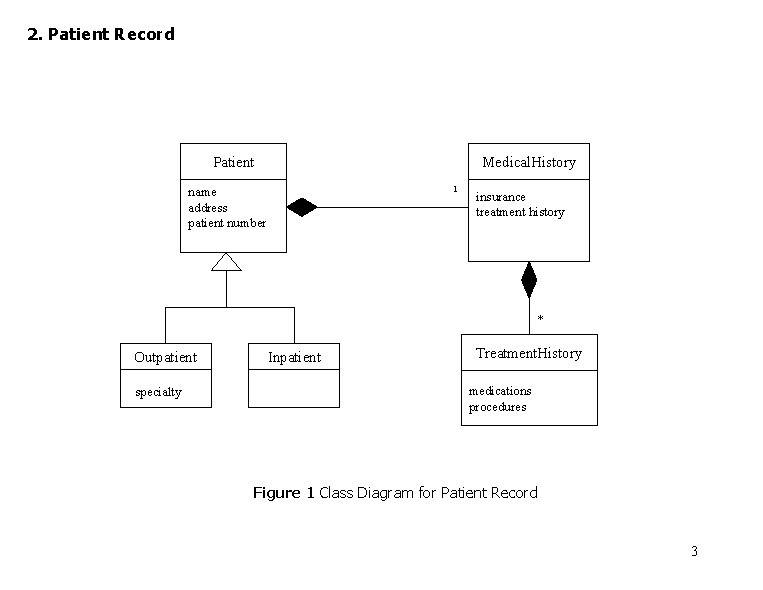
2. Patient Record Patient Medical. History 1 name address patient number insurance treatment history * Outpatient specialty Inpatient Treatment. History medications procedures Figure 1 Class Diagram for Patient Record 3
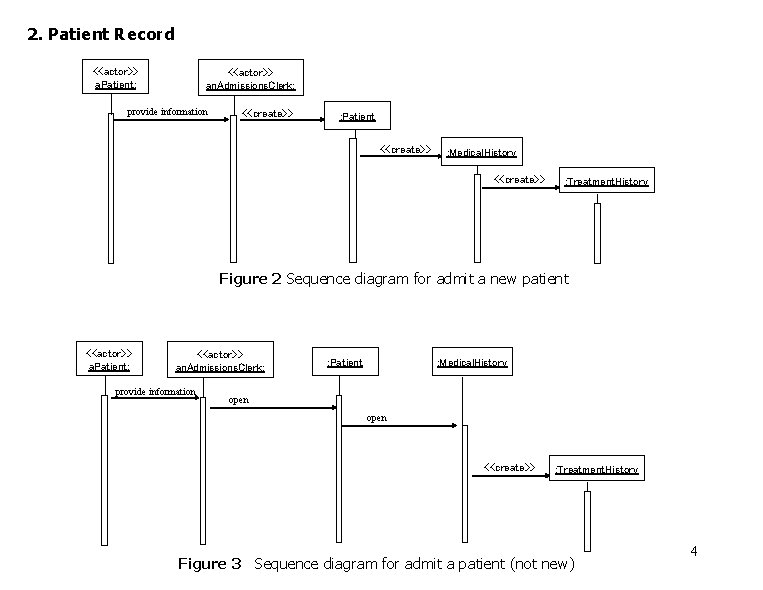
2. Patient Record <<actor>> a. Patient: <<actor>> an. Admissions. Clerk: provide information <<create>> : Patient <<create>> : Medical. History <<create>> : Treatment. History Figure 2 Sequence diagram for admit a new patient <<actor>> a. Patient: <<actor>> an. Admissions. Clerk: provide information : Patient : Medical. History open <<create>> : Treatment. History Figure 3 Sequence diagram for admit a patient (not new) 4
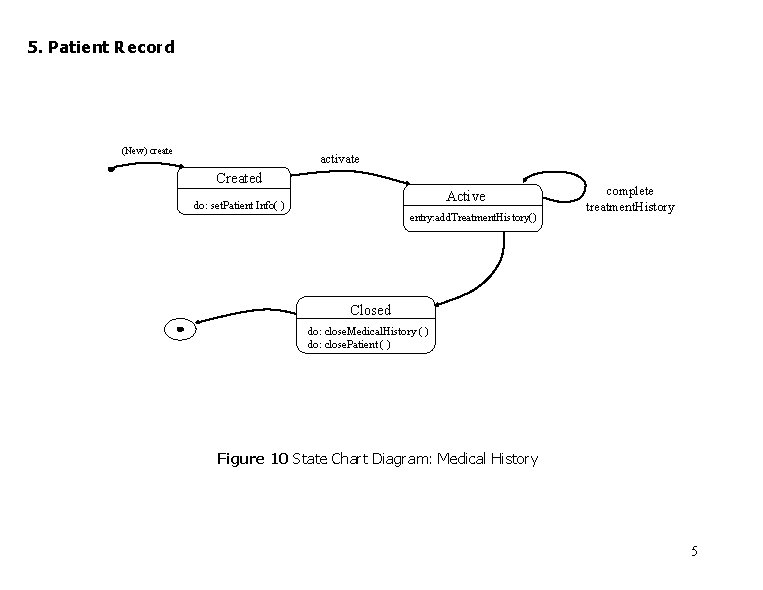
5. Patient Record (New) create activate Created Active do: set. Patient Info( ) entry: add. Treatment. History() complete treatment. History Closed do: close. Medical. History ( ) do: close. Patient ( ) Figure 10 State Chart Diagram: Medical History 5
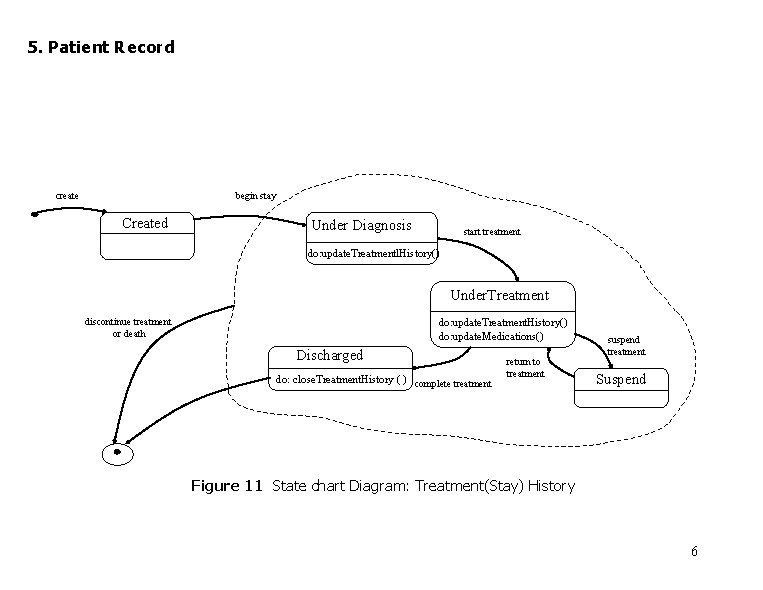
5. Patient Record create begin stay Created Under Diagnosis start treatment do: update. Treatmentl. History() Under. Treatment discontinue treatment or death do: update. Treatment. History() do: update. Medications() Discharged do: close. Treatment. History ( ) complete treatment return to treatment suspend treatment Suspend Figure 11 State chart Diagram: Treatment(Stay) History 6
2. Patient Record 2. 6 Consequences Advantages: • Each treatment or stay history is summarized into one record. • Each stay history is added to a patient medical history. • Each medical history provides information about the patient for future treatments within the medical consortium. • Role based access control can be used to protect the privacy of a patient. Disadvantages: • Policies about the size of a treatment history need to be established, if a patient receives treatment in too many departments by multiple doctors and nurses during one stay, it may need to be broken down into separate treatments. • The accuracy of patient records will depend upon the employees of the medical group. 2. 7 Known Uses • Every hospital or clinic maintains records about their patients. • For example if a patient visits West Boca Medical Center for the third time there will be a record of previous visits. 2. 8 Related Patterns • Collection Pattern 7
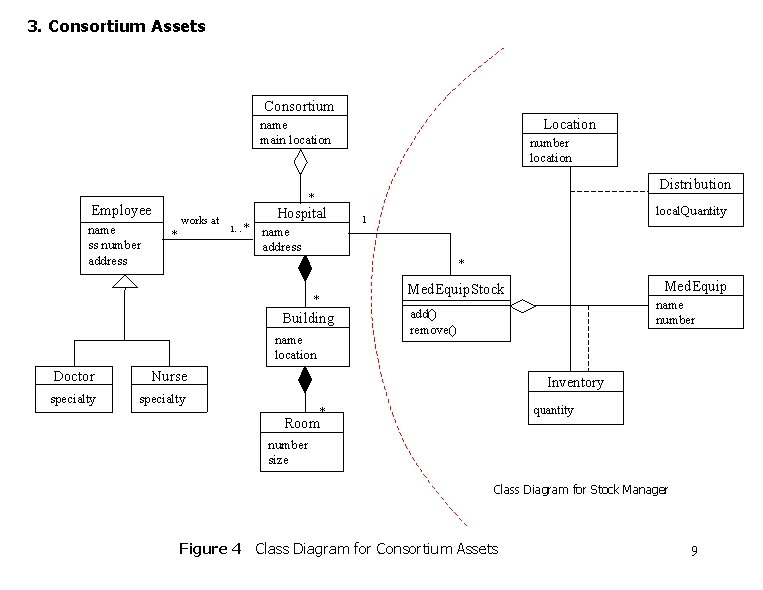
3. Consortium Assets 3. 1 Intent To manage the hospitals, buildings and employees and equipment of a medical consortium. 3. 2 Context A medical consortium that has multiple hospitals with buildings and rooms, medical equipment and employees. 3. 3 Problem Management of assets is crucial for efficient and professional service. 3. 4 Forces • In a medical consortium if employees or employee information changes this information needs to be recorded. • All hospitals of a medical consortium consist of buildings with rooms and the information about availability and use of these assets must be recorded and kept up to date. • We need to keep track of the use, stock, transfer and information about all medical equipment used by any hospital within the medical consortium. 3. 5 Solution • Maintain employee records with basic information and separate employees by their profession to add specific information, specialties and rights. • Each hospital is a separate asset of the consortium. Each building is an asset of the hospital. Each room is an asset of the building. This way all the information can be easily kept up to date. • Use the Stock Manager Pattern[Fer 2000] to keep track of the medical equipment inventory and use. 8
3. Consortium Assets Consortium Location name main location Distribution * Employee name ss number address number location works at * 1…* Hospital name address local. Quantity 1 * * Building name location Doctor Nurse specialty Med. Equip. Stock name number add() remove() Inventory quantity * Room number size Class Diagram for Stock Manager Figure 4 Class Diagram for Consortium Assets 9
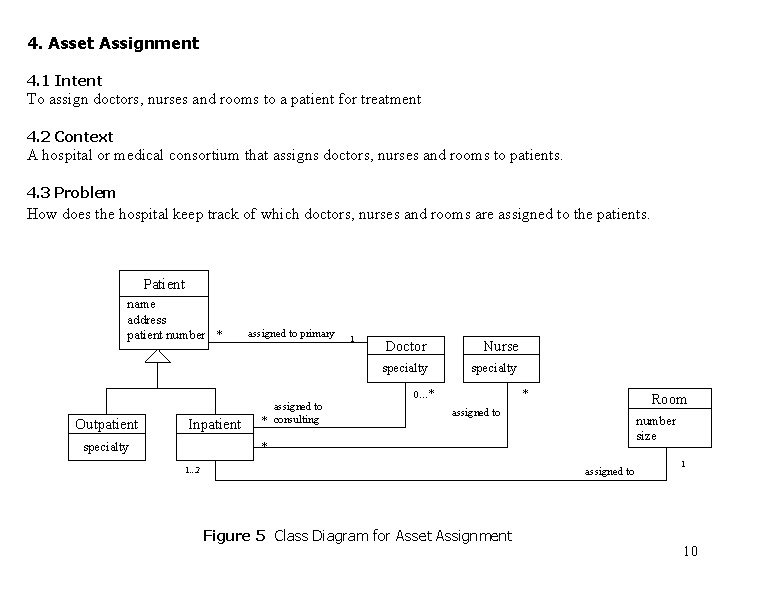
4. Asset Assignment 4. 1 Intent To assign doctors, nurses and rooms to a patient for treatment 4. 2 Context A hospital or medical consortium that assigns doctors, nurses and rooms to patients. 4. 3 Problem How does the hospital keep track of which doctors, nurses and rooms are assigned to the patients. Patient name address patient number * Outpatient Inpatient specialty assigned to primary assigned to * consulting 1 Doctor Nurse specialty 0. . . * * Room assigned to number size * 1. . . 2 assigned to Figure 5 Class Diagram for Asset Assignment 1 10
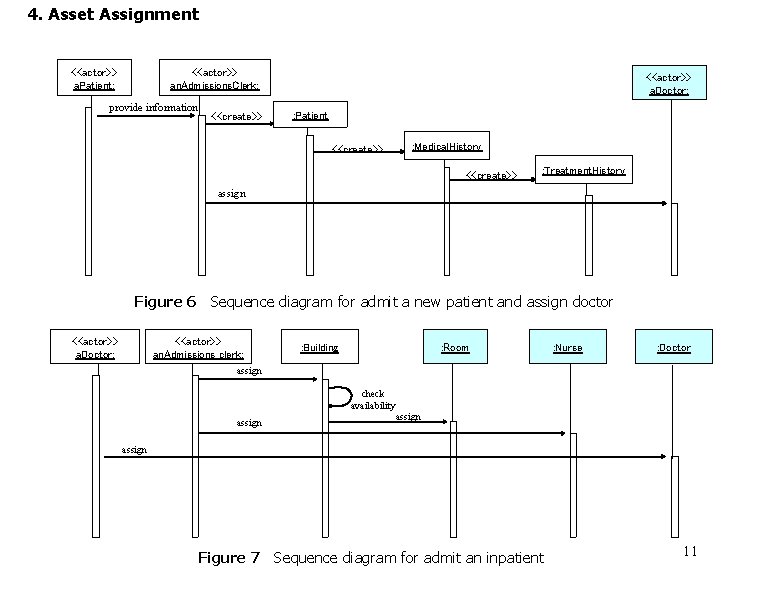
4. Asset Assignment <<actor>> a. Patient: <<actor>> an. Admissions. Clerk: provide information <<create>> <<actor>> a. Doctor: : Patient <<create>> : Medical. History <<create>> : Treatment. History assign Figure 6 Sequence diagram for admit a new patient and assign doctor <<actor>> a. Doctor: <<actor>> an. Admissions clerk: : Building : Room : Nurse : Doctor assign check availability assign Figure 7 Sequence diagram for admit an inpatient 11
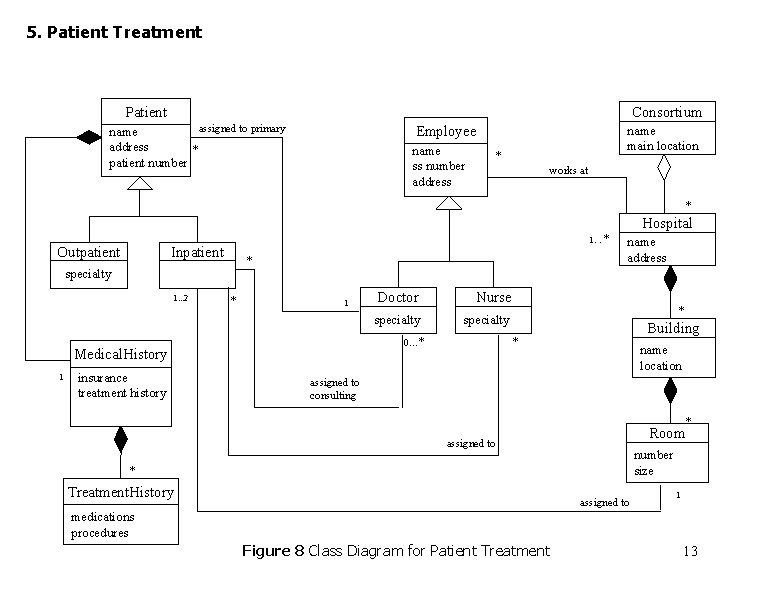
5. Patient Treatment 5. 1 Intent This pattern describes the process of admitting and treating a patient in a hospital. 5. 2 Context A medical facility that offers patient treatment. 5. 3 Problem To provide patients with necessary services the combination of patient records, medical consortium assets and assignment of patients to these assets needs to be organized, maintained and managed efficiently. 5. 4 Forces In addition to the forces of component patterns we also have: • A patient may be moved or reassigned during a stay and we need to document the new assignment and location. • After the patient is discharged all assignments need to be released and the records updated. • Patients may discontinue treatment for various reasons and all information needs to be recorded. 5. 5 Solution The combination of the previous patterns function together to manage patient treatment in a hospital. 12
5. Patient Treatment Patient Consortium assigned to primary name address * patient number Employee name ss number address name main location * works at * Outpatient 1…* Inpatient * specialty 1. . . 2 * 1 insurance treatment history Nurse specialty 0. . . * Medical. History 1 Doctor Hospital name address * Building * name location assigned to consulting * Room assigned to number size * Treatment. History assigned to 1 medications procedures Figure 8 Class Diagram for Patient Treatment 13
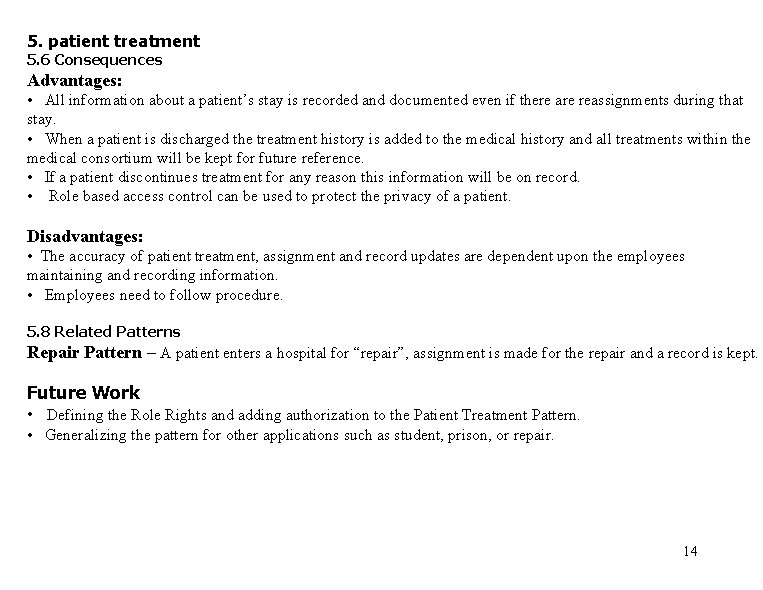
5. patient treatment 5. 6 Consequences Advantages: • All information about a patient’s stay is recorded and documented even if there are reassignments during that stay. • When a patient is discharged the treatment history is added to the medical history and all treatments within the medical consortium will be kept for future reference. • If a patient discontinues treatment for any reason this information will be on record. • Role based access control can be used to protect the privacy of a patient. Disadvantages: • The accuracy of patient treatment, assignment and record updates are dependent upon the employees maintaining and recording information. • Employees need to follow procedure. 5. 8 Related Patterns Repair Pattern – A patient enters a hospital for “repair”, assignment is made for the repair and a record is kept. Future Work • Defining the Role Rights and adding authorization to the Patient Treatment Pattern. • Generalizing the pattern for other applications such as student, prison, or repair. 14
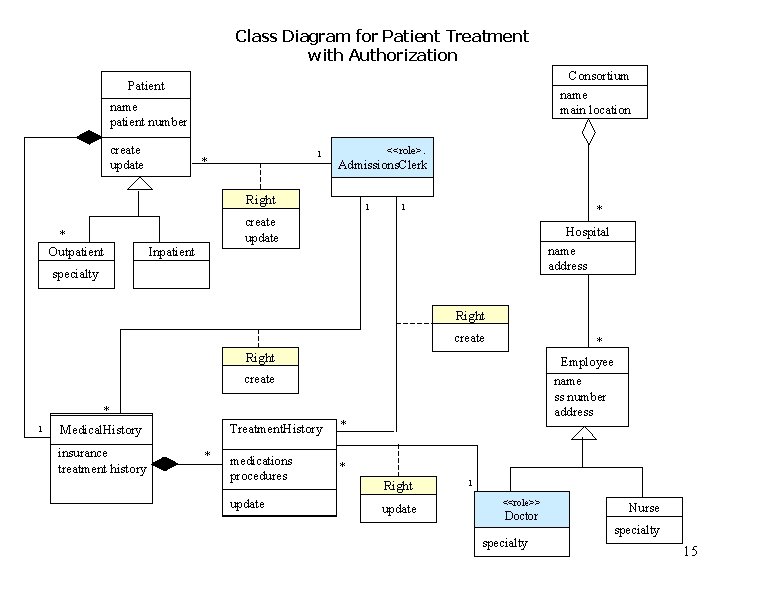
Class Diagram for Patient Treatment with Authorization Consortium name main location Patient name patient number create update 1 * <<role>. Admissions. Clerk Right * Outpatient 1 1 * create update Hospital name address Inpatient specialty Right create * Employee Right create * medications procedures update * insurance treatment history Treatment. History * 1 * Medical. History name ss number address Right update 1 <<role>> Doctor specialty Nurse specialty 15
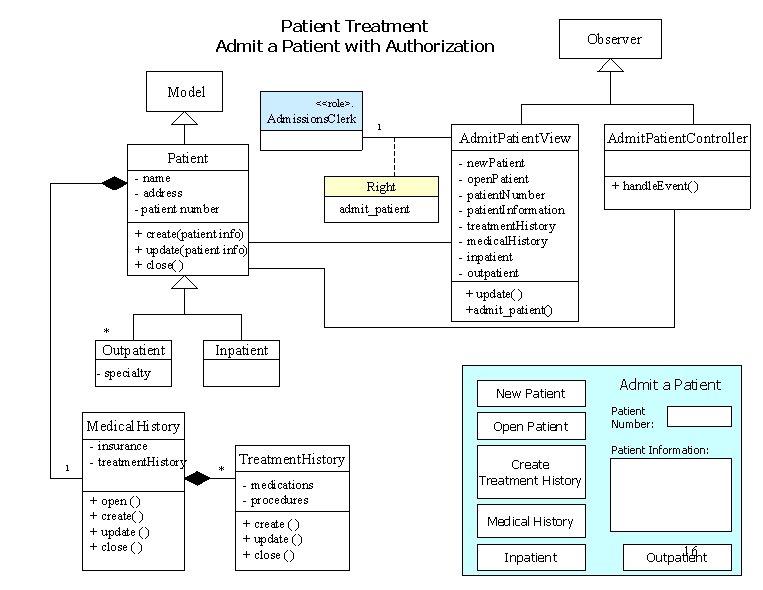
Patient Treatment Admit a Patient with Authorization Model Observer <<role>. Admissions. Clerk 1 Patient - name - address - patient number Right admit_patient + create(patient info) + update(patient info) + close( ) Admit. Patient. View - new. Patient - open. Patient - patient. Number - patient. Information - treatment. History - medical. History - inpatient - outpatient Admit. Patient. Controller + handle. Event( ) + update( ) +admit_patient() * Outpatient Inpatient - specialty New Patient Medical. History 1 - insurance - treatment. History + open ( ) + create( ) + update ( ) + close ( ) Open Patient * Treatment. History - medications - procedures + create ( ) + update ( ) + close ( ) Create Treatment History Admit a Patient Number: Patient Information: Medical History Inpatient 16 Outpatient
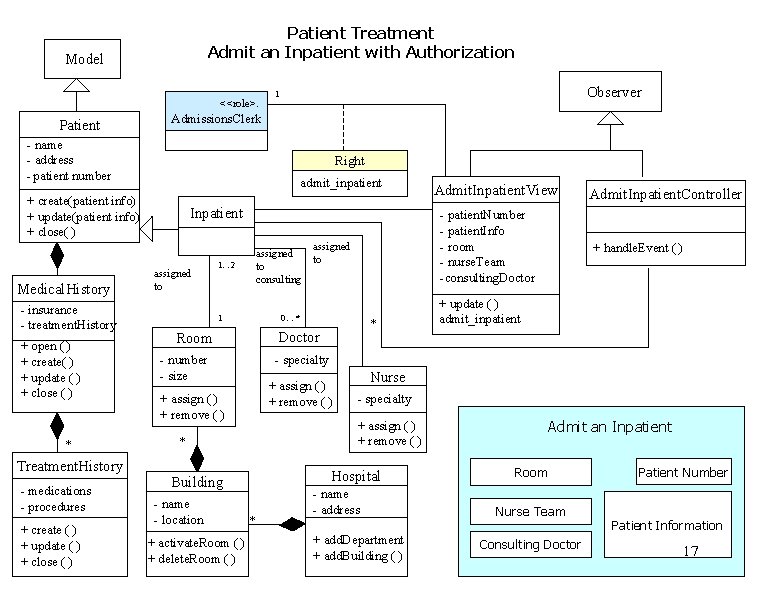
Patient Treatment Admit an Inpatient with Authorization Model <<role>. Admissions. Clerk - name - address - patient number Right admit_inpatient + create(patient info) + update(patient info) + close( ) + open ( ) + create( ) + update ( ) + close ( ) * Treatment. History - medications - procedures + create ( ) + update ( ) + close ( ) 1… 2 1 + handle. Event ( ) + update ( ) admit_inpatient - specialty - number - size + assign ( ) + remove ( ) Nurse - specialty Admit an Inpatient + assign ( ) + remove ( ) Hospital Building + activate. Room ( ) + delete. Room ( ) assigned to Admit. Inpatient. Controller Doctor Room - name - location Admit. Inpatient. View - patient. Number - patient. Info - room - nurse. Team -consulting. Doctor 0…* * - insurance - treatment. History assigned to consulting * Medical. History Inpatient * Patient Observer 1 - name - address + add. Department + add. Building ( ) Room Nurse Team Consulting Doctor Patient Number Patient Information 17
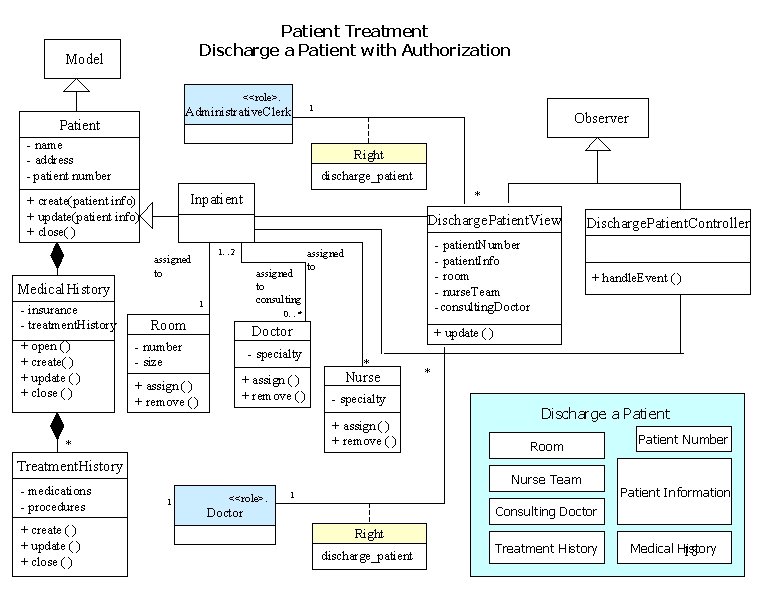
Patient Treatment Discharge a Patient with Authorization Model <<role>. Administrative. Clerk Patient - name - address - patient number discharge_patient * Inpatient Discharge. Patient. View 1… 2 assigned to consulting Medical. History 1 0…* Room Doctor - number - size + assign ( ) + remove ( ) - patient. Number - patient. Info - room - nurse. Team -consulting. Doctor assigned to - specialty + assign ( ) + remove ( ) Nurse - specialty + assign ( ) + remove ( ) * Treatment. History - medications - procedures + create ( ) + update ( ) + close ( ) Discharge. Patient. Controller + handle. Event ( ) + update ( ) * assigned to + open ( ) + create( ) + update ( ) + close ( ) Observer Right + create(patient info) + update(patient info) + close( ) - insurance - treatment. History 1 * Discharge a Patient Room Nurse Team 1 <<role>. 1 Patient Number Patient Information Consulting Doctor Right discharge_patient Treatment History Medical History 18
References E. B. Fernandez, X. Yuan, “An Analysis pattern for Course Management” [Fer 2000]E. B. Fernandez, “Stock Manager: An Analysis Pattern for Inventories”, Procs, of PLo. P 2000. E. B. Fernandez and X. Yuan, “Semantic Analysis Patterns”, Procs. of the 19 th Int, Conf on Conceptual Modeling (ER 2000), 183195. E. B Fernandez, X. Yuan, and S. Brey, “An Analysis Pattern for Order and Shipment of a Product”, Procs. of PLo. P 2000. E. B. Fernandez, “Layers and non-functional patterns” E. B. Fernandez and R. Pan, “A Pattern Language for security models”, Procs, of PLo. P 2001. E. B. Fernandez and J. C. Hawkins, “Determining Role Rights from Use Cases” E. B. Fernandez, M. Larrondo-Petrie, N. Seliya, N. Delessy and A. Herzberg, “A Pattern Language for Firewalls” 19