
AN ALGORITHM OF THE MANAGEMENT OF KNEE OSTEOARTHRITIS

- Slides: 31
AN ALGORITHM OF THE MANAGEMENT OF KNEE OSTEOARTHRITIS (OA) Prof. Matjaž Sajovic MD. Ph. D Department for Orthopedics and Sports Trauma Surgery General Teaching Hospital Celje
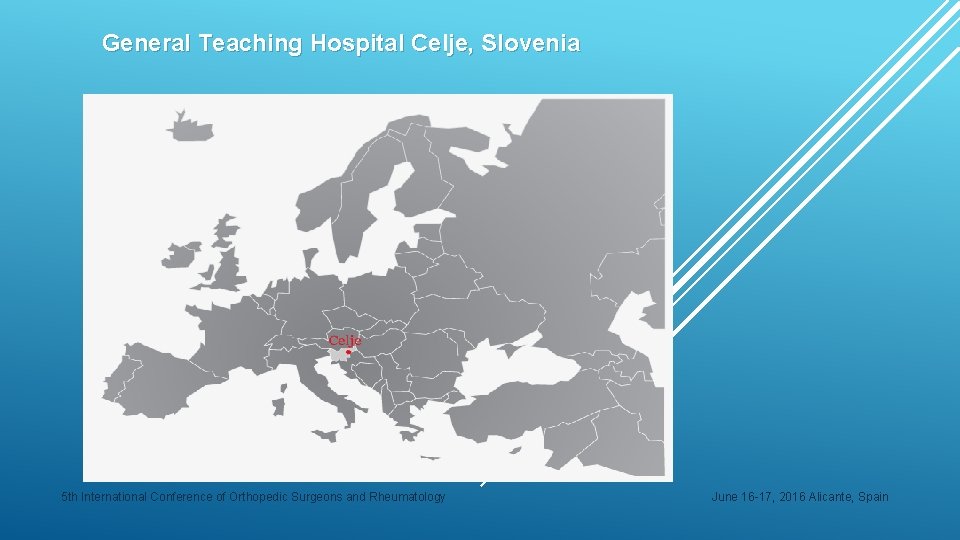
General Teaching Hospital Celje, Slovenia 5 th International Conference of Orthopedic Surgeons and Rheumatology June 16 -17, 2016 Alicante, Spain
OSTEOARTHRITIS (OA) IS THE MOST COMMON FORM OF ARTHRITIS AND A MAJOR CAUSE OF DISABILITY. OA HAS BEEN DEFINED AS A PROGRESSIVE DISEASE OF SYNOVIAL JOINTS THAT REPRESENT FAILED REPAIR OF JOINT DAMAGE THAT RESULTS FROM STRESSES THAT MAY BE INITIATED BY AN ABNORMALITY IN ANY OF THE SYNOVIAL JOINT TISSUES, INCLUDING ARTICULAR CARTILAGE. The knee is the most common joint localization of symptomatic OA, and symptomatic knee OA affects 24% of general population. 5 th International Conference of Orthopedic Surgeons and Rheumatology June 16 -17, 2016 Alicante, Spain
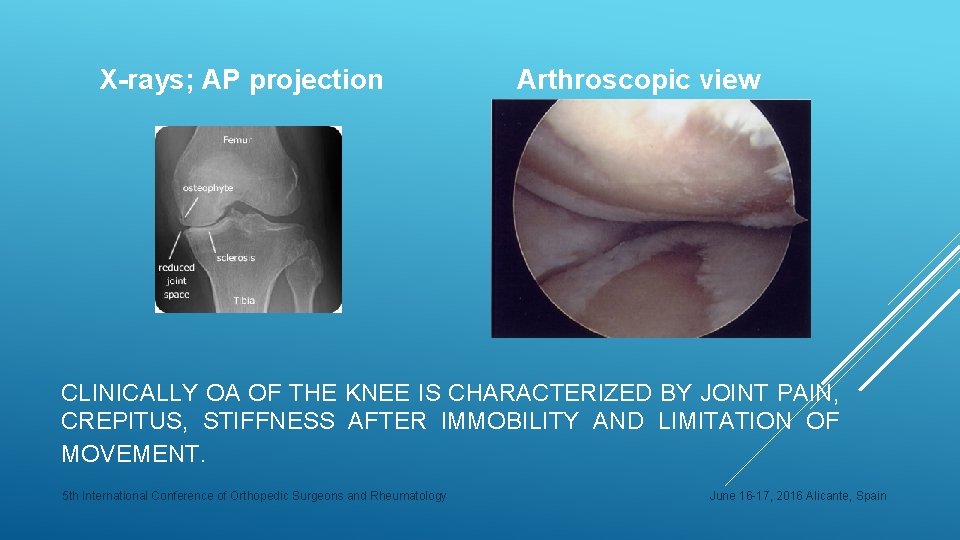
X-rays; AP projection Arthroscopic view CLINICALLY OA OF THE KNEE IS CHARACTERIZED BY JOINT PAIN, CREPITUS, STIFFNESS AFTER IMMOBILITY AND LIMITATION OF MOVEMENT. 5 th International Conference of Orthopedic Surgeons and Rheumatology June 16 -17, 2016 Alicante, Spain
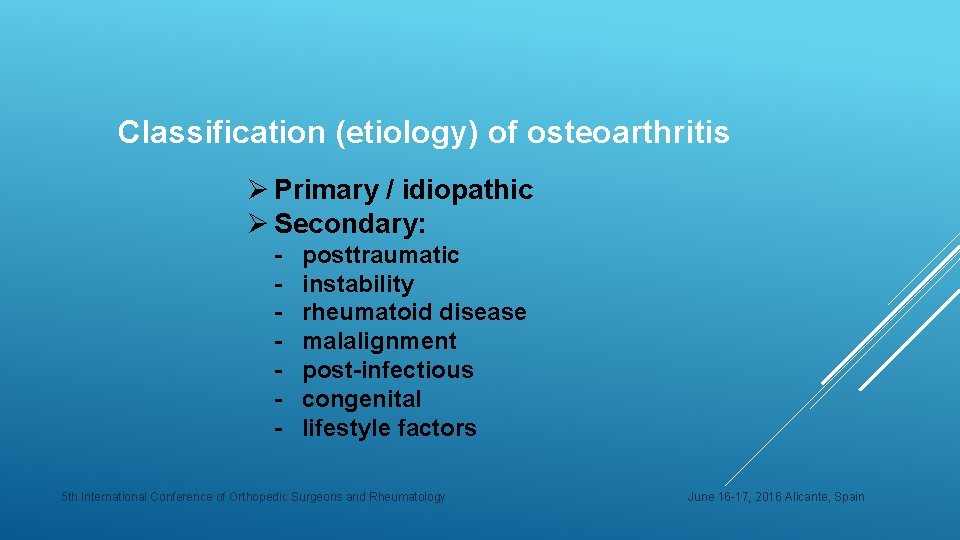
Classification (etiology) of osteoarthritis Ø Primary / idiopathic Ø Secondary: - posttraumatic instability rheumatoid disease malalignment post-infectious congenital lifestyle factors 5 th International Conference of Orthopedic Surgeons and Rheumatology June 16 -17, 2016 Alicante, Spain
OSTEOARTHRITIS (OA) IS ONE OF THE MOST COMMON FORMS OF MUSCULOSKELETAL DISORDERS AND INCURS SIGNIFICANT ECONOMIC, SOCIAL AND PSYCHOLOGICAL COSTS. Ø Progresive Ø Irreversibil Ø Poor quality of life Ø Difficult Ø Never treatment ending story 5 th International Conference of Orthopedic Surgeons and Rheumatology June 16 -17, 2016 Alicante, Spain
RECOMMENDATIONS FOR THE MANAGEMENT OF THE KNEE OA HAVE BEEN ISSUED BY NATIONAL, CONTINENTAL, OR GLOBAL SCIENTIFIC AUTHORITIES, INCLUDING, AMONG OTHERS: THE EUROPEAN SOCIETY FOR CLINICAL AND ECONOMIC ASPECTS OF OSTEOPOROSIS AND OSTEOARTHRITIS (ESCEO) DEVELOPED THE ALGORITHM TREATMENT OF OSTEOARTHRITIS. 5 th International Conference of Orthopedic Surgeons and Rheumatology June 16 -17, 2016 Alicante, Spain
THE FOLLOWING ORGANIZATIONS ALSO ISSUED GUIDELINE DOCUMENT FOR THE MANAGEMENT OF OA: European League Against Rheumatism (EULAR) American College of Rheumatology (ACR) Osteoarthritis Research Society International (OARSI) UK National Institute for Health and Clinical Excellence (NICE) 5 th International Conference of Orthopedic Surgeons and Rheumatology June 16 -17, 2016 Alicante, Spain
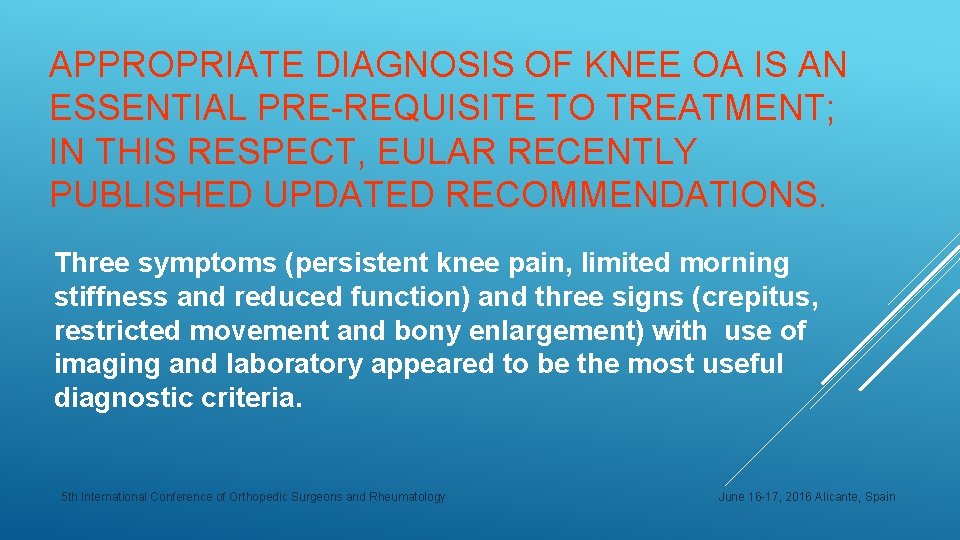
APPROPRIATE DIAGNOSIS OF KNEE OA IS AN ESSENTIAL PRE-REQUISITE TO TREATMENT; IN THIS RESPECT, EULAR RECENTLY PUBLISHED UPDATED RECOMMENDATIONS. Three symptoms (persistent knee pain, limited morning stiffness and reduced function) and three signs (crepitus, restricted movement and bony enlargement) with use of imaging and laboratory appeared to be the most useful diagnostic criteria. 5 th International Conference of Orthopedic Surgeons and Rheumatology June 16 -17, 2016 Alicante, Spain
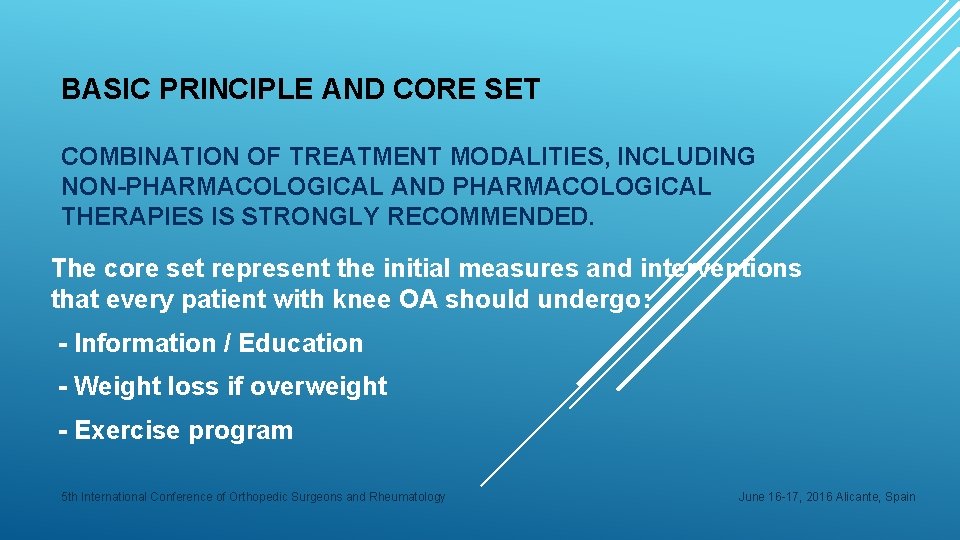
BASIC PRINCIPLE AND CORE SET COMBINATION OF TREATMENT MODALITIES, INCLUDING NON-PHARMACOLOGICAL AND PHARMACOLOGICAL THERAPIES IS STRONGLY RECOMMENDED. The core set represent the initial measures and interventions that every patient with knee OA should undergo: - Information / Education - Weight loss if overweight - Exercise program 5 th International Conference of Orthopedic Surgeons and Rheumatology June 16 -17, 2016 Alicante, Spain
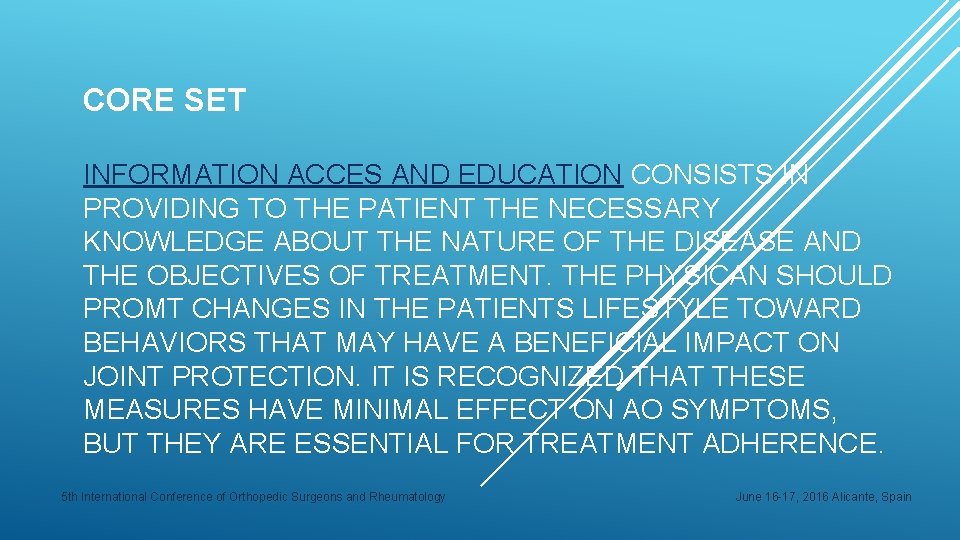
CORE SET INFORMATION ACCES AND EDUCATION CONSISTS IN PROVIDING TO THE PATIENT THE NECESSARY KNOWLEDGE ABOUT THE NATURE OF THE DISEASE AND THE OBJECTIVES OF TREATMENT. THE PHYSICAN SHOULD PROMT CHANGES IN THE PATIENTS LIFESTYLE TOWARD BEHAVIORS THAT MAY HAVE A BENEFICIAL IMPACT ON JOINT PROTECTION. IT IS RECOGNIZED THAT THESE MEASURES HAVE MINIMAL EFFECT ON AO SYMPTOMS, BUT THEY ARE ESSENTIAL FOR TREATMENT ADHERENCE. 5 th International Conference of Orthopedic Surgeons and Rheumatology June 16 -17, 2016 Alicante, Spain
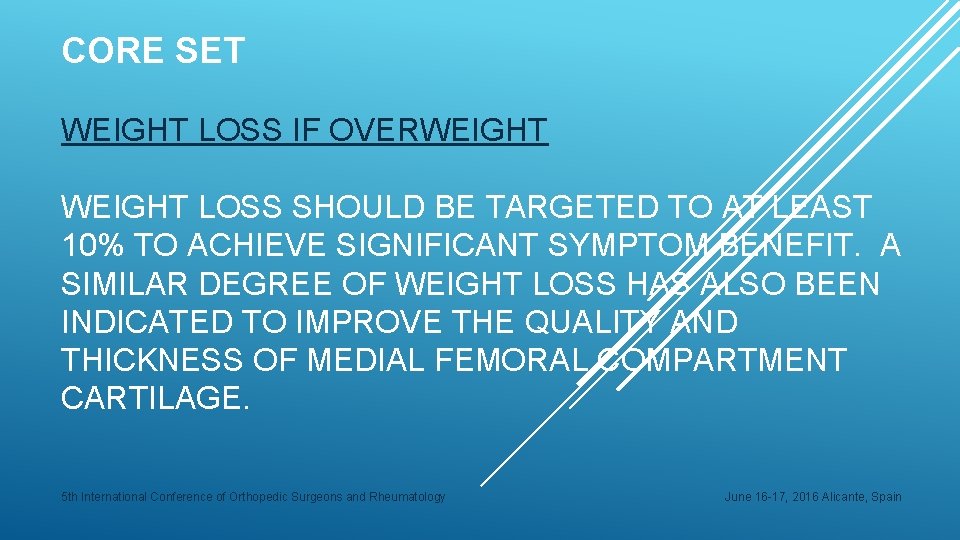
CORE SET WEIGHT LOSS IF OVERWEIGHT LOSS SHOULD BE TARGETED TO AT LEAST 10% TO ACHIEVE SIGNIFICANT SYMPTOM BENEFIT. A SIMILAR DEGREE OF WEIGHT LOSS HAS ALSO BEEN INDICATED TO IMPROVE THE QUALITY AND THICKNESS OF MEDIAL FEMORAL COMPARTMENT CARTILAGE. 5 th International Conference of Orthopedic Surgeons and Rheumatology June 16 -17, 2016 Alicante, Spain
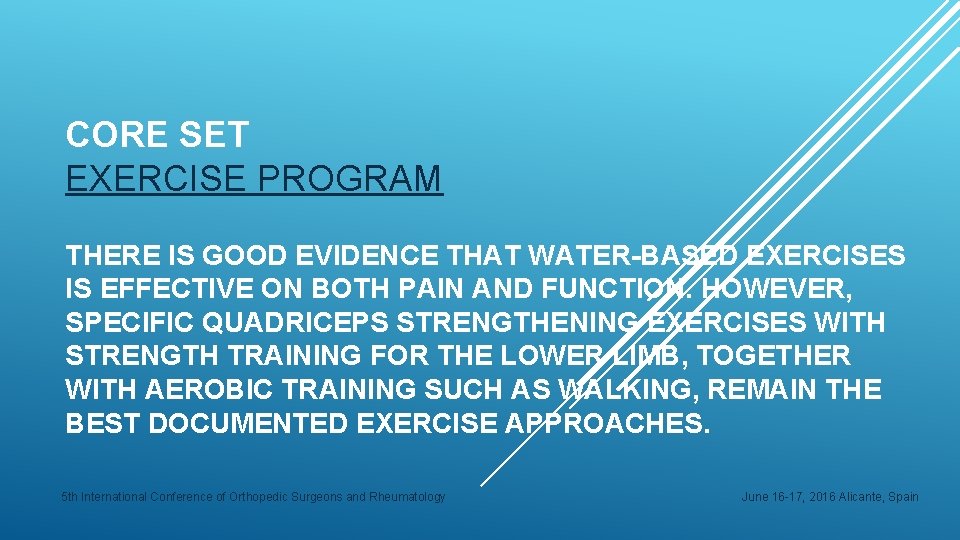
CORE SET EXERCISE PROGRAM THERE IS GOOD EVIDENCE THAT WATER-BASED EXERCISES IS EFFECTIVE ON BOTH PAIN AND FUNCTION. HOWEVER, SPECIFIC QUADRICEPS STRENGTHENING EXERCISES WITH STRENGTH TRAINING FOR THE LOWER LIMB, TOGETHER WITH AEROBIC TRAINING SUCH AS WALKING, REMAIN THE BEST DOCUMENTED EXERCISE APPROACHES. 5 th International Conference of Orthopedic Surgeons and Rheumatology June 16 -17, 2016 Alicante, Spain
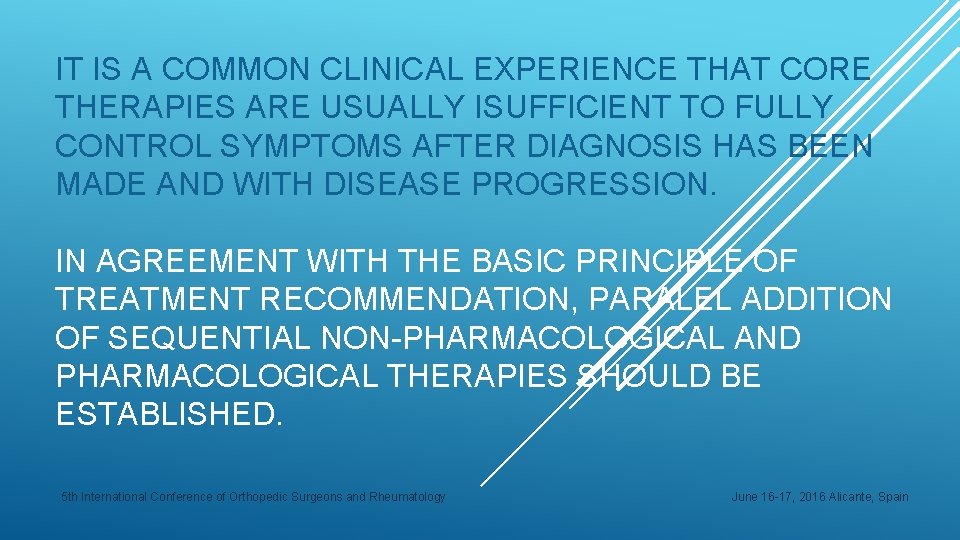
IT IS A COMMON CLINICAL EXPERIENCE THAT CORE THERAPIES ARE USUALLY ISUFFICIENT TO FULLY CONTROL SYMPTOMS AFTER DIAGNOSIS HAS BEEN MADE AND WITH DISEASE PROGRESSION. IN AGREEMENT WITH THE BASIC PRINCIPLE OF TREATMENT RECOMMENDATION, PARALEL ADDITION OF SEQUENTIAL NON-PHARMACOLOGICAL AND PHARMACOLOGICAL THERAPIES SHOULD BE ESTABLISHED. 5 th International Conference of Orthopedic Surgeons and Rheumatology June 16 -17, 2016 Alicante, Spain
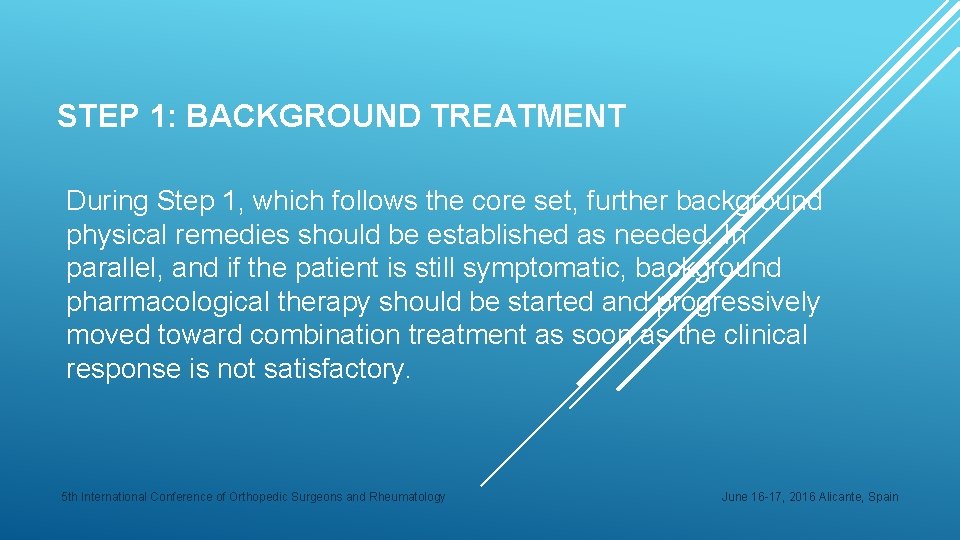
STEP 1: BACKGROUND TREATMENT During Step 1, which follows the core set, further background physical remedies should be established as needed. In parallel, and if the patient is still symptomatic, background pharmacological therapy should be started and progressively moved toward combination treatment as soon as the clinical response is not satisfactory. 5 th International Conference of Orthopedic Surgeons and Rheumatology June 16 -17, 2016 Alicante, Spain
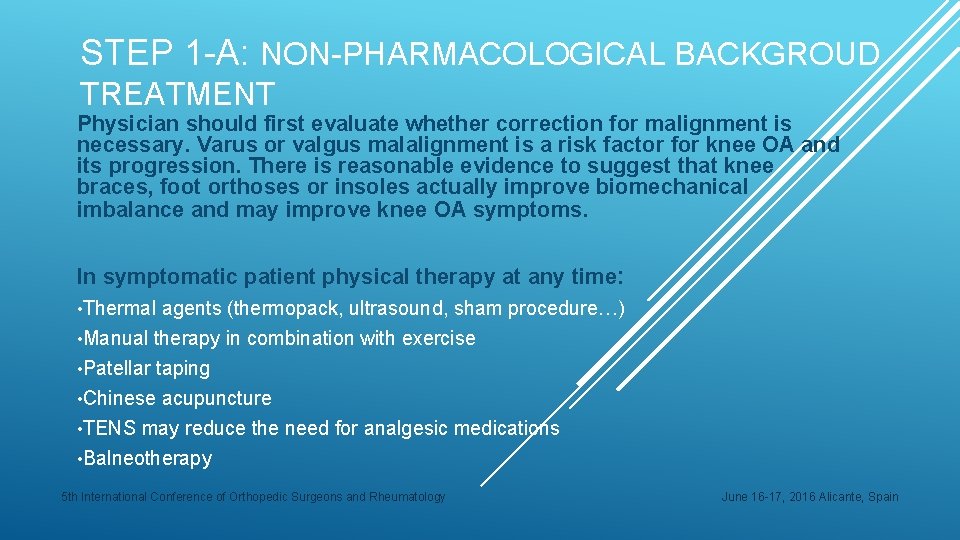
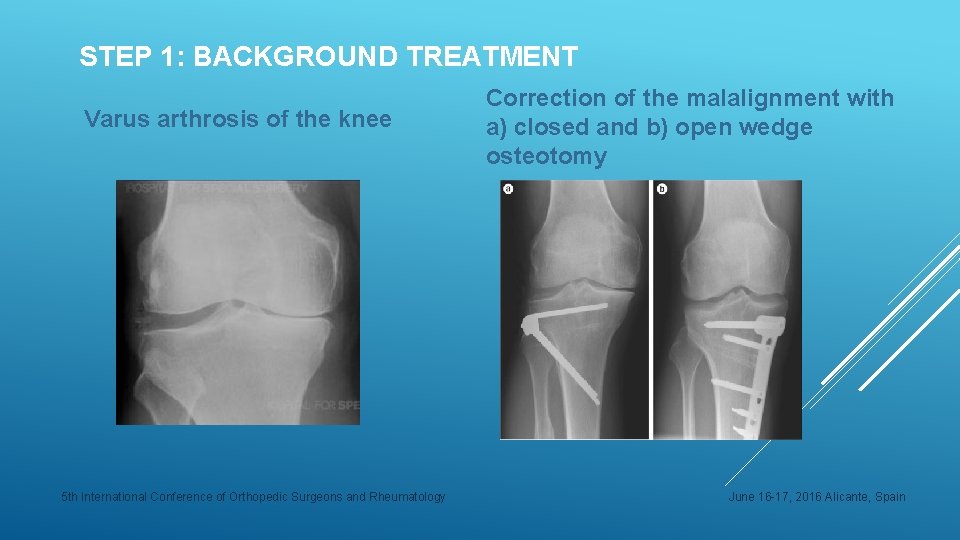
STEP 1 -A: NON-PHARMACOLOGICAL BACKGROUD TREATMENT Physician should first evaluate whether correction for malignment is necessary. Varus or valgus malalignment is a risk factor for knee OA and its progression. There is reasonable evidence to suggest that knee braces, foot orthoses or insoles actually improve biomechanical imbalance and may improve knee OA symptoms. In symptomatic patient physical therapy at any time: • Thermal agents (thermopack, ultrasound, sham procedure…) • Manual therapy in combination with exercise • Patellar taping • Chinese acupuncture • TENS may reduce the need for analgesic medications • Balneotherapy 5 th International Conference of Orthopedic Surgeons and Rheumatology June 16 -17, 2016 Alicante, Spain
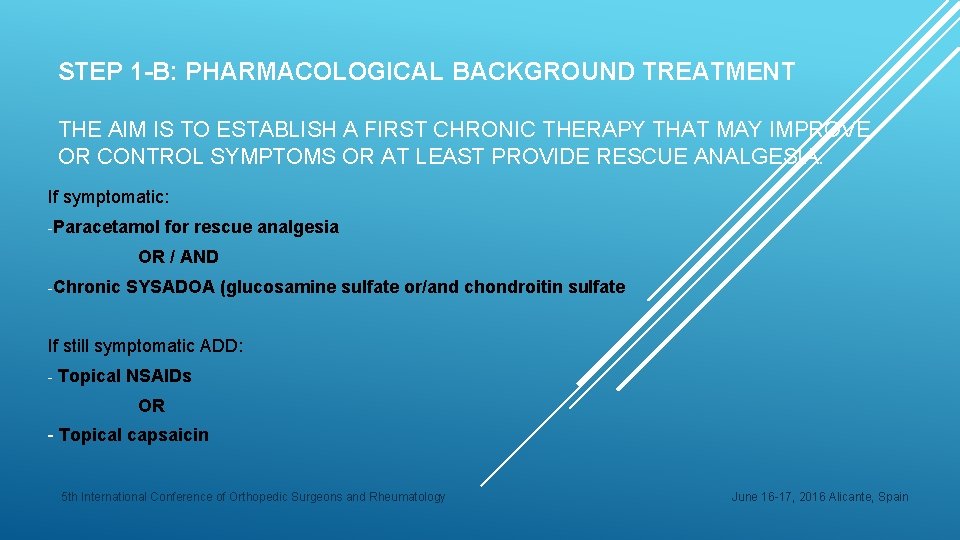
STEP 1 -B: PHARMACOLOGICAL BACKGROUND TREATMENT THE AIM IS TO ESTABLISH A FIRST CHRONIC THERAPY THAT MAY IMPROVE OR CONTROL SYMPTOMS OR AT LEAST PROVIDE RESCUE ANALGESIA. If symptomatic: -Paracetamol for rescue analgesia OR / AND -Chronic SYSADOA (glucosamine sulfate or/and chondroitin sulfate If still symptomatic ADD: - Topical NSAIDs OR - Topical capsaicin 5 th International Conference of Orthopedic Surgeons and Rheumatology June 16 -17, 2016 Alicante, Spain
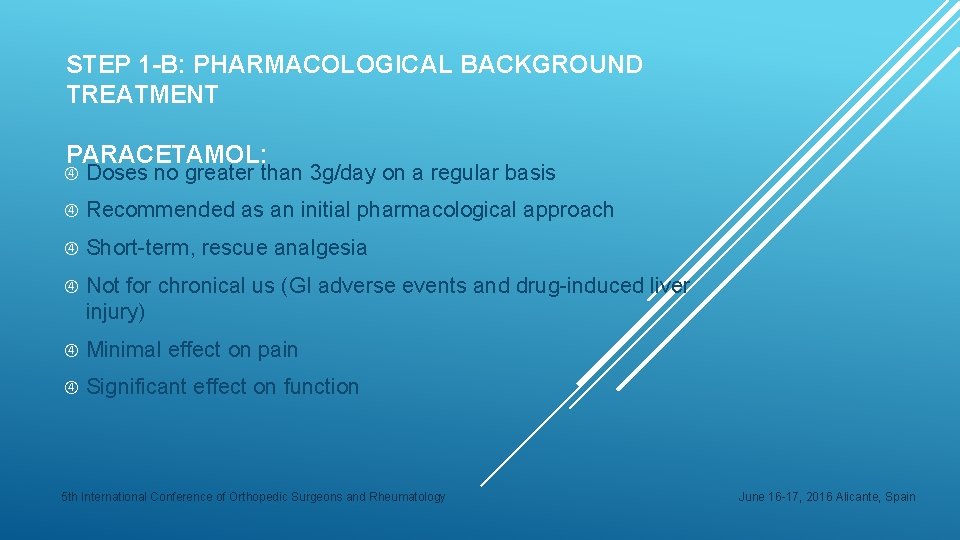
STEP 1 -B: PHARMACOLOGICAL BACKGROUND TREATMENT PARACETAMOL: Doses no greater than 3 g/day on a regular basis Recommended as an initial pharmacological approach Short-term, rescue analgesia Not for chronical us (GI adverse events and drug-induced liver injury) Minimal effect on pain Significant effect on function 5 th International Conference of Orthopedic Surgeons and Rheumatology June 16 -17, 2016 Alicante, Spain
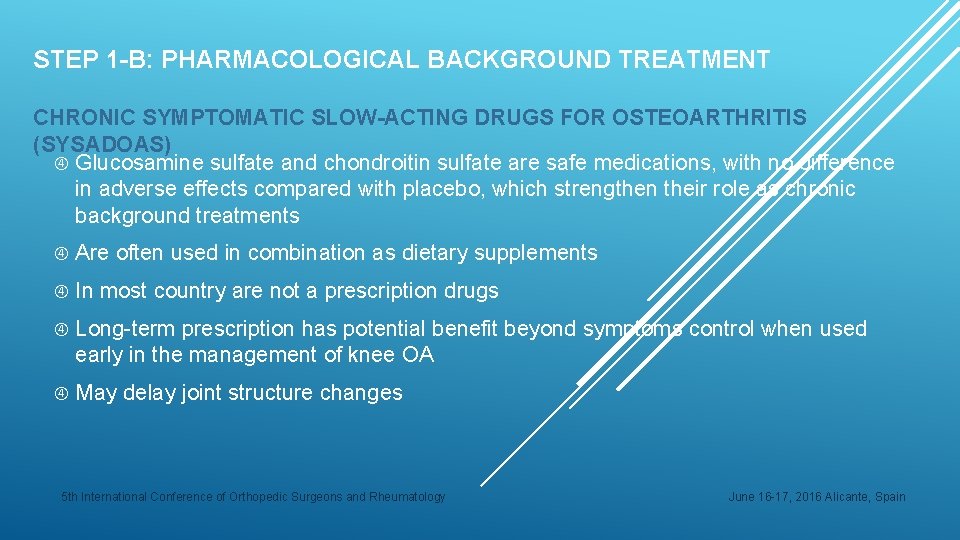
STEP 1 -B: PHARMACOLOGICAL BACKGROUND TREATMENT CHRONIC SYMPTOMATIC SLOW-ACTING DRUGS FOR OSTEOARTHRITIS (SYSADOAS) Glucosamine sulfate and chondroitin sulfate are safe medications, with no difference in adverse effects compared with placebo, which strengthen their role as chronic background treatments Are often used in combination as dietary supplements In most country are not a prescription drugs Long-term prescription has potential benefit beyond symptoms control when used early in the management of knee OA May delay joint structure changes 5 th International Conference of Orthopedic Surgeons and Rheumatology June 16 -17, 2016 Alicante, Spain
STEP 1: BACKGROUND TREATMENT Varus arthrosis of the knee Correction of the malalignment with a) closed and b) open wedge osteotomy 5 th International Conference of Orthopedic Surgeons and Rheumatology June 16 -17, 2016 Alicante, Spain
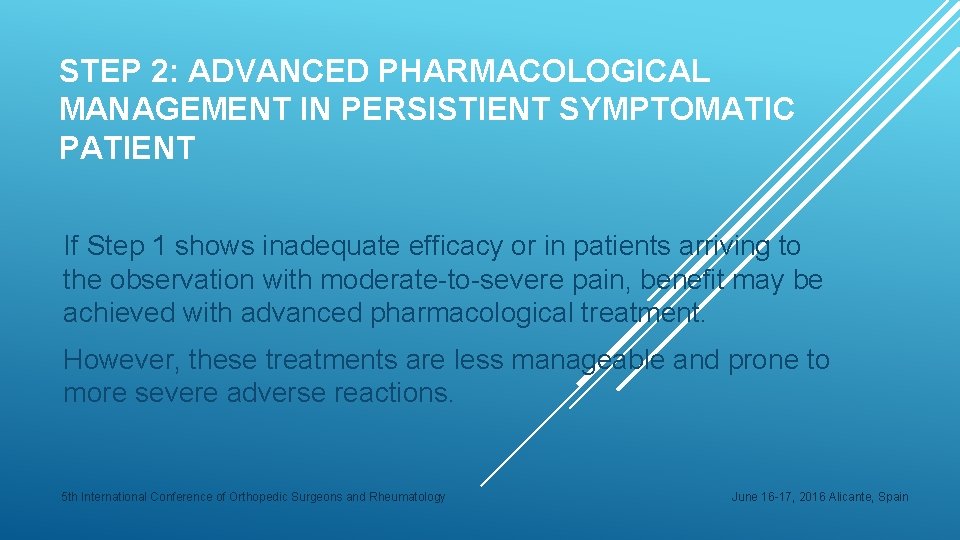
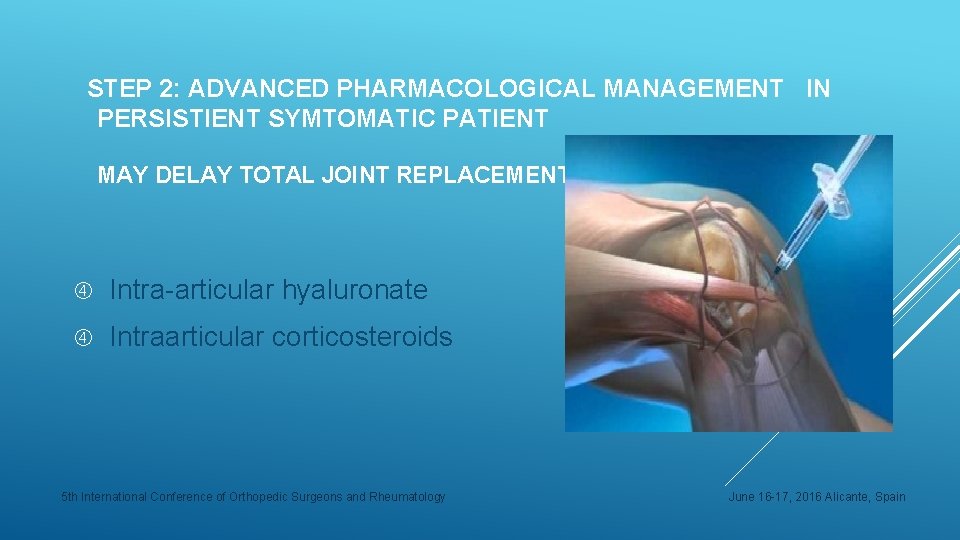
STEP 2: ADVANCED PHARMACOLOGICAL MANAGEMENT IN PERSISTIENT SYMPTOMATIC PATIENT If Step 1 shows inadequate efficacy or in patients arriving to the observation with moderate-to-severe pain, benefit may be achieved with advanced pharmacological treatment. However, these treatments are less manageable and prone to more severe adverse reactions. 5 th International Conference of Orthopedic Surgeons and Rheumatology June 16 -17, 2016 Alicante, Spain
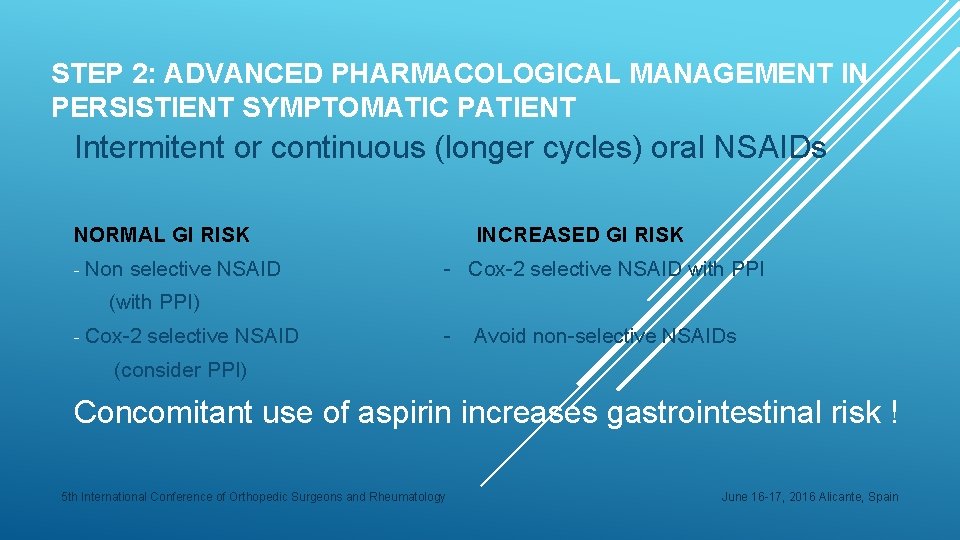
STEP 2: ADVANCED PHARMACOLOGICAL MANAGEMENT IN PERSISTIENT SYMPTOMATIC PATIENT Intermitent or continuous (longer cycles) oral NSAIDs NORMAL GI RISK INCREASED GI RISK - Non selective NSAID - Cox-2 selective NSAID with PPI (with PPI) - Cox-2 selective NSAID - Avoid non-selective NSAIDs (consider PPI) Concomitant use of aspirin increases gastrointestinal risk ! 5 th International Conference of Orthopedic Surgeons and Rheumatology June 16 -17, 2016 Alicante, Spain
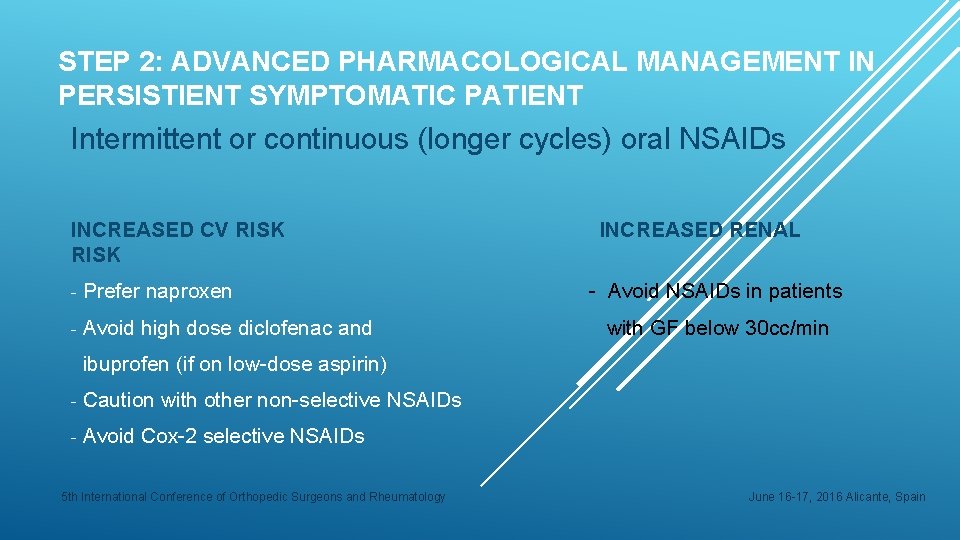
STEP 2: ADVANCED PHARMACOLOGICAL MANAGEMENT IN PERSISTIENT SYMPTOMATIC PATIENT Intermittent or continuous (longer cycles) oral NSAIDs INCREASED CV RISK INCREASED RENAL - Prefer naproxen - Avoid NSAIDs in patients - Avoid high dose diclofenac and with GF below 30 cc/min ibuprofen (if on low-dose aspirin) - Caution with other non-selective NSAIDs - Avoid Cox-2 selective NSAIDs 5 th International Conference of Orthopedic Surgeons and Rheumatology June 16 -17, 2016 Alicante, Spain
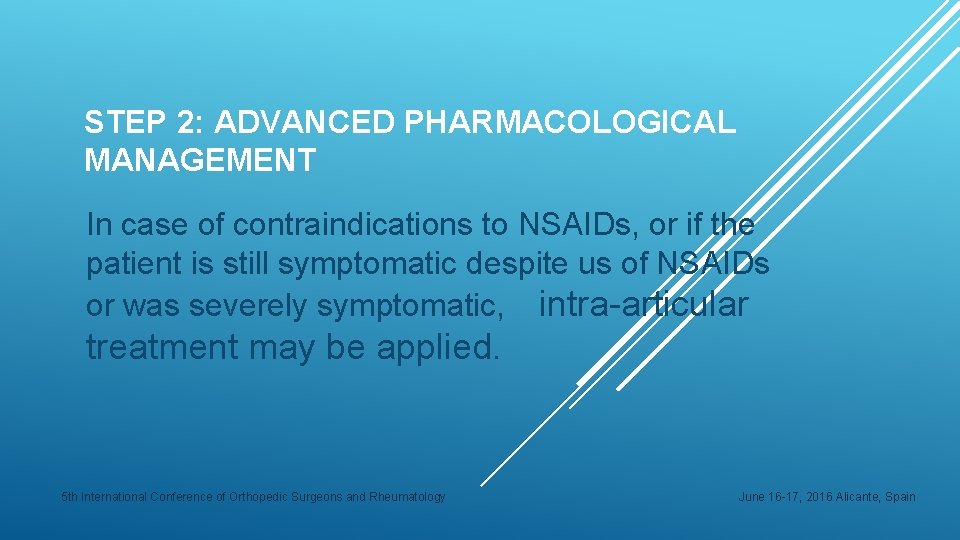
STEP 2: ADVANCED PHARMACOLOGICAL MANAGEMENT In case of contraindications to NSAIDs, or if the patient is still symptomatic despite us of NSAIDs or was severely symptomatic, intra-articular treatment may be applied. 5 th International Conference of Orthopedic Surgeons and Rheumatology June 16 -17, 2016 Alicante, Spain
STEP 2: ADVANCED PHARMACOLOGICAL MANAGEMENT IN PERSISTIENT SYMTOMATIC PATIENT MAY DELAY TOTAL JOINT REPLACEMENT Intra-articular hyaluronate Intraarticular corticosteroids 5 th International Conference of Orthopedic Surgeons and Rheumatology June 16 -17, 2016 Alicante, Spain
STEP 3: LAST PHARMACOLOGICAL ATTEMPTS IN SEVERE SYMPTOMATIC PATIENTS BEFORE SURGERY • Short-term weak opioids (tramadol) - relieving pain and improving function but adverse events are significant • Antidepressants are commonly used in chronic pain syndromes - they alter pain neurotransmitters (i. e. , serotonin and norepinephrine) centrally - central sensitization may play a role in the severity of osteoarthritis pain 5 th International Conference of Orthopedic Surgeons and Rheumatology June 16 -17, 2016 Alicante, Spain
THERE IS NO FAVORABLE EVIDENCE FOR ARTHROSCOPIC JOINT LAVAGE/ DEBRIDEMENT. 5 th International Conference of Orthopedic Surgeons and Rheumatology June 16 -17, 2016 Alicante, Spain
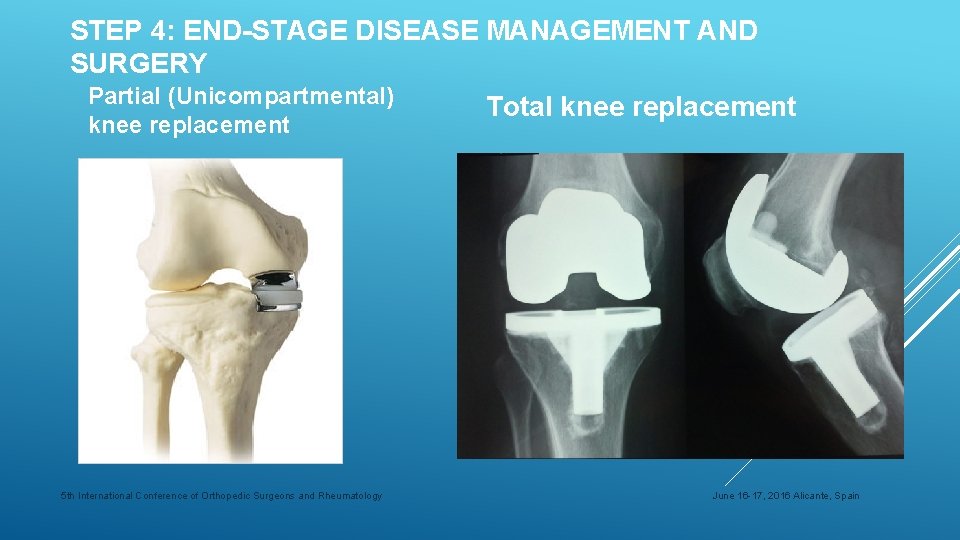
STEP 4: END-STAGE DISEASE MANAGEMENT AND SURGERY Total joint replacement is very effective in relieving severe symptoms of knee OA and has a high benefit/risk ratio when patients are carefully selected, well informed, anesthesia and surgery are well performed, and rehabilitation is appropriate. 5 th International Conference of Orthopedic Surgeons and Rheumatology June 16 -17, 2016 Alicante, Spain
STEP 4: END-STAGE DISEASE MANAGEMENT AND SURGERY Partial (Unicompartmental) knee replacement Total knee replacement 5 th International Conference of Orthopedic Surgeons and Rheumatology June 16 -17, 2016 Alicante, Spain
STEP 4: END-STAGE DISEASE MANAGEMENT FOR SEVERELY SYMPTOMATIC PATIENTS IF SURGERY IS CONTRAINDICATED OR IF THEY ARE UNWILLING TO UNDERGO SURGERY Last pharmacological treatment may be represented: • Classical or transdermal opioids • Guidelines should be followed as in the management of chronic non-cancer pain 5 th International Conference of Orthopedic Surgeons and Rheumatology June 16 -17, 2016 Alicante, Spain
THANKS FOR YOUR ATTENTION 5 th International Conference of Orthopedic Surgeons and Rheumatology June 16 -17, 2016 Alicante, Spain