
An Agricultural Harvest Knowledge Survey to Distinguish Types

- Slides: 28
An Agricultural Harvest Knowledge Survey to Distinguish Types of Expertise How to capture expertise within combine operators Chase Meusel*, M. S. , Iowa State University Chase Grimm**, Iowa State University Stephen Gilbert, Ph. D. , Iowa State University Greg Luecke, Ph. D. , Iowa State University *Graduate student **Undergraduate student Project sponsor
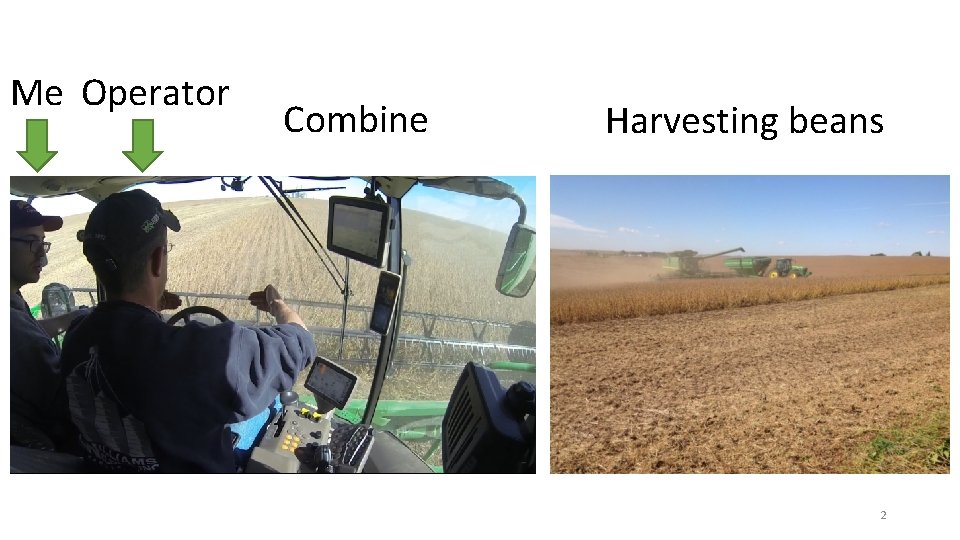
Me Operator Combine Harvesting beans 2
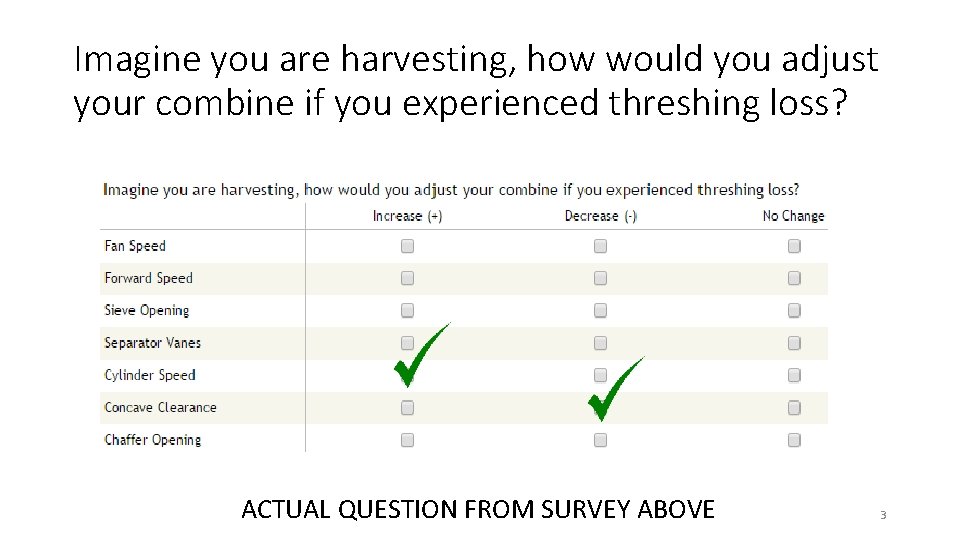
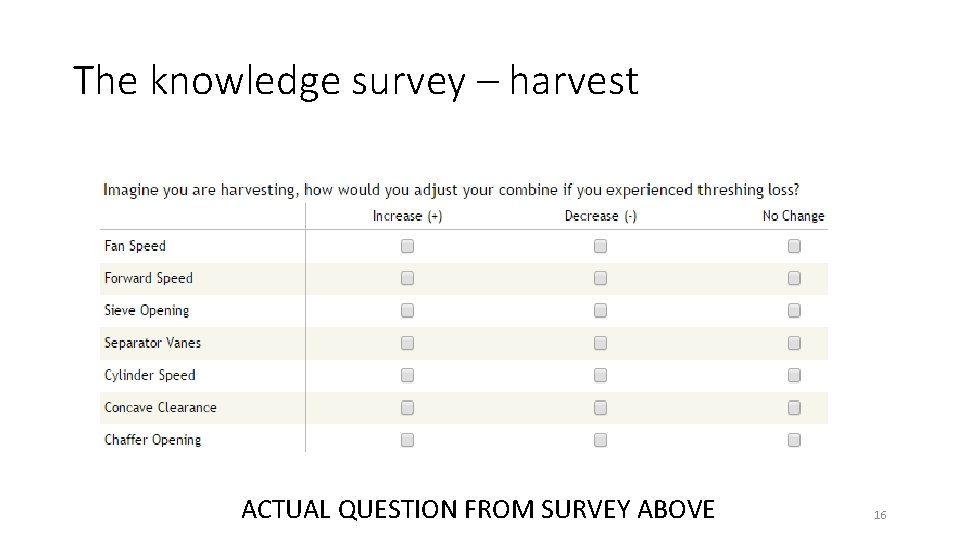
Imagine you are harvesting, how would you adjust your combine if you experienced threshing loss? ACTUAL QUESTION FROM SURVEY ABOVE 3
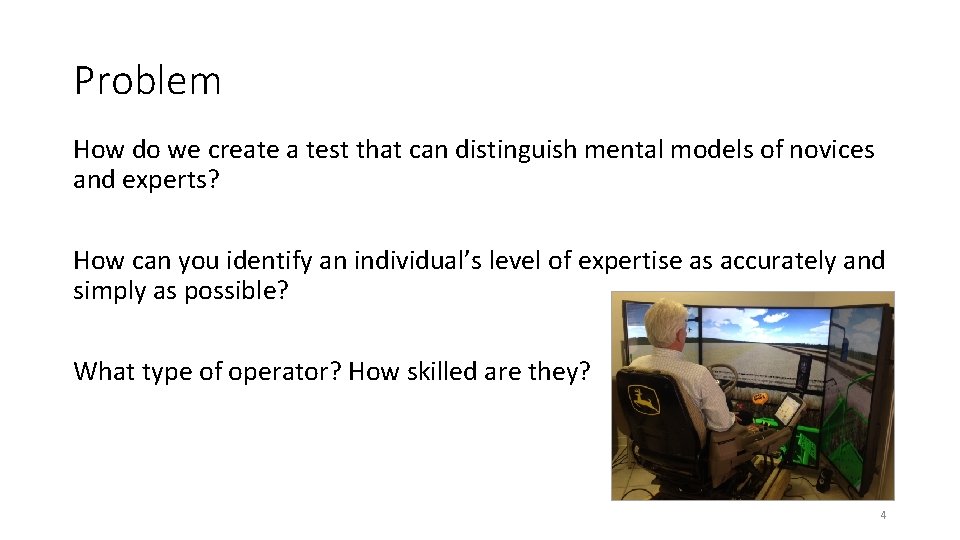
Problem How do we create a test that can distinguish mental models of novices and experts? How can you identify an individual’s level of expertise as accurately and simply as possible? What type of operator? How skilled are they? 4
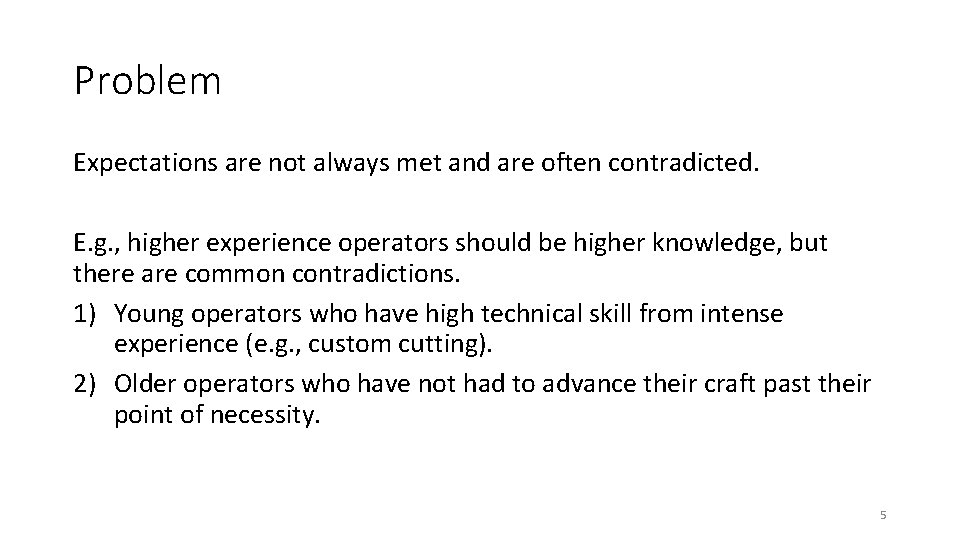
Problem Expectations are not always met and are often contradicted. E. g. , higher experience operators should be higher knowledge, but there are common contradictions. 1) Young operators who have high technical skill from intense experience (e. g. , custom cutting). 2) Older operators who have not had to advance their craft past their point of necessity. 5
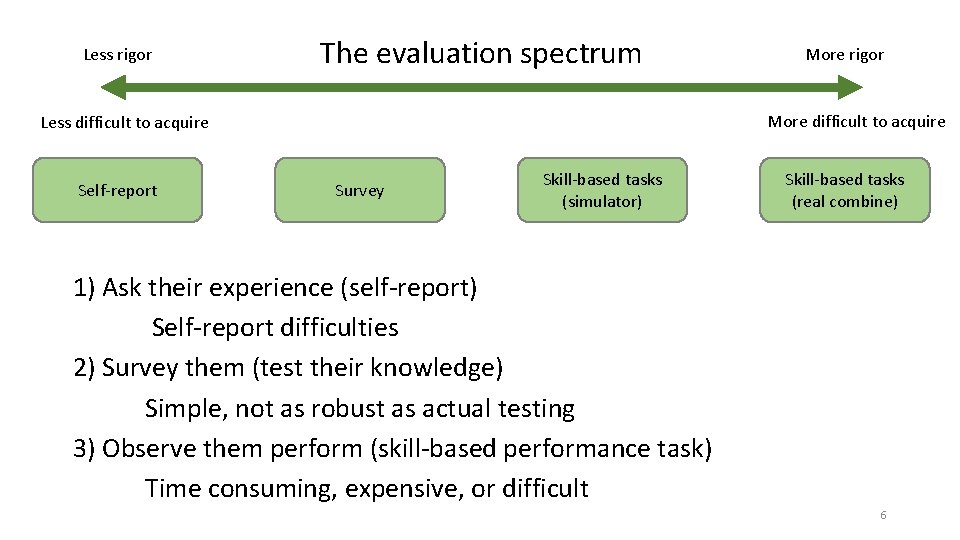
Less rigor The evaluation spectrum More difficult to acquire Less difficult to acquire Self-report More rigor Survey Skill-based tasks (simulator) Skill-based tasks (real combine) 1) Ask their experience (self-report) Self-report difficulties 2) Survey them (test their knowledge) Simple, not as robust as actual testing 3) Observe them perform (skill-based performance task) Time consuming, expensive, or difficult 6
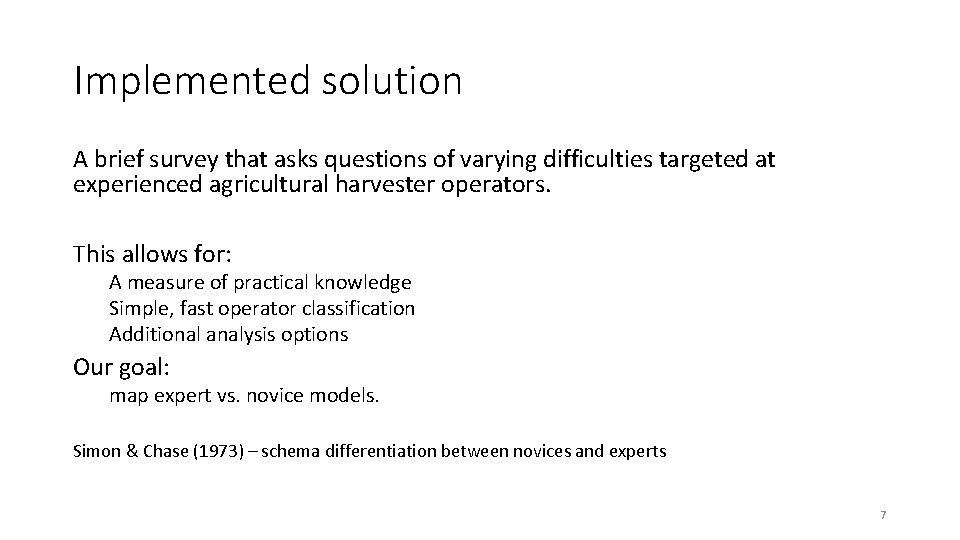
Implemented solution A brief survey that asks questions of varying difficulties targeted at experienced agricultural harvester operators. This allows for: A measure of practical knowledge Simple, fast operator classification Additional analysis options Our goal: map expert vs. novice models. Simon & Chase (1973) – schema differentiation between novices and experts 7
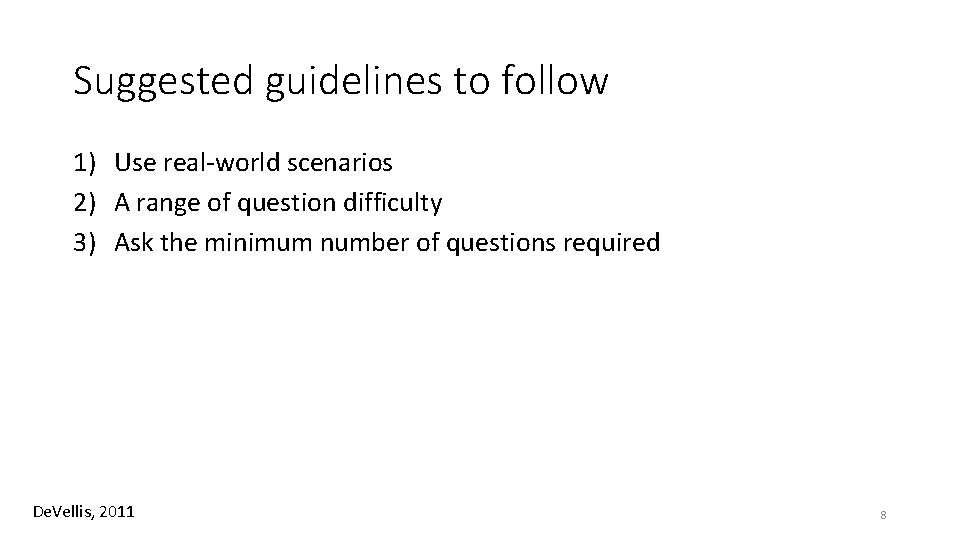
Suggested guidelines to follow 1) Use real-world scenarios 2) A range of question difficulty 3) Ask the minimum number of questions required De. Vellis, 2011 8
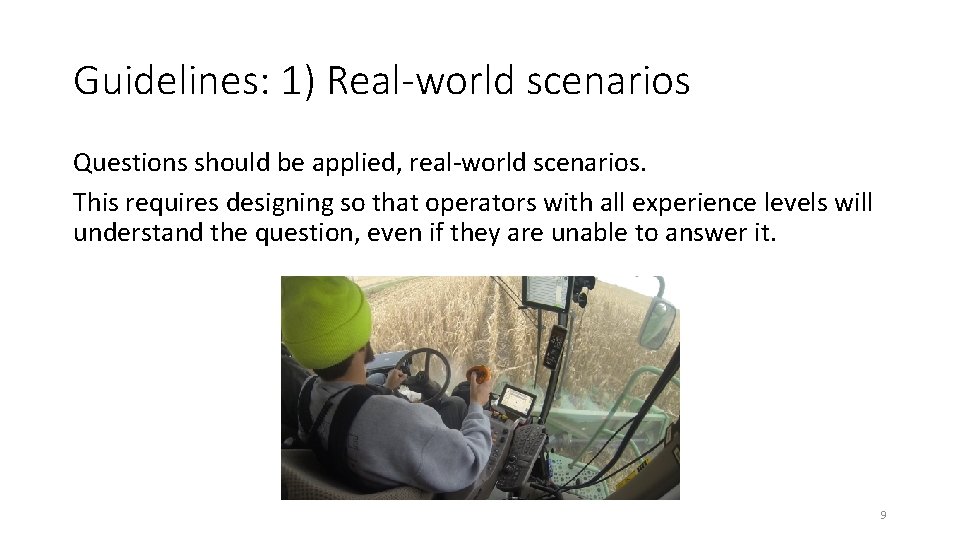
Guidelines: 1) Real-world scenarios Questions should be applied, real-world scenarios. This requires designing so that operators with all experience levels will understand the question, even if they are unable to answer it. 9
Guidelines: 2) Question difficulty The answers to the questions should neither be too difficult nor too easy. By avoiding difficulty extremes, a broad spectrum of knowledge across participants can be assessed. 10
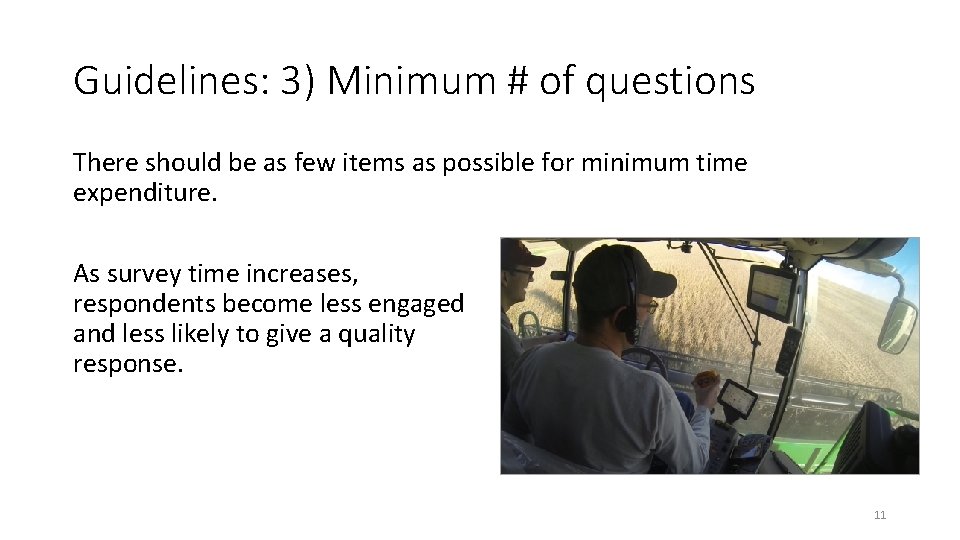
Guidelines: 3) Minimum # of questions There should be as few items as possible for minimum time expenditure. As survey time increases, respondents become less engaged and less likely to give a quality response. 11
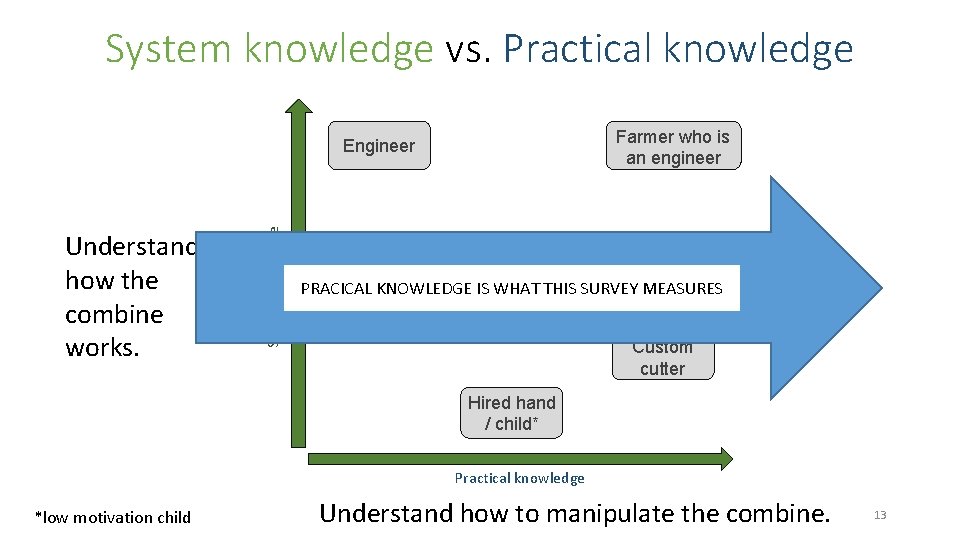
Types of operators In this work, the knowledge survey represents practical knowledge. Practical knowledge represents how well an operator understands what to manipulate within the combine to gain a desired result. What it is missing is system knowledge. System knowledge represents how well an operator understands what is happening within the combine, at an internal level when a manipulation occurs. 12
System knowledge vs. Practical knowledge Farmer who is an engineer Understand how the combine works. System knowledge Engineer Low acre farmer PRACICAL KNOWLEDGE IS WHAT THIS SURVEY MEASURES Custom cutter Hired hand / child* Practical knowledge *low motivation child Understand how to manipulate the combine. 13
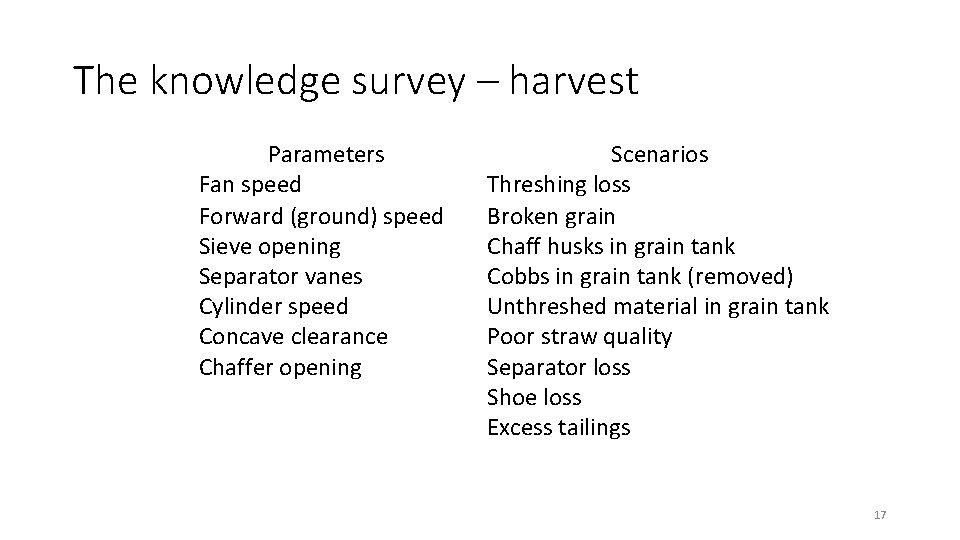
The knowledge survey – harvest First use, harvest study. How well does the operator understand general harvest principles? The primary harvest parameters were used as options. 14
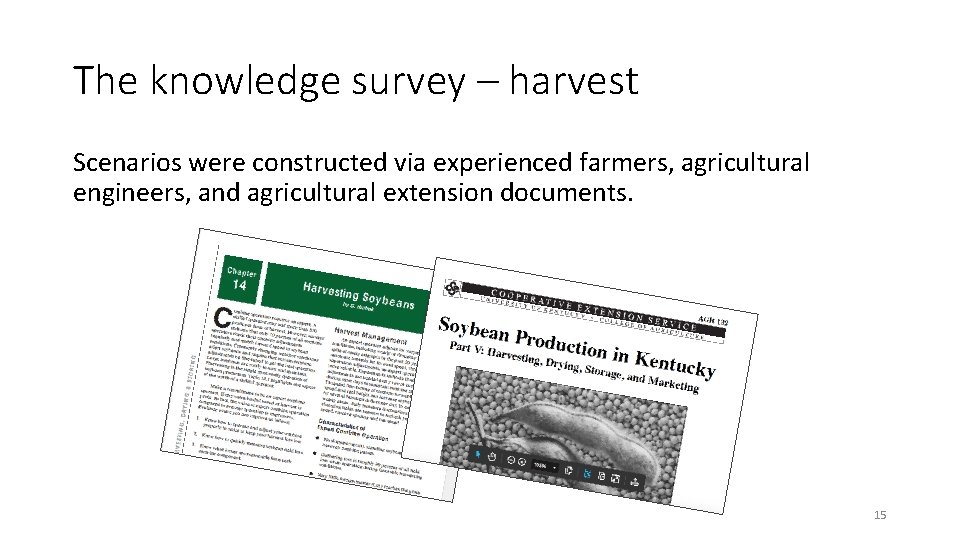
The knowledge survey – harvest Scenarios were constructed via experienced farmers, agricultural engineers, and agricultural extension documents. 15
The knowledge survey – harvest ACTUAL QUESTION FROM SURVEY ABOVE 16
The knowledge survey – harvest Parameters Fan speed Forward (ground) speed Sieve opening Separator vanes Cylinder speed Concave clearance Chaffer opening Scenarios Threshing loss Broken grain Chaff husks in grain tank Cobbs in grain tank (removed) Unthreshed material in grain tank Poor straw quality Separator loss Shoe loss Excess tailings 17
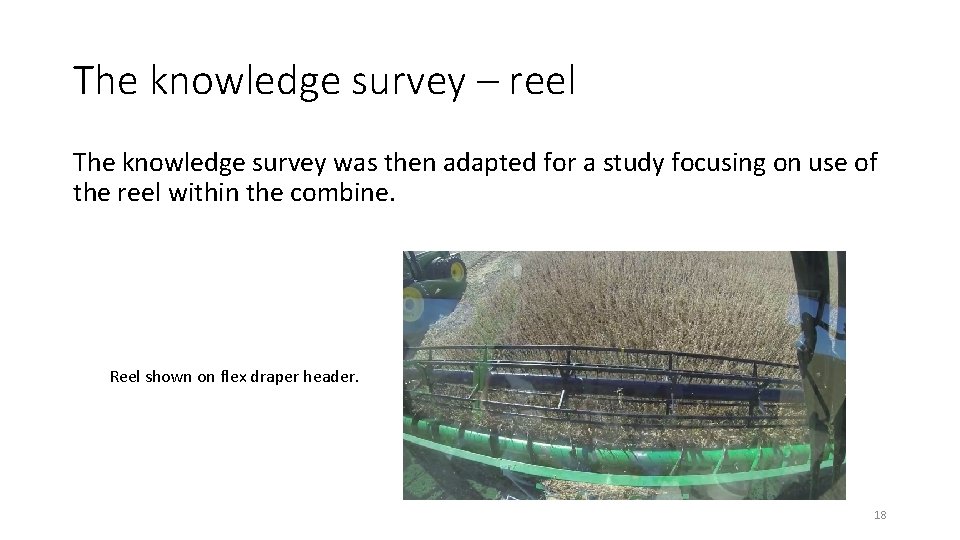
The knowledge survey – reel The knowledge survey was then adapted for a study focusing on use of the reel within the combine. Reel shown on flex draper header. 18
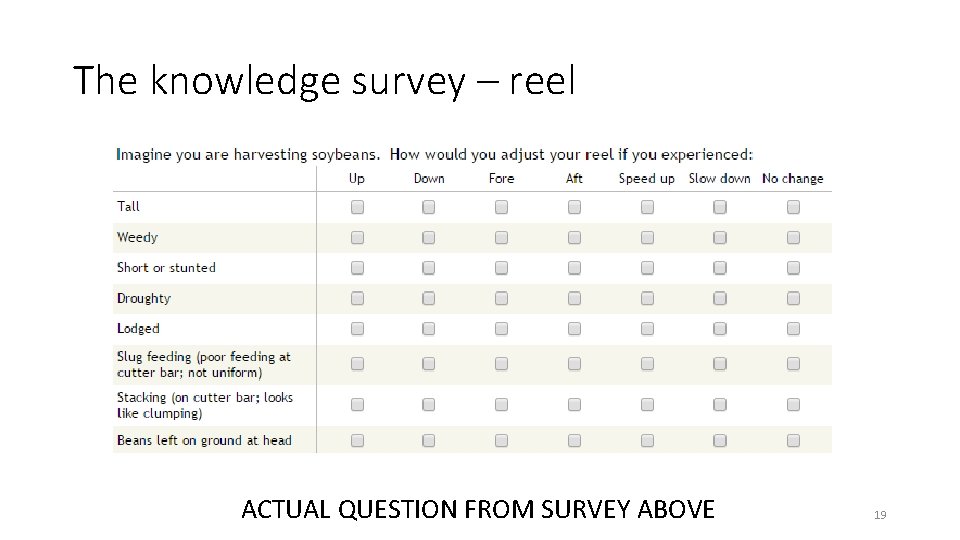
The knowledge survey – reel ACTUAL QUESTION FROM SURVEY ABOVE 19
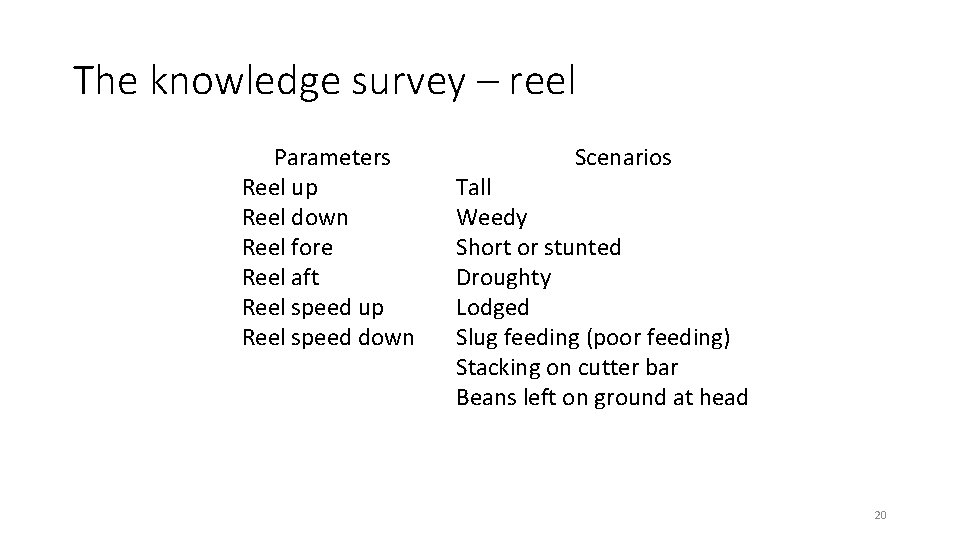
The knowledge survey – reel Parameters Reel up Reel down Reel fore Reel aft Reel speed up Reel speed down Scenarios Tall Weedy Short or stunted Droughty Lodged Slug feeding (poor feeding) Stacking on cutter bar Beans left on ground at head 20
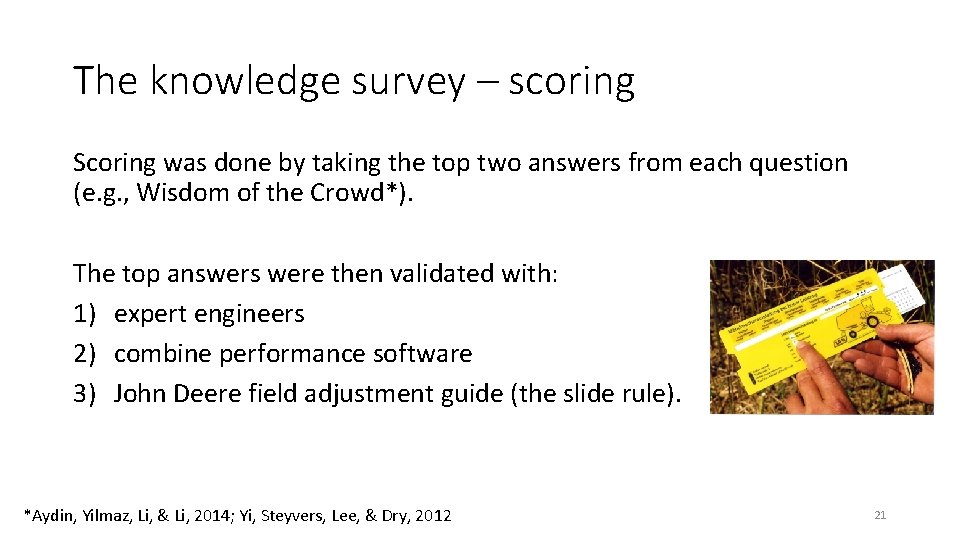
The knowledge survey – scoring Scoring was done by taking the top two answers from each question (e. g. , Wisdom of the Crowd*). The top answers were then validated with: 1) expert engineers 2) combine performance software 3) John Deere field adjustment guide (the slide rule). *Aydin, Yilmaz, Li, & Li, 2014; Yi, Steyvers, Lee, & Dry, 2012 21
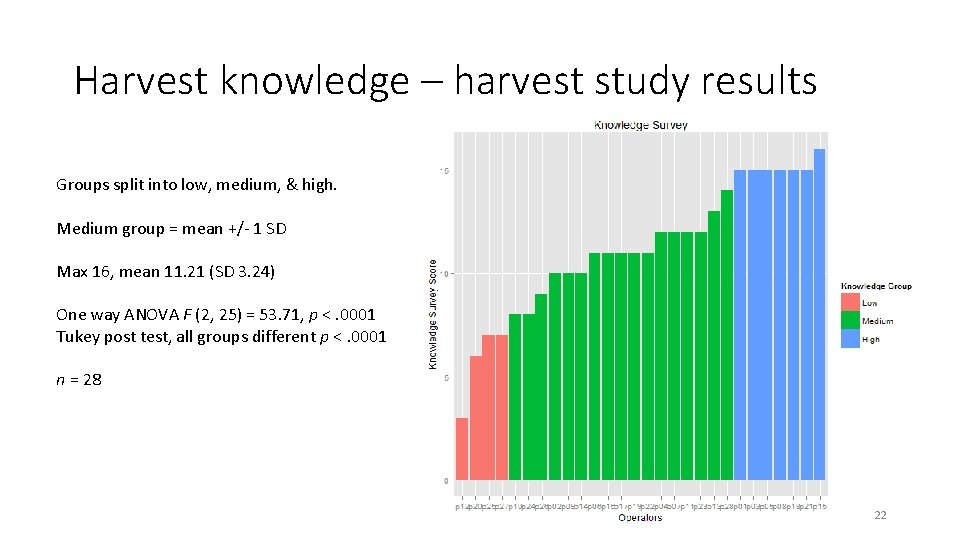
Harvest knowledge – harvest study results Groups split into low, medium, & high. Medium group = mean +/- 1 SD Max 16, mean 11. 21 (SD 3. 24) One way ANOVA F (2, 25) = 53. 71, p <. 0001 Tukey post test, all groups different p <. 0001 n = 28 22
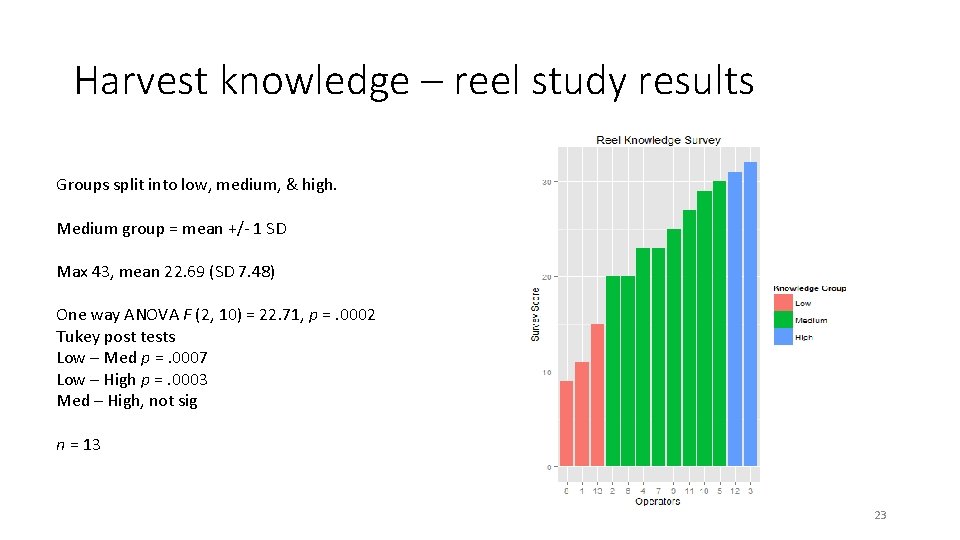
Harvest knowledge – reel study results Groups split into low, medium, & high. Medium group = mean +/- 1 SD Max 43, mean 22. 69 (SD 7. 48) One way ANOVA F (2, 10) = 22. 71, p =. 0002 Tukey post tests Low – Med p =. 0007 Low – High p =. 0003 Med – High, not sig n = 13 23
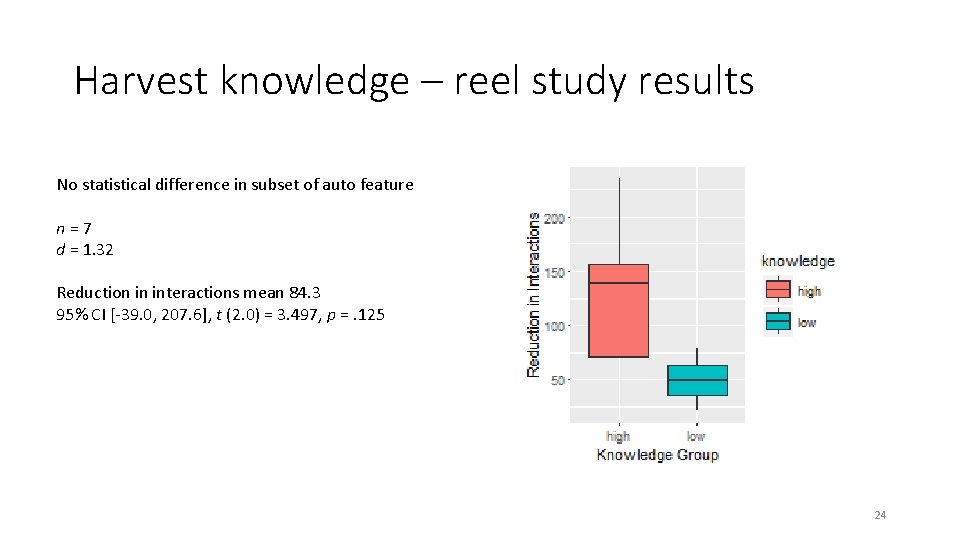
Harvest knowledge – reel study results No statistical difference in subset of auto feature n=7 d = 1. 32 Reduction in interactions mean 84. 3 95% CI [-39. 0, 207. 6], t (2. 0) = 3. 497, p =. 125 24
Conclusion The knowledge survey is a quick, and simple tool to employ to identify levels of operator practical expertise. This type of survey could be used on a large scale to determine what type of training or products a particular population could most benefit from. 25
Future work Future iterations of the knowledge survey will ask additional questions to help better differentiate system knowledge vs practical knowledge. Additionally, revised scoring mechanics are now being utilized to remove answers which may favor sub-optimal solutions. e. g. adjusting the ground speed may help resolve multiple issues, but it is often not the best choice, even though it may be the most popular. 26
Questions? 27
28