
An Agile ETL Data Development for ERA XML

- Slides: 24
An Agile ETL Data Development for ERA XML Submission Dr Paul Wong Research Office, Australian National University
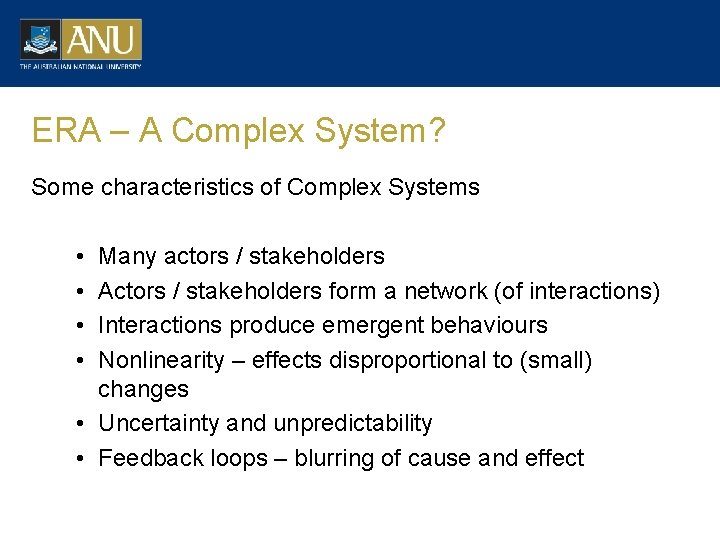
ERA – A Complex System? Some characteristics of Complex Systems • • Many actors / stakeholders Actors / stakeholders form a network (of interactions) Interactions produce emergent behaviours Nonlinearity – effects disproportional to (small) changes • Uncertainty and unpredictability • Feedback loops – blurring of cause and effect
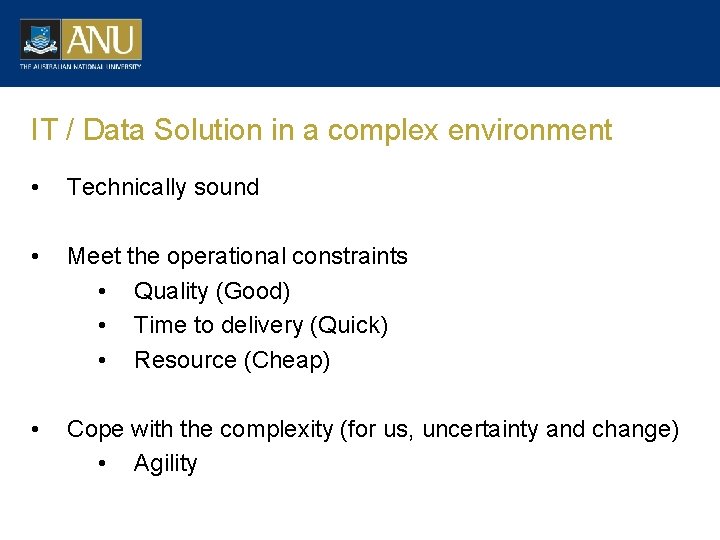
IT / Data Solution in a complex environment • Technically sound • Meet the operational constraints • Quality (Good) • Time to delivery (Quick) • Resource (Cheap) • Cope with the complexity (for us, uncertainty and change) • Agility
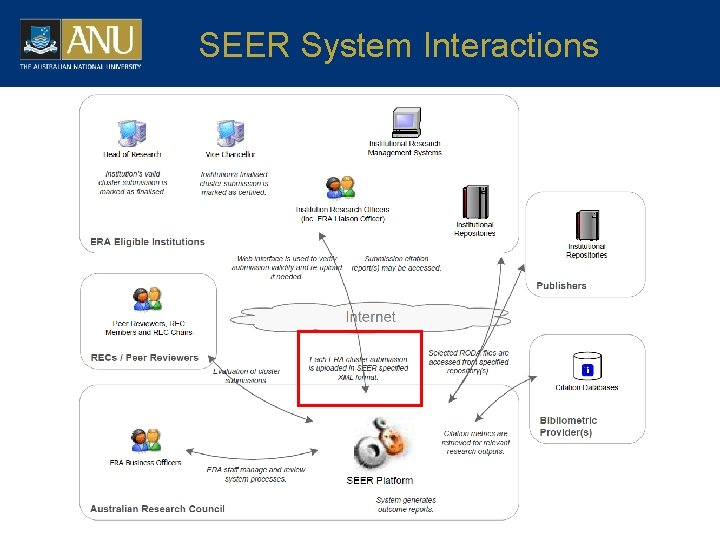
SEER System Interactions
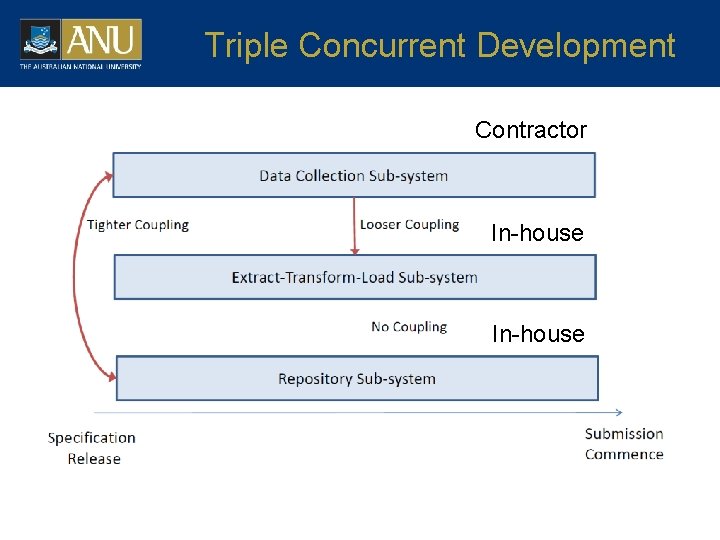
Triple Concurrent Development Contractor In-house
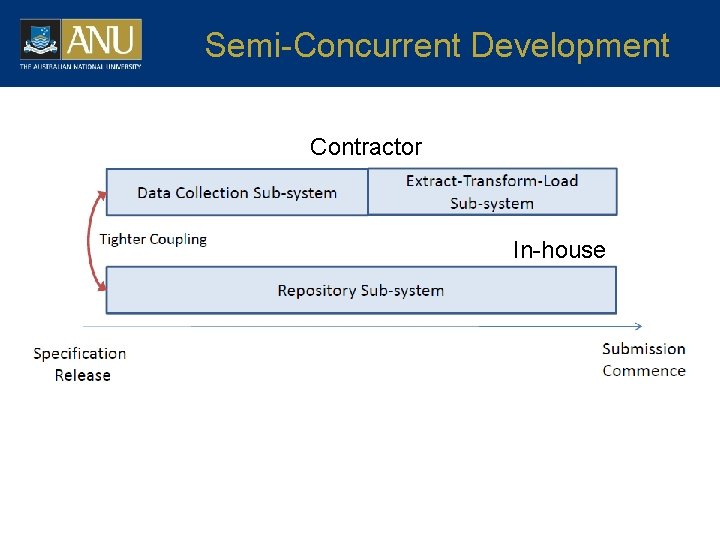
Semi-Concurrent Development Contractor In-house
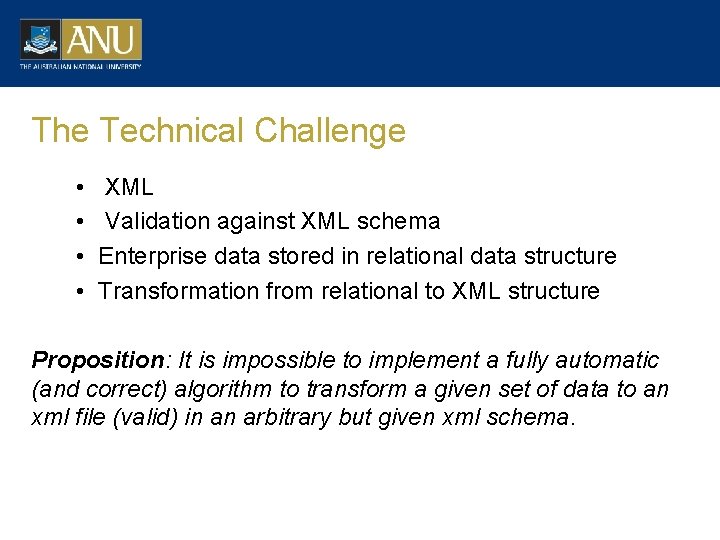
The Technical Challenge • • XML Validation against XML schema Enterprise data stored in relational data structure Transformation from relational to XML structure Proposition: It is impossible to implement a fully automatic (and correct) algorithm to transform a given set of data to an xml file (valid) in an arbitrary but given xml schema.
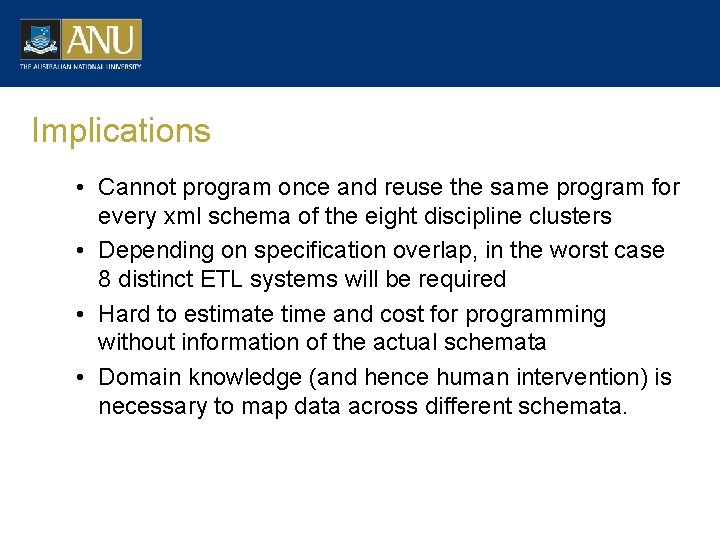
Implications • Cannot program once and reuse the same program for every xml schema of the eight discipline clusters • Depending on specification overlap, in the worst case 8 distinct ETL systems will be required • Hard to estimate time and cost for programming without information of the actual schemata • Domain knowledge (and hence human intervention) is necessary to map data across different schemata.
The Technical Solution • Commercial-Off-The-Shelf (COTS) system architecture • A blue print of how components fit together to form the whole system to deliver the required functions • Build methodology • A systematic method to build the underlying system • Skill, knowledge and understanding • Technical know-how • Interpret business rules, government guidelines, internal organisation processes and policies
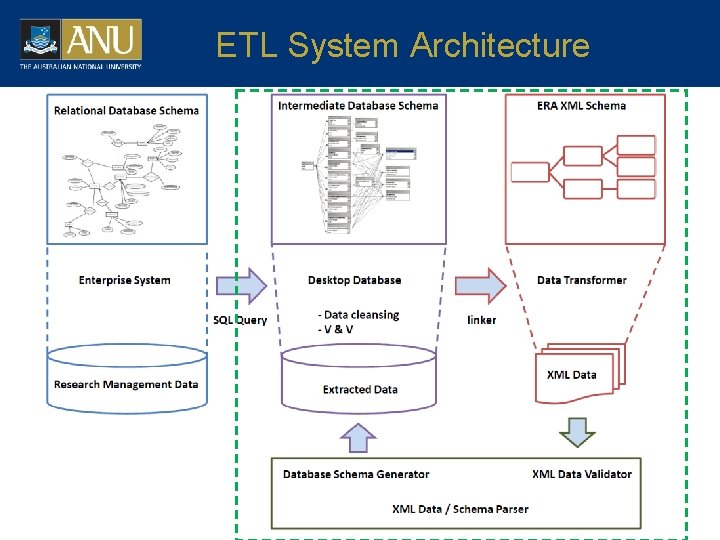
ETL System Architecture
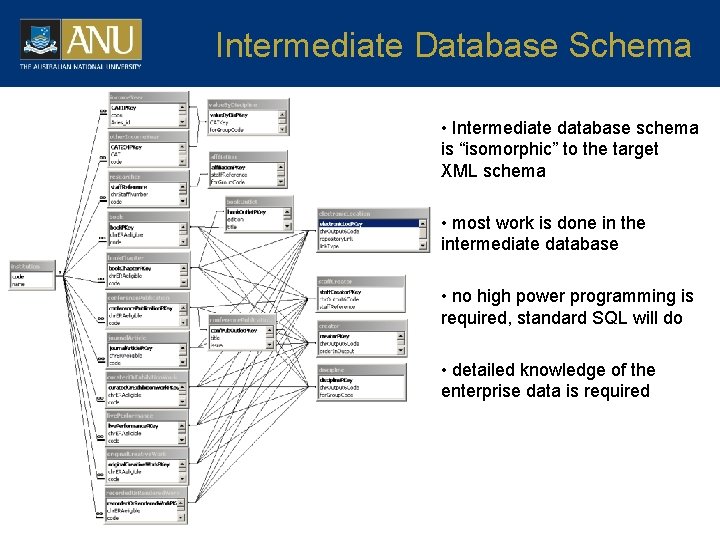
Intermediate Database Schema • Intermediate database schema is “isomorphic” to the target XML schema • most work is done in the intermediate database • no high power programming is required, standard SQL will do • detailed knowledge of the enterprise data is required
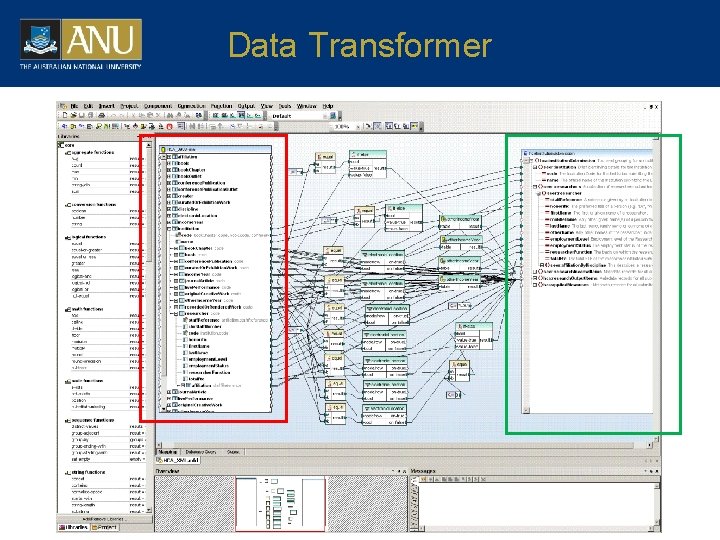
Data Transformer
Main Features of the Architecture • Plug into the database backend of any Research Management Information System • Two-pass process of data transformation • First pass takes a snap shot of enterprise data • Provide an intermediate step for data cleansing, implementing V&V rules and data debugging • Intermediate database schema is “isomorphic” to the final target XML schema – simplify data mapping downstream • No high power programming required, SQL will do
To Cut a Long Story Short We have • a COTS system architecture • a Build methodology • A systematic method to build the underlying system • relevant knowledge • technical know-how • interpret business rules, government guidelines, internal organisation processes and policies
From Technical to Operational Challenges We need • Good – data quality must pass the final V&V in SEER • Quick – must be delivered on time to SEER • Cheap – must be within the limit of available resources In addition • embrace complexities, changes and uncertainties – must become more agile.
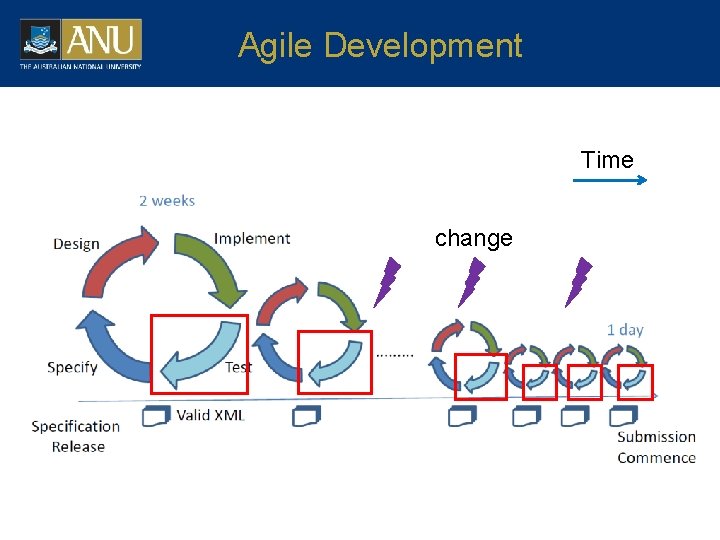
Agile Software / System Development • New breed of software / system development methodology – offspring of rapid prototyping • Short iterative development cycles with lightweight processes • Incremental – add functionalities as we go • Tacit knowledge – instead of documentation • Self-organising – collective decision • Emergence – work structure to be realised during the project instead of a predefined plan
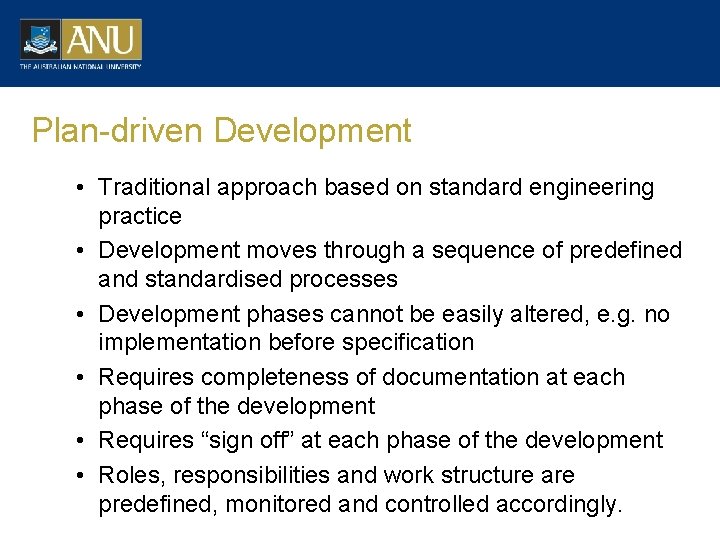
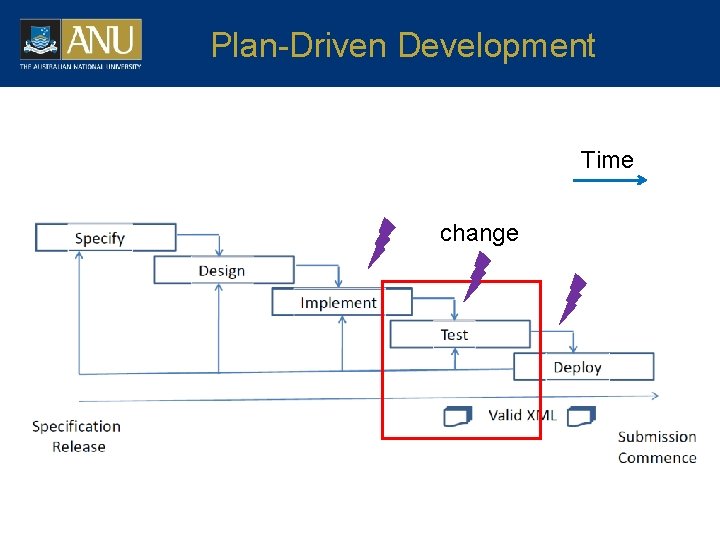
Plan-driven Development • Traditional approach based on standard engineering practice • Development moves through a sequence of predefined and standardised processes • Development phases cannot be easily altered, e. g. no implementation before specification • Requires completeness of documentation at each phase of the development • Requires “sign off” at each phase of the development • Roles, responsibilities and work structure are predefined, monitored and controlled accordingly.
Agile Development Time change
Plan-Driven Development Time change
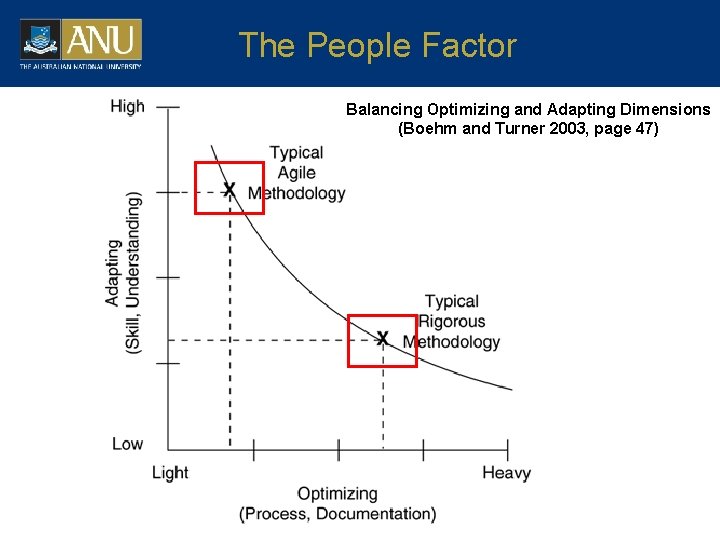
The People Factor Balancing Optimizing and Adapting Dimensions (Boehm and Turner 2003, page 47)
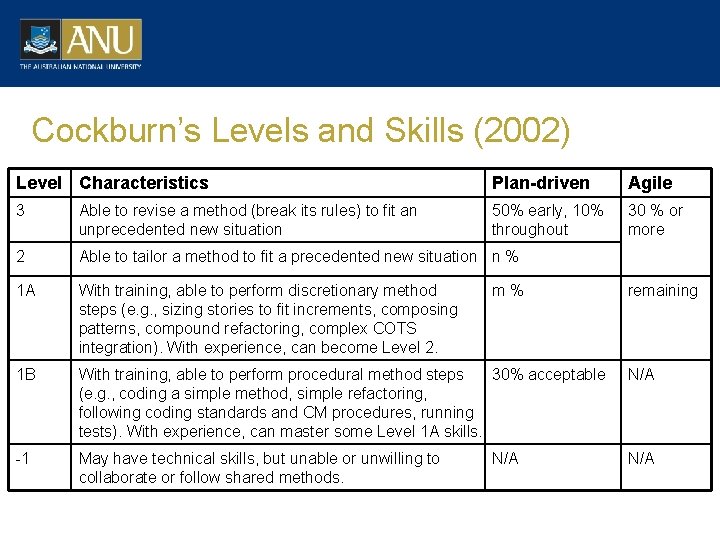
Cockburn’s Levels and Skills (2002) Level Characteristics Plan-driven Agile 3 Able to revise a method (break its rules) to fit an unprecedented new situation 50% early, 10% throughout 30 % or more 2 Able to tailor a method to fit a precedented new situation n % 1 A With training, able to perform discretionary method steps (e. g. , sizing stories to fit increments, composing patterns, compound refactoring, complex COTS integration). With experience, can become Level 2. 1 B With training, able to perform procedural method steps 30% acceptable (e. g. , coding a simple method, simple refactoring, following coding standards and CM procedures, running tests). With experience, can master some Level 1 A skills. N/A -1 May have technical skills, but unable or unwilling to collaborate or follow shared methods. N/A m% N/A remaining
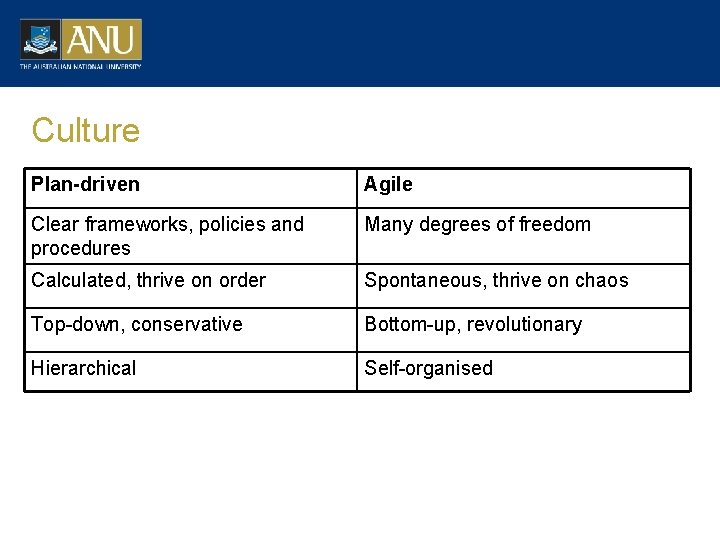
Culture Plan-driven Agile Clear frameworks, policies and procedures Many degrees of freedom Calculated, thrive on order Spontaneous, thrive on chaos Top-down, conservative Bottom-up, revolutionary Hierarchical Self-organised
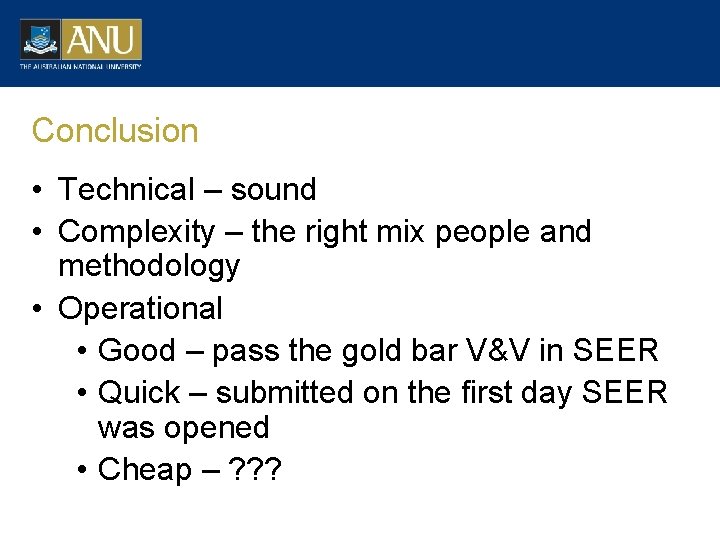
Conclusion • Technical – sound • Complexity – the right mix people and methodology • Operational • Good – pass the gold bar V&V in SEER • Quick – submitted on the first day SEER was opened • Cheap – ? ? ?
Questions, Comments, Abuses? Paul. Wong@anu. edu. au