
An AGDD Xml File Builder Christopher Lestercern ch
An AGDD “Xml. File. Builder” Christopher. Lester@cern. ch
AGDD_Xml. File. Builder • Why do we need Xml. File builders? • What do we want from them? • What can AGDD_Xml. File. Builder do? • Where can you get it? Christopher. Lester@cern. ch

The problems … part 1 AGDD/XML files contain. . . • Repeated numbers. Eg: tubes of similar design sharing common diameters but having different lengths. • Functionally related numbers. Eg: translationx=width/2+cos(θstereo) • Algorithmically related numbers. Eg: const int N=10; // number of trds for(int n=0; n<N; n++) { // loop over each trd. Skew[n]=atan(n); // set skew angle } Christopher. Lester@cern. ch
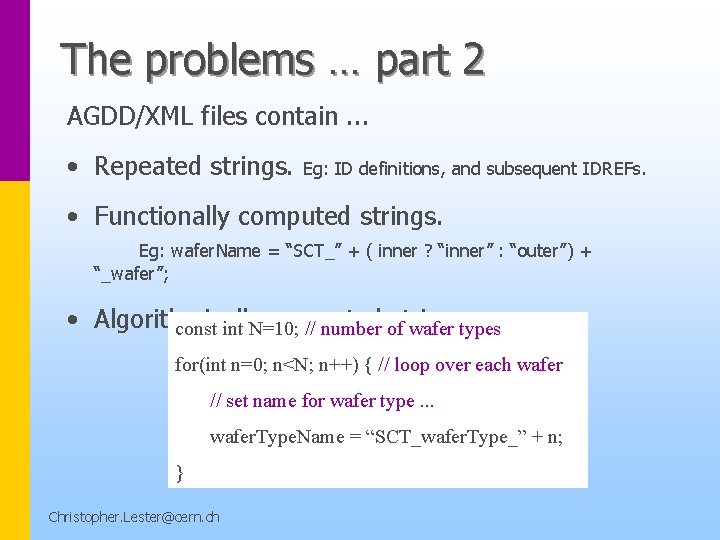
The problems … part 2 AGDD/XML files contain. . . • Repeated strings. Eg: ID definitions, and subsequent IDREFs. • Functionally computed strings. Eg: wafer. Name = “SCT_” + ( inner ? “inner” : “outer”) + “_wafer”; • Algorithmically computed strings. Eg: const int N=10; // number of wafer types for(int n=0; n<N; n++) { // loop over each wafer // set name for wafer type. . . wafer. Type. Name = “SCT_wafer. Type_” + n; } Christopher. Lester@cern. ch
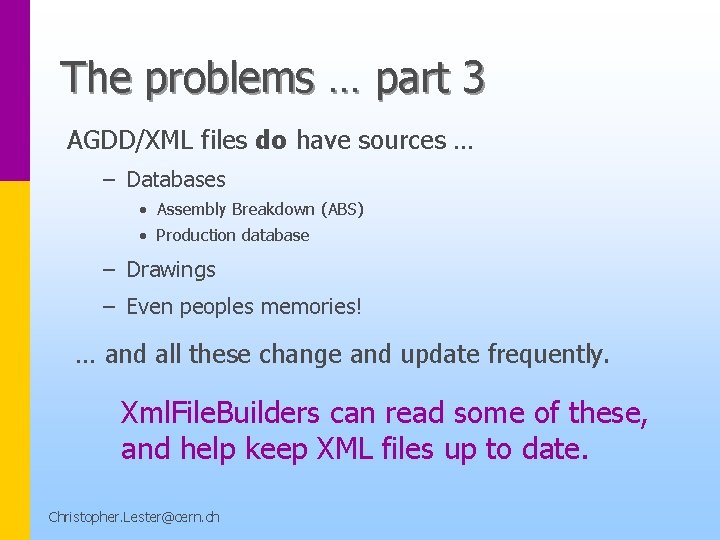
The problems … part 3 AGDD/XML files do have sources … – Databases • Assembly Breakdown (ABS) • Production database – Drawings – Even peoples memories! … and all these change and update frequently. Xml. File. Builders can read some of these, and help keep XML files up to date. Christopher. Lester@cern. ch
Xml. File. Builders - what do we want from them? • Freedom: – Freedom to use the full power of any developed language (C++, Java, Fortran, Perl, …) when building our XML file. • Simplicity: – Close relationship between builder code and output XML, but. . . Christopher. Lester@cern. ch
Xml. File. Builders - what do we want from them … • Benefits: – “Out of order” building – Reference management – Syntax handling (<pos>…</pos>) – Strong syntax checking – Independence of output format / DTD – Define complex constructions Christopher. Lester@cern. ch
What is AGDD_Xml. File. Builder? • In the ATLAS software under offline/Detector. Description/AGDD_Xml. File. Builder • The set of C++ tools comprises – library – user tool classes – ( and implementation classes … ) Christopher. Lester@cern. ch
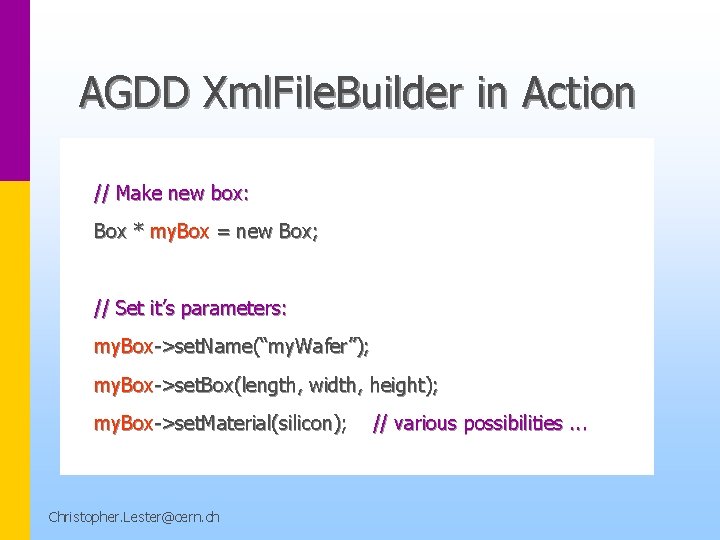
AGDD Xml. File. Builder in Action // Make new box: Box * my. Box = new Box; // Set it’s parameters: my. Box->set. Name(“my. Wafer”); my. Box->set. Box(length, width, height); my. Box->set. Material(silicon); Christopher. Lester@cern. ch // various possibilities. . .
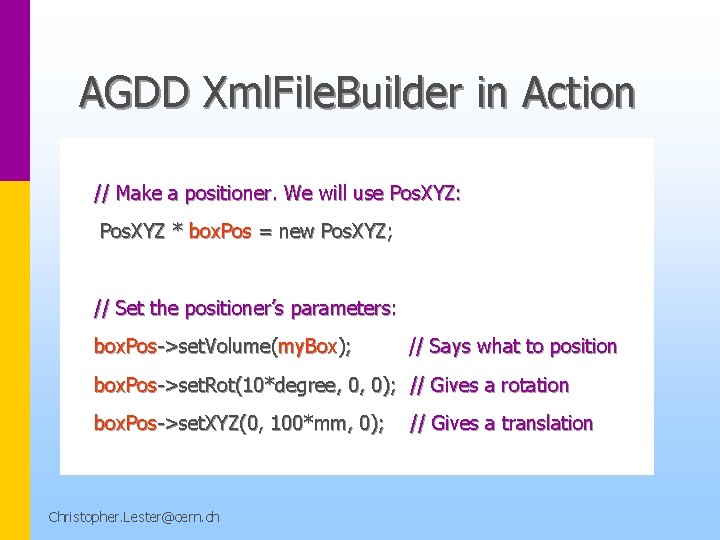
AGDD Xml. File. Builder in Action // Make a positioner. We will use Pos. XYZ: Pos. XYZ * box. Pos = new Pos. XYZ; // Set the positioner’s parameters: box. Pos->set. Volume(my. Box); // Says what to position box. Pos->set. Rot(10*degree, 0, 0); // Gives a rotation box. Pos->set. XYZ(0, 100*mm, 0); Christopher. Lester@cern. ch // Gives a translation
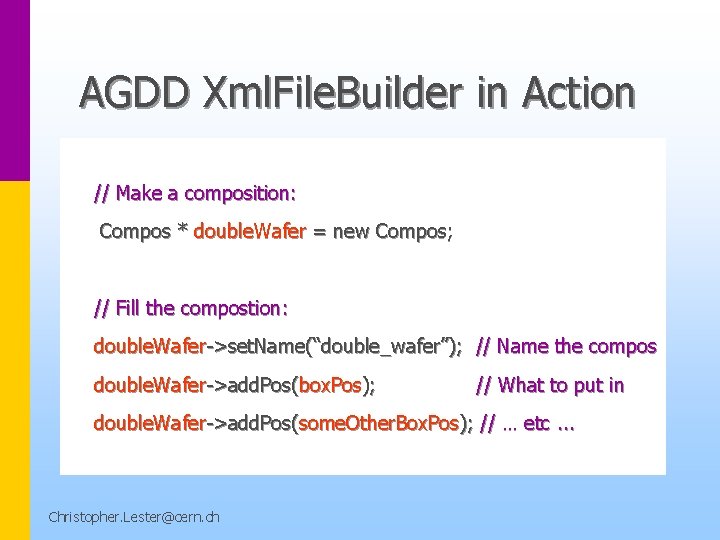
AGDD Xml. File. Builder in Action // Make a composition: Compos * double. Wafer = new Compos; // Fill the compostion: double. Wafer->set. Name(“double_wafer”); // Name the compos double. Wafer->add. Pos(box. Pos); // What to put in double. Wafer->add. Pos(some. Other. Box. Pos); // … etc. . . Christopher. Lester@cern. ch
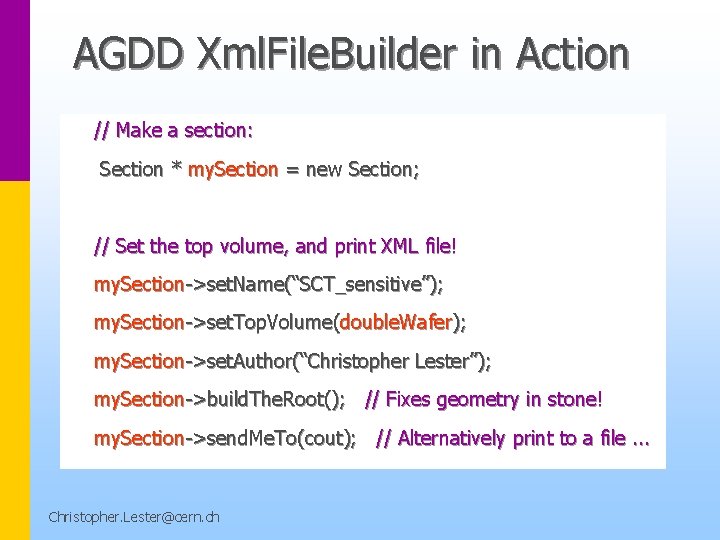
AGDD Xml. File. Builder in Action // Make a section: Section * my. Section = new Section; // Set the top volume, and print XML file! my. Section->set. Name(“SCT_sensitive”); my. Section->set. Top. Volume(double. Wafer); my. Section->set. Author(“Christopher Lester”); my. Section->build. The. Root(); // Fixes geometry in stone! my. Section->send. Me. To(cout); // Alternatively print to a file. . . Christopher. Lester@cern. ch
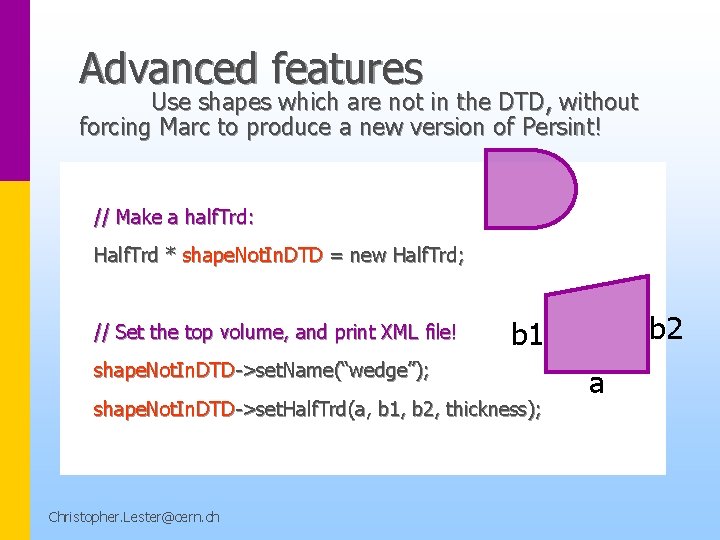
Advanced features Use shapes which are not in the DTD, without forcing Marc to produce a new version of Persint! // Make a half. Trd: Half. Trd * shape. Not. In. DTD = new Half. Trd; // Set the top volume, and print XML file! shape. Not. In. DTD->set. Name(“wedge”); shape. Not. In. DTD->set. Half. Trd(a, b 1, b 2, thickness); Christopher. Lester@cern. ch b 2 b 1 a
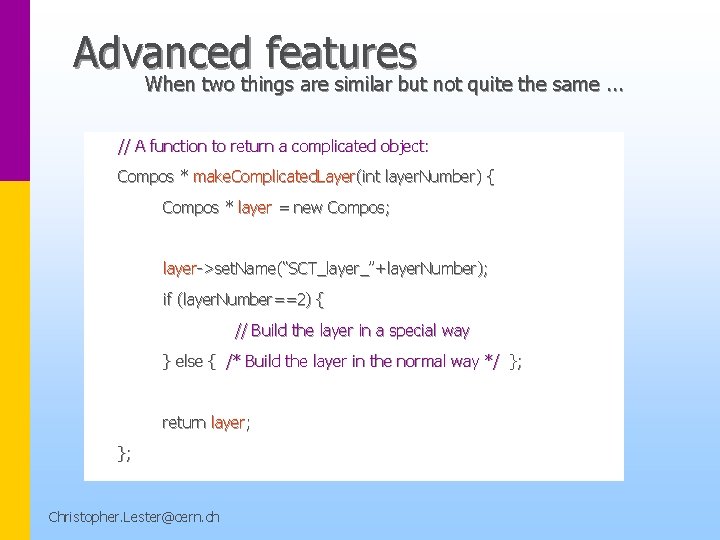
Advanced features When two things are similar but not quite the same. . . // A function to return a complicated object: Compos * make. Complicated. Layer(int layer. Number) { Compos * layer = new Compos; layer->set. Name(“SCT_layer_”+layer. Number); if (layer. Number==2) { // Build the layer in a special way } else { /* Build the layer in the normal way */ }; return layer; }; Christopher. Lester@cern. ch
Benefits summary • Frees users from some limitations of AGDD/XML (see “What do we want? ” slides) • Permits external sources of “fundamental parameters” from which to build XML files • Meets goals for functional and algorithmical operations on parameters • Permits complex objects to be manipulated Christopher. Lester@cern. ch
AGDD_Xml. File. Builder • In the ATLAS software under offline/Detector. Description/AGDD_Xml. File. Builder • Christopher. Lester@cern. ch • Some examples in offline/Inner. Detector/In. Det. Descr/SCT_AGDD_Xml. File. Builder Christopher. Lester@cern. ch
Down-sides: • Someone has to maintain it ! : ( • Tools must update with each DTD – OK if update is minor – Hard work if change is major? • At least the geometry code has a hope of staying the same • Three things to version: – Inputs – Tools – Geo. Code Christopher. Lester@cern. ch
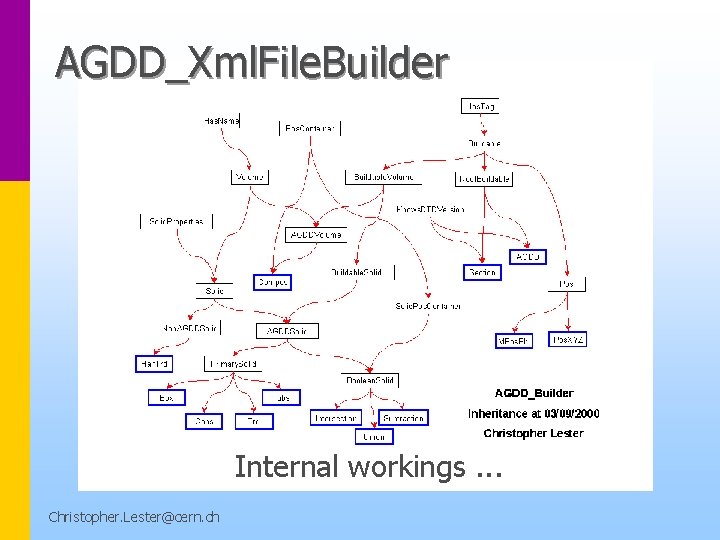
AGDD_Xml. File. Builder Internal workings. . . Christopher. Lester@cern. ch
- Slides: 18