
AN AFFLUENT SOCIETY 1950 s GUIDING QUESTION To






- Slides: 37
AN AFFLUENT SOCIETY 1950 s
GUIDING QUESTION To what extent did the decade of the 1950 s deserve its reputation as an age of political, social, and cultural conformity? “Conservatism, Complacency, and Contentment” OR “Anxiety, Alienation, and Social Unrest” ? ?
AFFLUENT SOCIETY Economic Prosperity in the 1950 s
AN AFFLUENT SOCIETY u Post-WWII Recession (1946) u Reduced government spending u high inflation pent-up demand, u available savings & income u elimination of government rationing & price controls u u labor unrest
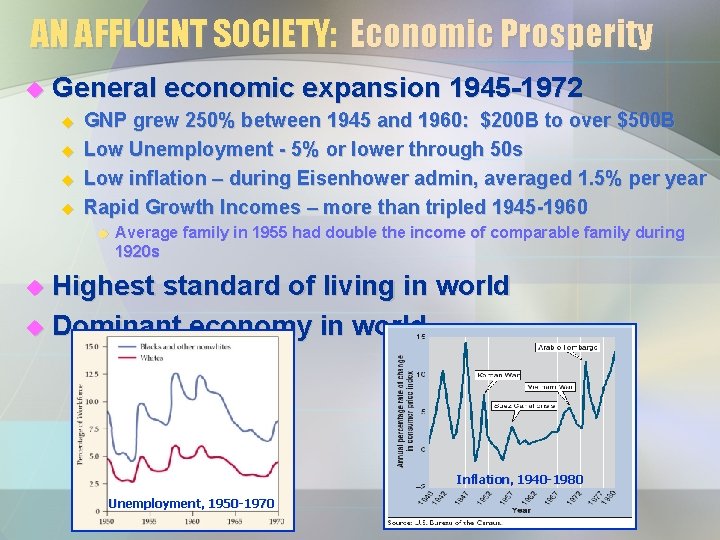
AN AFFLUENT SOCIETY: Economic Prosperity u General economic expansion 1945 -1972 u u GNP grew 250% between 1945 and 1960: $200 B to over $500 B Low Unemployment - 5% or lower through 50 s Low inflation – during Eisenhower admin, averaged 1. 5% per year Rapid Growth Incomes – more than tripled 1945 -1960 u Average family in 1955 had double the income of comparable family during 1920 s Highest standard of living in world u Dominant economy in world u Inflation, 1940 -1980 Unemployment, 1950 -1970
AN AFFLUENT SOCIETY: Economic Prosperity Reasons for Prosperity: u Pent-up savings u Lack of foreign competition u Government spending u u military (Korean War, Cold War) G. I. Bill u Expansion of suburbs – grew 47% during decade u stimulated demand for cars and homes
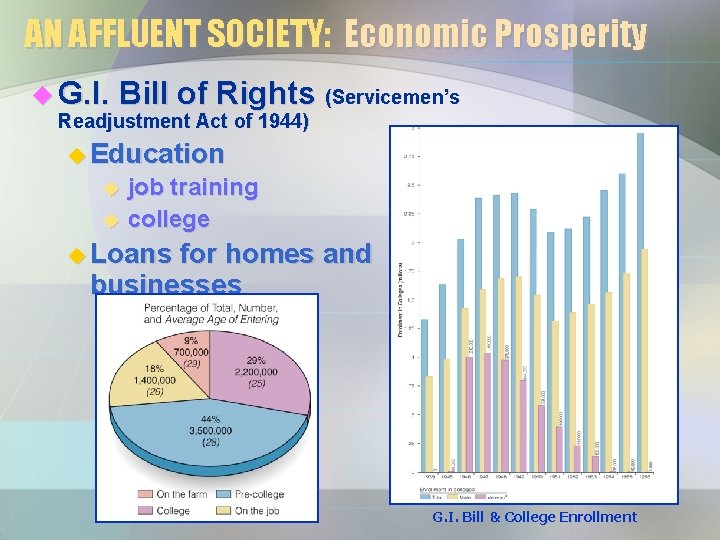
AN AFFLUENT SOCIETY: Economic Prosperity u G. I. Bill of Rights (Servicemen’s Readjustment Act of 1944) u Education job training u college u u Loans for homes and businesses G. I. Bill & College Enrollment
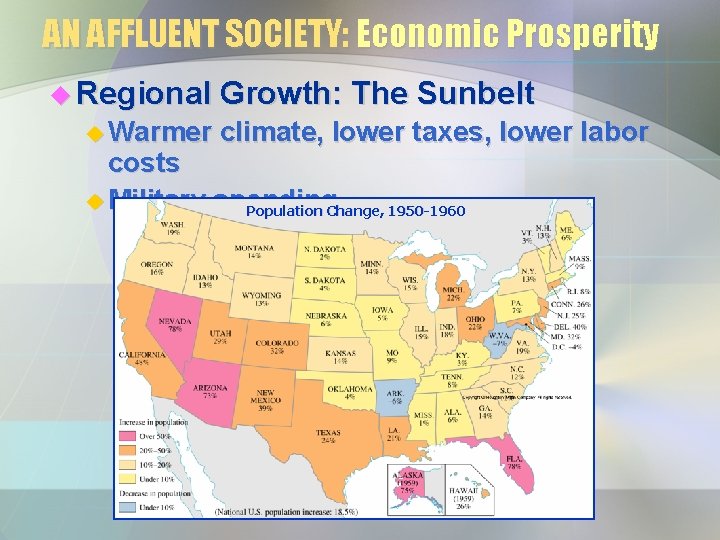
AN AFFLUENT SOCIETY: Economic Prosperity u Regional u Warmer Growth: The Sunbelt climate, lower taxes, lower labor costs u Military spending Population Change, 1950 -1960
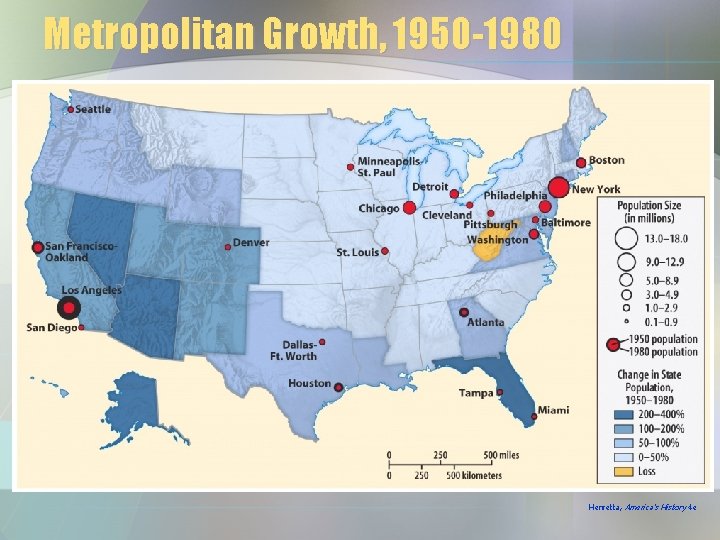
Metropolitan Growth, 1950 -1980 Henretta, America’s History 4 e
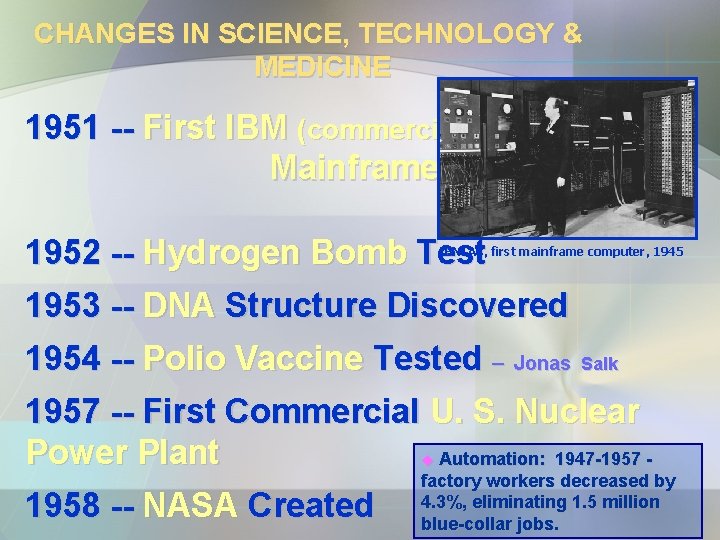
CHANGES IN SCIENCE, TECHNOLOGY & MEDICINE 1951 -- First IBM (commercial) Mainframe Computer 1952 -- Hydrogen Bomb Test ENIAC, first mainframe computer, 1945 1953 -- DNA Structure Discovered 1954 -- Polio Vaccine Tested – Jonas Salk 1957 -- First Commercial U. S. Nuclear Power Plant Automation: 1947 -1957 u 1958 -- NASA Created factory workers decreased by 4. 3%, eliminating 1. 5 million blue-collar jobs.
CONSENSUS & CONFORMITY SUBURBIA AND MIDDLE-CLASS AMERICA IN THE 1950 s
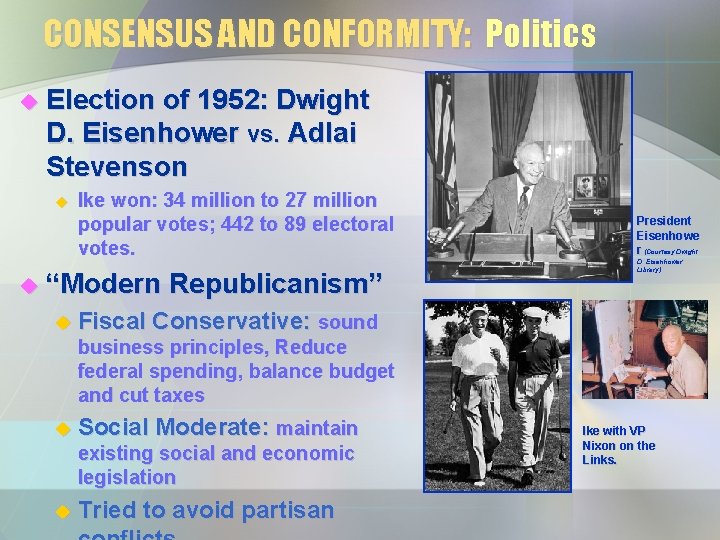
CONSENSUS AND CONFORMITY: Politics u Election of 1952: Dwight D. Eisenhower vs. Adlai Stevenson u u Ike won: 34 million to 27 million popular votes; 442 to 89 electoral votes. “Modern Republicanism” u Fiscal President Eisenhowe r (Courtesy Dwight D. Eisenhower Library) Conservative: sound business principles, Reduce federal spending, balance budget and cut taxes u Social Moderate: maintain existing social and economic legislation u Tried to avoid partisan Ike with VP Nixon on the Links.
The Challenge of Sputnik ● National Defense Education Act (1958) ● NASA (1958) ● “missile gap”
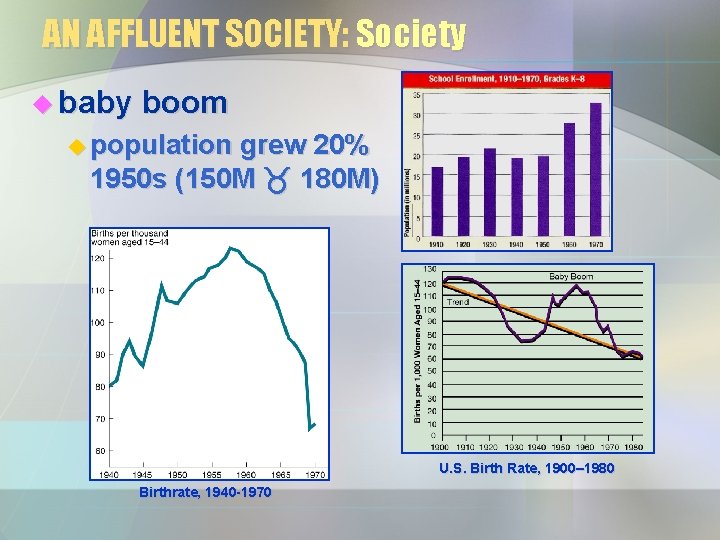
AN AFFLUENT SOCIETY: Society u baby boom u population grew 20% 1950 s (150 M 180 M) U. S. Birth Rate, 1900– 1980 Birthrate, 1940 -1970
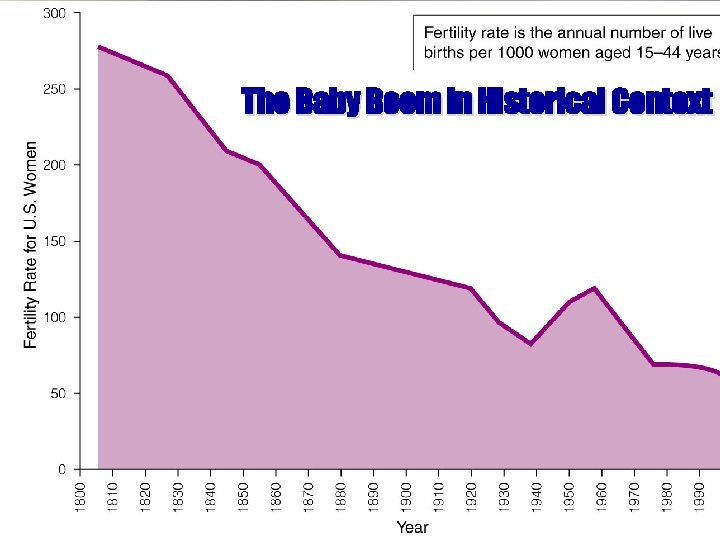
The Baby Boom in Historical Context
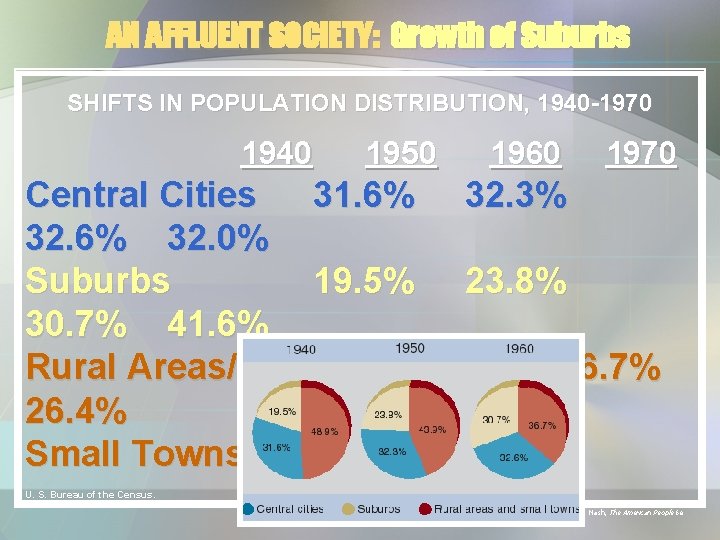
AN AFFLUENT SOCIETY: Growth of Suburbs SHIFTS IN POPULATION DISTRIBUTION, 1940 -1970 1940 1950 1960 1970 Central Cities 31. 6% 32. 3% 32. 6% 32. 0% Suburbs 19. 5% 23. 8% 30. 7% 41. 6% Rural Areas/ 48. 9% 43. 9% 36. 7% 26. 4% Small Towns U. S. Bureau of the Census. Nash, The American People 6 e
AN AFFLUENT SOCIETY: Growth of Suburbs REASONS FOR THE GROWTH OF SUBURBS u Growth of families (“baby boom”) u Home-ownership became more affordable u Low-interest mortgage loans u gov’t-backed & interest tax-deductable u Mass-produced subdivisions u Expressways – facilitated commuting u Decline in inner city housing stock u Also: congestion, pollution u Race – “white flight”
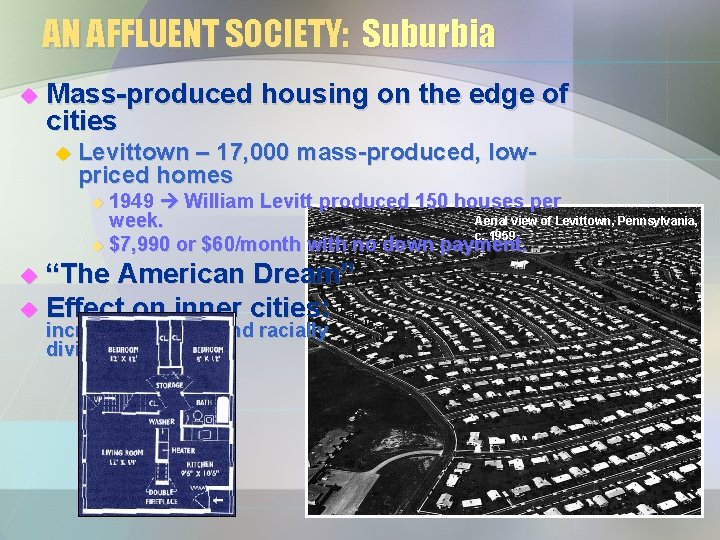
AN AFFLUENT SOCIETY: Suburbia u Mass-produced housing on the edge of cities u Levittown – 17, 000 mass-produced, lowpriced homes u 1949 William Levitt produced 150 houses per Aerial view of Levittown, Pennsylvania, week. c. 1959 u $7, 990 or $60/month with no down payment. “The American Dream” u Effect on inner cities: u increasingly poor and racially divided
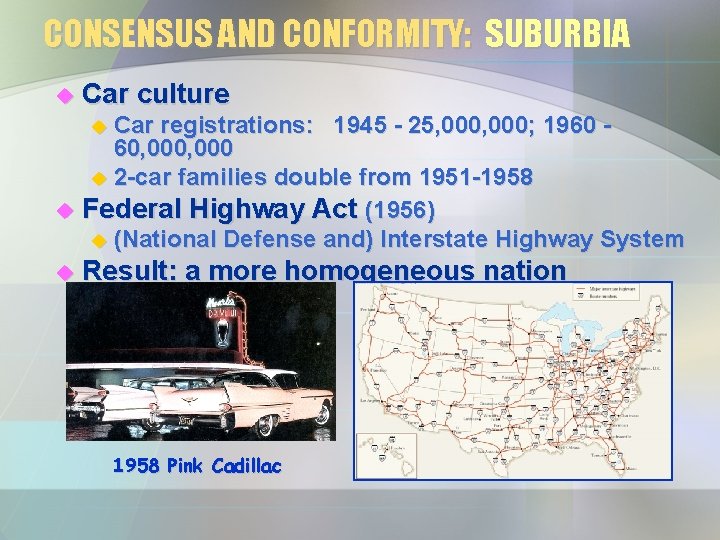
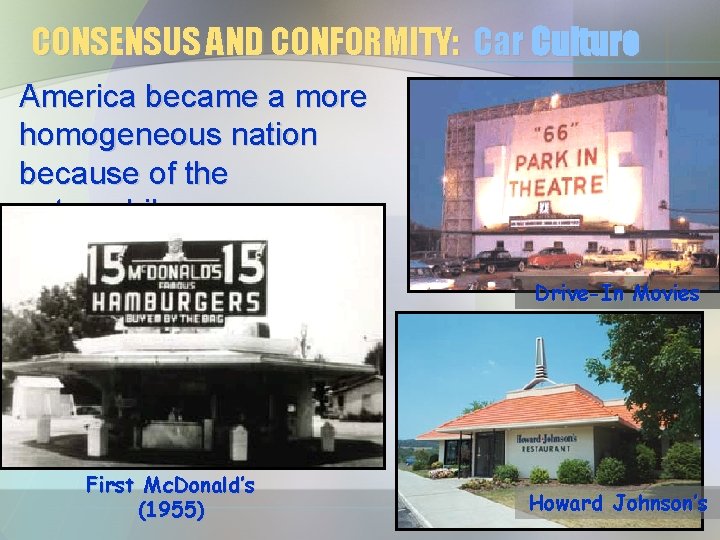
CONSENSUS AND CONFORMITY: SUBURBIA u Car culture u Car registrations: 1945 - 25, 000; 1960 60, 000 u 2 -car families double from 1951 -1958 u Federal Highway Act (1956) u (National Defense and) Interstate Highway System u Result: a more homogeneous nation 1958 Pink Cadillac
CONSENSUS AND CONFORMITY: Car Culture America became a more homogeneous nation because of the automobile. Drive-In Movies First Mc. Donald’s (1955) Howard Johnson’s
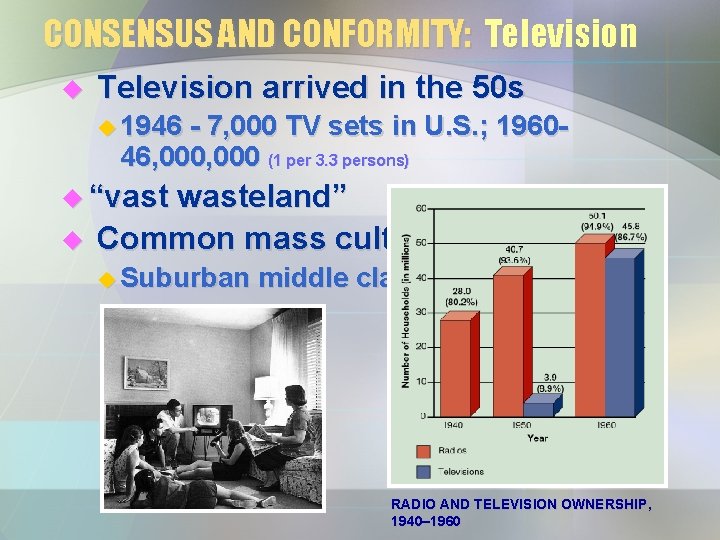
CONSENSUS AND CONFORMITY: Television u Television arrived in the 50 s u 1946 - 7, 000 TV sets in U. S. ; 196046, 000 (1 per 3. 3 persons) u “vast u wasteland” Common mass culture u Suburban middle class RADIO AND TELEVISION OWNERSHIP, 1940– 1960
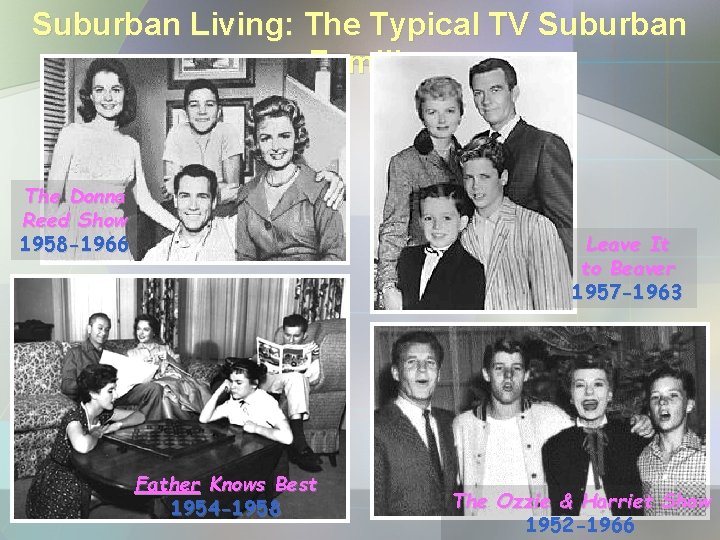
Suburban Living: The Typical TV Suburban Families The Donna Reed Show 1958 -1966 Leave It to Beaver 1957 -1963 Father Knows Best 1954 -1958 The Ozzie & Harriet Show 1952 -1966
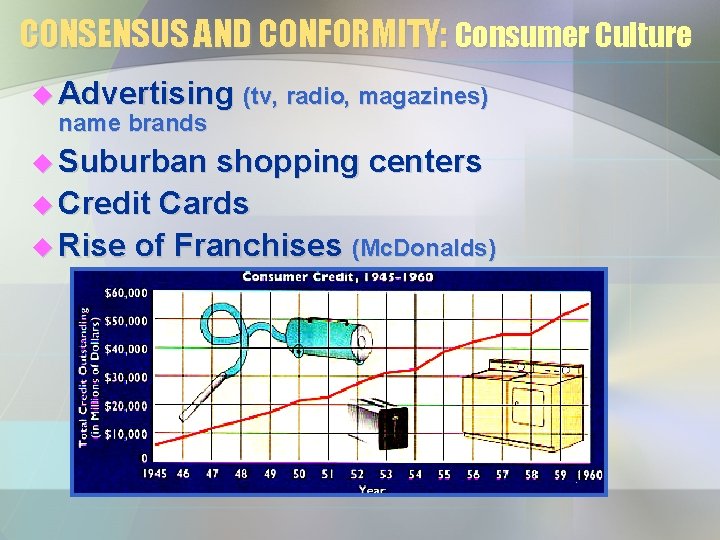
CONSENSUS AND CONFORMITY: Consumer Culture u Advertising (tv, radio, magazines) name brands u Suburban shopping centers u Credit Cards u Rise of Franchises (Mc. Donalds)
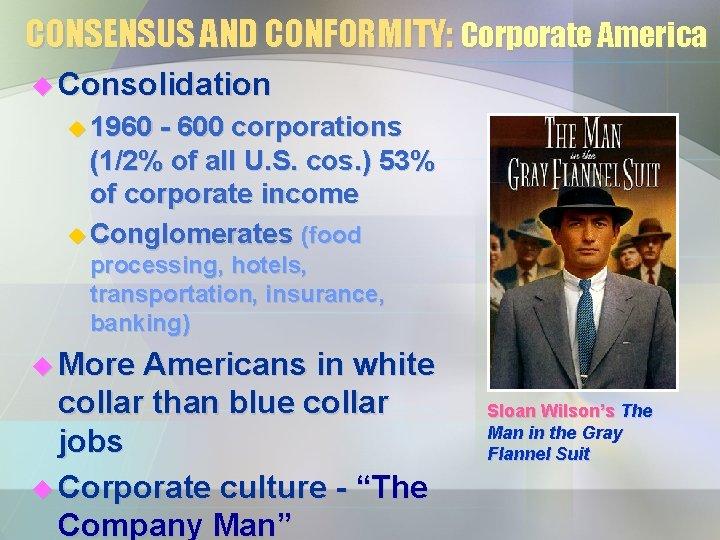
CONSENSUS AND CONFORMITY: Corporate America u Consolidation u 1960 - 600 corporations (1/2% of all U. S. cos. ) 53% of corporate income u Conglomerates (food processing, hotels, transportation, insurance, banking) u More Americans in white collar than blue collar jobs u Corporate culture - “The Company Man” Sloan Wilson’s The Man in the Gray Flannel Suit
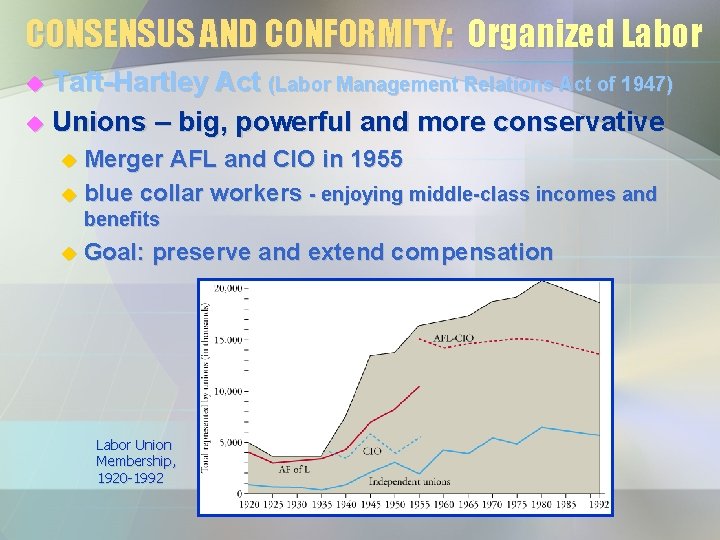
CONSENSUS AND CONFORMITY: Organized Labor Taft-Hartley Act (Labor Management Relations Act of 1947) u Unions – big, powerful and more conservative u u Merger AFL and CIO in 1955 u blue collar workers - enjoying middle-class incomes and benefits u Goal: preserve and extend compensation Labor Union Membership, 1920 -1992
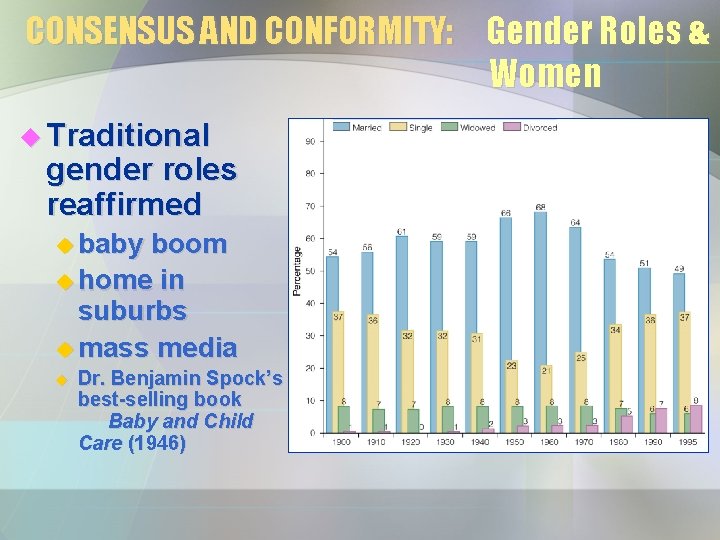
CONSENSUS AND CONFORMITY: Gender Roles & Women u Traditional gender roles reaffirmed u baby boom u home in suburbs u mass media u Dr. Benjamin Spock’s best-selling book Baby and Child Care (1946)
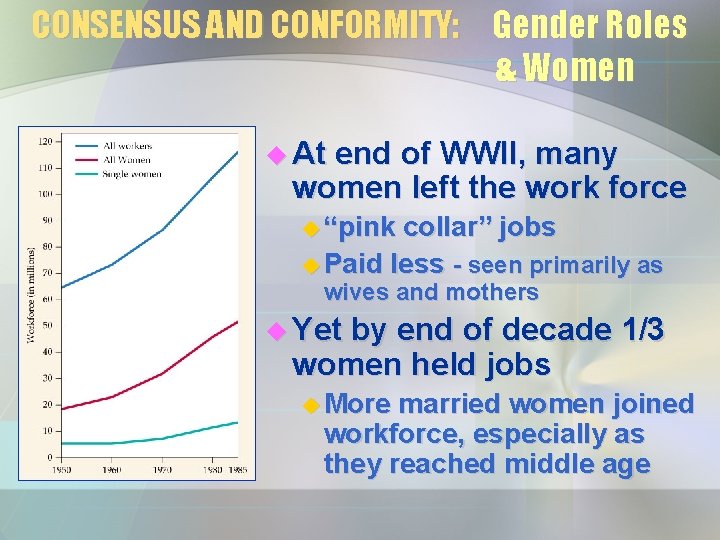
CONSENSUS AND CONFORMITY: Gender Roles & Women u At end of WWII, many women left the work force u “pink collar” jobs u Paid less - seen primarily as wives and mothers u Yet by end of decade 1/3 women held jobs u More married women joined workforce, especially as they reached middle age
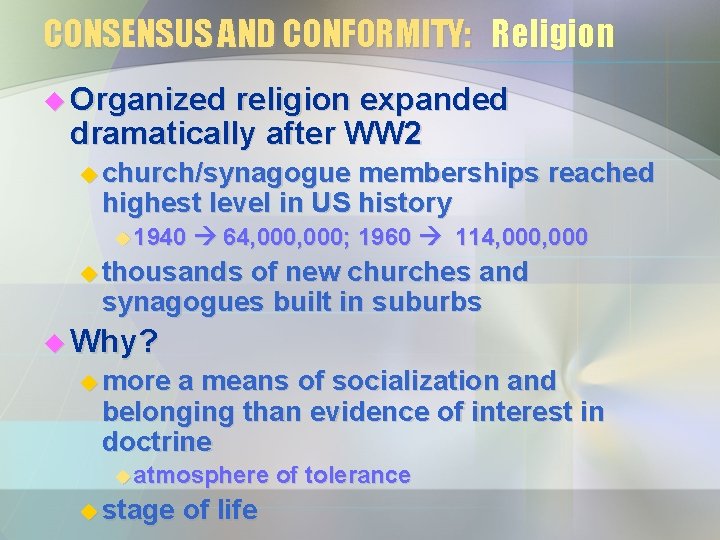
CONSENSUS AND CONFORMITY: Religion u Organized religion expanded dramatically after WW 2 u church/synagogue memberships reached highest level in US history u 1940 64, 000; 1960 114, 000 u thousands of new churches and synagogues built in suburbs u Why? u more a means of socialization and belonging than evidence of interest in doctrine u atmosphere u stage of life of tolerance
Other Americas
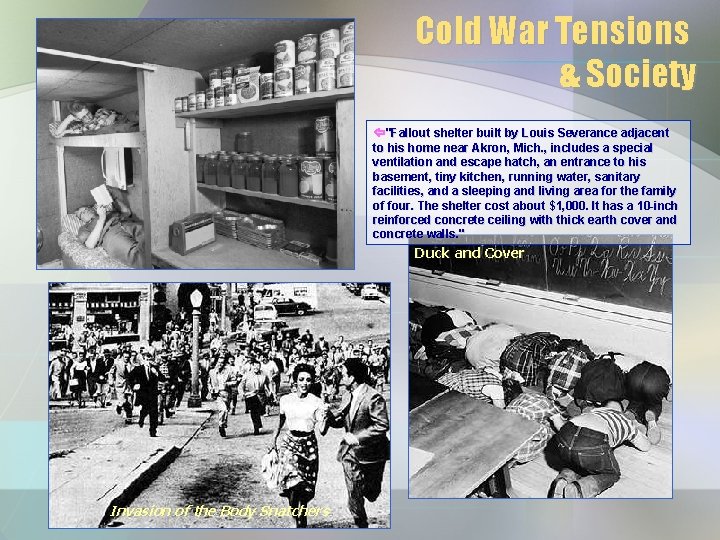
Cold War Tensions & Society "Fallout shelter built by Louis Severance adjacent to his home near Akron, Mich. , includes a special ventilation and escape hatch, an entrance to his basement, tiny kitchen, running water, sanitary facilities, and a sleeping and living area for the family of four. The shelter cost about $1, 000. It has a 10 -inch reinforced concrete ceiling with thick earth cover and concrete walls. " Duck and Cover Invasion of the Body Snatchers
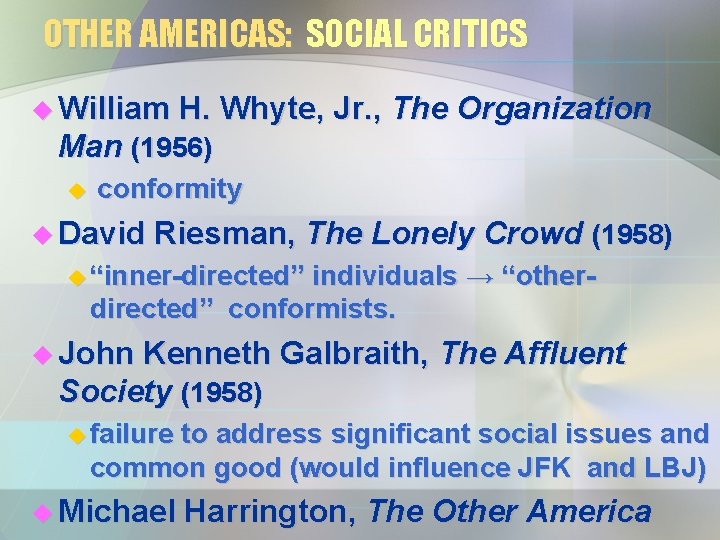
OTHER AMERICAS: SOCIAL CRITICS u William H. Whyte, Jr. , The Organization Man (1956) u conformity u David Riesman, The Lonely Crowd (1958) u “inner-directed” individuals → “otherdirected” conformists. u John Kenneth Galbraith, The Affluent Society (1958) u failure to address significant social issues and common good (would influence JFK and LBJ) u Michael Harrington, The Other America
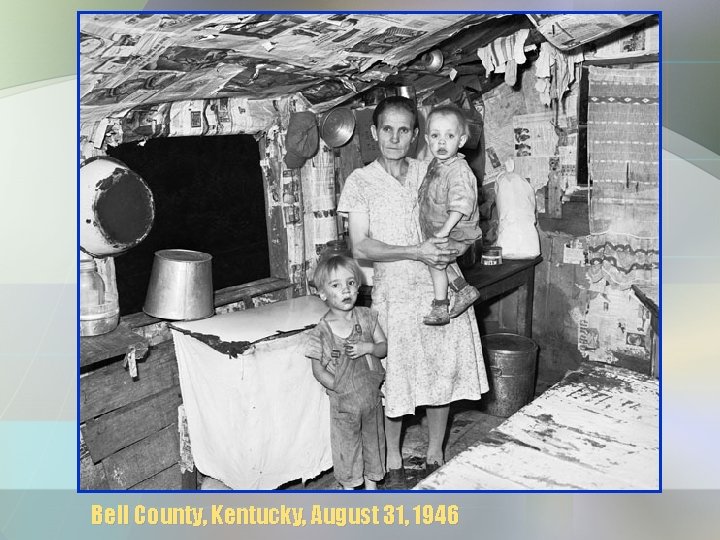
Other Americas “The entire invisible land of the other Americans became a ghetto, a modern poor farm for the rejects of society and the economy. ” Michael Harrington
Bell County, Kentucky, August 31, 1946
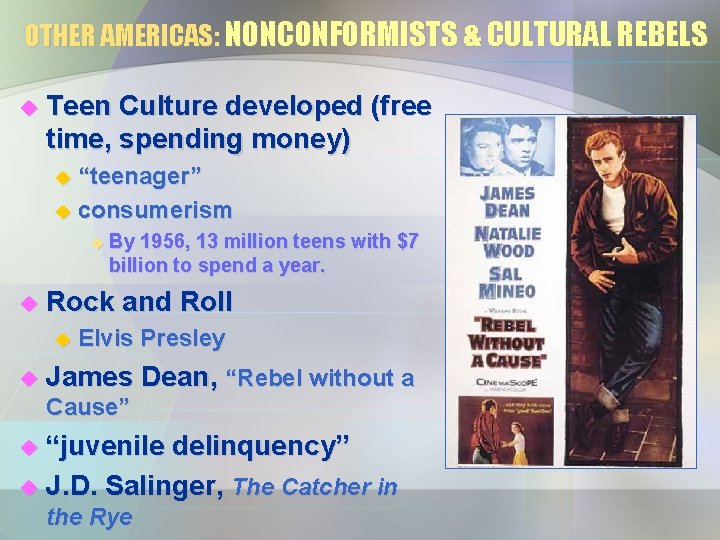
OTHER AMERICAS: NONCONFORMISTS & CULTURAL REBELS u Teen Culture developed (free time, spending money) u “teenager” u consumerism u By 1956, 13 million teens with $7 billion to spend a year. u Rock and Roll u Elvis u Presley James Dean, “Rebel without a Cause” “juvenile delinquency” u J. D. Salinger, The Catcher in u the Rye
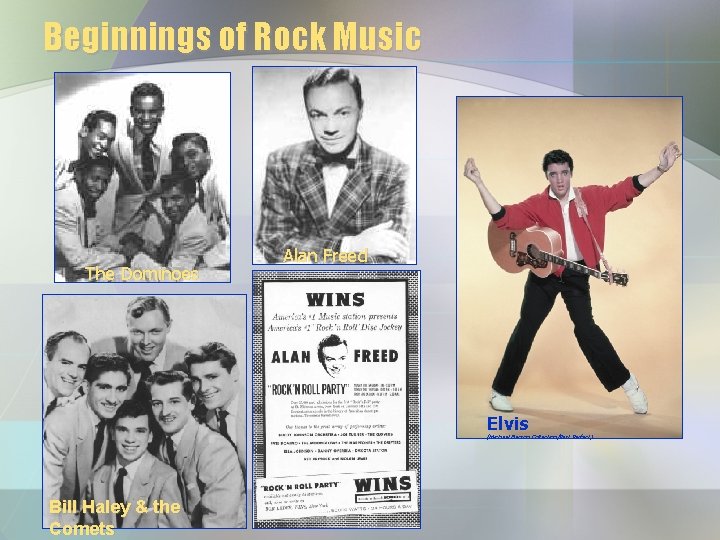
Beginnings of Rock Music The Dominoes Alan Freed Elvis (Michael Barson Collection/Past Perfect) Bill Haley & the Comets
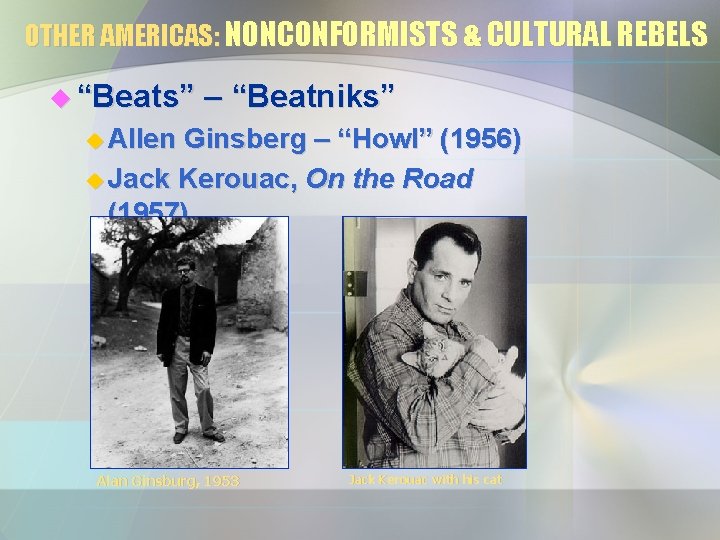
OTHER AMERICAS: NONCONFORMISTS & CULTURAL REBELS u “Beats” – “Beatniks” u Allen Ginsberg – “Howl” (1956) u Jack Kerouac, On the Road (1957) Alan Ginsburg, 1953 Jack Kerouac with his cat
Class Discussion Topic: The postwar era witnessed tremendous economic growth and rising social contentment and conformity. Yet in the midst of such increasing affluence and comfortable domesticity, social critics expressed a growing sense of unease with American culture in the 1950 s. Assess the validity of the above statement and explain how the decade of the 1950 s laid the groundwork for the social and political turbulence of the 1960 s.