
An Additive Latent Feature Model for Mario Fritz
![Related Work • Material recognition: – Finding Glass [Mc. Henry@CVPR 05/06] – Detecting Specular](https://slidetodoc.com/presentation_image_h2/8469071c291f7db587d98eadc6c62ab8/image-3.jpg "Related Work • Material recognition: – Finding Glass [Mc. Henry@CVPR 05/06] – Detecting Specular")
![Related Work • Material recognition: – Finding Glass [Mc. Henry@CVPR 05/06] – Detecting Specular](https://slidetodoc.com/presentation_image_h2/8469071c291f7db587d98eadc6c62ab8/image-4.jpg "Related Work • Material recognition: – Finding Glass [Mc. Henry@CVPR 05/06] – Detecting Specular")
![Related Work • Material recognition: – Finding Glass [Mc. Henry@CVPR 05/06] – Detecting Specular](https://slidetodoc.com/presentation_image_h2/8469071c291f7db587d98eadc6c62ab8/image-5.jpg "Related Work • Material recognition: – Finding Glass [Mc. Henry@CVPR 05/06] – Detecting Specular")
![Related Work • Material recognition: – Finding Glass [Mc. Henry@CVPR 05/06] – Detecting Specular](https://slidetodoc.com/presentation_image_h2/8469071c291f7db587d98eadc6c62ab8/image-6.jpg "Related Work • Material recognition: – Finding Glass [Mc. Henry@CVPR 05/06] – Detecting Specular")
![Related Work • Material recognition: – Finding Glass [Mc. Henry@CVPR 05/06] – Detecting Specular](https://slidetodoc.com/presentation_image_h2/8469071c291f7db587d98eadc6c62ab8/image-7.jpg "Related Work • Material recognition: – Finding Glass [Mc. Henry@CVPR 05/06] – Detecting Specular")

- Slides: 30
An Additive Latent Feature Model for Mario Fritz UC Berkeley Michael Black Brown University Gary Bradski Sergey Karayev Trevor Darrell Willow Garage UC Berkeley
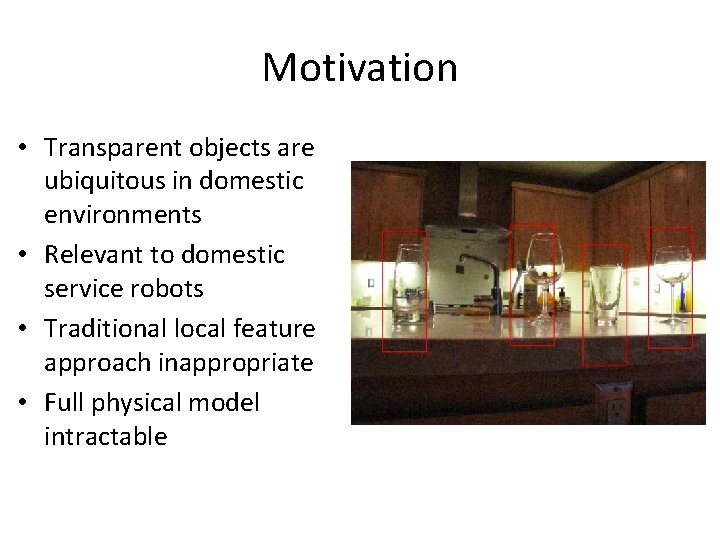
Motivation • Transparent objects are ubiquitous in domestic environments • Relevant to domestic service robots • Traditional local feature approach inappropriate • Full physical model intractable
Related Work • Material recognition: – Finding Glass [Mc. Henry@CVPR 05/06] – Detecting Specular Surfaces in Natural Images [Del. Pozo@CVPR 07] – Classifying Materials from their Reflectance Properties [Nillius@ECCV 04] – Low-Level Image Cues in the Perception of Translucent Materials [Fleming, Transactions on Applied Perception ’ 05] • Recognition by Specularities: – Using Specularities for Recognition [Osadchy@ICCV 03] • Transparent Motion and Layered Phenomena – E. g. [Roth@CVPR 06], [Ben-Ezra@ICCV 03], [Darrell@CVPR 93] … • Acquisition and rendering of refractive patterns – Environment Matting and Composition [Zongker@Siggraph 99]
Related Work • Material recognition: – Finding Glass [Mc. Henry@CVPR 05/06] – Detecting Specular Surfaces in Natural Images [Del. Pozo@CVPR 07] – Classifying Materials from their Reflectance Properties [Nillius@ECCV 04] – Low-Level Image Cues in the Perception of Translucent Materials [Fleming, Transactions on Applied Perception ’ 05] • Recognition by Specularities: – Using Specularities for Recognition [Osadchy@ICCV 03] • Transparent Motion and Layered Phenomena – E. g. [Roth@CVPR 06], [Ben-Ezra@ICCV 03], [Darrell@CVPR 93] … • Acquisition and rendering of refractive patterns – Environment Matting and Composition [Zongker@Siggraph 99]
Related Work • Material recognition: – Finding Glass [Mc. Henry@CVPR 05/06] – Detecting Specular Surfaces in Natural Images [Del. Pozo@CVPR 07] – Classifying Materials from their Reflectance Properties [Nillius@ECCV 04] – Low-Level Image Cues in the Perception of Translucent Materials [Fleming, Transactions on Applied Perception ’ 05] • Recognition by Specularities: – Using Specularities for Recognition [Osadchy@ICCV 03] • Transparent Motion and Layered Phenomena – E. g. [Roth@CVPR 06], [Ben-Ezra@ICCV 03], [Darrell@CVPR 93] … • Acquisition and rendering of refractive patterns – Environment Matting and Composition [Zongker@Siggraph 99]
Related Work • Material recognition: – Finding Glass [Mc. Henry@CVPR 05/06] – Detecting Specular Surfaces in Natural Images [Del. Pozo@CVPR 07] – Classifying Materials from their Reflectance Properties [Nillius@ECCV 04] – Low-Level Image Cues in the Perception of Translucent Materials [Fleming, Transactions on Applied Perception ’ 05] • Recognition by Specularities: – Using Specularities for Recognition [Osadchy@ICCV 03] • Transparent Motion and Layered Phenomena – E. g. [Roth@CVPR 06], [Ben-Ezra@ICCV 03], [Darrell@CVPR 93] … • Acquisition and rendering of refractive patterns – Environment Matting and Composition [Zongker@Siggraph 99]
Related Work • Material recognition: – Finding Glass [Mc. Henry@CVPR 05/06] – Detecting Specular Surfaces in Natural Images [Del. Pozo@CVPR 07] – Classifying Materials from their Reflectance Properties [Nillius@ECCV 04] – Low-Level Image Cues in the Perception of Translucent Materials [Fleming, Transactions on Applied Perception ’ 05] • Recognition by Specularities: – Using Specularities for Recognition [Osadchy@ICCV 03] • Transparent Motion and Layered Phenomena – E. g. [Roth@CVPR 06], [Ben-Ezra@ICCV 03], [Darrell@CVPR 93] … • Acquisition and rendering of refractive patterns – Environment Matting and Composition [Zongker@Siggraph 99] • Non of these approaches addresses transparent objects recognition in real-world conditions
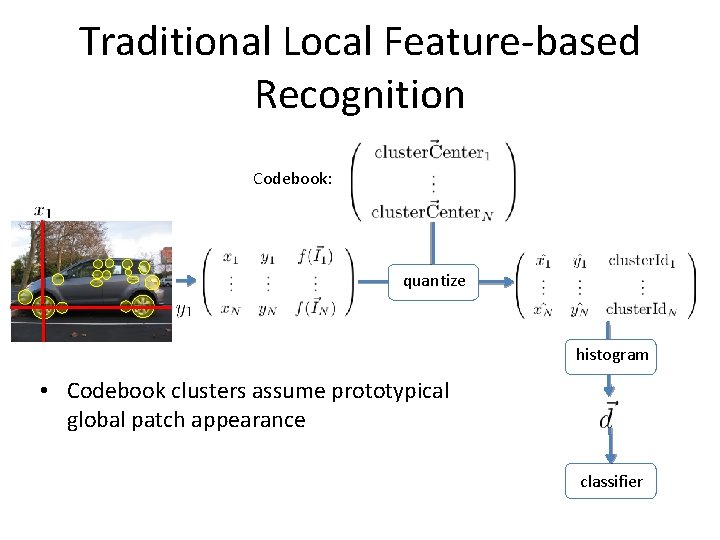
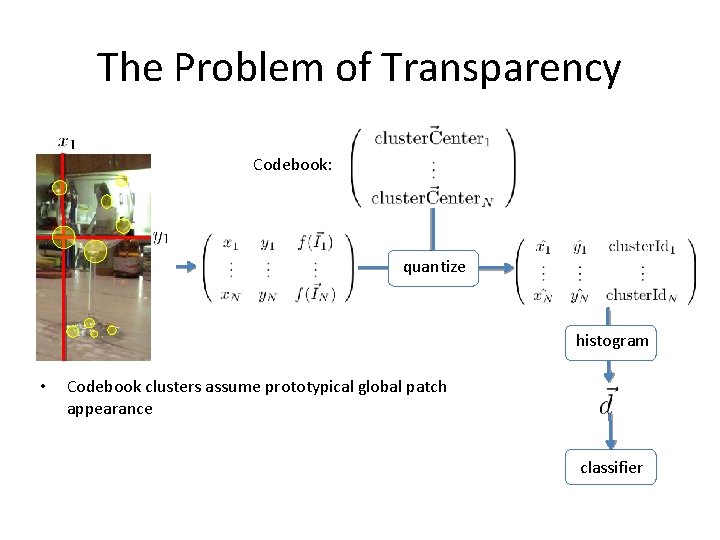
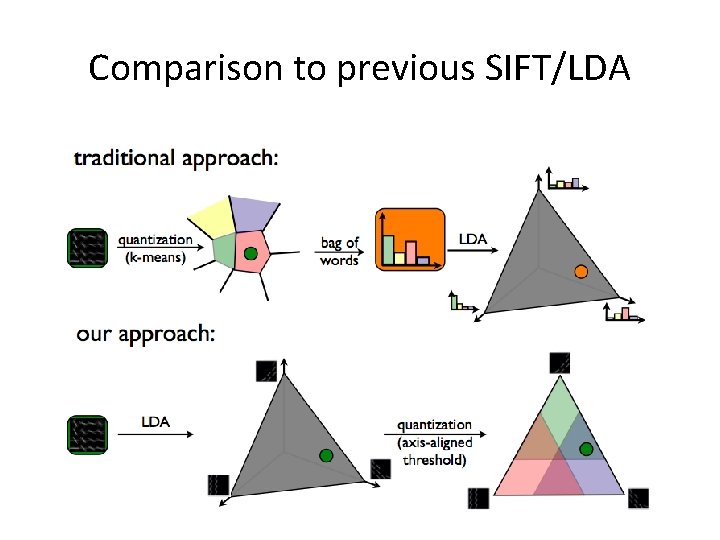
Traditional Local Feature-based Recognition Codebook: quantize histogram • Codebook clusters assume prototypical global patch appearance classifier
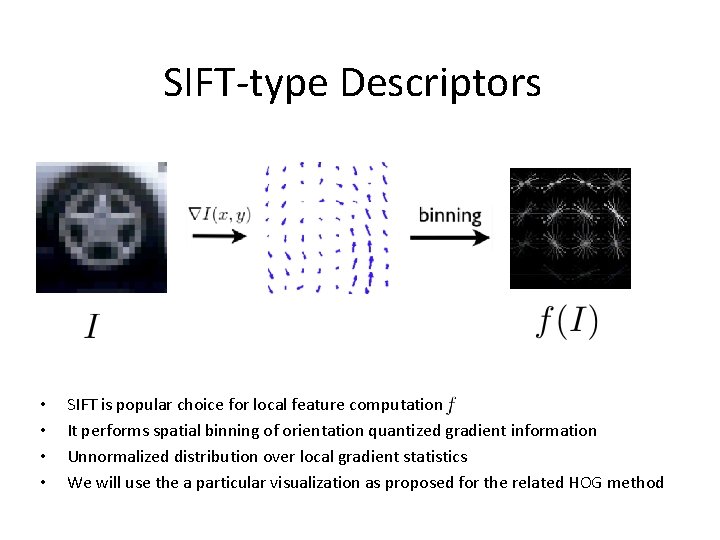
SIFT-type Descriptors • • SIFT is popular choice for local feature computation It performs spatial binning of orientation quantized gradient information Unnormalized distribution over local gradient statistics We will use the a particular visualization as proposed for the related HOG method
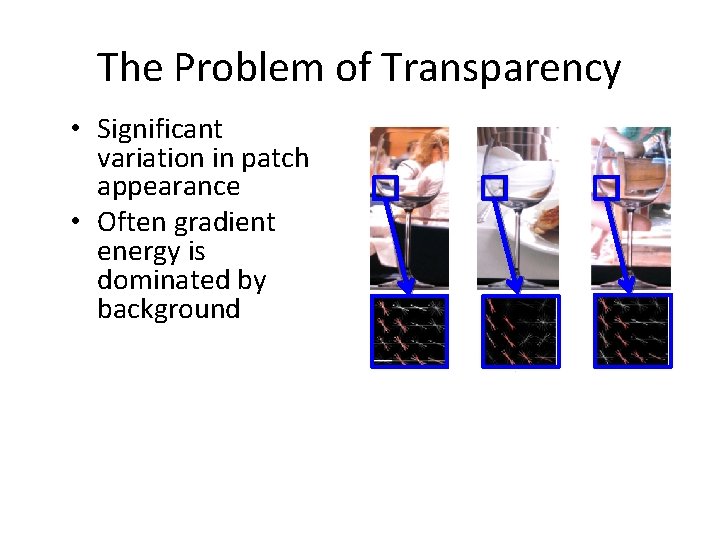
The Problem of Transparency • Significant variation in patch appearance • Often gradient energy is dominated by background
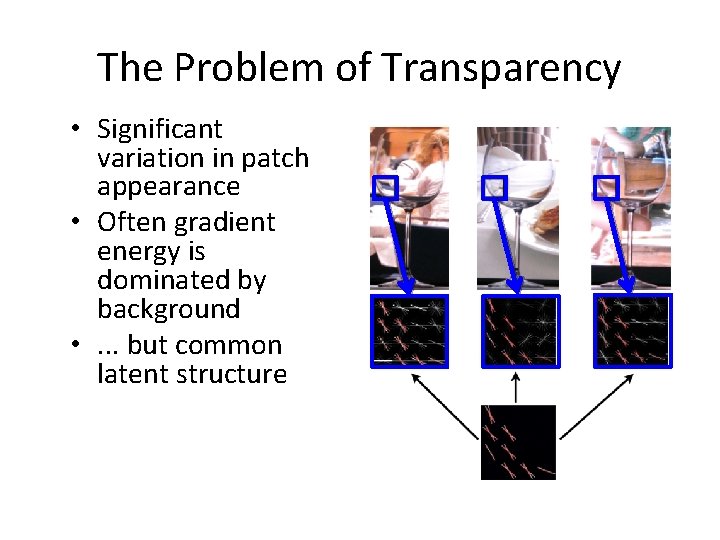
The Problem of Transparency • Significant variation in patch appearance • Often gradient energy is dominated by background • . . . but common latent structure
The Problem of Transparency Codebook: quantize histogram • Codebook clusters assume prototypical global patch appearance classifier
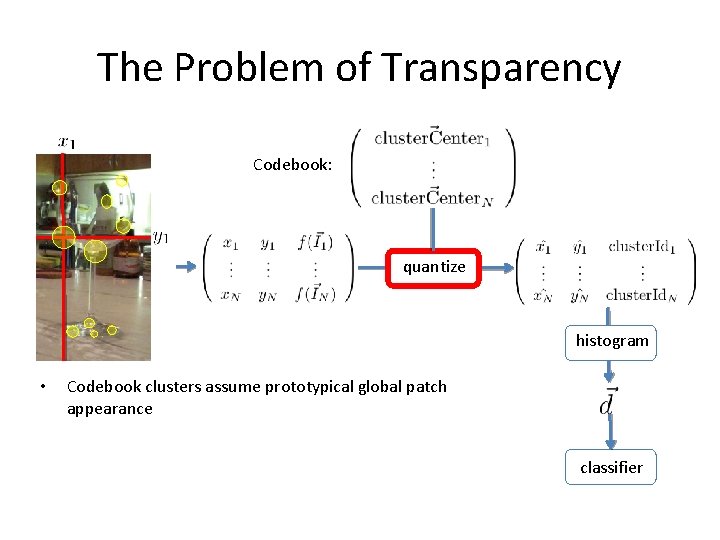
The Problem of Transparency Codebook: quantize histogram • Codebook clusters assume prototypical global patch appearance classifier
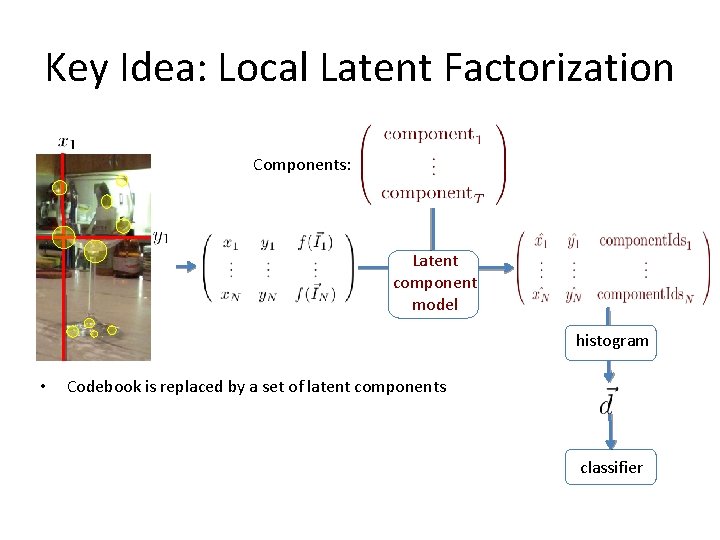
Key Idea: Local Latent Factorization Components: Latent component latent model histogram • Codebook is replaced by a set of latent components classifier
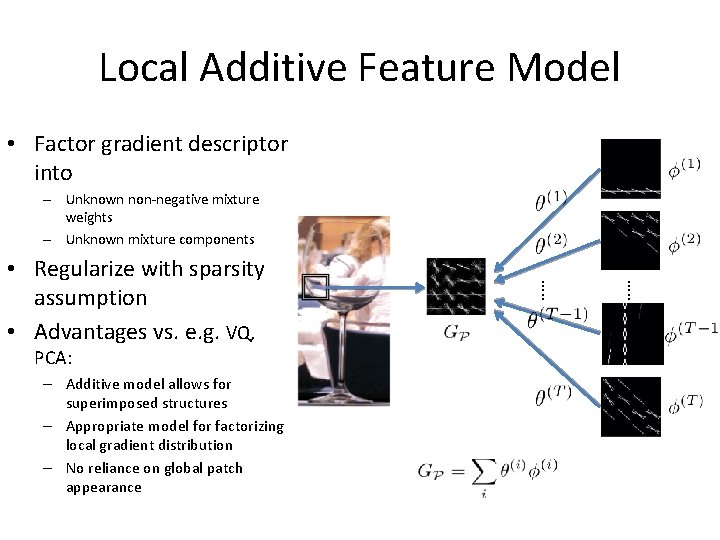
Local Additive Feature Model • Factor gradient descriptor into – Unknown non-negative mixture weights – Unknown mixture components – Additive model allows for superimposed structures – Appropriate model for factorizing local gradient distribution – No reliance on global patch appearance …. . PCA: …. . • Regularize with sparsity assumption • Advantages vs. e. g. VQ,
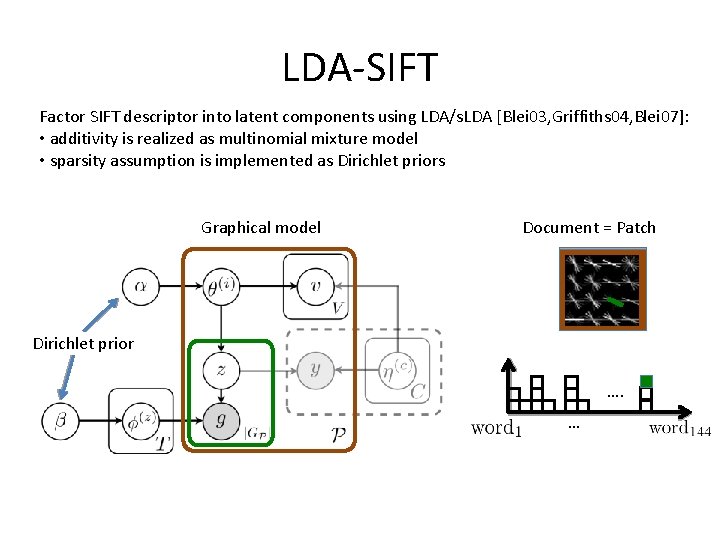
LDA-SIFT Factor SIFT descriptor into latent components using LDA/s. LDA [Blei 03, Griffiths 04, Blei 07]: • additivity is realized as multinomial mixture model • sparsity assumption is implemented as Dirichlet priors Graphical model Document = Patch Dirichlet prior …. …
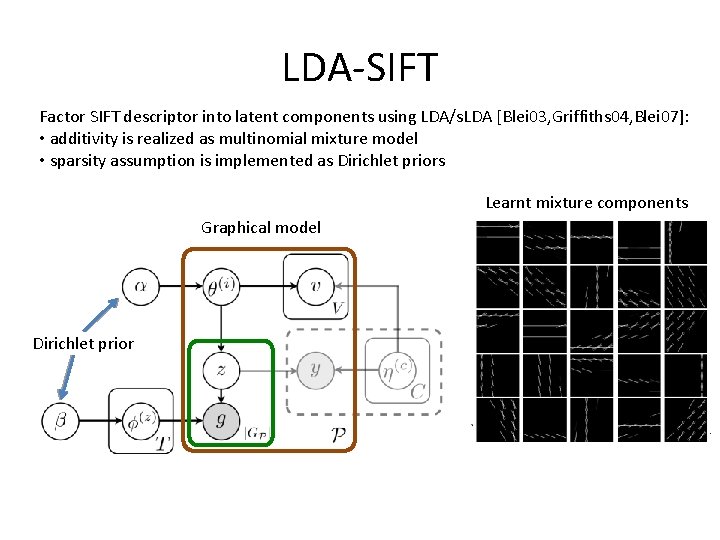
LDA-SIFT Factor SIFT descriptor into latent components using LDA/s. LDA [Blei 03, Griffiths 04, Blei 07]: • additivity is realized as multinomial mixture model • sparsity assumption is implemented as Dirichlet priors Graphical model Learnt mixture components Document = Patch Dirichlet prior …. …
Comparison to previous SIFT/LDA
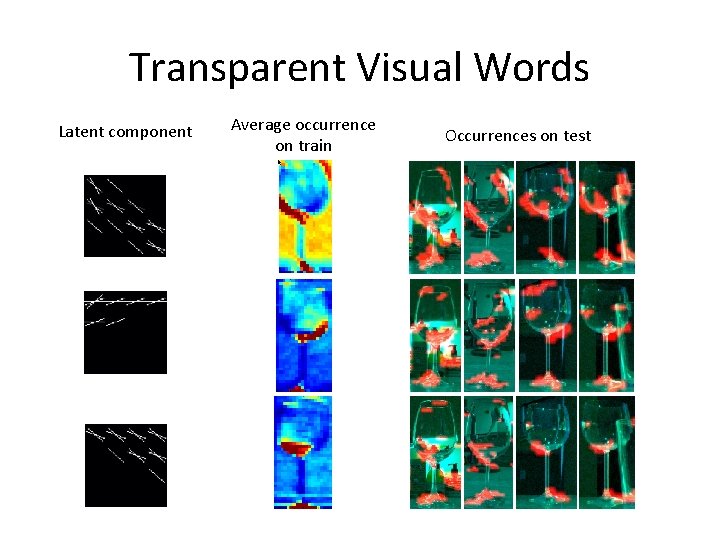
Transparent Visual Words Latent component Average occurrence on train Occurrences on test
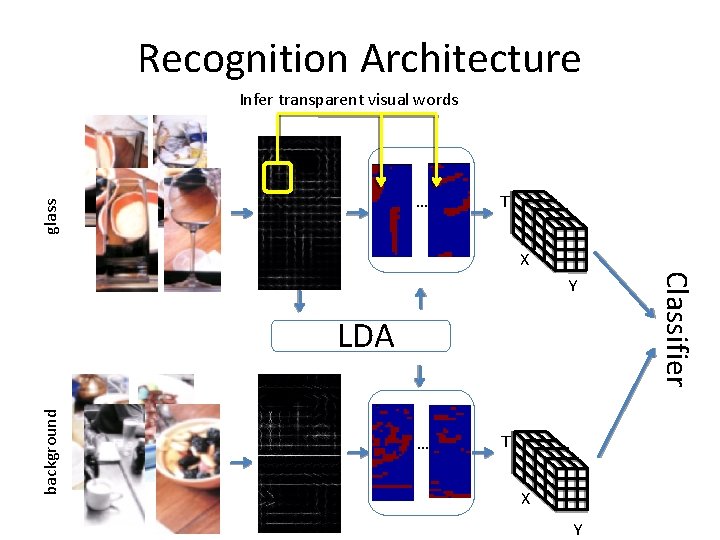
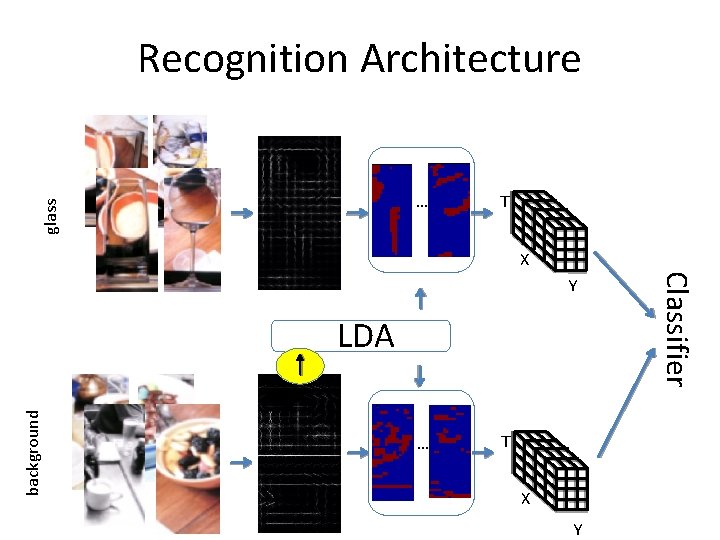
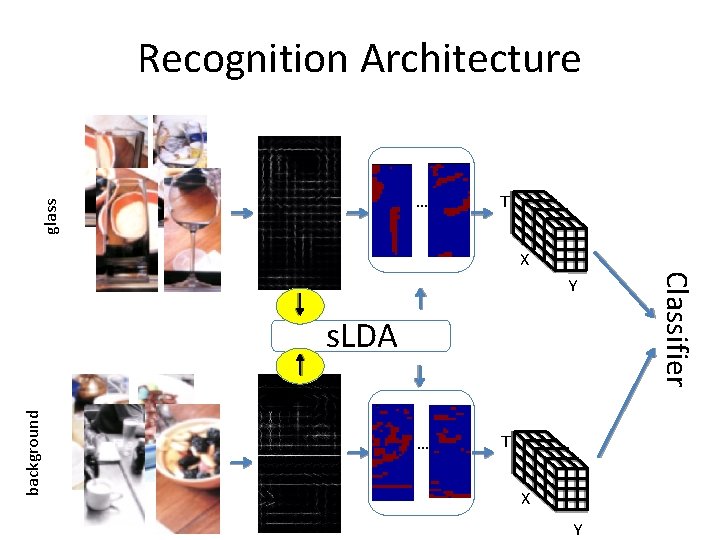
Recognition Architecture glass Infer transparent visual words T … X … background LDA T X Y Classifier Y
Experiments
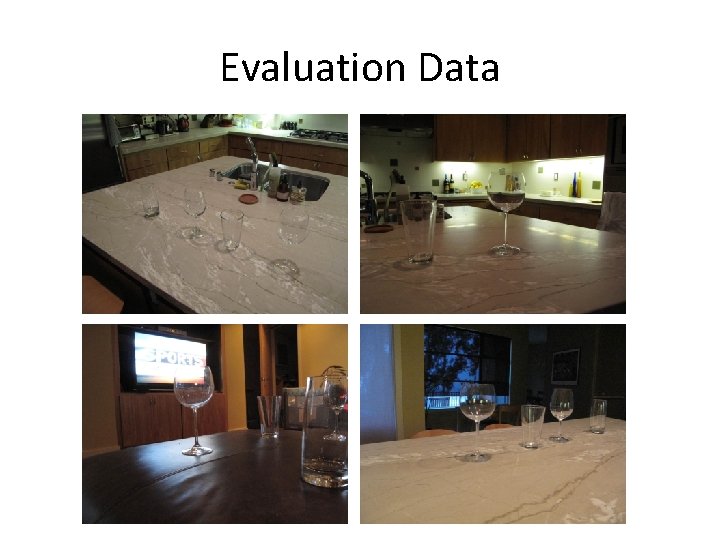
Evaluation Data
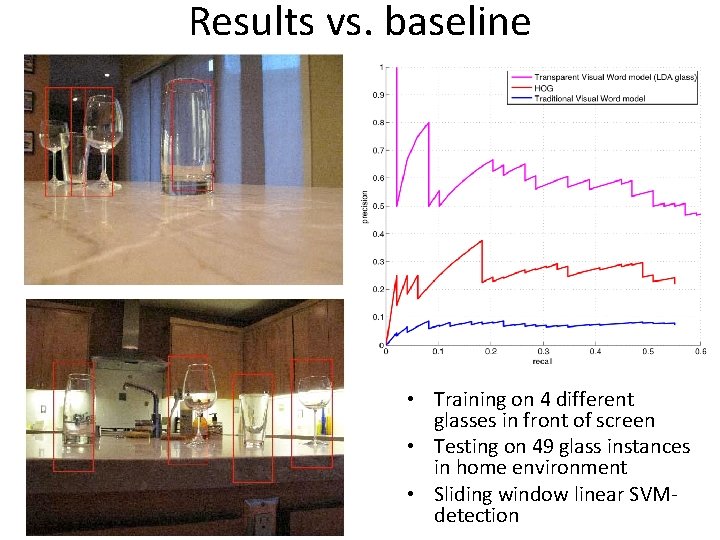
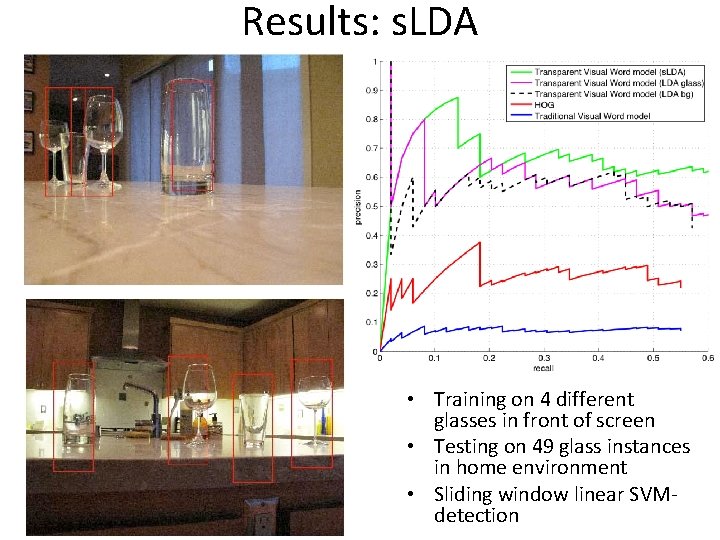
Results vs. baseline • Training on 4 different glasses in front of screen • Testing on 49 glass instances in home environment • Sliding window linear SVMdetection
glass Recognition Architecture T … X … background LDA T X Y Classifier Y
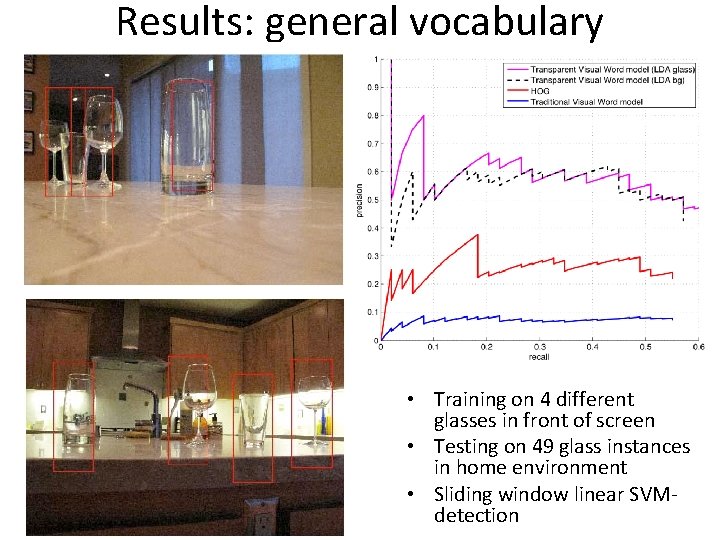
Results: general vocabulary • Training on 4 different glasses in front of screen • Testing on 49 glass instances in home environment • Sliding window linear SVMdetection
glass Recognition Architecture T … X … background s. LDA T X Y Classifier Y
Results: s. LDA • Training on 4 different glasses in front of screen • Testing on 49 glass instances in home environment • Sliding window linear SVMdetection
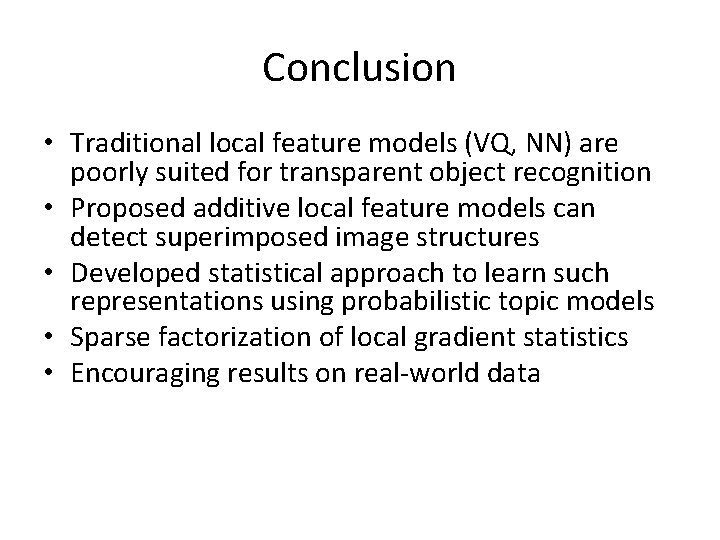
Conclusion • Traditional local feature models (VQ, NN) are poorly suited for transparent object recognition • Proposed additive local feature models can detect superimposed image structures • Developed statistical approach to learn such representations using probabilistic topic models • Sparse factorization of local gradient statistics • Encouraging results on real-world data
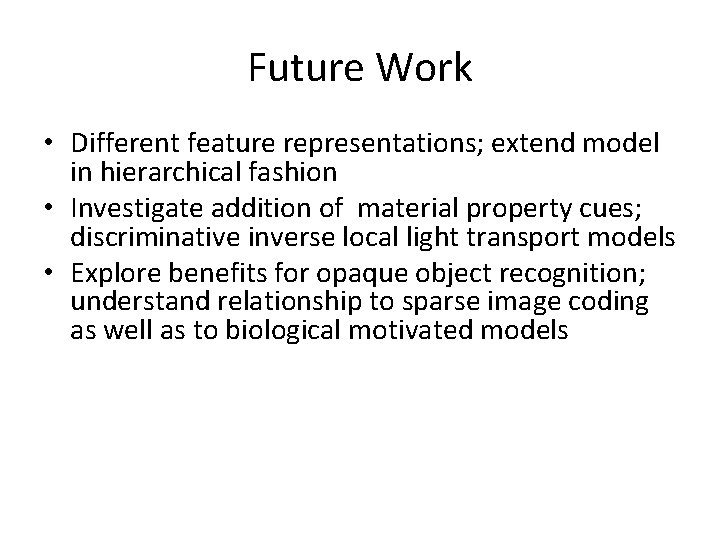
Future Work • Different feature representations; extend model in hierarchical fashion • Investigate addition of material property cues; discriminative inverse local light transport models • Explore benefits for opaque object recognition; understand relationship to sparse image coding as well as to biological motivated models
Thank you for your attention.