
An Adaptive Multichannel MAC protocol for Wireless Ad

- Slides: 40
An Adaptive Multi-channel MAC protocol for Wireless Ad Hoc Networks Advisor: Wen-Tsuen Chen Student: Ting-Kai Huang 2005 -10 -7 Ting-Kai Huang, MNET Lab
Outline n n n Introduction Related works Proposed method Simulation results Conclusion 2005 -10 -7 Ting-Kai Huang, MNET Lab 2
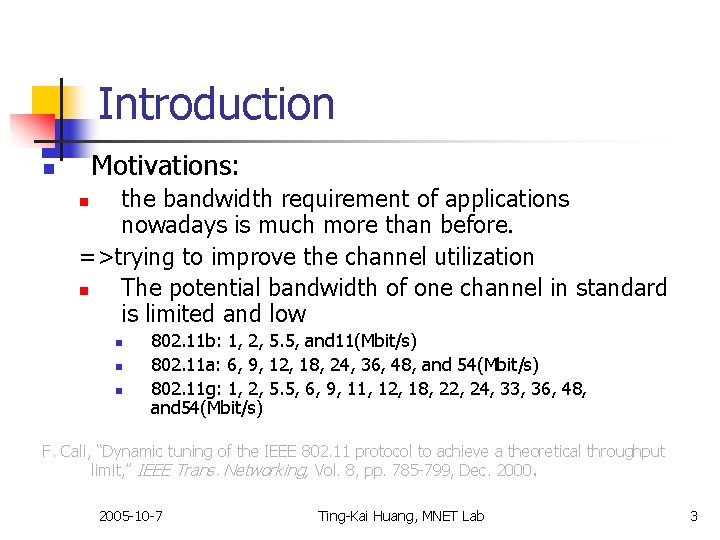
Introduction Motivations: n the bandwidth requirement of applications nowadays is much more than before. =>trying to improve the channel utilization n The potential bandwidth of one channel in standard is limited and low n n 802. 11 b: 1, 2, 5. 5, and 11(Mbit/s) 802. 11 a: 6, 9, 12, 18, 24, 36, 48, and 54(Mbit/s) 802. 11 g: 1, 2, 5. 5, 6, 9, 11, 12, 18, 22, 24, 33, 36, 48, and 54(Mbit/s) F. Cali, “Dynamic tuning of the IEEE 802. 11 protocol to achieve a theoretical throughput limit, ” IEEE Trans. Networking, Vol. 8, pp. 785 -799, Dec. 2000. 2005 -10 -7 Ting-Kai Huang, MNET Lab 3
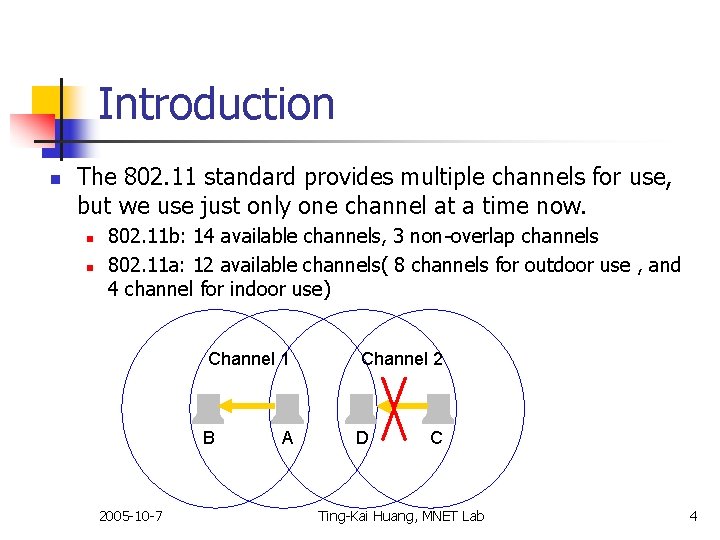
Introduction n The 802. 11 standard provides multiple channels for use, but we use just only one channel at a time now. n n 802. 11 b: 14 available channels, 3 non-overlap channels 802. 11 a: 12 available channels( 8 channels for outdoor use , and 4 channel for indoor use) Channel 1 B 2005 -10 -7 A Channel 2 D C Ting-Kai Huang, MNET Lab 4
Introduction n Design a MAC protocol to exploit multiple channels in wireless ad hoc networks. It is an effective way to increase the networks capacity. Multi-channel MAC protocols can be divided into two parts: n Channel assignment n Medium access control 2005 -10 -7 Ting-Kai Huang, MNET Lab 5
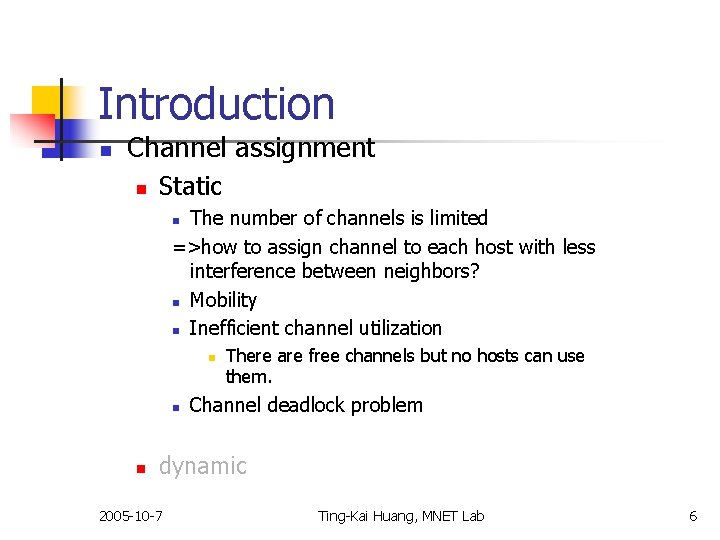
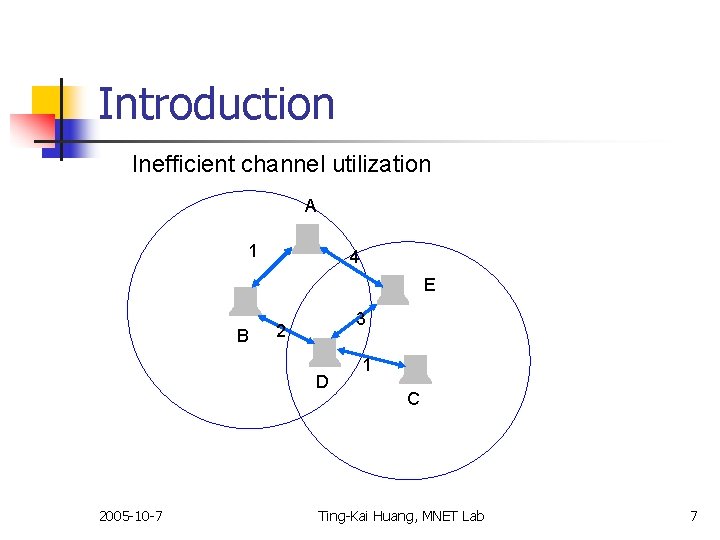
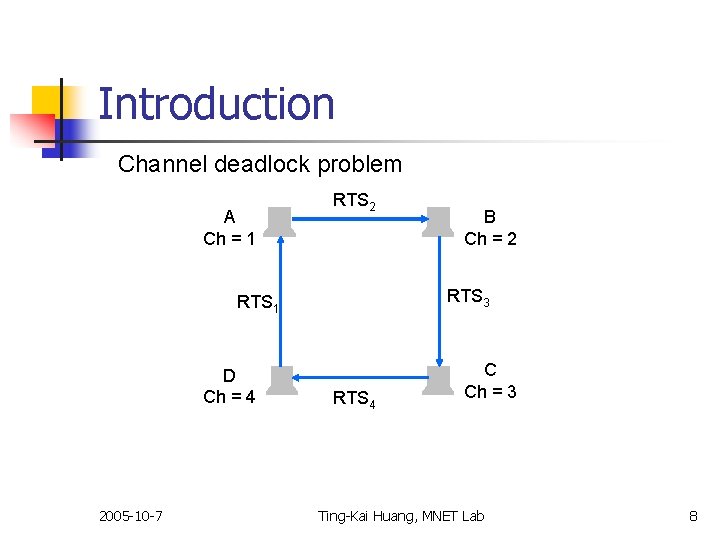
Introduction n Channel assignment n Static The number of channels is limited =>how to assign channel to each host with less interference between neighbors? n Mobility n Inefficient channel utilization n n There are free channels but no hosts can use them. Channel deadlock problem dynamic 2005 -10 -7 Ting-Kai Huang, MNET Lab 6
Introduction Inefficient channel utilization A 1 4 E B 3 2 D 2005 -10 -7 1 C Ting-Kai Huang, MNET Lab 7
Introduction Channel deadlock problem A Ch = 1 RTS 2 RTS 3 RTS 1 D Ch = 4 2005 -10 -7 B Ch = 2 RTS 4 C Ch = 3 Ting-Kai Huang, MNET Lab 8
Introduction n Static n Dynamic n n Hosts listen on the same channel when they don’t have packets to send. A Host negotiates with its receiver to reserved a channel for data transmission and releases the channel when it finishes the transmission. 2005 -10 -7 Ting-Kai Huang, MNET Lab 9
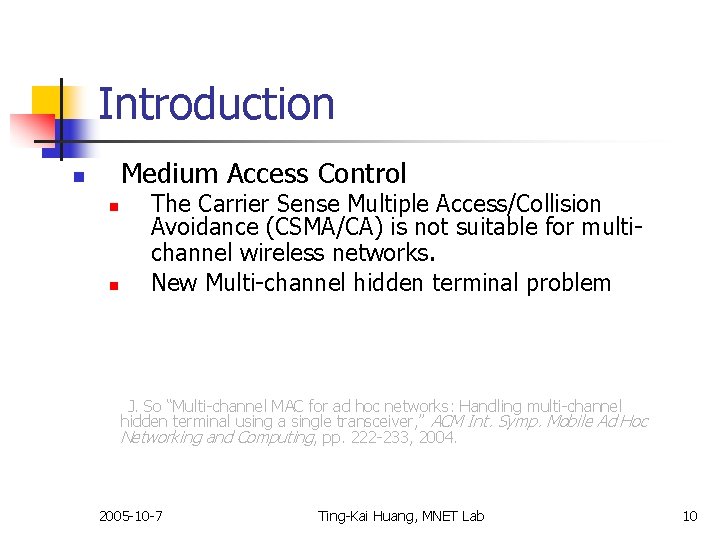
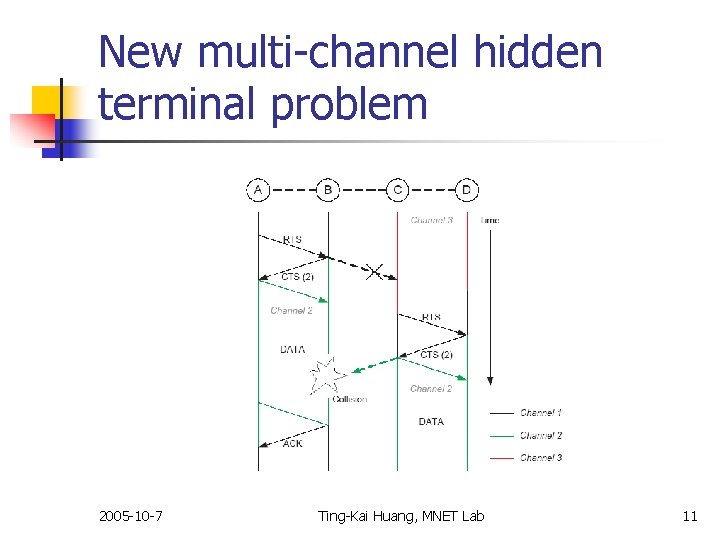
Introduction Medium Access Control n n n The Carrier Sense Multiple Access/Collision Avoidance (CSMA/CA) is not suitable for multichannel wireless networks. New Multi-channel hidden terminal problem J. So “Multi-channel MAC for ad hoc networks: Handling multi-channel hidden terminal using a single transceiver, ” ACM Int. Symp. Mobile Ad Hoc Networking and Computing, pp. 222 -233, 2004. 2005 -10 -7 Ting-Kai Huang, MNET Lab 10
New multi-channel hidden terminal problem 2005 -10 -7 Ting-Kai Huang, MNET Lab 11
Related Works n In order to overcome the new multi-channel hidden terminal problem, =>Each host is equipped with multiple transceivers( as much as the number of channels. ) Nasipuri, A. ; Zhuang, and J. ; Das, S. R. ”A multichannel CSMA MAC protocol for multihop wireless networks, ” IEEE Conf. WCNC, vol. 3, pp. 1402 -1406, Sept. 1999. 2005 -10 -7 Ting-Kai Huang, MNET Lab 12
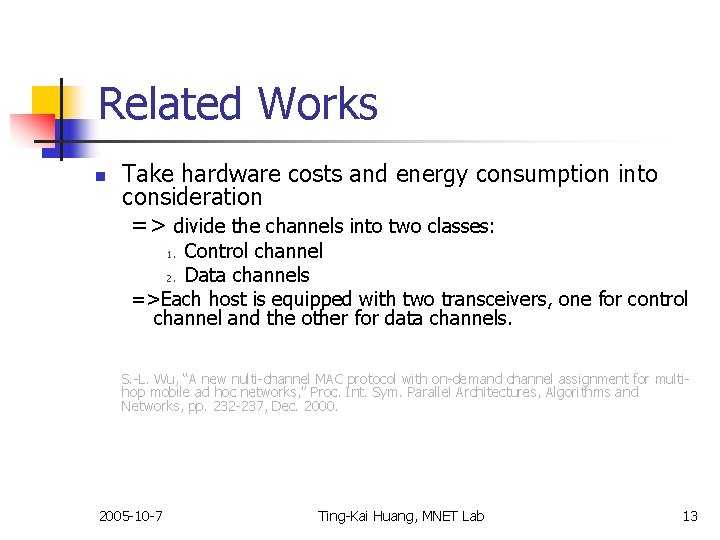
Related Works n Take hardware costs and energy consumption into consideration => divide the channels into two classes: Control channel 2. Data channels =>Each host is equipped with two transceivers, one for control channel and the other for data channels. 1. S. -L. Wu, “A new nulti-channel MAC protocol with on-demand channel assignment for multihop mobile ad hoc networks, ” Proc. Int. Sym. Parallel Architectures, Algorithms and Networks, pp. 232 -237, Dec. 2000. 2005 -10 -7 Ting-Kai Huang, MNET Lab 13
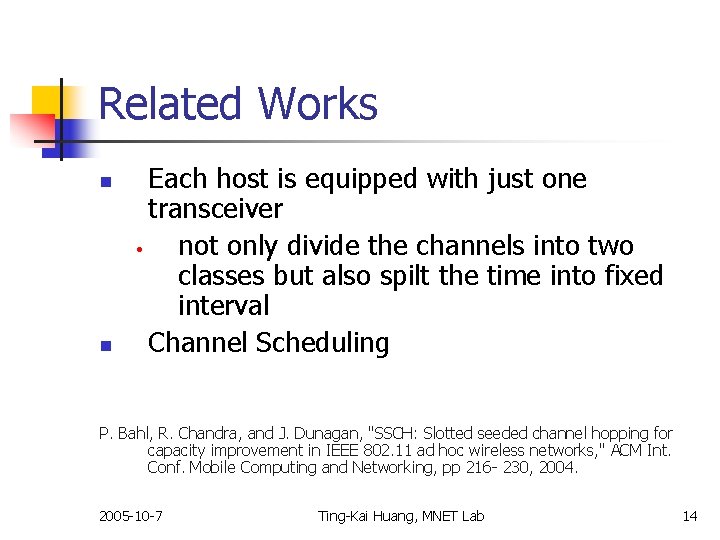
Related Works n n Each host is equipped with just one transceiver • not only divide the channels into two classes but also spilt the time into fixed interval Channel Scheduling P. Bahl, R. Chandra, and J. Dunagan, "SSCH: Slotted seeded channel hopping for capacity improvement in IEEE 802. 11 ad hoc wireless networks, " ACM Int. Conf. Mobile Computing and Networking, pp 216 - 230, 2004. 2005 -10 -7 Ting-Kai Huang, MNET Lab 14
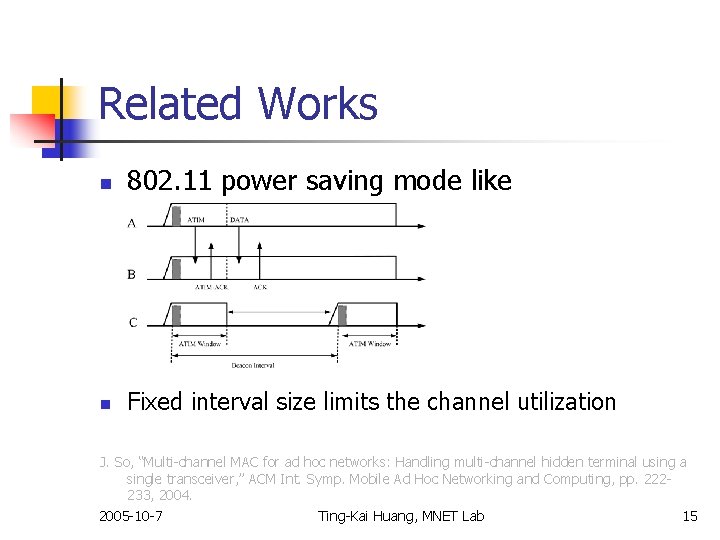
Related Works n 802. 11 power saving mode like n Fixed interval size limits the channel utilization J. So, “Multi-channel MAC for ad hoc networks: Handling multi-channel hidden terminal using a single transceiver, ” ACM Int. Symp. Mobile Ad Hoc Networking and Computing, pp. 222233, 2004. 2005 -10 -7 Ting-Kai Huang, MNET Lab 15
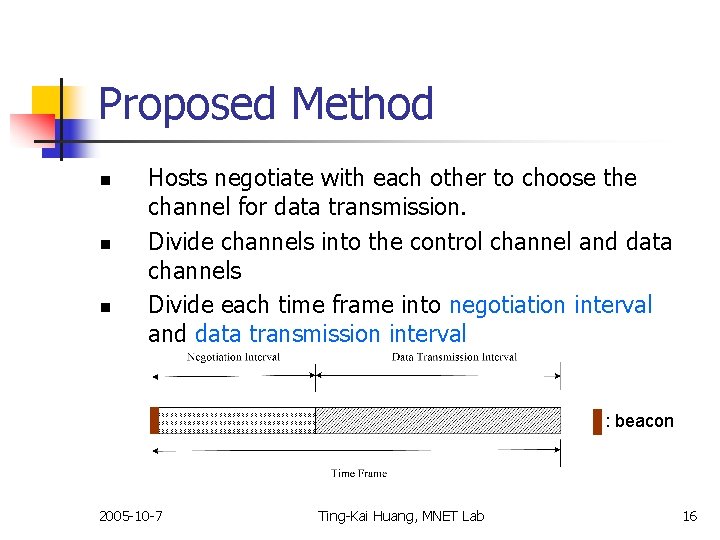
Proposed Method n n n Hosts negotiate with each other to choose the channel for data transmission. Divide channels into the control channel and data channels Divide each time frame into negotiation interval and data transmission interval : beacon 2005 -10 -7 Ting-Kai Huang, MNET Lab 16
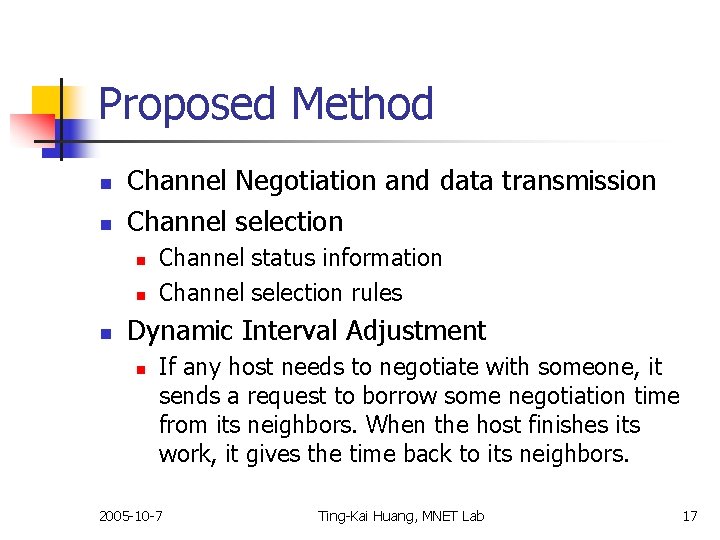
Proposed Method n n Channel Negotiation and data transmission Channel selection n Channel status information Channel selection rules Dynamic Interval Adjustment n If any host needs to negotiate with someone, it sends a request to borrow some negotiation time from its neighbors. When the host finishes its work, it gives the time back to its neighbors. 2005 -10 -7 Ting-Kai Huang, MNET Lab 17
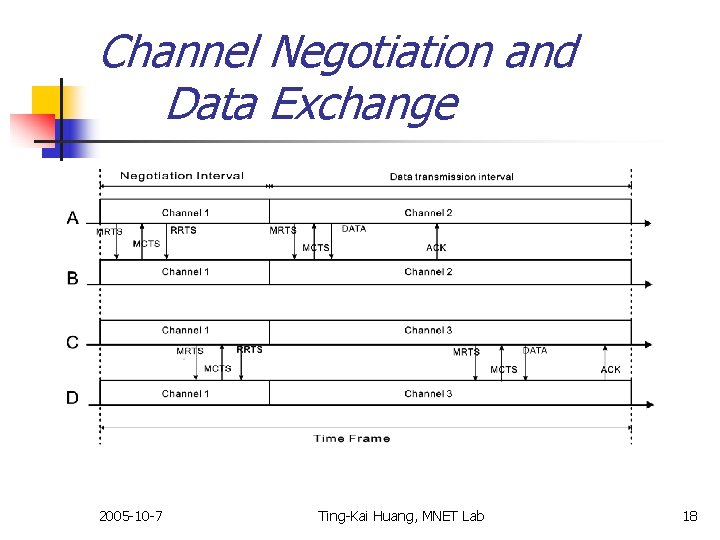
Channel Negotiation and Data Exchange 2005 -10 -7 Ting-Kai Huang, MNET Lab 18
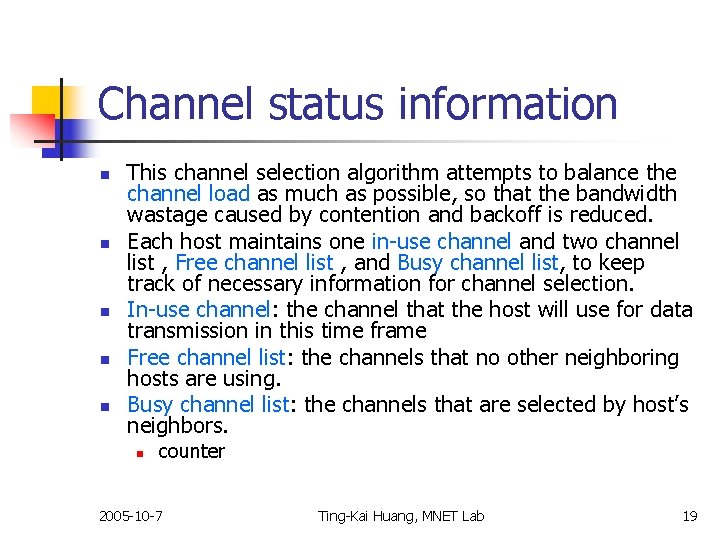
Channel status information n n This channel selection algorithm attempts to balance the channel load as much as possible, so that the bandwidth wastage caused by contention and backoff is reduced. Each host maintains one in-use channel and two channel list , Free channel list , and Busy channel list, to keep track of necessary information for channel selection. In-use channel: the channel that the host will use for data transmission in this time frame Free channel list: the channels that no other neighboring hosts are using. Busy channel list: the channels that are selected by host’s neighbors. n counter 2005 -10 -7 Ting-Kai Huang, MNET Lab 19
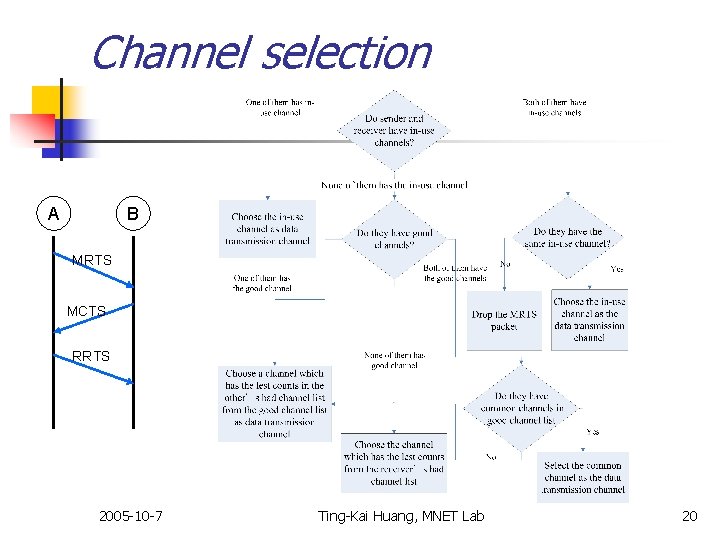
Channel selection A B MRTS MCTS RRTS 2005 -10 -7 Ting-Kai Huang, MNET Lab 20
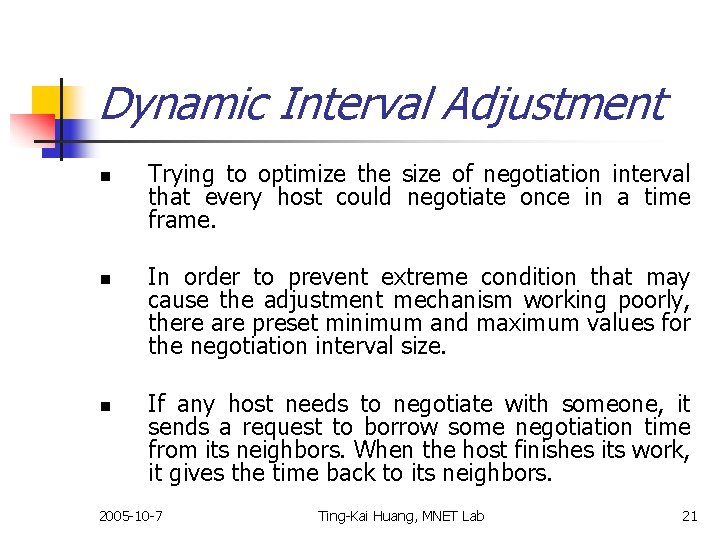
Dynamic Interval Adjustment n n n Trying to optimize the size of negotiation interval that every host could negotiate once in a time frame. In order to prevent extreme condition that may cause the adjustment mechanism working poorly, there are preset minimum and maximum values for the negotiation interval size. If any host needs to negotiate with someone, it sends a request to borrow some negotiation time from its neighbors. When the host finishes its work, it gives the time back to its neighbors. 2005 -10 -7 Ting-Kai Huang, MNET Lab 21
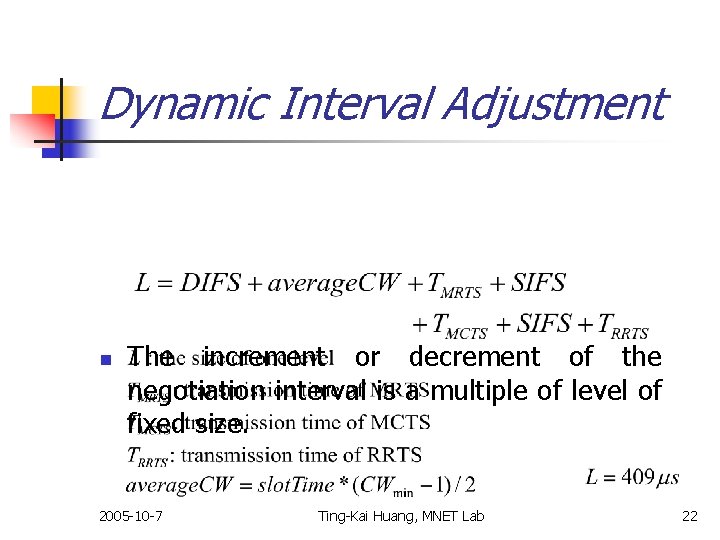
Dynamic Interval Adjustment n The increment or decrement of the negotiation interval is a multiple of level of fixed size. 2005 -10 -7 Ting-Kai Huang, MNET Lab 22
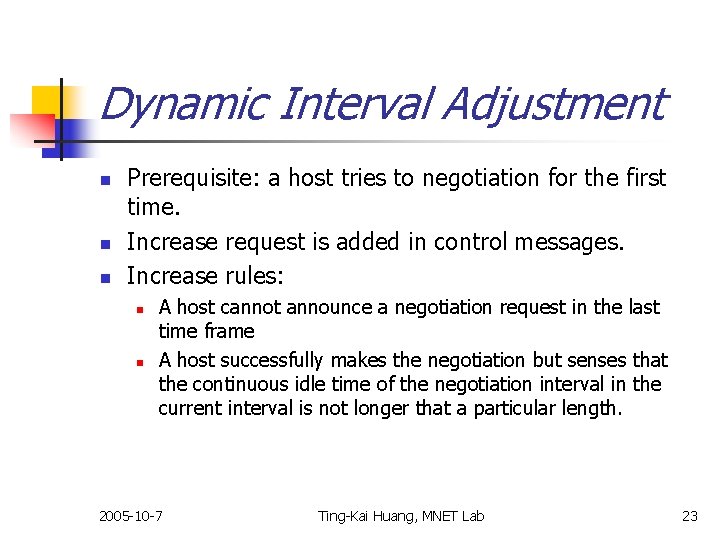
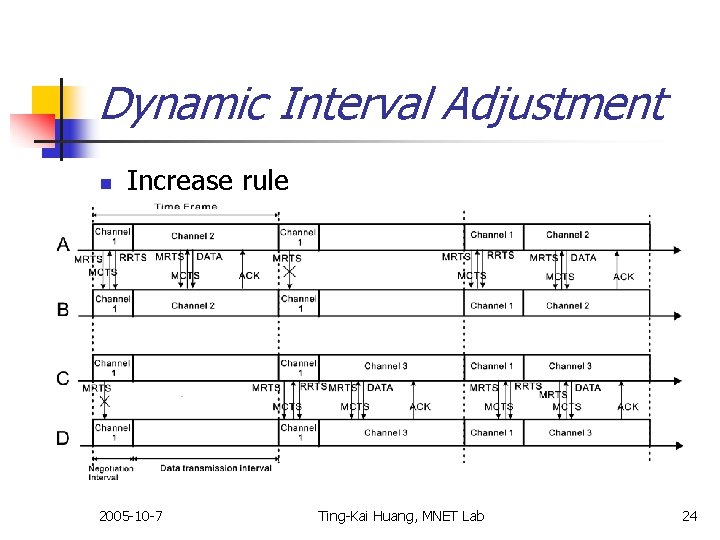
Dynamic Interval Adjustment n n n Prerequisite: a host tries to negotiation for the first time. Increase request is added in control messages. Increase rules: n n A host cannot announce a negotiation request in the last time frame A host successfully makes the negotiation but senses that the continuous idle time of the negotiation interval in the current interval is not longer that a particular length. 2005 -10 -7 Ting-Kai Huang, MNET Lab 23
Dynamic Interval Adjustment n Increase rule 2005 -10 -7 Ting-Kai Huang, MNET Lab 24
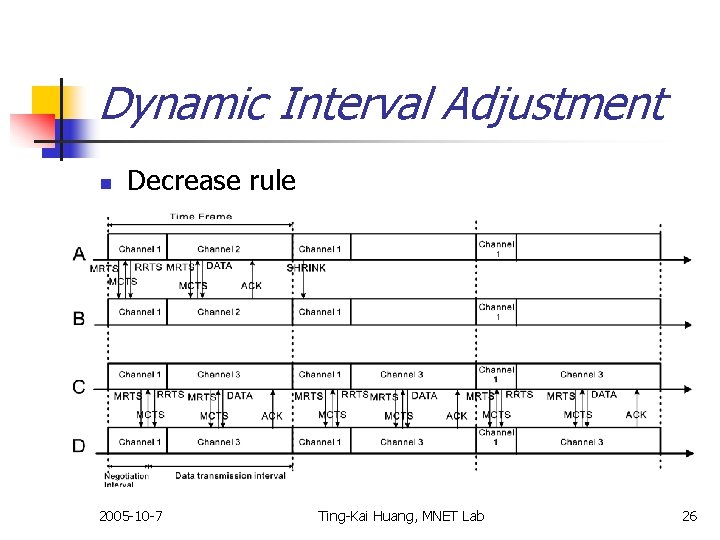
Dynamic Interval Adjustment n Decrease rule: n n A host finishes its data transmission and does not have any packet in the next time frame. New type message, SHRINK. 2005 -10 -7 Ting-Kai Huang, MNET Lab 25
Dynamic Interval Adjustment n Decrease rule 2005 -10 -7 Ting-Kai Huang, MNET Lab 26
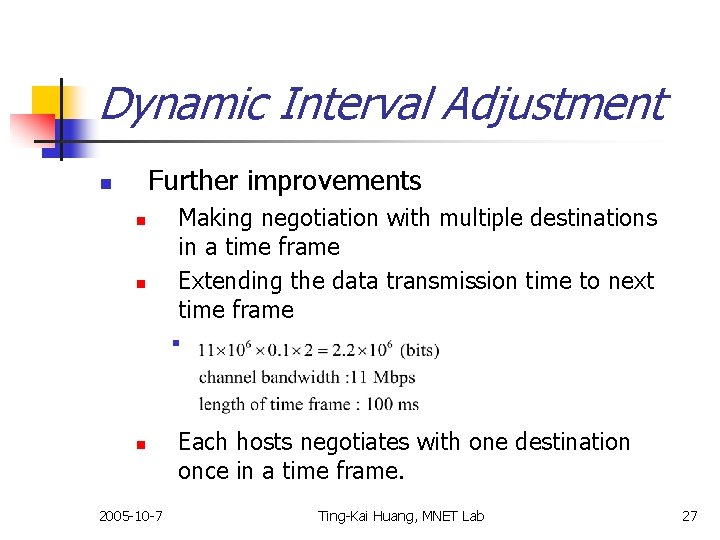
Dynamic Interval Adjustment Further improvements n n n Making negotiation with multiple destinations in a time frame Extending the data transmission time to next time frame n n 2005 -10 -7 Each hosts negotiates with one destination once in a time frame. Ting-Kai Huang, MNET Lab 27
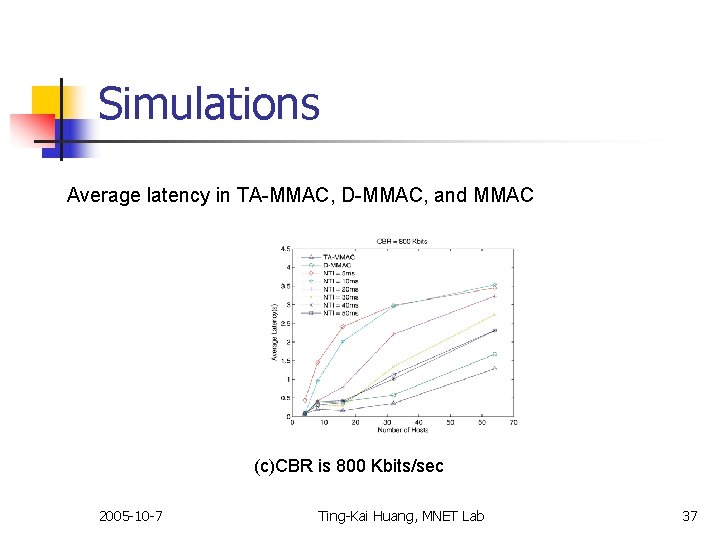
Simulations n Metric n Aggregate throughput over all flows in the network n n total throughput of network Average packets delivery delay over all flows in the networks n 2005 -10 -7 queuing, backoff, channel negotiation and transmission delay Ting-Kai Huang, MNET Lab 28
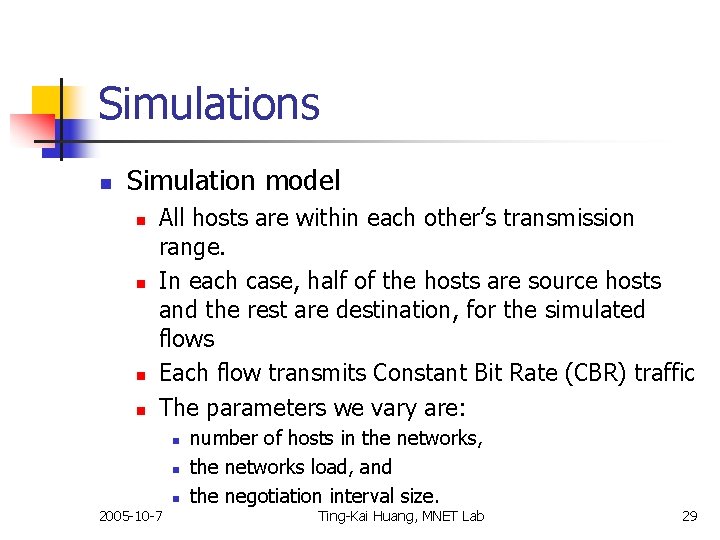
Simulations n Simulation model n n All hosts are within each other’s transmission range. In each case, half of the hosts are source hosts and the rest are destination, for the simulated flows Each flow transmits Constant Bit Rate (CBR) traffic The parameters we vary are: n n n 2005 -10 -7 number of hosts in the networks, the networks load, and the negotiation interval size. Ting-Kai Huang, MNET Lab 29
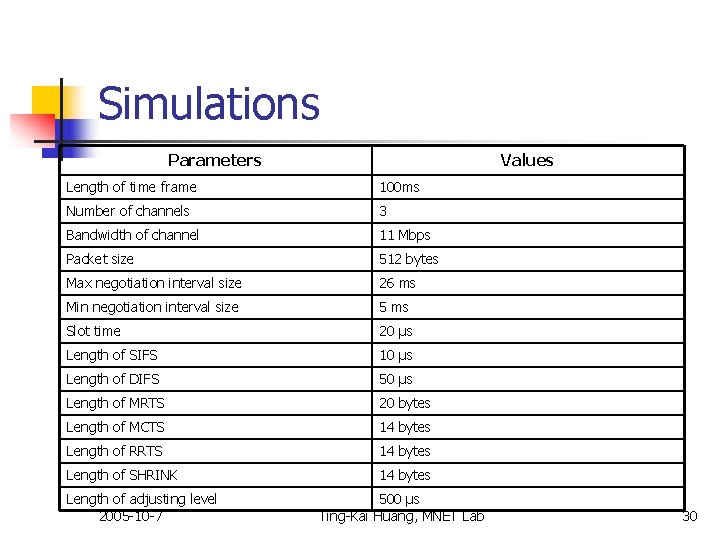
Simulations Parameters Values Length of time frame 100 ms Number of channels 3 Bandwidth of channel 11 Mbps Packet size 512 bytes Max negotiation interval size 26 ms Min negotiation interval size 5 ms Slot time 20 μs Length of SIFS 10 μs Length of DIFS 50 μs Length of MRTS 20 bytes Length of MCTS 14 bytes Length of RRTS 14 bytes Length of SHRINK 14 bytes Length of adjusting level 2005 -10 -7 500 μs Ting-Kai Huang, MNET Lab 30
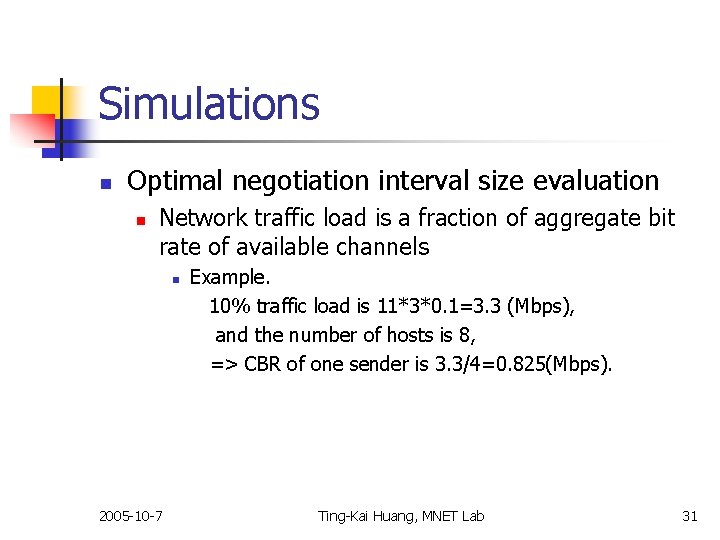
Simulations n Optimal negotiation interval size evaluation n Network traffic load is a fraction of aggregate bit rate of available channels n 2005 -10 -7 Example. 10% traffic load is 11*3*0. 1=3. 3 (Mbps), and the number of hosts is 8, => CBR of one sender is 3. 3/4=0. 825(Mbps). Ting-Kai Huang, MNET Lab 31
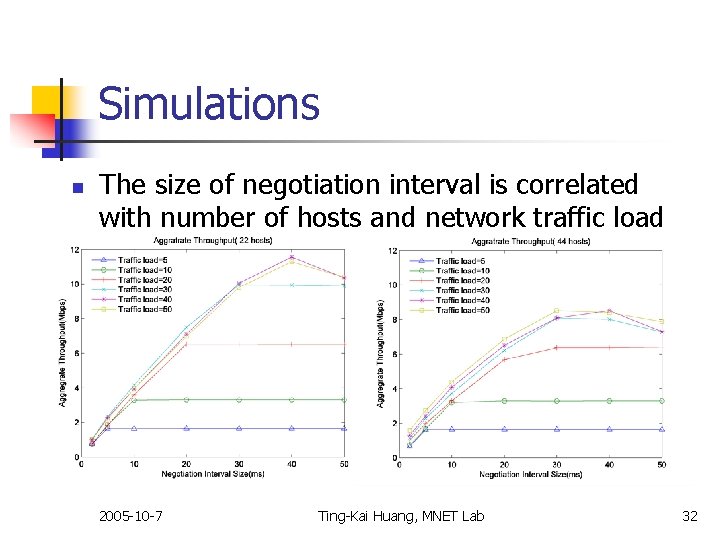
Simulations n The size of negotiation interval is correlated with number of hosts and network traffic load 2005 -10 -7 Ting-Kai Huang, MNET Lab 32
Simulations n n D-MMAC Increasing rules 1. 2. 3. 4. n Based on the number of pending packets that the host could not negotiate with their destination successfully Overhearing the packets on the air Receiving the negotiation packet in data transmission Receiving the marked packets Decreasing rule 1. If a host announces all the packets to the destinations, it sets it negotiation interval size to be minimum. E. -S. “An energy efficient MAC protocol for wireless LANs, ” Proc. IEEE INFOCOM, Vol. 3, pp. 1756 -1764, June 2002. Huang, MNET Lab 2005 -10 -7 Ting-Kai 33
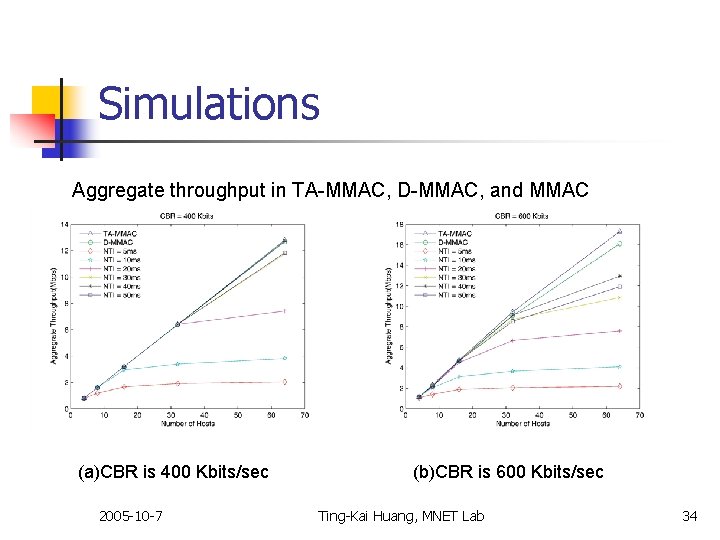
Simulations Aggregate throughput in TA-MMAC, D-MMAC, and MMAC (a)CBR is 400 Kbits/sec 2005 -10 -7 (b)CBR is 600 Kbits/sec Ting-Kai Huang, MNET Lab 34
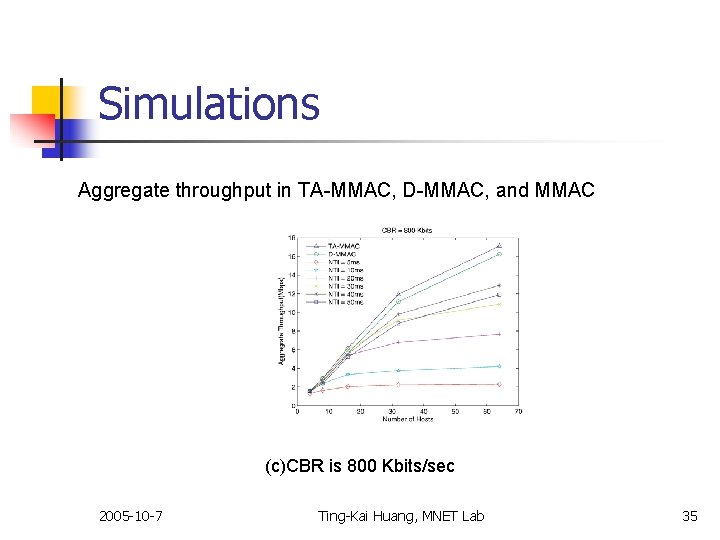
Simulations Aggregate throughput in TA-MMAC, D-MMAC, and MMAC (c)CBR is 800 Kbits/sec 2005 -10 -7 Ting-Kai Huang, MNET Lab 35
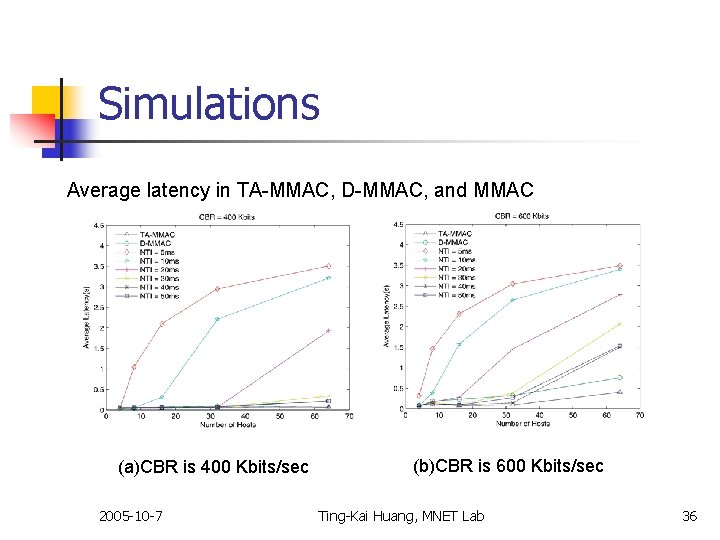
Simulations Average latency in TA-MMAC, D-MMAC, and MMAC (a)CBR is 400 Kbits/sec 2005 -10 -7 (b)CBR is 600 Kbits/sec Ting-Kai Huang, MNET Lab 36
Simulations Average latency in TA-MMAC, D-MMAC, and MMAC (c)CBR is 800 Kbits/sec 2005 -10 -7 Ting-Kai Huang, MNET Lab 37
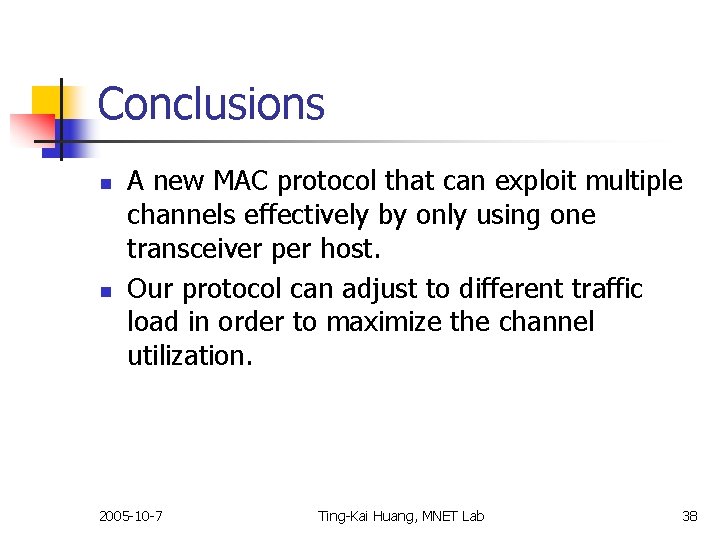
Conclusions n n A new MAC protocol that can exploit multiple channels effectively by only using one transceiver per host. Our protocol can adjust to different traffic load in order to maximize the channel utilization. 2005 -10 -7 Ting-Kai Huang, MNET Lab 38
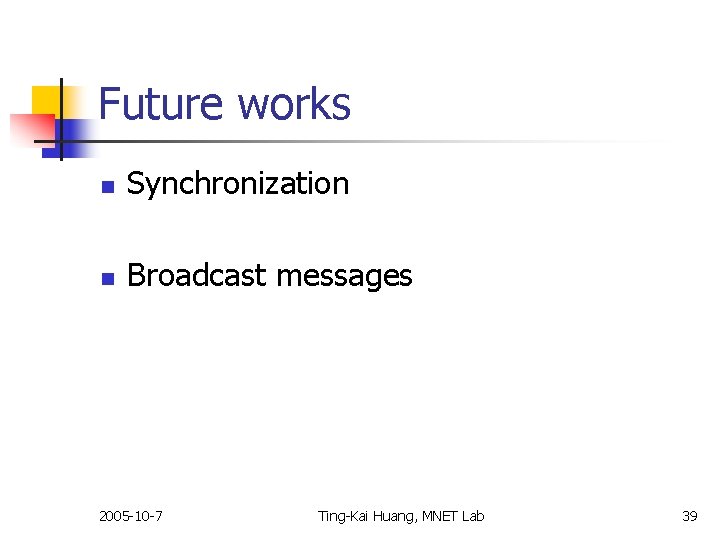
Future works n Synchronization n Broadcast messages 2005 -10 -7 Ting-Kai Huang, MNET Lab 39
2005 -10 -7 Ting-Kai Huang, MNET Lab 40