
An Academy for Developmental Intervention Assistants Orientation to


- Slides: 173
An Academy for Developmental Intervention Assistants Orientation to Early Intervention Slides This document contains slides/transparencies that are used with the Orientation to Early Intervention Instructor’s Guide and Handout. The instructor may project the slides using a LCD projector or print slides and convert them into transparencies to project them using a traditional overhead projector. 1
Orientation to Early Intervention 2
LOGISTICS & NORMS 3
Activity: Let us get to know each other • In the note cards write four statements about yourself. The last line is a question: "Who Am I? ” You have 3 minutes. • The instructor will collect the note cards and will read them one by one. Each time you have to guess who the person is. 4
Module Goals Time to take a look at your Handout #1 titled “Module Goals” H 1 5
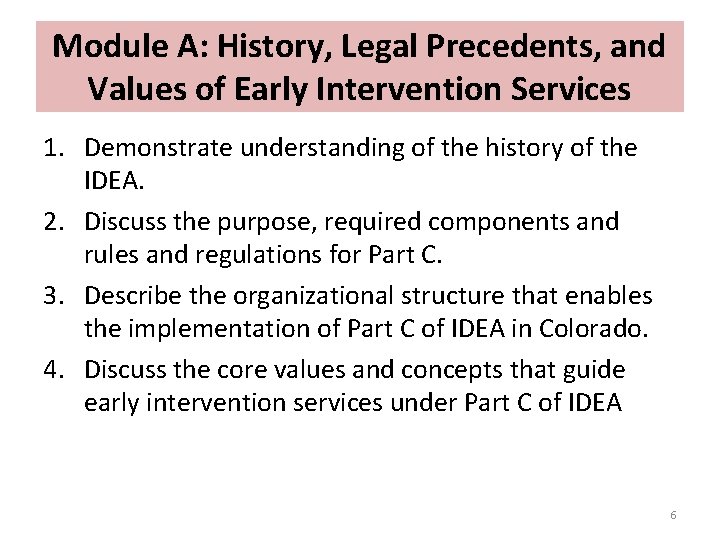
Module A: History, Legal Precedents, and Values of Early Intervention Services 1. Demonstrate understanding of the history of the IDEA. 2. Discuss the purpose, required components and rules and regulations for Part C. 3. Describe the organizational structure that enables the implementation of Part C of IDEA in Colorado. 4. Discuss the core values and concepts that guide early intervention services under Part C of IDEA 6
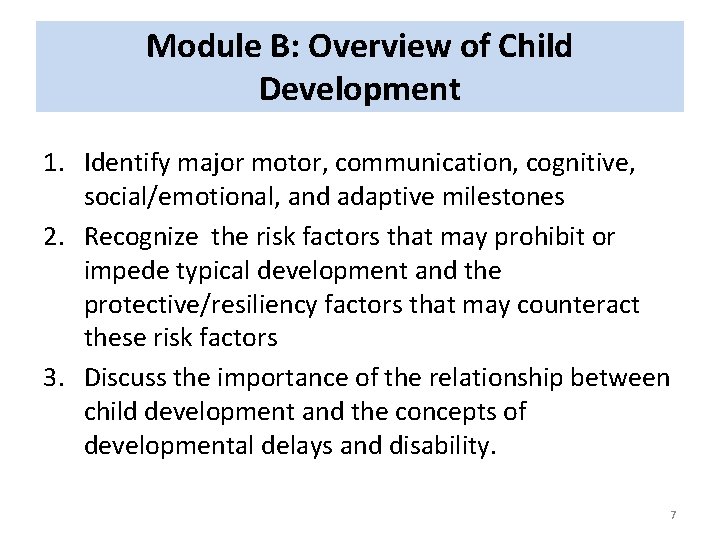
Module B: Overview of Child Development 1. Identify major motor, communication, cognitive, social/emotional, and adaptive milestones 2. Recognize the risk factors that may prohibit or impede typical development and the protective/resiliency factors that may counteract these risk factors 3. Discuss the importance of the relationship between child development and the concepts of developmental delays and disability. 7
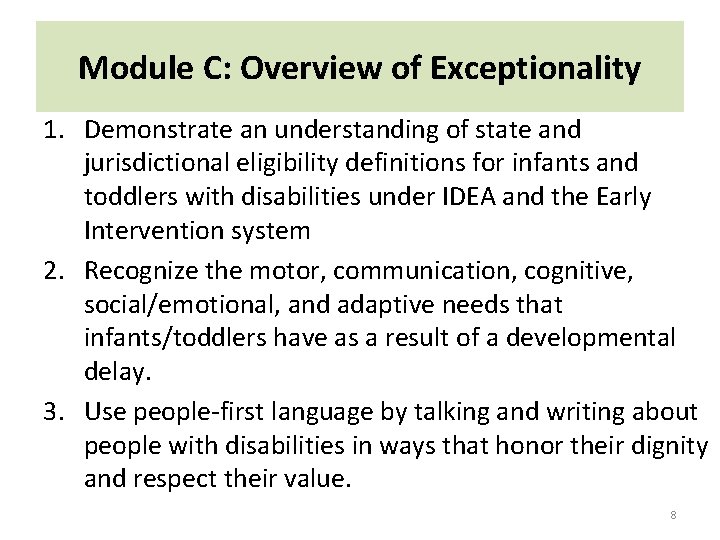
Module C: Overview of Exceptionality 1. Demonstrate an understanding of state and jurisdictional eligibility definitions for infants and toddlers with disabilities under IDEA and the Early Intervention system 2. Recognize the motor, communication, cognitive, social/emotional, and adaptive needs that infants/toddlers have as a result of a developmental delay. 3. Use people-first language by talking and writing about people with disabilities in ways that honor their dignity and respect their value. 8
Alphabet Soup/ Glossary • As we move along in this academy, you will encounter a number of acronyms commonly used in the field of early intervention/ special education. • You are welcome to come up to the poster board during the breaks and write the acronym they encounter and the full word on the poster. • Let it develop into a community of learning! 9
Module A: History, Legal Precedents, and Values of Early Intervention Services 1. Demonstrate understanding of the history of the IDEA. 2. Discuss the purpose, required components and rules and regulations for Part C. 3. Describe the organizational structure that enables the implementation of Part C of IDEA in Colorado. 4. Discuss the core values and concepts that guide early intervention services under Part C of IDEA. 10
H 4 The History of the IDEA, Ready to learn? How about a quick quiz first? 11
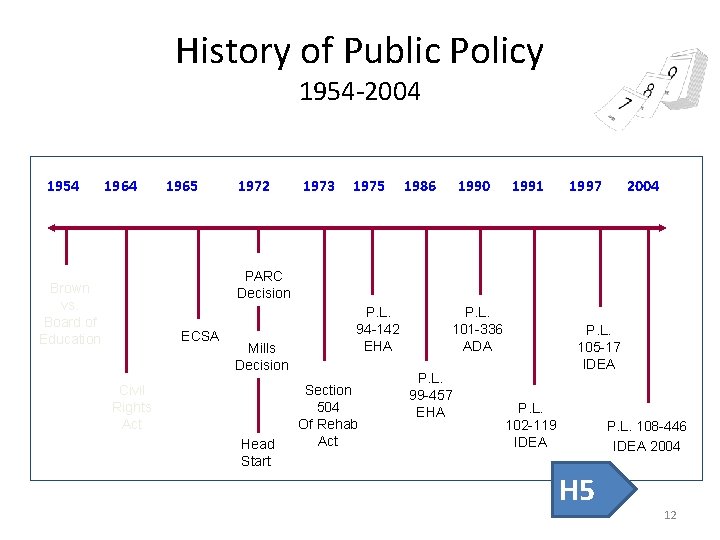
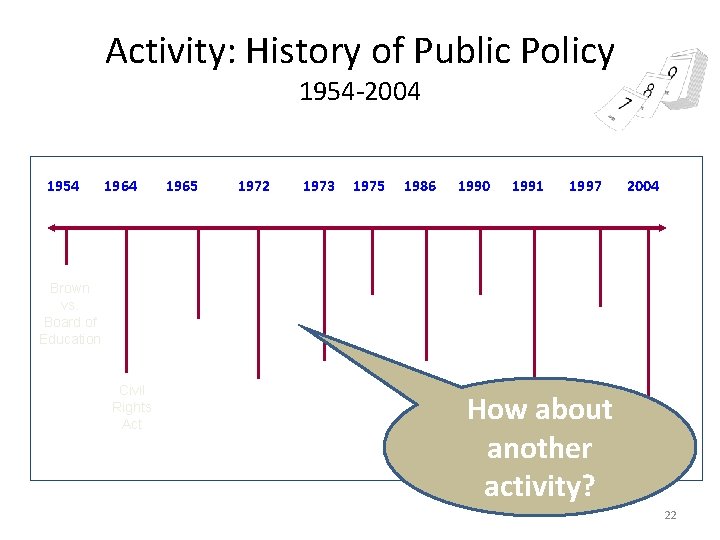
History of Public Policy 1954 -2004 1954 1965 1972 1973 1975 1986 1990 1991 1997 2004 PARC Decision Brown vs. Board of Education ECSA Mills Decision Civil Rights Act Head Start P. L. 94 -142 EHA Section 504 Of Rehab Act P. L. 101 -336 ADA P. L. 99 -457 EHA P. L. 105 -17 IDEA P. L. 102 -119 IDEA P. L. 108 -446 IDEA 2004 H 5 12
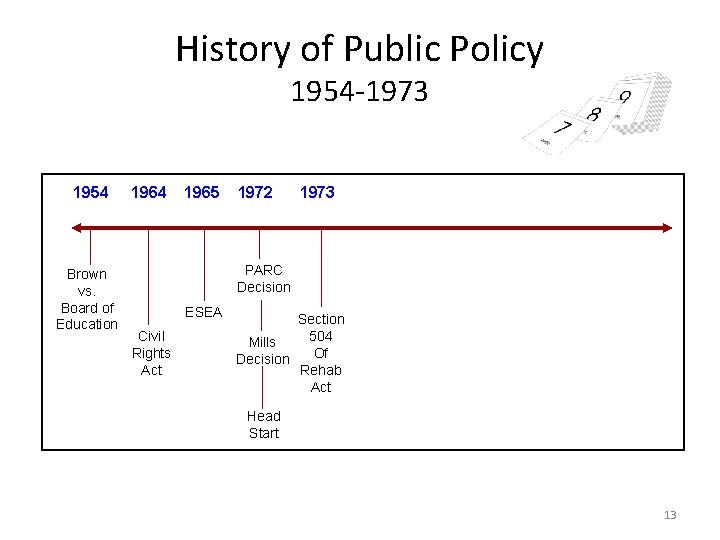
History of Public Policy 1954 -1973 1954 1964 1965 1972 1973 Brown vs. Board of Education PARC Decision ESEA Civil Rights Act Section 504 Mills Of Decision Rehab Act Head Start 13
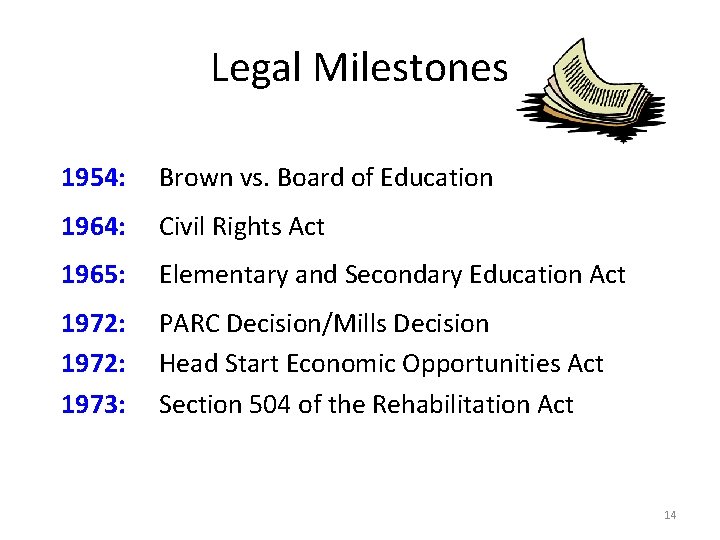
Legal Milestones 1954: Brown vs. Board of Education 1964: Civil Rights Act 1965: Elementary and Secondary Education Act 1972: PARC Decision/Mills Decision 1972: Head Start Economic Opportunities Act 1973: Section 504 of the Rehabilitation Act 14
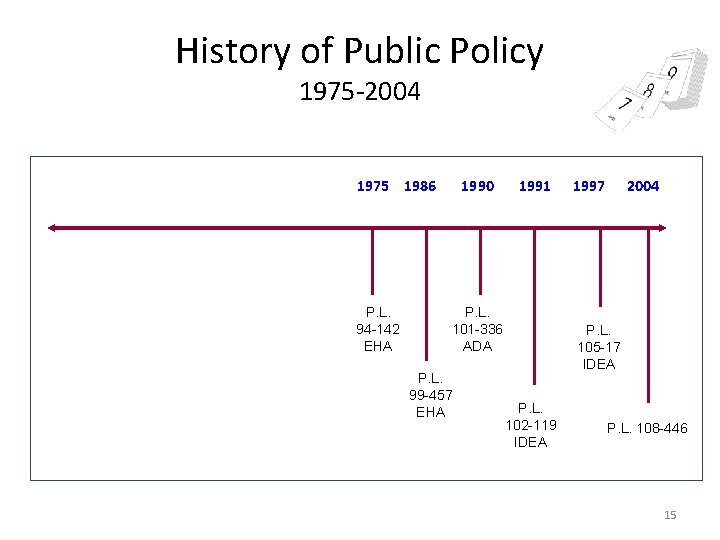
History of Public Policy 1975 -2004 1975 1986 1990 1991 1997 2004 P. L. 94 -142 EHA P. L. 101 -336 ADA P. L. 99 -457 EHA P. L. 105 -17 IDEA P. L. 102 -119 IDEA P. L. 108 -446 15
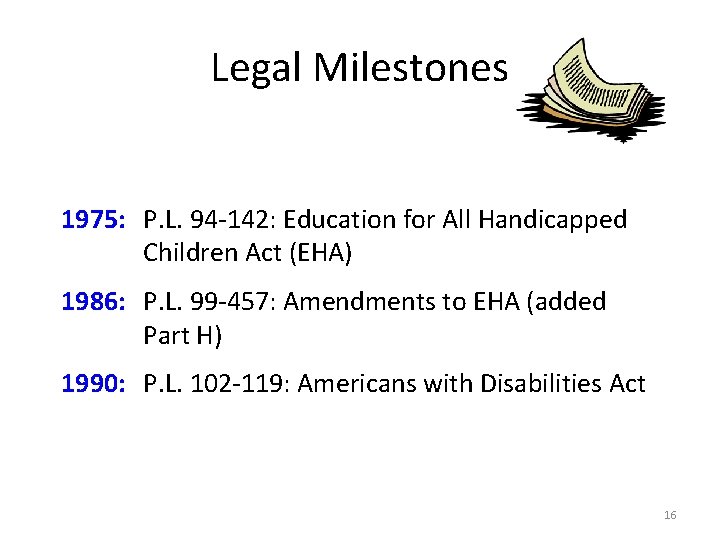
Legal Milestones 1975: P. L. 94 -142: Education for All Handicapped Children Act (EHA) 1986: P. L. 99 -457: Amendments to EHA (added Part H) 1990: P. L. 102 -119: Americans with Disabilities Act 16
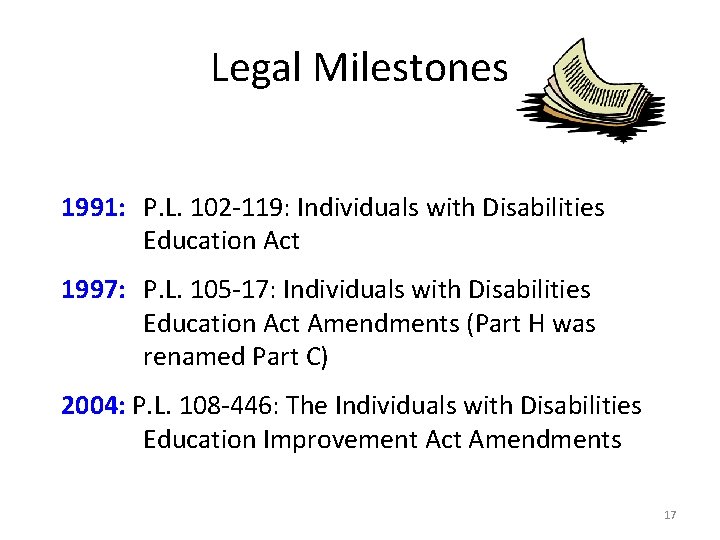
Legal Milestones 1991: P. L. 102 -119: Individuals with Disabilities Education Act 1997: P. L. 105 -17: Individuals with Disabilities Education Act Amendments (Part H was renamed Part C) 2004: P. L. 108 -446: The Individuals with Disabilities Education Improvement Act Amendments 17
IDEA 2004 Individuals with Disabilities Education Improvement Act P. L. 108 -446 18
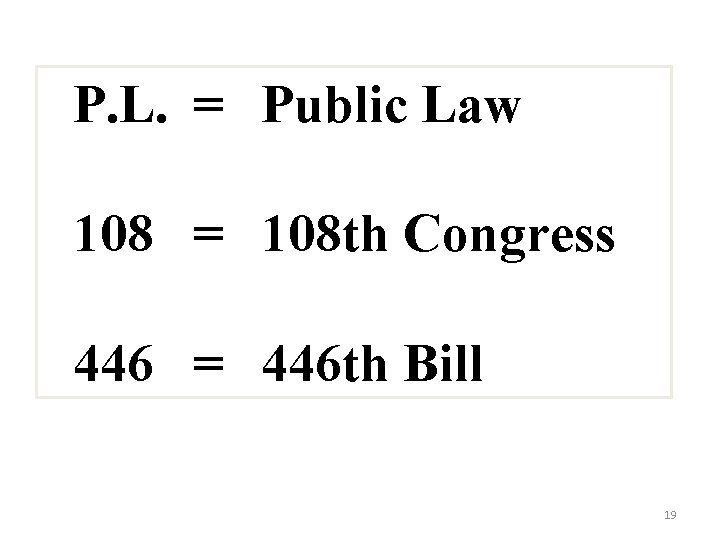
P. L. = Public Law 108 = 108 th Congress 446 = 446 th Bill 19
General Intent of IDEA To insure that children with disabilities have equal access to public education and are prepared for employment and independent living. 20
What Does This Mean? Disability is a natural part of the human experience and in no way diminishes the right of individuals to participate in or contribute to society. Improving educational results for children with disabilities is an essential element of our national policy of ensuring equality of opportunity, full participation, independent living, and economic self-sufficiency for individuals with disabilities. IDEA 2004 21
Activity: History of Public Policy 1954 -2004 1954 1965 1972 1973 1975 1986 1990 1991 1997 2004 Brown vs. Board of Education Civil Rights Act How about another activity? 22
Now let us learn about: The purpose, required components, and rules ad regulations of Part C. But before we do that, do you know about the different Parts of the IDEA? 23
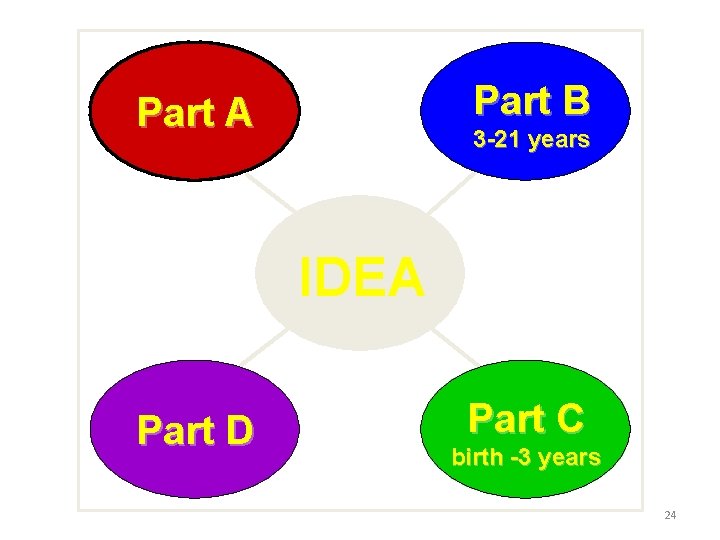
Part B Part A 3 -21 years IDEA Part D Part C birth -3 years 24
IDEA Part A: General Provisions IDEA Part A: – Gives general information about the law, why the law was enacted and who it serves. – Gives definitions for terms referenced in the law. – Defines what the state and federal government needs to do administratively 25
IDEA Part B: Assistance for Education for all Children with Disabilities IDEA Part B authorizes state funding and requirements for children 3 -21 years that include: • Child Find activities • Preschool provisions • Free Appropriate Public Education (FAPE) • Least Restrictive Environment (LRE) 26
IDEA Part D: National Activities to Improve Education of Children with Disabilities IDEA Part D authorizes discretionary funding for a variety of activities: • Research and Innovation • Personnel Preparation • Technical assistance • Dissemination of information 27
Part C Early Intervention System For Infants, Toddlers, and Their Families 28
Part C of IDEA Provides financial assistance for states to: 1 maintain and implement a statewide, comprehensive, coordinated, multidisciplinary, interagency system that provides early intervention services for infants and toddlers with disabilities and their families. 2 facilitate the coordination of payment for early intervention services from Federal, State, local, and private sources. 29
Part C of IDEA Provides financial assistance for states to: 3 enhance their capacity to provide quality early intervention services and expand improve existing early intervention services. 4 enhance the capacity of State and local agencies and service providers to identify, evaluate, and meet the needs of historically underrepresented populations, particularly minority, low-income, inner-city, and rural populations. 30
Purpose of Early Intervention Discussion: • to enhance the development of 1. What do each of these infants and toddlers purposes mean for you? with disabilities. • to enhance the capacity 2. What do each of these of families to meet the purposes look like in special needs of their your community? infants and toddlers with disabilities. 31
Let us Recap… 32
Required components of Part C 33
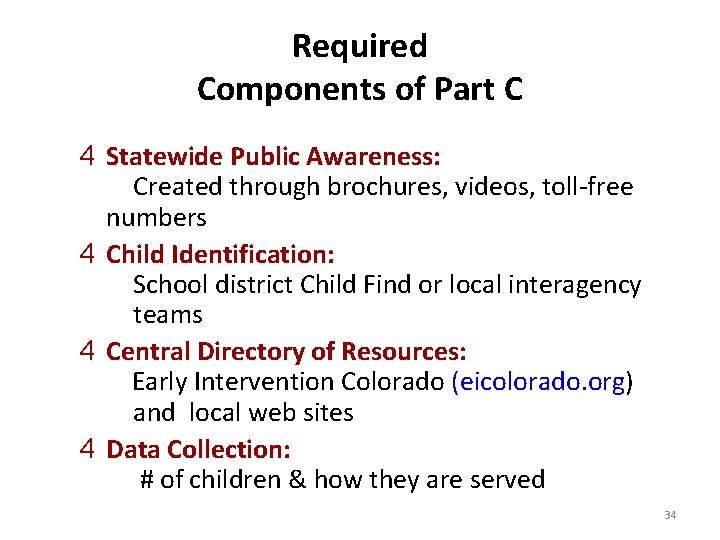
Required Components of Part C 4 Statewide Public Awareness: Created through brochures, videos, toll-free numbers 4 Child Identification: School district Child Find or local interagency teams 4 Central Directory of Resources: Early Intervention Colorado (eicolorado. org) and local web sites 4 Data Collection: # of children & how they are served 34
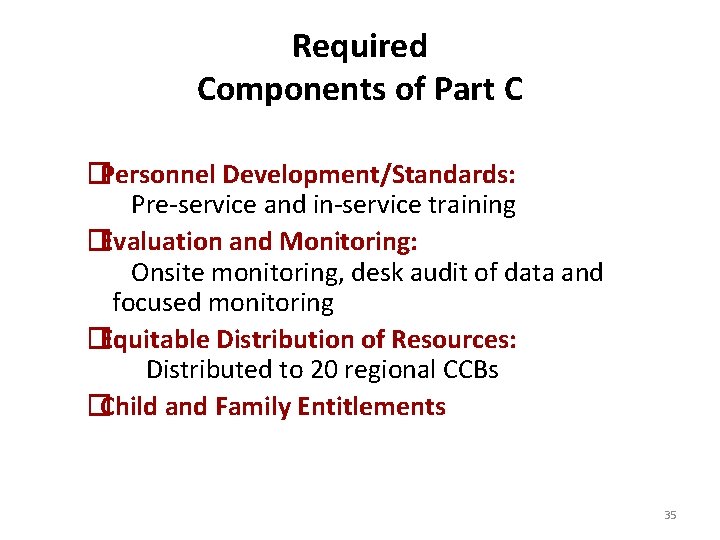
Required Components of Part C � Personnel Development/Standards: Pre-service and in-service training � Evaluation and Monitoring: Onsite monitoring, desk audit of data and focused monitoring � Equitable Distribution of Resources: Distributed to 20 regional CCBs � Child and Family Entitlements 35
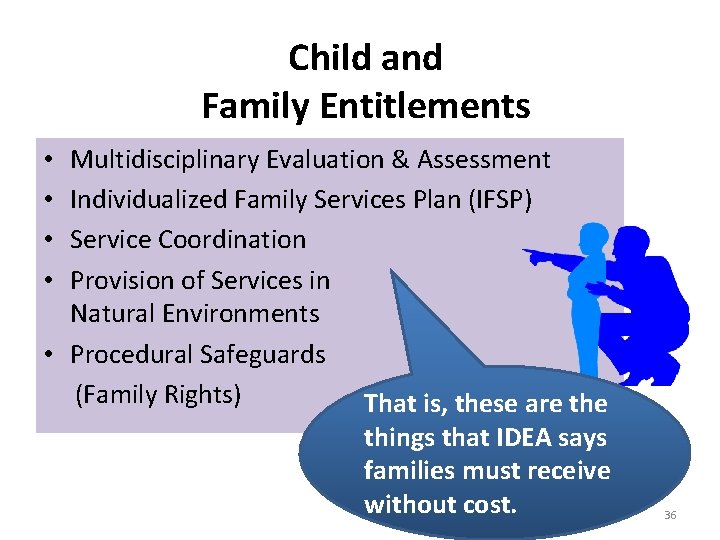
Child and Family Entitlements Multidisciplinary Evaluation & Assessment Individualized Family Services Plan (IFSP) Service Coordination Provision of Services in Natural Environments • Procedural Safeguards (Family Rights) That is, these are the • • things that IDEA says families must receive without cost. 36
Organizational structure For Part C Services in Colorado 37
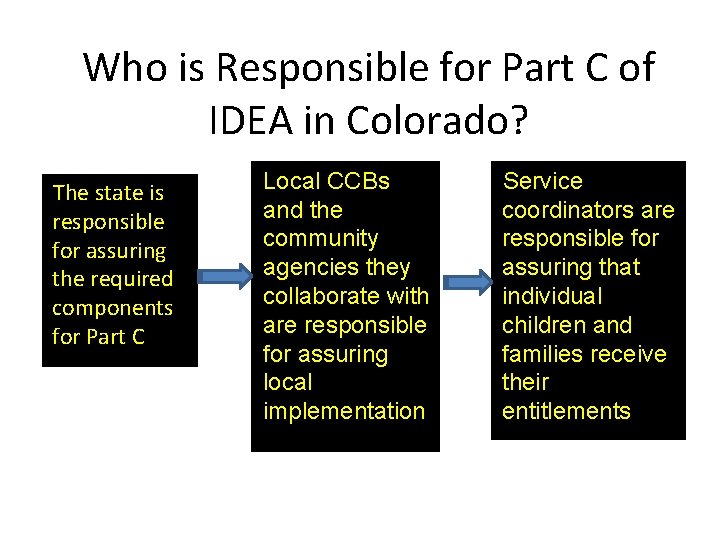
Who is Responsible for Part C of IDEA in Colorado? The state is responsible for assuring the required components for Part C Local CCBs and the community agencies they collaborate with are responsible for assuring local implementation Service coordinators are responsible for assuring that individual children and families receive their entitlements
2004 Re-authorization of IDEA: Requirements for Paraprofessionals • The State educational agency establishes and maintains standards to ensure that paraprofessionals and assistants are appropriately and adequately trained and supervised. • SEC 635 The State has a comprehensive system of personnel development, including the training of paraprofessionals … 612(a)(14 • SEC. 653. The State improvement plan shall address the identified needs for in-service and pre-service preparation for all personnel (professional and paraprofessional …… (ii) prepare professionals and paraprofessionals in the area of early intervention with the content knowledge and collaborative skills; (iii) to participate in pre-service and in-service training • Develop career opportunities for paraprofessionals to receive training as special education teachers, related services personnel, and early intervention personnel Individuals with Disabilities Education Improvement Act, Amendments of 2004, Pub. L. No. 108 -446, U. S. C. 20 & 1400 et seq.
Definition of DI Assistant Title for some paraprofessionals in Colorado is Developmental Intervention Assistant (DI Assistant): Developmental Intervention Assistant (DI Assistant) provides *Developmental Intervention services to families, infants and toddlers under the supervision of a qualified early intervention provider who holds a current license/certificate that meets the standards in the Early Intervention Colorado State Plan. http: //www. eicolorado. org/Files/2009 State. Plan_with. Appendices. pdf 40
Colorado Interagency Coordinating Council Vision The Colorado Interagency Coordinating Council (CICC) will support a wide range of activities that promote inclusive communities, that enhance participation and the growth, development and quality of life for children birth to three and their families in a culturally competent manner. 41
Guiding Values 1. Children and families are valued for their unique capacities, experiences, and potential. 42
Guiding Values 2. Families have the right and responsibility to make decisions on behalf of their children and themselves. 43
Guiding Values 3. Parent leadership is valued as an essential aspect of the statewide system of early intervention. 44
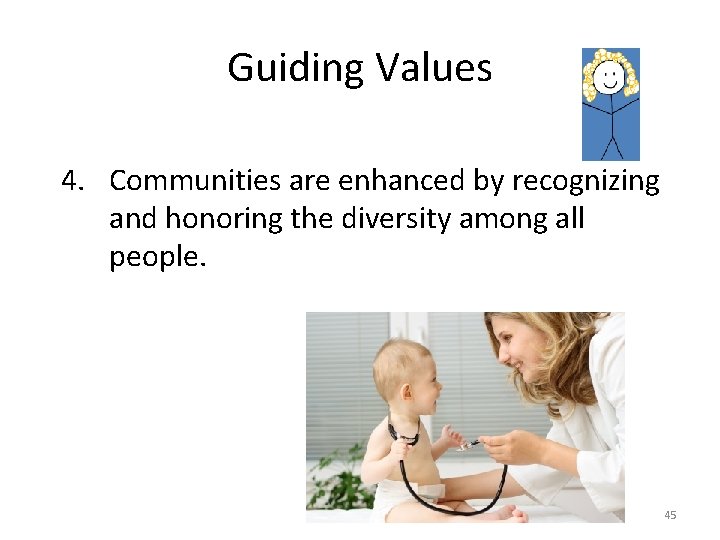
Guiding Values 4. Communities are enhanced by recognizing and honoring the diversity among all people. 45
Guiding Values 5. Families make the best choices when they have comprehensive information about the full range of formal and natural resources in their communities. 46
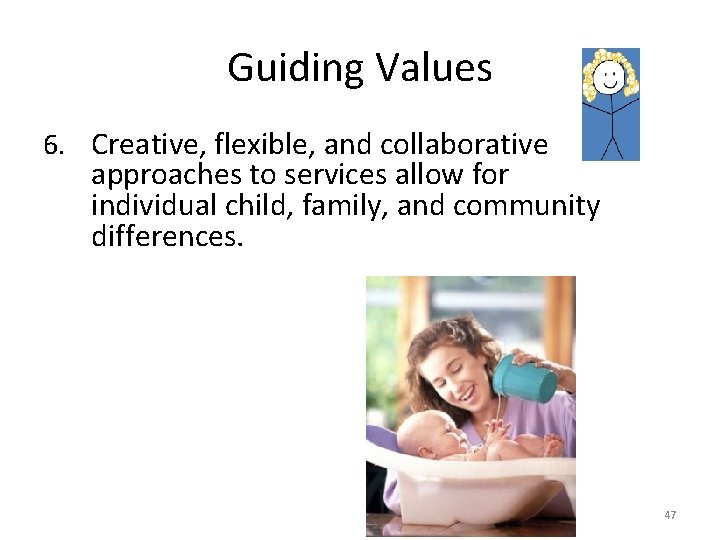
Guiding Values 6. Creative, flexible, and collaborative approaches to services allow for individual child, family, and community differences. 47
Activity: CICC Guiding Values • Review the six guiding values one by one on each slide and the handout (H 9) • Write the key words for each value. • Ask the participants to add the key words on their handouts, under “What Does it Look Like (Key Words)? ” 48
How are Early Intervention Services Delivered? Federal law and evidence-based practices dictate that early intervention services be provided in the context of an infant's or toddler's everyday routines, activities and places (natural environments). Colorado has promoted a transdisciplinary team approach utilizing a primary service provider model to increase the effectiveness and coordination of early intervention. 49
Natural Environments Natural environments are the places including the home, and community settings in which children without disabilities typically participate, live, learn, and play. Can you think of some examples? 50
Examples of Natural Environments ühome ü· gymnastic programs ü· parks ü· neighbor’s homes ü· neighborhood play groups ü· toy lending libraries ü· museums ü· church festivals · ü· swimming pools ü· family hikes ü· mommy and me class ü· child care ü· birthdays ü· fast food restaurants (and play spaces) übook stores and library story hours 51
Daily Routines in Natural Environments • Many naturally occurring activities in the home present learning opportunities. Some examples are: · Every child, family, and community übrushing teeth üDiapering ümeal time üplaying with siblings üplaying with neighbors üwatching TV üfolding laundry üreading stories ünap time is different. What is a natural part of one family’s routine may never happen in another family. An environment is not considered “natural” if it was invented to meet the needs of children with disabilities 52
Participation in families’ everyday routines, activities, places, and relationships • Providing supports and services within the context of families’ lives. • Supporting child and family participation in everyday life. • Creating functional rather than developmental outcomes. • Supporting that which happens between visits. • Being guided by the context of a child and family's everyday life and the families’ goals for their child’s participation, independence, and learning. 53
What is Home Visiting? Home visiting is a “process by which a professional or paraprofessional provides support and information to a family in their own home. ” Home visiting can different forms - it can be the only mode of services or it can be a part of any array of services or it can be primarily as a communication vehicle 54
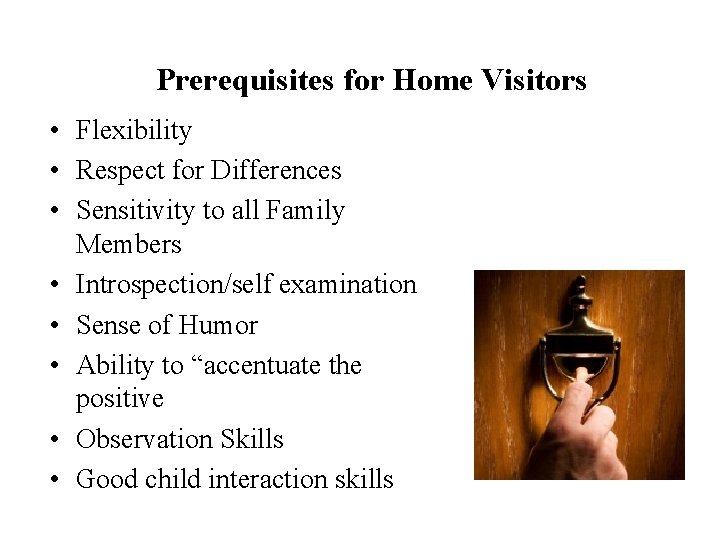
Prerequisites for Home Visitors • Flexibility • Respect for Differences • Sensitivity to all Family Members • Introspection/self examination • Sense of Humor • Ability to “accentuate the positive • Observation Skills • Good child interaction skills
Transdisciplinary Team Practices • The transdisciplinary team consists of parents and professionals. • The team bases its services and supports on the needs of the child and family within their daily routines. • Intervention is most effective when parents and professionals work together utilizing everyone’s strengths and knowledge. 56
What Does Transdisciplinary Early Intervention Look Like? • The EI professionals rely on the family to inform them about the routines of the child and the family, what their main concerns and priorities are, and how those will be addressed. • There is regular communication between the primary service provider, the transdisciplinary team, family, and the service coordinator. • Having a primary service provider reduces the number of professionals and visits that a family has to have in their home. • Primary Service providers provide instruction to the family so that they can imbed supportive developmental strategies within their daily routines. 57
Get ready to play. . . Who Wants to be a Millionaire? 58
Sequence These Events Chronologically A. Education for All Handicapped Children Act B. Civil Rights Act C. Section 504 of the Rehabilitation Act D. Individuals with Disabilities Education Act 59
The correct answer is. . B. Civil Rights Act C. Section 504 of the Rehabilitation Act A. Education for All Handicapped Children Act D. Individuals with Disabilities Education Act 60
Do You Know The Rules? $1, 000 $250, 000 $125, 000 $64, 000 $32, 000 $16, 000 $8000 $4000 $2000 $1000 $500 $300 $200 $100 61
Lifelines * * * Ask the audience 50 -50 Phone a friend 62
$100 What is the English word for the liquid called “aqua” in Spanish? A. water B. milk C. coffee D. Snapple 63
$100 What is the English word for the liquid called “agua” in Spanish? A. water 64
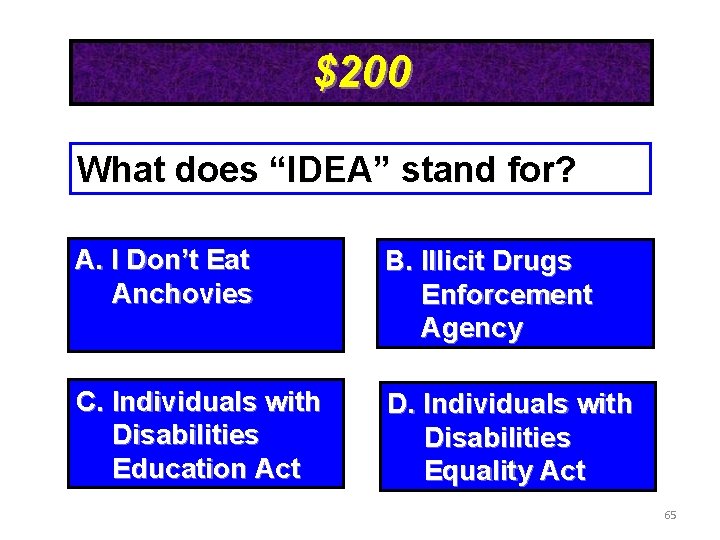
$200 What does “IDEA” stand for? A. I Don’t Eat Anchovies B. Illicit Drugs Enforcement Agency C. Individuals with Disabilities Education Act D. Individuals with Disabilities Equality Act 65
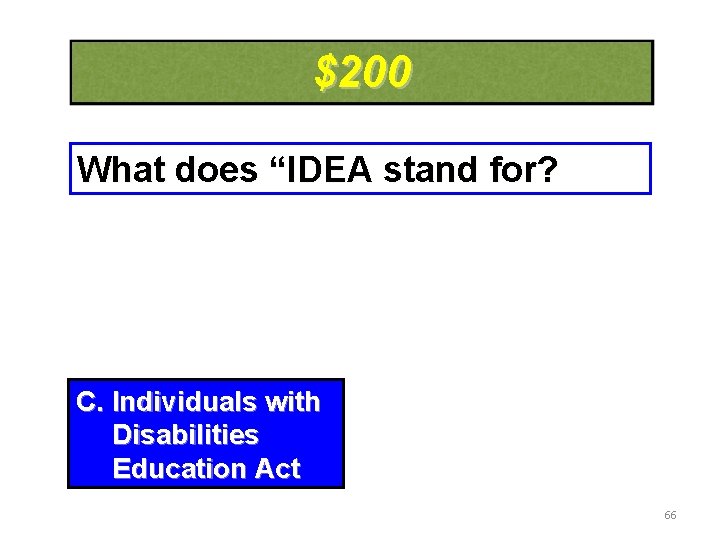
$200 What does “IDEA stand for? C. Individuals with Disabilities Education Act 66
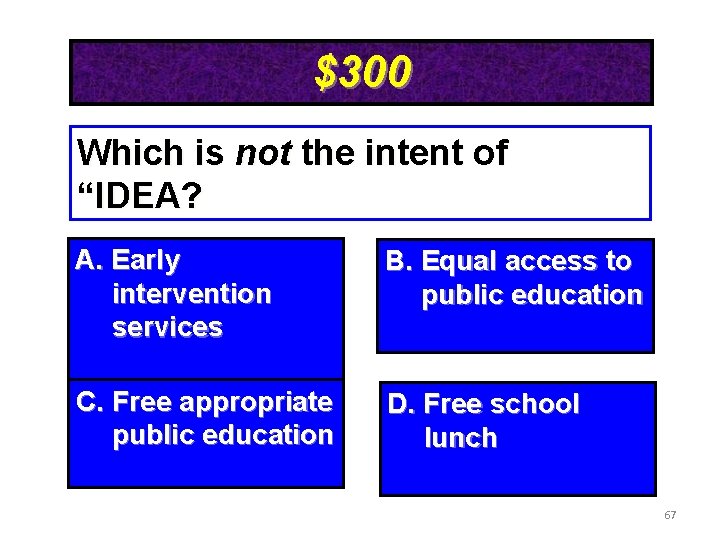
$300 Which is not the intent of “IDEA? A. Early intervention services B. Equal access to public education C. Free appropriate public education D. Free school lunch 67
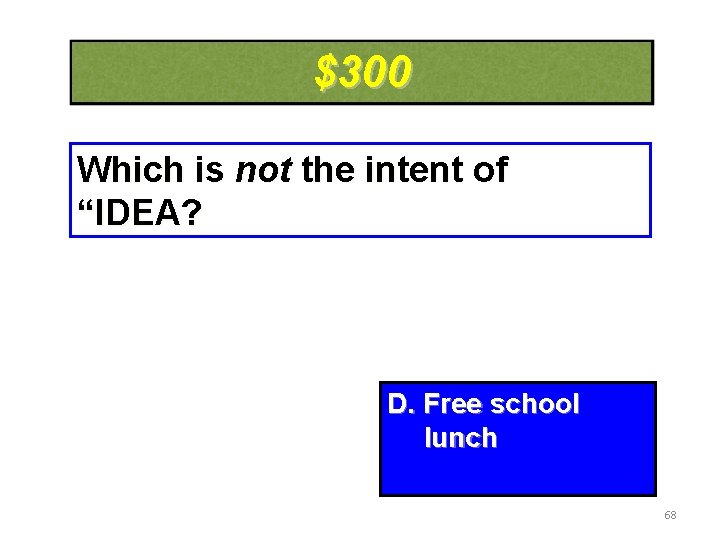
$300 Which is not the intent of “IDEA? D. Free school lunch 68
$500 How many parts does IDEA have? A. Five B. Nine C. Four D. Eleven 69
$500 How many parts does IDEA have? C. Four 70
$1, 000 Part C of IDEA serves which ages? A. 0 – 21 years B. 0 – 5 years C. 0 – 3 years D. 3 – 5 years 71
$1, 000 Part C of IDEA serves which ages? C. 0 – 3 years 72
$2, 000 When were the early childhood amendments to EHA enacted? A. 1964 B. 1986 C. 1492 D. 1975 73
$2, 000 When were the early childhood amendments to EHA enacted? B. 1986 74
$4, 000 The purpose of EI is to enhance all but one of these. . . A. development of toddlers B. capacity of families C. development of families D. development of infants 75
$4, 000 The purpose of EI is to enhance all but one of these. . . C. development of families 76
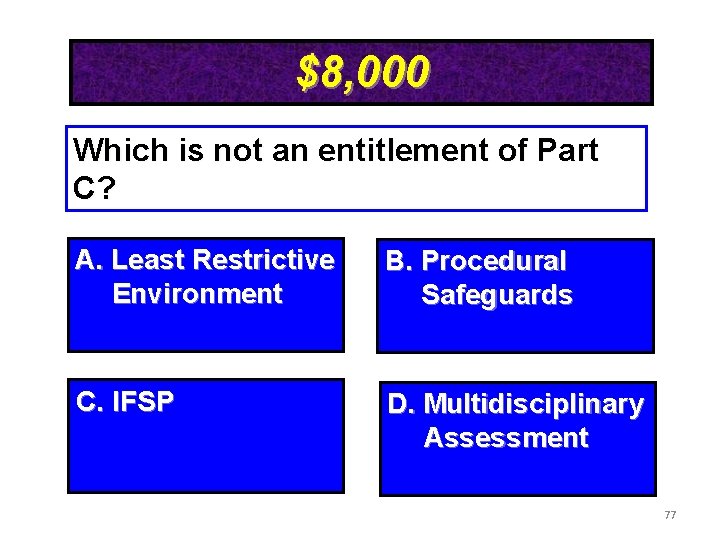
$8, 000 Which is not an entitlement of Part C? A. Least Restrictive Environment B. Procedural Safeguards C. IFSP D. Multidisciplinary Assessment 77
$8, 000 Which is not an entitlement of Part C? A. Least Restrictive Environment 78
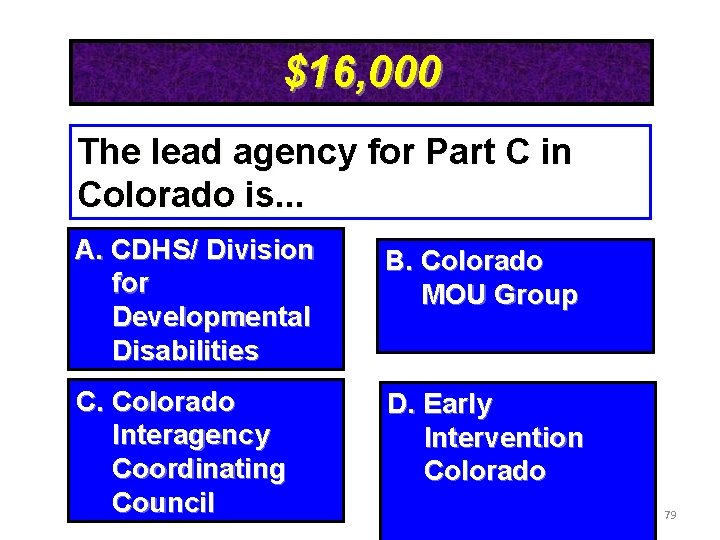
$16, 000 The lead agency for Part C in Colorado is. . . A. CDHS/ Division for Developmental Disabilities B. Colorado MOU Group C. Colorado Interagency Coordinating Council D. Early Intervention Colorado 79
$16, 000 The lead agency for Part C in Colorado is. . . A. CDHS/ Division for Developmental Disabilities 80
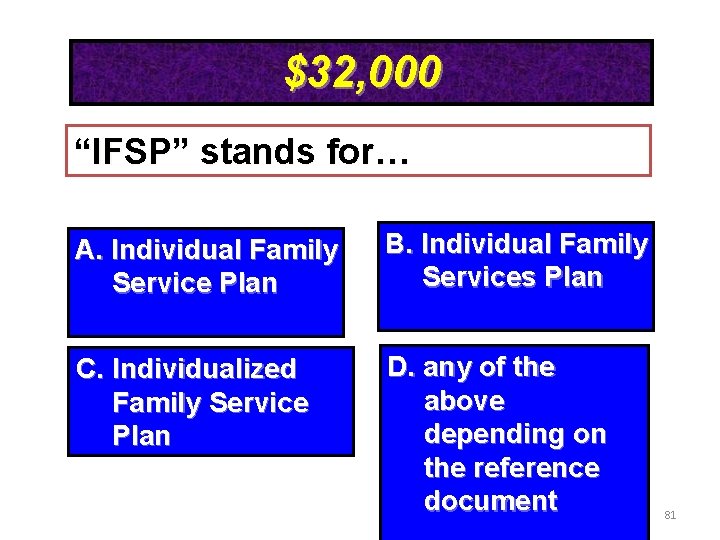
$32, 000 “IFSP” stands for… A. Individual Family Service Plan B. Individual Family Services Plan C. Individualized Family Service Plan D. any of the above depending on the reference document 81
$32, 000 “IFSP” stands for. . . D. any of the above depending on the reference document 82
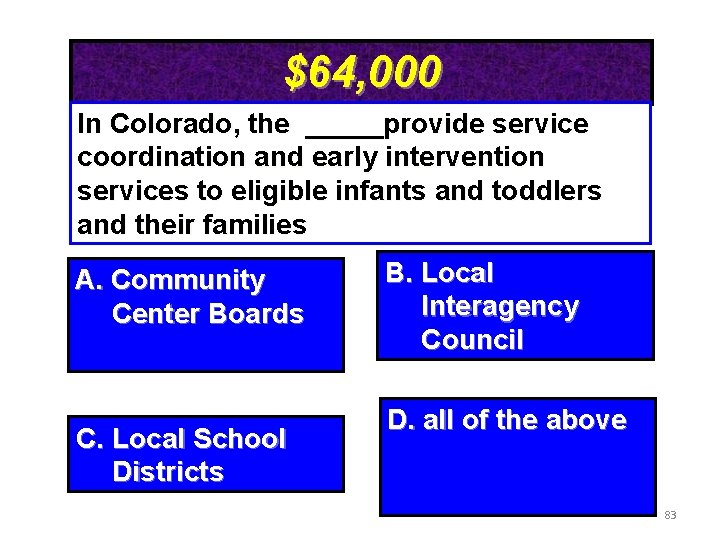
$64, 000 In Colorado, the _____provide service coordination and early intervention services to eligible infants and toddlers and their families A. Community Center Boards C. Local School Districts B. Local Interagency Council D. all of the above 83
$64, 000 In Colorado, the _____provide service coordination and direct early intervention services to eligible infants and toddlers and their families A. Community Center Boards 84
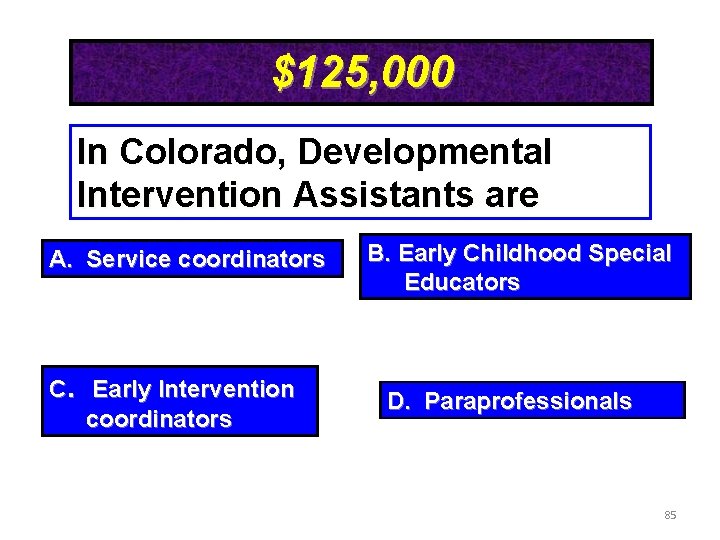
$125, 000 In Colorado, Developmental Intervention Assistants are A. Service coordinators C. Early Intervention coordinators B. Early Childhood Special Educators D. Paraprofessionals 85
$125, 000 In Colorado, Developmental Intervention Assistants are D. Paraprofessionals 86
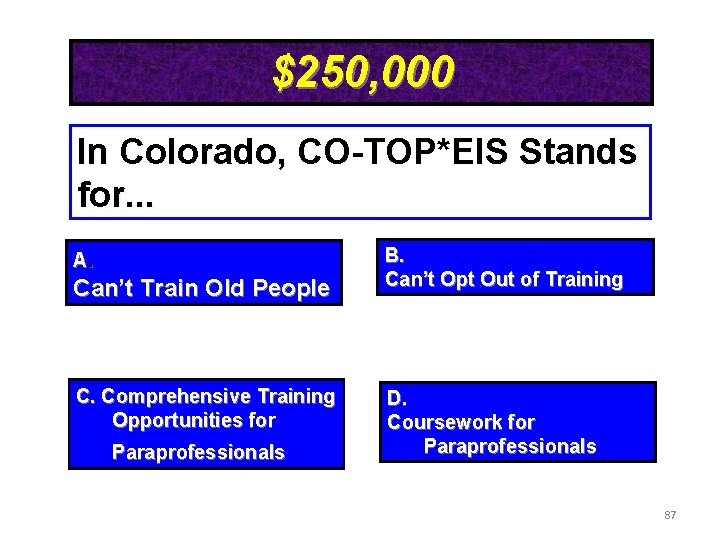
$250, 000 In Colorado, CO-TOP*EIS Stands for. . . A. Can’t Train Old People C. Comprehensive Training Opportunities for Paraprofessionals B. Can’t Opt Out of Training D. Coursework for Paraprofessionals 87
$250, 000 In Colorado, CO-TOP*EIS stands for…. C. Comprehensive Training Opportunities for Paraprofessionals 88
$500, 000 There are _____ Academies in CO-TOP*EIS DI Assistant Coursework A. Five B. Twelve C. Twenty D. Fifteen 89
$500, 000 There are _____ Academies in in COTOP*EIS DI Assistant Coursework D. Fifteen 90
$1, 000 A group of rhinoceroses is properly known as what? A. trample B. crash C. rumble D. wake 91
$1, 000 A group of rhinoceroses is properly known as what? B. crash 92
Post Quiz: Module A • Pull out the quiz (H 4, page #xx) you had completed at the beginning of the Module. • Review your answers from last time and make changes to correct the responses based on your new learning. 93
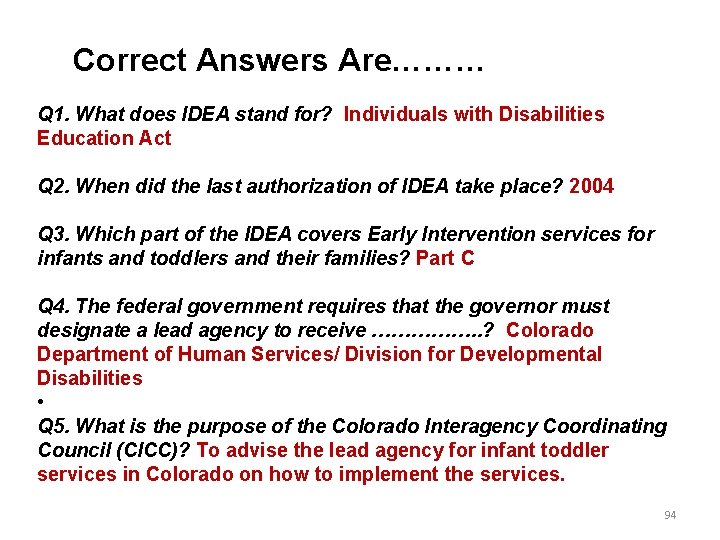
Correct Answers Are……… Q 1. What does IDEA stand for? Individuals with Disabilities Education Act Q 2. When did the last authorization of IDEA take place? 2004 Q 3. Which part of the IDEA covers Early Intervention services for infants and toddlers and their families? Part C Q 4. The federal government requires that the governor must designate a lead agency to receive ……………. . ? Colorado Department of Human Services/ Division for Developmental Disabilities • Q 5. What is the purpose of the Colorado Interagency Coordinating Council (CICC)? To advise the lead agency for infant toddler services in Colorado on how to implement the services. 94
95
Recap of Module A: History, Legal Precedents, and Values of Early Intervention Services You learned about: • the history of the IDEA, • the purpose, required components and rules and regulations for Part C • the organizational structure that enables the implementation of IDEA in Colorado • the core values and concepts that guide early intervention services 96
Module B: Overview of Child Development and Learning 97
Module B: Overview of Child Development 1. Identify major motor, communication, cognitive, social/emotional, and adaptive milestones 2. Recognize the risk factors that may prohibit or impede typical development and the protective/resiliency factors that may counteract these risk factors 3. Discuss the importance of the relationship between child development and the concepts of developmental delays and disability. 98
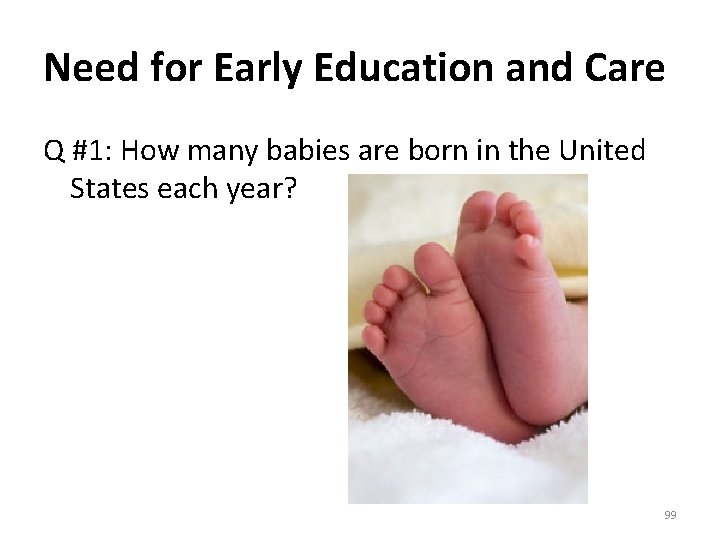
Need for Early Education and Care Q #1: How many babies are born in the United States each year? 99
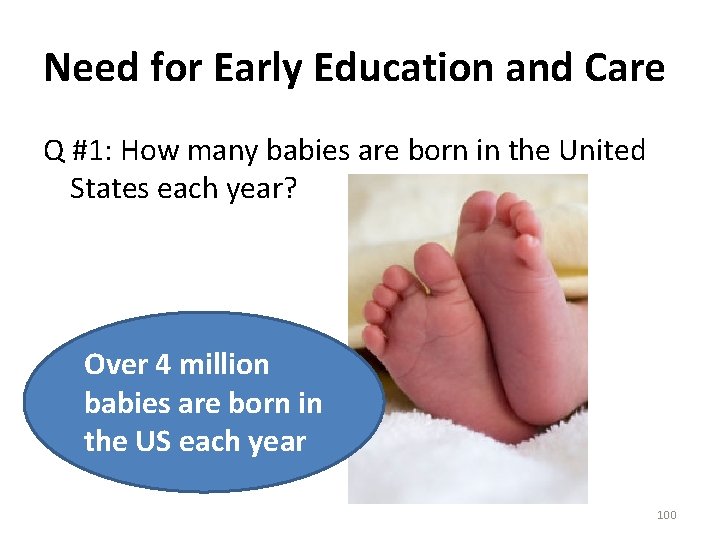
Need for Early Education and Care Q #1: How many babies are born in the United States each year? Over 4 million babies are born in the US each year 100
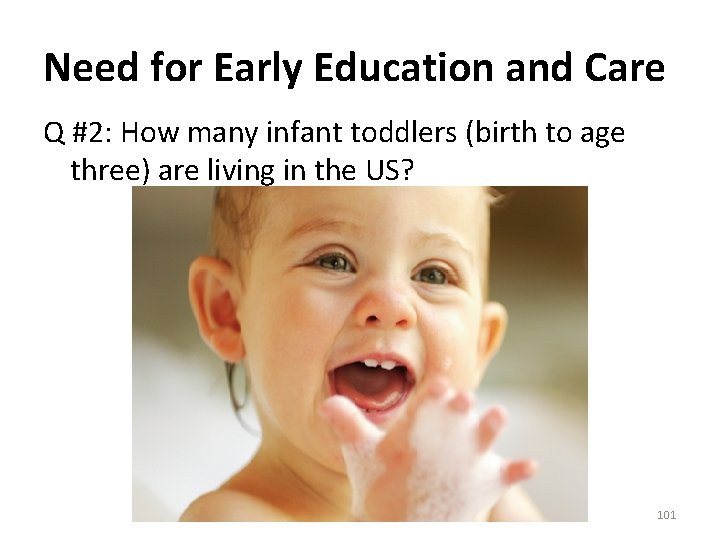
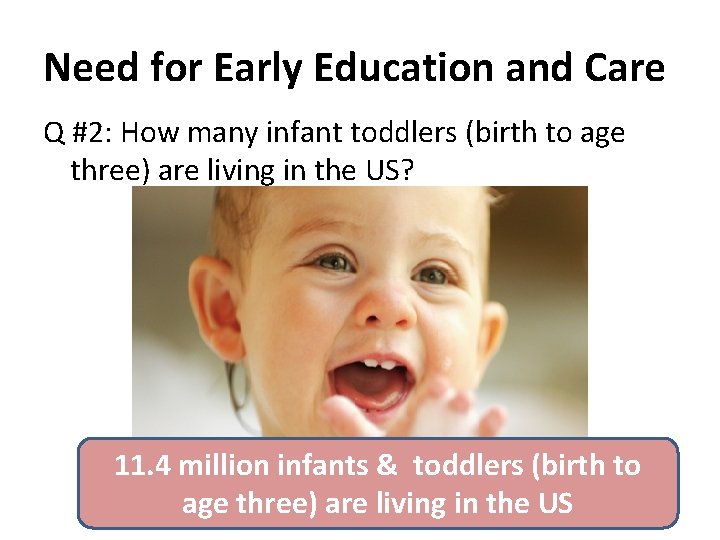
Need for Early Education and Care Q #2: How many infant toddlers (birth to age three) are living in the US? 101
Need for Early Education and Care Q #2: How many infant toddlers (birth to age three) are living in the US? 11. 4 million infants & toddlers (birth to age three) are living in the US 102
Let us watch: If babies come with a manual. . 103
The Relationship Between Child Development and Early Intervention 104
Why Do We Need To Know About Child Development? • To remember that children are more alike than different. • To understand that all children are children first and are not defined by any single characteristic. • To support families to keep the picture of the “whole child” as they interpret separate pieces of information. 105
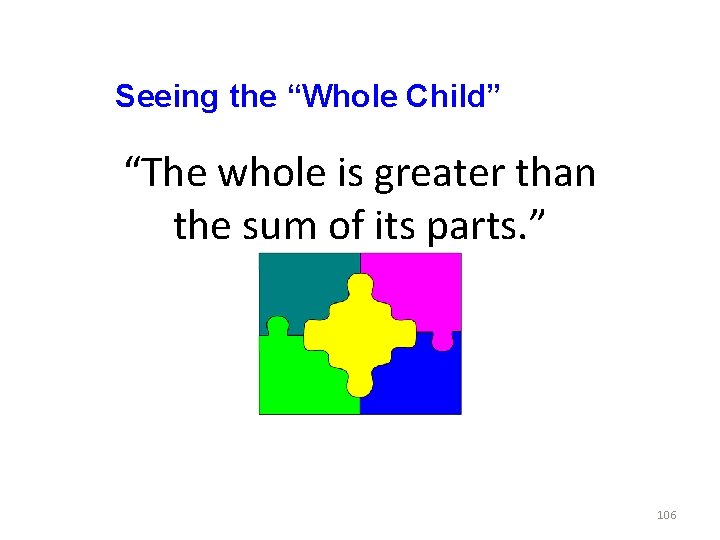
Seeing the “Whole Child” “The whole is greater than the sum of its parts. ” 106
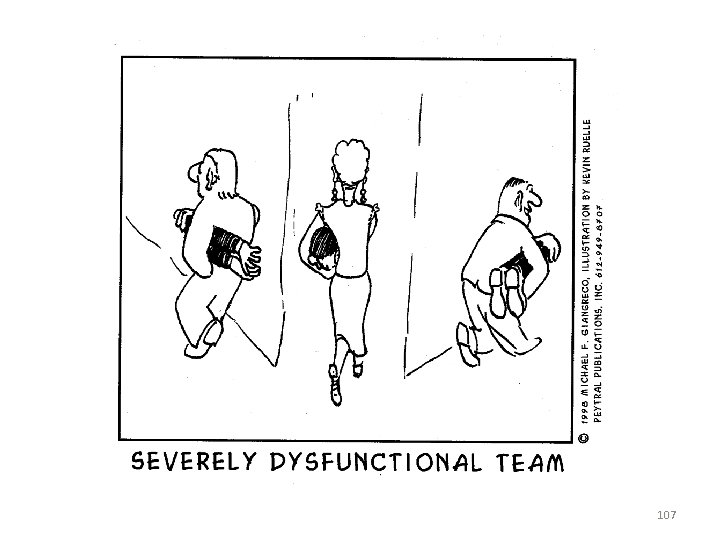
107
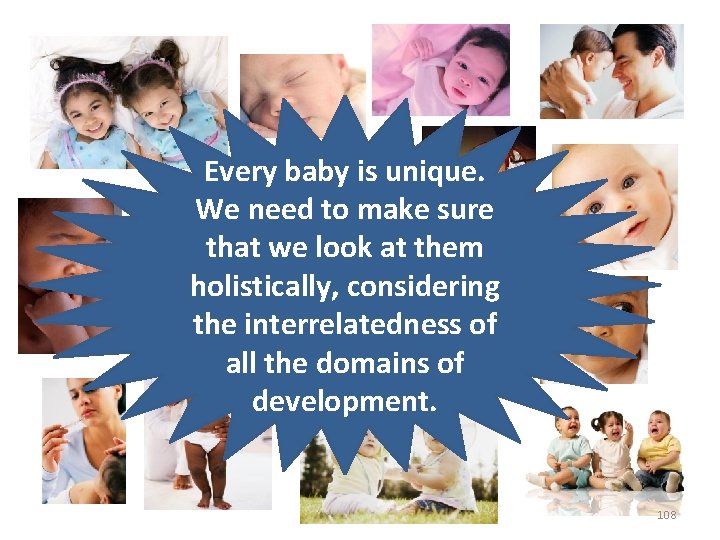
Every baby is unique. We need to make sure that we look at them holistically, considering the interrelatedness of all the domains of development. 108
The Various “Parts” Development is influenced by: • Family context and relationships • Culture • Genetics, biochemistry, physiology • Socio-economic context • Environment and experiences Can you name the 5 There are five developmental domains? 109
Developmental Domains • • • “Physical Growth” Includes Motor (fine/gross motor) and Sensory systems (such as vision and hearing) Motor Development Communication Development Cognitive Development Social and Emotional development Adaptive Development or self-help These five domains of development reflect the standard manner of dividing the study of child development and are reflected specifically on the Colorado IFSP in this order 110
Important Question • Why do we talk about children in terms of “domains”? • What are the benefits? 111
Why do we talk about children in terms of “domains”? • Human development is multifaceted and remarkably complex. • We divide development into domains so we can more easily understand talk about it. • When looking at the characteristics that make up a child, we have to not only look at the major domains individually, but also at how each of those domains interact with each other. Based on this rationale, IDEA mandates that we look at all these domains. 112
Principles of Development Let us now review …… 113
Principle 1: Development is sequential and occurs in bursts and plateaus. 114
Principle 2: Development is interdependent: Progress in one developmental domain influences progress in other domains. 115
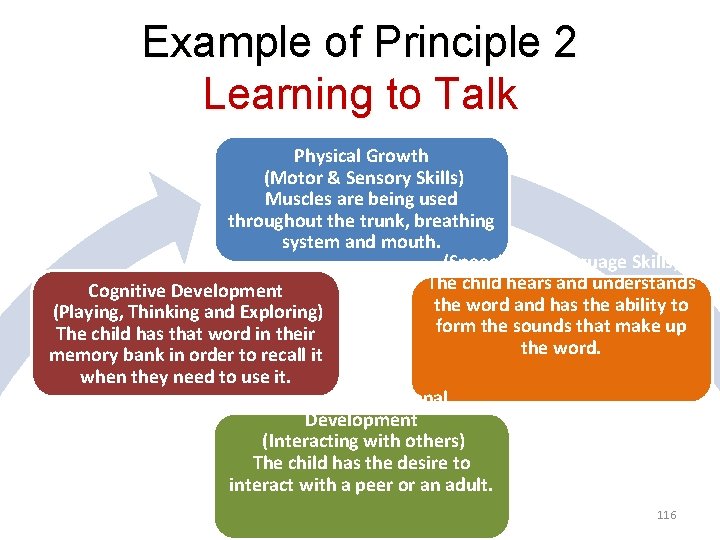
Example of Principle 2 Learning to Talk Physical Growth (Motor & Sensory Skills) Muscles are being used throughout the trunk, breathing system and mouth. (Speech and Language Skills) The child hears and understands Cognitive Development the word and has the ability to (Playing, Thinking and Exploring) form the sounds that make up The child has that word in their the word. memory bank in order to recall it when they need to use it. Social and Emotional Development (Interacting with others) The child has the desire to interact with a peer or an adult. 116
Principle 3 Children’s growth and development are influenced by both their genetic constitution and environmental experiences. And there is interplay between the two. 117
Differences in development are influenced by culture and linguistic context • Families of some cultures carry their children for the first 18 months which will influence the rate of motor development. • Children exposed to more than one language may show differences in the language acquisition process. 118
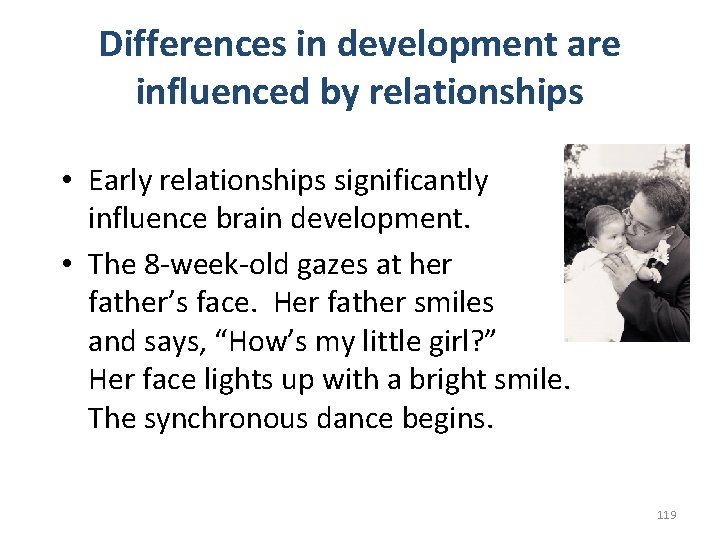
Differences in development are influenced by relationships • Early relationships significantly influence brain development. • The 8 -week-old gazes at her father’s face. Her father smiles and says, “How’s my little girl? ” Her face lights up with a bright smile. The synchronous dance begins. 119
Principle 4 Development occurs differently for different children. 120
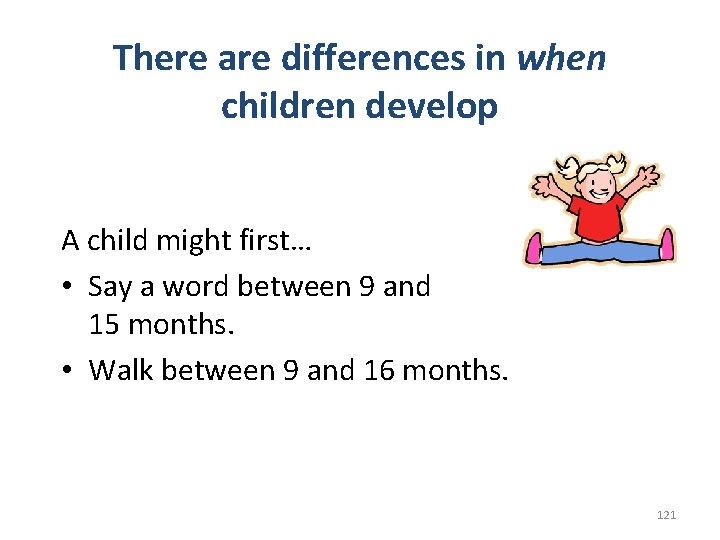
There are differences in when children develop A child might first… • Say a word between 9 and 15 months. • Walk between 9 and 16 months. 121
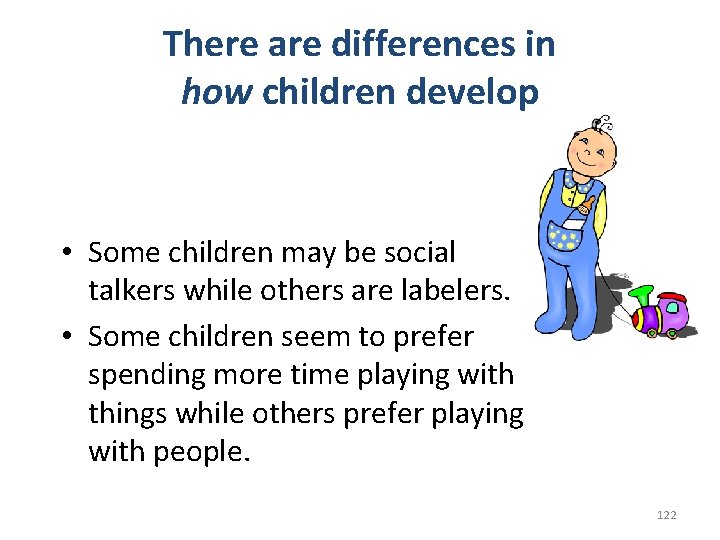
There are differences in how children develop • Some children may be social talkers while others are labelers. • Some children seem to prefer spending more time playing with things while others prefer playing with people. 122
Child Development Video #1 Let us now look at this video to review some developmental milestones • http: //www. cdc. gov/CDCtv/Baby. Steps/ 123
Developmental Milestones in Young Children Motor Domain: • When does the child begin to transfer an object from one hand to another? Why is this skill important in later physical development? Can learning in any other domain benefit from this? • Richa is 34 months old. She can stand by herself, and walk with a broad based gait. She crawls up the stairs. Richa’s parents are worried that she is not running and doing things other children in her preschool her age are doing. Is their concern justified? 124
Developmental Milestones in Young Children Communication Domain: • At what age do children typically turn head towards the direction of sound? • When do children begin to use 2 -4 word sentences? • Rosina is two years old and does not follow simple instructions such as “Rosina, come here. ” Should Rosina’s parents be worried? 125
Developmental Milestones in Young Children Cognitive Domain: • When do children start to find partially hidden toys? • Josh can match pictures with their names, is starting to babble with intonation, and imitates gestures. How old do you think Josh is? • 32 month old Mark can complete 8 -10 large piece puzzles of cars and airplanes. Is his development typical? 126
Developmental Milestones in Young Children Social /Emotional Domain: • When do children start becoming interested in mirror image? How does this learning impact other domains? • When do children begin to smile socially? • At what age do children typically demonstrate stranger anxiety? 127
Developmental Milestones in Young Children Adaptive Domain: • When do children typically begin picking up and eating cheerios and other small finger foods? • What are some of the adaptive skills you would observe for an infant or toddler? 128
Child Development Video #2 http: //abavtooldev. pearsoncmg. com/myeducati onlab/singleplay. php? project. ID=mcdevitt. orm rod&clip. ID=Cognitive_Development_Infancy. fl v 129
The risk factors that may prohibit or impede typical development and the protective/resiliency factors that may counteract these risk factors 130
The Resiliency Quiz Activity: • Complete the quiz for yourself. You have 10 minutes to complete the quiz. • After 10 minutes, pair with a partner and share – What are the some of strengths you see in yourself that help you be resilient? – How can you improve your resiliency? – What can you do to help a friend/ loved one become more resilient? – How will this knowledge about your own resiliency help in your work with families and infants/toddlers ? • Share with the large group 131
Risk • Risk refers to the presence of one or more factors that increases the probability of negative outcomes for a child • Risk may be caused due to: – Biological factors (may be genetic) – Ecological factors (may be environmental) – Combined biopsychosocial factors (both genetic and environmental) (Richman & Fraser, 2003) 132
Examples of Risk Factors – Biological risk factors: Chronic health conditions, prenatal exposure to toxic substances, disabilities, low birth weight, prematurity, poor health. – Ecological risk factors: neighborhood violence, parents who are incarcerated, parents who are not literate, parents who work, factors of abuse and/or neglect, the experience of homelessness or poverty, domestic violence, divorce etc. – Combined biopsychosocial factors: Parental mental illness, parental disability (may be genetic in nature and increase the chances of disability/ mental illness in the child) (Richman & Fraser, 2003) 133
Protective Factors • Protective factors are characteristics or conditions that counteract the risk to which children are exposed. • Protective factors delay, suppress, or neutralize negative outcomes. • Protective factors sometimes provide a buffer against risk. • Protective factors are important because they provide clues for designing more effective social programs that lessen the risk. 134
Protective Factors Three categories – individual factors (e. g. tenacity, optimism, openness) – familial factors (e. g. parental support, supervision) – extra-familial factors (e. g. community networks) Other Examples: ? 135
Resilience • Resilience refers to successful coping and adaptation despite adversity • Three aspects to resilience – overcoming the odds – sustaining competence under pressure – recovering from trauma (Richman & Fraser, 2003) 136
Activity: Risk, Protection, & Resilience • Read the Case Study(Handout H 17 a-e) of an infant/ toddler your group has received. • List some of the risk factors for the child. • Identify the protective factors you observe. • Identify what resilience factors you foresee. • Choose a notes taker and a leader for the group. • Share in thirty minutes. Your timer starts NOW. . 137
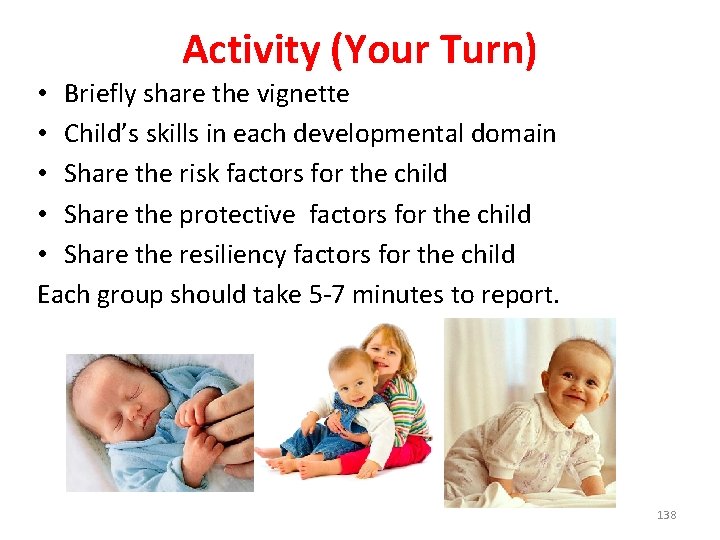
Activity (Your Turn) • Briefly share the vignette • Child’s skills in each developmental domain • Share the risk factors for the child • Share the protective factors for the child • Share the resiliency factors for the child Each group should take 5 -7 minutes to report. 138
Unique Characteristics of Infant/Toddler Services: Early Intervention Birth to three or birth through 2 • “Developmental delay” and “established condition” are the two categories for determining eligibility for the system of early intervention • Primary responsibility for supporting the child’s development falls with family • Parents and caregivers are the primary provider of developmental intervention, with support and guidance from early intervention professionals • Interventions are best carried out in typical routines of daily life and within the natural environment of the family, referred to as “everyday routines, activities and places”. • Intervention may have to address multitude of domains - requiring multi-disciplinary expertise and collaboration among providers from different agencies or fields. • The child’s developmental progress is greatly dependent on the parent’s ability to provide for and support their child. 139
When are differences considered a delay or disability? • When the “when” or “how” of development is significantly outside of what is considered “typical development. ” • When a child has a diagnosed physical or mental condition that has a high probability of resulting in delays in development. 140
Remember……………. Disability is a difference, not a deviance. 141
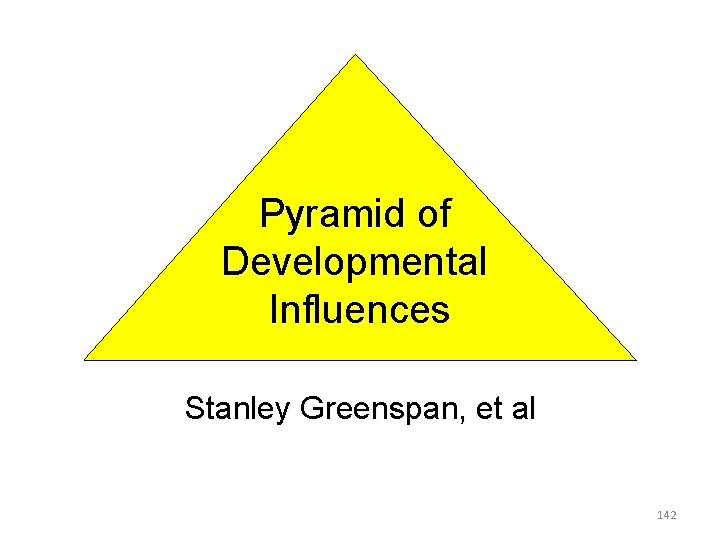
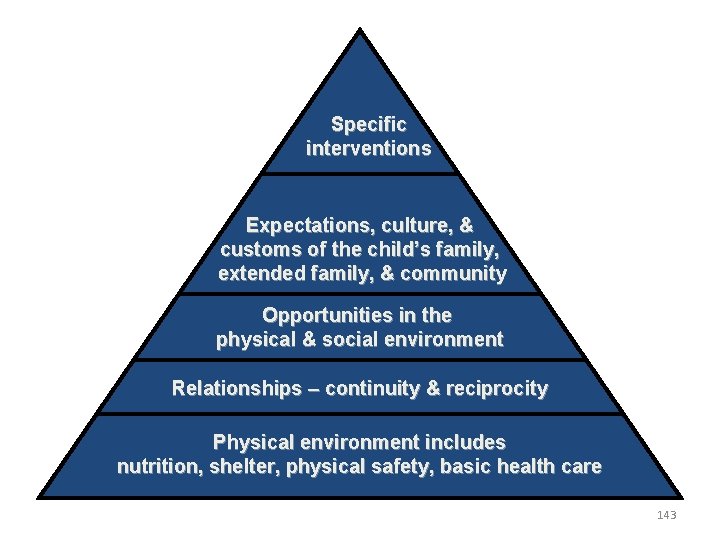
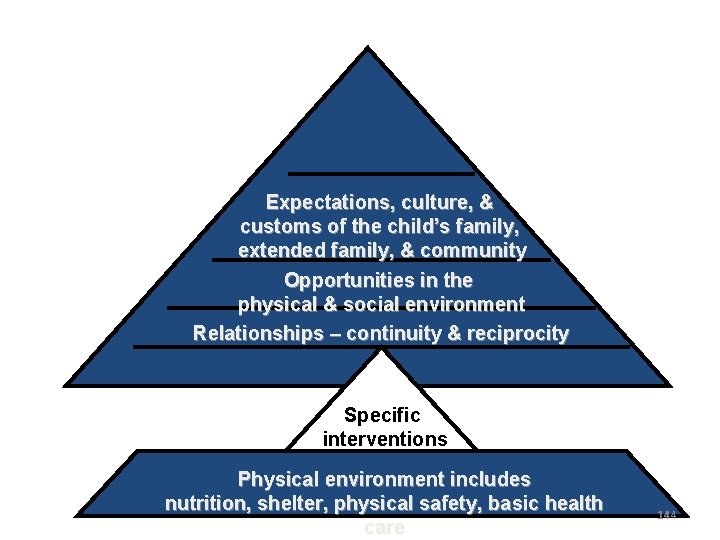
Pyramid of Developmental Influences Stanley Greenspan, et al 142
Specific interventions Expectations, culture, & customs of the child’s family, extended family, & community Opportunities in the physical & social environment Relationships – continuity & reciprocity Physical environment includes nutrition, shelter, physical safety, basic health care 143
Expectations, culture, & customs of the child’s family, extended family, & community Opportunities in the physical & social environment Relationships – continuity & reciprocity Specific interventions Physical environment includes nutrition, shelter, physical safety, basic health care 144
Recap of Module B: Overview of Child Development You learned about: • Major cognitive, communication, social, physical, and adaptive milestones • The risk factors that may prohibit or impede typical development and the protective/resiliency factors that may counteract these risk factors • The importance of the relationship between child development and the concepts of developmental delays and disability 145
Module C: Overview of Exceptionalities 146
Module C: Overview of Exceptionalities 1. Demonstrate an understanding of state and jurisdictional eligibility definitions for infants and toddlers with disabilities under IDEA and the Early Intervention system 2. Recognize the motor, communication, cognitive, social/emotional, and adaptive needs that infants/toddlers may have as a result of a developmental delay. 3. Use people-first language by talking and writing about people with disabilities in ways that honor their dignity and respect their value. 147
State and jurisdictional eligibility definitions for infants and toddlers with disabilities under IDEA 148
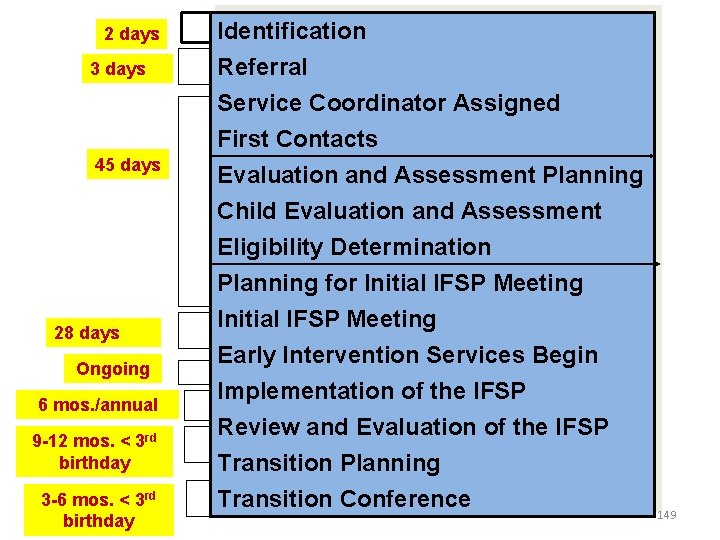
2 days 3 days 45 days 28 days Ongoing 6 mos. /annual 9 -12 mos. < 3 rd birthday 3 -6 mos. < 3 rd birthday Identification Referral Service Coordinator Assigned First Contacts Evaluation and Assessment Planning Child Evaluation and Assessment Eligibility Determination Planning for Initial IFSP Meeting Early Intervention Services Begin Implementation of the IFSP Review and Evaluation of the IFSP Transition Planning Transition Conference 149
Part C Eligibility Determination Part C eligibility is determined by each state's definition of developmental delay and includes children with established physical or mental conditions with a high probability of resulting in developmental delay. States may choose to include children at risk for disabilities in the eligible group. 150
Eligibility Determination in Colorado In Colorado, Community Center Boards are responsible for ensuring a local system of child find that includes public awareness, identification and referral, eligibility determination, and evaluation. There are two ways to determine eligibility for the Early Intervention System 151
Category # 1: Eligibility Determination in Colorado 1. Children who have a Developmental Delay: having a significant delay in development in one or more of the following domains: cognition, communication, physical including vision and hearing, social or emotional development or adaptive behavior. 152
Colorado’s Definition of Developmental Delay In Colorado the rigorous definition of a “developmental delay” means an infant or toddler who has a 25% or greater delay in one or more areas of development when compared with chronological age or the equivalent of 1. 5 standard deviations or more below the mean in one or more areas of development. 153
Category # 2: Eligibility Determination in Colorado 2. Children with an Established Condition: having a diagnosed physical or mental condition that has a high probability of resulting in significant delays in development Often referred to as “categorical eligibility”. 154
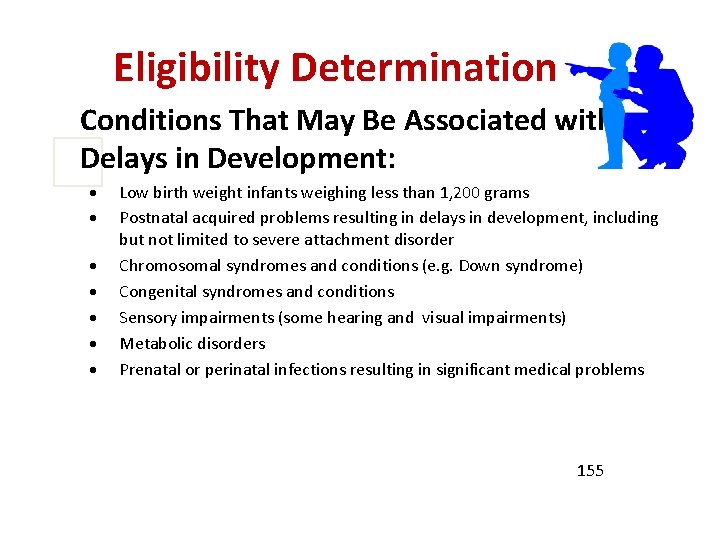
Eligibility Determination Conditions That May Be Associated with Delays in Development: · · · · Low birth weight infants weighing less than 1, 200 grams Postnatal acquired problems resulting in delays in development, including but not limited to severe attachment disorder Chromosomal syndromes and conditions (e. g. Down syndrome) Congenital syndromes and conditions Sensory impairments (some hearing and visual impairments) Metabolic disorders Prenatal or perinatal infections resulting in significant medical problems 155
Categories of Disability under IDEA There are 14 specific primary terms included in IDEA-Part B under the lead definition of "child with a disability. " These federal terms and definitions guide how States define disability and who is eligible for a free appropriate public education under special education law. • You will learn more about this in XV. Transition to Age 3 Academy. • Find more information at National Dissemination Center for Children with Disabilities website to learn more about Categories of disability for Part B. The article is also available at: http: //www. nichcy. org/Information. Resources/Documents/NIC HCY%20 PUBS/gr 3. pdf 156
Activity • Refer back to the case study of an infant/ toddler your group has received • List observation(s) about the child’s skills on each of the following four domains: Motor, Communication, Cognitive, Social/Emotional, & Adaptive that are atypical (remember some of the concerns you had when you completed the activity the previous time? ) • Number the list based on family's requests • Choose a notes taker and a leader for the group • Share in 20 minutes. Your timer starts NOW. . 157
The Power of Language
Guidelines for Speaking About Families • Families should be described in the same respectful manner, whether or not they are present • In the case of a written report, keep in mind parents have the right to examine records related to their children • Become aware of and avoid language that families might find offensive • Use people first language 159
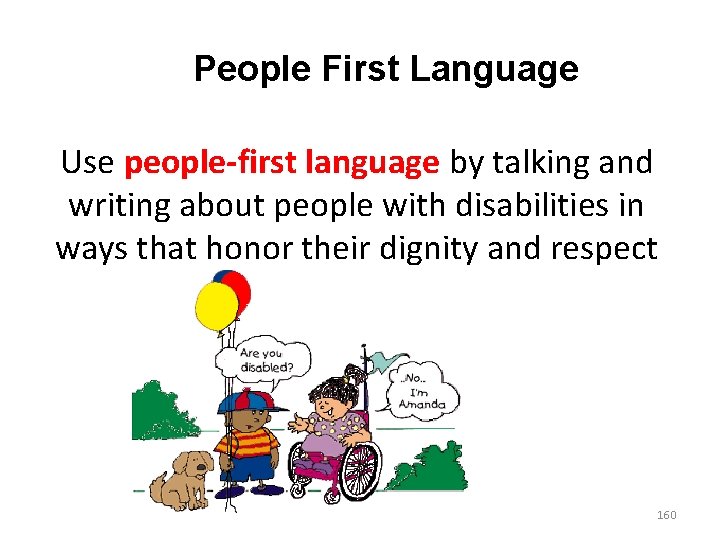
People First Language Use people-first language by talking and writing about people with disabilities in ways that honor their dignity and respect their value. 160
“People First Language” by Kathy Snow • Read the “People First Language” by Kathy Snow handout. • Reflect on the following questions: – What is people first language? – Why is it important to use people first language • Share with the large group. 161
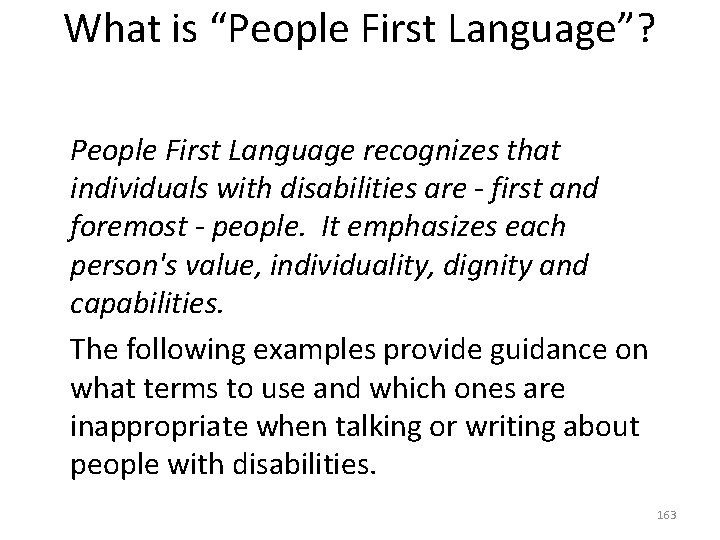
What is “People First Language”? People First Language (PFL) represents more respectful, accurate ways of communicating. People with disabilities are not their diagnoses or disabilities; they are people, first. PFL is not about "political correctness, " it's about good manners and "the golden rule. " 162
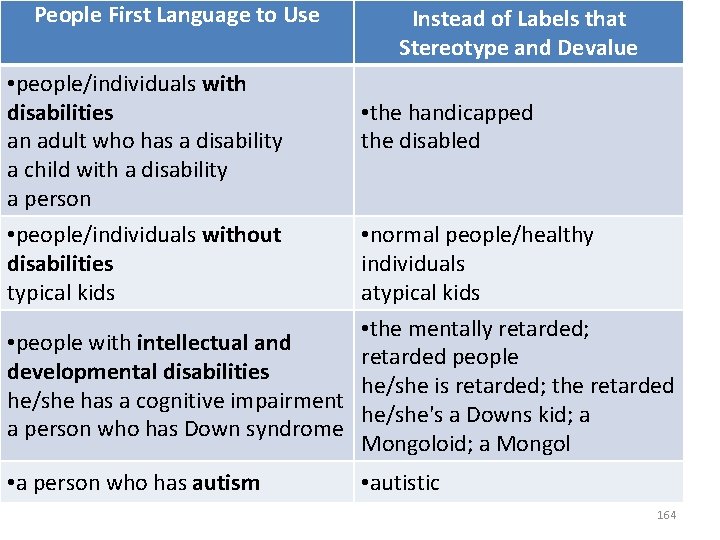
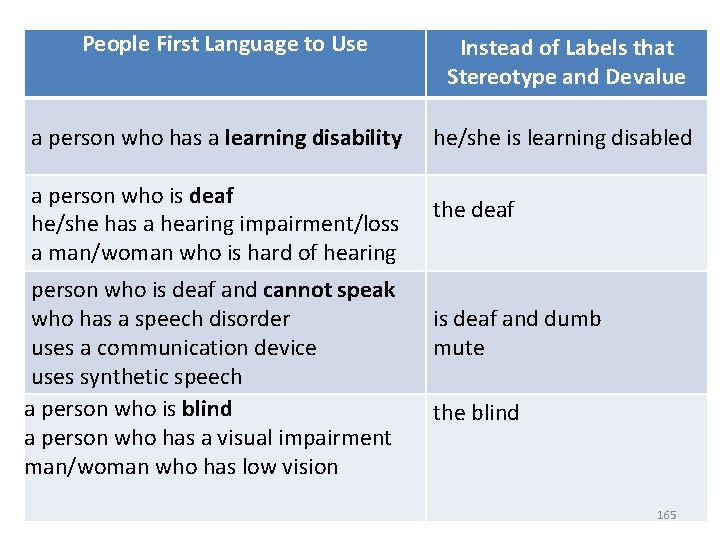
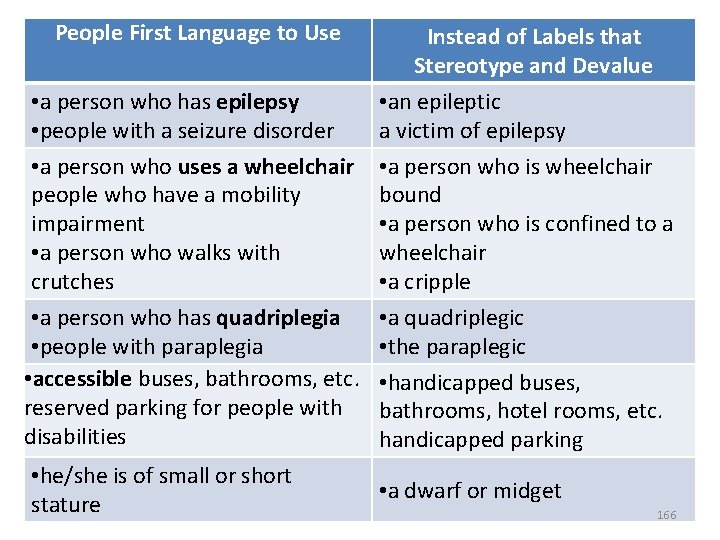
What is “People First Language”? People First Language recognizes that individuals with disabilities are - first and foremost - people. It emphasizes each person's value, individuality, dignity and capabilities. The following examples provide guidance on what terms to use and which ones are inappropriate when talking or writing about people with disabilities. 163
People First Language to Use • people/individuals with disabilities an adult who has a disability a child with a disability a person • people/individuals without disabilities typical kids Instead of Labels that Stereotype and Devalue • the handicapped the disabled • normal people/healthy individuals atypical kids • the mentally retarded; • people with intellectual and retarded people developmental disabilities he/she is retarded; the retarded he/she has a cognitive impairment he/she's a Downs kid; a a person who has Down syndrome Mongoloid; a Mongol • a person who has autism • autistic 164
People First Language to Use Instead of Labels that Stereotype and Devalue a person who has a learning disability he/she is learning disabled a person who is deaf he/she has a hearing impairment/loss a man/woman who is hard of hearing person who is deaf and cannot speak who has a speech disorder uses a communication device uses synthetic speech a person who is blind a person who has a visual impairment man/woman who has low vision the deaf is deaf and dumb mute the blind 165
People First Language to Use • a person who has epilepsy • people with a seizure disorder • a person who uses a wheelchair people who have a mobility impairment • a person who walks with crutches • a person who has quadriplegia • people with paraplegia • accessible buses, bathrooms, etc. reserved parking for people with disabilities • he/she is of small or short stature Instead of Labels that Stereotype and Devalue • an epileptic a victim of epilepsy • a person who is wheelchair bound • a person who is confined to a wheelchair • a cripple • a quadriplegic • the paraplegic • handicapped buses, bathrooms, hotel rooms, etc. handicapped parking • a dwarf or midget 166
Resources (Law/ Policy) 1. http: //www. disabilityresources. org/ABC. html : This website provides a quick guide to some of the more common acronyms in disability education, law, medicine and rehabilitation. 2. http: //idea. ed. gov/explore/home: This is the U. S. Department of Education, Office of Special Education Programs’ (OSEP’s) website on IDEA. 167
Resources (parent Groups) http: //www. peakparent. org/ : PEAK Parent Center is Colorado’s federally designated Parent Training and Information Center (PTI). PEAK assists families and others through services like its telephone hotline, workshops, conferences, website, and publications. http: //www. pacer. org/index. asp. The PACER Center (Parent Advocacy Coalition for Educational Rights) helps to expand opportunities and enhance the quality of life of children and young adults with disabilities and their families, based on the concept of parents helping parents. 168
Resources (Specific disabilities) • http: //www. thearc. org/ The Arc is the world’s largest community based organization of and for people with intellectual and developmental disabilities. • http: //www. ucp. org/: United Cerebral Palsy (UCP) is the leading source of information on cerebral palsy and is a pivotal advocate for the rights of persons with any disability. 169
Resources (Specific disabilities) • http: //www. ndss. org/ The National Down Syndrome Society is the national advocate for the value, acceptance and inclusion of people with Down syndrome. • http: //www. nationalautismassociation. org/in dex. php The National Autism Association educates and empowers families affected by autism and other neurological disorders. 170
Resources (Early Intervention) • http: //www. zerotothree. org/ 0 -3 is a national nonprofit organization that informs, trains and supports professionals, policymakers and parents in their efforts to improve the lives of infants and toddlers. • http: //www. nichcy. org/ National Dissemination Center for children with Disabilities (NICHCY) is a central source of information on: disabilities in infants, toddlers, children, and youth; IDEA; No Child Left Behind (as it relates to children with disabilities); and research-based information on effective educational practices. 171
Resources (Early Intervention) • http: //www. dec-sped. org/ The Division for Early Childhood (DEC) is one of seventeen divisions of the Council for Exceptional Children (CEC) - the largest international professional organization dedicated to improving educational outcomes for individuals with exceptionalities, students with disabilities, and/or the gifted. DEC is especially for individuals who work with or on behalf of children with special needs, birth through age eight, and their families. 172
Homework assignment • With a partner, pick a website from the list. • Research/ review the website based on the following criteria: – What is the information provided on this website? – What age range of children does the website cover? – Who does the website primarily cater to- service providers, policy makers, researchers, or families? – How will this website help you in you work with children and families? • Write a report and submit it to the instructor. 173