
Amygdala SubRegional Functional Connectivity Predicts Anxiety in Children
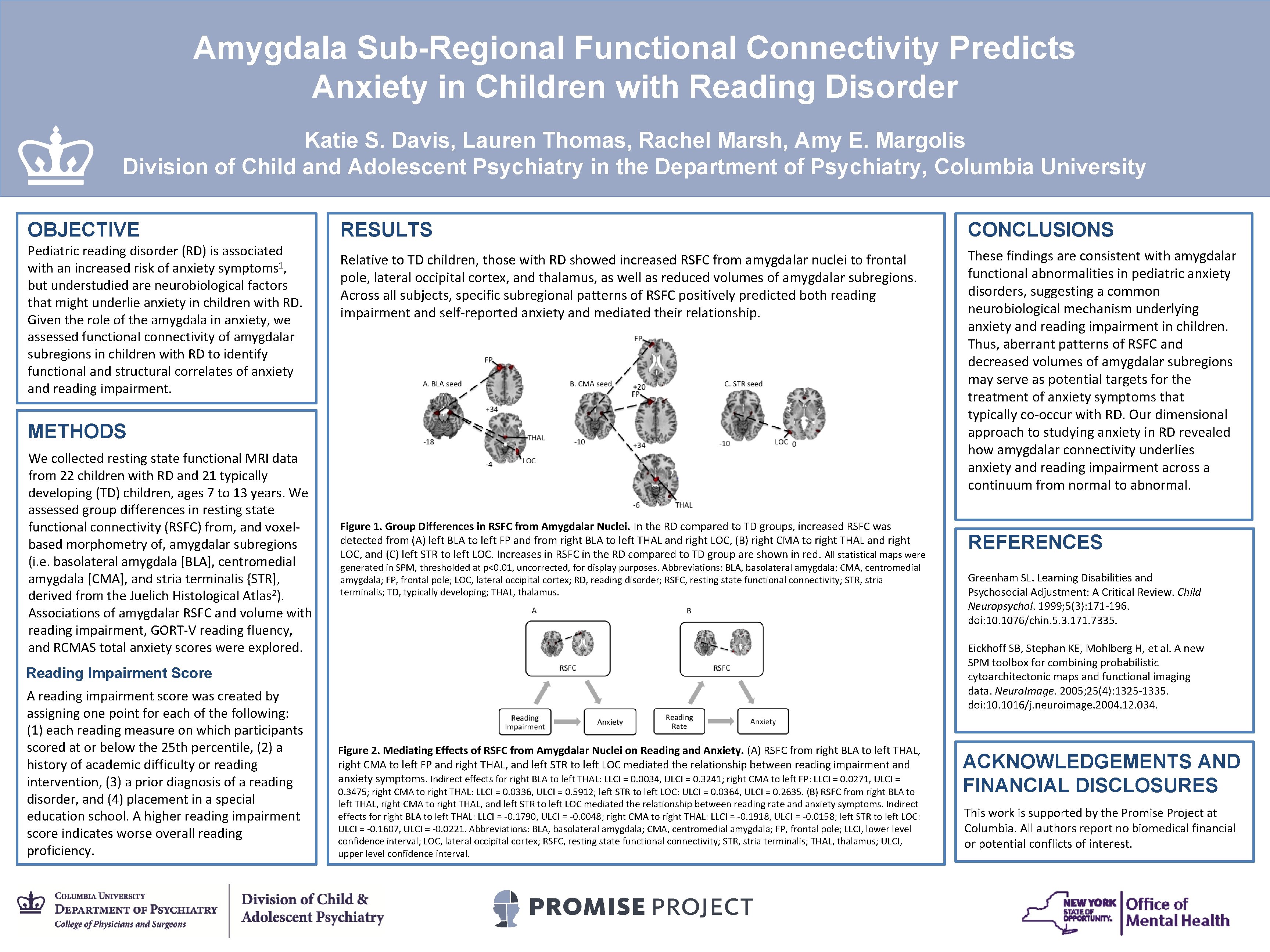
Amygdala Sub-Regional Functional Connectivity Predicts Anxiety in Children with Reading Disorder Katie S. Davis, Lauren Thomas, Rachel Marsh, Amy E. Margolis Division of Child and Adolescent Psychiatry in the Department of Psychiatry, Columbia University OBJECTIVE Pediatric reading disorder (RD) is associated with an increased risk of anxiety symptoms 1, but understudied are neurobiological factors that might underlie anxiety in children with RD. Given the role of the amygdala in anxiety, we assessed functional connectivity of amygdalar subregions in children with RD to identify functional and structural correlates of anxiety and reading impairment. RESULTS CONCLUSIONS Relative to TD children, those with RD showed increased RSFC from amygdalar nuclei to frontal pole, lateral occipital cortex, and thalamus, as well as reduced volumes of amygdalar subregions. Across all subjects, specific subregional patterns of RSFC positively predicted both reading impairment and self-reported anxiety and mediated their relationship. These findings are consistent with amygdalar functional abnormalities in pediatric anxiety disorders, suggesting a common neurobiological mechanism underlying anxiety and reading impairment in children. Thus, aberrant patterns of RSFC and decreased volumes of amygdalar subregions may serve as potential targets for the treatment of anxiety symptoms that typically co-occur with RD. Our dimensional approach to studying anxiety in RD revealed how amygdalar connectivity underlies anxiety and reading impairment across a continuum from normal to abnormal. METHODS We collected resting state functional MRI data from 22 children with RD and 21 typically developing (TD) children, ages 7 to 13 years. We assessed group differences in resting state functional connectivity (RSFC) from, and voxelbased morphometry of, amygdalar subregions (i. e. basolateral amygdala [BLA], centromedial amygdala [CMA], and stria terminalis {STR], derived from the Juelich Histological Atlas 2). Associations of amygdalar RSFC and volume with reading impairment, GORT-V reading fluency, and RCMAS total anxiety scores were explored. Figure 1. Group Differences in RSFC from Amygdalar Nuclei. In the RD compared to TD groups, increased RSFC was detected from (A) left BLA to left FP and from right BLA to left THAL and right LOC, (B) right CMA to right THAL and right LOC, and (C) left STR to left LOC. Increases in RSFC in the RD compared to TD group are shown in red. All statistical maps were generated in SPM, thresholded at p<0. 01, uncorrected, for display purposes. Abbreviations: BLA, basolateral amygdala; CMA, centromedial amygdala; FP, frontal pole; LOC, lateral occipital cortex; RD, reading disorder; RSFC, resting state functional connectivity; STR, stria terminalis; TD, typically developing; THAL, thalamus. Greenham SL. Learning Disabilities and Psychosocial Adjustment: A Critical Review. Child Neuropsychol. 1999; 5(3): 171 -196. doi: 10. 1076/chin. 5. 3. 171. 7335. Eickhoff SB, Stephan KE, Mohlberg H, et al. A new SPM toolbox for combining probabilistic cytoarchitectonic maps and functional imaging data. Neuro. Image. 2005; 25(4): 1325 -1335. doi: 10. 1016/j. neuroimage. 2004. 12. 034. Reading Impairment Score A reading impairment score was created by assigning one point for each of the following: (1) each reading measure on which participants scored at or below the 25 th percentile, (2) a history of academic difficulty or reading intervention, (3) a prior diagnosis of a reading disorder, and (4) placement in a special education school. A higher reading impairment score indicates worse overall reading proficiency. REFERENCES Figure 2. Mediating Effects of RSFC from Amygdalar Nuclei on Reading and Anxiety. (A) RSFC from right BLA to left THAL, right CMA to left FP and right THAL, and left STR to left LOC mediated the relationship between reading impairment and anxiety symptoms. Indirect effects for right BLA to left THAL: LLCI = 0. 0034, ULCI = 0. 3241; right CMA to left FP: LLCI = 0. 0271, ULCI = 0. 3475; right CMA to right THAL: LLCI = 0. 0336, ULCI = 0. 5912; left STR to left LOC: ULCI = 0. 0364, ULCI = 0. 2635. (B) RSFC from right BLA to left THAL, right CMA to right THAL, and left STR to left LOC mediated the relationship between reading rate and anxiety symptoms. Indirect effects for right BLA to left THAL: LLCI = -0. 1790, ULCI = -0. 0048; right CMA to right THAL: LLCI = -0. 1918, ULCI = -0. 0158; left STR to left LOC: ULCI = -0. 1607, ULCI = -0. 0221. Abbreviations: BLA, basolateral amygdala; CMA, centromedial amygdala; FP, frontal pole; LLCI, lower level confidence interval; LOC, lateral occipital cortex; RSFC, resting state functional connectivity; STR, stria terminalis; THAL, thalamus; ULCI, upper level confidence interval. ACKNOWLEDGEMENTS AND FINANCIAL DISCLOSURES This work is supported by the Promise Project at Columbia. All authors report no biomedical financial or potential conflicts of interest.
- Slides: 1