
Amy Brown Science There are two main reasons
© Amy Brown Science
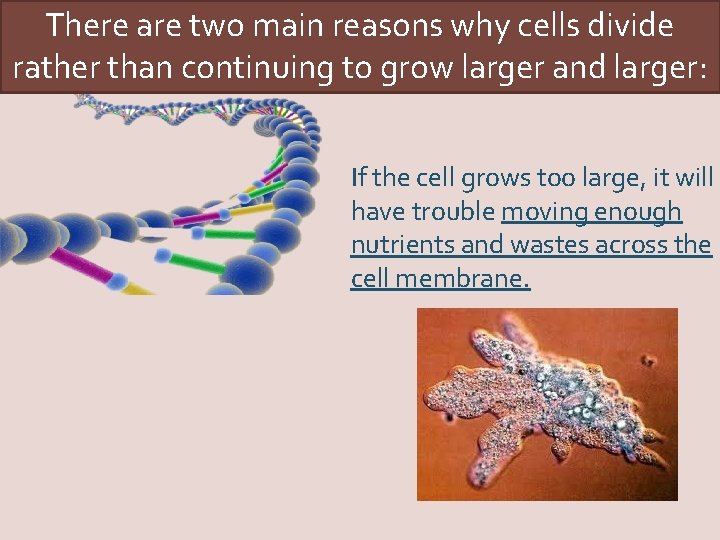
There are two main reasons why cells divide rather than continuing to grow larger and larger: If the cell grows too large, it will have trouble moving enough nutrients and wastes across the cell membrane.
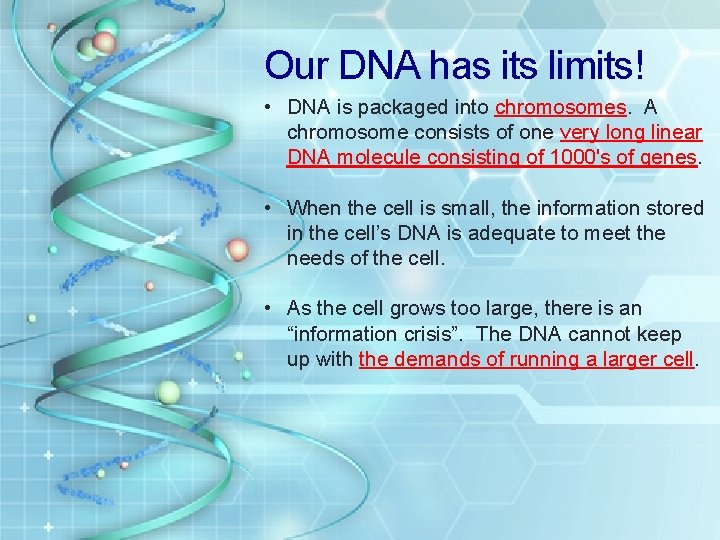
Our DNA has its limits! • DNA is packaged into chromosomes. A chromosome consists of one very long linear DNA molecule consisting of 1000's of genes. • When the cell is small, the information stored in the cell’s DNA is adequate to meet the needs of the cell. • As the cell grows too large, there is an “information crisis”. The DNA cannot keep up with the demands of running a larger cell.
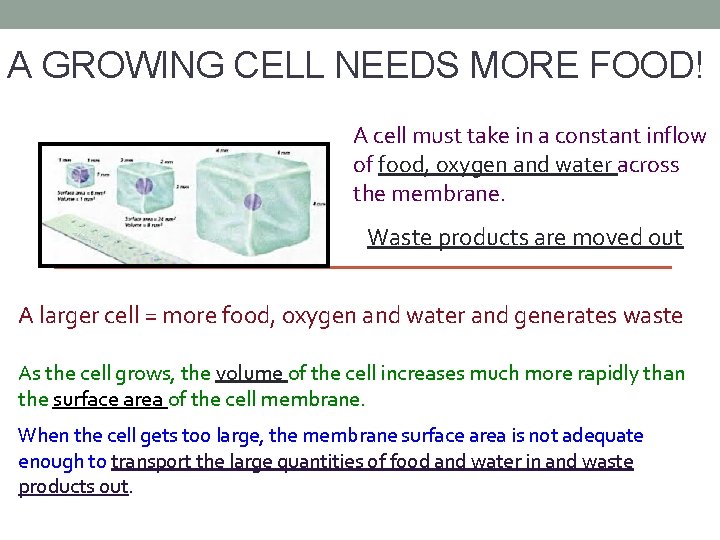
A GROWING CELL NEEDS MORE FOOD! A cell must take in a constant inflow of food, oxygen and water across the membrane. Waste products are moved out A larger cell = more food, oxygen and water and generates waste As the cell grows, the volume of the cell increases much more rapidly than the surface area of the cell membrane. When the cell gets too large, the membrane surface area is not adequate enough to transport the large quantities of food and water in and waste products out.
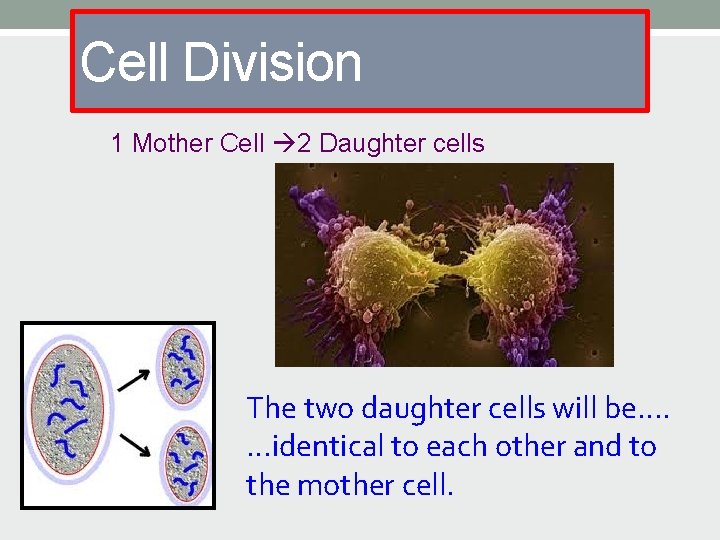
Cell Division 1 Mother Cell 2 Daughter cells The two daughter cells will be…. …identical to each other and to the mother cell.
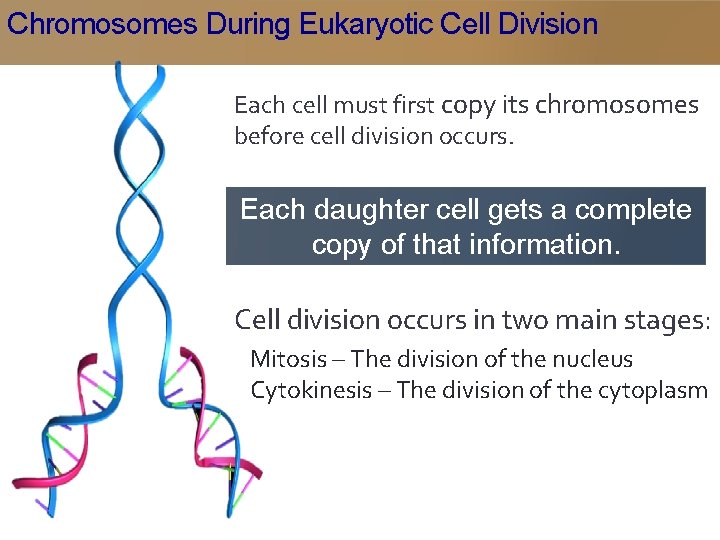
Chromosomes During Eukaryotic Cell Division Each cell must first copy its chromosomes before cell division occurs. Each daughter cell gets a complete copy of that information. Cell division occurs in two main stages: Mitosis – The division of the nucleus Cytokinesis – The division of the cytoplasm
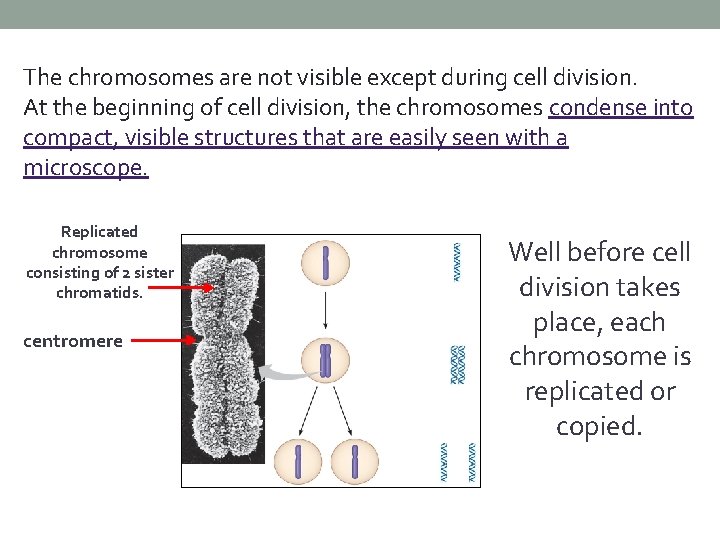
The chromosomes are not visible except during cell division. At the beginning of cell division, the chromosomes condense into compact, visible structures that are easily seen with a microscope. Replicated chromosome consisting of 2 sister chromatids. centromere Well before cell division takes place, each chromosome is replicated or copied.
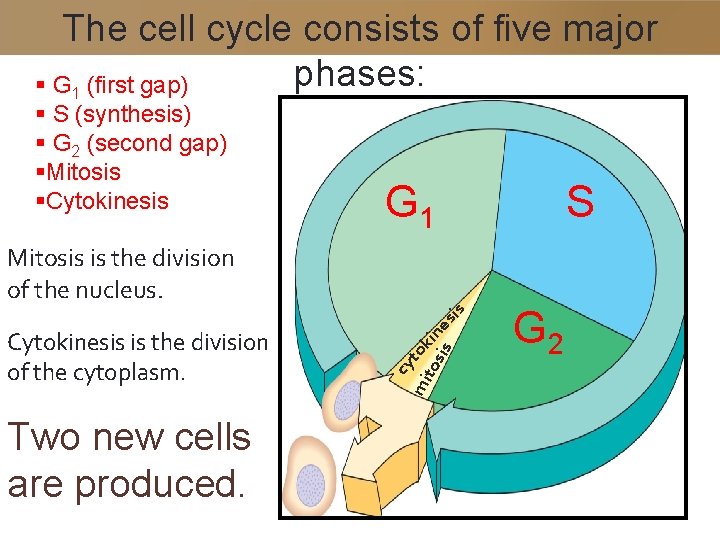
The cell cycle consists of five major phases: § G 1 (first gap) § S (synthesis) § G 2 (second gap) §Mitosis §Cytokinesis G 1 Two new cells are produced. cy Cytokinesis is the division of the cytoplasm. mi tok tos in is es is Mitosis is the division of the nucleus. S G 2
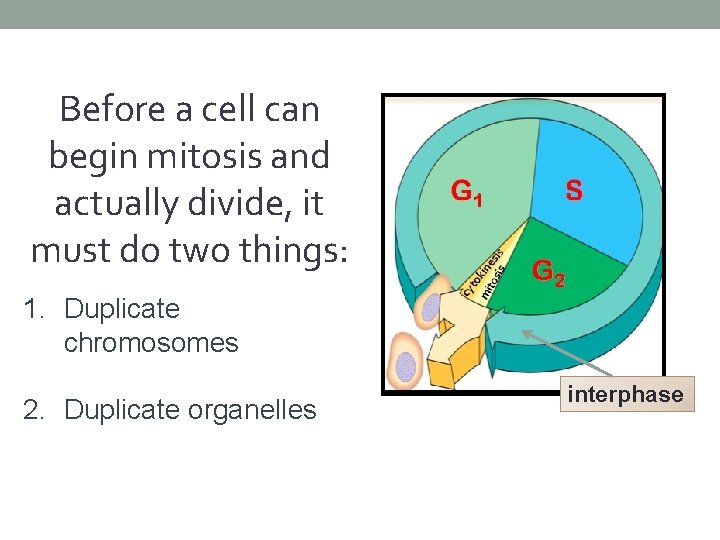
Before a cell can begin mitosis and actually divide, it must do two things: 1. Duplicate chromosomes 2. Duplicate organelles interphase
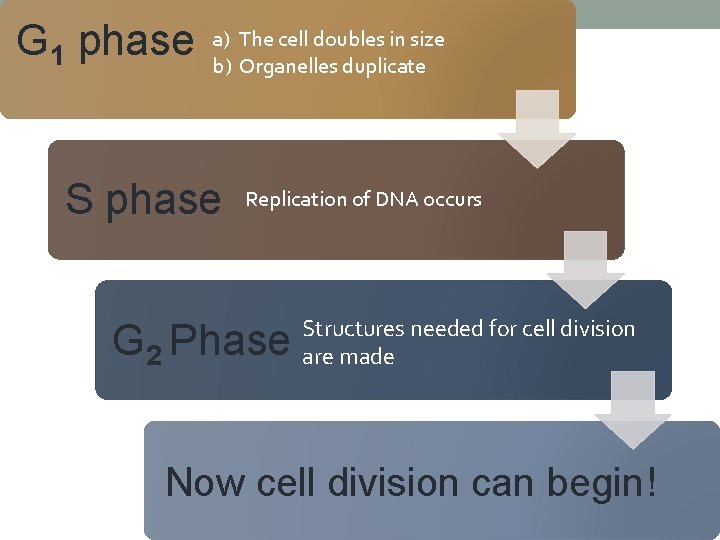
G 1 phase a) The cell doubles in size b) Organelles duplicate S phase Replication of DNA occurs G 2 Phase Structures needed for cell division are made Now cell division can begin!

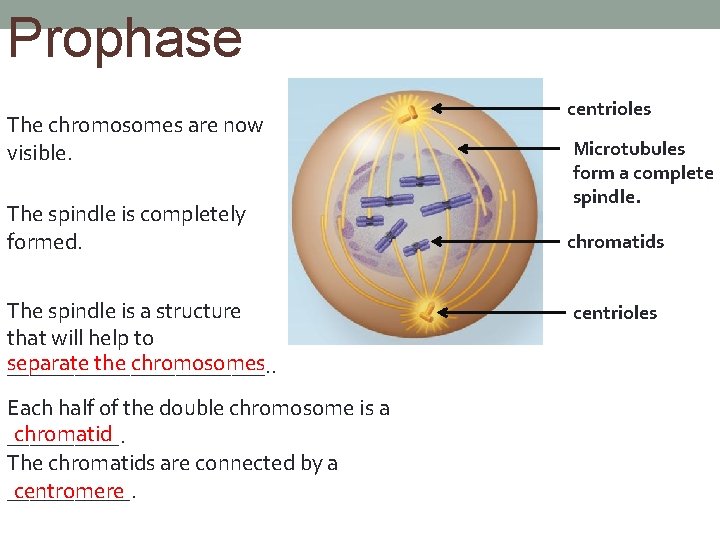
Prophase The chromosomes are now visible. The spindle is completely formed. The spindle is a structure that will help to separate the chromosomes ____________. . Each half of the double chromosome is a chromatid _____. The chromatids are connected by a ______. centromere centrioles Microtubules form a complete spindle. chromatids centrioles
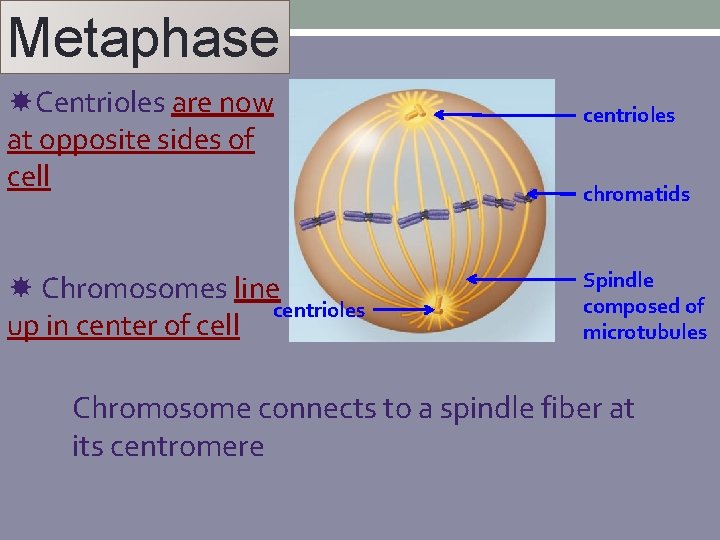
Metaphase Centrioles are now at opposite sides of cell Chromosomes line centrioles up in center of cell centrioles chromatids Spindle composed of microtubules Chromosome connects to a spindle fiber at its centromere
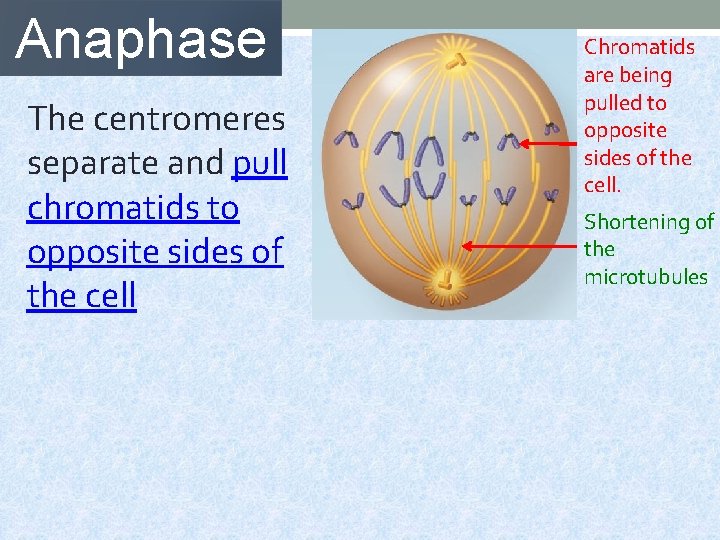
Anaphase The centromeres separate and pull chromatids to opposite sides of the cell Chromatids are being pulled to opposite sides of the cell. Shortening of the microtubules
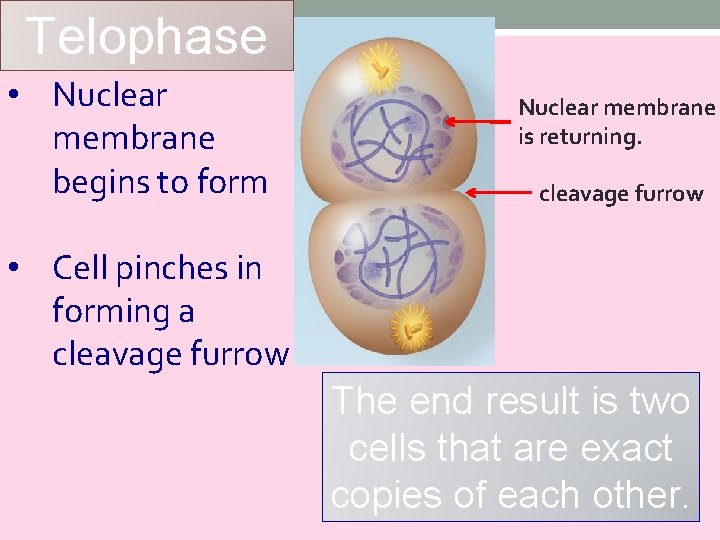
Telophase • Nuclear membrane begins to form Nuclear membrane is returning. cleavage furrow • Cell pinches in forming a cleavage furrow The end result is two cells that are exact copies of each other.
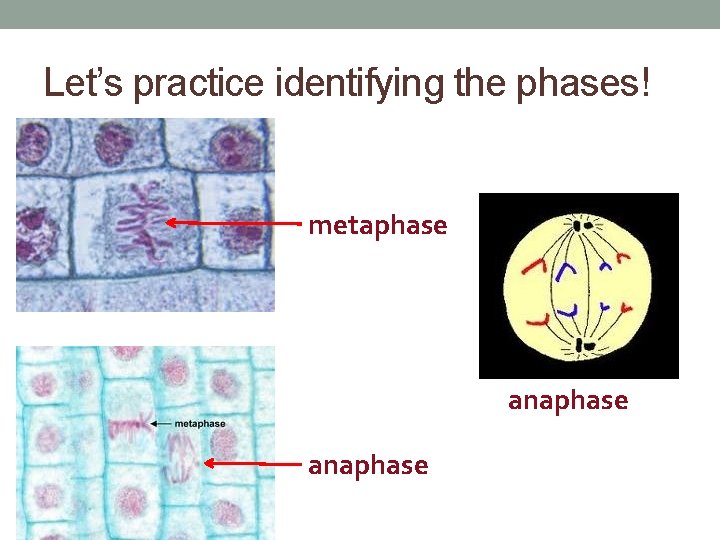
Let’s practice identifying the phases! metaphase anaphase
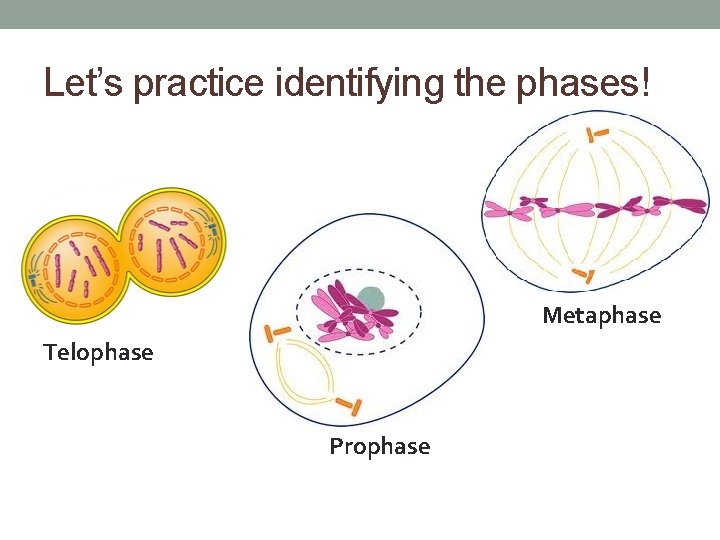
Let’s practice identifying the phases! Metaphase Telophase Prophase
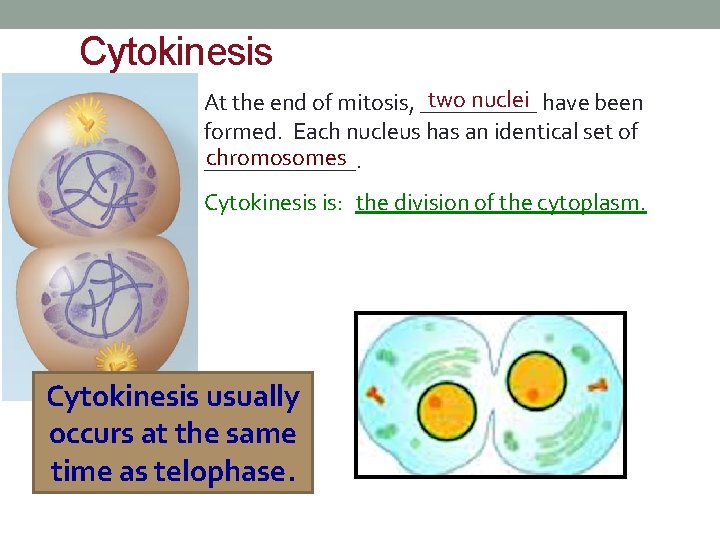
Cytokinesis two nuclei have been At the end of mitosis, _____ formed. Each nucleus has an identical set of chromosomes _______. Cytokinesis is: the division of the cytoplasm. Cytokinesis usually occurs at the same time as telophase.
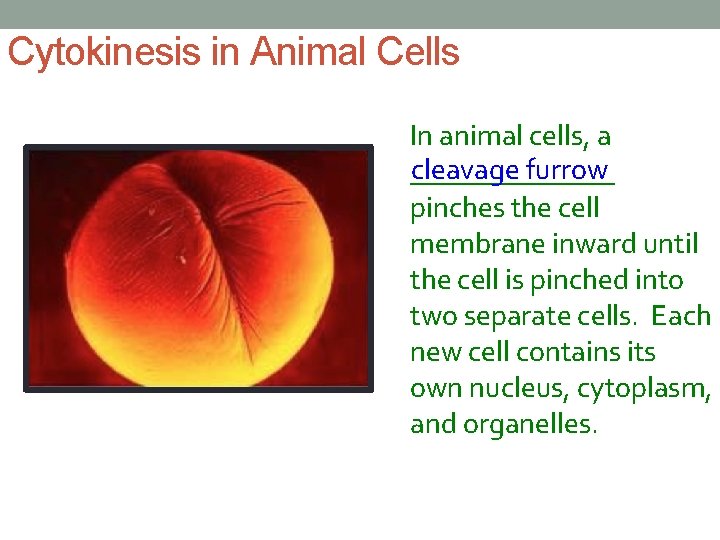
Cytokinesis in Animal Cells In animal cells, a cleavage furrow _______ pinches the cell membrane inward until the cell is pinched into two separate cells. Each new cell contains its own nucleus, cytoplasm, and organelles.
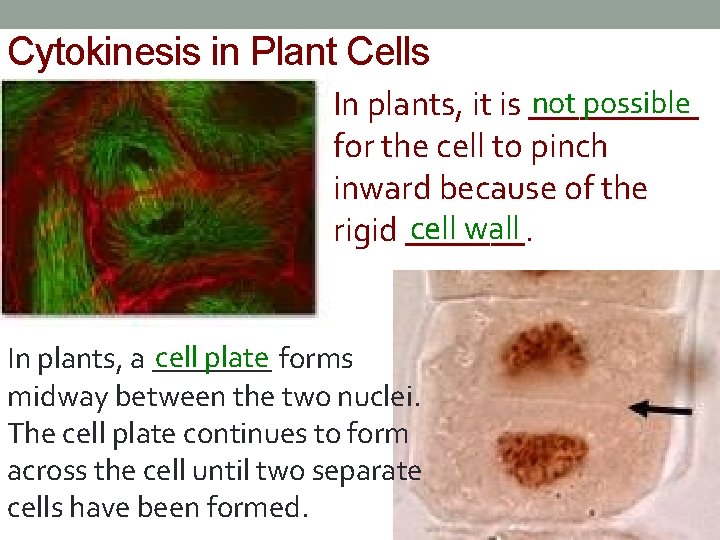
Cytokinesis in Plant Cells not possible In plants, it is _____ for the cell to pinch inward because of the cell wall rigid _______. cell plate forms In plants, a ____ midway between the two nuclei. The cell plate continues to form across the cell until two separate cells have been formed.
M I T O S I S 1. Takes between 30 minutes and 2 hours. 2. One Mother Cell = Two Daughter cells. 3. The two daughter cells are identical to the mother cell.
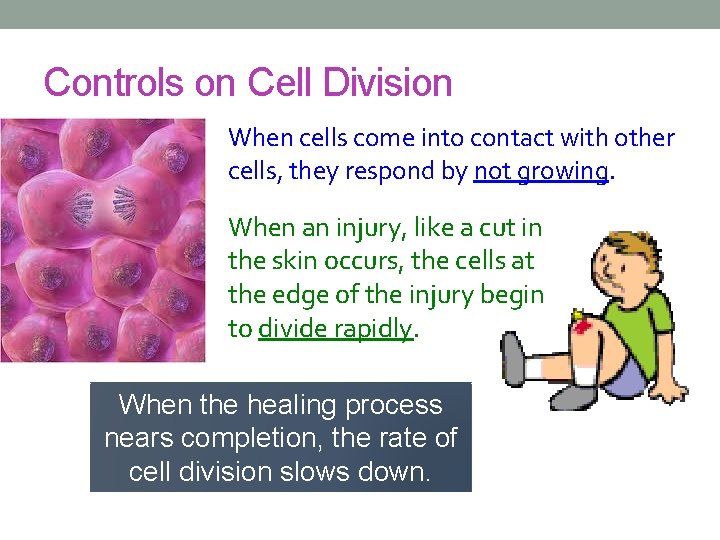
Controls on Cell Division When cells come into contact with other cells, they respond by not growing. When an injury, like a cut in the skin occurs, the cells at the edge of the injury begin to divide rapidly. When the healing process nears completion, the rate of cell division slows down.
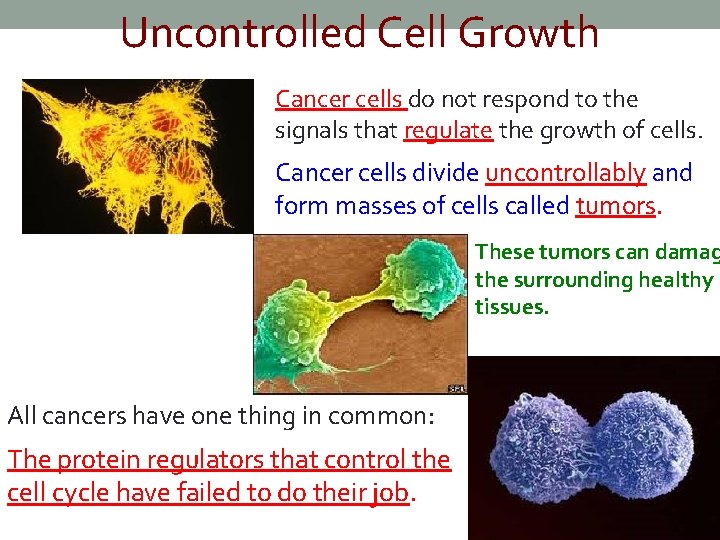
Uncontrolled Cell Growth Cancer cells do not respond to the signals that regulate the growth of cells. Cancer cells divide uncontrollably and form masses of cells called tumors. These tumors can damag the surrounding healthy tissues. All cancers have one thing in common: The protein regulators that control the cell cycle have failed to do their job.

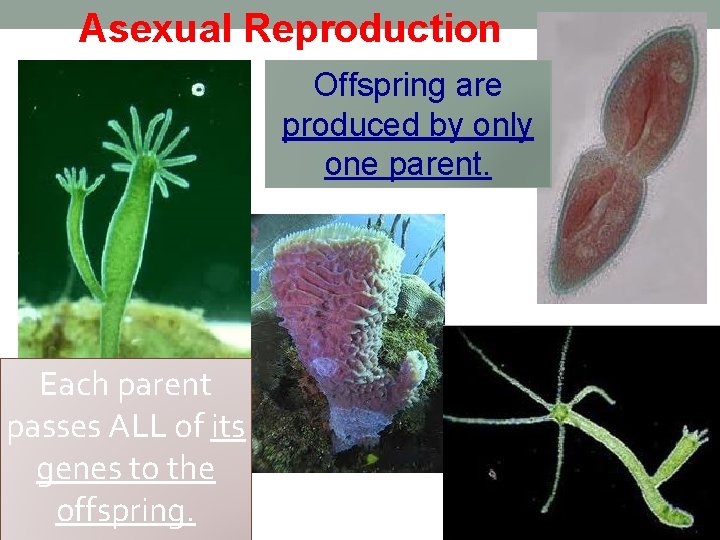
Asexual Reproduction Offspring are produced by only one parent. Each parent passes ALL of its genes to the offspring.
Asexual Reproduction Advantages Disadvantages a) It is faster a) No genetic variation b) Large numbers of b) Ability to adapt to offspring are produced c) No need for mate environment decreased
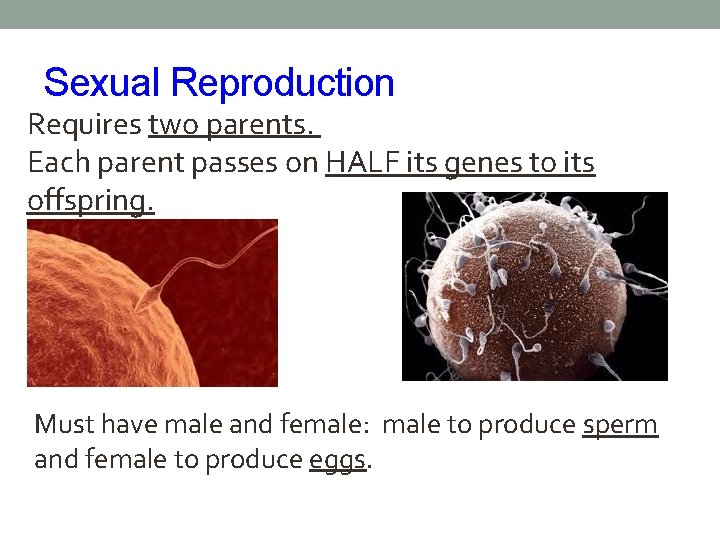
Sexual Reproduction Requires two parents. Each parent passes on HALF its genes to its offspring. Must have male and female: male to produce sperm and female to produce eggs.
Sexual Reproduction Advantages a) All of the offspring are genetically different from each other. Disadvantages a) The parent must find a mate. b) Fewer offspring will be produced. c) It takes longer. Sexual Reproduction involves: Gametes: Sex cells (egg and sperm) Fertilization: The union of sperm and egg Zygote: A fertilized egg
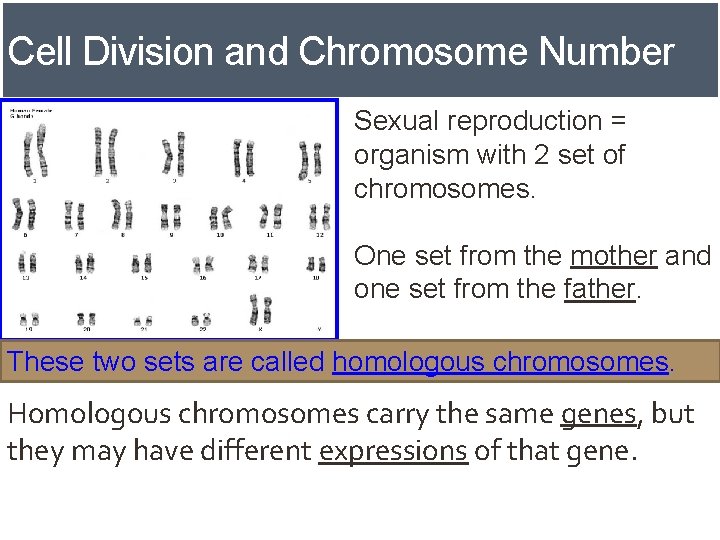
Cell Division and Chromosome Number Sexual reproduction = organism with 2 set of chromosomes. One set from the mother and one set from the father. These two sets are called homologous chromosomes. Homologous chromosomes carry the same genes, but they may have different expressions of that gene.
Diploid means that … You are a “diploid” organism. …there are two of each kind of chromosome in each cell. The symbol for diploid is 2 N “N” is the number of different chromosomes an organism has. Humans are 2 N because we have 2 of each kind of chromosome. So in mitosis: 1 (2 N) cell -------> 2 (2 N) cells
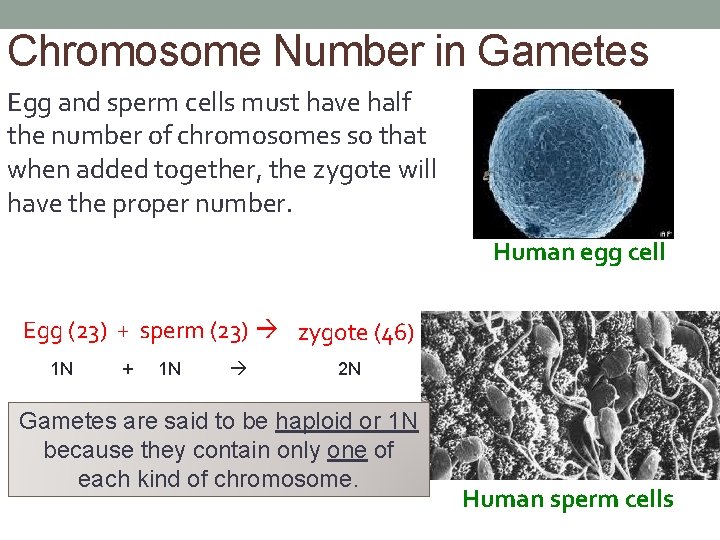
Chromosome Number in Gametes Egg and sperm cells must have half the number of chromosomes so that when added together, the zygote will have the proper number. Human egg cell Egg (23) + sperm (23) zygote (46) 1 N + 1 N 2 N Gametes are said to be haploid or 1 N because they contain only one of each kind of chromosome. Human sperm cells
Phases of Meiosis B. Purpose is A. Occurs to reduce the only to make chromosome sex cells: the number of egg and the egg and sperm by half. C. Unlike mitosis, chromosome replication is followed by two divisions: meiosis I and meiosis II.
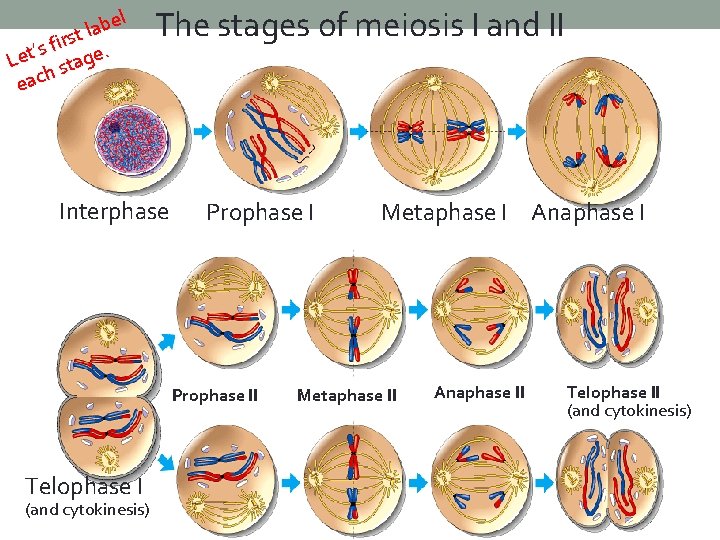
el b a l st r i f s Let’ stage. h eac The stages of meiosis I and II Interphase Prophase II Telophase I (and cytokinesis) Metaphase I Anaphase I Metaphase II Anaphase II Telophase II (and cytokinesis)
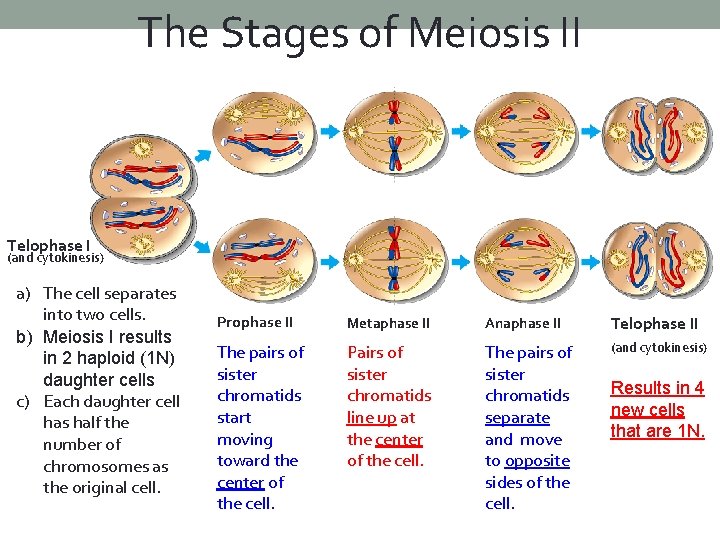
The Stages of Meiosis II Telophase I (and cytokinesis) a) The cell separates into two cells. b) Meiosis I results in 2 haploid (1 N) daughter cells c) Each daughter cell has half the number of chromosomes as the original cell. Prophase II Metaphase II Anaphase II Telophase II The pairs of sister chromatids start moving toward the center of the cell. Pairs of sister chromatids line up at the center of the cell. The pairs of sister chromatids separate and move to opposite sides of the cell. (and cytokinesis) Results in 4 new cells that are 1 N.
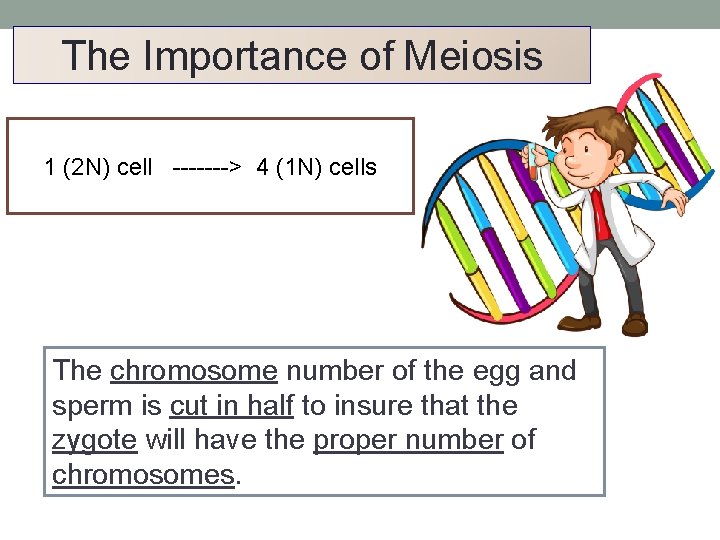
The Importance of Meiosis 1 (2 N) cell -------> 4 (1 N) cells The chromosome number of the egg and sperm is cut in half to insure that the zygote will have the proper number of chromosomes.
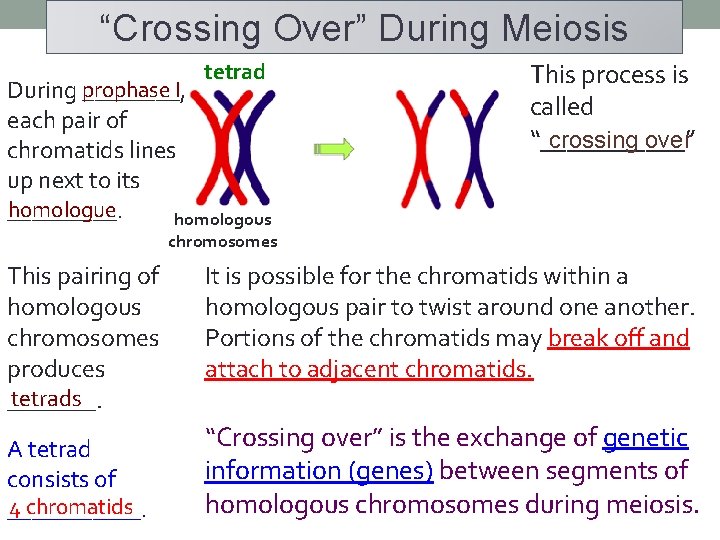
“Crossing Over” During Meiosis tetrad During prophase ____, I each pair of chromatids lines up next to its homologue _____. homologous This process is called “______” crossing over chromosomes This pairing of homologous chromosomes produces tetrads _______. A tetrad consists of 4 chromatids ______. It is possible for the chromatids within a homologous pair to twist around one another. Portions of the chromatids may break off and attach to adjacent chromatids. “Crossing over” is the exchange of genetic information (genes) between segments of homologous chromosomes during meiosis.
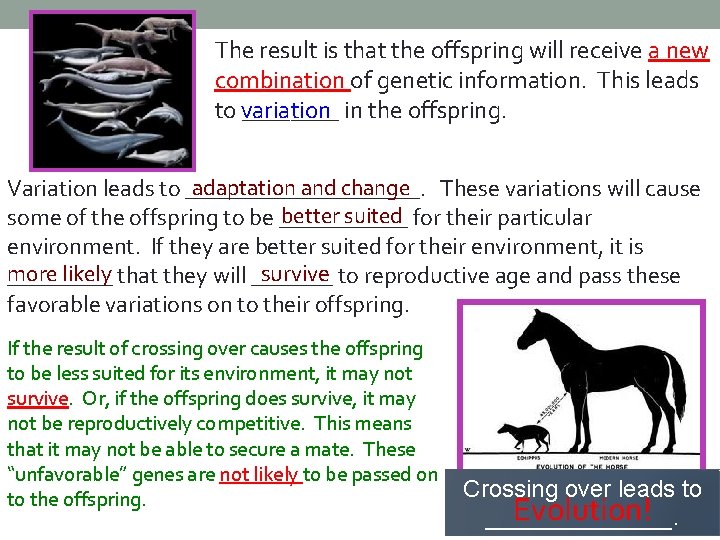
The result is that the offspring will receive a new combination of genetic information. This leads to variation ____ in the offspring. adaptation and change These variations will cause Variation leads to __________. better suited for their particular some of the offspring to be ______ environment. If they are better suited for their environment, it is survive to reproductive age and pass these more likely that they will _________ favorable variations on to their offspring. If the result of crossing over causes the offspring to be less suited for its environment, it may not survive. Or, if the offspring does survive, it may not be reproductively competitive. This means that it may not be able to secure a mate. These “unfavorable” genes are not likely to be passed on to the offspring. Crossing over leads to Evolution! _______.
Comparison of Mitosis and Meiosis A. Mitosis occurs in all cells of the egg and sperm _____ except _______. body B. Meiosis only occurs in the egg and sperm formation of _______.
Comparison of Mitosis and Meiosis diploid cell C. In meiosis, each _______ divides ______ twice to produce a total of 4 cells. ___ diploid cell D. In mitosis each _______ 2 cells. once to form ___ divides _____
Comparison of Mitosis and Meiosis E. In meiosis, each of the four cells half the number of contains _____ chromosomes as the parent cell. F. In mitosis, each new cell contains the same number of chromosomes as the ______ original cell.
Comparison of Mitosis and Meiosis F. In mitosis, the homologous pairs do not tetrads come together to form _______. G. In meiosis, the homologous pairs do come tetrads together to form _______. While the crossing over chromosomes are in tetrads, _______ may occur. There will be no crossing over in mitosis _______.
Comparison of Mitosis and Meiosis H. In meiosis, the four haploid cells different combinations of contain ____ chromosomes from each other. I. In mitosis, the new cells contain identical copies. ____
- Slides: 42