
Amsterdam Law School Tabitha I Oost LLM MSc
Amsterdam Law School Tabitha I. Oost, LLM, MSc From “Leader to Pariah” On the Dutch restitution committee and the inclusion of the public interest in assessing Nazi-spoliated art claims
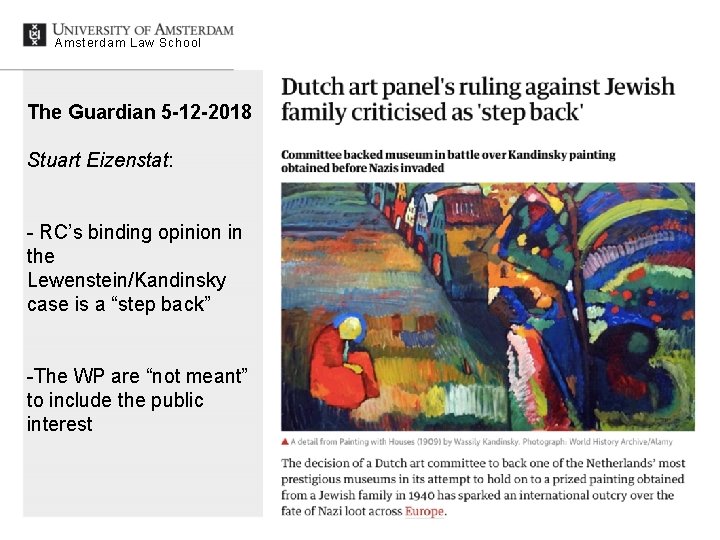
Amsterdam Law School The Guardian 5 -12 -2018 Stuart Eizenstat: - RC’s binding opinion in the Lewenstein/Kandinsky case is a “step back” -The WP are “not meant” to include the public interest
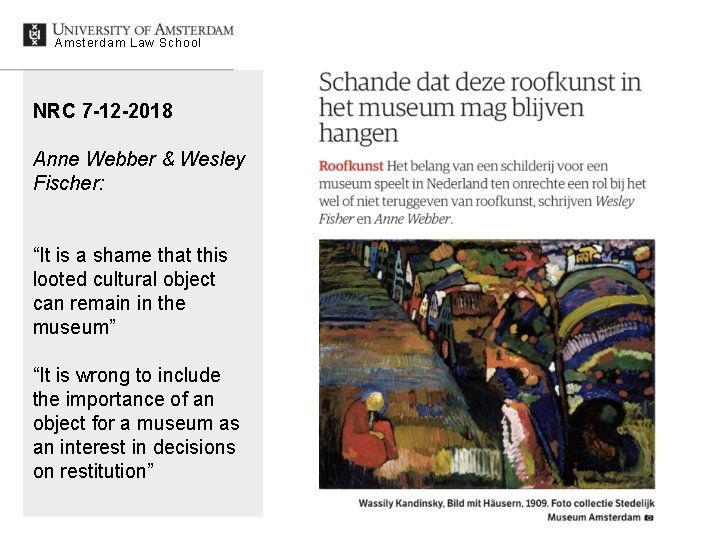
Amsterdam Law School NRC 7 -12 -2018 Anne Webber & Wesley Fischer: “It is a shame that this looted cultural object can remain in the museum” “It is wrong to include the importance of an object for a museum as an interest in decisions on restitution”
Amsterdam Law School Debate in the Netherlands (December 2018) Fred Hammerstein (chairman Dutch RC): “the interest of the victim is central in the Dutch restitution policy” Evelien Campfens (former secretary of the RC) “The Netherlands treats the issue of Nazi-looted cultural objects in a most conscientious manner. ” Gert-Jan van den Bergh (lawyer) “The Netherlands has taken the wrong approach” Emile Schrijver (director of the Jewish Cultural Quarter) “Looted-art is more than a legal matter, acknowledge the emotions involved”
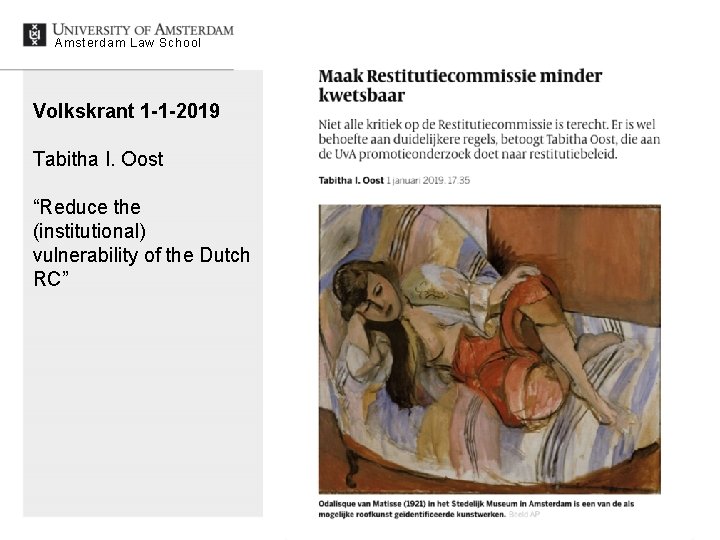
Amsterdam Law School Volkskrant 1 -1 -2019 Tabitha I. Oost “Reduce the (institutional) vulnerability of the Dutch RC”
Amsterdam Law School Throwback: the Dutch context I First ‘round” of restitution immediate post WWII years • System of Restoration of Rights based on Royal Decrees (E 100) • Strict legal approach: - burden of proof (of loss of possession and ownership) former owner - obligation to pay for administrative fees (storage etc) • Netherlands Art Property Collection or NK- collection: some 4000 objects that could not or were not restituted after WWII ended up at the state
Amsterdam Law School Throwback: the Dutch context II Second “round” of restitution • Renewed international attention on the fate of Jewish assets • Incentive for the debate on fate of spoliated cultural objects after seizure of Egon Schiele paintings in New York • In the Netherlands focus on “tainted heritage”: the NK-Collection • Government-installed research committee (Ekkart) to lift the “haze of secrecy”: Post WWII restitution policy “legalistic, bureaucratic, coldhearted and callous” Call for a renewed generous “round” of restitution
Amsterdam Law School Set-up Dutch Restitutions Committee I Two-pronged task based on article 2 (2001): “[…. ]task is to advise the Minister, at his request, on decisions to be taken concerning applications for the restitution of items of cultural value of which the original owners involuntarily lost possession due to circumstances directly related to the Nazi regime and which are currently in the possession of the State of the Netherlands. ” Eligible objects: NK-Collection AND Dutch national art collection “A further task of the Committee shall be to issue an opinion, on the Minister’s request, on disputes concerning the restitution of items of cultural value between the original owner who, due to circumstances directly related to the Nazi regime, involuntarily lost possession of such an item, or the owner’s heirs, and the current possessor which is not the State of the Netherlands. ”
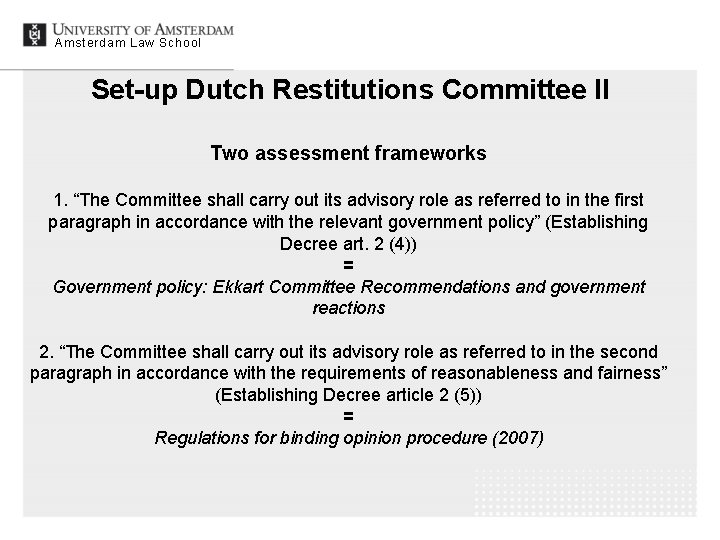
Amsterdam Law School Set-up Dutch Restitutions Committee II Two assessment frameworks 1. “The Committee shall carry out its advisory role as referred to in the first paragraph in accordance with the relevant government policy” (Establishing Decree art. 2 (4)) = Government policy: Ekkart Committee Recommendations and government reactions 2. “The Committee shall carry out its advisory role as referred to in the second paragraph in accordance with the requirements of reasonableness and fairness” (Establishing Decree article 2 (5)) = Regulations for binding opinion procedure (2007)
Amsterdam Law School Origins of inclusion of the public interest • Heikelien Verrijn Stuart (former RC Member) 17 May 2019: “after Goudstikker, everything changed” • In 2005 the RC’s recommendation in the Goudstikker case resulted in: − − the “deaccessioning” of more than 200 art works to Marei Van Saher (no consanguine relationship to Jaqcues Goudstikker who originally lost possession) • Annual reports RC refer to a “change in the public opinion”: 1. should there be “limits” on the “legitimacy of claims filed by heirs” ? 2. should the significance of valuable or unique art objects of public collections in the Netherlands be included in the assessments of these claims?
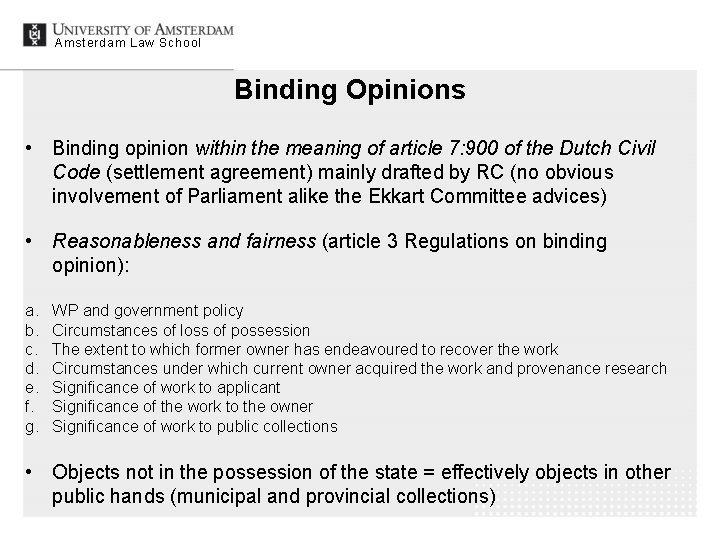
Amsterdam Law School Binding Opinions • Binding opinion within the meaning of article 7: 900 of the Dutch Civil Code (settlement agreement) mainly drafted by RC (no obvious involvement of Parliament alike the Ekkart Committee advices) • Reasonableness and fairness (article 3 Regulations on binding opinion): a. b. c. d. e. f. g. WP and government policy Circumstances of loss of possession The extent to which former owner has endeavoured to recover the work Circumstances under which current owner acquired the work and provenance research Significance of work to applicant Significance of the work to the owner Significance of work to public collections • Objects not in the possession of the state = effectively objects in other public hands (municipal and provincial collections)
Amsterdam Law School Towards one uniform framework I Semmel I, RC 1. 75 (2009) positive recommendation “It is unclear whether the painting was actually sold at this auction. The Committee assumes that if this was not the case, the painting was reauctioned at a later date or sold privately, since the Committee’s investigation has shown that the painting was no longer in Semmel’s possession in March 1934. The Committee, therefore, considers the painting to have been sold in connection with Semmel’s flight, and deems, therefore, the loss of possession involuntary as a result of circumstances directly related to the Nazi regime”
Amsterdam Law School Towards one uniform framework II Semmel II, RC 3. 128, RC 3. 131 (2013) negative decision on restitution i. same circumstances of loss of possession ii. BUT: claims concerned objects not in the possession of the State (municipality Utrecht and one owned by a museum- De Fundatie) iii. Negative advice of RC on the basis of the balance of interest test: − Importance of the work for the collection − Distant family relations and therewith a weak emotional link iv. RC’s binding opinion challenged in Dutch court: quashed (7: 906)
Amsterdam Law School Uniform assessment framework 22 July 2012 30 June 2015 Dutch national collection assessed on the basis of principles of reasonableness and fairness All objects, including NKcollection assessed on the basis of the principles of reasonableness and fairness Public/museal interest can be taken into account in all cases, including the “tainted” NK-collection Exception for “harrowing cases”
Amsterdam Law School A “just and fair solution”? Washington Principles (1998) “Nations are encouraged to develop national processes to implement these principles, particularly as they relate to alternative dispute resolution mechanisms for resolving ownership issues” (11) Terezin Declaration (2009) “The importance of restituting communal and immoving property […], rectify the consequences of wrongful property seizures […] “Just and fair solutions regarding cultural property […] that was looted or displaced during or as a result of the Nazi regime”
Amsterdam Law School A comparative perspective I Spoliation Advisory Panel (UK) - “paramount purpose shall be to achieve a solution which is fair and just both to the claimant and to the institution” - “give due weight to the moral strength of the claimants case” Benevento Missal/British Library 2005 “While the high quality of the British Library’s conservation and the accessibility of their collection is not in doubt, the Panel does not think this is by any means a decisive factor […] Indeed, if it were decisive, the same consideration would almost certainly defeat any claim for restitution against any of the national collections within our remit, and thus frustrate the Panel’s primary role as laid down in our terms of reference”
Amsterdam Law School A Comparative Perspective II Kunstrückgabebeirat (Austria) - Explicit legal basis for restitution policy: Kunstrückgabegesetz 1998 - “Selbstbindungsgesetz”: authorizes excutive to dispose of Bundesvermögen - Entirely government funded, “in house” provenance research and active search for claimants - Rectify “Widmungen”(objects retained in Austria post WWII based on the Ausfurverbotzgesetz), objects which should have been returned as the transaction was null and void under the Annulment Act 1946 and “heirless art” - No consideration of the public interest
Amsterdam Law School Discussion a. The public interest, a relevant consideration? a. Distant family relations (lineage and genealogy), a relevant consideration?
- Slides: 18