
AMS at ATLAS May 16 2014 Richard Pardo
- Slides: 14
AMS at ATLAS May 16, 2014 Richard Pardo ATLAS USERS MEETING: AMS at ATLAS R. Pardo May 16, 2014 1
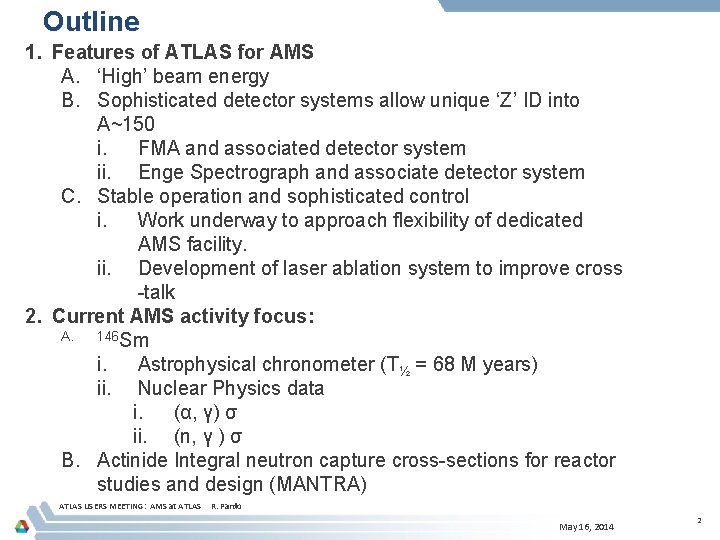
Outline 1. Features of ATLAS for AMS A. ‘High’ beam energy B. Sophisticated detector systems allow unique ‘Z’ ID into A~150 i. FMA and associated detector system ii. Enge Spectrograph and associate detector system C. Stable operation and sophisticated control i. Work underway to approach flexibility of dedicated AMS facility. ii. Development of laser ablation system to improve cross -talk 2. Current AMS activity focus: A. 146 Sm i. Astrophysical chronometer (T½ = 68 M years) ii. Nuclear Physics data i. (α, γ) σ ii. (n, γ ) σ B. Actinide Integral neutron capture cross-sections for reactor studies and design (MANTRA) ATLAS USERS MEETING: AMS at ATLAS R. Pardo May 16, 2014 2
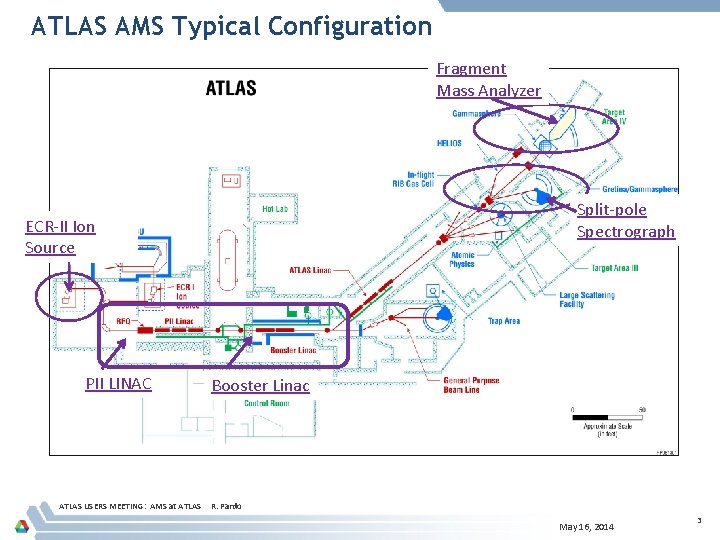
ATLAS AMS Typical Configuration Fragment Mass Analyzer Split-pole Spectrograph ECR-II Ion Source PII LINAC ATLAS USERS MEETING: AMS at ATLAS Booster Linac R. Pardo May 16, 2014 3
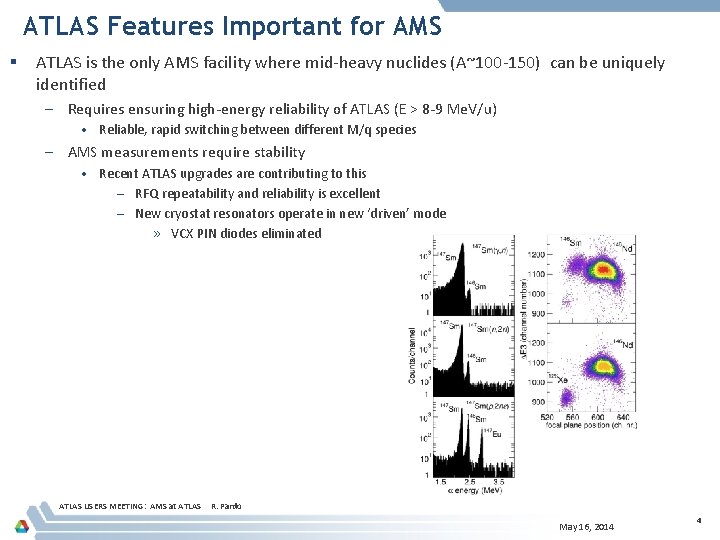
ATLAS Features Important for AMS § ATLAS is the only AMS facility where mid-heavy nuclides (A~100 -150) can be uniquely identified – Requires ensuring high-energy reliability of ATLAS (E > 8 -9 Me. V/u) • Reliable, rapid switching between different M/q species – AMS measurements require stability • Recent ATLAS upgrades are contributing to this – RFQ repeatability and reliability is excellent – New cryostat resonators operate in new ‘driven’ mode » VCX PIN diodes eliminated ATLAS USERS MEETING: AMS at ATLAS R. Pardo May 16, 2014 4
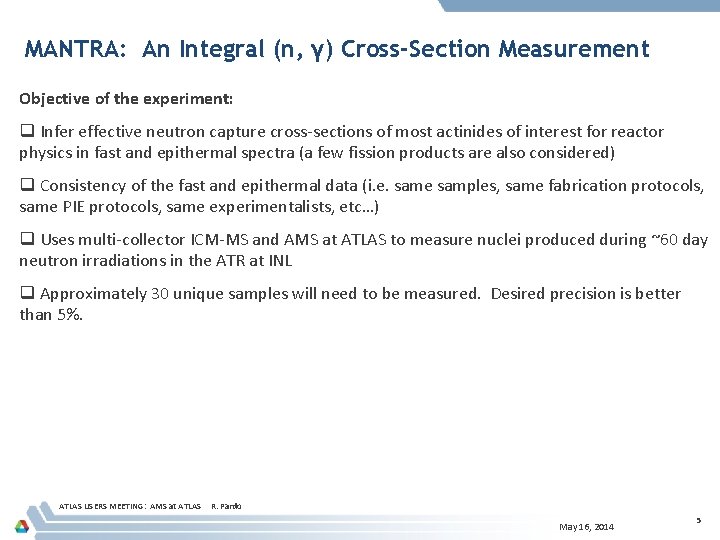
MANTRA: An Integral (n, γ) Cross-Section Measurement Objective of the experiment: q Infer effective neutron capture cross-sections of most actinides of interest for reactor physics in fast and epithermal spectra (a few fission products are also considered) q Consistency of the fast and epithermal data (i. e. same samples, same fabrication protocols, same PIE protocols, same experimentalists, etc…) q Uses multi-collector ICM-MS and AMS at ATLAS to measure nuclei produced during ~60 day neutron irradiations in the ATR at INL q Approximately 30 unique samples will need to be measured. Desired precision is better than 5%. ATLAS USERS MEETING: AMS at ATLAS R. Pardo May 16, 2014 5
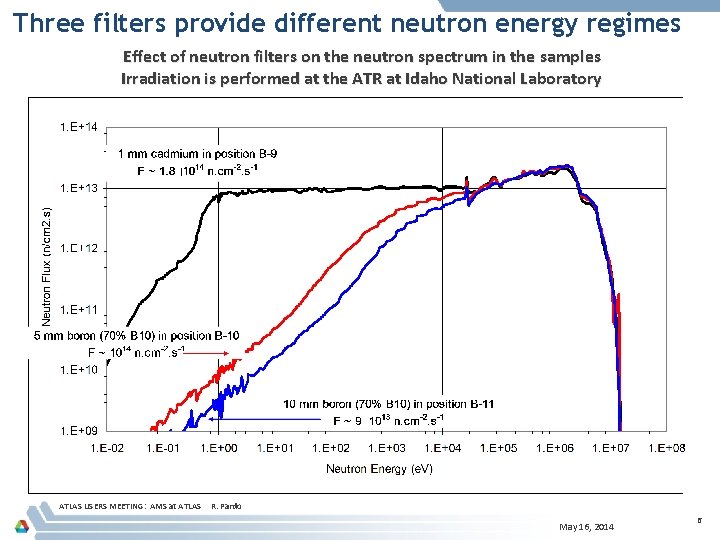
Three filters provide different neutron energy regimes Effect of neutron filters on the neutron spectrum in the samples Irradiation is performed at the ATR at Idaho National Laboratory ATLAS USERS MEETING: AMS at ATLAS R. Pardo May 16, 2014 6
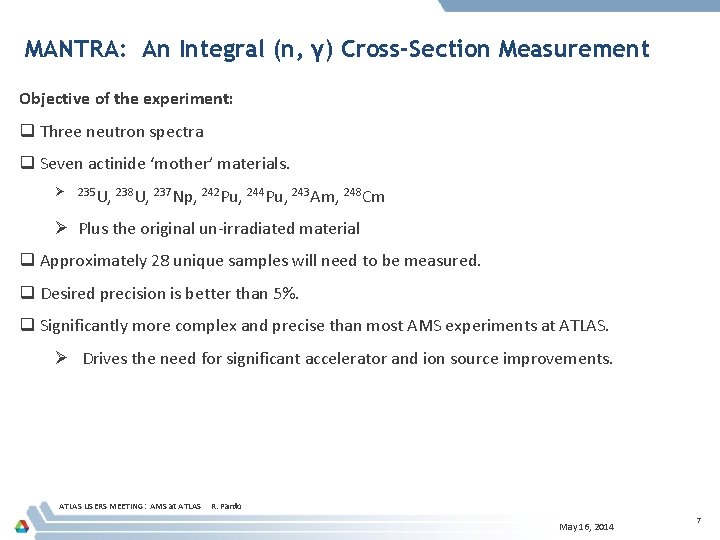
MANTRA: An Integral (n, γ) Cross-Section Measurement Objective of the experiment: q Three neutron spectra q Seven actinide ‘mother’ materials. Ø 235 U, 238 U, 237 Np, 242 Pu, 244 Pu, 243 Am, 248 Cm Ø Plus the original un-irradiated material q Approximately 28 unique samples will need to be measured. q Desired precision is better than 5%. q Significantly more complex and precise than most AMS experiments at ATLAS. Ø Drives the need for significant accelerator and ion source improvements. ATLAS USERS MEETING: AMS at ATLAS R. Pardo May 16, 2014 7
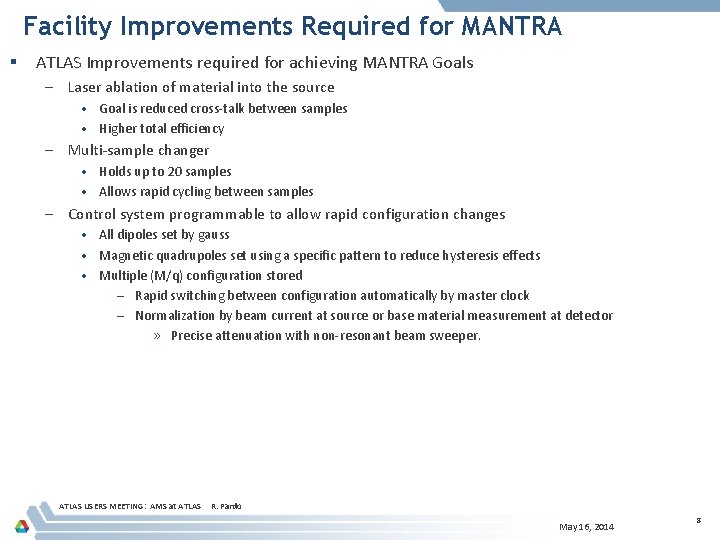
Facility Improvements Required for MANTRA § ATLAS Improvements required for achieving MANTRA Goals – Laser ablation of material into the source • Goal is reduced cross-talk between samples • Higher total efficiency – Multi-sample changer • Holds up to 20 samples • Allows rapid cycling between samples – Control system programmable to allow rapid configuration changes • All dipoles set by gauss • Magnetic quadrupoles set using a specific pattern to reduce hysteresis effects • Multiple (M/q) configuration stored – Rapid switching between configuration automatically by master clock – Normalization by beam current at source or base material measurement at detector » Precise attenuation with non-resonant beam sweeper. ATLAS USERS MEETING: AMS at ATLAS R. Pardo May 16, 2014 8
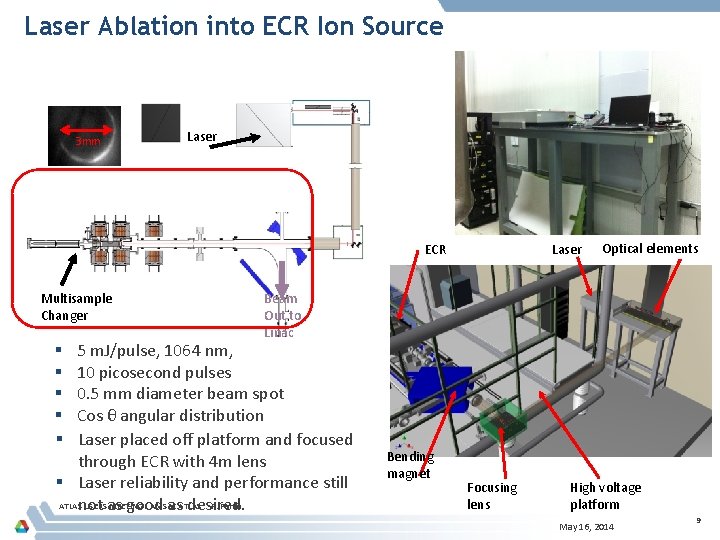
Laser Ablation into ECR Ion Source 3 mm Laser ECR Multisample Changer Optical elements Beam Out to Linac 5 m. J/pulse, 1064 nm, 10 picosecond pulses 0. 5 mm diameter beam spot Cos θ angular distribution Laser placed off platform and focused through ECR with 4 m lens § Laser reliability and performance still ATLASnot USERSas MEETING: AMS as at ATLAS R. Pardo good desired. § § § Laser Bending magnet Focusing lens High voltage platform May 16, 2014 9
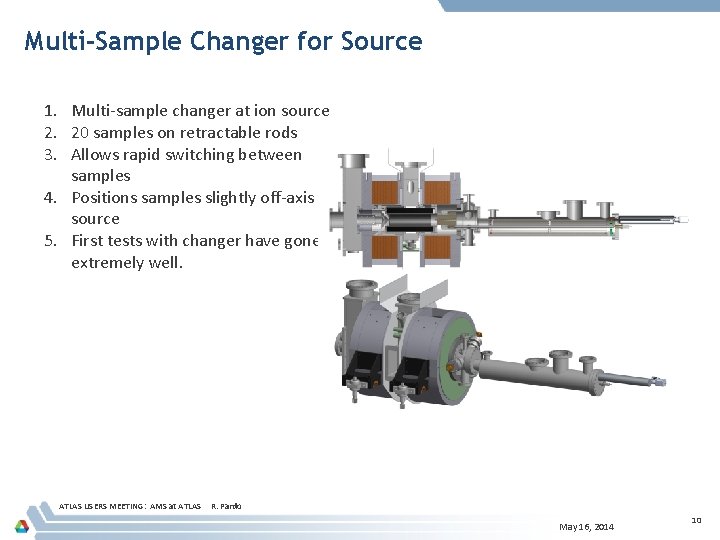
Multi-Sample Changer for Source 1. Multi-sample changer at ion source 2. 20 samples on retractable rods 3. Allows rapid switching between samples 4. Positions samples slightly off-axis of source 5. First tests with changer have gone extremely well. ATLAS USERS MEETING: AMS at ATLAS R. Pardo May 16, 2014 10
AMS Demands Benefit ATLAS Operation § The needs of the AMS program have driven significant improvements at ATLAS – Laser ablation of material into the source and Multi-sample changer • Successful development of laser ablation will benefit ATLAS Operation – Less source contamination – Ability to rapidly switch beams – Less start-up time – Control system improvements speed ATLAS beam changes. • All dipoles set by gauss • Magnetic quadrupoles set using a specific pattern to reduce hysteresis effects • Multiple (M/q) configuration stored – Rapid switching between configuration automatically by master clock – Normalization by beam current at source or base material measurement at detector » Precise attenuation with non-resonant beam sweeper. – Push to go to an M/q of 8 for the heaviest beams • Important for actinide AMS • Higher beam currents for other programs. § Runs for actual irradiation measurements should be ready to begin in August. ATLAS USERS MEETING: AMS at ATLAS R. Pardo May 16, 2014 11
Summary 1. Use of ATLAS for Accelerator Mass Spectroscopy provides unique capabilities, especially for mid-mass regime 2. Actinide AMS with ATLAS makes use of in-place equipment and ion source expertise ATLAS USERS MEETING: AMS at ATLAS R. Pardo May 16, 2014 12
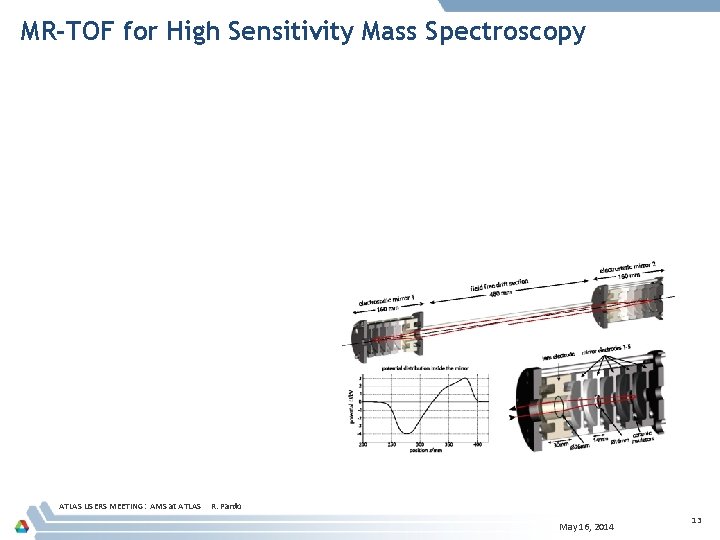
MR-TOF for High Sensitivity Mass Spectroscopy ATLAS USERS MEETING: AMS at ATLAS R. Pardo May 16, 2014 13
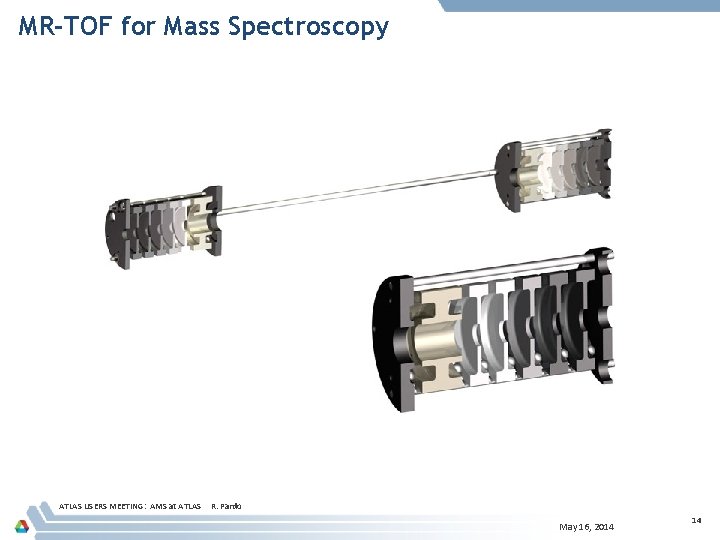
MR-TOF for Mass Spectroscopy ATLAS USERS MEETING: AMS at ATLAS R. Pardo May 16, 2014 14