
Amputations National Emphasis Program 1 Next Whats its
- Slides: 45
Amputations National Emphasis Program 1 Next
What’s its purpose? h Describe policies and procedures to identify, reduce, and eliminate workplace industry hazards likely to cause amputations 2 Previous Next
Where does it apply? h OSHA wide h 40% of nations workplaces h States encouraged to adopt similar programs h General industry employers whose workplaces include shears, saws, slicers, slitters, and power presses (the 4 s and a P) 3 Previous Next
What’s the background and reason for the program? h Continued incidence of amputations from the operation of saws, shears, slicers, slitters and power presses h Equipment was identified from three sources: 1990 NIOSH research project on machine safety – OSHA IMIS accident database – BLS data – 4 Previous Next
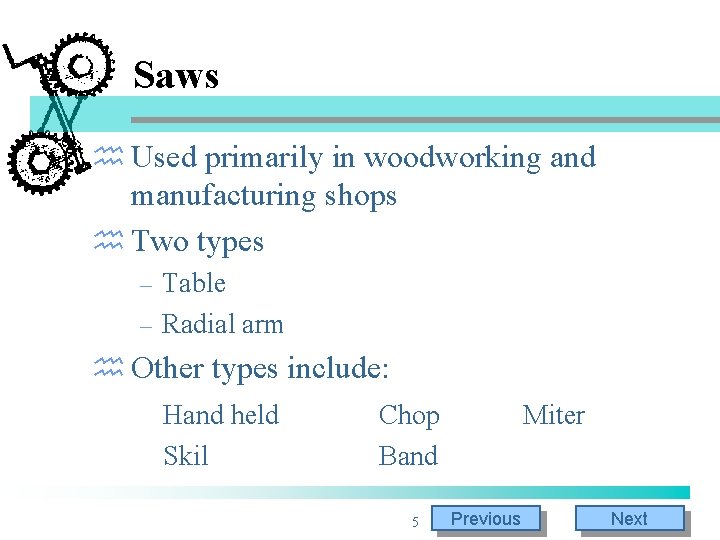
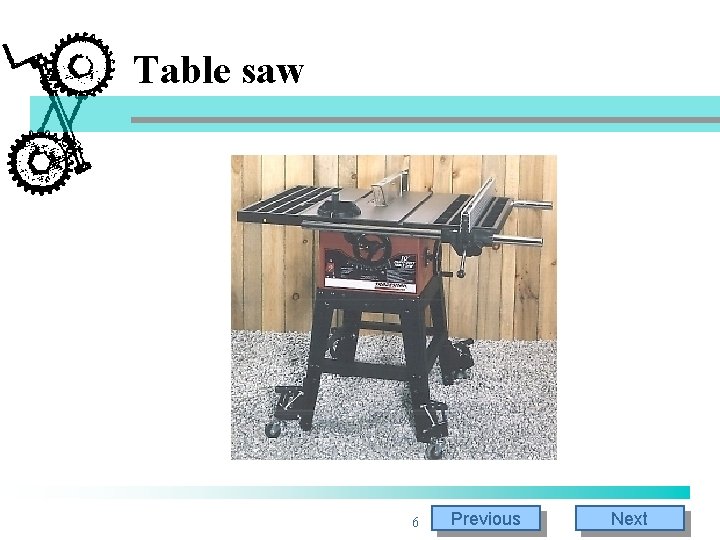
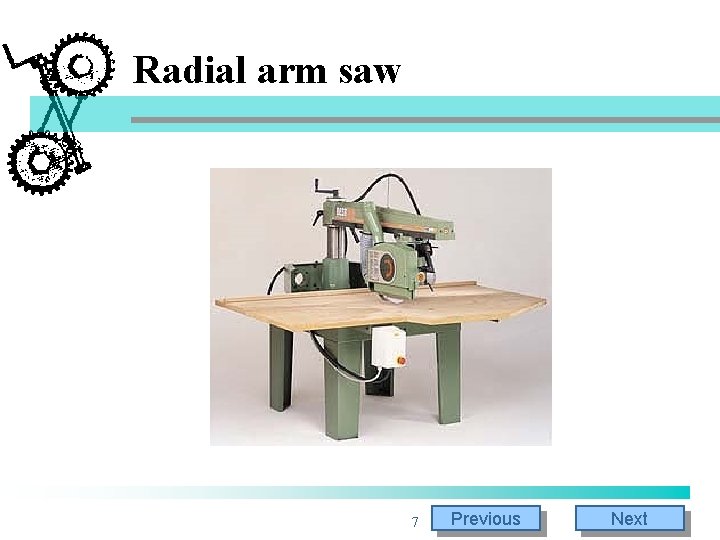
Saws h Used primarily in woodworking and manufacturing shops h Two types Table – Radial arm – h Other types include: Hand held Skil Chop Band 5 Miter Previous Next
Table saw 6 Previous Next
Radial arm saw 7 Previous Next
Hand held saw 8 Previous Next
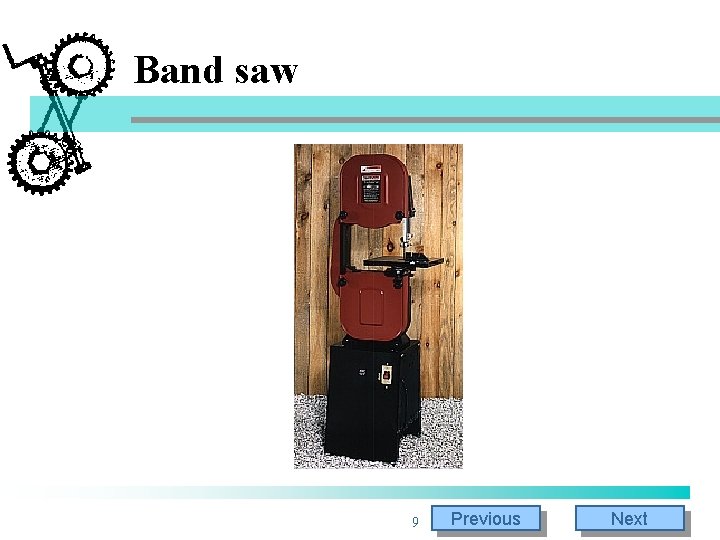
Band saw 9 Previous Next
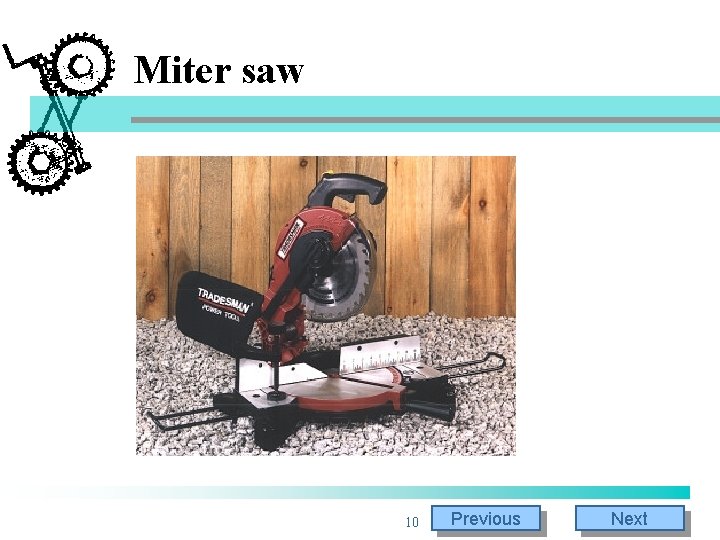
Miter saw 10 Previous Next
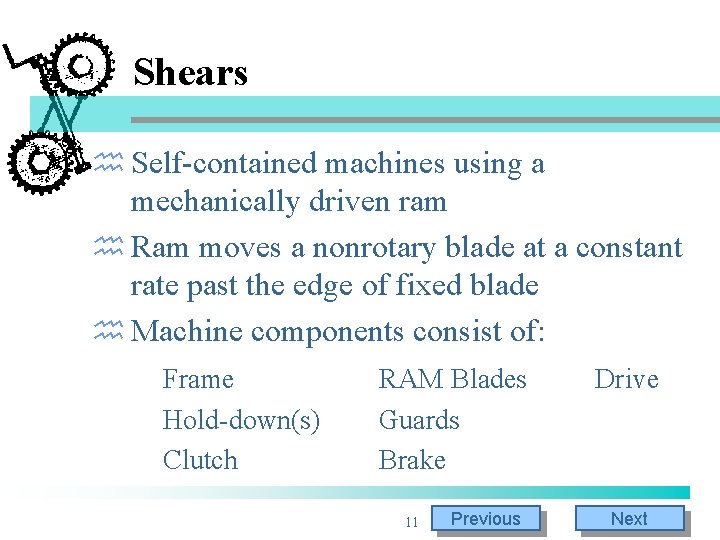
Shears h Self-contained machines using a mechanically driven ram h Ram moves a nonrotary blade at a constant rate past the edge of fixed blade h Machine components consist of: Frame Hold-down(s) Clutch RAM Blades Guards Brake 11 Previous Drive Next
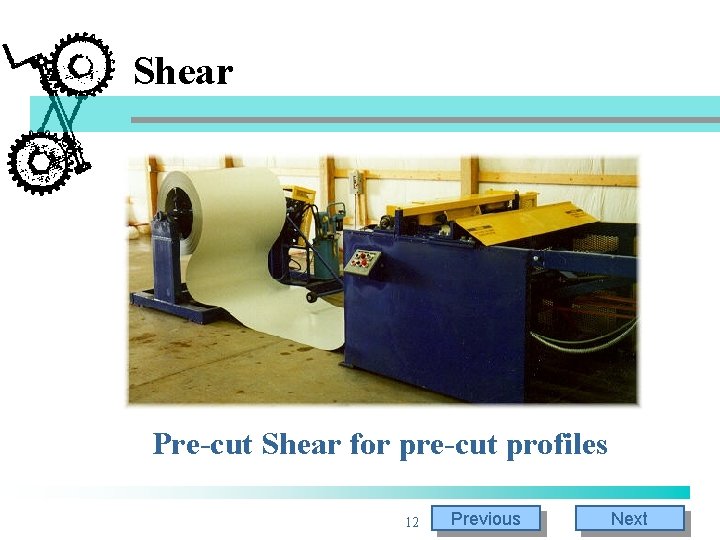
Shear Pre-cut Shear for pre-cut profiles 12 Previous Next
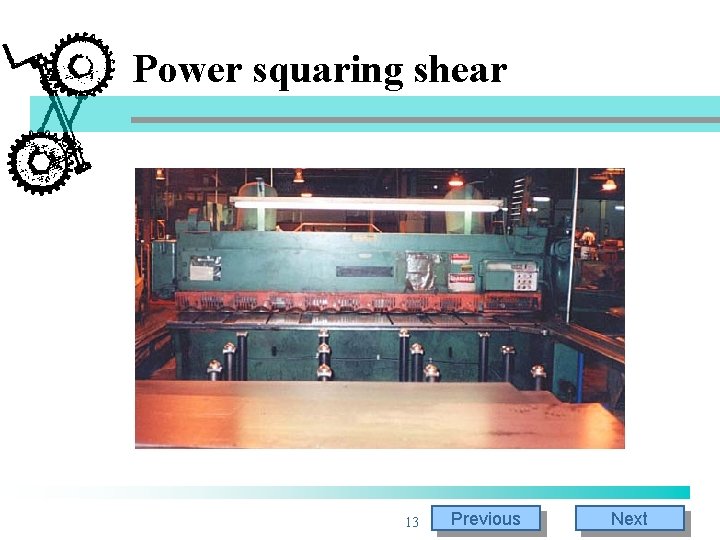
Power squaring shear 13 Previous Next
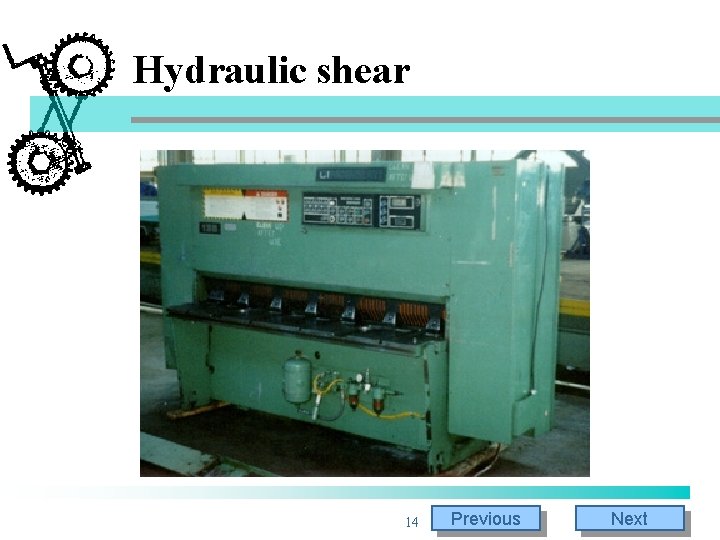
Hydraulic shear 14 Previous Next
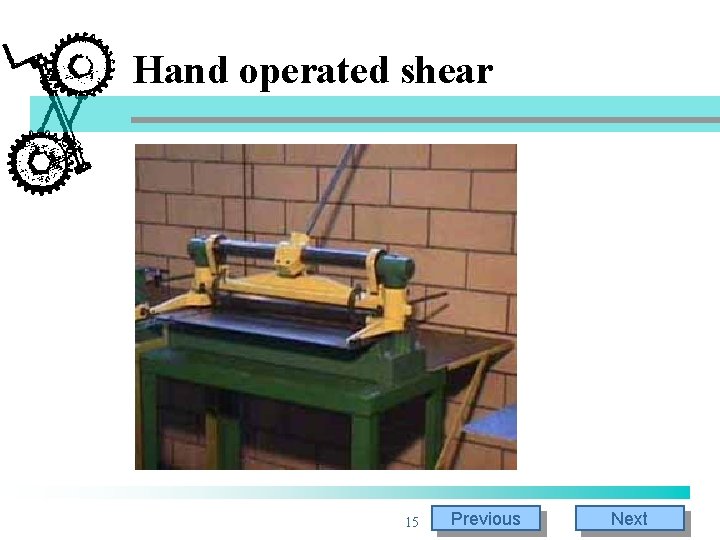
Hand operated shear 15 Previous Next
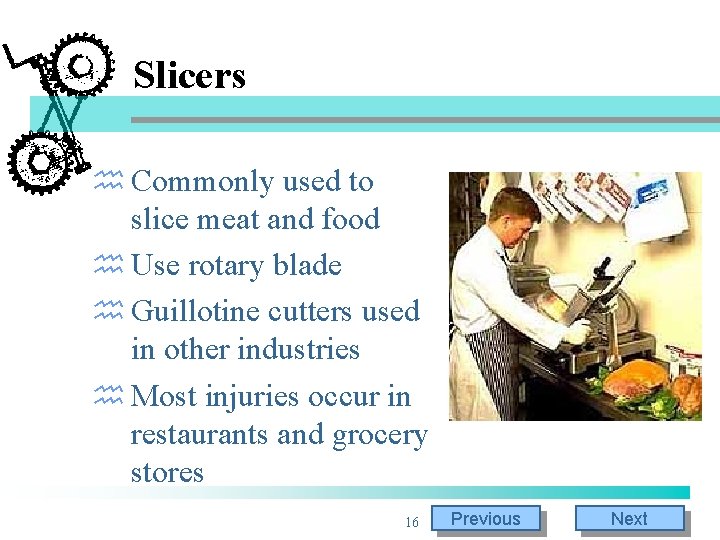
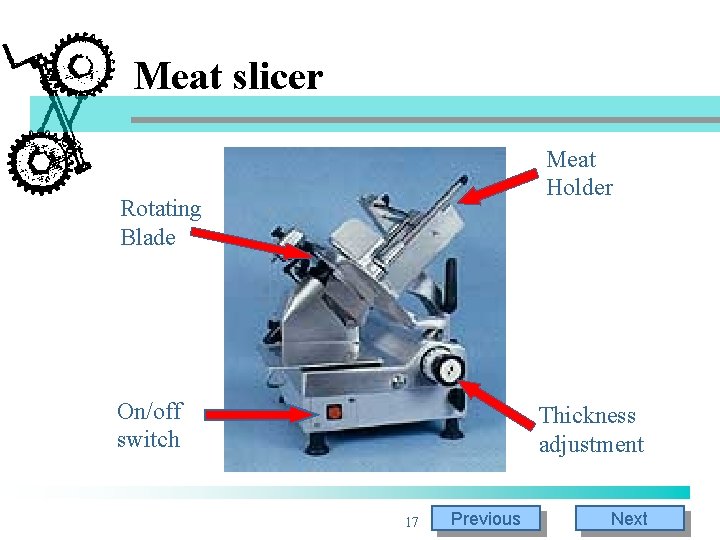
Slicers h Commonly used to slice meat and food h Use rotary blade h Guillotine cutters used in other industries h Most injuries occur in restaurants and grocery stores 16 Previous Next
Meat slicer Meat Holder Rotating Blade On/off switch Thickness adjustment 17 Previous Next
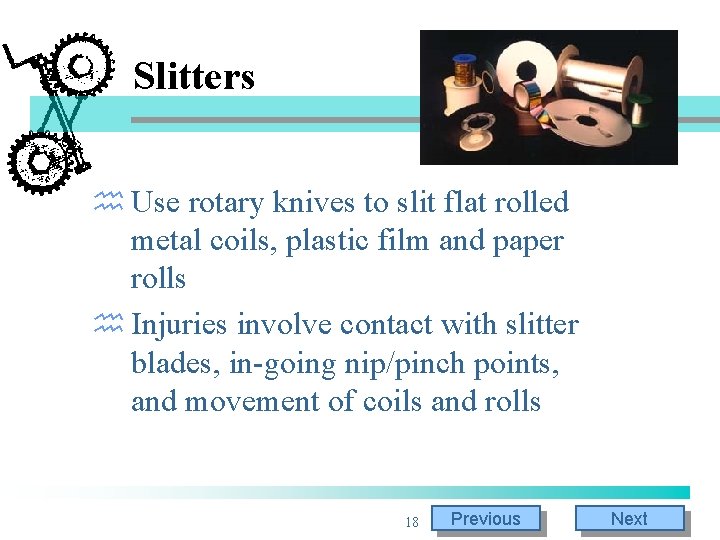
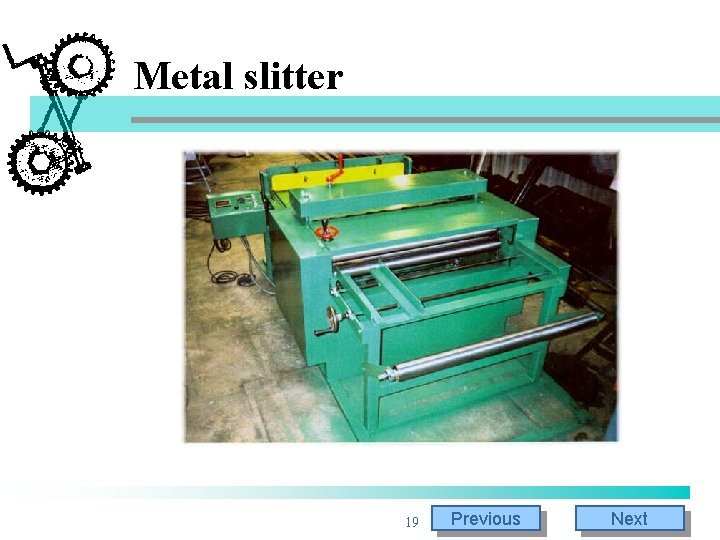
Slitters h Use rotary knives to slit flat rolled metal coils, plastic film and paper rolls h Injuries involve contact with slitter blades, in-going nip/pinch points, and movement of coils and rolls 18 Previous Next
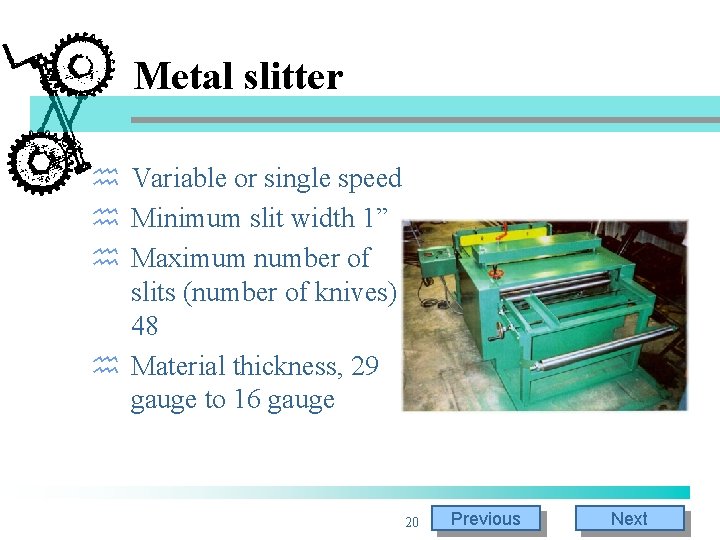
Metal slitter 19 Previous Next
Metal slitter h Variable or single speed h Minimum slit width 1” h Maximum number of slits (number of knives) 48 h Material thickness, 29 gauge to 16 gauge 20 Previous Next
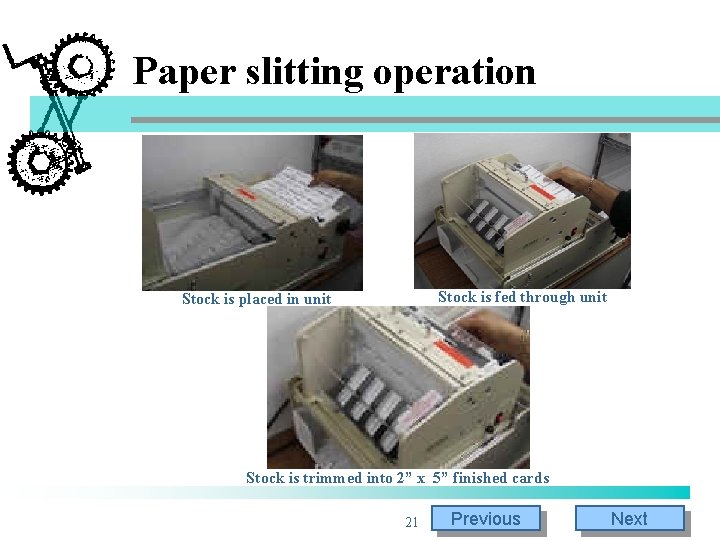
Paper slitting operation Stock is fed through unit Stock is placed in unit Stock is trimmed into 2” x 5” finished cards 21 Previous Next
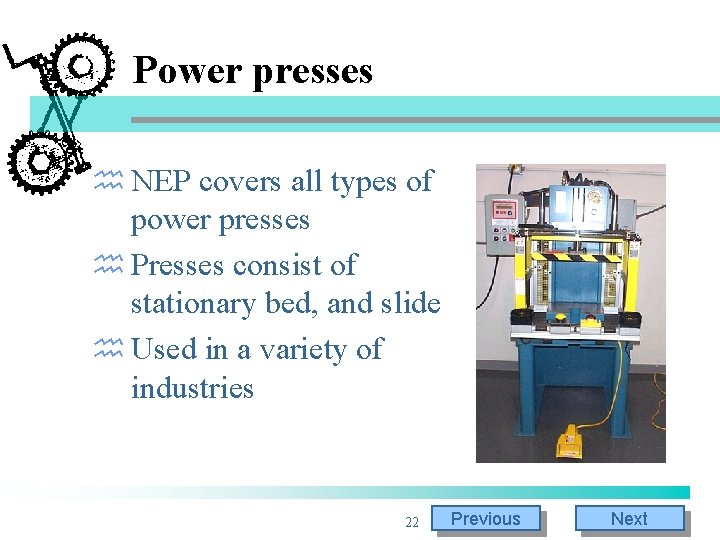
Power presses h NEP covers all types of power presses h Presses consist of stationary bed, and slide h Used in a variety of industries 22 Previous Next
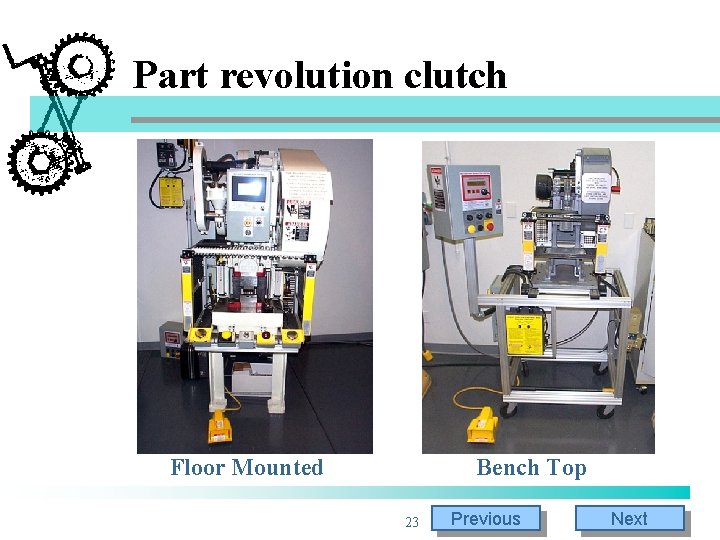
Part revolution clutch Floor Mounted Bench Top 23 Previous Next
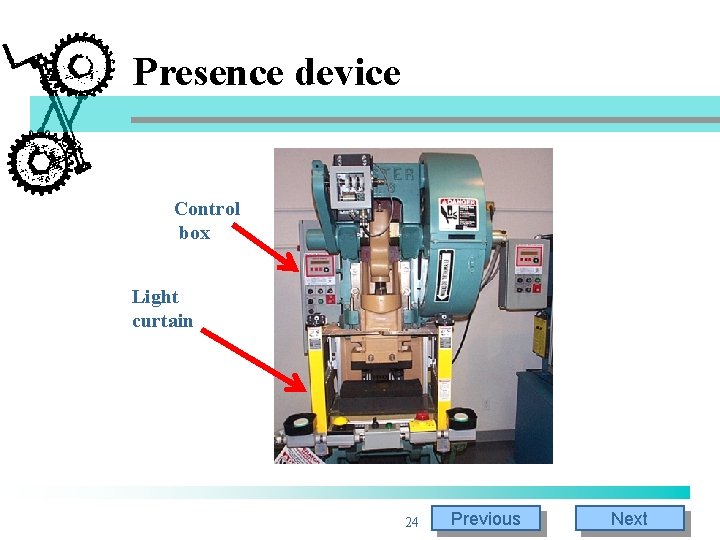
Presence device Control box Light curtain 24 Previous Next
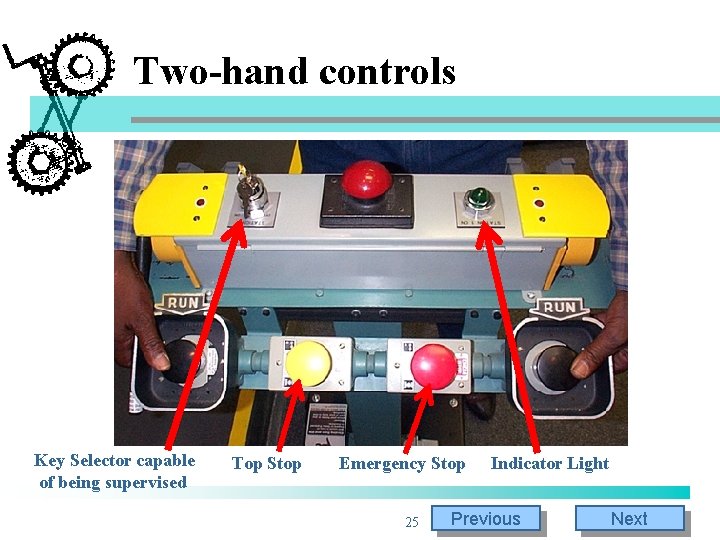
Two-hand controls Key Selector capable of being supervised Top Stop Emergency Stop 25 Indicator Light Previous Next
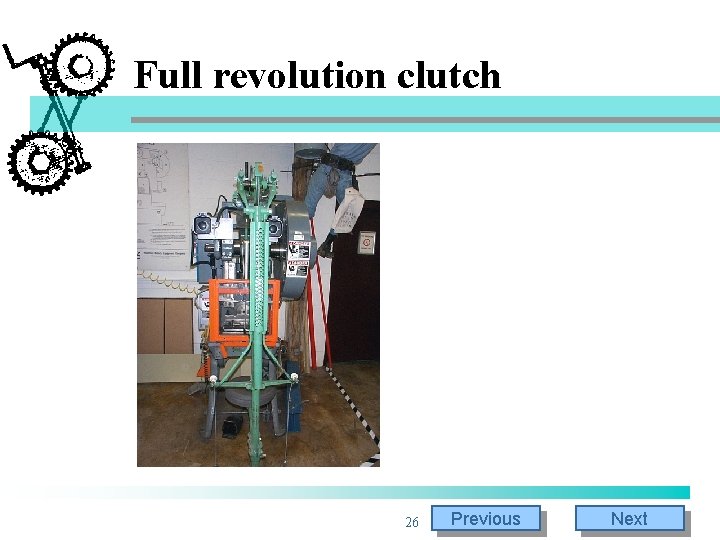
Full revolution clutch 26 Previous Next
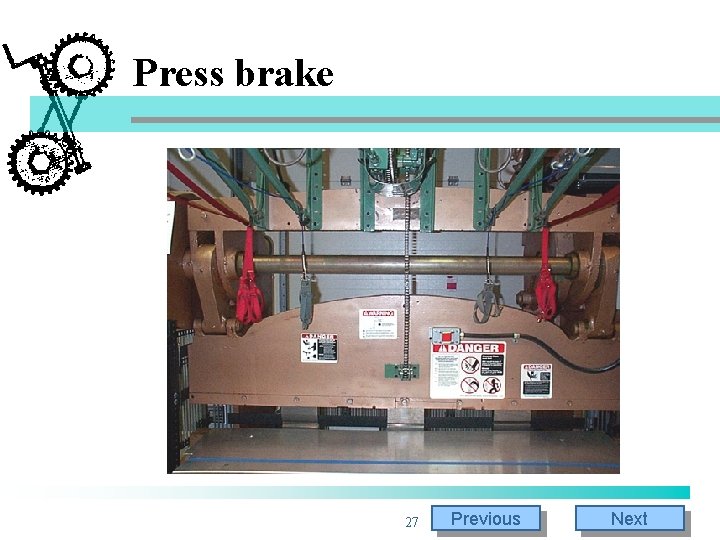
Press brake 27 Previous Next
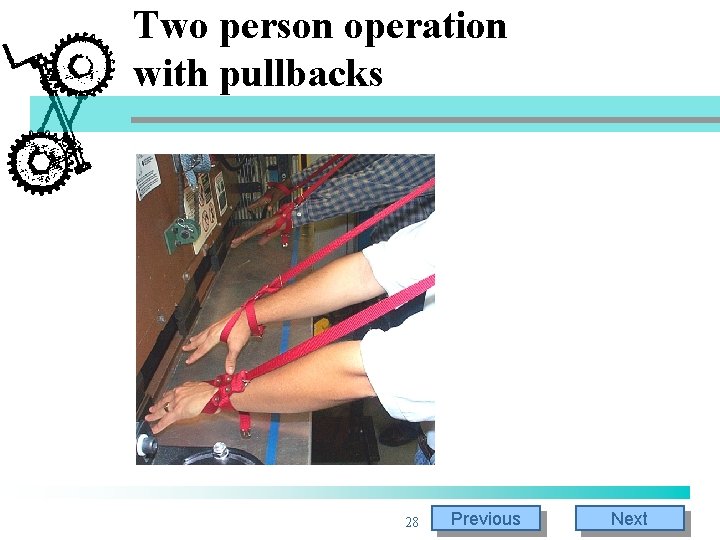
Two person operation with pullbacks 28 Previous Next
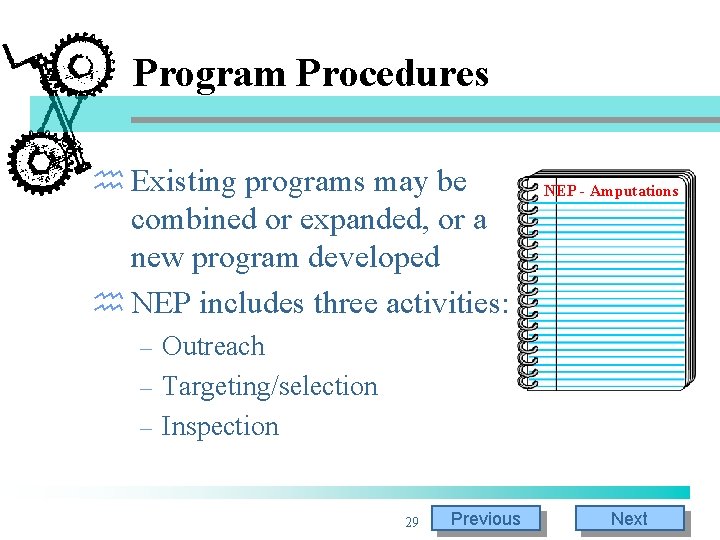
Program Procedures h Existing programs may be combined or expanded, or a new program developed h NEP includes three activities: NEP - Amputations Outreach – Targeting/selection – Inspection – 29 Previous Next
When will the program start? h Outreach - 30 days from effective date of directive h Inspections - 90 days after outreach period is initiated 30 Previous Next
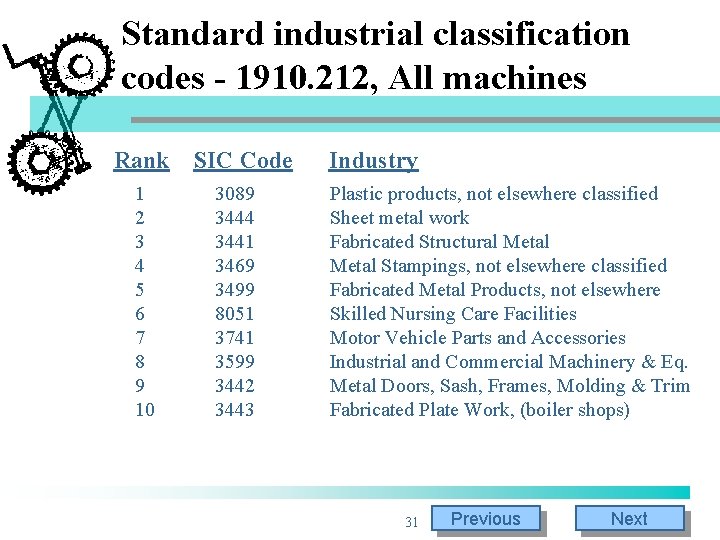
Standard industrial classification codes - 1910. 212, All machines Rank 1 2 3 4 5 6 7 8 9 10 SIC Code 3089 3444 3441 3469 3499 8051 3741 3599 3442 3443 Industry Plastic products, not elsewhere classified Sheet metal work Fabricated Structural Metal Stampings, not elsewhere classified Fabricated Metal Products, not elsewhere Skilled Nursing Care Facilities Motor Vehicle Parts and Accessories Industrial and Commercial Machinery & Eq. Metal Doors, Sash, Frames, Molding & Trim Fabricated Plate Work, (boiler shops) 31 Previous Next
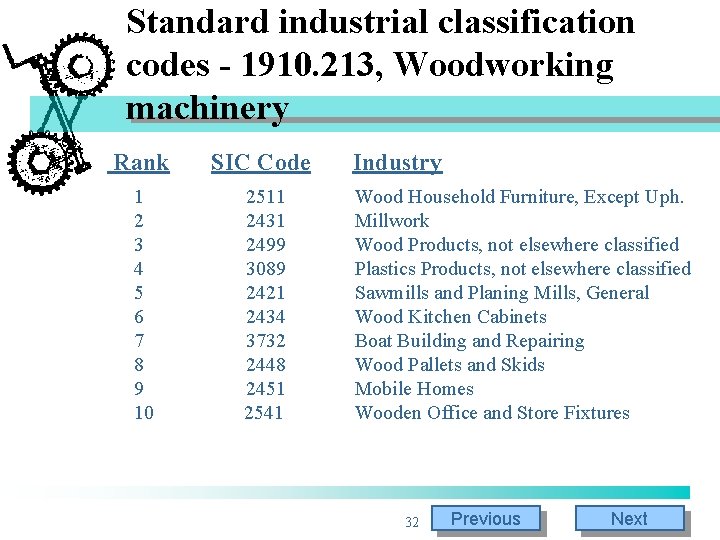
Standard industrial classification codes - 1910. 213, Woodworking machinery Rank SIC Code 1 2 3 4 5 6 7 8 9 10 2511 2431 2499 3089 2421 2434 3732 2448 2451 2541 Industry Wood Household Furniture, Except Uph. Millwork Wood Products, not elsewhere classified Plastics Products, not elsewhere classified Sawmills and Planing Mills, General Wood Kitchen Cabinets Boat Building and Repairing Wood Pallets and Skids Mobile Homes Wooden Office and Store Fixtures 32 Previous Next
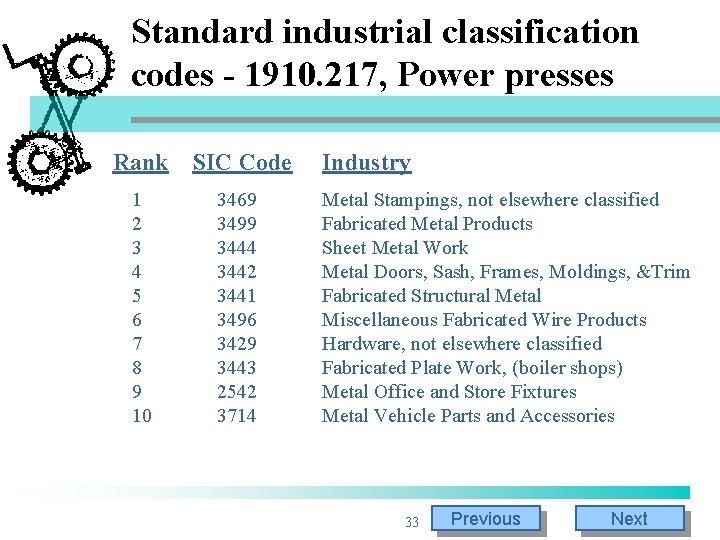
Standard industrial classification codes - 1910. 217, Power presses Rank SIC Code 1 2 3 4 5 6 7 8 9 10 3469 3499 3444 3442 3441 3496 3429 3443 2542 3714 Industry Metal Stampings, not elsewhere classified Fabricated Metal Products Sheet Metal Work Metal Doors, Sash, Frames, Moldings, &Trim Fabricated Structural Metal Miscellaneous Fabricated Wire Products Hardware, not elsewhere classified Fabricated Plate Work, (boiler shops) Metal Office and Store Fixtures Metal Vehicle Parts and Accessories 33 Previous Next
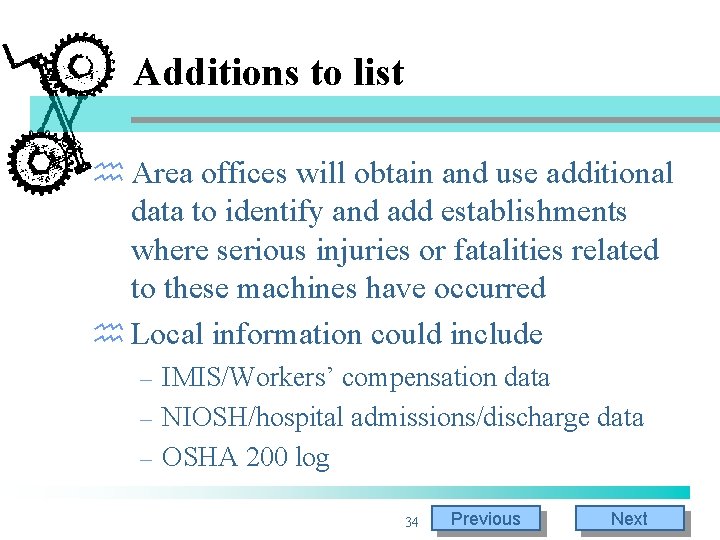
Additions to list h Area offices will obtain and use additional data to identify and add establishments where serious injuries or fatalities related to these machines have occurred h Local information could include IMIS/Workers’ compensation data – NIOSH/hospital admissions/discharge data – OSHA 200 log – 34 Previous Next
Inspection Procedures h Scheduled I. A. W. firm h Once scheduled, IMIS data base will be searched for employer’s citation and fatality/accident history prior to opening conference h At opening conference, CSHO will inquire if any of this machinery is present in the workplace 35 Previous Next
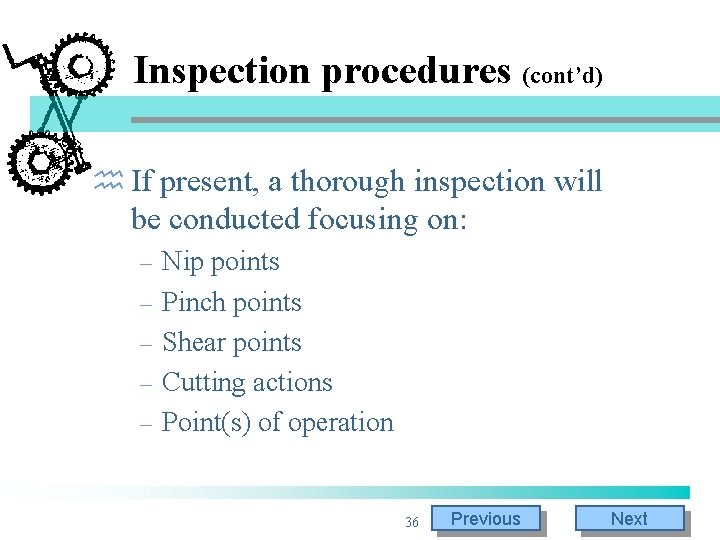
Inspection procedures (cont’d) h If present, a thorough inspection will be conducted focusing on: – – – Nip points Pinch points Shear points Cutting actions Point(s) of operation 36 Previous Next
Inspection procedures (cont’d) h CSHO will also evaluate employee exposures during the following: – – – – Regular operation of machine Setup/threading/preparation for operation of machine Clearing jamups or upset conditions Making adjustments while machine is operating Cleaning of machine Oiling/greasing of machine /machine parts Scheduled/unscheduled maintenance Lockout/tagout considerations 37 Previous Next
Inspections procedures (cont’d) h CSHO will review OSHA 200 log for all amputation injuries or hazards h Limited to hazards associated with power presses, saws, shears, slicers, and slitters, but may be expanded h Inspections will begin this fiscal year h Because program may yield significant cases, A. D. s, supervisors and CSHOs should ensure case developments are being met 38 Previous Next
Scheduling and resource allocation h Resources - R. A. ’s will ensure adequate resources for this NEP h Planning - R. A. ’s will report to DCP, # of inspections planned each quarter, and 30 days after end of each quarter, number of inspections conducted 39 Previous Next
Scheduling and resource allocation (cont’d) h Priority - Inspection conducted under this NEP have a lower priority than Site Specific Targeting (SST), but have a higher priority than other programmed inspections h Conflicts - May compete with available resources 40 Previous Next
Coordination h National Office – NEP will be coordinated with Office of General Industry Compliance, DCP h Field – Each R. A. will have a coordinator 41 Previous Next
Training h Due to nature of program, staff must have adequate training or experience h OTI provides training materials Additional sessions of power press/machine guarding course can be made available – Can be expanded to include use of stop time measuring device – 42 Previous Next
Additional training h On-the-Job-Training h Enforcement and compliance issues 43 Previous Next
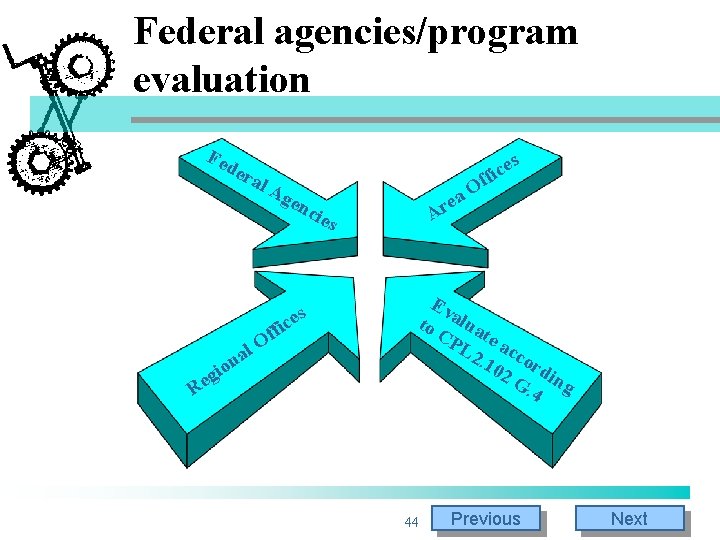
Federal agencies/program evaluation Fe de l a n io g e R ral s Ag ce ffi O a re enc i O ce i f f A es s Ev to alua CP te L 2 acc. 10 ord 2 G in. 4 g 44 Previous Next
IMIS coding h Inspections in industries where potential exposure exist will be coded as an amputation hazard h Done regardless of whether machinery was guarded and amputation hazard removed h Coding and back coding done for all industries except construction 45 Previous Next