
Amps Volts and Resistance Ohms Law Current Intensity
- Slides: 17
Amps, Volts and Resistance (Ohm’s Law)
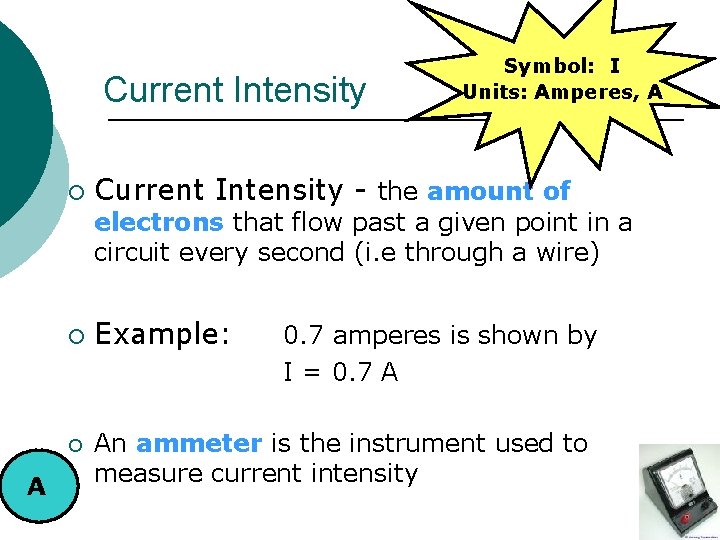
Current Intensity ¡ Symbol: I Units: Amperes, A Current Intensity - the amount of electrons that flow past a given point in a circuit every second (i. e through a wire) ¡ ¡ A Example: 0. 7 amperes is shown by I = 0. 7 A An ammeter is the instrument used to measure current intensity
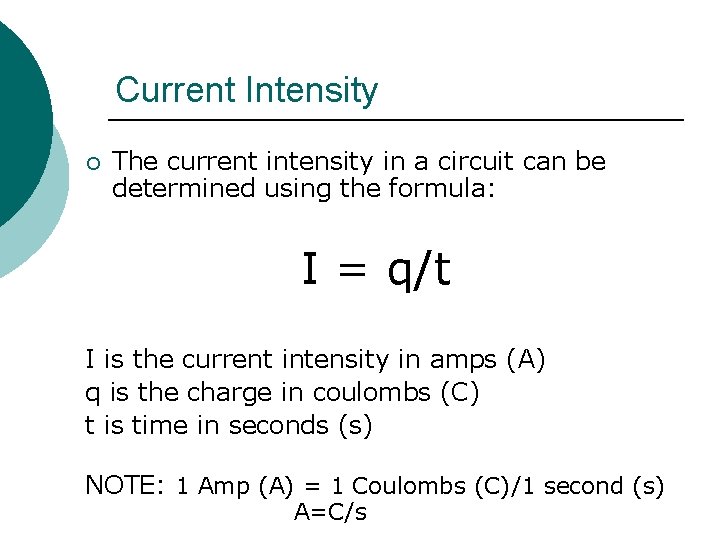
Current Intensity ¡ The current intensity in a circuit can be determined using the formula: I = q/t I is the current intensity in amps (A) q is the charge in coulombs (C) t is time in seconds (s) NOTE: 1 Amp (A) = 1 Coulombs (C)/1 second (s) A=C/s
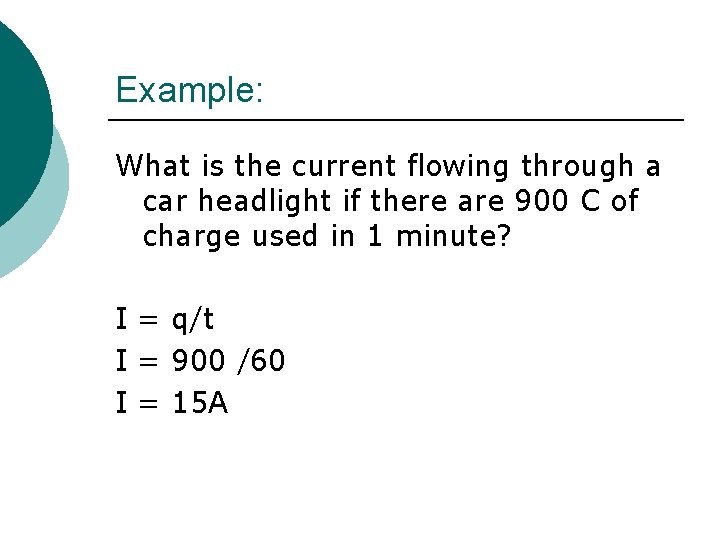
Example: What is the current flowing through a car headlight if there are 900 C of charge used in 1 minute? I = q/t I = 900 /60 I = 15 A
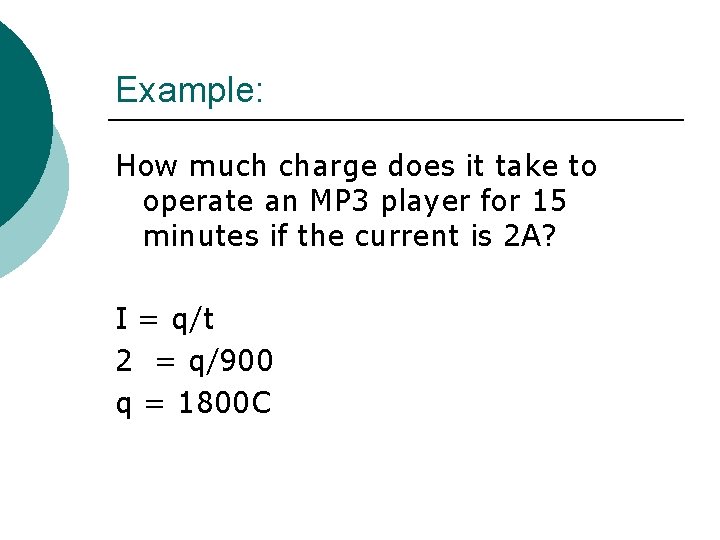
Example: How much charge does it take to operate an MP 3 player for 15 minutes if the current is 2 A? I = q/t 2 = q/900 q = 1800 C
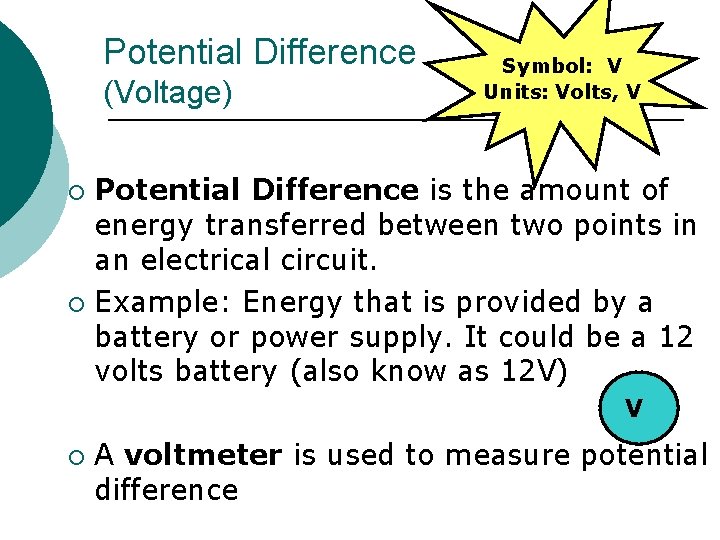
Potential Difference (Voltage) Symbol: V Units: Volts, V Potential Difference is the amount of energy transferred between two points in an electrical circuit. ¡ Example: Energy that is provided by a battery or power supply. It could be a 12 volts battery (also know as 12 V) ¡ V ¡ A voltmeter is used to measure potential difference
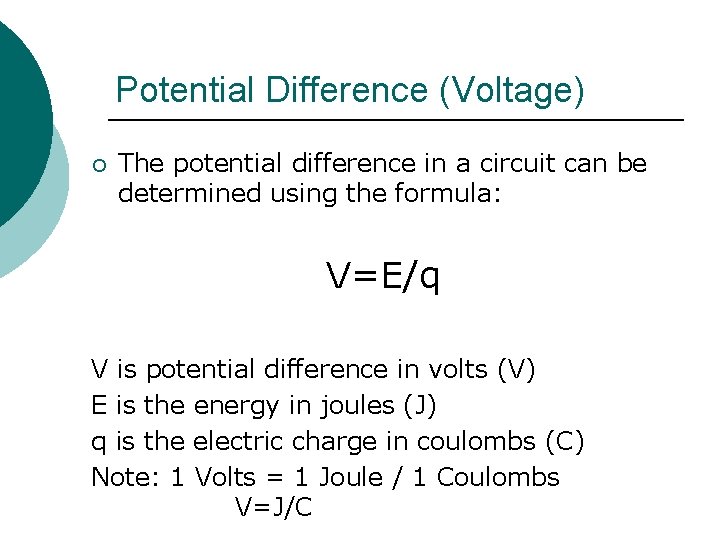
Potential Difference (Voltage) ¡ The potential difference in a circuit can be determined using the formula: V=E/q V is potential difference in volts (V) E is the energy in joules (J) q is the electric charge in coulombs (C) Note: 1 Volts = 1 Joule / 1 Coulombs V=J/C
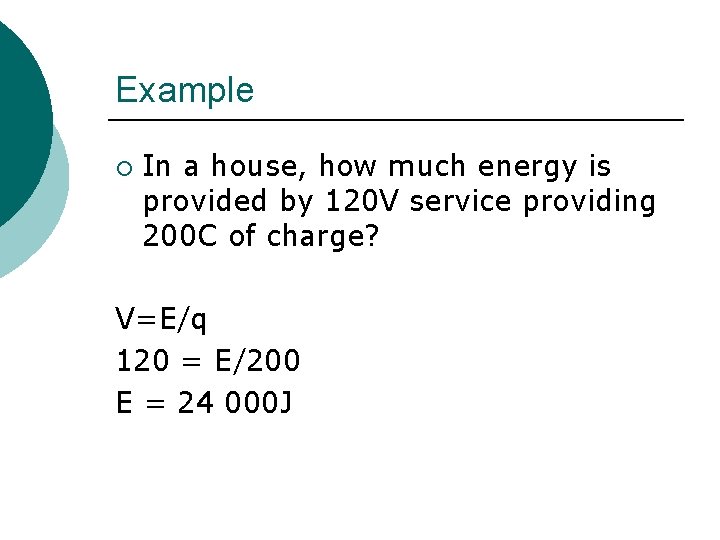
Example ¡ In a house, how much energy is provided by 120 V service providing 200 C of charge? V=E/q 120 = E/200 E = 24 000 J
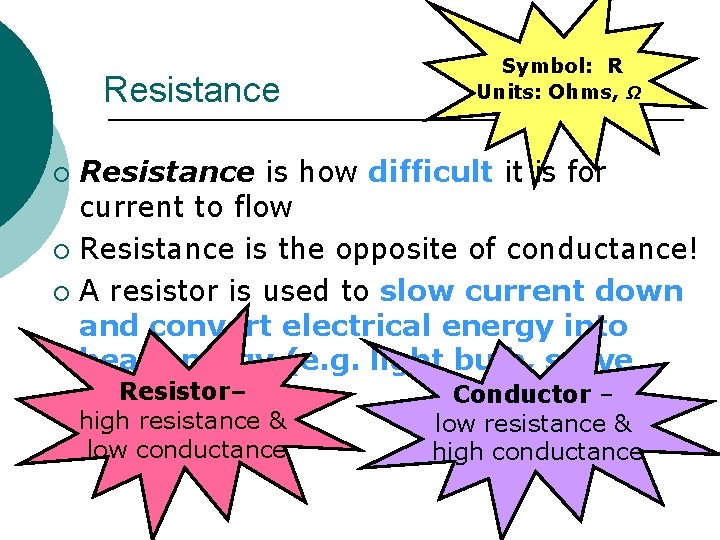
Resistance Symbol: R Units: Ohms, Ω Resistance is how difficult it is for current to flow ¡ Resistance is the opposite of conductance! ¡ A resistor is used to slow current down and convert electrical energy into heat energy (e. g. light bulb, stove Resistor– Conductor – element). ¡ high resistance & low conductance low resistance & high conductance
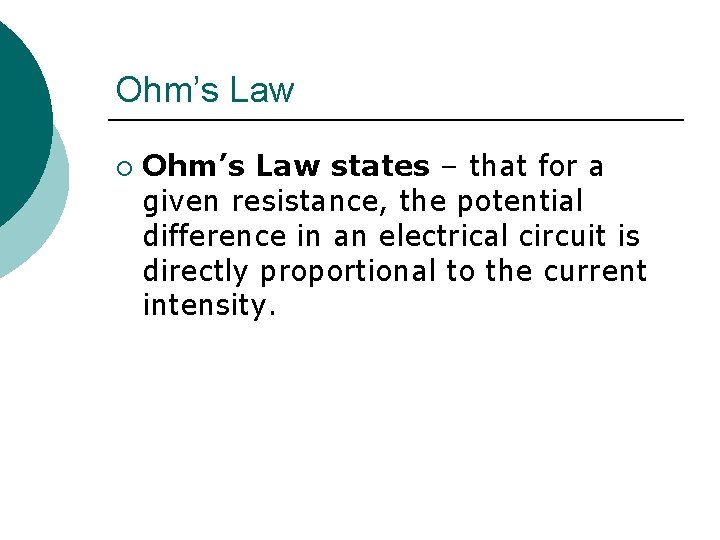
Ohm’s Law ¡ Ohm’s Law states – that for a given resistance, the potential difference in an electrical circuit is directly proportional to the current intensity.
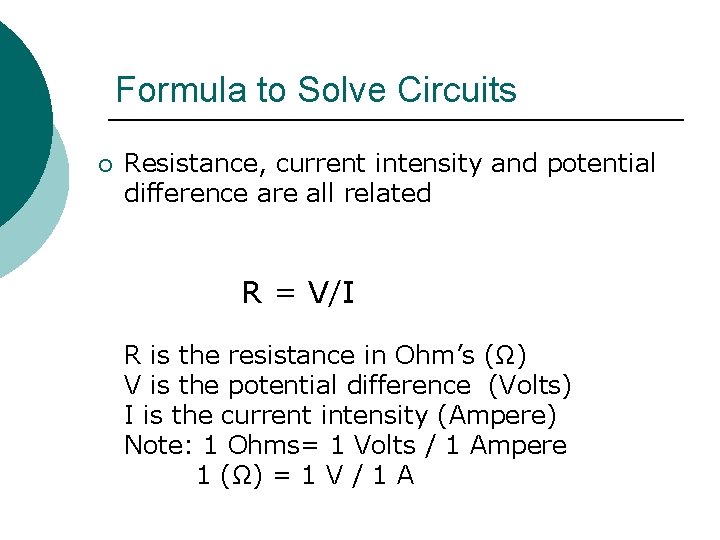
Formula to Solve Circuits ¡ Resistance, current intensity and potential difference are all related R = V/I R is the resistance in Ohm’s (Ω) V is the potential difference (Volts) I is the current intensity (Ampere) Note: 1 Ohms= 1 Volts / 1 Ampere 1 (Ω) = 1 V / 1 A
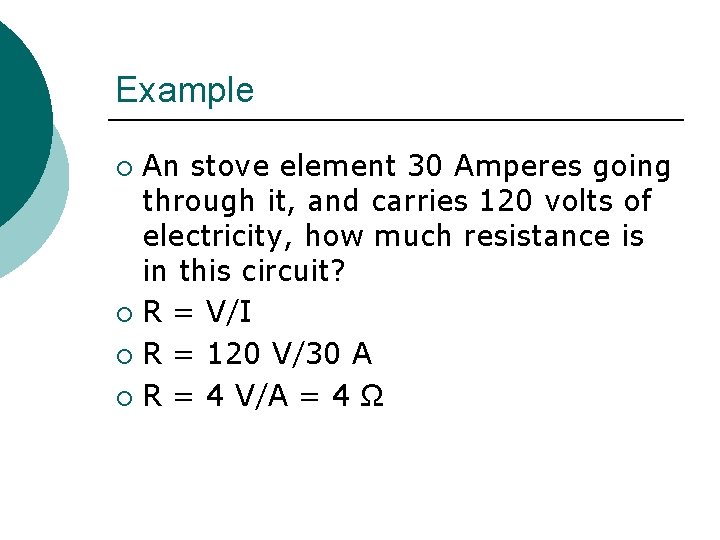
Example An stove element 30 Amperes going through it, and carries 120 volts of electricity, how much resistance is in this circuit? ¡ R = V/I ¡ R = 120 V/30 A ¡ R = 4 V/A = 4 Ω ¡
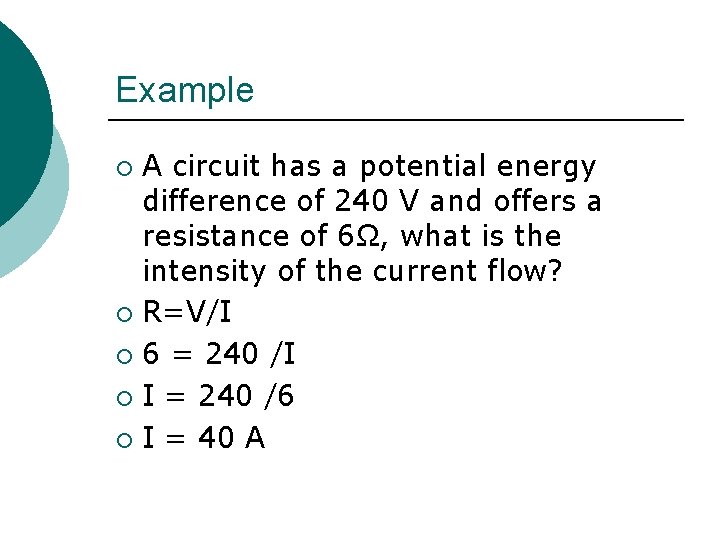
Example A circuit has a potential energy difference of 240 V and offers a resistance of 6Ω, what is the intensity of the current flow? ¡ R=V/I ¡ 6 = 240 /I ¡ I = 240 /6 ¡ I = 40 A ¡
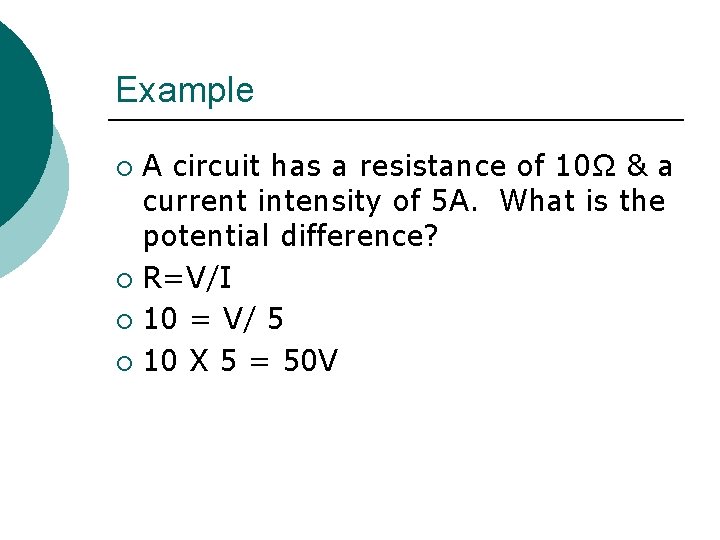
Example A circuit has a resistance of 10Ω & a current intensity of 5 A. What is the potential difference? ¡ R=V/I ¡ 10 = V/ 5 ¡ 10 X 5 = 50 V ¡
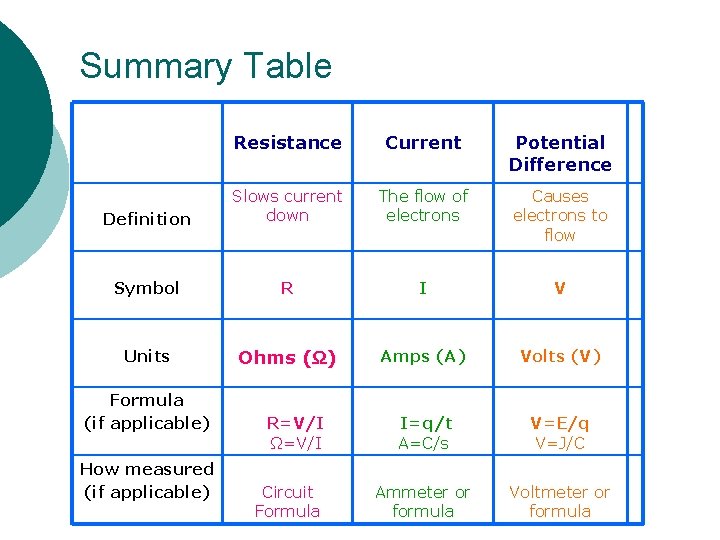
Summary Table Resistance Current Potential Difference Definition Slows current down The flow of electrons Causes electrons to flow Symbol R I V Units Ohms (Ω) Amps (A) Volts (V) I=q/t A=C/s V=E/q V=J/C Ammeter or formula Voltmeter or formula Formula (if applicable) How measured (if applicable) R=V/I Ω=V/I Circuit Formula
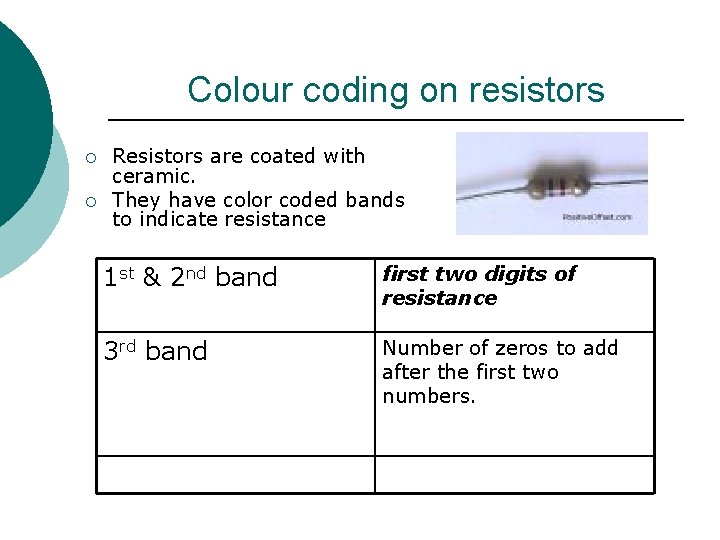
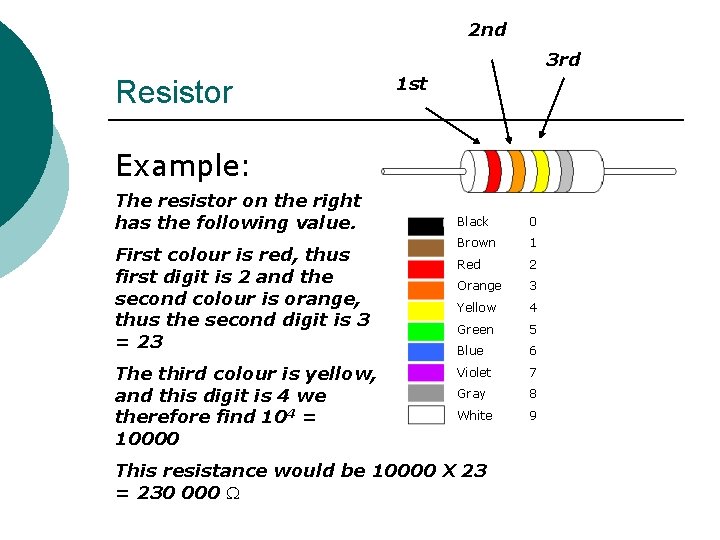
Colour coding on resistors ¡ ¡ Resistors are coated with ceramic. They have color coded bands to indicate resistance 1 st & 2 nd band first two digits of resistance 3 rd band Number of zeros to add after the first two numbers.
2 nd 3 rd Resistor 1 st Example: The resistor on the right has the following value. First colour is red, thus first digit is 2 and the second colour is orange, thus the second digit is 3 = 23 The third colour is yellow, and this digit is 4 we therefore find 104 = 10000 Black 0 Brown 1 Red 2 Orange 3 Yellow 4 Green 5 Blue 6 Violet 7 Gray 8 White 9 This resistance would be 10000 X 23 = 230 000 W