
Amplifying Student Discourse in Math Class CALLI High



- Slides: 18
Amplifying Student Discourse in Math Class CALLI High School Math Opt-in Vinci Daro, Jim Malamut, & Phil Daro
Essential Questions 1. What does it mean to cultivate academic student discourse in the classroom? 2. How can we create structures that will build the capacity of teachers to cultivate academic student discourse in the classroom? 3. How do we know quality academic student discourse is being cultivated in the classroom?
What does it mean to cultivate academic student discourse in the classroom? What are we looking for? What challenges are we facing? What steps are we already taking?
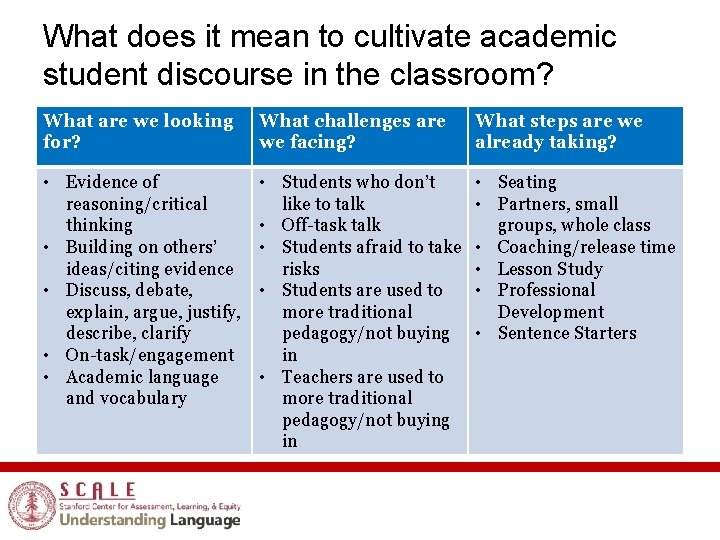
What does it mean to cultivate academic student discourse in the classroom? What are we looking for? What challenges are we facing? What steps are we already taking? • Evidence of reasoning/critical thinking • Building on others’ ideas/citing evidence • Discuss, debate, explain, argue, justify, describe, clarify • On-task/engagement • Academic language and vocabulary • Students who don’t like to talk • Off-task talk • Students afraid to take risks • Students are used to more traditional pedagogy/not buying in • Teachers are used to more traditional pedagogy/not buying in • Seating • Partners, small groups, whole class • Coaching/release time • Lesson Study • Professional Development • Sentence Starters
How can we create structures that will build the capacity of teachers to cultivate academic student discourse in the classroom?
Mathemafish Population https: //www. illustrativemathematics. org/content-standards/tasks/686 You are a marine biologist working for the Environmental Protection Agency (EPA). You are concerned that the rare coral mathemafish population is being threatened by an invasive species known as the fluted dropout shark. The fluted dropout shark is known for decimating whole schools of fish. Using a catch-tag-release method, you collected the following population data over the last year.
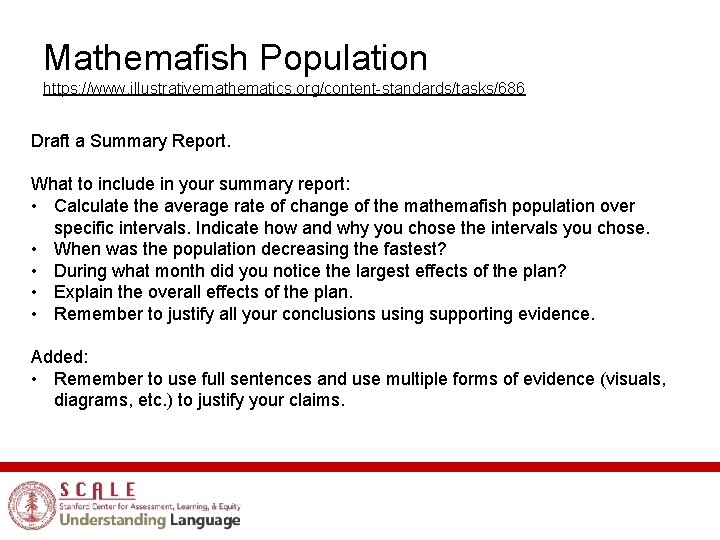
Mathemafish Population https: //www. illustrativemathematics. org/content-standards/tasks/686 Draft a Summary Report. What to include in your summary report: • Calculate the average rate of change of the mathemafish population over specific intervals. Indicate how and why you chose the intervals you chose. • When was the population decreasing the fastest? • During what month did you notice the largest effects of the plan? • Explain the overall effects of the plan. • Remember to justify all your conclusions using supporting evidence. Added: • Remember to use full sentences and use multiple forms of evidence (visuals, diagrams, etc. ) to justify your claims.
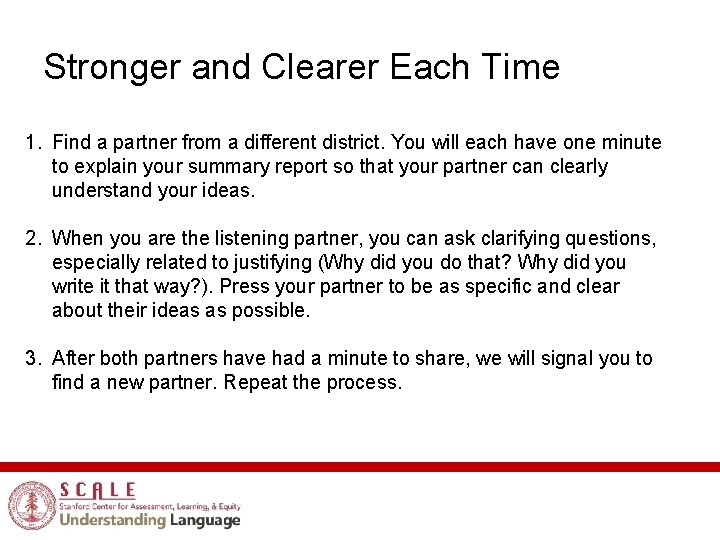
Stronger and Clearer Each Time 1. Find a partner from a different district. You will each have one minute to explain your summary report so that your partner can clearly understand your ideas. 2. When you are the listening partner, you can ask clarifying questions, especially related to justifying (Why did you do that? Why did you write it that way? ). Press your partner to be as specific and clear about their ideas as possible. 3. After both partners have had a minute to share, we will signal you to find a new partner. Repeat the process.
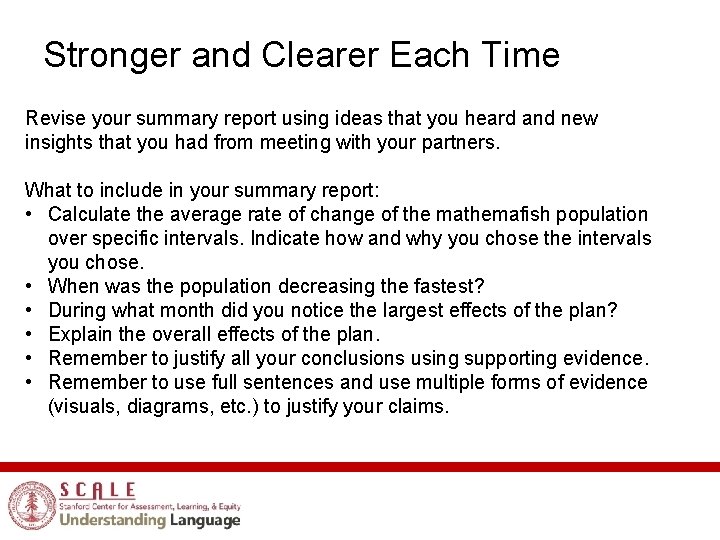
Stronger and Clearer Each Time Revise your summary report using ideas that you heard and new insights that you had from meeting with your partners. What to include in your summary report: • Calculate the average rate of change of the mathemafish population over specific intervals. Indicate how and why you chose the intervals you chose. • When was the population decreasing the fastest? • During what month did you notice the largest effects of the plan? • Explain the overall effects of the plan. • Remember to justify all your conclusions using supporting evidence. • Remember to use full sentences and use multiple forms of evidence (visuals, diagrams, etc. ) to justify your claims.
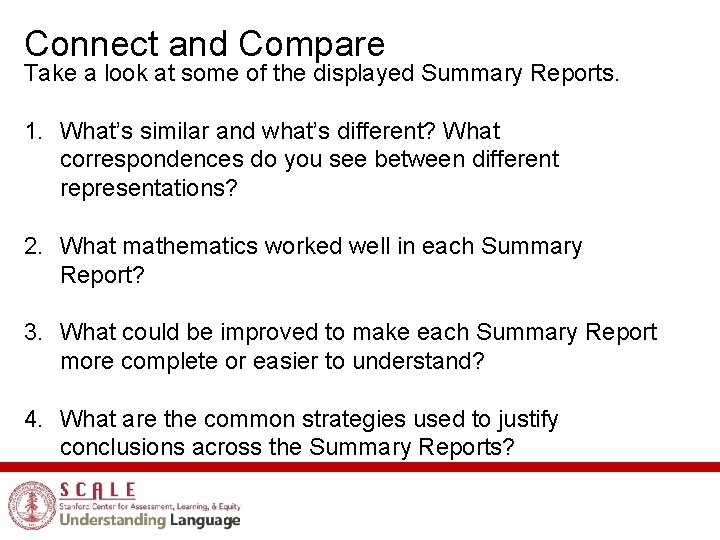
Connect and Compare Take a look at some of the displayed Summary Reports. 1. What’s similar and what’s different? What correspondences do you see between different representations? 2. What mathematics worked well in each Summary Report? 3. What could be improved to make each Summary Report more complete or easier to understand? 4. What are the common strategies used to justify conclusions across the Summary Reports?
How can we create structures that will build the capacity of teachers to cultivate academic student discourse in the classroom? What were some specific moves that were used to enhance student discourse in the lesson?
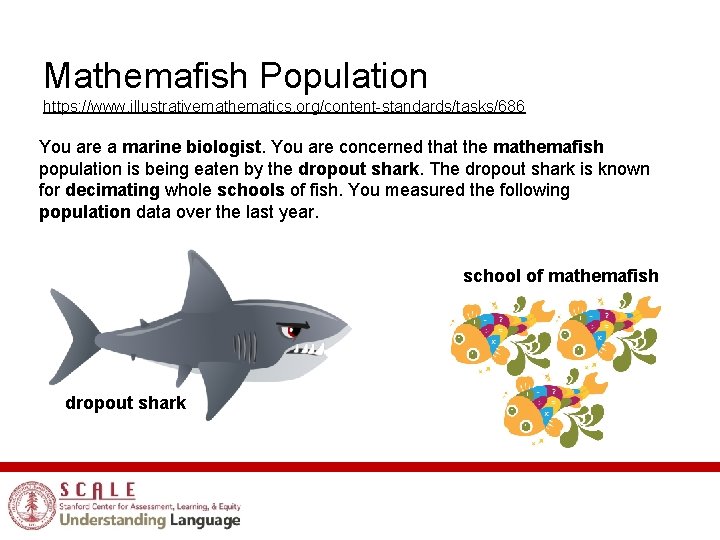
Mathemafish Population https: //www. illustrativemathematics. org/content-standards/tasks/686 You are a marine biologist. You are concerned that the mathemafish population is being eaten by the dropout shark. The dropout shark is known for decimating whole schools of fish. You measured the following population data over the last year. school of mathemafish dropout shark
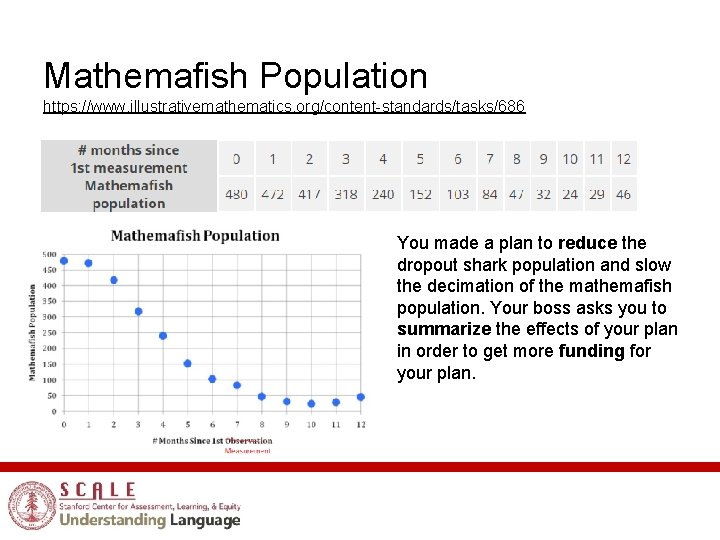
Mathemafish Population https: //www. illustrativemathematics. org/content-standards/tasks/686 You made a plan to reduce the dropout shark population and slow the decimation of the mathemafish population. Your boss asks you to summarize the effects of your plan in order to get more funding for your plan.
Connect and Compare Lead class discussion of Summary Reports. 1. Select a progression of Reports roughly from most concrete, easy entry to mathematically closest to target mathematics of the unit, including use of target representations and language. 2. Students present selected reports in turn. Teacher plays dumb, asks productive questions to elicit more explicit reasoning, labeling etc. ask for connections to previous reports. 3. Summarize mathematics learned today illustrating by connecting and comparing reports.
How can we create structures that will build the capacity of teachers to cultivate academic student discourse in the classroom? Principles for the Design of Mathematics Curricula: Promoting Language and Content Development
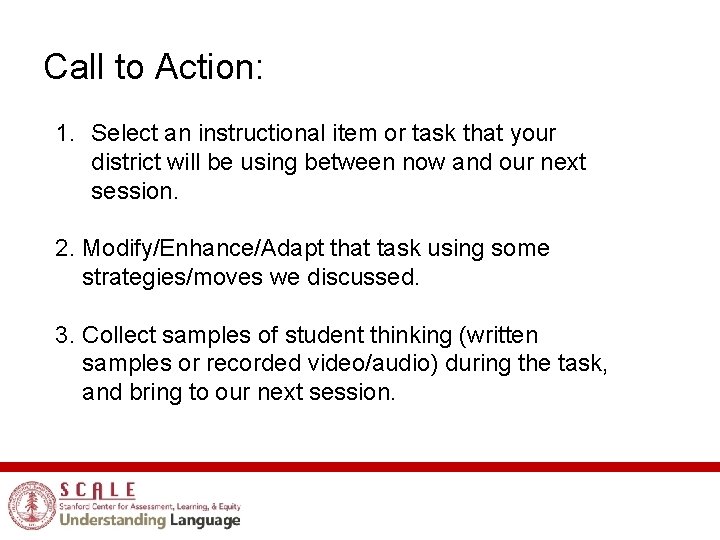
Call to Action: 1. Select an instructional item or task that your district will be using between now and our next session. 2. Modify/Enhance/Adapt that task using some strategies/moves we discussed. 3. Collect samples of student thinking (written samples or recorded video/audio) during the task, and bring to our next session.
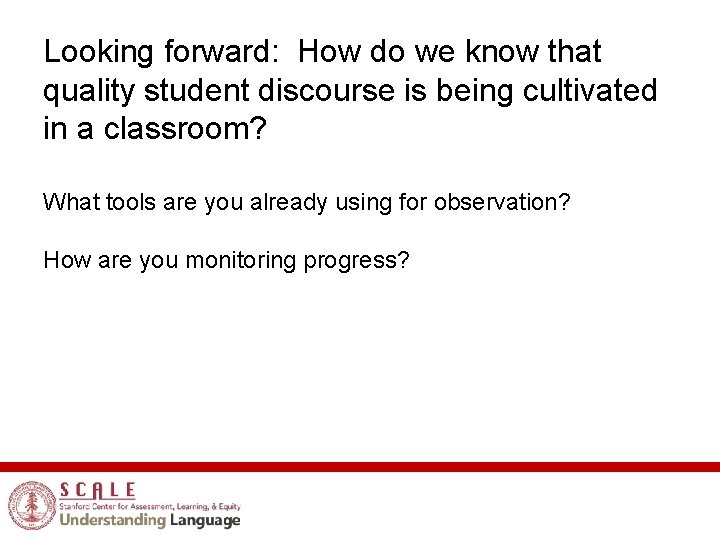
Looking forward: How do we know that quality student discourse is being cultivated in a classroom? What tools are you already using for observation? How are you monitoring progress?
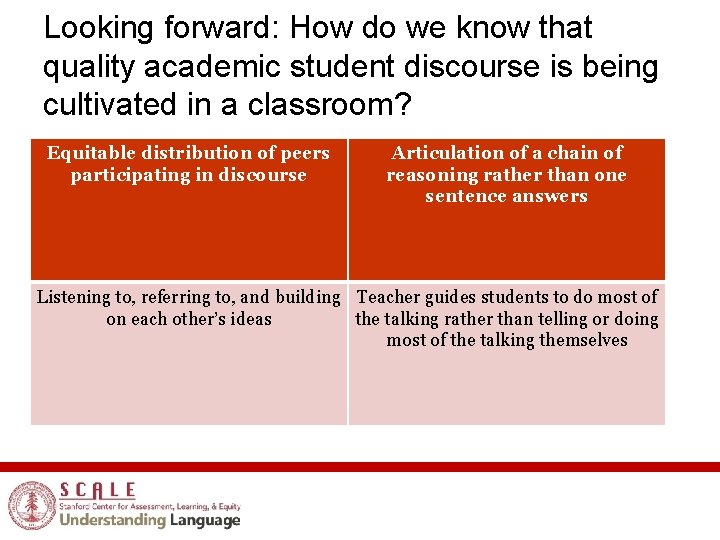
Looking forward: How do we know that quality academic student discourse is being cultivated in a classroom? Equitable distribution of peers participating in discourse Articulation of a chain of reasoning rather than one sentence answers Listening to, referring to, and building Teacher guides students to do most of on each other’s ideas the talking rather than telling or doing most of the talking themselves