
Amplification Chapter 6 Introduction Electronic Amplifiers Sources and
- Slides: 31
Amplification Chapter 6 § Introduction § Electronic Amplifiers § Sources and Loads § Equivalent Circuits of Amplifiers § Output Power § Power Gain § Frequency Response and Bandwidth § Differential Amplifiers § Simple Amplifiers Storey: Electrical & Electronic Systems © Pearson Education Limited 2004 OHT 6. 1
Introduction 6. 1 § Amplification is one of the most common processing functions § Amplification means making things bigger § Attenuation means making things smaller § There are many non-electronic forms of amplification Storey: Electrical & Electronic Systems © Pearson Education Limited 2004 OHT 6. 2
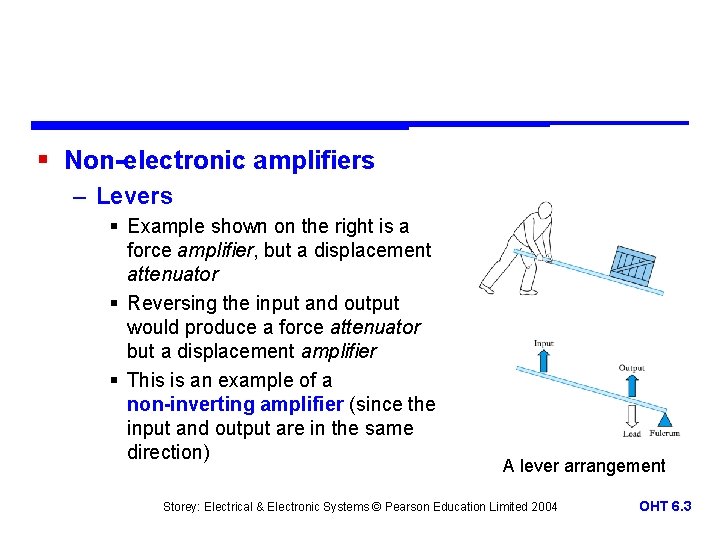
§ Non-electronic amplifiers – Levers § Example shown on the right is a force amplifier, but a displacement attenuator § Reversing the input and output would produce a force attenuator but a displacement amplifier § This is an example of a non-inverting amplifier (since the input and output are in the same direction) A lever arrangement Storey: Electrical & Electronic Systems © Pearson Education Limited 2004 OHT 6. 3
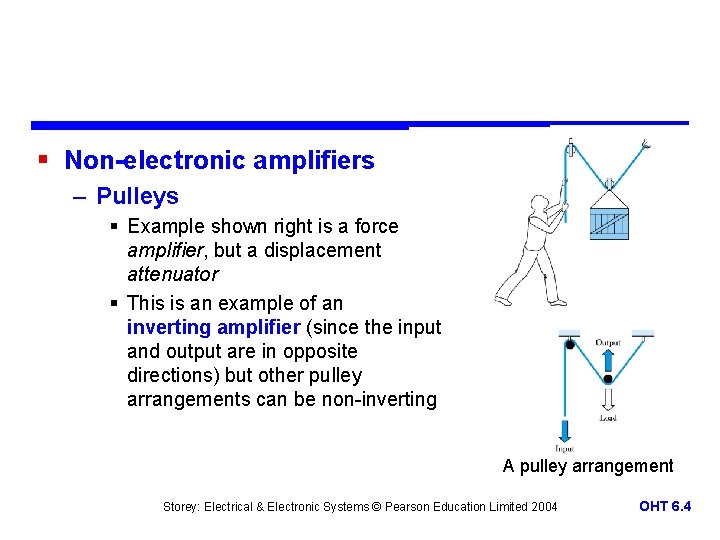
§ Non-electronic amplifiers – Pulleys § Example shown right is a force amplifier, but a displacement attenuator § This is an example of an inverting amplifier (since the input and output are in opposite directions) but other pulley arrangements can be non-inverting A pulley arrangement Storey: Electrical & Electronic Systems © Pearson Education Limited 2004 OHT 6. 4
§ Passive and active amplifiers – levers and pulleys are examples of passive amplifiers since they have no external energy source § in such amplifiers the power delivered at the output must be less than (or equal to) that absorbed at the input – some amplifiers are not passive but are active amplifiers in that they have an external source of power § in such amplifiers the output can deliver more power than is absorbed at the input Storey: Electrical & Electronic Systems © Pearson Education Limited 2004 OHT 6. 5
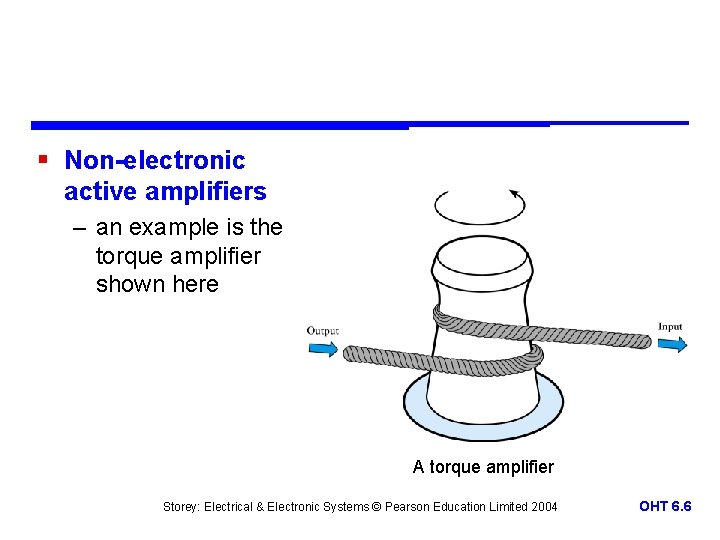
§ Non-electronic active amplifiers – an example is the torque amplifier shown here A torque amplifier Storey: Electrical & Electronic Systems © Pearson Education Limited 2004 OHT 6. 6
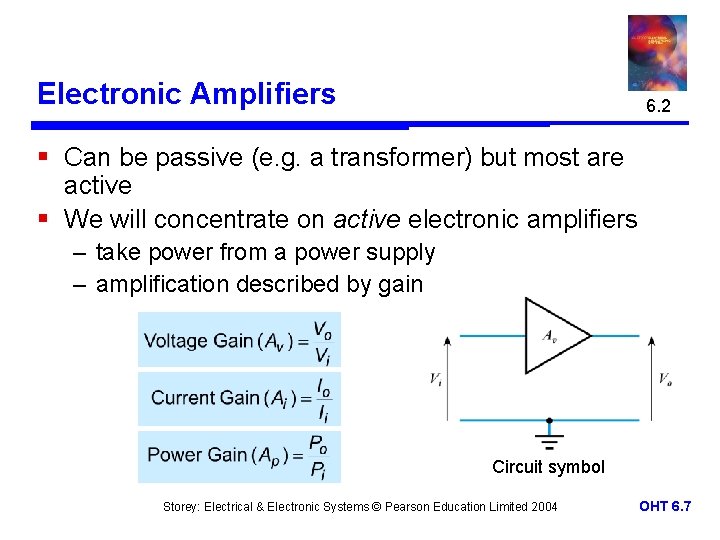
Electronic Amplifiers 6. 2 § Can be passive (e. g. a transformer) but most are active § We will concentrate on active electronic amplifiers – take power from a power supply – amplification described by gain Circuit symbol Storey: Electrical & Electronic Systems © Pearson Education Limited 2004 OHT 6. 7
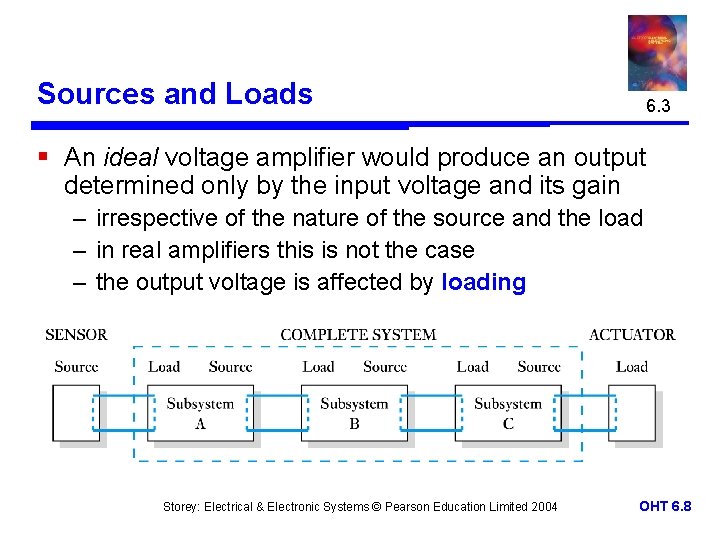
Sources and Loads 6. 3 § An ideal voltage amplifier would produce an output determined only by the input voltage and its gain – irrespective of the nature of the source and the load – in real amplifiers this is not the case – the output voltage is affected by loading Storey: Electrical & Electronic Systems © Pearson Education Limited 2004 OHT 6. 8
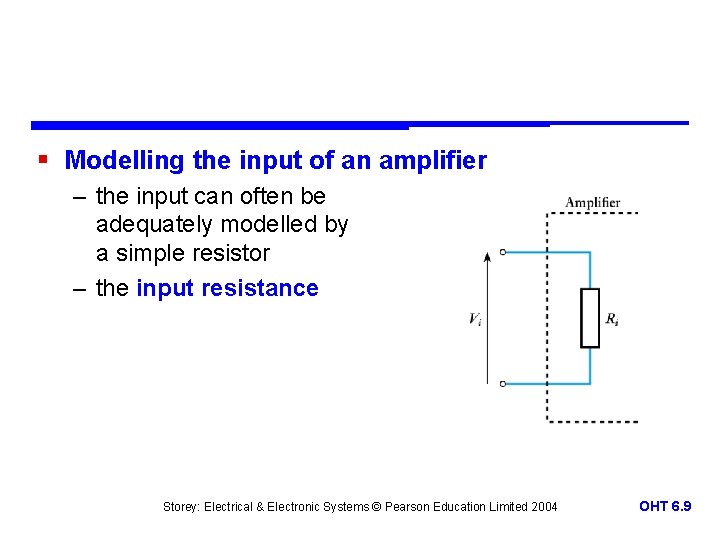
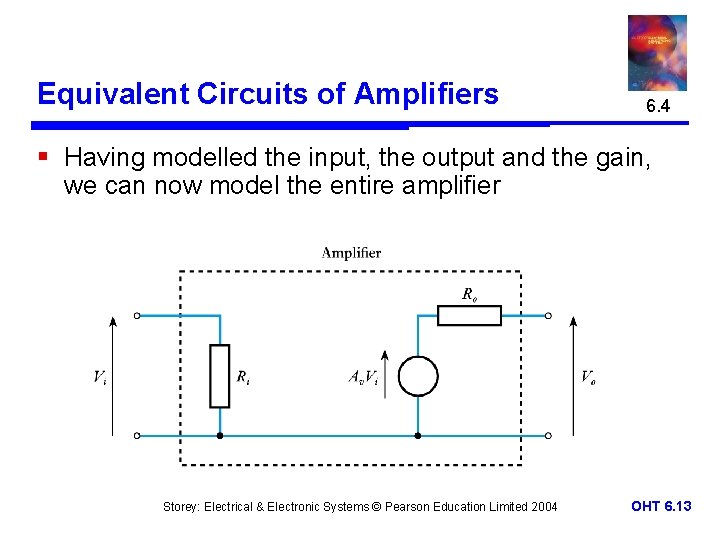
§ Modelling the input of an amplifier – the input can often be adequately modelled by a simple resistor – the input resistance Storey: Electrical & Electronic Systems © Pearson Education Limited 2004 OHT 6. 9
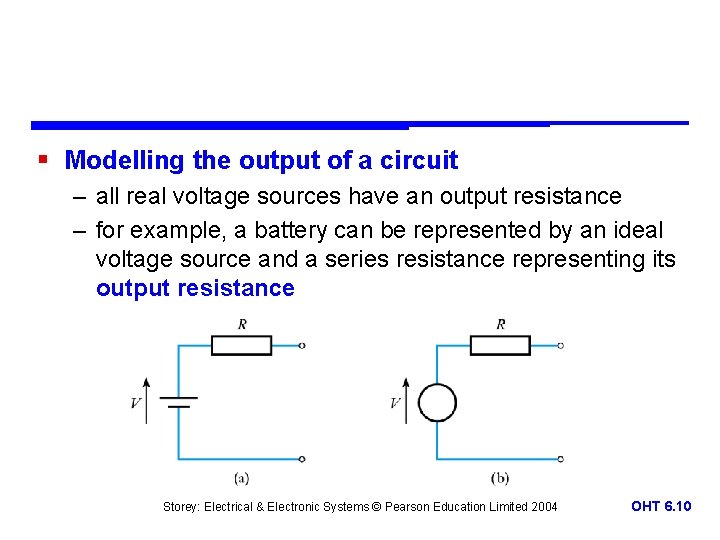
§ Modelling the output of a circuit – all real voltage sources have an output resistance – for example, a battery can be represented by an ideal voltage source and a series resistance representing its output resistance Storey: Electrical & Electronic Systems © Pearson Education Limited 2004 OHT 6. 10
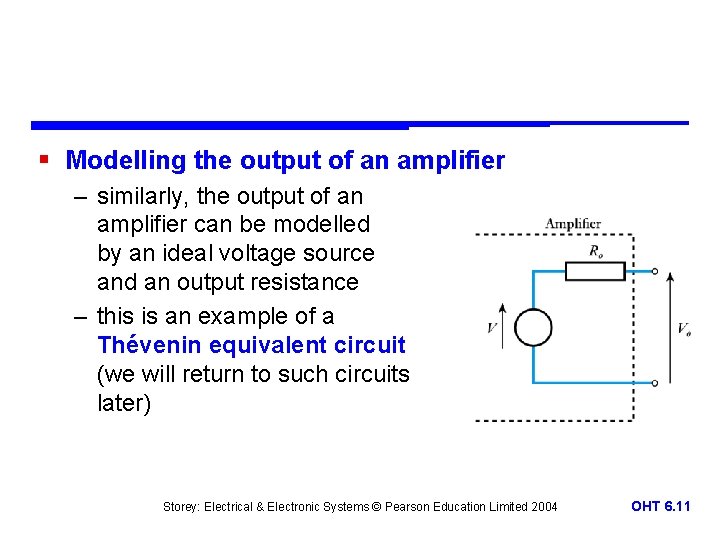
§ Modelling the output of an amplifier – similarly, the output of an amplifier can be modelled by an ideal voltage source and an output resistance – this is an example of a Thévenin equivalent circuit (we will return to such circuits later) Storey: Electrical & Electronic Systems © Pearson Education Limited 2004 OHT 6. 11
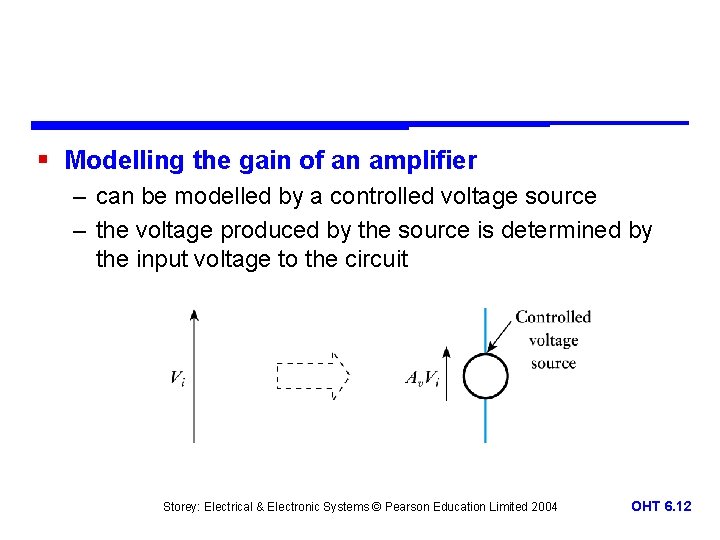
§ Modelling the gain of an amplifier – can be modelled by a controlled voltage source – the voltage produced by the source is determined by the input voltage to the circuit Storey: Electrical & Electronic Systems © Pearson Education Limited 2004 OHT 6. 12
Equivalent Circuits of Amplifiers 6. 4 § Having modelled the input, the output and the gain, we can now model the entire amplifier Storey: Electrical & Electronic Systems © Pearson Education Limited 2004 OHT 6. 13
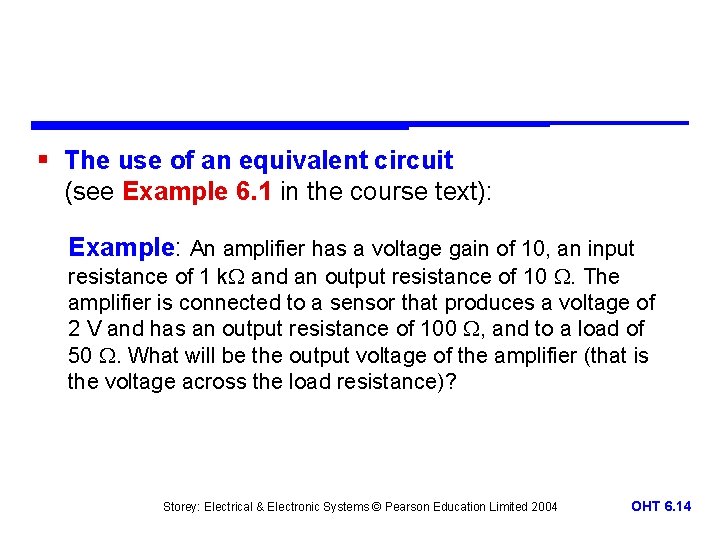
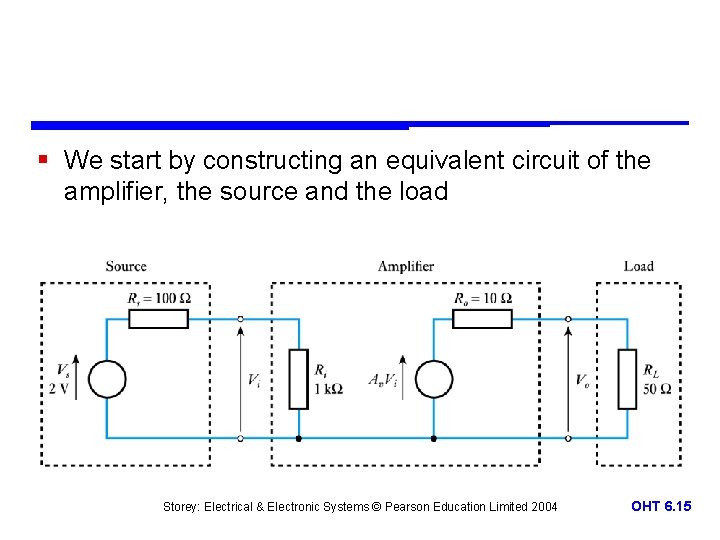
§ The use of an equivalent circuit (see Example 6. 1 in the course text): Example: An amplifier has a voltage gain of 10, an input resistance of 1 k and an output resistance of 10 . The amplifier is connected to a sensor that produces a voltage of 2 V and has an output resistance of 100 , and to a load of 50 . What will be the output voltage of the amplifier (that is the voltage across the load resistance)? Storey: Electrical & Electronic Systems © Pearson Education Limited 2004 OHT 6. 14
§ We start by constructing an equivalent circuit of the amplifier, the source and the load Storey: Electrical & Electronic Systems © Pearson Education Limited 2004 OHT 6. 15
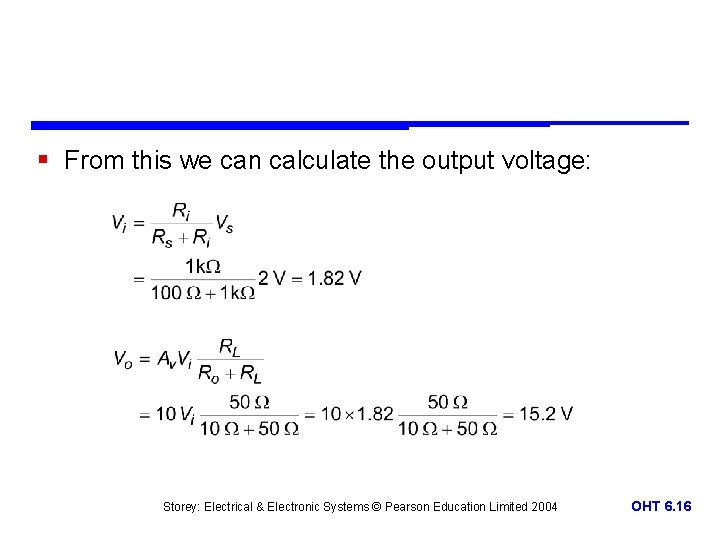
§ From this we can calculate the output voltage: Storey: Electrical & Electronic Systems © Pearson Education Limited 2004 OHT 6. 16
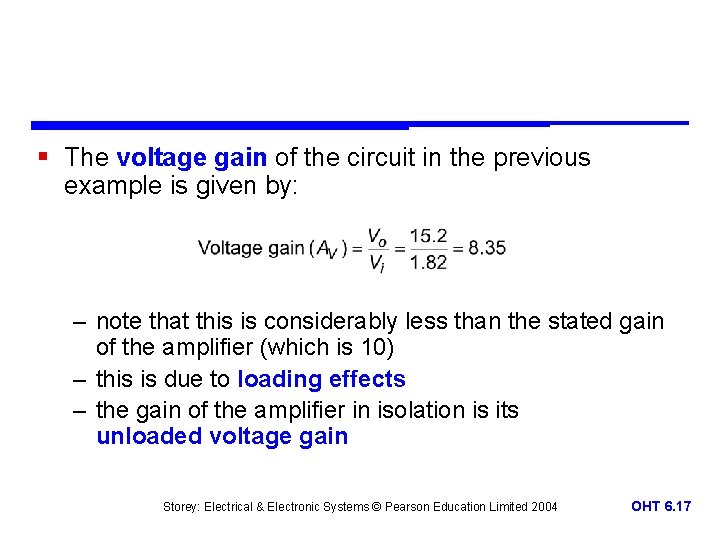
§ The voltage gain of the circuit in the previous example is given by: – note that this is considerably less than the stated gain of the amplifier (which is 10) – this is due to loading effects – the gain of the amplifier in isolation is its unloaded voltage gain Storey: Electrical & Electronic Systems © Pearson Education Limited 2004 OHT 6. 17
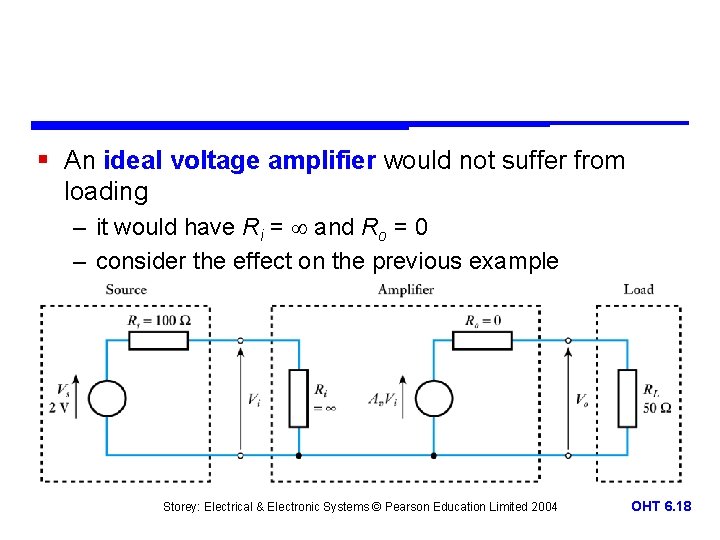
§ An ideal voltage amplifier would not suffer from loading – it would have Ri = and Ro = 0 – consider the effect on the previous example Storey: Electrical & Electronic Systems © Pearson Education Limited 2004 OHT 6. 18
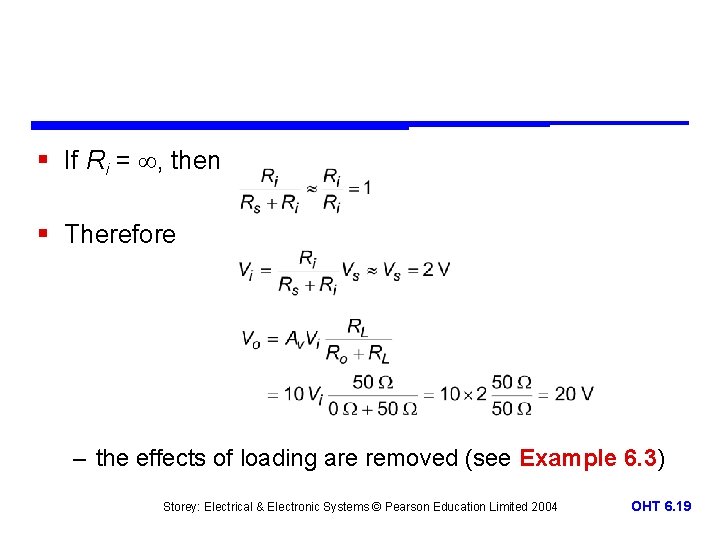
§ If Ri = , then § Therefore – the effects of loading are removed (see Example 6. 3) Storey: Electrical & Electronic Systems © Pearson Education Limited 2004 OHT 6. 19
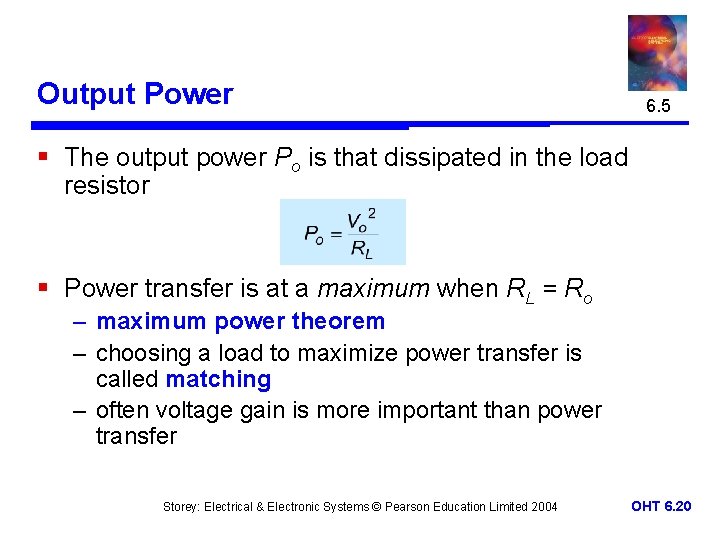
Output Power 6. 5 § The output power Po is that dissipated in the load resistor § Power transfer is at a maximum when RL = Ro – maximum power theorem – choosing a load to maximize power transfer is called matching – often voltage gain is more important than power transfer Storey: Electrical & Electronic Systems © Pearson Education Limited 2004 OHT 6. 20
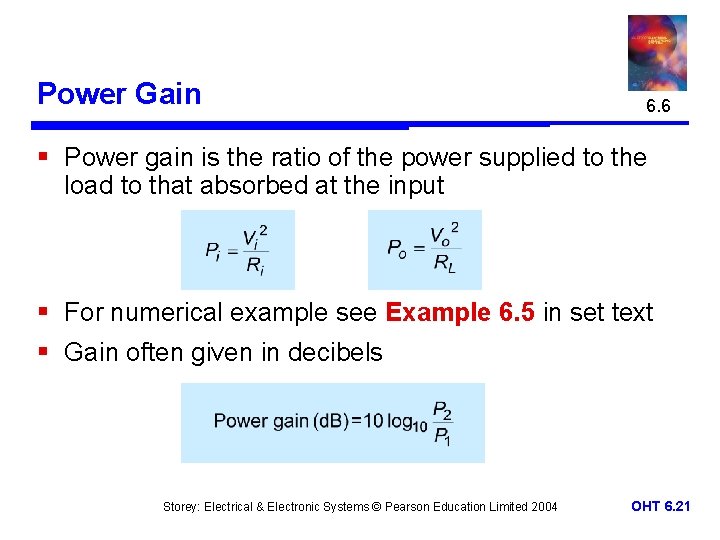
Power Gain 6. 6 § Power gain is the ratio of the power supplied to the load to that absorbed at the input § For numerical example see Example 6. 5 in set text § Gain often given in decibels Storey: Electrical & Electronic Systems © Pearson Education Limited 2004 OHT 6. 21
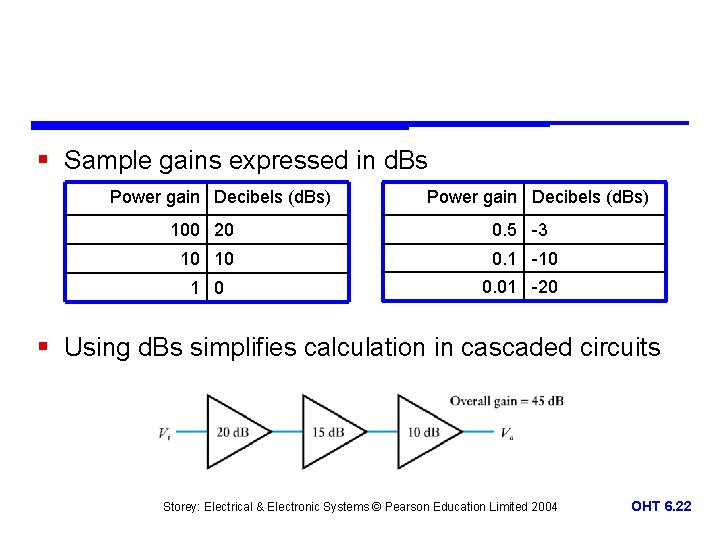
§ Sample gains expressed in d. Bs Power gain Decibels (d. Bs) 100 20 0. 5 -3 10 10 0. 1 -10 1 0 0. 01 -20 § Using d. Bs simplifies calculation in cascaded circuits Storey: Electrical & Electronic Systems © Pearson Education Limited 2004 OHT 6. 22
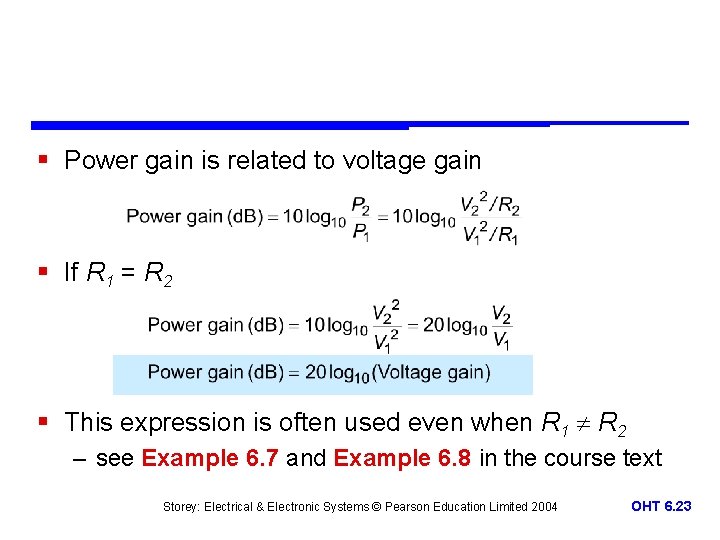
§ Power gain is related to voltage gain § If R 1 = R 2 § This expression is often used even when R 1 R 2 – see Example 6. 7 and Example 6. 8 in the course text Storey: Electrical & Electronic Systems © Pearson Education Limited 2004 OHT 6. 23
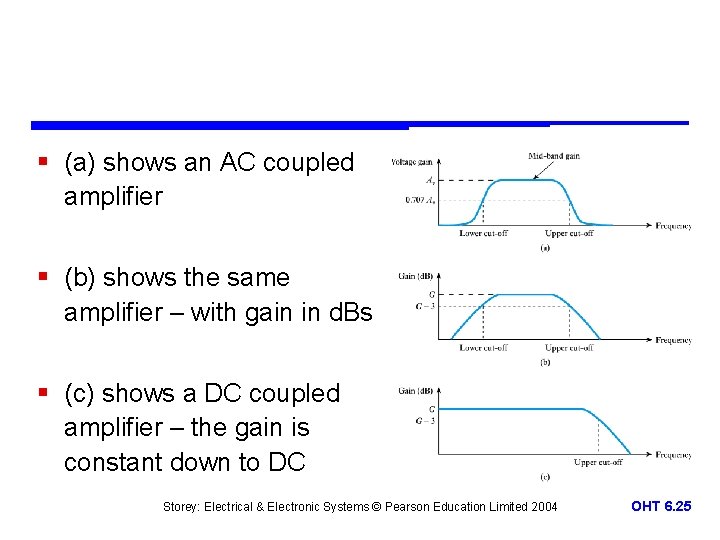
Frequency Response and Bandwidth 6. 7 § All real amplifiers have limits to the range of frequencies over which they can be used § The gain of a circuit in its normal operating range is termed its mid-band gain § The gain of all amplifiers falls at high frequencies – characteristic defined by the half-power point – gain falls to 1/ 2 = 0. 707 times the mid-band gain – this occurs at the cut-off frequency § In some amplifiers gain also falls at low frequencies – these are AC coupled amplifiers Storey: Electrical & Electronic Systems © Pearson Education Limited 2004 OHT 6. 24
§ (a) shows an AC coupled amplifier § (b) shows the same amplifier – with gain in d. Bs § (c) shows a DC coupled amplifier – the gain is constant down to DC Storey: Electrical & Electronic Systems © Pearson Education Limited 2004 OHT 6. 25
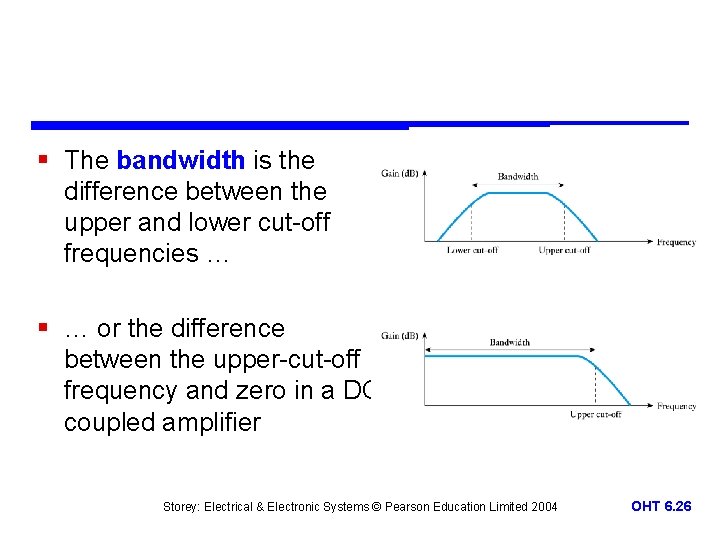
§ The bandwidth is the difference between the upper and lower cut-off frequencies … § … or the difference between the upper-cut-off frequency and zero in a DC coupled amplifier Storey: Electrical & Electronic Systems © Pearson Education Limited 2004 OHT 6. 26
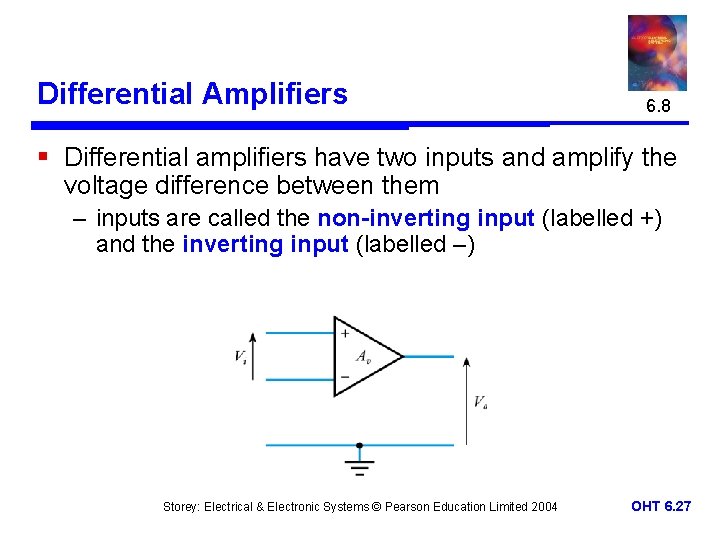
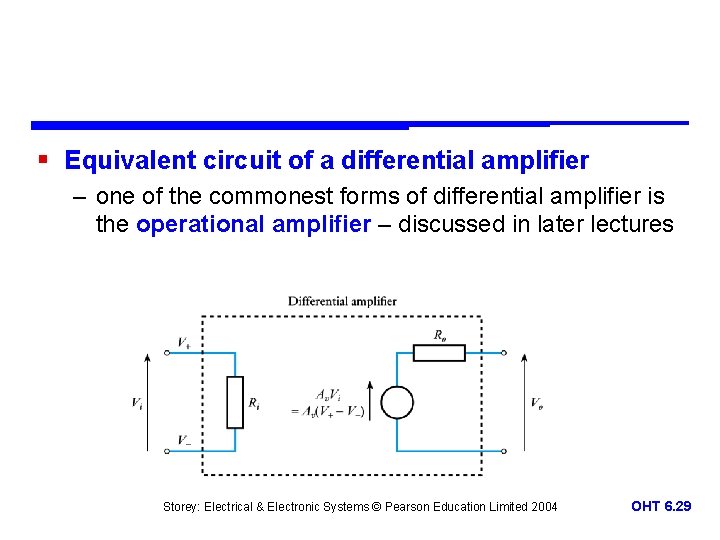
Differential Amplifiers 6. 8 § Differential amplifiers have two inputs and amplify the voltage difference between them – inputs are called the non-inverting input (labelled +) and the inverting input (labelled –) Storey: Electrical & Electronic Systems © Pearson Education Limited 2004 OHT 6. 27
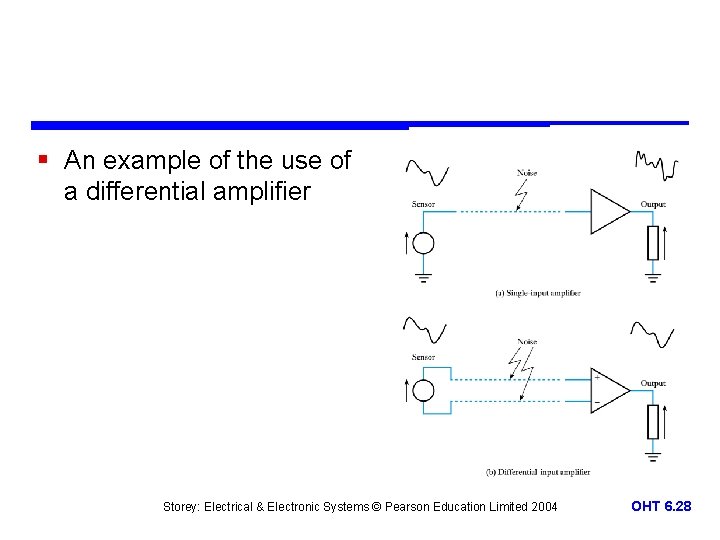
§ An example of the use of a differential amplifier Storey: Electrical & Electronic Systems © Pearson Education Limited 2004 OHT 6. 28
§ Equivalent circuit of a differential amplifier – one of the commonest forms of differential amplifier is the operational amplifier – discussed in later lectures Storey: Electrical & Electronic Systems © Pearson Education Limited 2004 OHT 6. 29
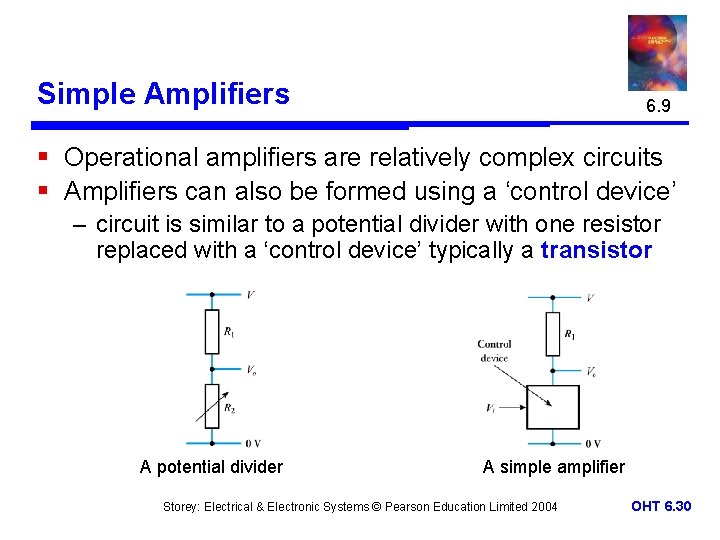
Simple Amplifiers 6. 9 § Operational amplifiers are relatively complex circuits § Amplifiers can also be formed using a ‘control device’ – circuit is similar to a potential divider with one resistor replaced with a ‘control device’ typically a transistor A potential divider A simple amplifier Storey: Electrical & Electronic Systems © Pearson Education Limited 2004 OHT 6. 30
Key Points § Amplification forms part of most electronic systems § Amplifiers may be active or passive § Equivalent circuits are useful when investigating the interaction between circuits § Amplifier gains are often measured in decibels (d. Bs) § The gain of all amplifiers falls at high frequencies § The gain of some amplifiers falls at low frequencies § Differential amplifiers take as their input the difference between two input signals § Some amplifiers are very simple in construction Storey: Electrical & Electronic Systems © Pearson Education Limited 2004 OHT 6. 31