
Amphitheater Native American Education Program 2018 2019 Teacher

- Slides: 14
Amphitheater Native American Education Program 2018 -2019 Teacher Guide All material within this publication are property of the Amphitheater Native American Education program. Any reproduction or copy of material without permission is strictly prohibited. Amphitheater Public Schools, REVISED 8/18
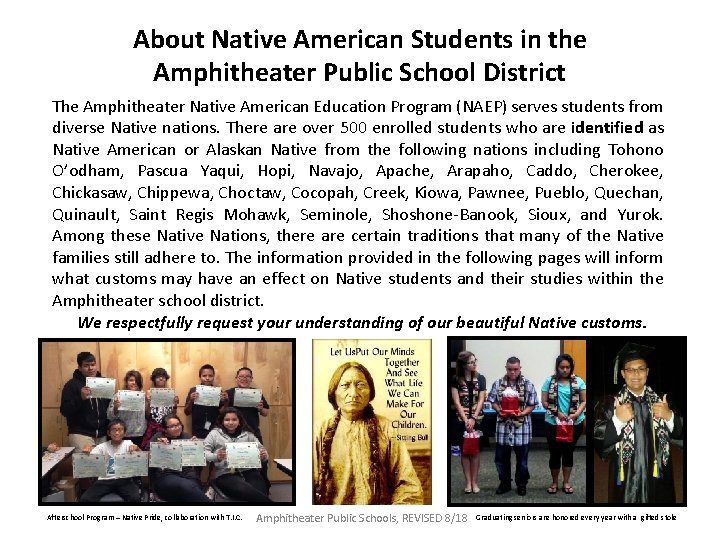
About Native American Students in the Amphitheater Public School District The Amphitheater Native American Education Program (NAEP) serves students from diverse Native nations. There are over 500 enrolled students who are identified as Native American or Alaskan Native from the following nations including Tohono O’odham, Pascua Yaqui, Hopi, Navajo, Apache, Arapaho, Caddo, Cherokee, Chickasaw, Chippewa, Choctaw, Cocopah, Creek, Kiowa, Pawnee, Pueblo, Quechan, Quinault, Saint Regis Mohawk, Seminole, Shoshone-Banook, Sioux, and Yurok. Among these Native Nations, there are certain traditions that many of the Native families still adhere to. The information provided in the following pages will inform what customs may have an effect on Native students and their studies within the Amphitheater school district. We respectfully request your understanding of our beautiful Native customs. Afterschool Program – Native Pride, collaboration with T. I. C. Amphitheater Public Schools, REVISED 8/18 Graduating seniors are honored every year with a gifted stole
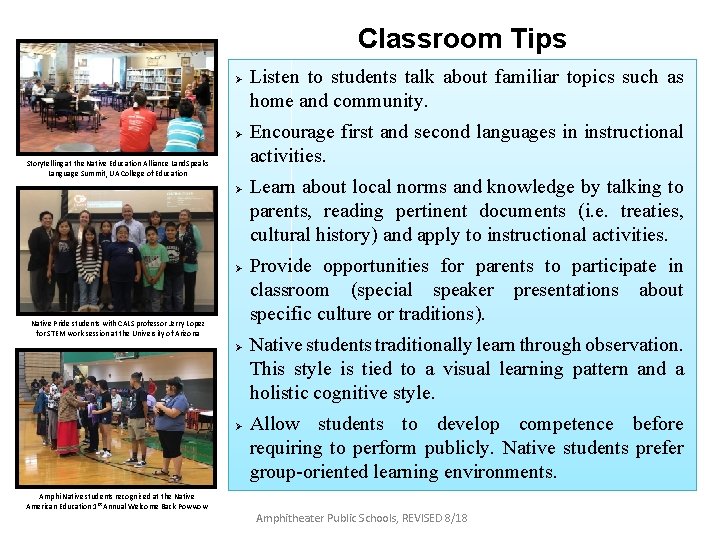
Classroom Tips Ø Ø Storytelling at the Native Education Alliance Land. Speaks Language Summit, UA College of Education Ø Ø Native Pride students with CALS professor Jerry Lopez for STEM work session at the University of Arizona Ø Ø Listen to students talk about familiar topics such as home and community. Encourage first and second languages in instructional activities. Learn about local norms and knowledge by talking to parents, reading pertinent documents (i. e. treaties, cultural history) and apply to instructional activities. Provide opportunities for parents to participate in classroom (special speaker presentations about specific culture or traditions). Native students traditionally learn through observation. This style is tied to a visual learning pattern and a holistic cognitive style. Allow students to develop competence before requiring to perform publicly. Native students prefer group-oriented learning environments. Amphi Native students recognized at the Native American Education 1 st Annual Welcome Back Powwow Amphitheater Public Schools, REVISED 8/18
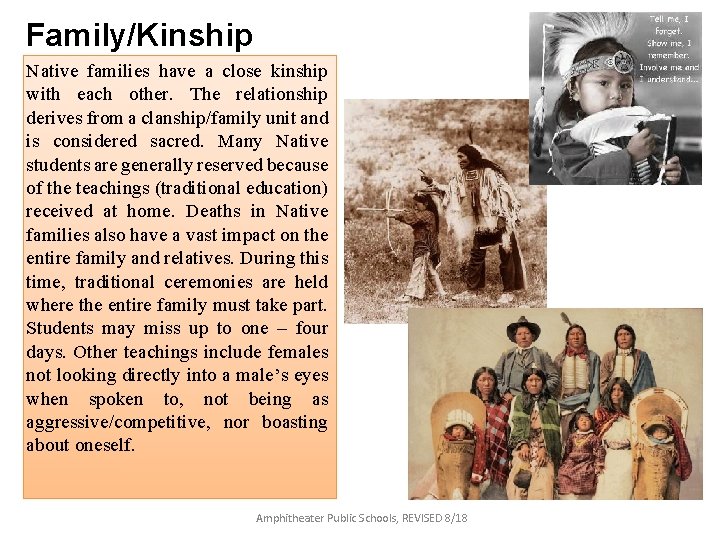
Family/Kinship Native families have a close kinship with each other. The relationship derives from a clanship/family unit and is considered sacred. Many Native students are generally reserved because of the teachings (traditional education) received at home. Deaths in Native families also have a vast impact on the entire family and relatives. During this time, traditional ceremonies are held where the entire family must take part. Students may miss up to one – four days. Other teachings include females not looking directly into a male’s eyes when spoken to, not being as aggressive/competitive, nor boasting about oneself. Amphitheater Public Schools, REVISED 8/18
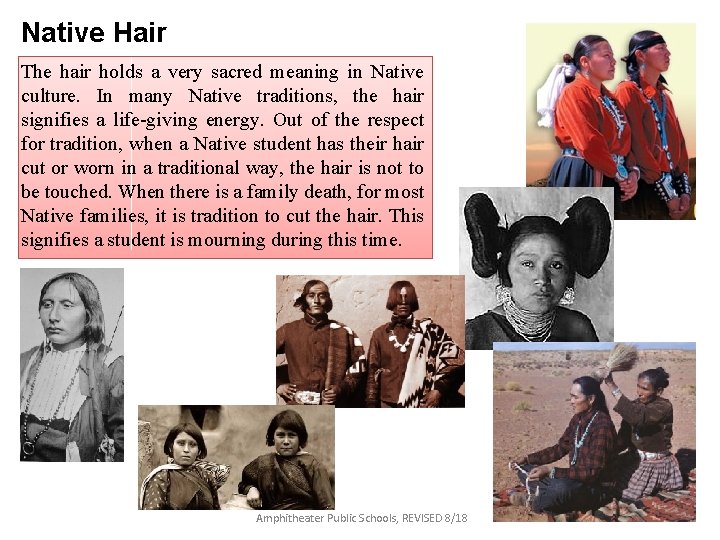
Native Hair The hair holds a very sacred meaning in Native culture. In many Native traditions, the hair signifies a life-giving energy. Out of the respect for tradition, when a Native student has their hair cut or worn in a traditional way, the hair is not to be touched. When there is a family death, for most Native families, it is tradition to cut the hair. This signifies a student is mourning during this time. Amphitheater Public Schools, REVISED 8/18
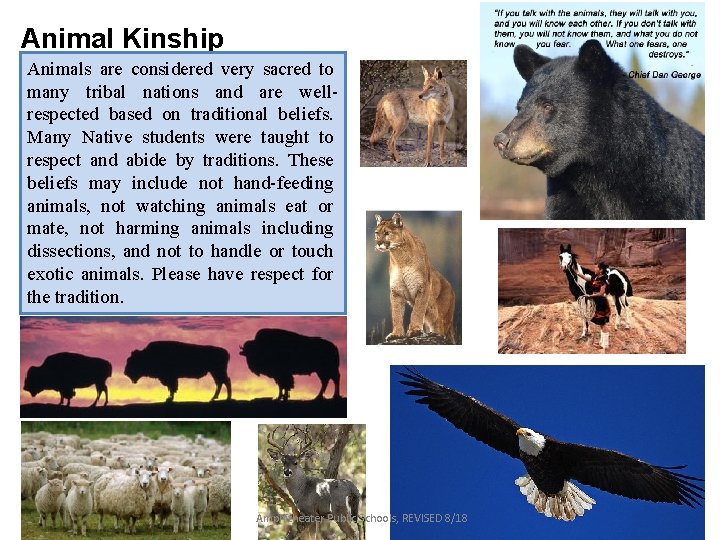
Animal Kinship Animals are considered very sacred to many tribal nations and are wellrespected based on traditional beliefs. Many Native students were taught to respect and abide by traditions. These beliefs may include not hand-feeding animals, not watching animals eat or mate, not harming animals including dissections, and not to handle or touch exotic animals. Please have respect for the tradition. Amphitheater Public Schools, REVISED 8/18
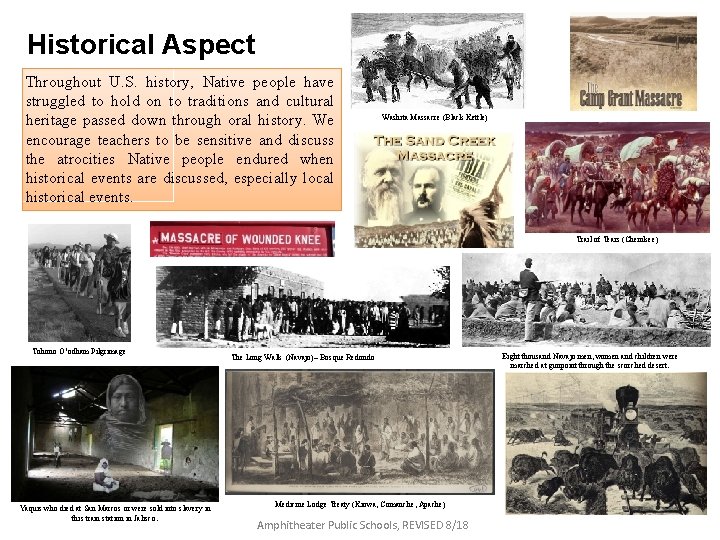
Historical Aspect Throughout U. S. history, Native people have struggled to hold on to traditions and cultural heritage passed down through oral history. We encourage teachers to be sensitive and discuss the atrocities Native people endured when historical events are discussed, especially local historical events. Washita Massacre (Black Kettle) Trail of Tears (Cherokee) Tohono O’odham Pilgrimage Yaquis who died at San Marcos or were sold into slavery in this train station in Jalisco. The Long Walk (Navajo)– Bosque Redondo Medicine Lodge Treaty (Kiowa, Comanche, Apache) Amphitheater Public Schools, REVISED 8/18 Eight thousand Navajo men, women and children were marched at gunpoint through the scorched desert.
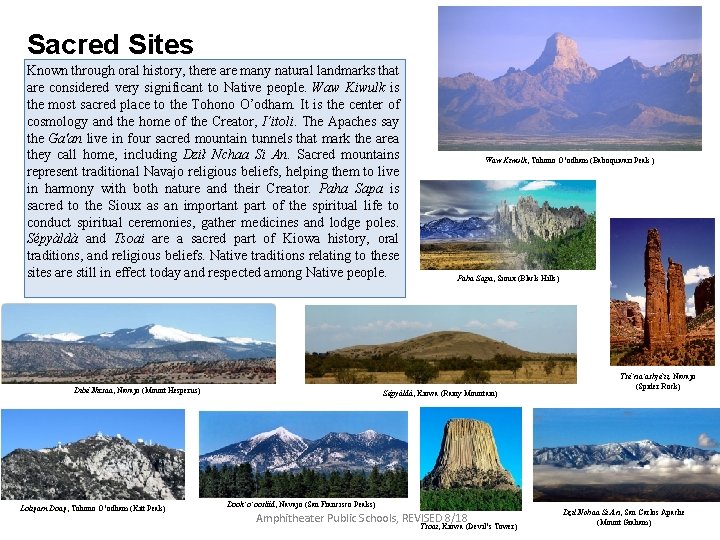
Sacred Sites Known through oral history, there are many natural landmarks that are considered very significant to Native people. Waw Kiwulk is the most sacred place to the Tohono O’odham. It is the center of cosmology and the home of the Creator, I’itoli. The Apaches say the Ga'an live in four sacred mountain tunnels that mark the area they call home, including Dził Nchaa Si An. Sacred mountains represent traditional Navajo religious beliefs, helping them to live in harmony with both nature and their Creator. Paha Sapa is sacred to the Sioux as an important part of the spiritual life to conduct spiritual ceremonies, gather medicines and lodge poles. Sépyàldà and Tsoai are a sacred part of Kiowa history, oral traditions, and religious beliefs. Native traditions relating to these sites are still in effect today and respected among Native people. Dibé Nitsaa, Navajo (Mount Hesperus) Loligam Doag, Tohono O’odham (Kitt Peak) Waw Kiwulk, Tohono O’odham (Baboquivari Peak ) Paha Sapa, Sioux (Black Hills) Sépyàldà, Kiowa (Rainy Mountain) Dookʼoʼoosłííd, Navajo (San Francisco Peaks) Amphitheater Public Schools, REVISED 8/18 Tsoai, Kiowa (Devil’s Tower) Tsé'na'ashjé'ii, Navajo (Spider Rock) Dził Nchaa Si An, San Carlos Apache (Mount Graham)
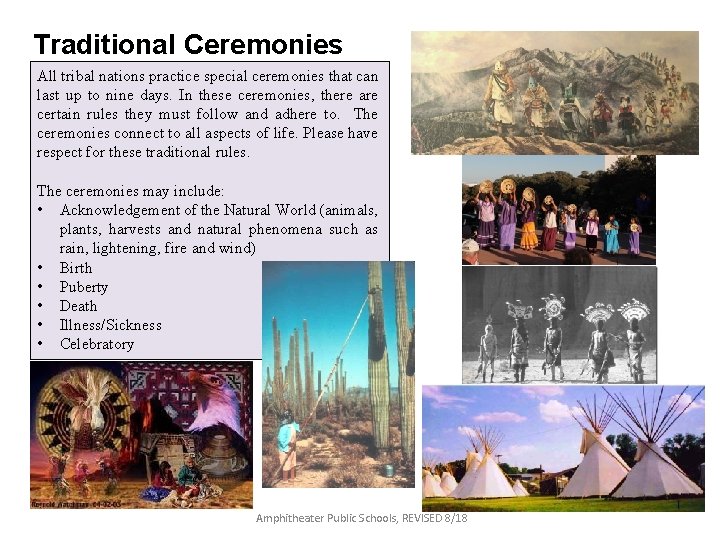
Traditional Ceremonies All tribal nations practice special ceremonies that can last up to nine days. In these ceremonies, there are certain rules they must follow and adhere to. The ceremonies connect to all aspects of life. Please have respect for these traditional rules. The ceremonies may include: • Acknowledgement of the Natural World (animals, plants, harvests and natural phenomena such as rain, lightening, fire and wind) • Birth • Puberty • Death • Illness/Sickness • Celebratory Amphitheater Public Schools, REVISED 8/18
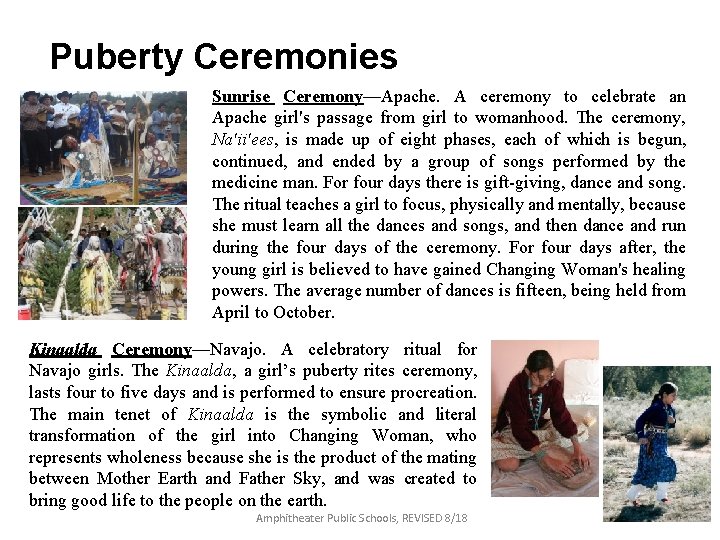
Puberty Ceremonies Sunrise Ceremony—Apache. A ceremony to celebrate an Apache girl's passage from girl to womanhood. The ceremony, Na'ii'ees, is made up of eight phases, each of which is begun, continued, and ended by a group of songs performed by the medicine man. For four days there is gift-giving, dance and song. The ritual teaches a girl to focus, physically and mentally, because she must learn all the dances and songs, and then dance and run during the four days of the ceremony. For four days after, the young girl is believed to have gained Changing Woman's healing powers. The average number of dances is fifteen, being held from April to October. Kinaalda Ceremony—Navajo. A celebratory ritual for Navajo girls. The Kinaalda, a girl’s puberty rites ceremony, lasts four to five days and is performed to ensure procreation. The main tenet of Kinaalda is the symbolic and literal transformation of the girl into Changing Woman, who represents wholeness because she is the product of the mating between Mother Earth and Father Sky, and was created to bring good life to the people on the earth. Amphitheater Public Schools, REVISED 8/18
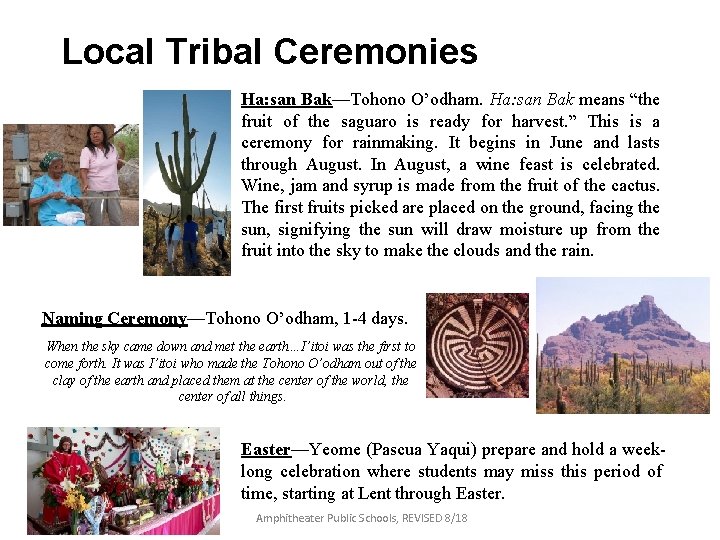
Local Tribal Ceremonies Ha: san Bak—Tohono O’odham. Ha: san Bak means “the fruit of the saguaro is ready for harvest. ” This is a ceremony for rainmaking. It begins in June and lasts through August. In August, a wine feast is celebrated. Wine, jam and syrup is made from the fruit of the cactus. The first fruits picked are placed on the ground, facing the sun, signifying the sun will draw moisture up from the fruit into the sky to make the clouds and the rain. Naming Ceremony—Tohono O’odham, 1 -4 days. When the sky came down and met the earth…I’itoi was the first to come forth. It was I’itoi who made the Tohono O’odham out of the clay of the earth and placed them at the center of the world, the center of all things. Easter—Yeome (Pascua Yaqui) prepare and hold a weeklong celebration where students may miss this period of time, starting at Lent through Easter. Amphitheater Public Schools, REVISED 8/18
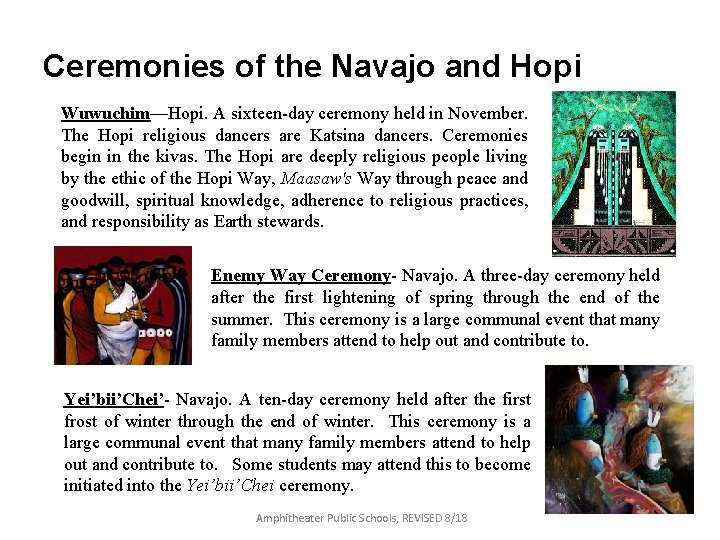
Ceremonies of the Navajo and Hopi Wuwuchim—Hopi. A sixteen-day ceremony held in November. The Hopi religious dancers are Katsina dancers. Ceremonies begin in the kivas. The Hopi are deeply religious people living by the ethic of the Hopi Way, Maasaw's Way through peace and goodwill, spiritual knowledge, adherence to religious practices, and responsibility as Earth stewards. Enemy Way Ceremony- Navajo. A three-day ceremony held after the first lightening of spring through the end of the summer. This ceremony is a large communal event that many family members attend to help out and contribute to. Yei’bii’Chei’- Navajo. A ten-day ceremony held after the first frost of winter through the end of winter. This ceremony is a large communal event that many family members attend to help out and contribute to. Some students may attend this to become initiated into the Yei’bii’Chei ceremony. Amphitheater Public Schools, REVISED 8/18
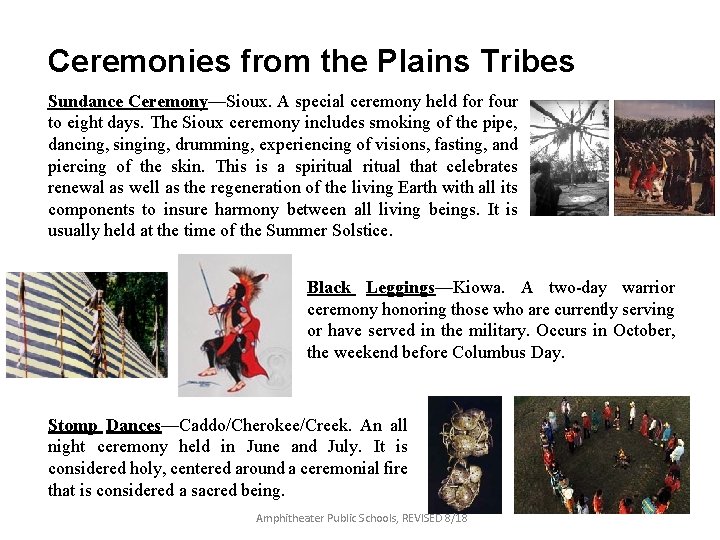
Ceremonies from the Plains Tribes Sundance Ceremony—Sioux. A special ceremony held for four to eight days. The Sioux ceremony includes smoking of the pipe, dancing, singing, drumming, experiencing of visions, fasting, and piercing of the skin. This is a spiritual that celebrates renewal as well as the regeneration of the living Earth with all its components to insure harmony between all living beings. It is usually held at the time of the Summer Solstice. Black Leggings—Kiowa. A two-day warrior ceremony honoring those who are currently serving or have served in the military. Occurs in October, the weekend before Columbus Day. Stomp Dances—Caddo/Cherokee/Creek. An all night ceremony held in June and July. It is considered holy, centered around a ceremonial fire that is considered a sacred being. Amphitheater Public Schools, REVISED 8/18
Annual Cultural Events ·September – Navajo Nation Fair, Window Rock ·October – Pilgrimage to Mexico (Tohono O’Odham) ·October – Black Leggings (Kiowa) ·November ·January – Deer Head Ceremony (Pascua Yaqui) ·February ·March ·May – Lent preparation (Pascua Yaqui) – Tohono O’Odham Salt Pilgrimage – Feast of the Holy Cross (Pascua Yaqui) ·June/July ·July – Feeding of All Souls Day (Tohono O’Odham) – Sundance Ceremonies (Sioux) 2 -4 – Gourd Clan Celebration (Kiowa) For any questions, please do not hesitate to contact our office at (520) 696 -5051. Satellite office: (520) 696 -6258 Website: https: //www. amphi. com/Domain/1071 Kimberly Daingkau-Begay, Coordinator/Advisor Margaret Blaine, Tutor/Advisor kbegay@amphi. com mblaine@amphi. com Governing Board Members – Deanna M. Day, M. Ed. , President; Vicki Cox Golder, Vice-President; Scott K. Baker, Ph. D. ; Scott A. Leska; Susan Zibrat District Administration – Todd A. Jaeger, J. D. , Superintendent ; Roseanne Lopez, Ed. D. , Associate Superintendent for Elementary Education; Michael Bejarano, Associate Superintendent for Secondary Education; Michelle H. Tong, J. D. , Associate to the Superintendent and General Counsel; Scott Little, Chief Financial Officer; Kristin Mc. Graw, Executive Director of Student Services; James Burns, Executive Manager of Operational Support; Michelle Valenzuela, Director of Communications; Tassi Call, Director of 21 st Century Education Darlene Mansouri, State & Federal Intervention Programs Director All material within this publication are property of the Amphitheater Native American Education program. Any reproduction or copy of material without permission is strictly prohibited. Amphitheater Public Schools, REVISED 8/18