
Amphibians April 2016 Amphibians Whats so special about

Amphibians April 2016
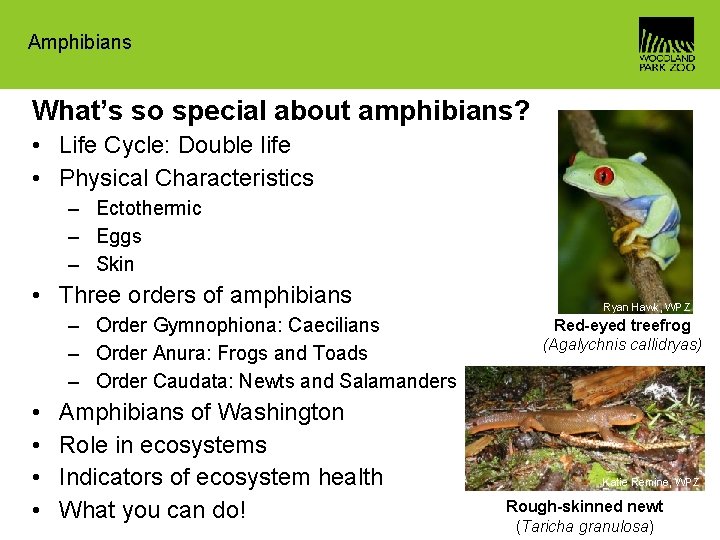
Amphibians What’s so special about amphibians? • Life Cycle: Double life • Physical Characteristics – Ectothermic – Eggs – Skin • Three orders of amphibians – Order Gymnophiona: Caecilians – Order Anura: Frogs and Toads – Order Caudata: Newts and Salamanders • • Amphibians of Washington Role in ecosystems Indicators of ecosystem health What you can do! Ryan Hawk, WPZ Red-eyed treefrog (Agalychnis callidryas) Katie Remine, WPZ Rough-skinned newt (Taricha granulosa)
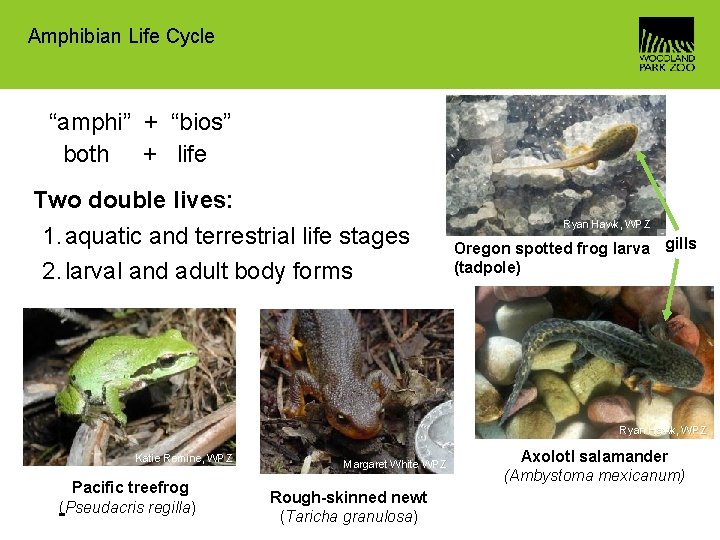
Amphibian Life Cycle “amphi” + “bios” both + life Two double lives: 1. aquatic and terrestrial life stages 2. larval and adult body forms Ryan Hawk, WPZ Oregon spotted frog larva gills (tadpole) Ryan Hawk, WPZ Katie Remine, WPZ Pacific treefrog (Pseudacris regilla)) Margaret White WPZ Rough-skinned newt (Taricha granulosa) Axolotl salamander (Ambystoma mexicanum)
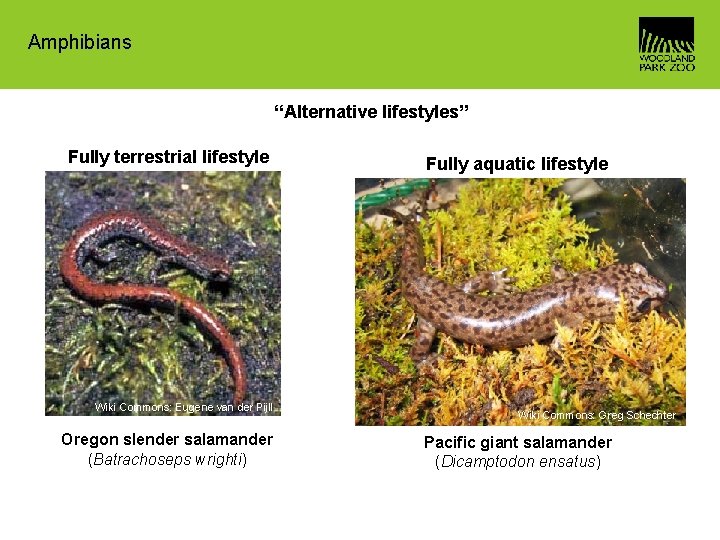
Amphibians “Alternative lifestyles” Fully terrestrial lifestyle Wiki Commons: Eugene van der Pijll Oregon slender salamander (Batrachoseps wrighti) Fully aquatic lifestyle Wiki Commons: Greg Schechter Pacific giant salamander (Dicamptodon ensatus)
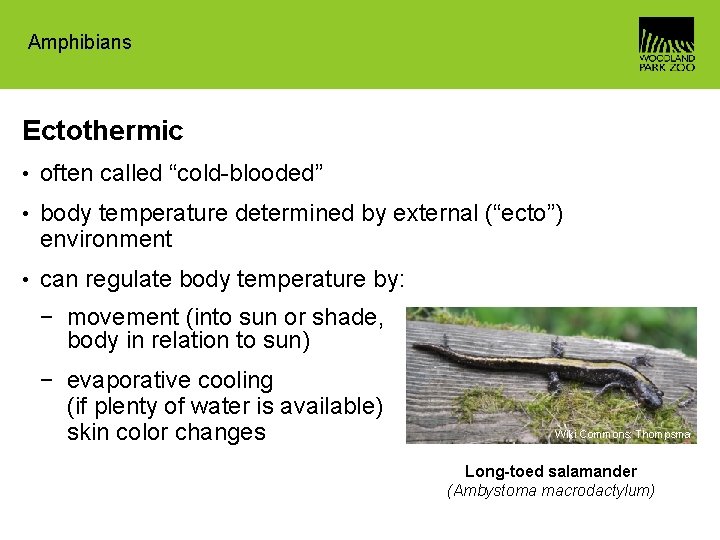
Amphibians Ectothermic • often called “cold-blooded” • body temperature determined by external (“ecto”) environment • can regulate body temperature by: − movement (into sun or shade, body in relation to sun) − evaporative cooling (if plenty of water is available) skin color changes Wiki Commons: Thompsma Long-toed salamander (Ambystoma macrodactylum)

Amphibians Amphibian Eggs egg (ovum) • Similar in structure to fish eggs jelly layers • No hard shell or membrane • Gelatinous covering, permeable to gases and liquids Tarquin at the English language Wikipedia • Usually laid in water or moist places (prone to drying out) • External or internal fertilization Ryan Hawk, WPZ Blue poison dart frogs (Dendrobates azureus)

Amphibians Amphibian Skin • Only class of vertebrates with no protective skin covering (scales, feathers, hair/fur) • Permeable skin (liquids and gases can pass across) Rough-skinned newt (Taricha granulosa) • Shed skin (but often consume sheds) • Many skin glands (some exude toxic compounds) Ryan Hawk, WPZ Tomato frog (Dyscophus guineti)
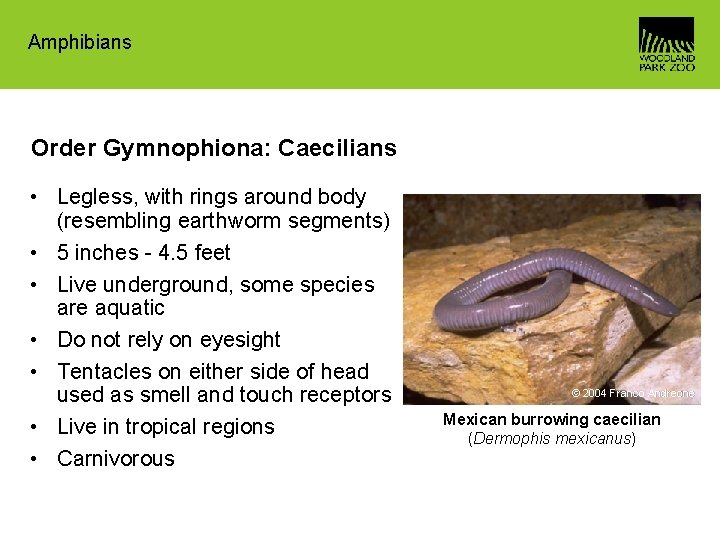
Amphibians Order Gymnophiona: Caecilians • Legless, with rings around body (resembling earthworm segments) • 5 inches - 4. 5 feet • Live underground, some species are aquatic • Do not rely on eyesight • Tentacles on either side of head used as smell and touch receptors • Live in tropical regions • Carnivorous © 2004 Franco Andreone Mexican burrowing caecilian (Dermophis mexicanus)
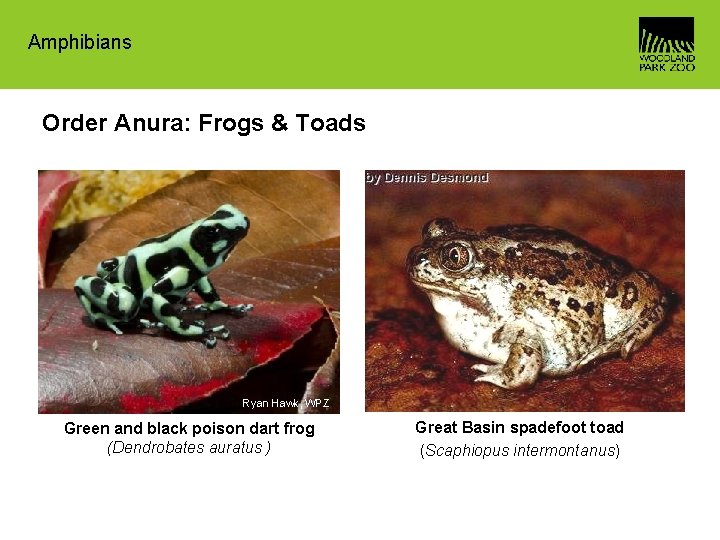
Amphibians Order Anura: Frogs & Toads Ryan Hawk, WPZ Green and black poison dart frog (Dendrobates auratus ) Great Basin spadefoot toad (Scaphiopus intermontanus)
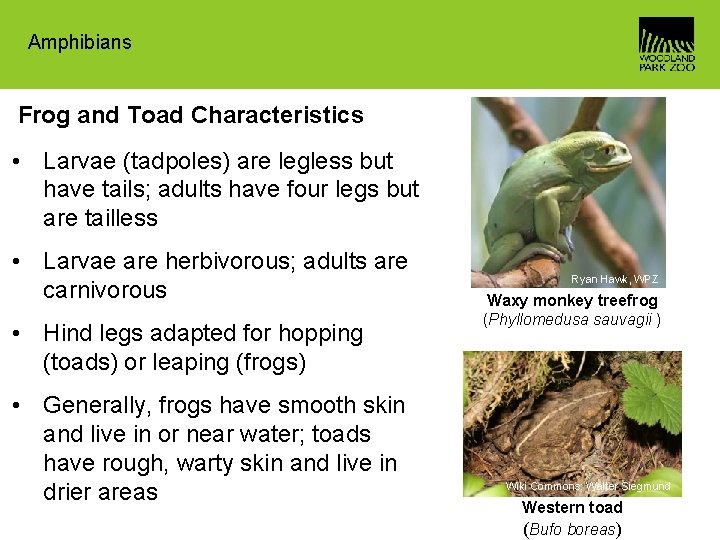
Amphibians Frog and Toad Characteristics • Larvae (tadpoles) are legless but have tails; adults have four legs but are tailless • Larvae are herbivorous; adults are carnivorous • Hind legs adapted for hopping (toads) or leaping (frogs) • Generally, frogs have smooth skin and live in or near water; toads have rough, warty skin and live in drier areas Ryan Hawk, WPZ Waxy monkey treefrog (Phyllomedusa sauvagii ) Wiki Commons: Walter Siegmund Western toad (Bufo boreas)
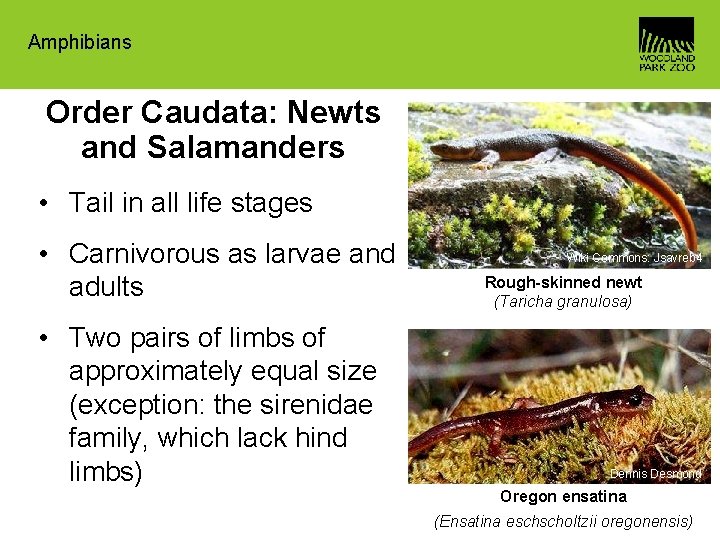
Amphibians Order Caudata: Newts and Salamanders • Tail in all life stages • Carnivorous as larvae and adults • Two pairs of limbs of approximately equal size (exception: the sirenidae family, which lack hind limbs) Wiki Commons: Jsavreb 4 Rough-skinned newt (Taricha granulosa) Dennis Desmond Oregon ensatina (Ensatina eschscholtzii oregonensis)
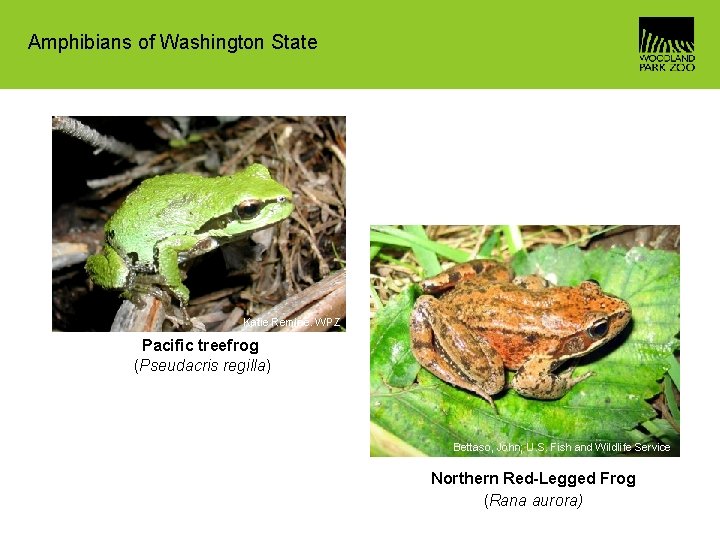
Amphibians of Washington State Katie Remine. WPZ Pacific treefrog (Pseudacris regilla) Bettaso, John; U. S. Fish and Wildlife Service Northern Red-Legged Frog (Rana aurora)
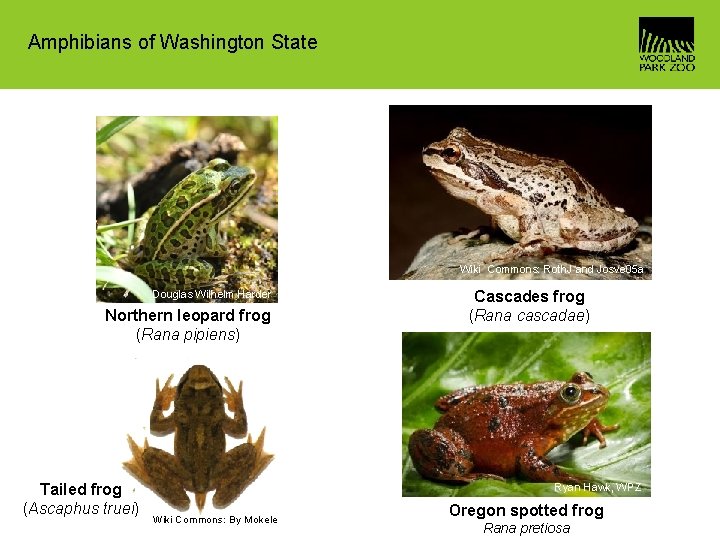
Amphibians of Washington State Wiki Commons: Roth. J and Josve 05 a Douglas Wilhelm Harder Northern leopard frog (Rana pipiens) Tailed frog (Ascaphus truei) Cascades frog (Rana cascadae) Ryan Hawk, WPZ Wiki Commons: By Mokele Oregon spotted frog Rana pretiosa
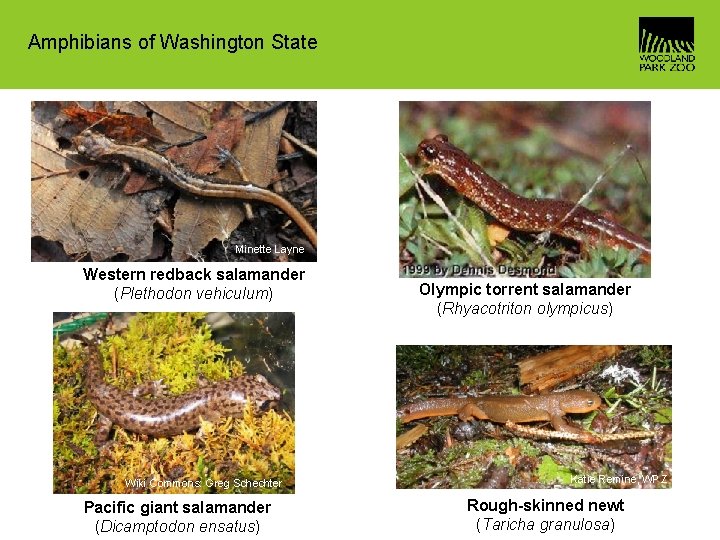
Amphibians of Washington State Minette Layne Western redback salamander (Plethodon vehiculum) Wiki Commons: Greg Schechter Pacific giant salamander (Dicamptodon ensatus) Olympic torrent salamander (Rhyacotriton olympicus) Katie Remine, WPZ Rough-skinned newt (Taricha granulosa)
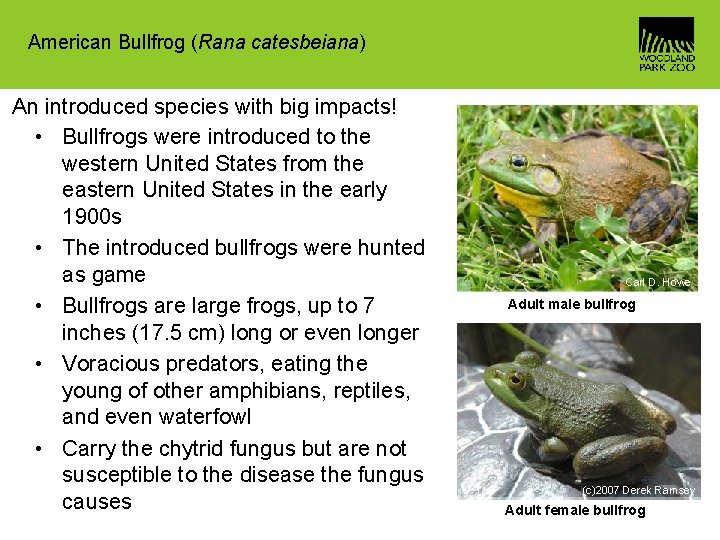
American Bullfrog (Rana catesbeiana) An introduced species with big impacts! • Bullfrogs were introduced to the western United States from the eastern United States in the early 1900 s • The introduced bullfrogs were hunted as game • Bullfrogs are large frogs, up to 7 inches (17. 5 cm) long or even longer • Voracious predators, eating the young of other amphibians, reptiles, and even waterfowl • Carry the chytrid fungus but are not susceptible to the disease the fungus causes Carl D. Howe Adult male bullfrog (c)2007 Derek Ramsey Adult female bullfrog
The roles of amphibians in ecosystems • Frog and toad larvae feed on organic debris and algae contributing to the breakdown of organic matter and controlling algae growth. • Amphibians eat large numbers of invertebrates and provide an important step in the transfer of energy up the food chain. • Although we don’t see them, amphibians can be very densely distributed in habitats (especially salamanders in the temperate forests of the Pacific Northwest). • Amphibians are a major food source for many freshwater fish. Jeremy Dwyer-Lindgren. WPZ
Amphibians as indicators of ecosystem health • aquatic and terrestrial life stages • permeable skin and eggs • susceptible to cold and desiccation (drying out) • food habits (tadpoles feed on algae and plants, other amphibians are carnivorous) − chemicals can accumulate at the surface and on the bottom of wetlands − toxins can “biomagnify” as they are passed up the food chain in the fat tissue of animals Jeremy Dwyer-Lindgren. WPZ
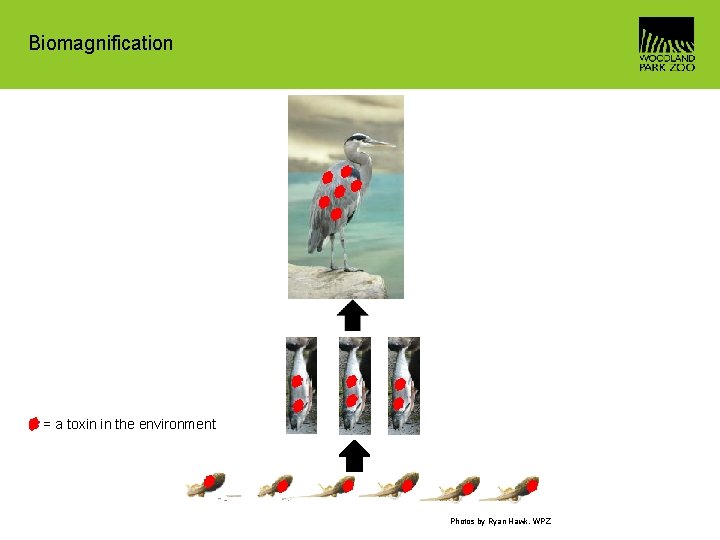
Biomagnification = a toxin in the environment Photos by Ryan Hawk, WPZ
Amphibian Population Decline • Habitat destruction (of wetlands and forests) has been a major factor in the decline of many species. However, worldwide declines have also been documented in populations inhabiting areas not directly affected by human activity. • Not one factor has been singled out as “the” cause of recent declines in amphibian populations. However, a disease caused by a chytrid fungus has been implicated in numerous declines across the globe. Contributing factors include: − introduced species − global climate change (including increased UV-B radiation) − diseases and pathogens (esp. chytrid fungus) − environmental toxins, such as pesticides Some of these factors also result in malformations of amphibians.
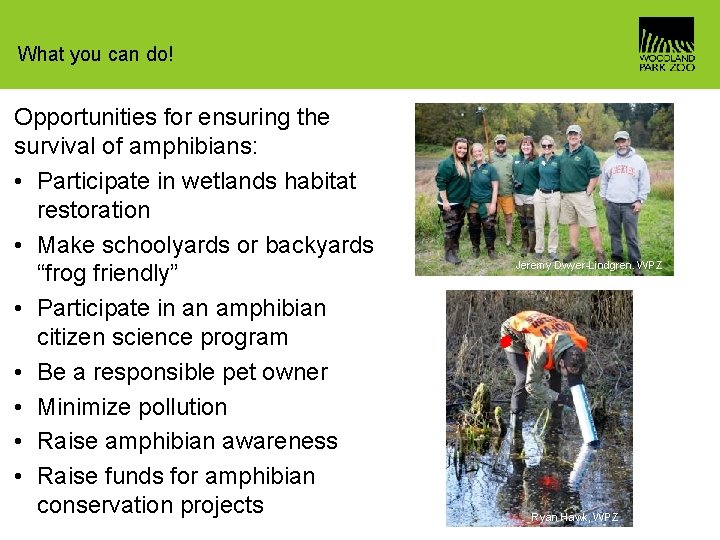
What you can do! Opportunities for ensuring the survival of amphibians: • Participate in wetlands habitat restoration • Make schoolyards or backyards “frog friendly” • Participate in an amphibian citizen science program • Be a responsible pet owner • Minimize pollution • Raise amphibian awareness • Raise funds for amphibian conservation projects Jeremy Dwyer-Lindgren. WPZ Ryan Hawk, WPZ
Photo Credits Woodland Park Zoo Photos Red-eyed treefrog, Oregon spotted frog larva (tadpole), axolotl, blue poison dart frog, green and black poison dart frog, tomato frog, Oregon spotted frog, great blue heron, salmon, amphibian monitoring – Ryan Hawk, WPZ Pacific treefrog – Katie Remine, WPZ Rough-skinned newt – Katie Remine and Margaret White, WPZ Slide background photos and amphibian release photos - Jeremy Dwyer-Lindgren, WPZ Waxy monkey treefrog – Dennis Dow, WPZ All WPZ photos property of Woodland Park Zoo. All rights reserved. All Other Photos Oregon Slender Salamander – Wiki Commons: Eugene Van Der Pill Pacific Giant Salamander – Wiki Commons: Greg Schechter Long-toed salamander- Wiki Commons: Thompsma Amphibian eggs - Tarquin at the English language Wikipedia Rough-skinned newt – Wiki Commons: Jsaver 4 Mexican burrowing caecilian – Franco Andreone Great Basin Spadefoot Toad and Olympic Torrent Salamander – Dennis Desmond Northern Red-Legged frog - Bettaso, John; U. S. Fish and Wildlife Service Western Toad - Wiki Commons: Walter Siegmund Rough Skinned Newt - Wiki Commons: Jsavreb 4 Oregon ensatina - Dennis Desmond Northern Leopard Frog - Douglas Wilhelm Harder Cascades Frog - Wiki Commons: Roth. J and Josve 05 a Tailed Frog - Wiki Commons: By Mokele Western Redback Salamander - Minette Layne Adult Male Bullfrog - Carl D. Howe Adult Female Bullfrog - (c)2007 Derek Ramsey Used with permission. All rights reserved.

www. zoo. org
- Slides: 22