
Amphibian and Reptilian Anatomy and Physiology Mosby items
Amphibian and Reptilian Anatomy and Physiology Mosby items and derived items © 2008 by Mosby, Inc. , an affiliate of Elsevier Inc.

Vision Reptiles – iris made up of skeletal muscle under voluntary control Ø Pupillary light reflex: consensual reflexes usually not seen Lower lid usually more mobile than upper Mosby items and derived items © 2008 by Mosby, Inc. , an affiliate of Elsevier Inc.
Vision Some species of lizards have thin, transparent lower lids Ø Allows for a degree of vision even when lids are closed Cartilagenous pads (tarsal pads): found in lids of some reptiles Nictitans: well-developed, mobile in many reptiles Mosby items and derived items © 2008 by Mosby, Inc. , an affiliate of Elsevier Inc.
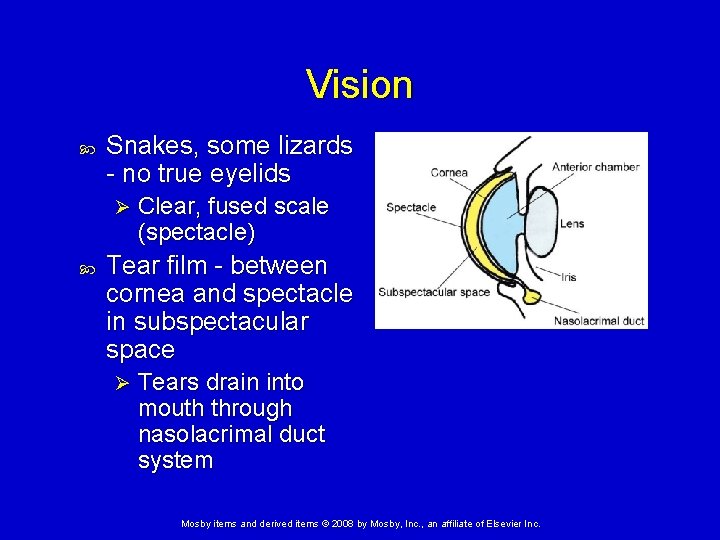
Vision Snakes, some lizards - no true eyelids Ø Clear, fused scale (spectacle) Tear film - between cornea and spectacle in subspectacular space Ø Tears drain into mouth through nasolacrimal duct system Mosby items and derived items © 2008 by Mosby, Inc. , an affiliate of Elsevier Inc.
Vision Most reptiles - poorly developed extraocular muscles Ø Exception - chameleons; eyes move freely and independently of one another Chelonians - no nasolacrimal ducts; tears spill over the lid margin Mosby items and derived items © 2008 by Mosby, Inc. , an affiliate of Elsevier Inc.
Vision Lacrimal and harderian glands present in most reptiles and amphibians Ø Produce secretions that combine to form the tear film Eyelids absent in some aquatic species Caecilians - eyes covered with skin Amphibian eyes - often protrude ventrally into the oral cavity when animal swallowing Mosby items and derived items © 2008 by Mosby, Inc. , an affiliate of Elsevier Inc.
Vision Ossicles: scleral bones present in most reptiles (except snakes and crocodilians) Lens: more fluid in reptiles than mammals (more rigid in snakes) Accommodation Chelonians - lens is squeezed through the pupil Ø Snakes - lens moves back and forth due to pressure changes within the aqueous and vitreous humors Ø Mosby items and derived items © 2008 by Mosby, Inc. , an affiliate of Elsevier Inc.
Vision Reptiles - avascular retinas Nutrition and waste removal via choroidal vessels in vitreous Ø Conus papillaris: in lizards, extends into vitreous from optic disc Ø • provides nutrition and waste removal Crocodilians have a tapetum Parietal eye - found in some reptiles Rudimentary retina and cornea, no iris, lids, or musculature Ø Exact function unknown Ø May play a role in light-cycle-mediated hormone function Ø Mosby items and derived items © 2008 by Mosby, Inc. , an affiliate of Elsevier Inc.
Hearing Ears - both sides of head, usually caudal to eyes Tympanum - may lie in depression and/or be covered by folds of skin (some lizards and crocodilians) Columella - single bone in middle ear of reptiles Connects to tympanum and quadrate bone Ø Transmits vibrations to oval window of cochlea Ø Converted to nerve impulses and transmitted to the brain via the vestibulocochlear nerve Ø Mosby items and derived items © 2008 by Mosby, Inc. , an affiliate of Elsevier Inc.
Hearing Semicircular canals control balance and equilibrium (reptiles) Snakes - no external ears; columella articulates with quadrate bone Allows snakes to be very sensitive to ground vibrations transmitted through the mandibles Ø Snakes also able to hear aerial sounds Ø Salamanders and caecilians - no tympanic membranes; columella may be degenerate Mosby items and derived items © 2008 by Mosby, Inc. , an affiliate of Elsevier Inc.

Feeding Strategies Carnivorous, omnivorous and herbivorous reptiles all exist Snakes, crocodilians, and adult amphibians are strict carnivores Some diets are very specialized Mosby items and derived items © 2008 by Mosby, Inc. , an affiliate of Elsevier Inc.
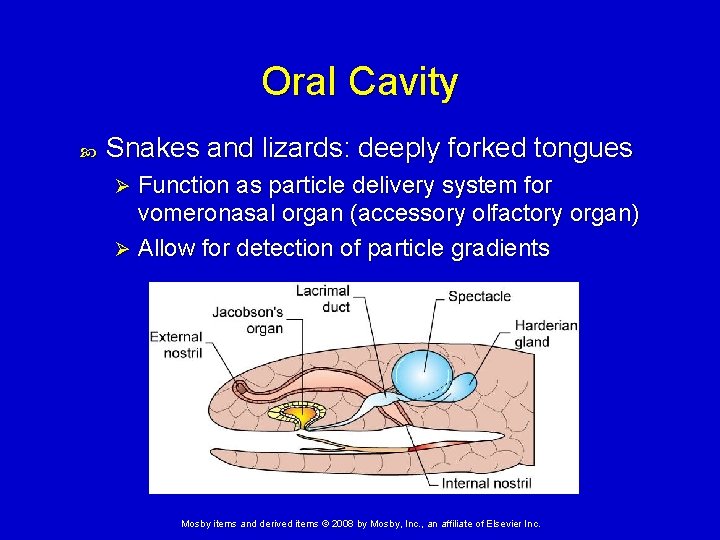
Oral Cavity Snakes and lizards: deeply forked tongues Function as particle delivery system for vomeronasal organ (accessory olfactory organ) Ø Allow for detection of particle gradients Ø Mosby items and derived items © 2008 by Mosby, Inc. , an affiliate of Elsevier Inc.
Oral Cavity Chameleons: specialized projectile tongues designed for capturing prey from long distances Ø Sticky end which the prey items stick to Turtles and tortoises: typically thick, fleshy, relatively immobile tongues Mosby items and derived items © 2008 by Mosby, Inc. , an affiliate of Elsevier Inc.
Oral Cavity Crocodilians: immobile tongue attached to intermandibular space Ø Muscular flaps from base of tongue and dorsal pharynx allow for opening of mouth while submerged without ingesting or inhaling water Mosby items and derived items © 2008 by Mosby, Inc. , an affiliate of Elsevier Inc.
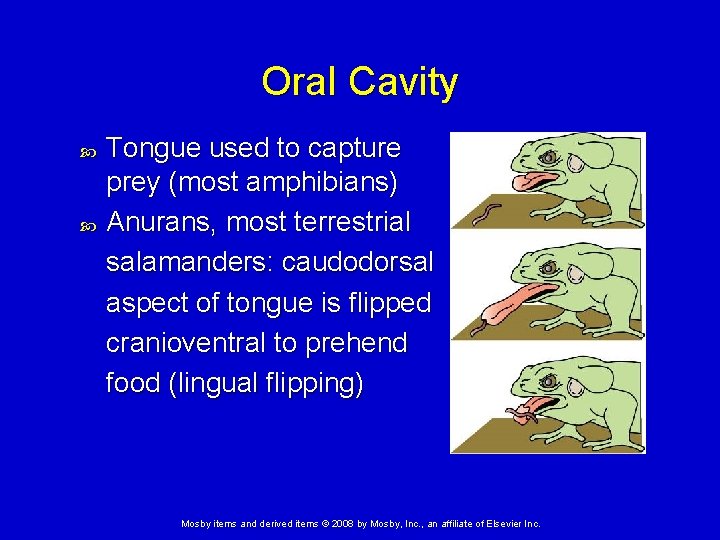
Oral Cavity Tongue used to capture prey (most amphibians) Anurans, most terrestrial salamanders: caudodorsal aspect of tongue is flipped cranioventral to prehend food (lingual flipping) Mosby items and derived items © 2008 by Mosby, Inc. , an affiliate of Elsevier Inc.

Oral Cavity Numerous salivary glands Salivary secretions provide lubrication that aids in ingestion of large prey Ø Also has enzymatic properties Venom glands (some snakes, lizards) modified salivary gland Mosby items and derived items © 2008 by Mosby, Inc. , an affiliate of Elsevier Inc.
Dentition Turtles and tortoises No teeth Tomia (keratinized beaks) Other reptiles: 3 types of dentition Mosby items and derived items © 2008 by Mosby, Inc. , an affiliate of Elsevier Inc.
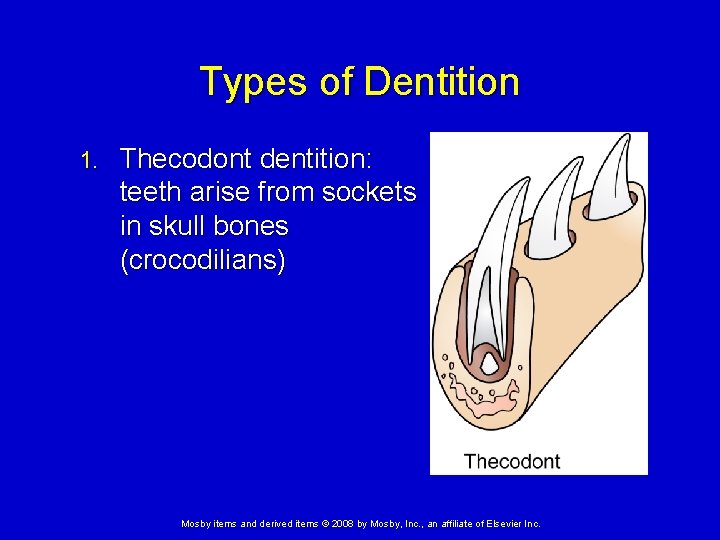
Types of Dentition 1. Thecodont dentition: teeth arise from sockets in skull bones (crocodilians) Mosby items and derived items © 2008 by Mosby, Inc. , an affiliate of Elsevier Inc.
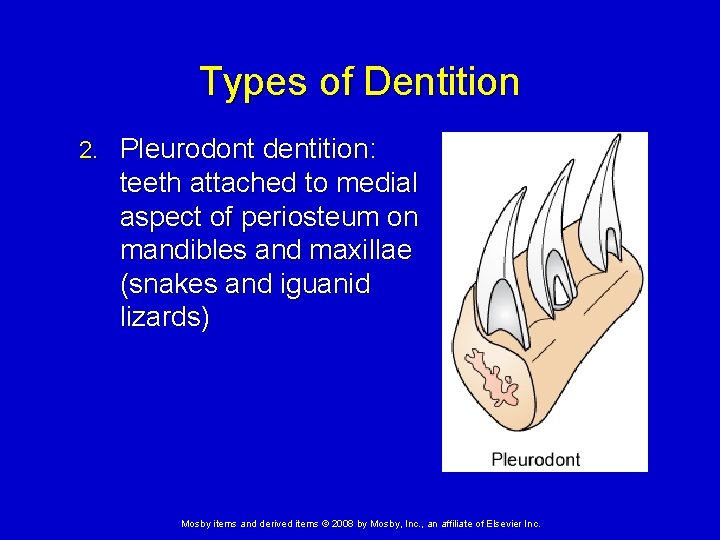
Types of Dentition 2. Pleurodont dentition: teeth attached to medial aspect of periosteum on mandibles and maxillae (snakes and iguanid lizards) Mosby items and derived items © 2008 by Mosby, Inc. , an affiliate of Elsevier Inc.
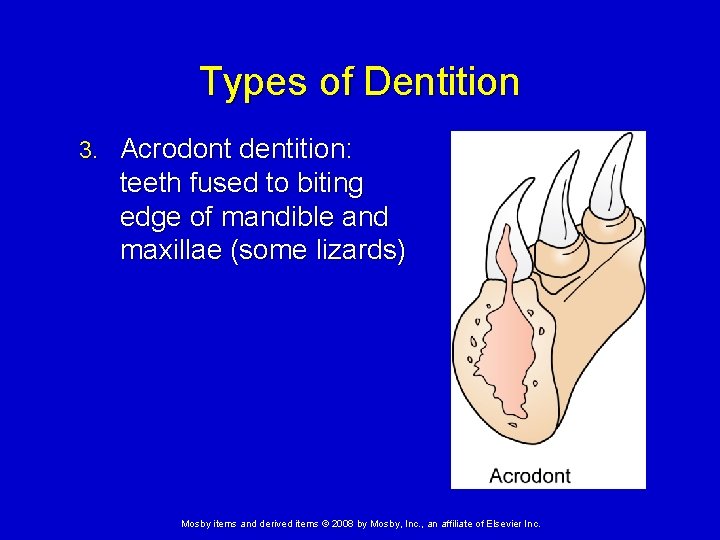
Types of Dentition 3. Acrodont dentition: teeth fused to biting edge of mandible and maxillae (some lizards) Mosby items and derived items © 2008 by Mosby, Inc. , an affiliate of Elsevier Inc.

Dentition Snakes have 6 rows of teeth: two mandibular, two maxillary, two on palantine/pterygoid bones Aglyphous snakes lack fangs Mosby items and derived items © 2008 by Mosby, Inc. , an affiliate of Elsevier Inc.

Dentition Venomous snakes - specialized dentition for venom delivery Proteroglyphous and opisthoglyphous fangs are fixed upright Solenoglyphous - fangs are folded on roof of mouth when mouth is closed and are erect when snake bites Mosby items and derived items © 2008 by Mosby, Inc. , an affiliate of Elsevier Inc.
Dentition Venom-delivering teeth: hollow with an opening near end where venom expelled Fangs receive venom through a duct from venom gland at its base Contraction of muscles around venom gland forces venom out through the fang Snakes can control amount of venom delivered with each bite Mosby items and derived items © 2008 by Mosby, Inc. , an affiliate of Elsevier Inc.
Dentition Most amphibians have teeth Caecilians and salamanders - both maxillary and mandibular teeth Ø Palatal teeth in some species Maxillary dentition present in some anuran species Odontoid process: cutting plates on rostral mandibles of some frogs Mosby items and derived items © 2008 by Mosby, Inc. , an affiliate of Elsevier Inc.
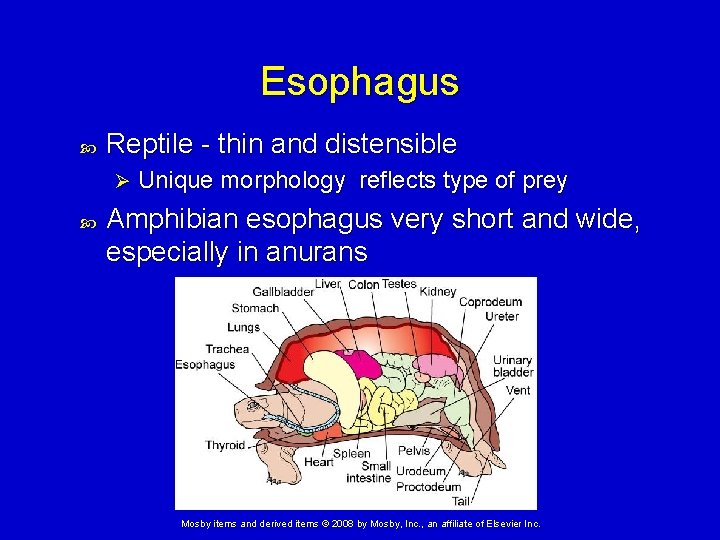
Esophagus Reptile - thin and distensible Ø Unique morphology reflects type of prey Amphibian esophagus very short and wide, especially in anurans Mosby items and derived items © 2008 by Mosby, Inc. , an affiliate of Elsevier Inc.
Stomach Reptile - variable size and shape Snakes - highly distensible Ø Crocodilians - thick muscle comparable to avian gizzard Ø Amphibian - anurans capable of prolapsing stomach through the mouth; gastric prolapse is a terminal event in dying animals Mosby items and derived items © 2008 by Mosby, Inc. , an affiliate of Elsevier Inc.
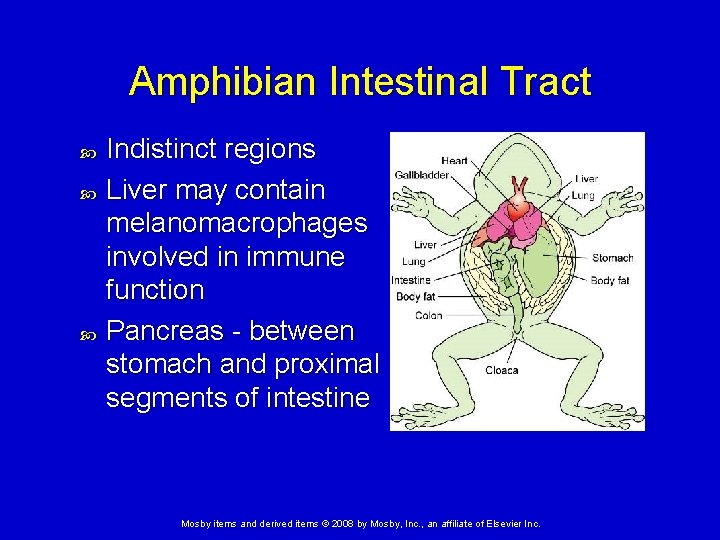
Amphibian Intestinal Tract Indistinct regions Liver may contain melanomacrophages involved in immune function Pancreas - between stomach and proximal segments of intestine Mosby items and derived items © 2008 by Mosby, Inc. , an affiliate of Elsevier Inc.
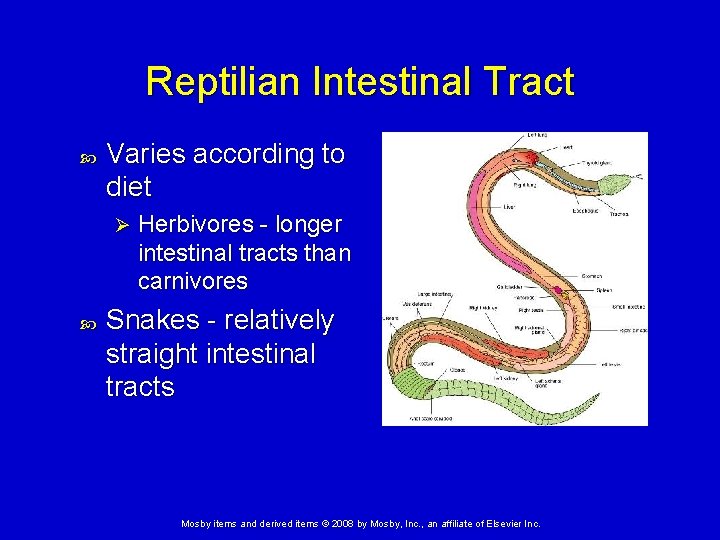
Reptilian Intestinal Tract Varies according to diet Ø Herbivores - longer intestinal tracts than carnivores Snakes - relatively straight intestinal tracts Mosby items and derived items © 2008 by Mosby, Inc. , an affiliate of Elsevier Inc.
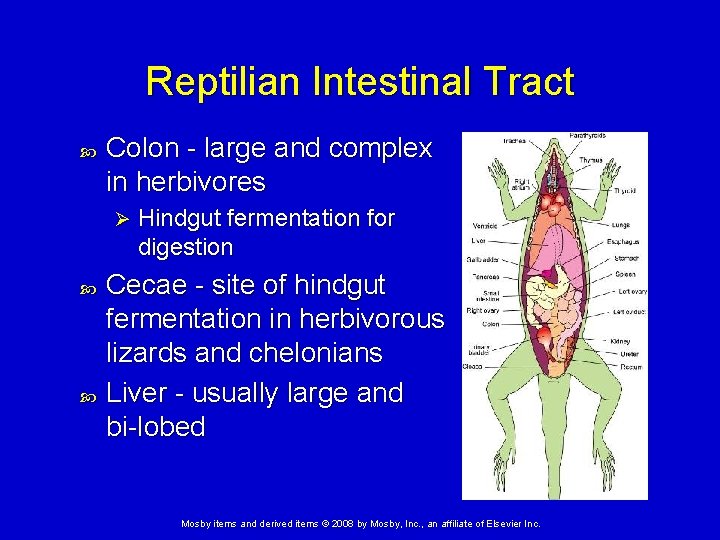
Reptilian Intestinal Tract Colon - large and complex in herbivores Ø Hindgut fermentation for digestion Cecae - site of hindgut fermentation in herbivorous lizards and chelonians Liver - usually large and bi-lobed Mosby items and derived items © 2008 by Mosby, Inc. , an affiliate of Elsevier Inc.
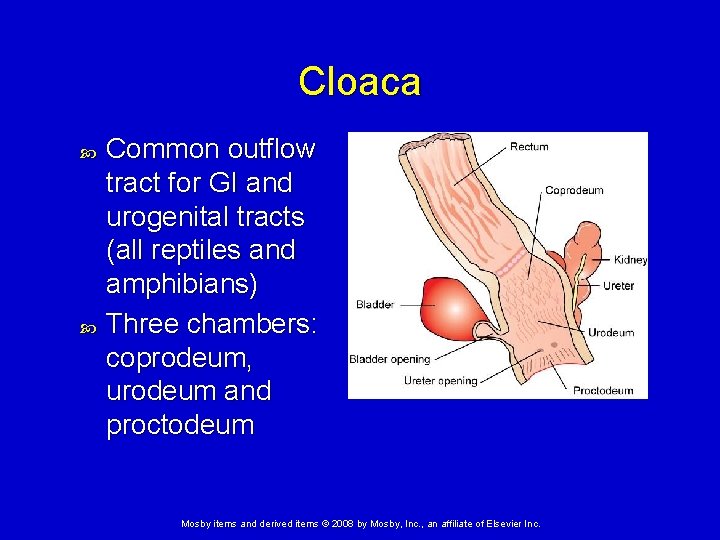
Cloaca Common outflow tract for GI and urogenital tracts (all reptiles and amphibians) Three chambers: coprodeum, urodeum and proctodeum Mosby items and derived items © 2008 by Mosby, Inc. , an affiliate of Elsevier Inc.

Reptile Kidney Usually oblong and smooth-surfaced Snakes - kidneys that are lobulated Ureters empty into dorsolateral aspects of the urodeum Ø Some species do not have urinary bladders Mosby items and derived items © 2008 by Mosby, Inc. , an affiliate of Elsevier Inc.

Reptile Kidney No distinct renal pelvis Distal collecting tubules join into collecting ducts that merge to form the ureter No loop of Henle present Not able to concentrate urine as mammals do Water can be absorbed from urine through wall of the urinary bladder, rectum, or cloaca Mosby items and derived items © 2008 by Mosby, Inc. , an affiliate of Elsevier Inc.
Amphibian Kidney Nephrostomes - connect the coelomic cavity to the renal tubules; filter blood and coelomic fluid Kidneys usually lobulated and in caudodorsal coelomic cavity Mosby items and derived items © 2008 by Mosby, Inc. , an affiliate of Elsevier Inc.
Amphibian Kidney Some amphibians excrete ammonia as a nitrogenous waste product; others excrete urea, some excrete uric acid No ability to concentrate urine Urinary bladders and cloacal anatomy similar to reptiles Mosby items and derived items © 2008 by Mosby, Inc. , an affiliate of Elsevier Inc.

Reptile Reproductive System Males have internal testes located in dorsal coelomic cavity Ductus deferens leads from testes to dorsal wall of the urodeum Most also have a sexual portion to the kidney tubules Develops in response to high levels of circulating sex hormones Ø Probably provide secretions that contribute to the seminal fluid Ø Mosby items and derived items © 2008 by Mosby, Inc. , an affiliate of Elsevier Inc.
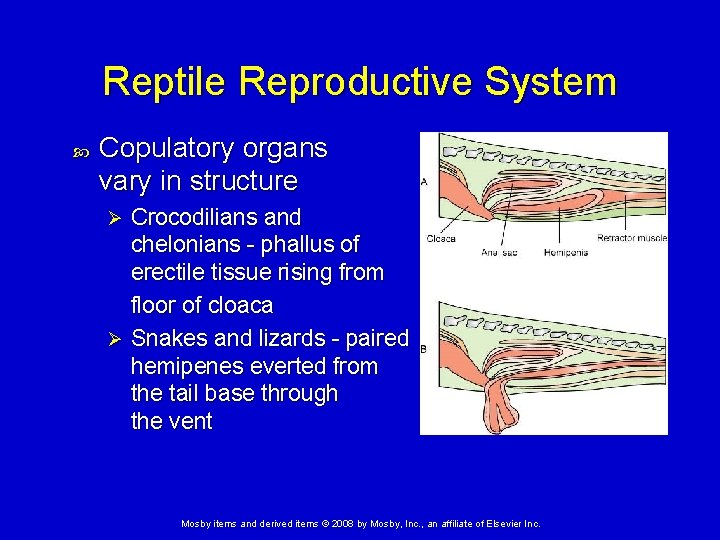
Reptile Reproductive System Copulatory organs vary in structure Crocodilians and chelonians - phallus of erectile tissue rising from floor of cloaca Ø Snakes and lizards - paired hemipenes everted from the tail base through the vent Ø Mosby items and derived items © 2008 by Mosby, Inc. , an affiliate of Elsevier Inc.
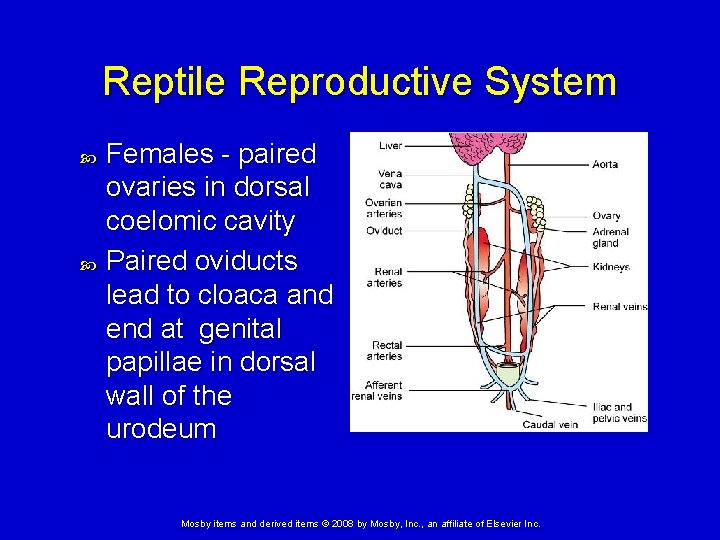
Reptile Reproductive System Females - paired ovaries in dorsal coelomic cavity Paired oviducts lead to cloaca and end at genital papillae in dorsal wall of the urodeum Mosby items and derived items © 2008 by Mosby, Inc. , an affiliate of Elsevier Inc.
Reptile Reproductive System Oviducts - 5 regions: infundibulum, magnum, isthmus, uterus, and vagina Albumin and shell - in oviparous species, added to ova in the oviduct prior to egg laying In viviparous species, fetuses are retained in uterine portion of oviduct Mosby items and derived items © 2008 by Mosby, Inc. , an affiliate of Elsevier Inc.

Reptile Reproductive Cycle Vitellogenesis - development and maturation of the follicles Ø Vitellogenin - lipid substance added to yolk within developing follicle Ø Triggered by environmental cues that stimulate release of FSH and estrogen Large amounts of calcium are also added In viviparous reptiles - some support of fetus Ø Some lizards have true placentas Mosby items and derived items © 2008 by Mosby, Inc. , an affiliate of Elsevier Inc.
Reptile Reproductive Cycle Oviposition - many reptiles dig nests to lay eggs Ø Without suitable nesting material, female may experience dystocia Chelonians and lizard species may excavate deep holes to deposit eggs Mosby items and derived items © 2008 by Mosby, Inc. , an affiliate of Elsevier Inc.
Reptile Reproductive Cycle After oviposition or parturition, reptiles not involved with care of eggs or offspring Exceptions - crocodilians protect their nests and young for a period of time following hatching Ø Pythons and cobras - protect their nests until hatching Ø Mosby items and derived items © 2008 by Mosby, Inc. , an affiliate of Elsevier Inc.
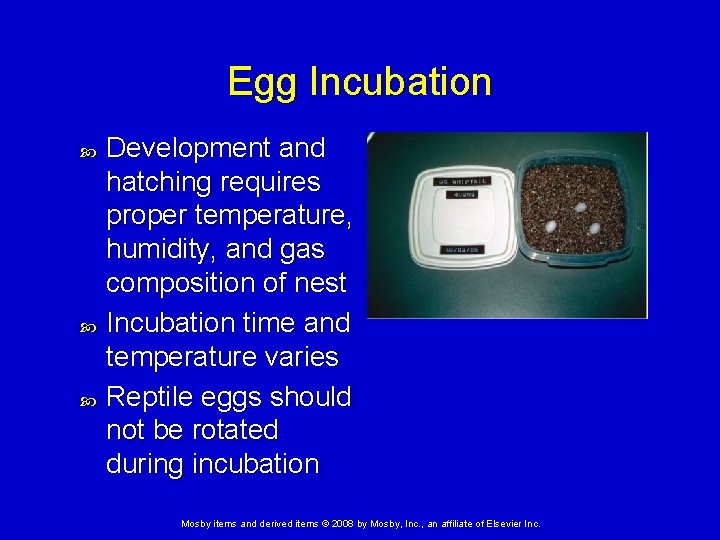
Egg Incubation Development and hatching requires proper temperature, humidity, and gas composition of nest Incubation time and temperature varies Reptile eggs should not be rotated during incubation Mosby items and derived items © 2008 by Mosby, Inc. , an affiliate of Elsevier Inc.
Sex Determination in Reptiles Determined by genotype or temperature at which eggs are incubated Sex chromosomes: Ø Females are heterozygous (ZW) and males are homozygous (ZZ) Mosby items and derived items © 2008 by Mosby, Inc. , an affiliate of Elsevier Inc.
Sex Determination in Reptiles Some species do not have sex chromosomes Higher incubation temperatures produce males in crocodilians and lizards Ø Opposite occurs in chelonians Ø Temperature range within the nest allows for production of a mixed clutch of hatchlings Ø Mosby items and derived items © 2008 by Mosby, Inc. , an affiliate of Elsevier Inc.
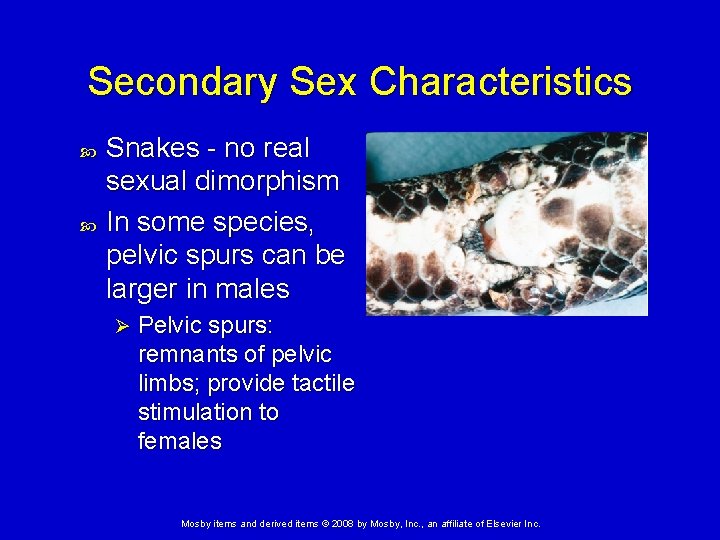
Secondary Sex Characteristics Snakes - no real sexual dimorphism In some species, pelvic spurs can be larger in males Ø Pelvic spurs: remnants of pelvic limbs; provide tactile stimulation to females Mosby items and derived items © 2008 by Mosby, Inc. , an affiliate of Elsevier Inc.
Secondary Sex Characteristics Male chelonians may have concave plastron and more distally located vent Ø Allows closer apposition of the cloacas when the male mounts the female Some lizards show obvious dimorphism Ø Example: male Jackson’s chameleon has three well-developed horns on its face Mosby items and derived items © 2008 by Mosby, Inc. , an affiliate of Elsevier Inc.
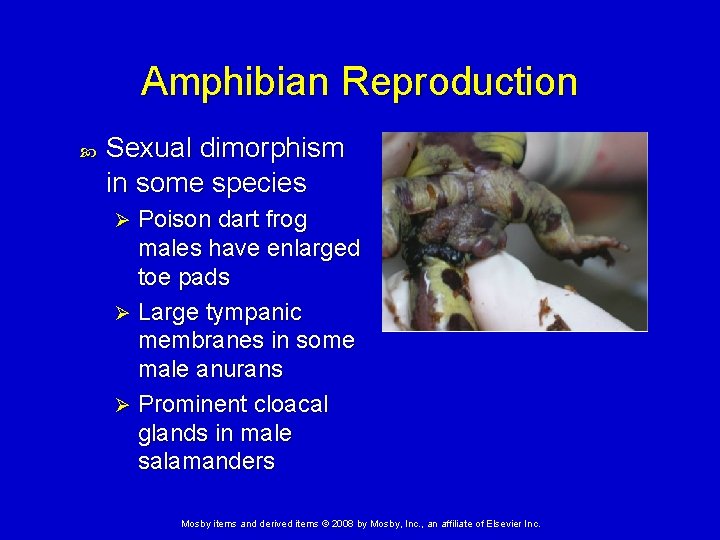
Amphibian Reproduction Sexual dimorphism in some species Poison dart frog males have enlarged toe pads Ø Large tympanic membranes in some male anurans Ø Prominent cloacal glands in male salamanders Ø Mosby items and derived items © 2008 by Mosby, Inc. , an affiliate of Elsevier Inc.
Amphibian Reproduction Paired gonads in dorsocaudal coelomic cavity Bidder’s organs - ovarian remnants near testes in male toads Most caecilians are viviparous Most anurans and salamanders are oviparous Amplexus - Male frogs and toads fertilize eggs as they are laid while grasping the female Mosby items and derived items © 2008 by Mosby, Inc. , an affiliate of Elsevier Inc.
Amphibian Reproduction Phallodeum - portion of cloaca in caecilians that is everted to deposit semen into female’s cloaca Spermatophores - packets of sperm deposited onto substrate by male salamanders Picked up by the female salamander’s cloaca Ø Spermatotheca - pocket in cloaca of female salamanders where sperm can be stored Ø Mosby items and derived items © 2008 by Mosby, Inc. , an affiliate of Elsevier Inc.
Amphibian Reproduction Eggs are usually deposited in or near water Some parental care of eggs and/or young in anurans and most salamanders Larval anurans (tadpoles) have completely aquatic lives prior to metamorphosis Tadpole metamorphosis - usually complete within 90 days Ø Metamorphosis is stimulated by thyroid hormones Mosby items and derived items © 2008 by Mosby, Inc. , an affiliate of Elsevier Inc.
Endocrine System Single thyroid gland (except lizard) Ø Crocodilians - bilobed thyroid has a thin isthmus between lobes Size of thyroid gland varies according to season and metabolic state Parathyroid glands and ultimobrachial bodies in cervical region Mosby items and derived items © 2008 by Mosby, Inc. , an affiliate of Elsevier Inc.
Endocrine System Adrenal glands - usually within the ligaments that suspend the gonads Produce epinephrine, norepinephrine, aldosterone, and corticosterone No distinct separation of adrenal cortex and medulla Exact location of endocrine organs in amphibians varies Mosby items and derived items © 2008 by Mosby, Inc. , an affiliate of Elsevier Inc.
Reptile Nervous System Three major divisions of reptilian brain Forebrain - olfactory lobes, cerebral hemispheres, diencephalon 2. Midbrain - optic lobes, cerebral peduncles, nerve fibers connecting forebrain and hindbrain 3. Hindbrain - cerebellum, medulla oblongata 1. No surface gyri or sulci on the brain Mosby items and derived items © 2008 by Mosby, Inc. , an affiliate of Elsevier Inc.
Reptile Nervous System Brain meninges: pia-arachnoid layer and dura mater 12 cranial nerves Depend on spinal segmental reflexes and locomotor centers for control of movement Mosby items and derived items © 2008 by Mosby, Inc. , an affiliate of Elsevier Inc.

Amphibian Nervous System Brain - well developed for basic functions (sight, olfaction, and movement) 10 cranial nerves Spinal cord extends to the tip of the tail in amphibians and caecilians; ends in lumbar region in frogs and toads Animal dependent upon spinal segmental reflexes to control movement Mosby items and derived items © 2008 by Mosby, Inc. , an affiliate of Elsevier Inc.
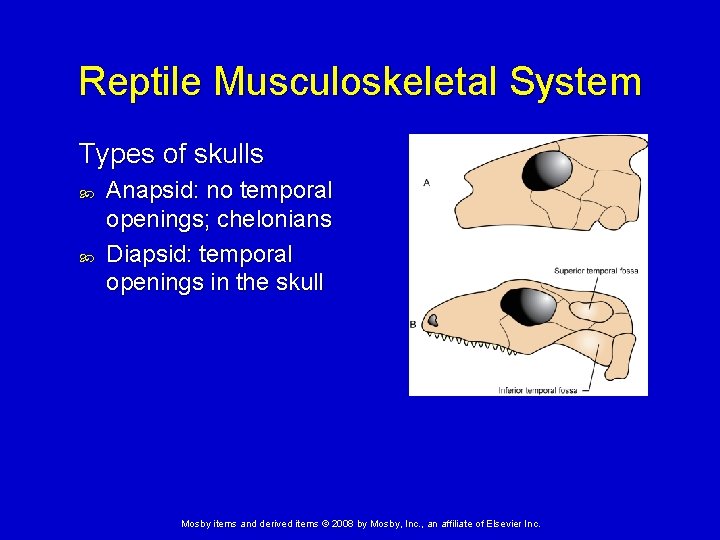
Reptile Musculoskeletal System Types of skulls Anapsid: no temporal openings; chelonians Diapsid: temporal openings in the skull Mosby items and derived items © 2008 by Mosby, Inc. , an affiliate of Elsevier Inc.
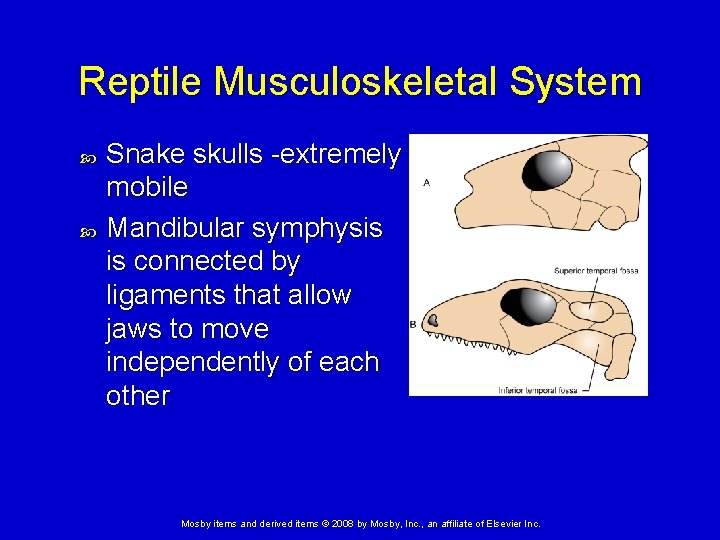
Reptile Musculoskeletal System Snake skulls -extremely mobile Mandibular symphysis is connected by ligaments that allow jaws to move independently of each other Mosby items and derived items © 2008 by Mosby, Inc. , an affiliate of Elsevier Inc.
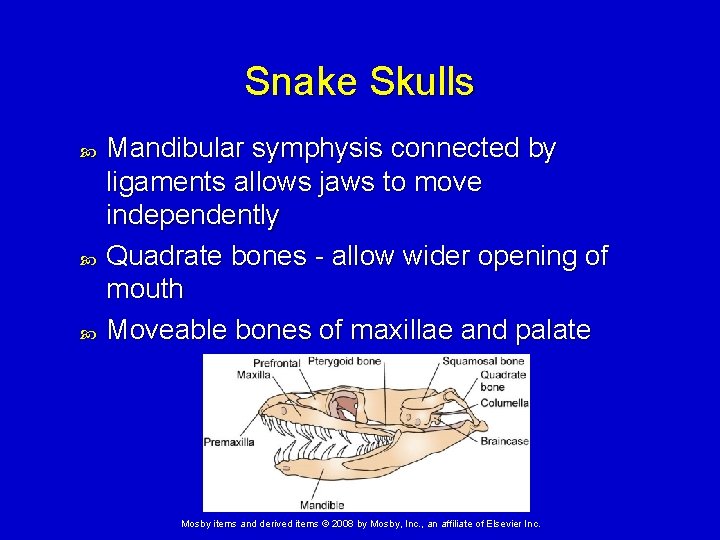
Snake Skulls Mandibular symphysis connected by ligaments allows jaws to move independently Quadrate bones - allow wider opening of mouth Moveable bones of maxillae and palate Mosby items and derived items © 2008 by Mosby, Inc. , an affiliate of Elsevier Inc.
Reptile Musculoskeletal System Spine - extremely flexible; presacral, and caudal-vertebral regions Single occipital condyle forms the articulation between skull and spine Well-developed ribs Ø Exceptions: chelonians’ spine and ribs are fused to the bony shell Mosby items and derived items © 2008 by Mosby, Inc. , an affiliate of Elsevier Inc.
Amphibian Musculoskeletal System Skulls of anurans - broad and fenestrated Parts of the skull involved with olfaction and hearing are well developed Palate - poorly developed with reduced dentition Caecilians - compact, well-ossified skulls with well-developed dentition Mosby items and derived items © 2008 by Mosby, Inc. , an affiliate of Elsevier Inc.

Amphibian Musculoskeletal System Highly variable number of vertebrae Vertebrae - no distinctions of regions Ø Anurans’ vertebrae are fused Ø Salamanders and anurans also possess sacral vertebrae Urostyle - last caudal vertebra Caecilians lack a sternum Sternum is a small cartilaginous plate in salamanders Mosby items and derived items © 2008 by Mosby, Inc. , an affiliate of Elsevier Inc.
Axial Skeleton Tail autonomy - defensive mechanism Some lizards and salamanders Ø Discarded tail usually continues to wiggle and distract predator Ø The species capable of tail autonomy have “fracture planes” along which tails break Ø Little to no blood loss Lost tail can regenerate; regenerated tail stiff and cartilaginous Mosby items and derived items © 2008 by Mosby, Inc. , an affiliate of Elsevier Inc.
Reptile Appendicular Skeleton Pectoral girdle - scapula and coracoid bone with muscular attachments to the body Pectoral limbs - humerus, radius, ulna, carpal bones, metacarpal bones, and phalanges Pelvic limb - femur, tibia, tarsal and metatarsal bones, and the phalanges Ø Usually five digits on both front and rear feet Mosby items and derived items © 2008 by Mosby, Inc. , an affiliate of Elsevier Inc.
Reptile Appendicular Skeleton Spurs - vestigial pelvic limbs of some snake species Found on either side of the vent Ø Used in courtship behavior Ø Some lizards have very reduced limbs Ø “Legless lizards” retain vestigial thoracic and pelvic limb structures Mosby items and derived items © 2008 by Mosby, Inc. , an affiliate of Elsevier Inc.
Amphibian Appendicular Skeleton Pectoral girdle - primarily cartilaginous; consists of precoracoid, coracoid and scapula Ø Pectoral limb - similar to reptile, except for radioulna (fused radius and ulna in anurans) Ø Exception - anurans’ pectoral girdle is completely ossified and consists of scapula, clavicle, and coracoid Four toes usually present on the pectoral limbs Pelvic girdle - ilium, ischium and pubis Mosby items and derived items © 2008 by Mosby, Inc. , an affiliate of Elsevier Inc.
Amphibian Appendicular Skeleton Pelvic limb - elongated and well developed for swimming and jumping Elongated metatarsal bones in anurans Ø Usually five toes are present Ø Mosby items and derived items © 2008 by Mosby, Inc. , an affiliate of Elsevier Inc.
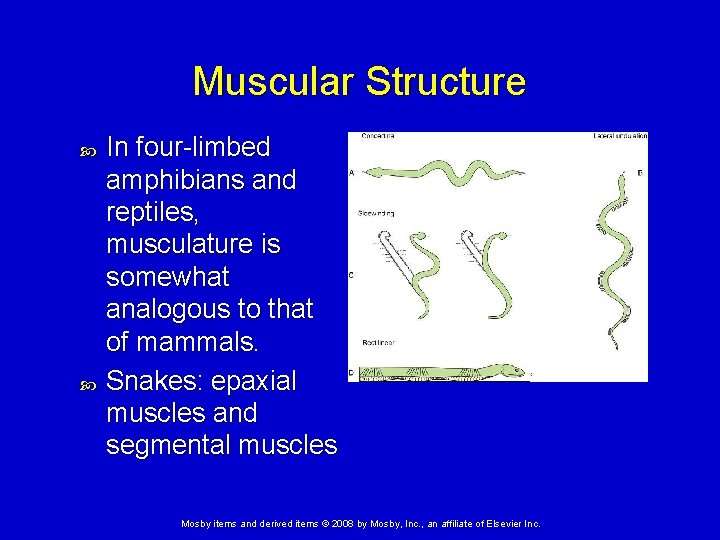
Muscular Structure In four-limbed amphibians and reptiles, musculature is somewhat analogous to that of mammals. Snakes: epaxial muscles and segmental muscles Mosby items and derived items © 2008 by Mosby, Inc. , an affiliate of Elsevier Inc.
- Slides: 67