
Amos Paran UCL Institute of Education a paranucl



- Slides: 44
Amos Paran UCL Institute of Education a. paran@ucl. ac. uk Engaging learners with reading: the role of literary texts
Fire and Ice Some say the world will end in fire, Some say in ice. From what I’ve tasted of desire I hold with those who favor fire. But if it had to perish twice I think I know enough of hate To say that for destruction ice Is also great, And will suffice.
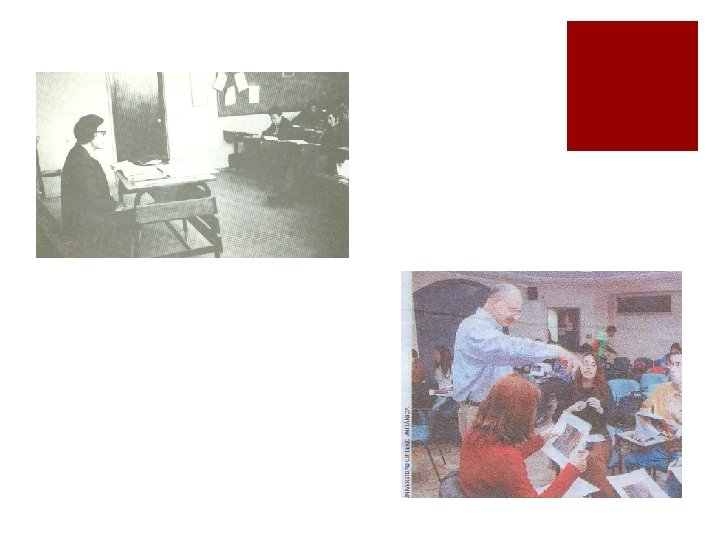
Which of the following sentences is more likely to have been actually said? ¡“I still remember your lesson on the present perfect and the diagram you drew to explain it. ” ¡“I still remember your lesson on Eveline and the diagram that you drew to show themes in the story. ”
I was digging in my archives and found the famous binding of Issac work but missing the poems and the actual question. One I was able to easily locate (The parable of the old man and the young) but the others were harder. I was wondering if you remember what they were and how the question was phrased? I am also putting through school the "shooting an elephant" booklet I also found. Such a great essay. . . (…) I think it had a major impact on my thinking. And of my views of essays in general : -). He sure knows how to write!
Why is literature important in L 2 education? ¡A literature lesson can leave a lasting impact on the learners ¡Good literature creates an affective response, thus raising motivation ¡It supports reading longer pieces – which means more exposure to the L 2 ¡It supports reading longer pieces – which means supporting the development of concentration and attention
Duncan and Paran (in preparation): Focus on assessment ¡Three case studies of three international schools in Europe: classroom observations, interviews with teachers, group interviews with students. ¡All teachers mentioned the assessment – strong washback effect … ¡… though teachers said they would teach literature even if it weren’t a requirement ¡The assessment was mentioned in the lessons as well ¡Type of instrumentality (even when style was being analysed)
‘Classroom instruction that fosters motivation, strategic development, knowledge gains and social growth can be undermined by evaluation that contradicts these instructional purposes’. Guthrie and Wigfield 2000: 415.
Learning and Knowledge Goals ‘when students believed that teachers thought that understanding the work was more important than just getting right answers, students were likely to believe in their capacity to do the hardest work’. Guthrie and Wigfield 2000: 410
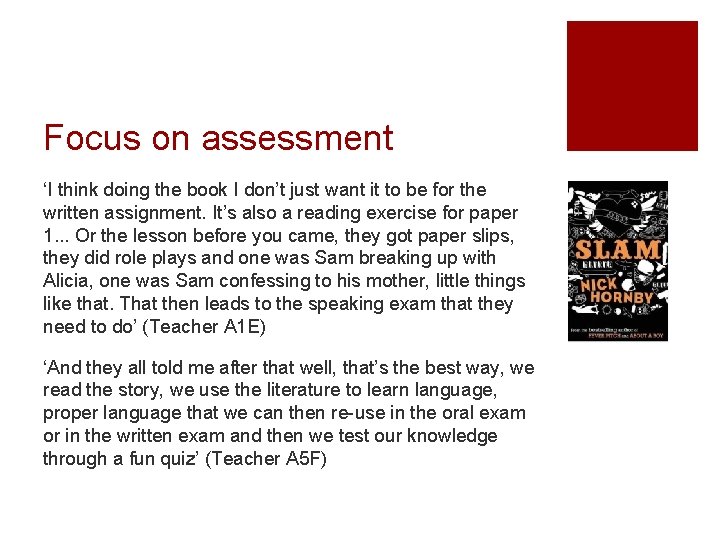
Focus on assessment ‘I think doing the book I don’t just want it to be for the written assignment. It’s also a reading exercise for paper 1. . . Or the lesson before you came, they got paper slips, they did role plays and one was Sam breaking up with Alicia, one was Sam confessing to his mother, little things like that. That then leads to the speaking exam that they need to do’ (Teacher A 1 E) ‘And they all told me after that well, that’s the best way, we read the story, we use the literature to learn language, proper language that we can then re-use in the oral exam or in the written exam and then we test our knowledge through a fun quiz’ (Teacher A 5 F)
The importance of engagement ‘Desired outcomes of teaching, such as text comprehension ability, knowledge acquisition from text, and sustainable reading practices, do not result automatically in response to instruction. These outcomes rely on engagement as a mediating process’ (Guthrie and Wigfield 2000: 415)
Principle 1: Relevance Guthrie and Wigfield 2000: ‘Interesting texts for discussion’. Relevance: an important component of ‘interesting’ ¡Which of the poems on the handout is going to be more relevant to your students? ¡Is the relevance immediate? ¡Which of these poems would you teach?
Principle 1: Relevance ¡Relevance: ¡ It connects to their lives ¡ They can see the connection ¡ The tasks that the teacher constructs bring out the relevance
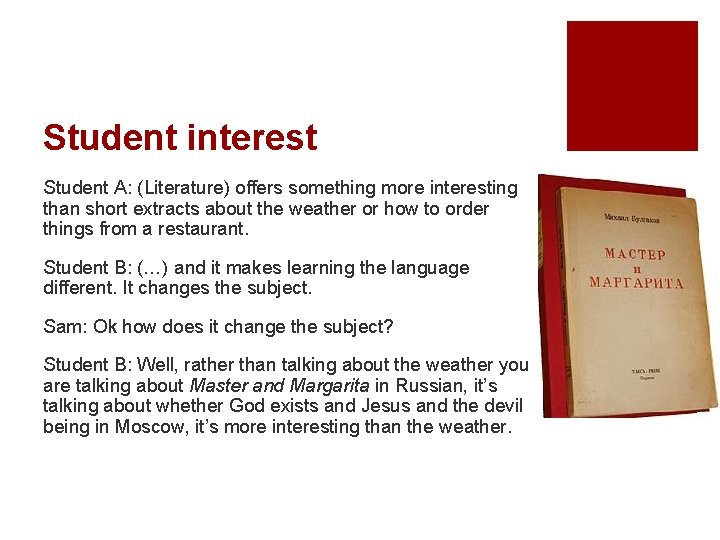
Student interest Student A: (Literature) offers something more interesting than short extracts about the weather or how to order things from a restaurant. Student B: (…) and it makes learning the language different. It changes the subject. Sam: Ok how does it change the subject? Student B: Well, rather than talking about the weather you are talking about Master and Margarita in Russian, it’s talking about whether God exists and Jesus and the devil being in Moscow, it’s more interesting than the weather.
Relevance – not preaching ¡A Summer’s Reading (Bernard Malamud) ¡Everything That Rises Must Converge (Flannery O’Connor) ¡“I actually like the minimalistic EMT approach. Just to point you in the right direction, and not stuff it down your throat as some of the things they do now at school tend to be. Oh well, I guess it's not popular anymore. ”
Principle 2: Student control/choice ¡‘teachers who enabled students to make choices about their learning and participation in instructional decisions created a classroom environment in which students were intrinsically motivated to learn the content and contributed actively to classroom activities’ (Guthrie & Wigfield 2000: 411 - 412) ¡‘As students perceive that teachers respect them enough to provide genuine choices, students increase their effort and commitment to learning’. (Guthrie & Wigfield 2000: 412)
Student control/choice ¡Students choose what they read ¡Students choose what they study ¡Students choose what they want to talk about ¡Students choose the activities they want to do
Students choosing what they read ¡An important tenet of the Extensive Reading movement ¡Choice enables learners to read at their own level rather than at a level that is too difficult for them ¡Choice enables learners to choose what interests them ¡Presupposes rich resources in the school library… ¡… but can also be achieved through a book box scheme
Students choosing what they study ¡Students read the first page of a choice of books ¡Students read a summary plot or a blurb of different books ¡Teacher brings a selection of books to class and students spend an hour looking at them and discussing them
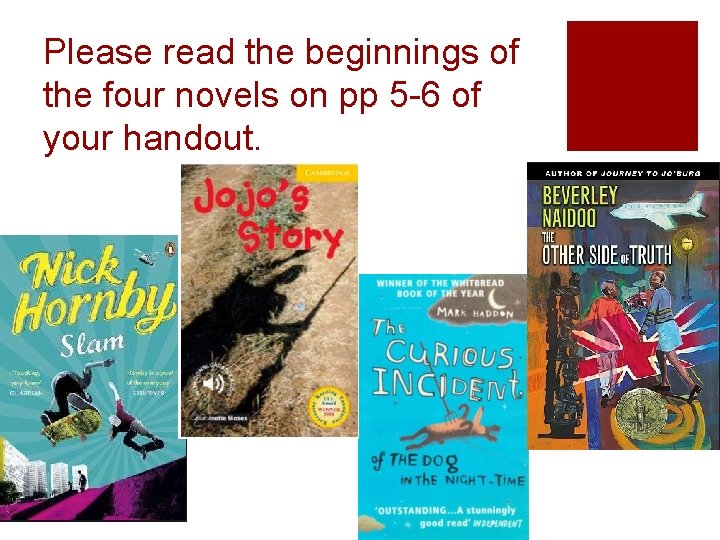
Please read the beginnings of the four novels on pp 5 -6 of your handout.
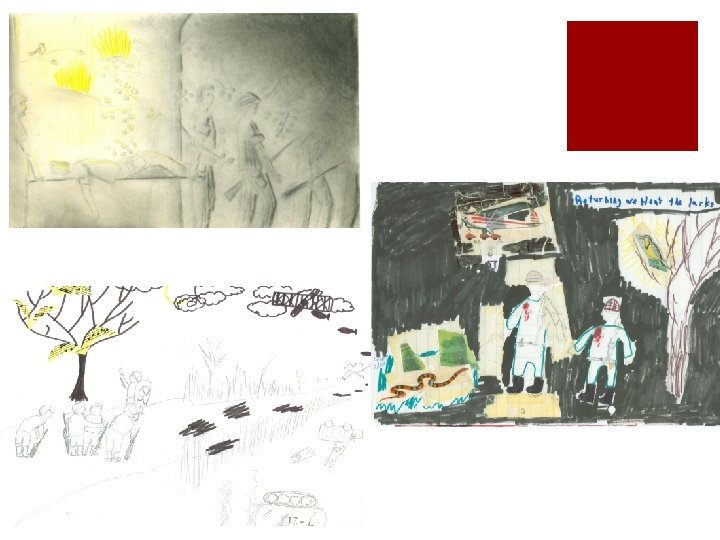
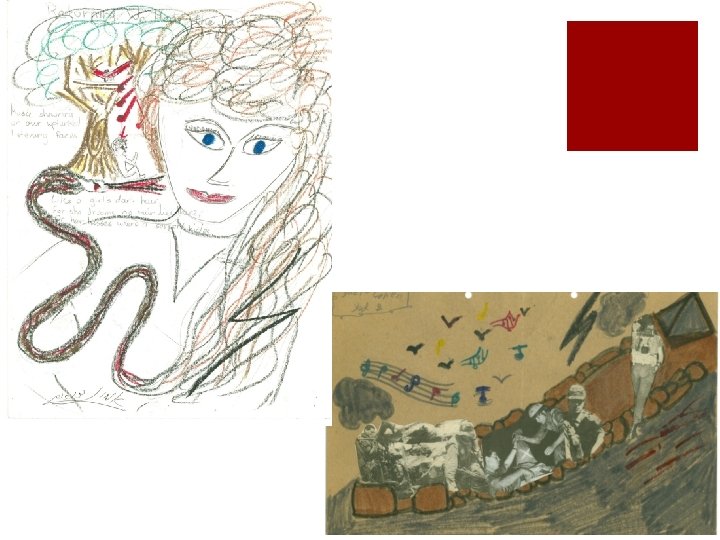
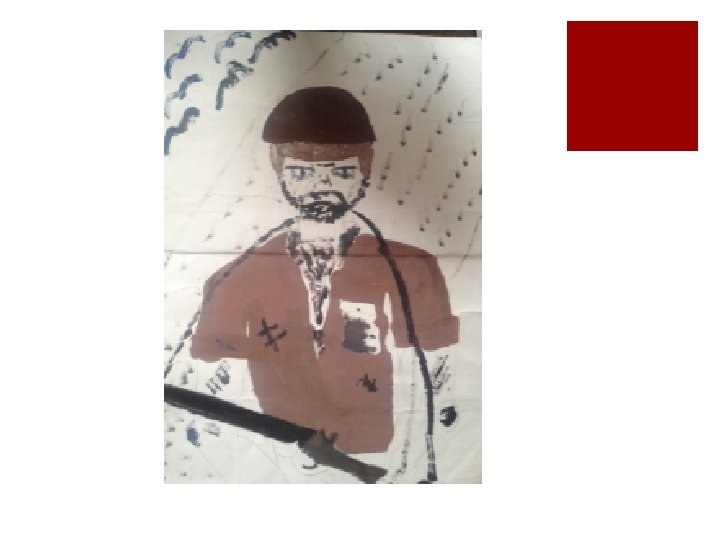
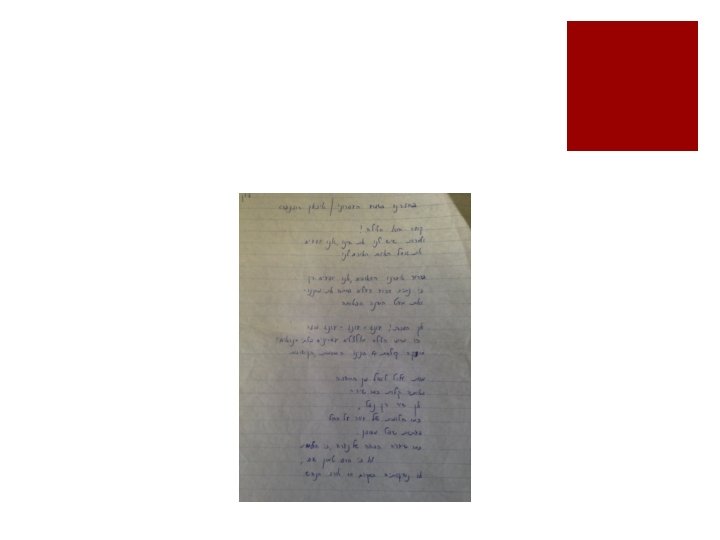
Students choose their homework ¡Illustrate the poem. ¡Translate the poem. ¡Learn the poem by heart. In a class of 40, given a choice of homework for Returning, we hear the larks, ……. translated ……. learnt by heart ……. drew or produced a collage
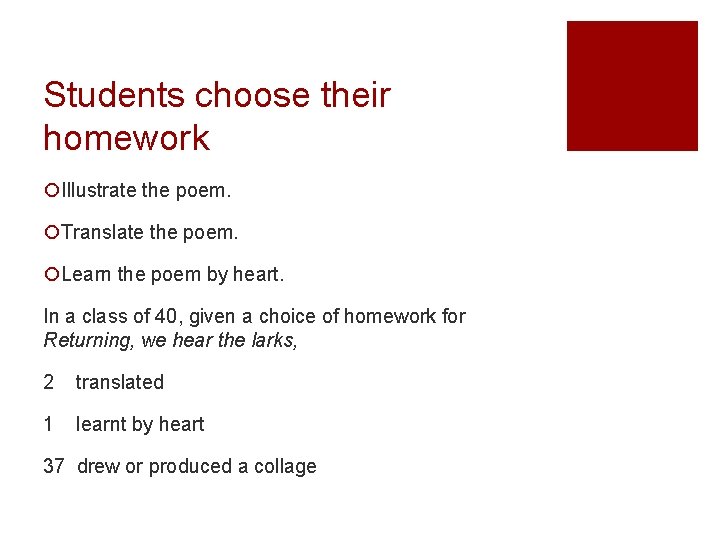
Students choose their homework ¡Illustrate the poem. ¡Translate the poem. ¡Learn the poem by heart. In a class of 40, given a choice of homework for Returning, we hear the larks, 2 translated 1 learnt by heart 37 drew or produced a collage
Students choose their homework ¡Illustrate the poem/story/chapter in the novel ¡Translate the poem/a section from the work ¡Learn the poem by heart ¡Compose music for the poem ¡Find appropriate music for the poem ¡Create a video for the poem ¡Create a powerpoint presentation for the poem ¡Write a review of the book and post it on Amazon
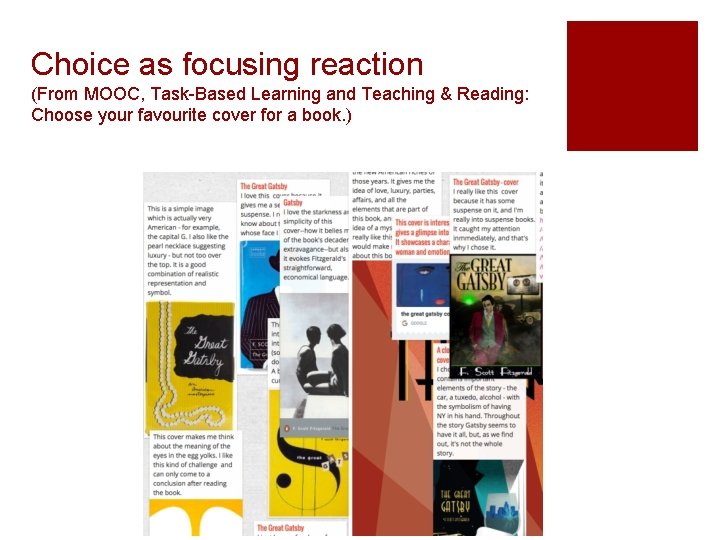
Choice as focusing reaction (From MOOC, Task-Based Learning and Teaching & Reading: Choose your favourite cover for a book. )
Padlet: Choose a cover for a book
Principle 3: Constructing appropriate tasks …. a dominating expert interrogates diminished learners about literature which they feel to be at a great distance from their lives. The teacher has studied the text and knows the right answers; the learners are reluctant participants in a negative quest for comprehension. (Tomlinson 1998)
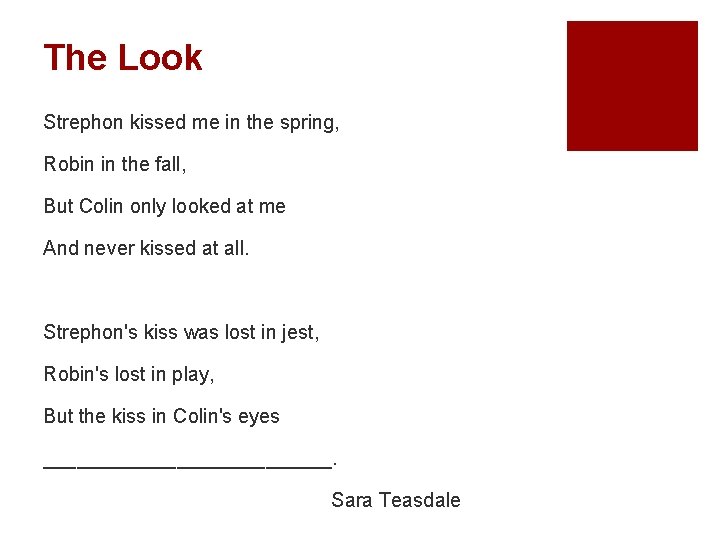
The Look Strephon kissed me in the spring, Robin in the fall, But Colin only looked at me And never kissed at all. Strephon's kiss was lost in jest, Robin's lost in play, But the kiss in Colin's eyes _____________. Sara Teasdale
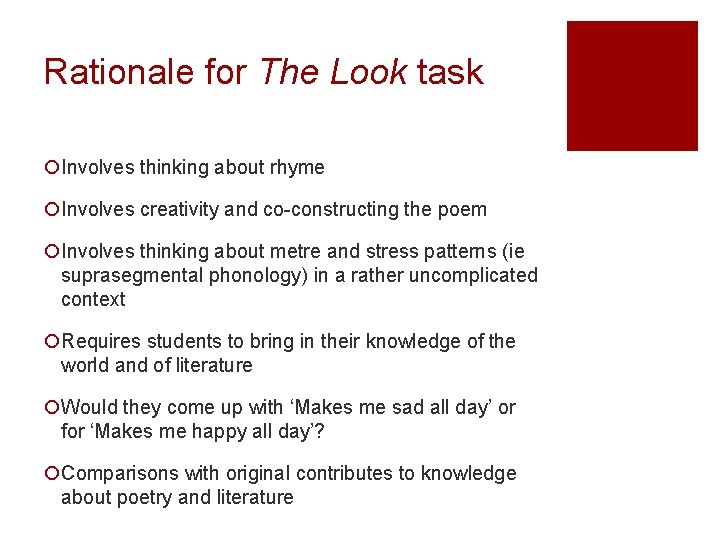
Rationale for The Look task ¡Involves thinking about rhyme ¡Involves creativity and co-constructing the poem ¡Involves thinking about metre and stress patterns (ie suprasegmental phonology) in a rather uncomplicated context ¡Requires students to bring in their knowledge of the world and of literature ¡Would they come up with ‘Makes me sad all day’ or for ‘Makes me happy all day’? ¡Comparisons with original contributes to knowledge about poetry and literature
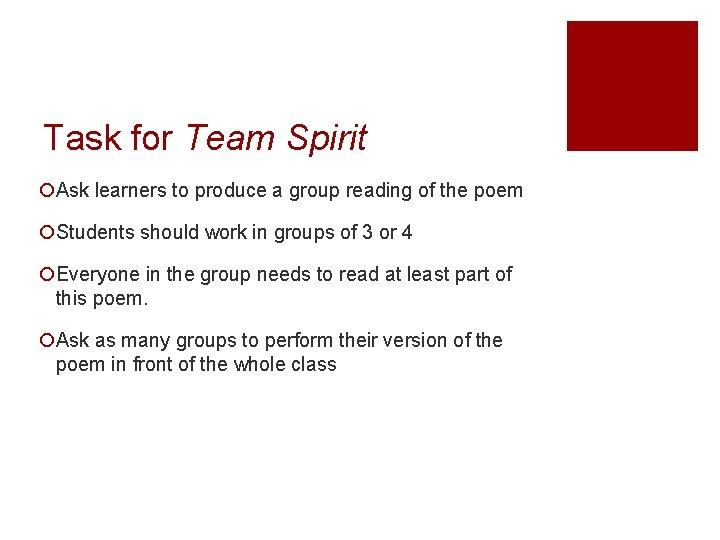
Task for Team Spirit ¡Ask learners to produce a group reading of the poem ¡Students should work in groups of 3 or 4 ¡Everyone in the group needs to read at least part of this poem. ¡Ask as many groups to perform their version of the poem in front of the whole class
Rationale for Team Spirit task It involves rehearsal and repetition It involves pronunciation work It allows students who are ‘weaker’ to do something less challenging – ie read a shorter part of the poem It allows students who are ‘weaker’ to get ‘swept along’ by the more proficient learners and learn from them Poetry is meant to be performed
Task for Day of Atonement ¡Which tasks do you think you could construct for A Day of Atonement?
Task for Day of Atonement ¡Draw the poem ¡Turn the poem into a short film/video ¡ What would the camera focus on? ¡ Why? ¡How would you rewrite the poem if it was about Ramadan? About Easter Sunday mass? What would you need to change?
Task for Day of Atonement ¡Ask students which of the following endings is better: ¡ Waiting for you to wake up ¡ Waiting for you to die Why did the poet choose the ending that she did? ¡Ask students which of the following is better: ¡ The shofar moans its last held breath…. ¡ The shofar sounds its last held breath…. ¡ The shofar trumpets its last held breath…. ¡ The shofar rings its last held breath…. Why did the poet choose the word that she did?
Principle 3: Appropriate tasks ¡Appropriate tasks are: ¡ Scaffolded ¡ Not too easy but not too challenging. ¡ Bring out the relevance of the text for the students ¡ Do not destroy the text through overinterpretation ¡ Are connected to the main idea of the text
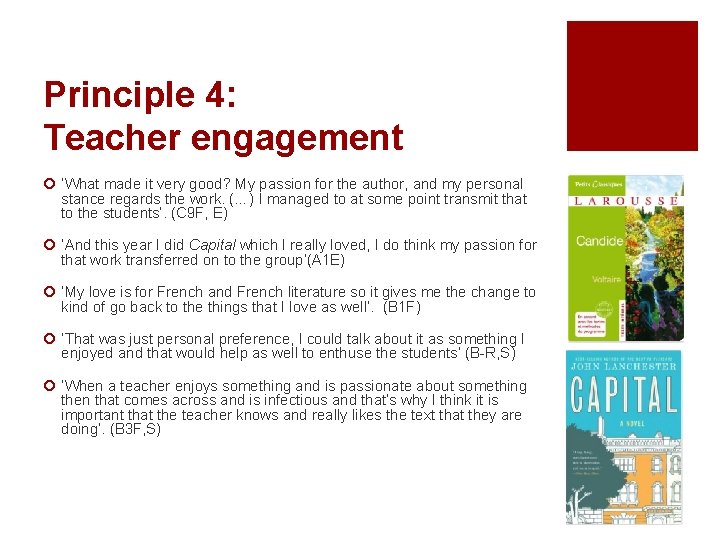
Principle 4: Teacher engagement ¡ ‘What made it very good? My passion for the author, and my personal stance regards the work. (…) I managed to at some point transmit that to the students’. (C 9 F, E) ¡ ‘And this year I did Capital which I really loved, I do think my passion for that work transferred on to the group’(A 1 E) ¡ ‘My love is for French and French literature so it gives me the change to kind of go back to the things that I love as well’. (B 1 F) ¡ ‘That was just personal preference, I could talk about it as something I enjoyed and that would help as well to enthuse the students’ (B-R, S) ¡ ‘When a teacher enjoys something and is passionate about something then that comes across and is infectious and that’s why I think it is important that the teacher knows and really likes the text that they are doing’. (B 3 F, S)
Teacher engagement does not mean a doctorate on the piece that you are teaching. It means a love of the piece that you are teaching and the wish to share that love with the students.
Principle 5: Building and Sustaining Engagement Literature and literary engagement need to run through the school year. Short poems can be focused on in 5 minutes before moving on to someone else … … or can be the focus of the last 5 -10 minutes of a class Extensive reading means reading a book every few weeks at least The message is that literature is an important part of the human experience
¡Engagement has three dimensions – cognitive; social; motivation: ‘engaged readers in the classroom or elsewhere coordinate their strategies and knowledge (cognition) within a community of literacy (social) in order to fulfill their personal goals, desires, and intentions(motivation). ’ (Guthrie and Wigfield 2000: 404)