
Amorphous Wire Localization Final Presentation May 10 2001



- Slides: 31
Amorphous Wire Localization Final Presentation May 10, 2001 Matthew Foy Richard Kao Matthias Ziegler
Hardware Project Overview • Objective – To create a system in which we can detect the amorphous wire to the highest accuracy that will allow us to test our software • Deliverables – A system that is based on 15 sensors that returns a single location of the wire
Software Overview • Expected Deliverables – Input amplitude and phase for each sensor – Compute distance from the wire to 3 separate sensor arrays – Determine the location and approximate orientation of the wire in 3 space
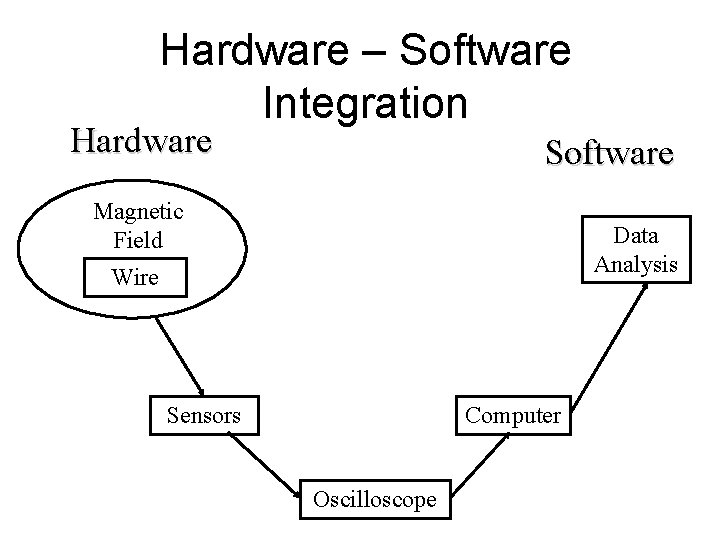
Hardware – Software Integration Hardware Software Magnetic Field Data Analysis Wire Sensors Computer Oscilloscope
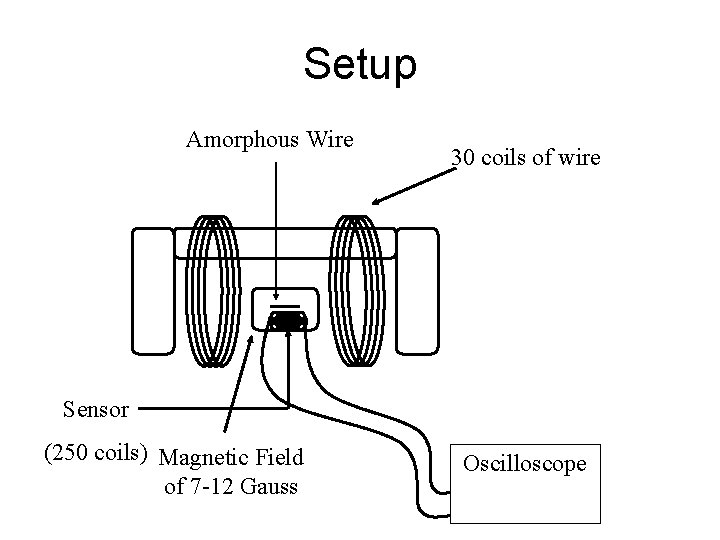
Setup Amorphous Wire 30 coils of wire Sensor (250 coils) Magnetic Field of 7 -12 Gauss Oscilloscope
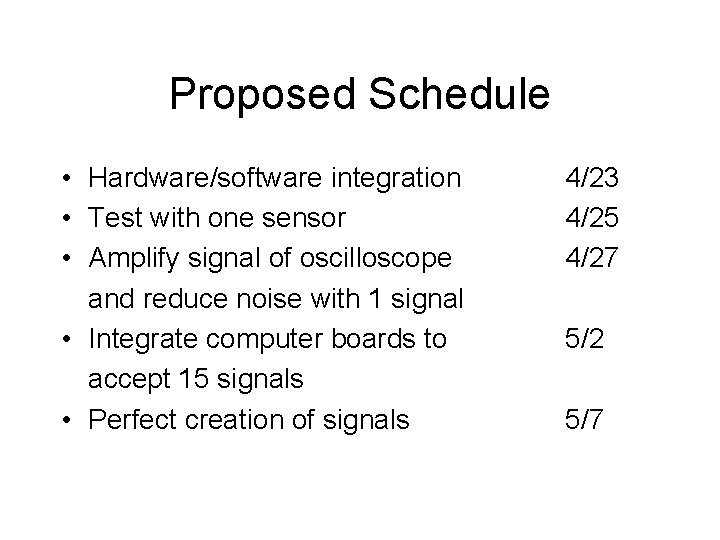
Proposed Schedule • Hardware/software integration • Test with one sensor • Amplify signal of oscilloscope and reduce noise with 1 signal • Integrate computer boards to accept 15 signals • Perfect creation of signals 4/23 4/25 4/27 5/2 5/7
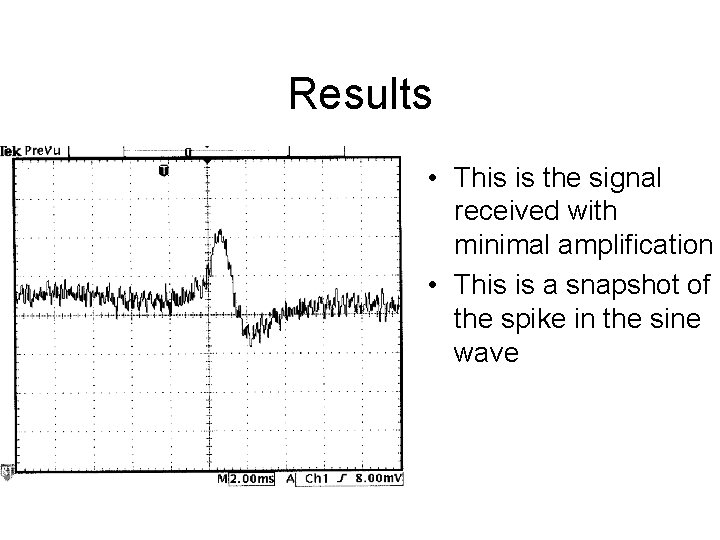
Results • This is the signal received with minimal amplification • This is a snapshot of the spike in the sine wave
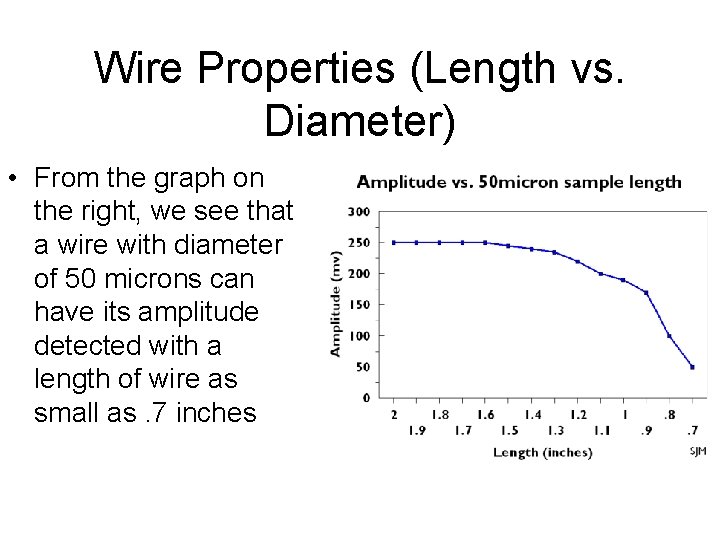
Wire Properties (Length vs. Diameter) • From the graph on the right, we see that a wire with diameter of 50 microns can have its amplitude detected with a length of wire as small as. 7 inches
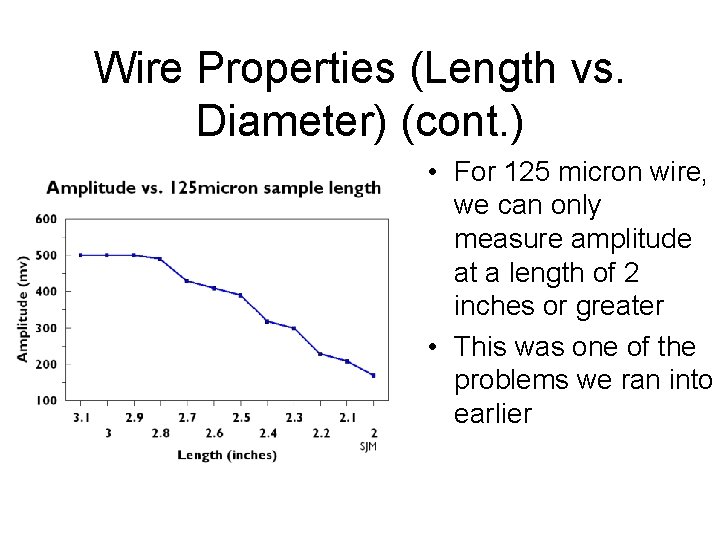
Wire Properties (Length vs. Diameter) (cont. ) • For 125 micron wire, we can only measure amplitude at a length of 2 inches or greater • This was one of the problems we ran into earlier
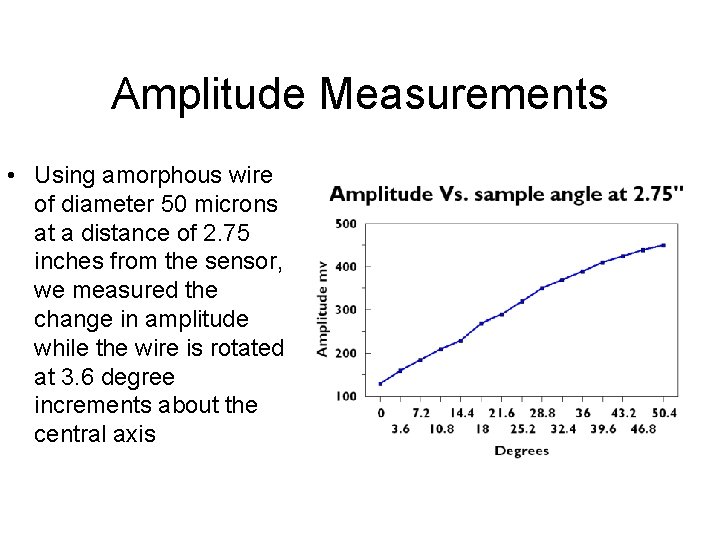
Amplitude Measurements • Using amorphous wire of diameter 50 microns at a distance of 2. 75 inches from the sensor, we measured the change in amplitude while the wire is rotated at 3. 6 degree increments about the central axis
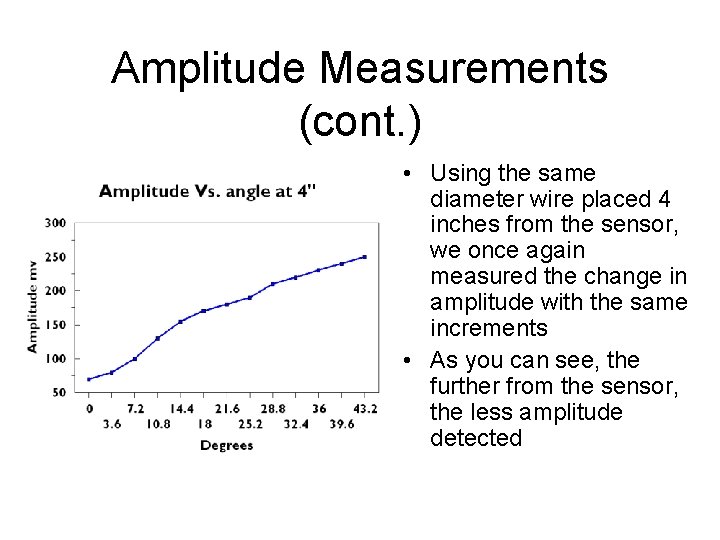
Amplitude Measurements (cont. ) • Using the same diameter wire placed 4 inches from the sensor, we once again measured the change in amplitude with the same increments • As you can see, the further from the sensor, the less amplitude detected
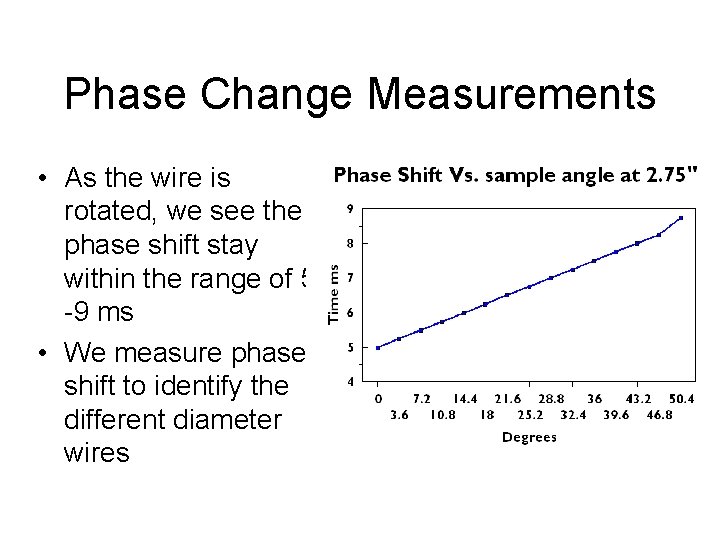
Phase Change Measurements • As the wire is rotated, we see the phase shift stay within the range of 5 -9 ms • We measure phase shift to identify the different diameter wires
Phase Change Measurements (cont. ) • Phase shift once again stays within the range of 5 -9 ms • Regardless of how far the wire is from the sensor, phase shift stays within the range, allowing us to identify the specific diameter wire
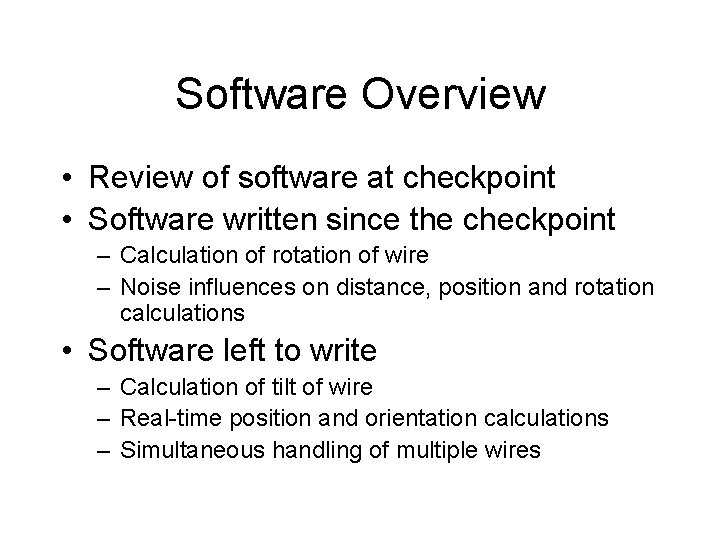
Software Overview • Review of software at checkpoint • Software written since the checkpoint – Calculation of rotation of wire – Noise influences on distance, position and rotation calculations • Software left to write – Calculation of tilt of wire – Real-time position and orientation calculations – Simultaneous handling of multiple wires
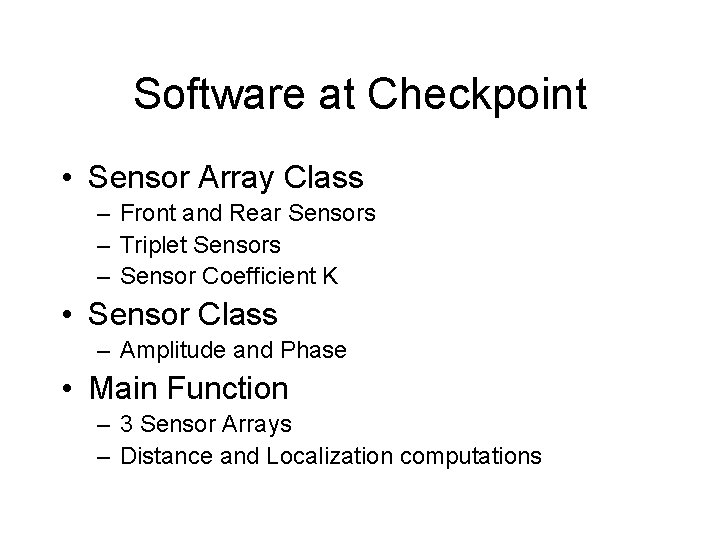
Software at Checkpoint • Sensor Array Class – Front and Rear Sensors – Triplet Sensors – Sensor Coefficient K • Sensor Class – Amplitude and Phase • Main Function – 3 Sensor Arrays – Distance and Localization computations
Software Since Checkpoint • Wire Orientation • Effects of Noise – Distance – Position – Orientation – Minimizing the effects of noise
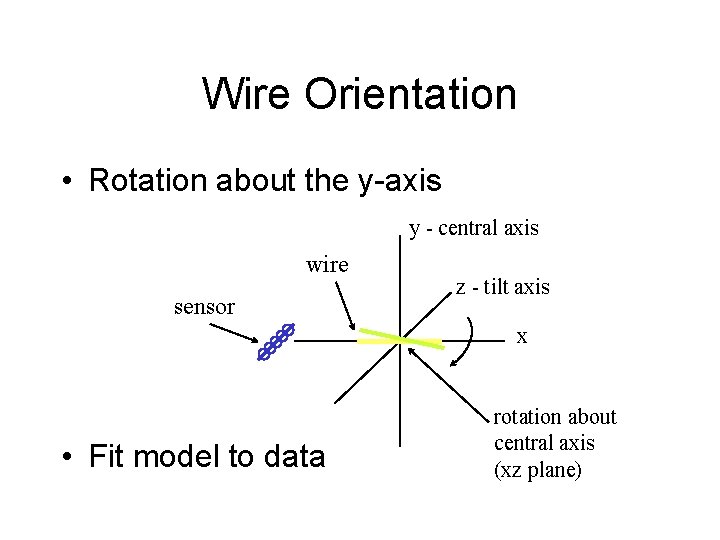
Wire Orientation • Rotation about the y-axis y - central axis wire sensor z - tilt axis x • Fit model to data rotation about central axis (xz plane)
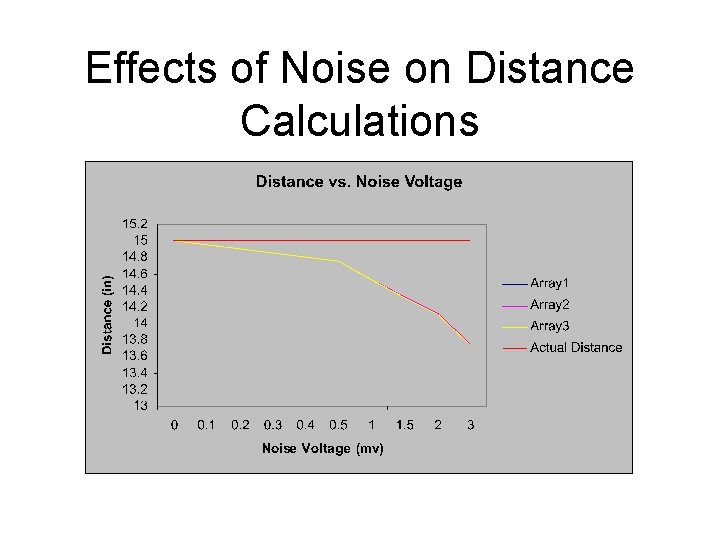
Effects of Noise on Distance Calculations
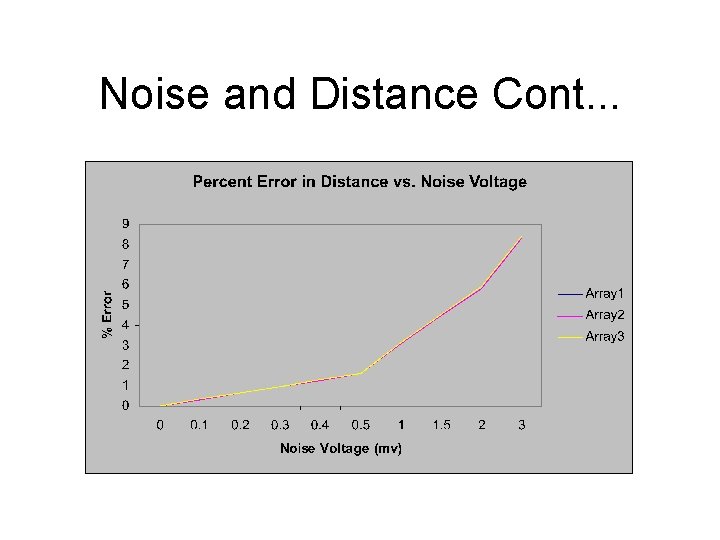
Noise and Distance Cont. . .
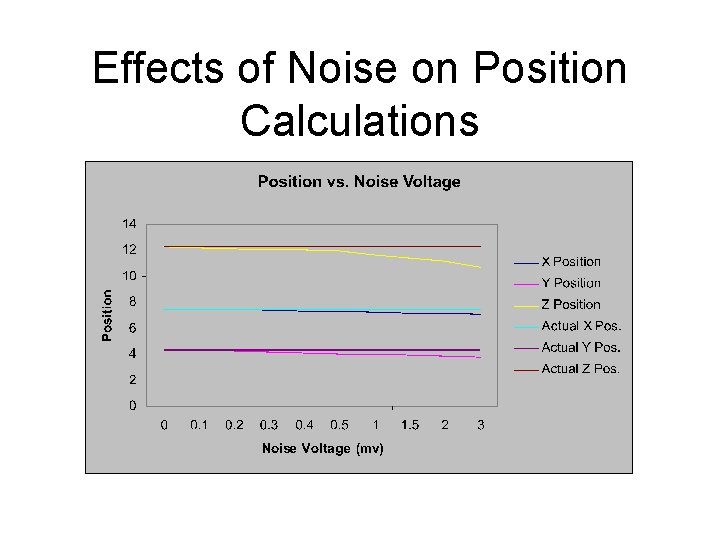
Effects of Noise on Position Calculations
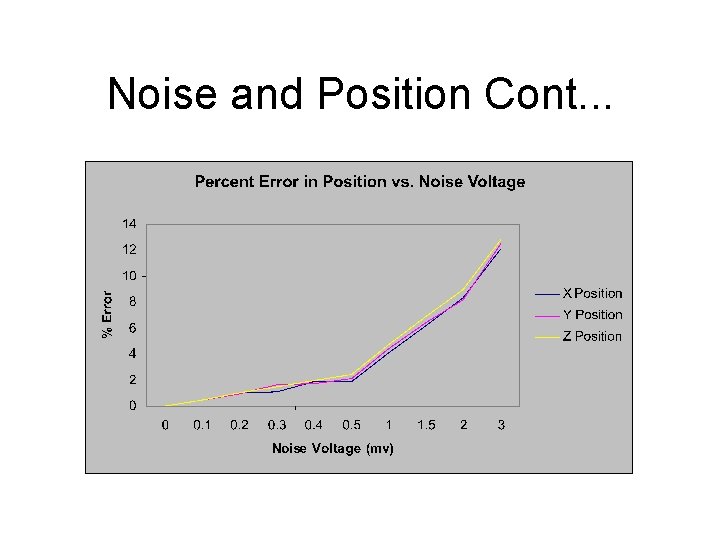
Noise and Position Cont. . .
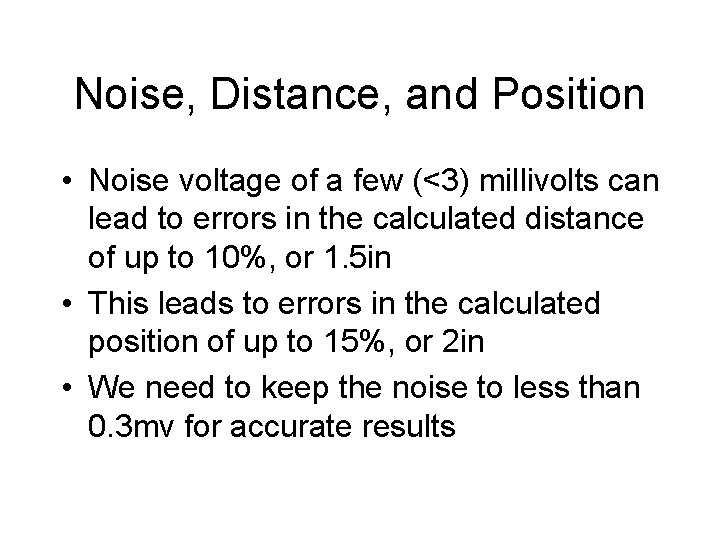
Noise, Distance, and Position • Noise voltage of a few (<3) millivolts can lead to errors in the calculated distance of up to 10%, or 1. 5 in • This leads to errors in the calculated position of up to 15%, or 2 in • We need to keep the noise to less than 0. 3 mv for accurate results
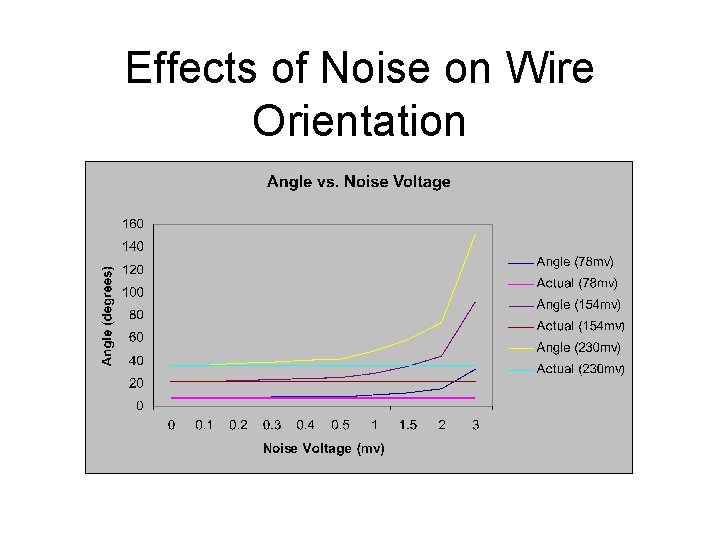
Effects of Noise on Wire Orientation
Noise and Orientation Cont. . .
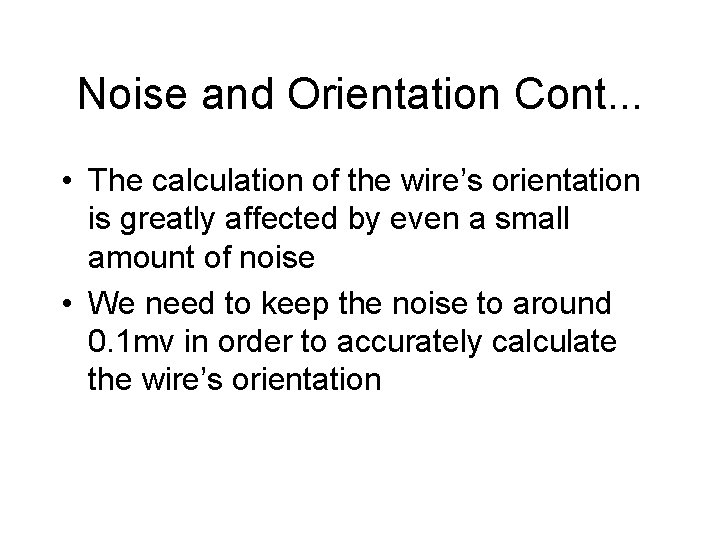
Noise and Orientation Cont. . . • The calculation of the wire’s orientation is greatly affected by even a small amount of noise • We need to keep the noise to around 0. 1 mv in order to accurately calculate the wire’s orientation
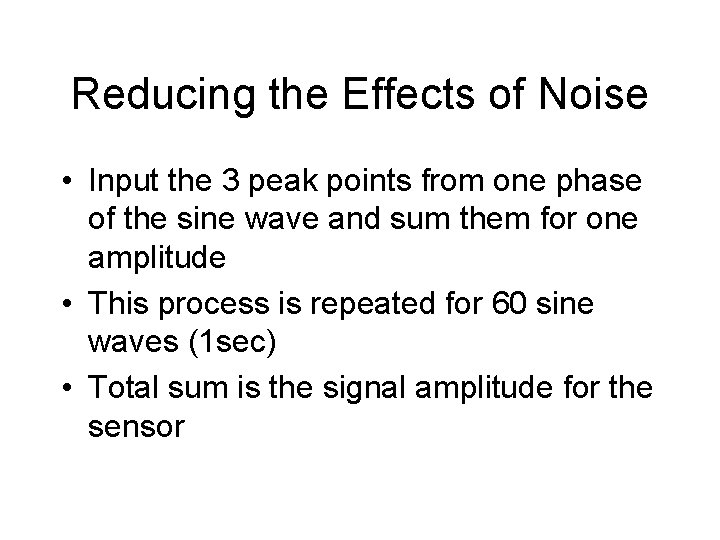
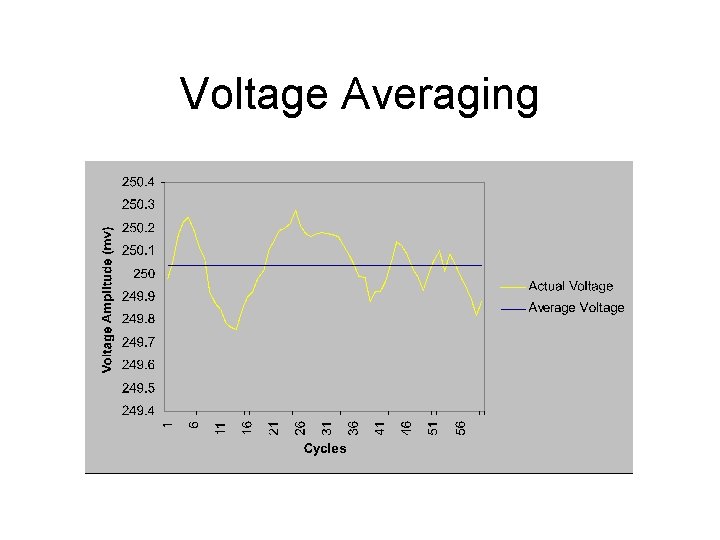
Reducing the Effects of Noise • Input the 3 peak points from one phase of the sine wave and sum them for one amplitude • This process is repeated for 60 sine waves (1 sec) • Total sum is the signal amplitude for the sensor
Voltage Averaging
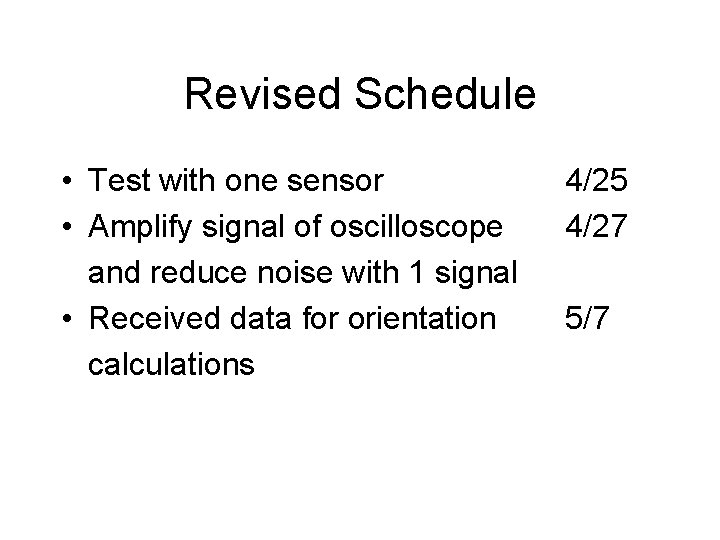
Revised Schedule • Test with one sensor • Amplify signal of oscilloscope and reduce noise with 1 signal • Received data for orientation calculations 4/25 4/27 5/7
Problems • Obtaining the analog input board from the vendor so we can complete realtime localization of the wire • Required better amplification equipment, so we used IBM’s high-end amplification equipment
Division of Labor • Hardware – Matthias and Rich • Software – Matt • Final Integration – Rich, Matthias, and Matt • Group Lead: Matthias
What We Learned • For ALL external dependencies, have backups so they do not become the barrier in the progress of the project • Ensure quality of all equipment is within an acceptable range • Magnetic Theory and Fields