
Ammonia Production Pertinent properties of Ammonia Mol Wt






- Slides: 16
Ammonia Production
Pertinent properties of Ammonia: Mol. Wt. 17. 03 M. P. -77. 7 deg. C. B. P. -33. 4 deg. C Solubility very soluble in water
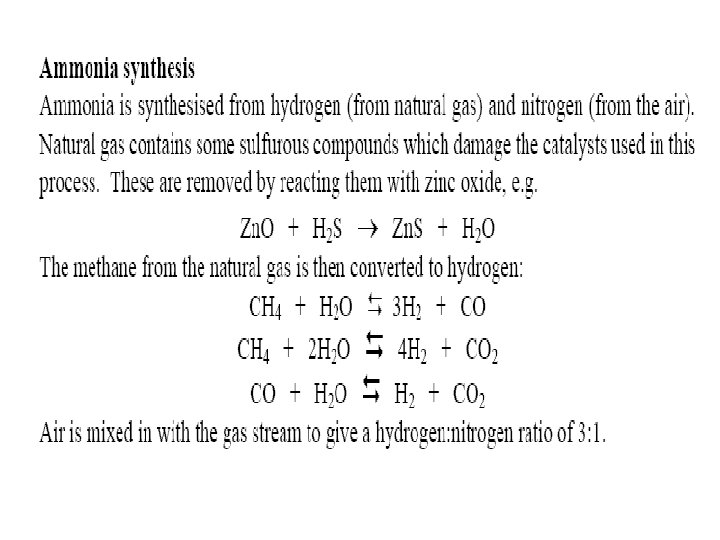
Raw material : Hydrogen from synthesis gas, Nitrogen from air addition or from liquefication process Quantitative requirements: Basis: 1 ton ammonia 85% yield Hydrogen 0. 21 ton or 2000 Nm 3 Nitrogen 0. 96 ton Synthesis catalyst 0. 2 kg power 850 KWH Fuel gas or compressors 3, 800 Kcal Cooling water 12. 5 tons Plant capacity: 100 -1, 500 tons/day of ammonia
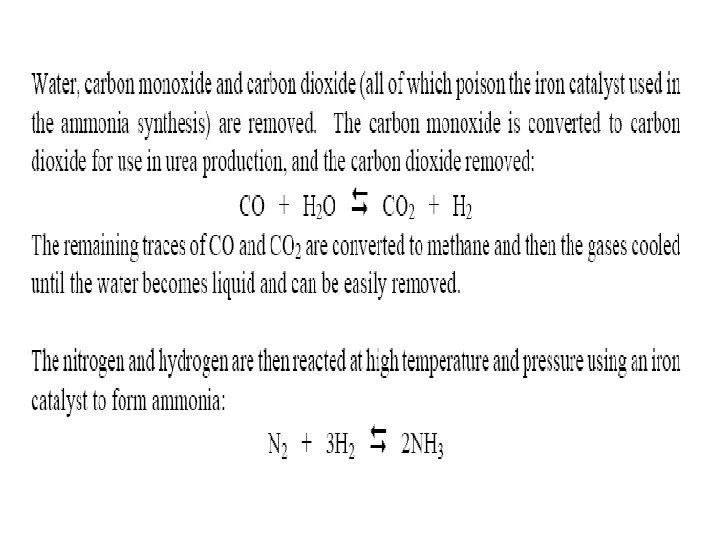
Process Description: Ammonia synthesis gas ( 3 moles pure hydrogen : 1 mole pure nitrogen) is compressed to the operating pressure (1001, 000 atm). It is sent through a filter to remove compression oil and additionally through a high temperature guard converter ( converts CO and CO 2 to CH 4 and removes traces of H 2 O, H 2 S, P and As). The relatively cool gas is added along the outside of converter tube walls to provide cooling so that carbon steel can be used for thick walls to provide cooling.
The preheated gas flows through the inside of tube which contains promoted porous iron catalyst at 500 - 550 deg. C. The ammonia product, with an 8 -30% conversion depending on process conditions, is removed by condensation, first with water cooling and then refrigeration. The unconverted N 2 – H 2 mixture is recirculated to allow an 85 -90% yield.
Major engineering problems : (a) Thermodynamic and kinetic considerations: Highest equilibrium yield can be obtained by high pressure and low temperature. (b) Catalyst development: The preparation and use of active catalysts for ammonia synthesis has been subject of years of research. The principle aim is to develop the catalyst that will allow improved yields at lower temperature and pressures and thus lower production costs. All ammonia synthesis catalysts are based on iron oxide promoted by alkali or non ferrous metal oxides such as K 2 O(1 -2%) and Al 2 O 3 (2 -5%). The iron oxide is fused in an electric furnace and promoters added.
Major engineering problems contd: (c ) Process design modifications: the above considerations have resulted in a number of design modifications, particularly as to the pressure used affects conversion, recirculation rates and refrigeration. The following are modifications (i) very high pressure (900 -1000 atms, 500 – 600 deg. c, 40 n 80% conversion) , Claude Depont (ii) High pressure ( 600 atms, 5000 deg. C. , 15 – 25% conversion)- Casale (iii) Moderate pressure ( 200 – 300 atms , 500 – 550 deg. C. , 10 – 30 % conversion) Kellog Process (iv) low pressure ( 100 atms, 400 - 425 deg. C. , 8 -20% conversion)