
Ammonia and Particulate matter emissions from animal feeding
- Slides: 27
Ammonia and Particulate matter emissions from animal feeding operations Pius Ndegwa Nutrient Management & Air Quality Specialist Biological Systems Engineering Washington State University
Outline 1. Background 2. EPA-Industry collaboration: Birth of NAEMS 3. After NAEMS? 4. Outreach Programs and Activities
Background • Prior to year 2000, EPA was mainly concerned on the impact of animal feeding operations (AFOs) on water – comprehensive nutrient managements. • In 2000, pressure from citizens and environmental groups forced EPA to start enforcing two federal air quality laws in AFOs for select pollutants including: PM 10 & PM 2. 5, non-methane VOCs, H 2 S, and NH 3. • PM 10 & PM 2. 5 and non-methane VOCs emissions as criteria air pollutants are enforced under the U. S. Clean Air Act (CAA) of 1990.
Background • Notification requirements for certain quantities of NH 3 and H 2 S emissions enforceable under the Comprehensive Environmental Response, Compensation, and Liability Act (CERCLA) and the Emergency Planning and Community Right-to-Know Act (EPCRA).
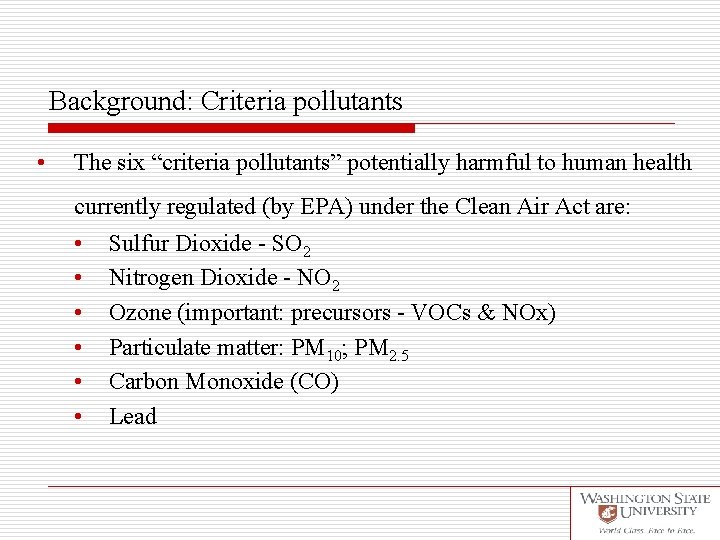
Background: Criteria pollutants • The six “criteria pollutants” potentially harmful to human health currently regulated (by EPA) under the Clean Air Act are: • • • Sulfur Dioxide - SO 2 Nitrogen Dioxide - NO 2 Ozone (important: precursors - VOCs & NOx) Particulate matter: PM 10; PM 2. 5 Carbon Monoxide (CO) Lead
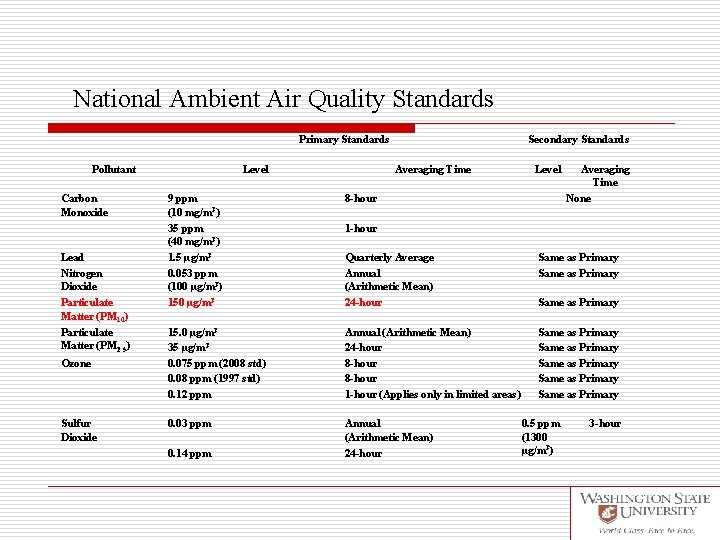
National Ambient Air Quality Standards Primary Standards Pollutant Carbon Monoxide Lead Nitrogen Dioxide Particulate Matter (PM 10) Particulate Matter (PM 2. 5) Ozone Sulfur Dioxide Level Secondary Standards Averaging Time Level Averaging Time None 9 ppm (10 mg/m 3) 35 ppm (40 mg/m 3) 1. 5 µg/m 3 0. 053 ppm (100 µg/m 3) 150 µg/m 3 8 -hour Quarterly Average Annual (Arithmetic Mean) 24 -hour Same as Primary 15. 0 µg/m 3 35 µg/m 3 0. 075 ppm (2008 std) 0. 08 ppm (1997 std) 0. 12 ppm Annual (Arithmetic Mean) 24 -hour 8 -hour 1 -hour (Applies only in limited areas) Same as Primary Same as Primary 0. 03 ppm Annual (Arithmetic Mean) 24 -hour 0. 14 ppm 1 -hour Same as Primary 0. 5 ppm (1300 µg/m 3) 3 -hour
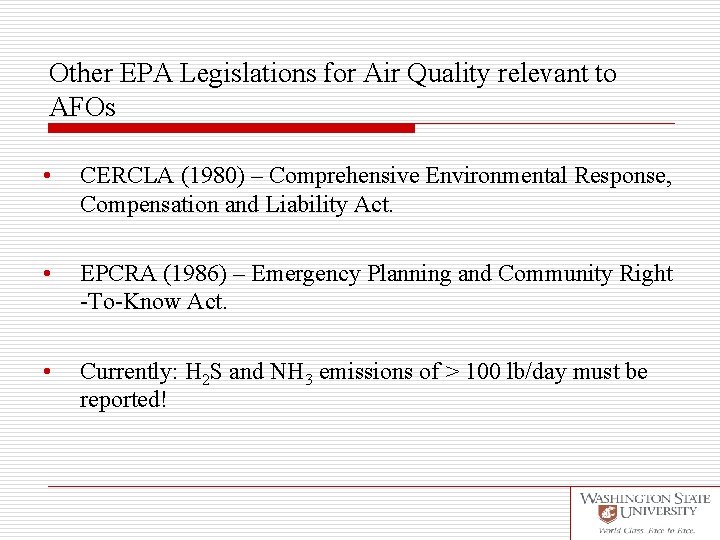
Other EPA Legislations for Air Quality relevant to AFOs • CERCLA (1980) – Comprehensive Environmental Response, Compensation and Liability Act. • EPCRA (1986) – Emergency Planning and Community Right -To-Know Act. • Currently: H 2 S and NH 3 emissions of > 100 lb/day must be reported!
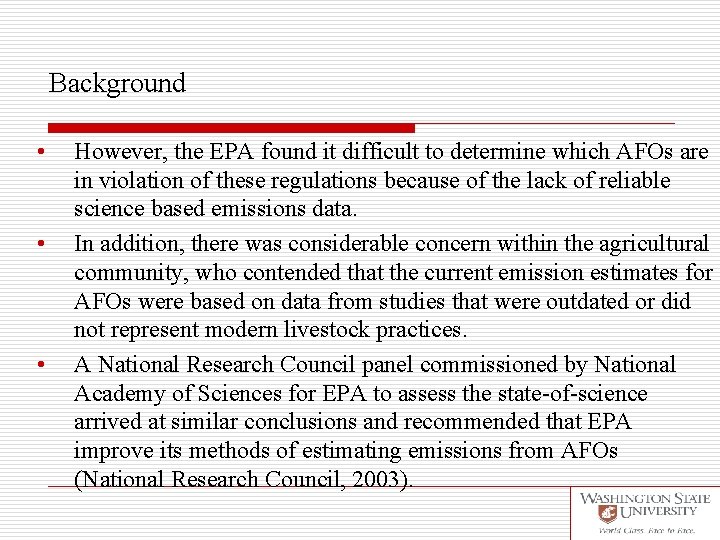
Background • • • However, the EPA found it difficult to determine which AFOs are in violation of these regulations because of the lack of reliable science based emissions data. In addition, there was considerable concern within the agricultural community, who contended that the current emission estimates for AFOs were based on data from studies that were outdated or did not represent modern livestock practices. A National Research Council panel commissioned by National Academy of Sciences for EPA to assess the state-of-science arrived at similar conclusions and recommended that EPA improve its methods of estimating emissions from AFOs (National Research Council, 2003).
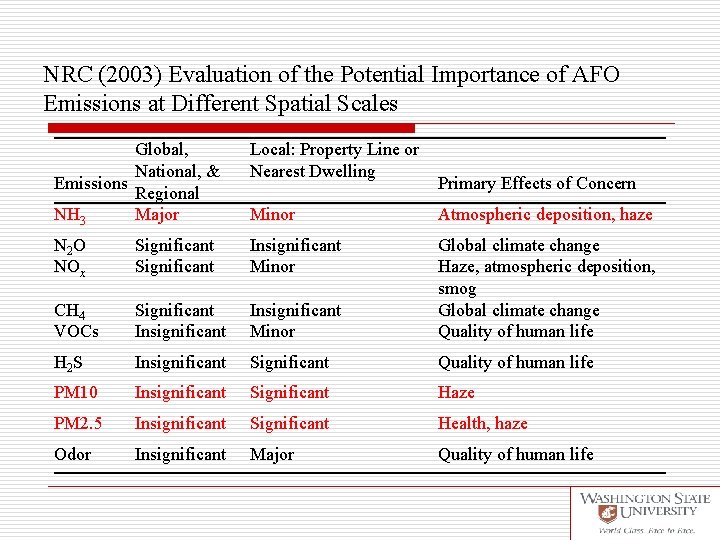
NRC (2003) Evaluation of the Potential Importance of AFO Emissions at Different Spatial Scales Global, National, & Emissions Regional NH 3 Major Local: Property Line or Nearest Dwelling Minor Atmospheric deposition, haze N 2 O NOx Significant Insignificant Minor CH 4 VOCs Significant Insignificant Minor Global climate change Haze, atmospheric deposition, smog Global climate change Quality of human life H 2 S Insignificant Significant Quality of human life PM 10 Insignificant Significant Haze PM 2. 5 Insignificant Significant Health, haze Odor Insignificant Major Quality of human life Primary Effects of Concern
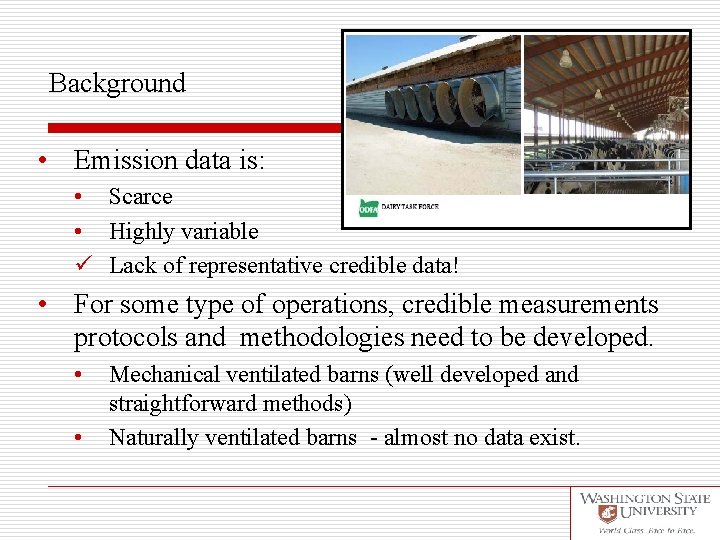
Background • Emission data is: • Scarce • Highly variable ü Lack of representative credible data! • For some type of operations, credible measurements protocols and methodologies need to be developed. • • Mechanical ventilated barns (well developed and straightforward methods) Naturally ventilated barns - almost no data exist.
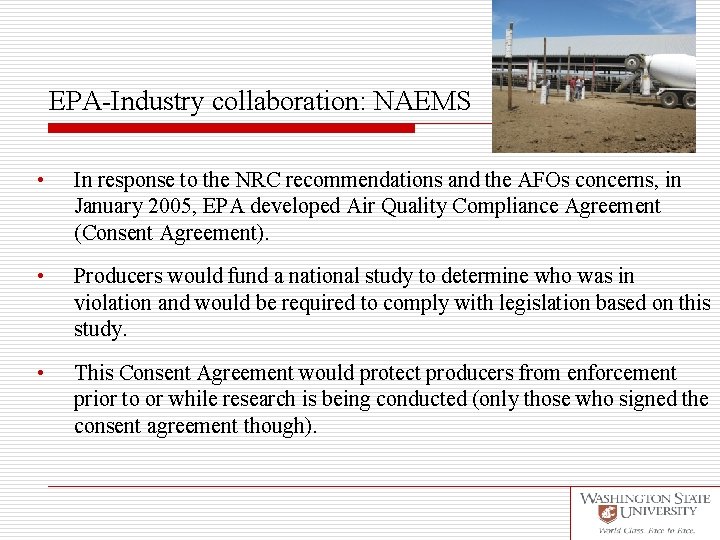
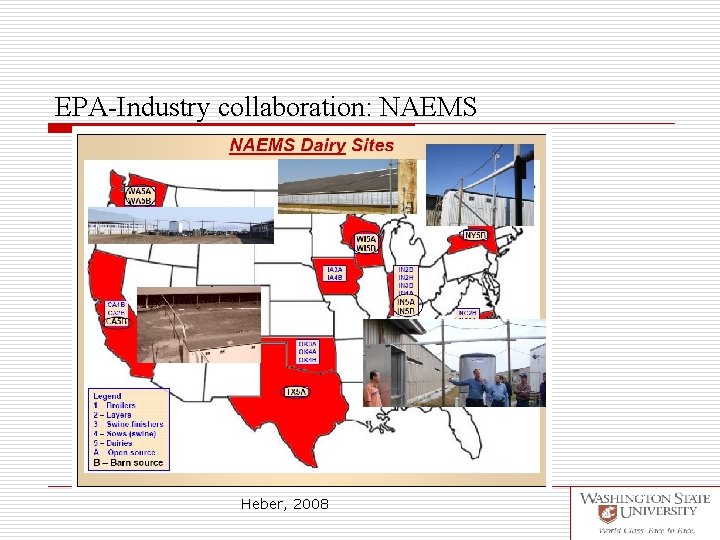
EPA-Industry collaboration: NAEMS • In response to the NRC recommendations and the AFOs concerns, in January 2005, EPA developed Air Quality Compliance Agreement (Consent Agreement). • Producers would fund a national study to determine who was in violation and would be required to comply with legislation based on this study. • This Consent Agreement would protect producers from enforcement prior to or while research is being conducted (only those who signed the consent agreement though).
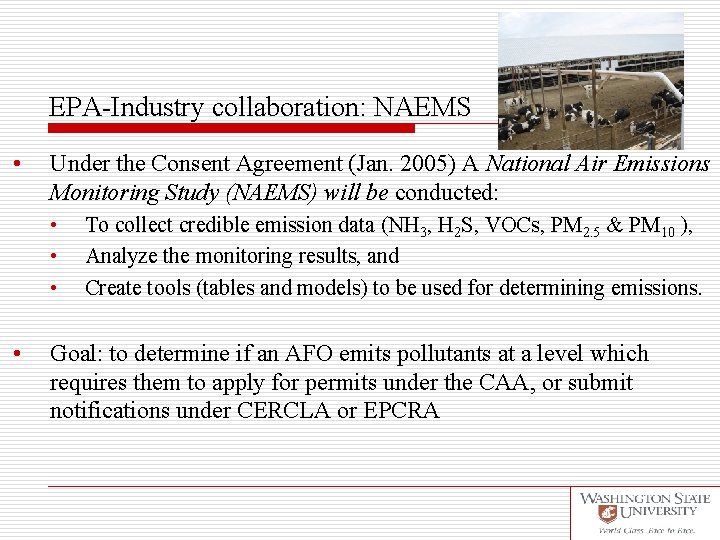
EPA-Industry collaboration: NAEMS • Under the Consent Agreement (Jan. 2005) A National Air Emissions Monitoring Study (NAEMS) will be conducted: • • To collect credible emission data (NH 3, H 2 S, VOCs, PM 2. 5 & PM 10 ), Analyze the monitoring results, and Create tools (tables and models) to be used for determining emissions. Goal: to determine if an AFO emits pollutants at a level which requires them to apply for permits under the CAA, or submit notifications under CERCLA or EPCRA
EPA-Industry collaboration: NAEMS Heber, 2008
EPA-Industry collaboration: NAEMS • In this study, the same instrumentation, protocols, and quality assurance and quality control methods are applied to all species. • Study is being conducted in different climatic or geographic areas to reflect different production systems. • Current Status: NAEMS is in its second year. We have four sites in the West: two dairies (WA and CA), Two poultry (both in CA).
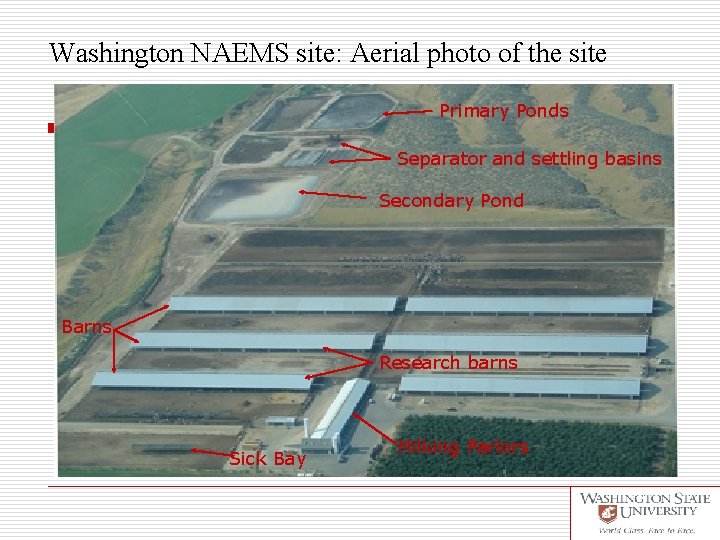
Washington NAEMS site: Aerial photo of the site Primary Ponds Separator and settling basins Secondary Pond Barns Research barns Sick Bay Milking Parlors
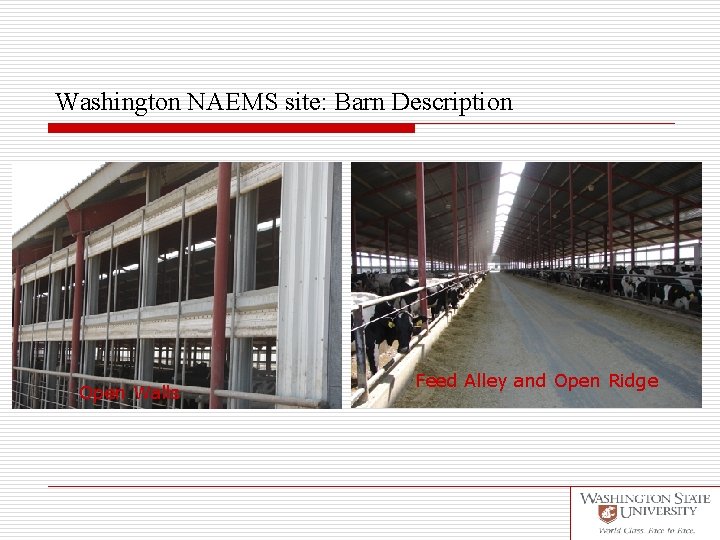
Washington NAEMS site: Barn Description Open Walls Feed Alley and Open Ridge
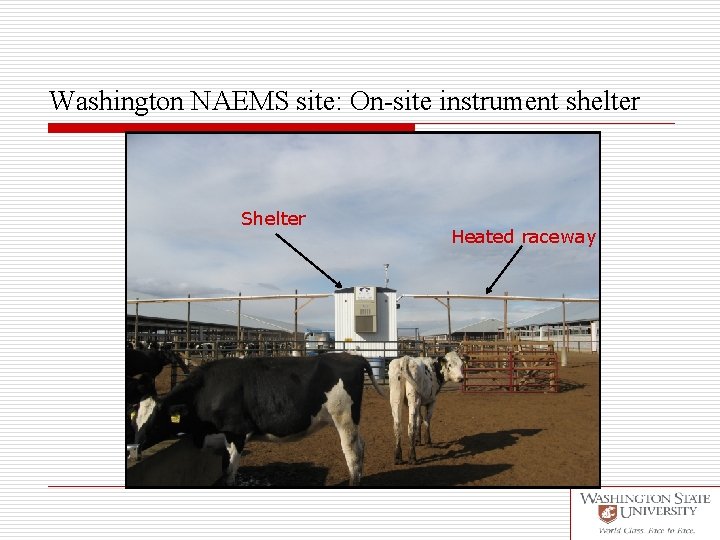
Washington NAEMS site: On-site instrument shelter Shelter Heated raceway
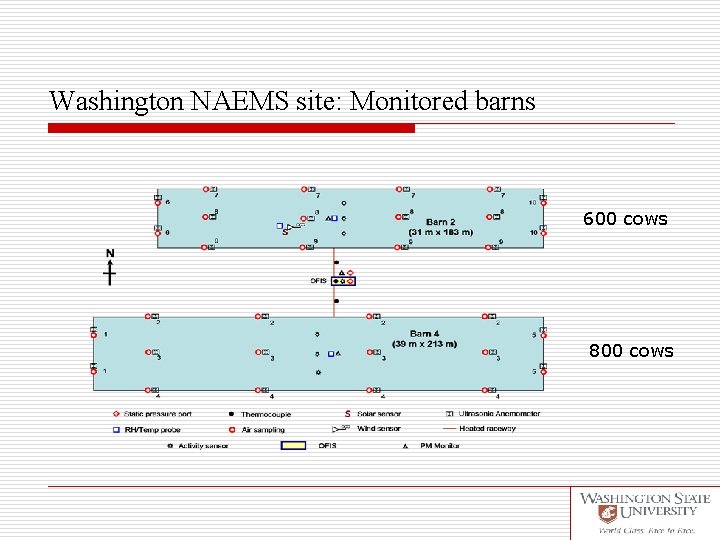
Washington NAEMS site: Monitored barns 600 cows 800 cows
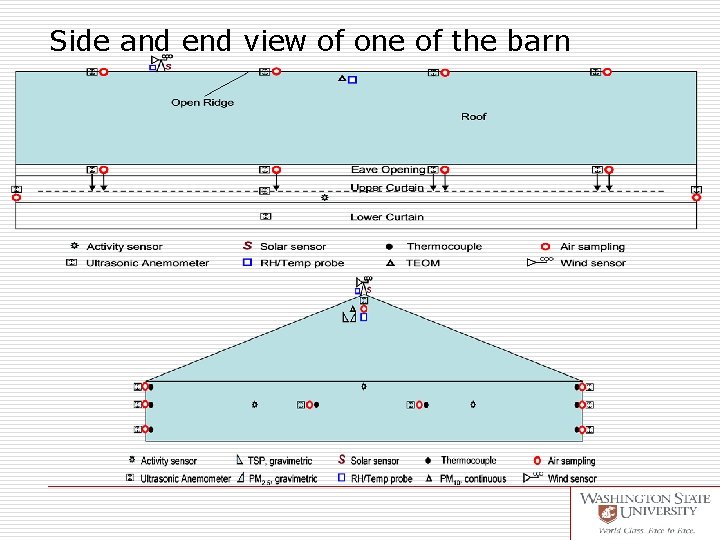
Side and end view of one of the barn
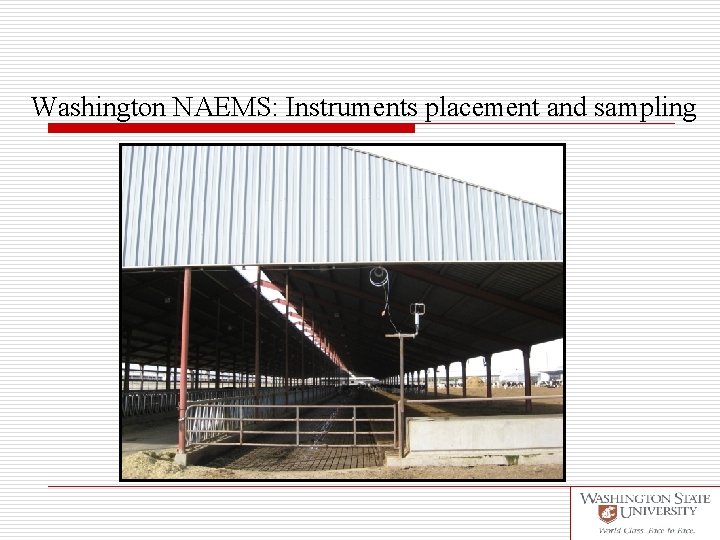
Washington NAEMS: Instruments placement and sampling
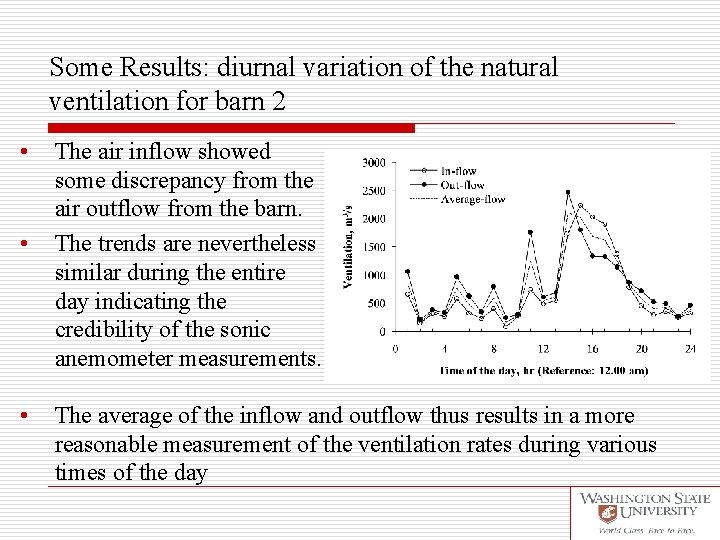
Some Results: diurnal variation of the natural ventilation for barn 2 • • • The air inflow showed some discrepancy from the air outflow from the barn. The trends are nevertheless similar during the entire day indicating the credibility of the sonic anemometer measurements. The average of the inflow and outflow thus results in a more reasonable measurement of the ventilation rates during various times of the day
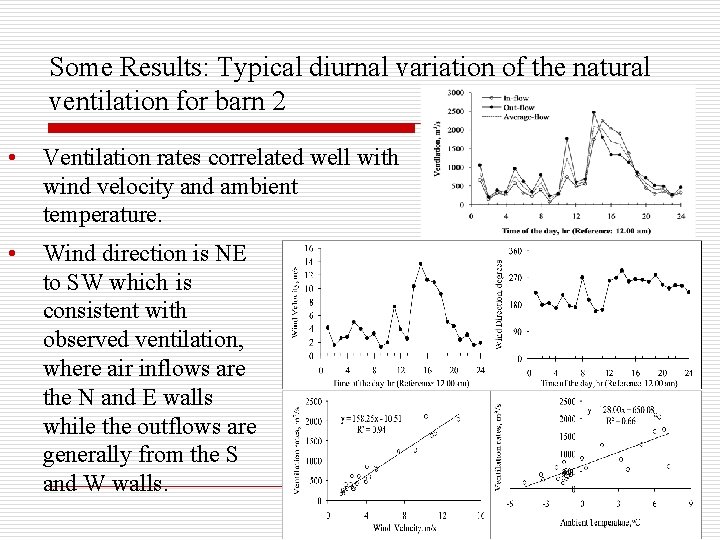
Some Results: Typical diurnal variation of the natural ventilation for barn 2 • Ventilation rates correlated well with wind velocity and ambient temperature. • Wind direction is NE to SW which is consistent with observed ventilation, where air inflows are the N and E walls while the outflows are generally from the S and W walls.
Conclusion • Based on the mass balance of air inflow and outflow from NV barn, this approach can be used to accurately estimate the ventilation of the NV barns – which is ½ the work done! • Why? The ventilation can then be coupled with the concentrations of the various gases of interest at the inflow and outflow to determine emissions fluxes from the barns. • Can’t share the emission fluxes – has not authority!
After NAEMS? By at least 2011 all livestock farms identified as sources of pollution will have to comply with: • The Clean Air Act (CAA) • The Comprehensive Environmental Response, Compensation and Liability Act (CERCLA) • The Emergency Planning and Community Right to Know Act (EPCRA). ü Mitigation Studies are expected to commence once emission studies are completed.
What else is going on? - Outreach Programs and Activities Western Region Odor and Air Quality Education Program • A collaboration between five universities in the western US to develop and deliver a comprehensive odor and air quality education program to frontline extension professionals • In partnership with: Currently funded by: Producer Organizations
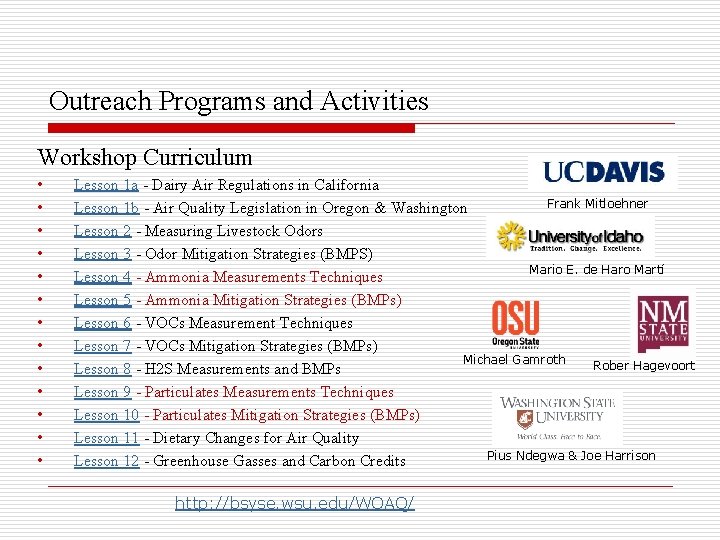
Outreach Programs and Activities Workshop Curriculum • • • • Lesson 1 a - Dairy Air Regulations in California Frank Mitloehner Lesson 1 b - Air Quality Legislation in Oregon & Washington Lesson 2 - Measuring Livestock Odors Lesson 3 - Odor Mitigation Strategies (BMPS) Mario E. de Haro Martí Lesson 4 - Ammonia Measurements Techniques Lesson 5 - Ammonia Mitigation Strategies (BMPs) Lesson 6 - VOCs Measurement Techniques Lesson 7 - VOCs Mitigation Strategies (BMPs) Michael Gamroth Rober Hagevoort Lesson 8 - H 2 S Measurements and BMPs Lesson 9 - Particulates Measurements Techniques Lesson 10 - Particulates Mitigation Strategies (BMPs) Lesson 11 - Dietary Changes for Air Quality Pius Ndegwa & Joe Harrison Lesson 12 - Greenhouse Gasses and Carbon Credits http: //bsyse. wsu. edu/WOAQ/
Questions?