
Amiodarone Toxicity Preventable With Proper Monitoring Jeffrey Spence
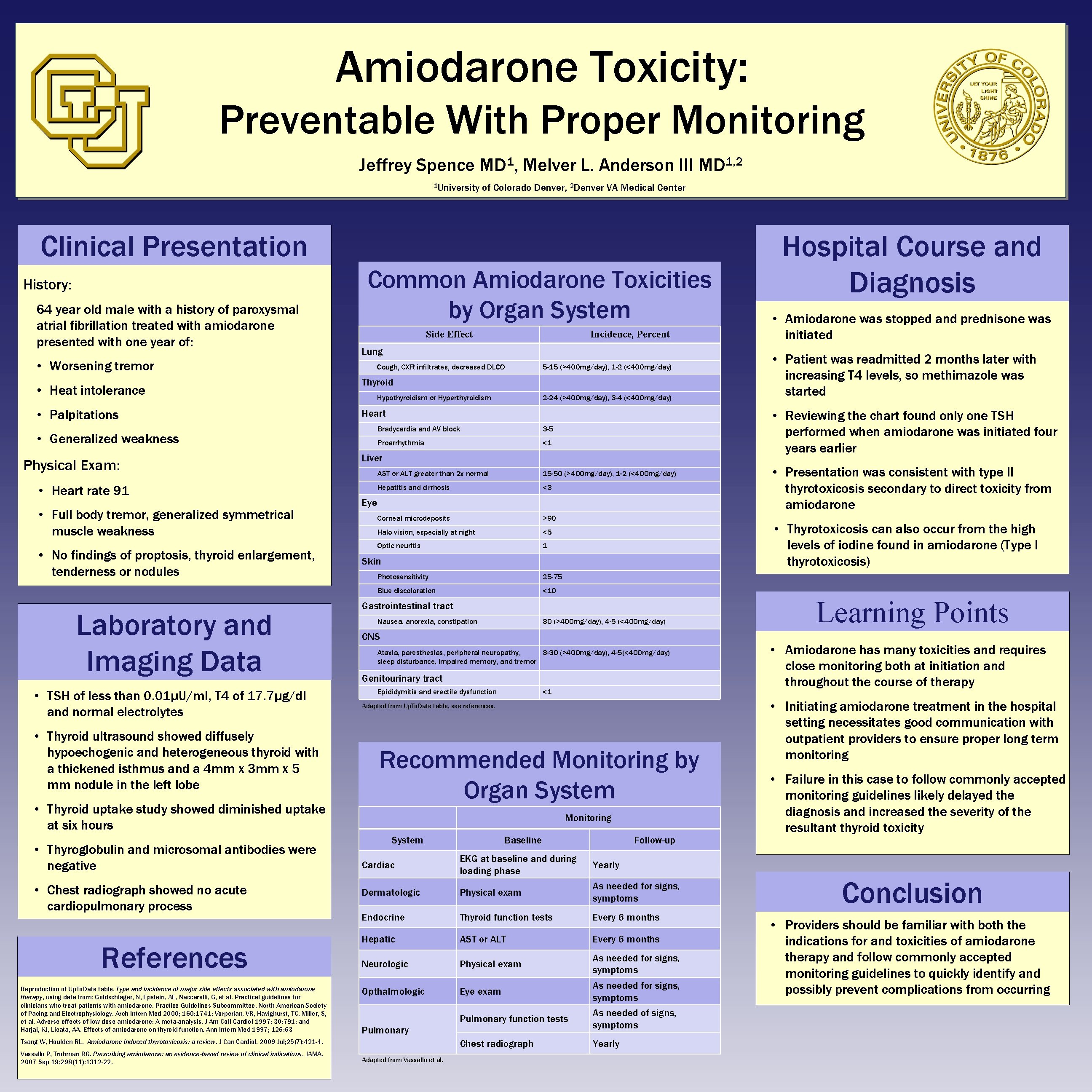
Amiodarone Toxicity: Preventable With Proper Monitoring Jeffrey Spence MD 1, Melver L. Anderson III MD 1, 2 1 University of Colorado Denver, 2 Denver VA Medical Center Clinical Presentation History: 64 year old male with a history of paroxysmal atrial fibrillation treated with amiodarone presented with one year of: • Worsening tremor • Heat intolerance • Palpitations Common Amiodarone Toxicities by Organ System Side Effect Lung Cough, CXR infiltrates, decreased DLCO • Heart rate 91 • Full body tremor, generalized symmetrical muscle weakness • No findings of proptosis, thyroid enlargement, tenderness or nodules Laboratory and Imaging Data • TSH of less than 0. 01µU/ml, T 4 of 17. 7µg/dl and normal electrolytes • Thyroid ultrasound showed diffusely hypoechogenic and heterogeneous thyroid with a thickened isthmus and a 4 mm x 3 mm x 5 mm nodule in the left lobe • Thyroid uptake study showed diminished uptake at six hours • Thyroglobulin and microsomal antibodies were negative • Chest radiograph showed no acute cardiopulmonary process References Reproduction of Up. To. Date table, Type and incidence of major side effects associated with amiodarone therapy, using data from: Goldschlager, N, Epstein, AE, Naccarelli, G, et al. Practical guidelines for clinicians who treat patients with amiodarone. Practice Guidelines Subcommittee, North American Society of Pacing and Electrophysiology. Arch Intern Med 2000; 160: 1741; Vorperian, VR, Havighurst, TC, Miller, S, et al. Adverse effects of low dose amiodarone: A meta-analysis. J Am Coll Cardiol 1997; 30: 791; and Harjai, KJ, Licata, AA. Effects of amiodarone on thyroid function. Ann Intern Med 1997; 126: 63 Hypothyroidism or Hyperthyroidism 2 -24 (>400 mg/day), 3 -4 (<400 mg/day) Heart Bradycardia and AV block 3 -5 Proarrhythmia <1 AST or ALT greater than 2 x normal 15 -50 (>400 mg/day), 1 -2 (<400 mg/day) Hepatitis and cirrhosis <3 Corneal microdeposits >90 Halo vision, especially at night <5 Optic neuritis 1 Eye 25 -75 Blue discoloration <10 Gastrointestinal tract Nausea, anorexia, constipation 30 (>400 mg/day), 4 -5 (<400 mg/day) CNS Ataxia, paresthesias, peripheral neuropathy, 3 -30 (>400 mg/day), 4 -5(<400 mg/day) sleep disturbance, impaired memory, and tremor Genitourinary tract Epididymitis and erectile dysfunction <1 Adapted from Up. To. Date table, see references. Recommended Monitoring by Organ System Monitoring System Baseline Follow-up EKG at baseline and during loading phase Yearly Dermatologic Physical exam As needed for signs, symptoms Endocrine Thyroid function tests Every 6 months Hepatic AST or ALT Every 6 months Physical exam As needed for signs, symptoms Eye exam As needed for signs, symptoms Pulmonary function tests As needed of signs, symptoms Chest radiograph Yearly Cardiac Neurologic Opthalmologic Pulmonary Adapted from Vassallo et al. • Patient was readmitted 2 months later with increasing T 4 levels, so methimazole was started • Presentation was consistent with type II thyrotoxicosis secondary to direct toxicity from amiodarone • Thyrotoxicosis can also occur from the high levels of iodine found in amiodarone (Type I thyrotoxicosis) Skin Photosensitivity • Amiodarone was stopped and prednisone was initiated • Reviewing the chart found only one TSH performed when amiodarone was initiated four years earlier Liver Tsang W, Houlden RL. Amiodarone-induced thyrotoxicosis: a review. J Can Cardiol. 2009 Jul; 25(7): 421 -4. Vassallo P, Trohman RG. Prescribing amiodarone: an evidence-based review of clinical indications. JAMA. 2007 Sep 19; 298(11): 1312 -22. 5 -15 (>400 mg/day), 1 -2 (<400 mg/day) Thyroid • Generalized weakness Physical Exam: Incidence, Percent Hospital Course and Diagnosis Learning Points • Amiodarone has many toxicities and requires close monitoring both at initiation and throughout the course of therapy • Initiating amiodarone treatment in the hospital setting necessitates good communication with outpatient providers to ensure proper long term monitoring • Failure in this case to follow commonly accepted monitoring guidelines likely delayed the diagnosis and increased the severity of the resultant thyroid toxicity Conclusion • Providers should be familiar with both the indications for and toxicities of amiodarone therapy and follow commonly accepted monitoring guidelines to quickly identify and possibly prevent complications from occurring
- Slides: 1