
Amino sugars Contain anNH 2 group in place
- Slides: 24
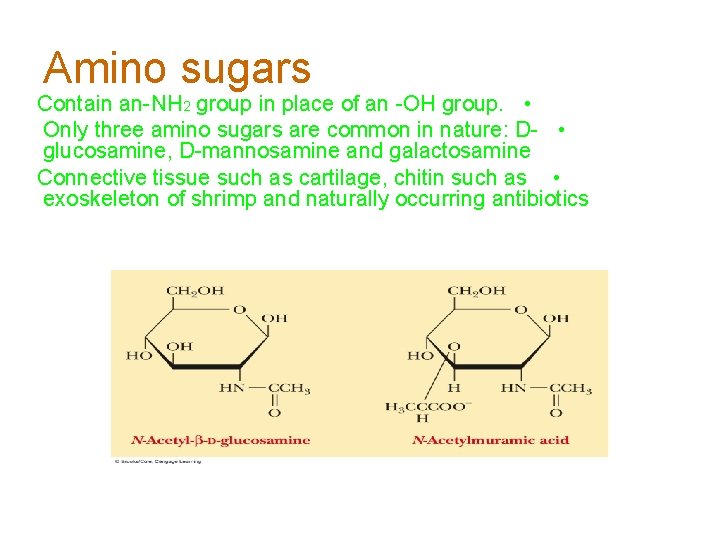
Amino sugars Contain an-NH 2 group in place of an -OH group. • Only three amino sugars are common in nature: D- • glucosamine, D-mannosamine and galactosamine Connective tissue such as cartilage, chitin such as • exoskeleton of shrimp and naturally occurring antibiotics
Disaccharides are two units of • monosaccharides joined by a glycosidic linkage. Example Maltose (Glucose + Glucose). 1 Lactose (Glucose + Galactose). 2 Sucrose (Glucose + Fructose). 3
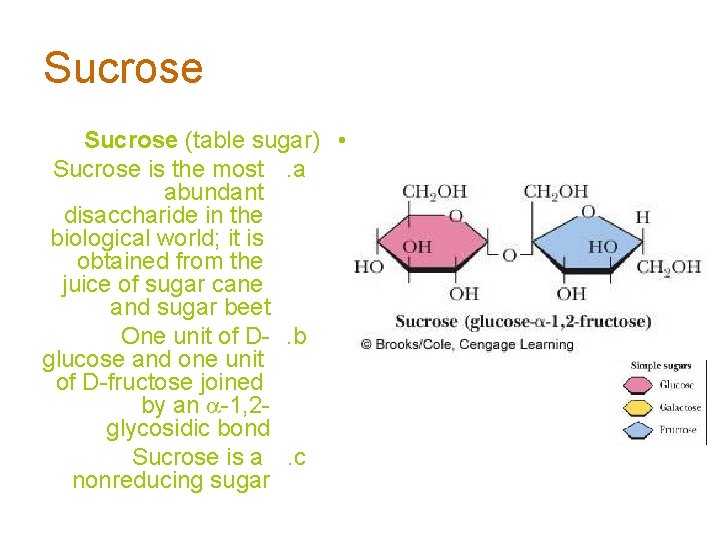
Sucrose (table sugar) • Sucrose is the most . a abundant disaccharide in the biological world; it is obtained from the juice of sugar cane and sugar beet One unit of D-. b glucose and one unit of D-fructose joined by an a-1, 2 glycosidic bond Sucrose is a . c nonreducing sugar
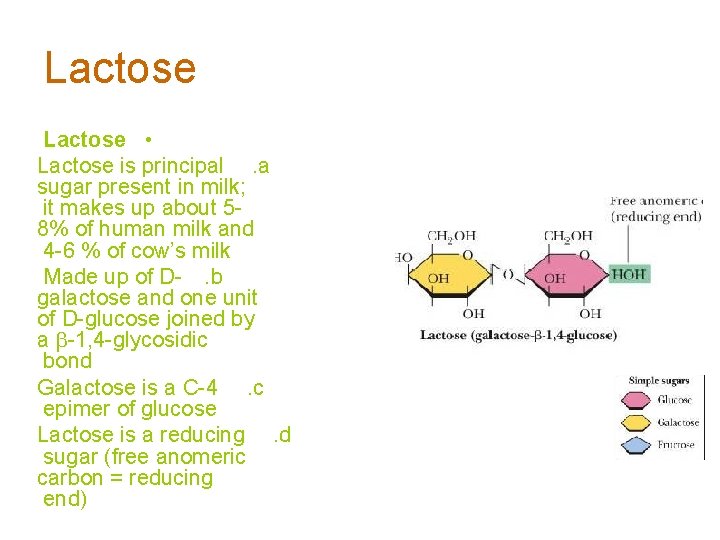
Lactose • Lactose is principal . a sugar present in milk; it makes up about 58% of human milk and 4 -6 % of cow’s milk Made up of D-. b galactose and one unit of D-glucose joined by a -1, 4 -glycosidic bond Galactose is a C-4 . c epimer of glucose Lactose is a reducing . d sugar (free anomeric carbon = reducing end)
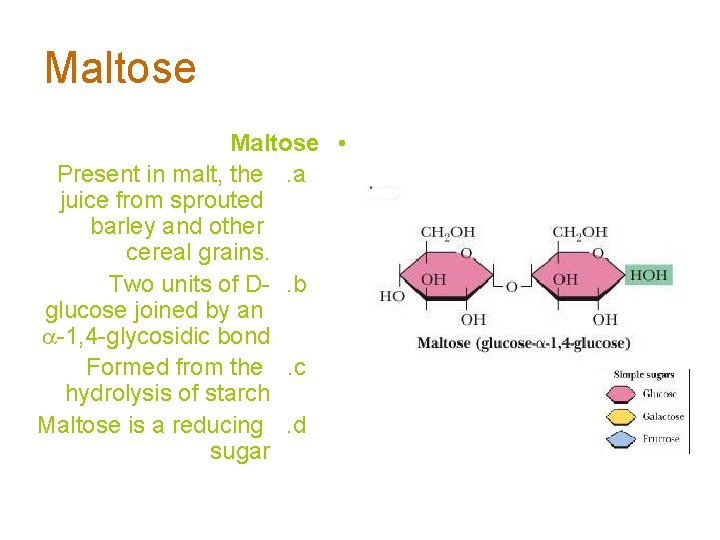
Maltose • Present in malt, the . a juice from sprouted barley and other cereal grains. Two units of D-. b glucose joined by an a-1, 4 -glycosidic bond Formed from the . c hydrolysis of starch Maltose is a reducing . d sugar
Summary The disaccharide sucrose is a common • table sugar. It consists of glucose and fructose linked by a glycosidic bond Lactose, found in milk, and maltose, • obtained from starch, are two other common disaccharides
Oligosaccharides Oligosaccharide: a linear or branched • carbohydrate usually from two to sex monosaccharide units joined by means of glycosidic bonds Often found covalently attached to proteins • or membrane lipids to form glycoproteins and glycolipids
Polysaccharides Most carbohydrates are large • polysaccharide molecules. They are made up of large numbers of monosaccharide units linked together by glycosidic bonds. On chemical or enzymatic hydrolysis they yield simple monosaccharides which differ in: The kind of monosaccharides units. 1 Length of the chain. 2 The degree of branching . 3
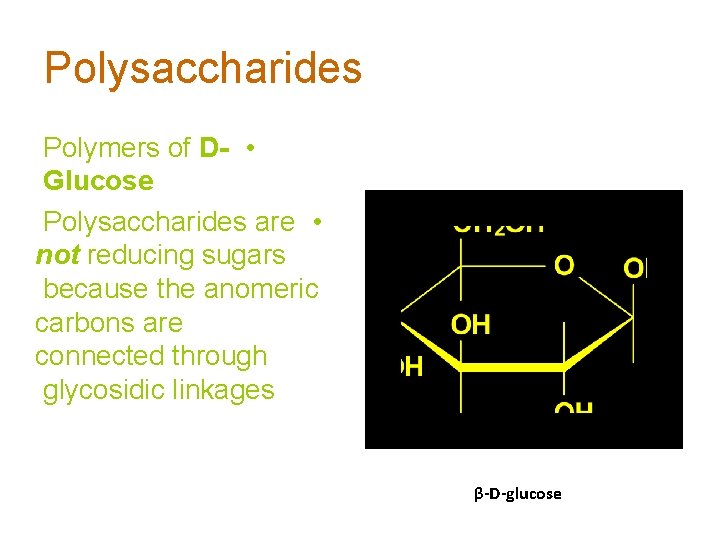
Polysaccharides Polymers of D- • Glucose Polysaccharides are • not reducing sugars because the anomeric carbons are connected through glycosidic linkages β-D-glucose
Storage polysaccharides Starch (plants) • Starch is the storage form of carbohydrate in – plants ingested by humans Two types – Amylose (unbranched). 1 Amylopectin (branched). 2 Glycogen (animals) • Glycogen is the storage form of glucose in – animals, predominantly found in liver and muscle Cellulose •
Starch is the storage polysaccharide in • plants and some microorganisms. In times of glucose surplus, glucose is stored by enzymatic linkage to the ends of an existing polymer. At times of needs the linkage is cleaved to release glucose. Plants store starch mostly in the roots and seeds. Plants will use the stored glucose mostly to synthesize cellulose for new growth.
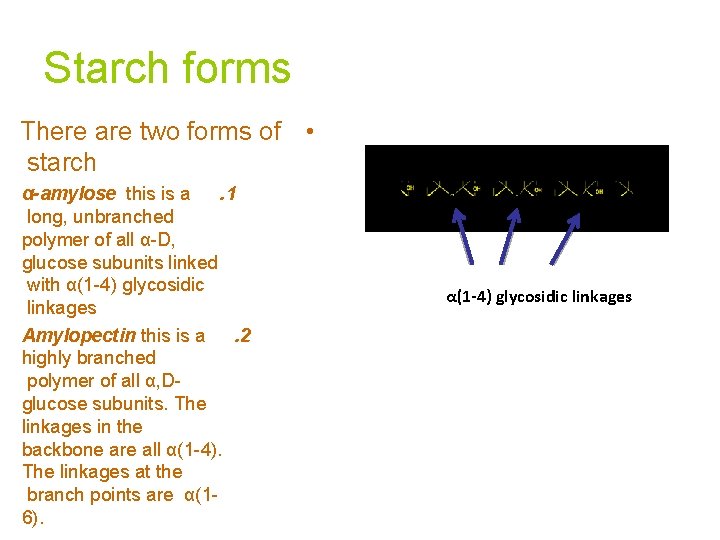
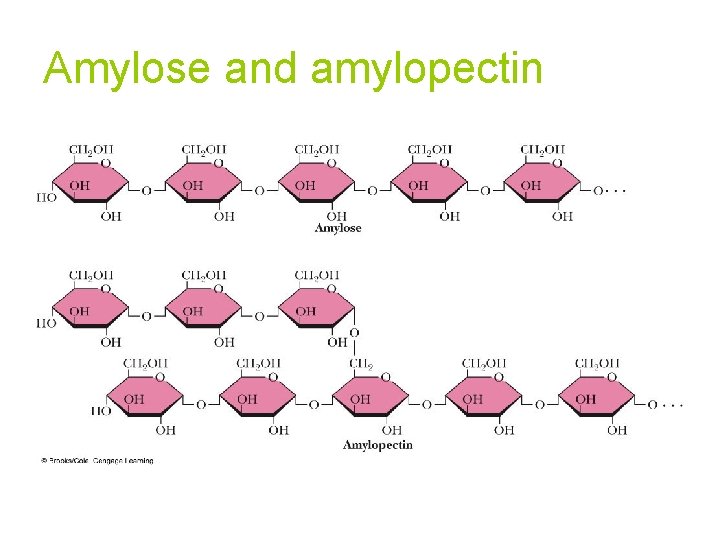
Starch forms There are two forms of • starch α-amylose this is a . 1 long, unbranched polymer of all α-D, glucose subunits linked with α(1 -4) glycosidic linkages Amylopectin this is a . 2 highly branched polymer of all α, Dglucose subunits. The linkages in the backbone are all α(1 -4). The linkages at the branch points are α(16). α(1 -4) glycosidic linkages
Amylose and amylopectin
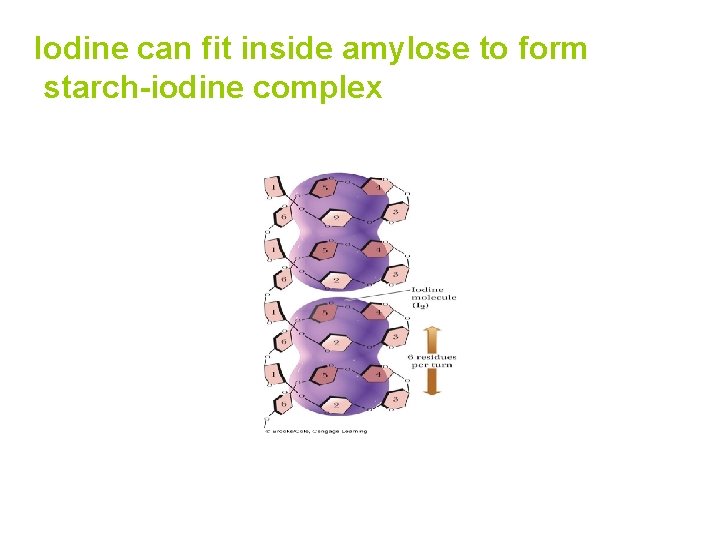
Iodine can fit inside amylose to form starch-iodine complex
Cellulose is the most abundant • polysaccharide in the world. It is the major structural component of plants, especially wood and plant fibers It is a unbranched linear polymer of D- • glucose with β(1 -4)-D-glucose linkage. It makes up the material of plant cell walls The only difference between cellulose • and starch is the β- linkage.
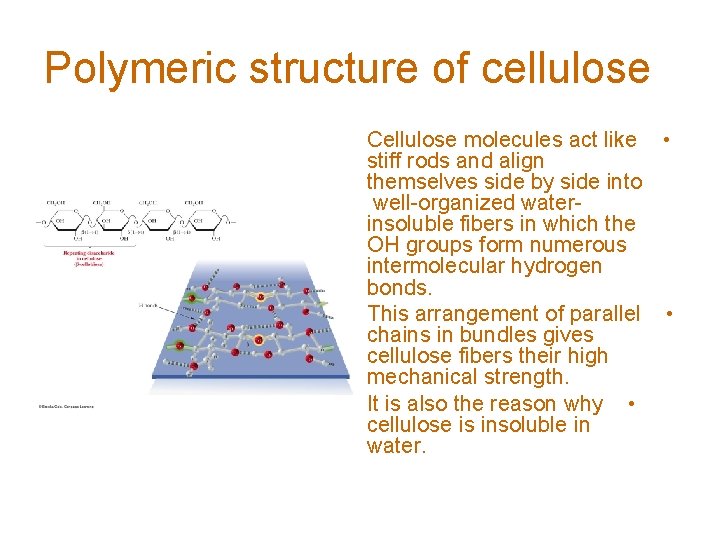
Polymeric structure of cellulose Cellulose molecules act like • stiff rods and align themselves side by side into well-organized waterinsoluble fibers in which the OH groups form numerous intermolecular hydrogen bonds. This arrangement of parallel • chains in bundles gives cellulose fibers their high mechanical strength. It is also the reason why • cellulose is insoluble in water.
Glycogen is the main storage • polysaccharide in animal cells. It is abundant in the liver and muscle on hydrolysis it forms glucose, which maintains normal blood sugar level and provides energy. It is the energy-reserve carbohydrate for animals. It also is a polysaccharide of α, D-glucose • subunits with an α(1 -4) backbone and α(16) branch points.
Amylases Amylose, amylopectin and glycogen are • enzymatically hydrolyzed at the α(1 -4) linkages by amylases. α -amylase is an endoglycosidase and • hydrolyzes glycosidic linkages anywhere along the chain to produces a mixture of glucose and maltose. β-amylase attacks the same type of linkages, is • an exoglycosidicase and cleaves from the nonreducing end of the polymer, but yields maltoses. α(1 -6) glycosidase: this is a de-branching • enzyme which attacks the α(1 -6) branching type linkages.
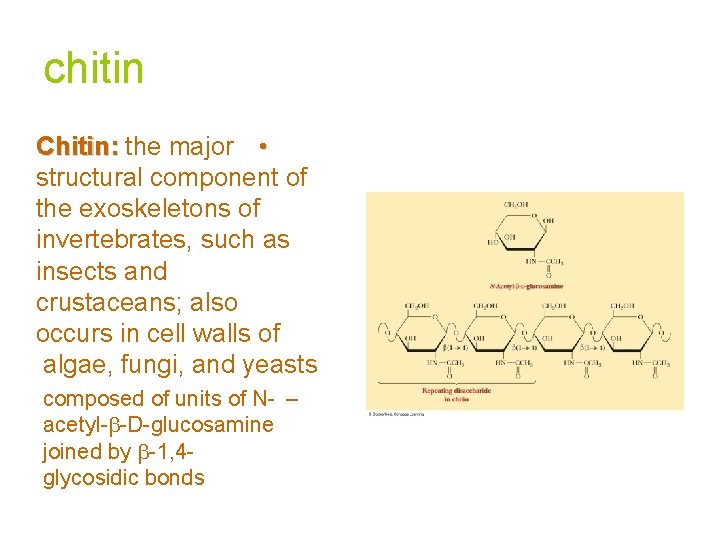
chitin Chitin: the major • structural component of the exoskeletons of invertebrates, such as insects and crustaceans; also occurs in cell walls of algae, fungi, and yeasts composed of units of N- – acetyl- -D-glucosamine joined by -1, 4 glycosidic bonds
Glycosaminoglycans: polysaccharides • based on a repeating disaccharide where one of the monomers is an amino sugar and the other has a negative charge due to a sulfate or carboxylate group Heparin: natural anticoagulant – Hyaluronic acid: a component of the vitreous – humor of the eye and the lubricating fluid of joints Chondroitin sulfate and keratan sulfate: – components of connective tissue
Summary Polysaccharides are formed by linking • monomeric sugars through glycosidic linkages Starch and glycogen are energy-storage • polymers or sugars Cellulose and chitin are structural • polymers
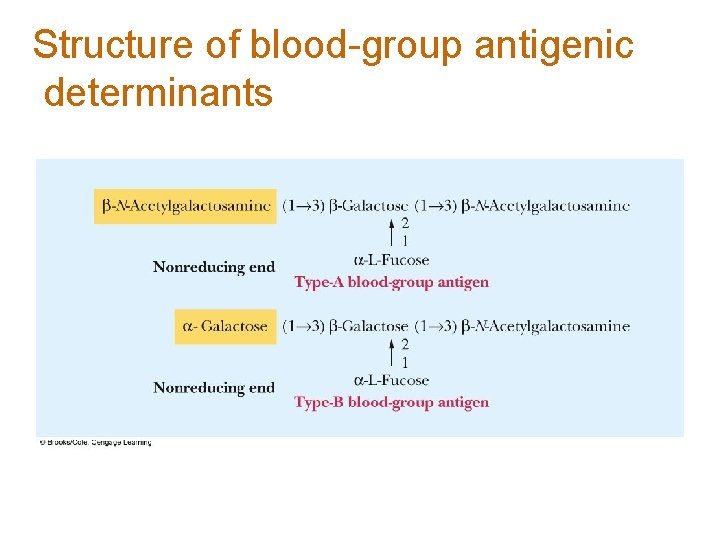
Glycoproteins contain carbohydrate units • covalently bonded to a polypeptide chain antibodies are glycoproteins – Oligosaccharide portion of glycoproteins act as – antigenic determinants Among the first antigenic determinants discovered – were the blood group substances In the ABO system, individuals are classified – according to four blood types: A, B, AB, and O At the cellular level, the biochemical basis for this – classification is a group of relatively small membrane-bound carbohydrates
Structure of blood-group antigenic determinants
Summary Sugars can be found in specific bonding • arrangements in some proteins Glycoproteins frequently play a role in the • immune response