
Amino Acids Monomers of proteins Link together via
- Slides: 12
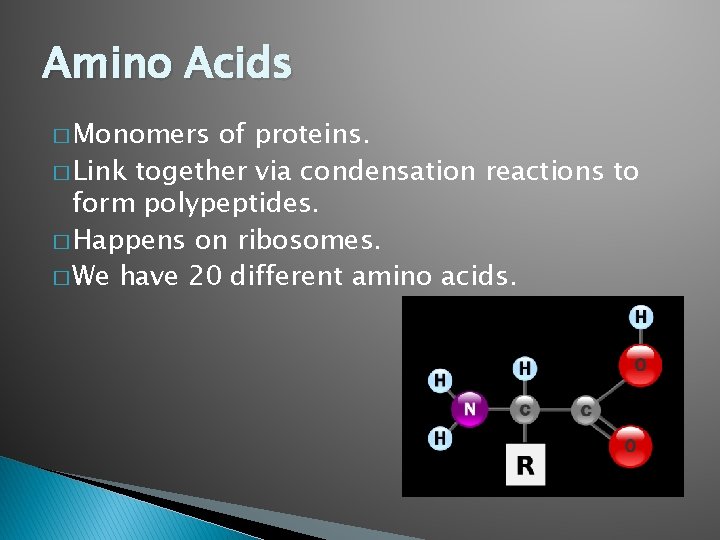
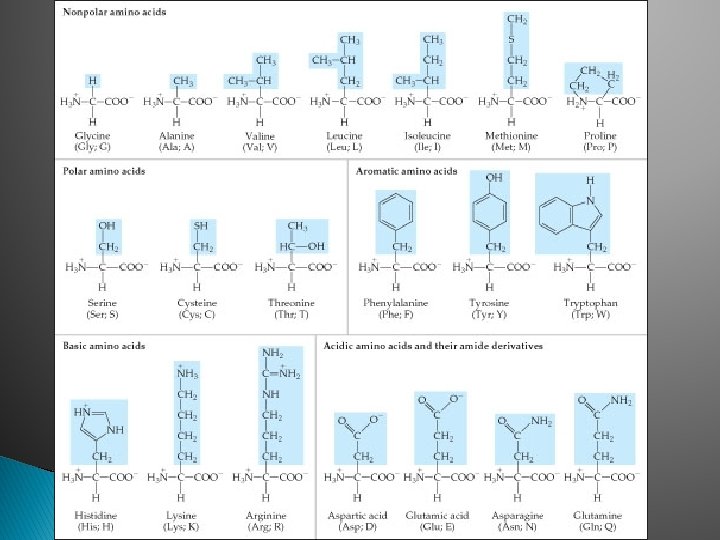
Amino Acids � Monomers of proteins. � Link together via condensation reactions to form polypeptides. � Happens on ribosomes. � We have 20 different amino acids.
Peptide Bonds � Special name for the bonds between two amino acids. � Happens between the N of one a. a. and the CO of another.
Polypeptide Diversity � 1 polypeptide can be as short as 20 amino acids or as long as 10, 000. � Amino acids can create infinite combinations. � Proteins can be made of one polypeptide, or multiple polypeptides.
Genes � Contain the genetic directions to make proteins. � Most genes code for protein. � It takes 3 bases, a codon, to code for one amino acid.
� The sequence of bases determines the amino acid sequence in a polypeptide. � The sequence of bases is called an open reading frame.
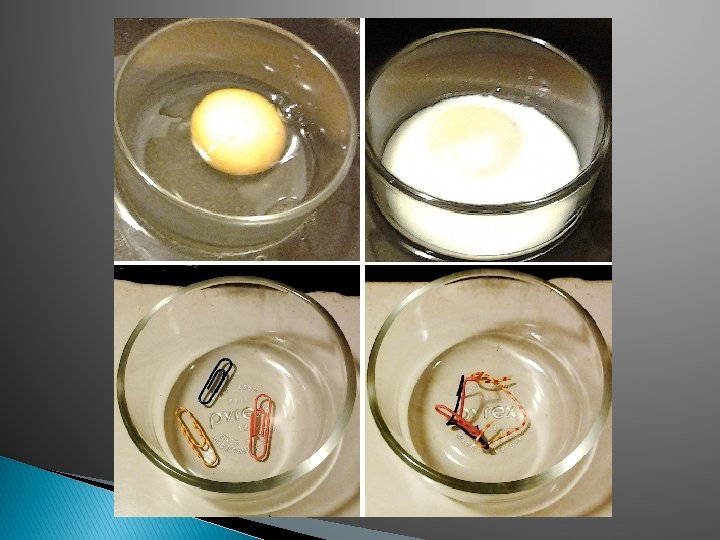
Protein Conformations � The sequence of amino acids determines the conformation, or 3 -D structure, of a protein. � The same protein is always made the same way. � Heating up a protein or placing it in p. H extremes can cause a protein to denature.
Protein Functions � Proteins have a vast array of functions in living things. 1. Catalysis- Speed up chemical reactions. 2. Muscle Contractions 3. Cytoskeletons- Help form cell structure. 4. Tensile strengthening- Help give strength to skin, tendons, and ligaments. 5. Blood Clotting- Turn blood from liquid to a gel.
6. 7. 8. 9. Transport Gases- Hemoglobin helps transport O 2 and CO 2 throughout blood. Cell Adhesion- Membrane proteins cause adjacent animal cells to stick together. Membrane Transport- Used in facilitated diffusion, active transport, and electron transport chain. Hormones
10) 11) 12) Receptors- Binding site for hormones. Packing DNA- Histone proteins help pack DNA tightly. Immunity- Proteins help form anitbodies.
Proteome � All the proteins made by a cell. � Can differ between cells. � Outside of identical twins, no one’s proteomes are the same.