
Amino acids Dr Mamoun Ahram Nursing First semester
![REMEMBER!! As p. H decreases, [H+] increases, and ionizable groups become protonotaed. Protonation of](https://slidetodoc.com/presentation_image/57610fc8ec38d2503b44836783dd33e2/image-27.jpg "REMEMBER!! As p. H decreases, [H+] increases, and ionizable groups become protonotaed. Protonation of")


- Slides: 45
Amino acids Dr. Mamoun Ahram Nursing First semester, 2018
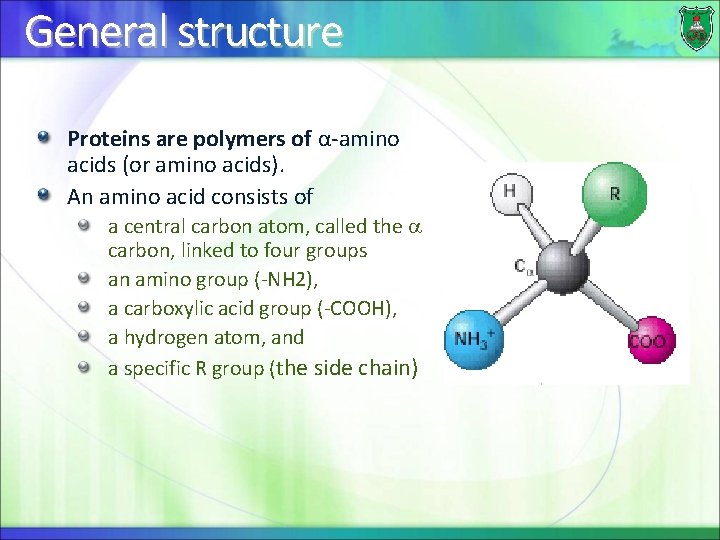
General structure Proteins are polymers of α-amino acids (or amino acids). An amino acid consists of a central carbon atom, called the carbon, linked to four groups an amino group (-NH 2), a carboxylic acid group (-COOH), a hydrogen atom, and a specific R group (the side chain)
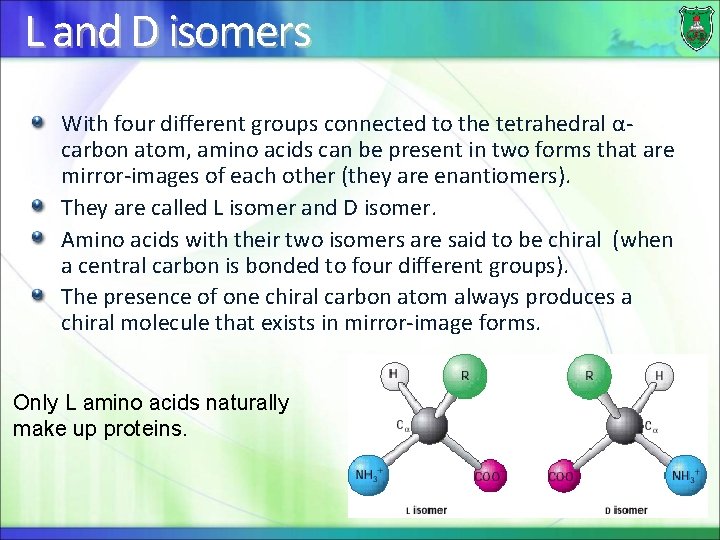
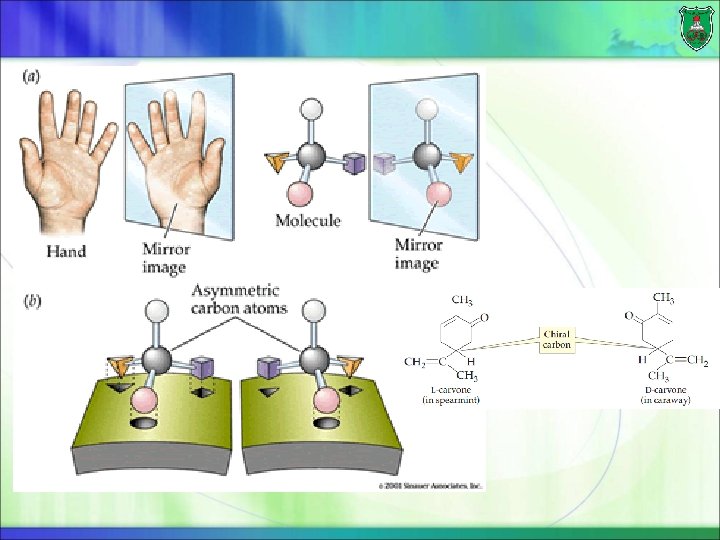
L and D isomers With four different groups connected to the tetrahedral αcarbon atom, amino acids can be present in two forms that are mirror-images of each other (they are enantiomers). They are called L isomer and D isomer. Amino acids with their two isomers are said to be chiral (when a central carbon is bonded to four different groups). The presence of one chiral carbon atom always produces a chiral molecule that exists in mirror-image forms. Only L amino acids naturally make up proteins.
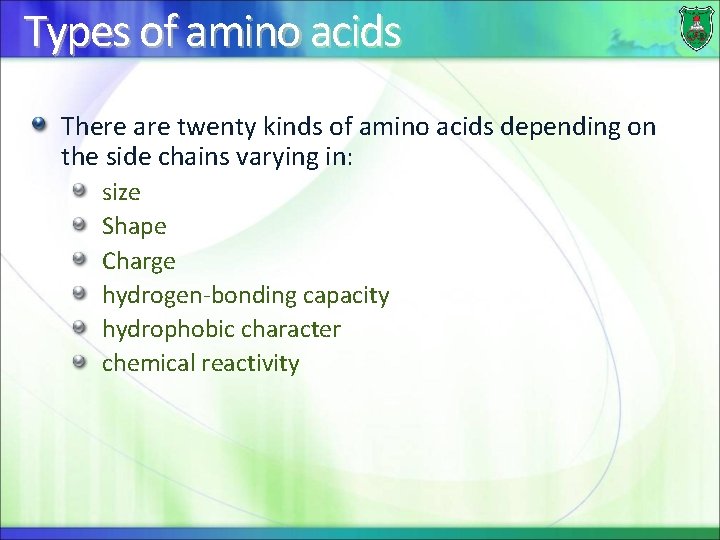
Types of amino acids There are twenty kinds of amino acids depending on the side chains varying in: size Shape Charge hydrogen-bonding capacity hydrophobic character chemical reactivity
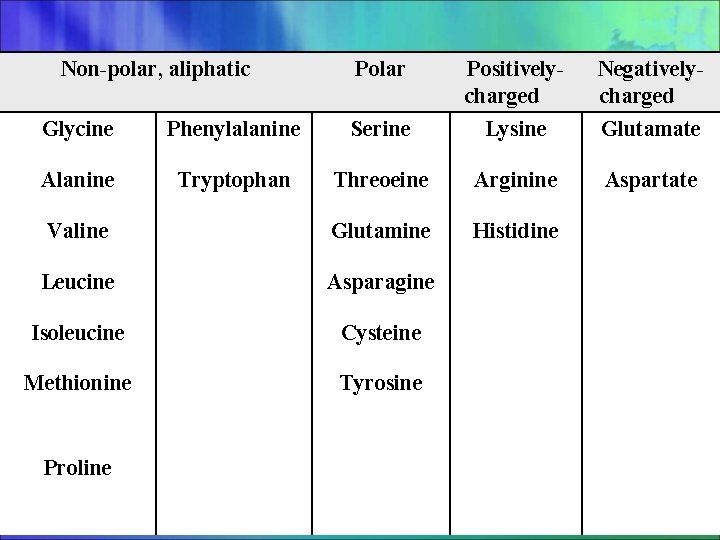
Non-polar, aliphatic Polar Positivelycharged Negativelycharged Glycine Phenylalanine Serine Lysine Glutamate Alanine Tryptophan Threoeine Arginine Aspartate Valine Glutamine Histidine Leucine Asparagine Isoleucine Cysteine Methionine Tyrosine Proline
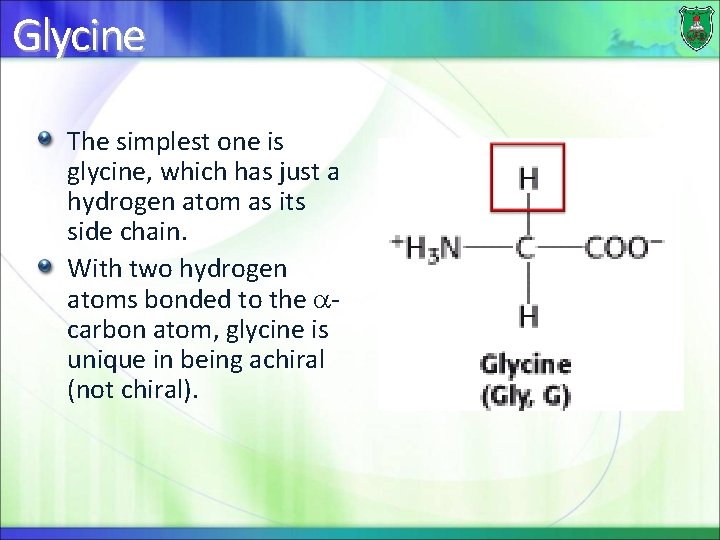
Glycine The simplest one is glycine, which has just a hydrogen atom as its side chain. With two hydrogen atoms bonded to the carbon atom, glycine is unique in being achiral (not chiral).
Non-polar, aliphatic amino acids
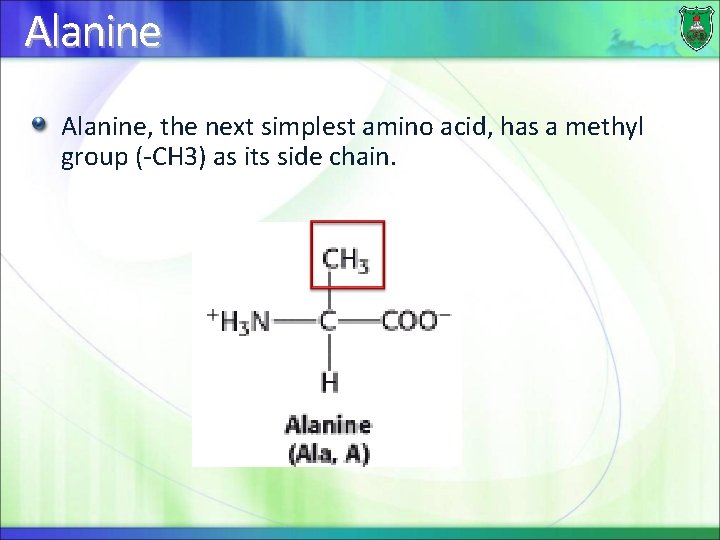
Alanine, the next simplest amino acid, has a methyl group (-CH 3) as its side chain.
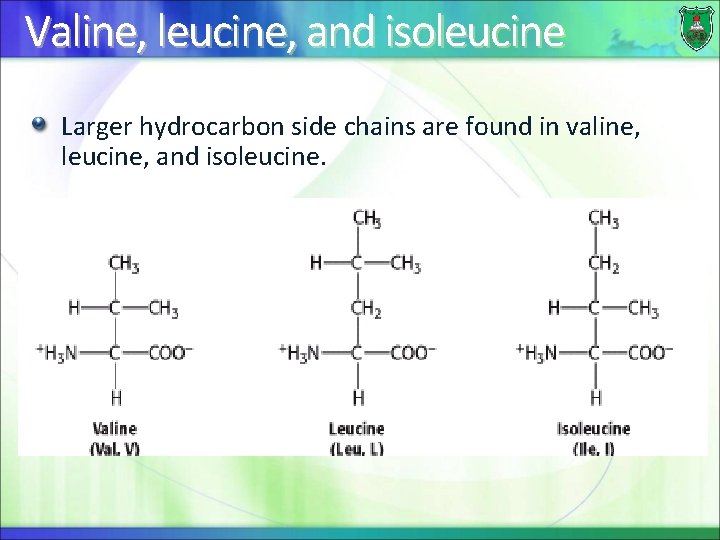
Valine, leucine, and isoleucine Larger hydrocarbon side chains are found in valine, leucine, and isoleucine.
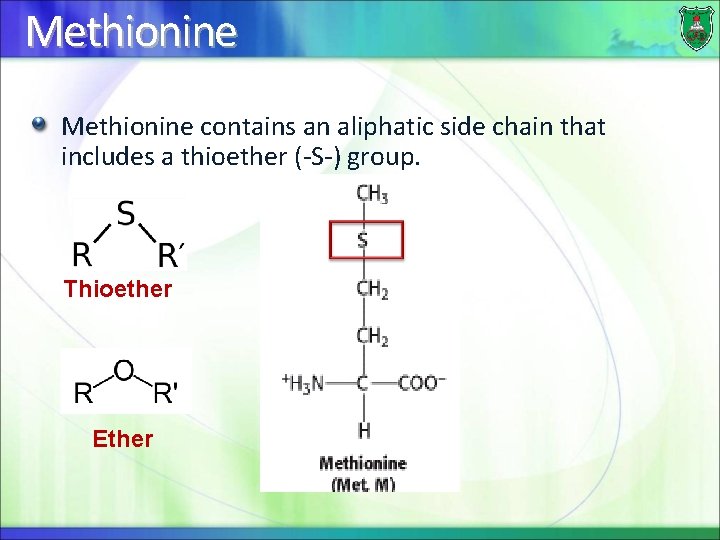
Methionine contains an aliphatic side chain that includes a thioether (-S-) group. Thioether Ether
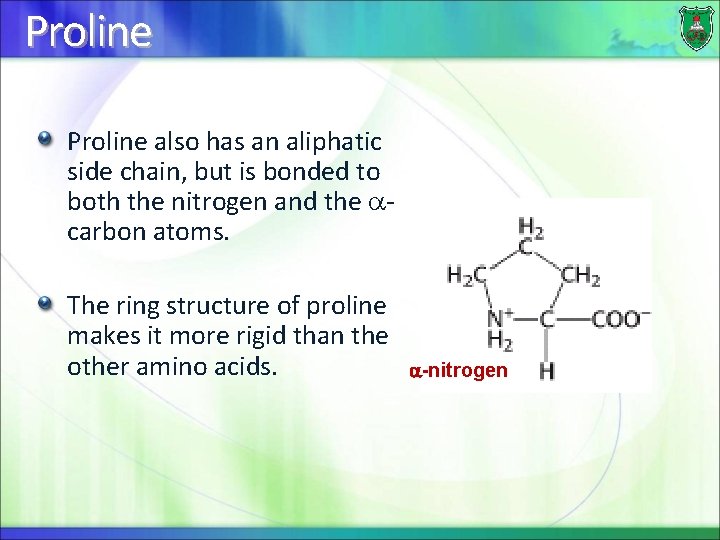
Proline also has an aliphatic side chain, but is bonded to both the nitrogen and the carbon atoms. The ring structure of proline makes it more rigid than the other amino acids. -nitrogen
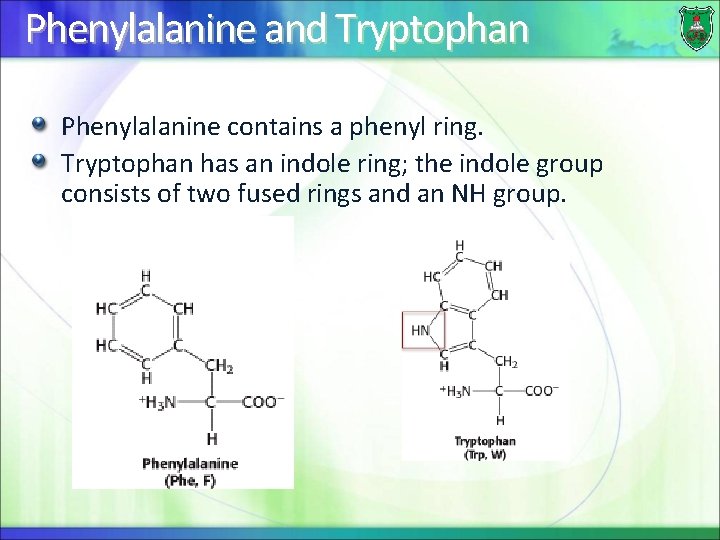
Phenylalanine and Tryptophan Phenylalanine contains a phenyl ring. Tryptophan has an indole ring; the indole group consists of two fused rings and an NH group.
Positively-charged amino acids
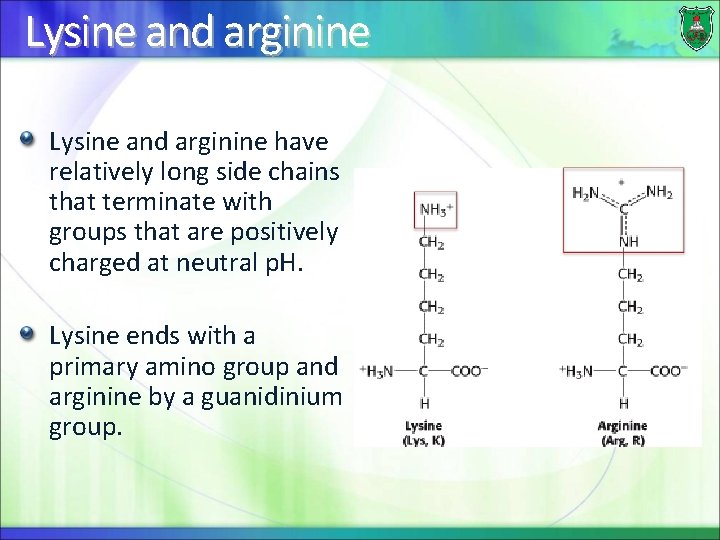
Lysine and arginine have relatively long side chains that terminate with groups that are positively charged at neutral p. H. Lysine ends with a primary amino group and arginine by a guanidinium group.
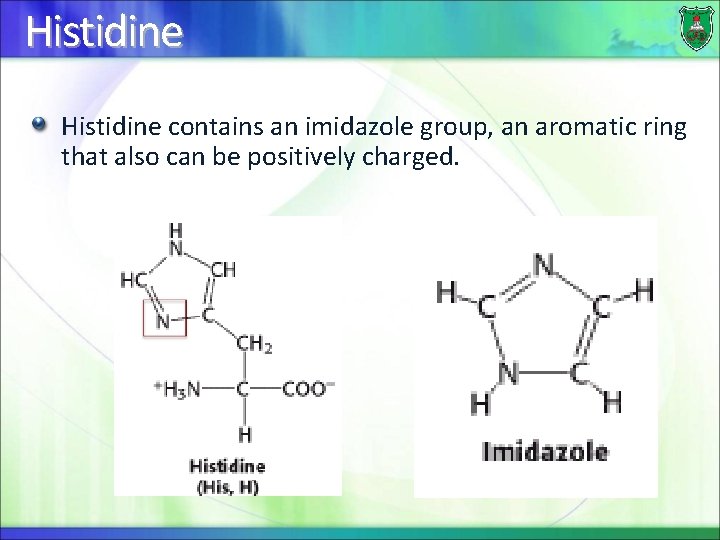
Histidine contains an imidazole group, an aromatic ring that also can be positively charged.
Negatively-charged amino acids
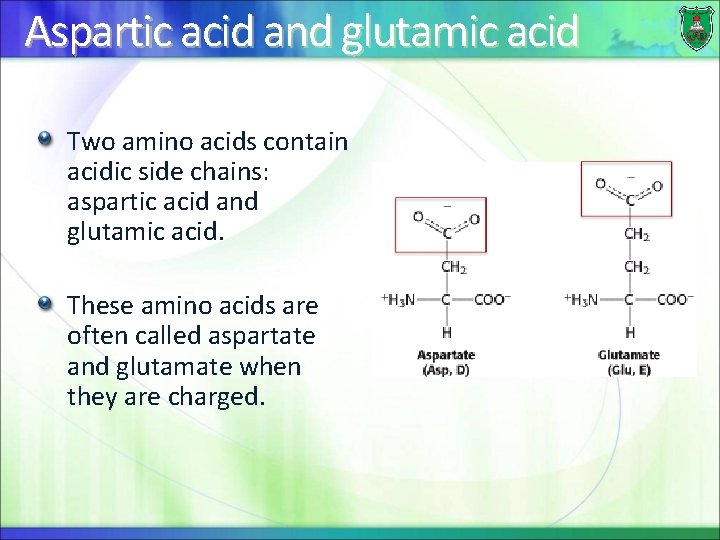
Aspartic acid and glutamic acid Two amino acids contain acidic side chains: aspartic acid and glutamic acid. These amino acids are often called aspartate and glutamate when they are charged.
Polar amino acids
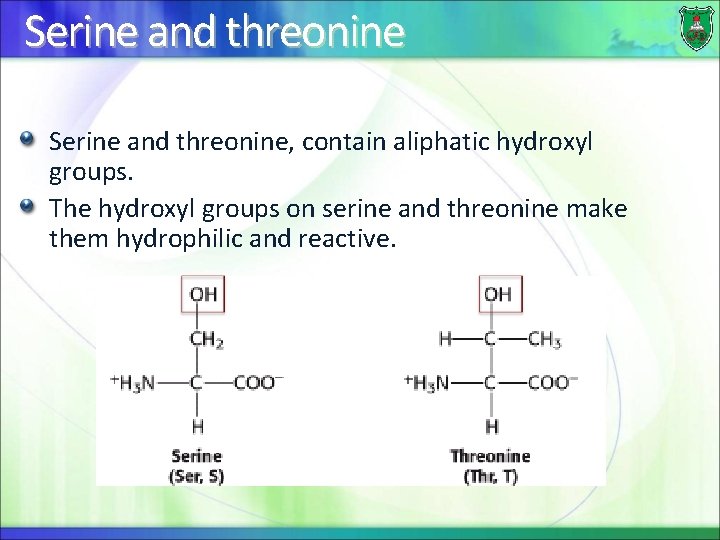
Serine and threonine, contain aliphatic hydroxyl groups. The hydroxyl groups on serine and threonine make them hydrophilic and reactive.
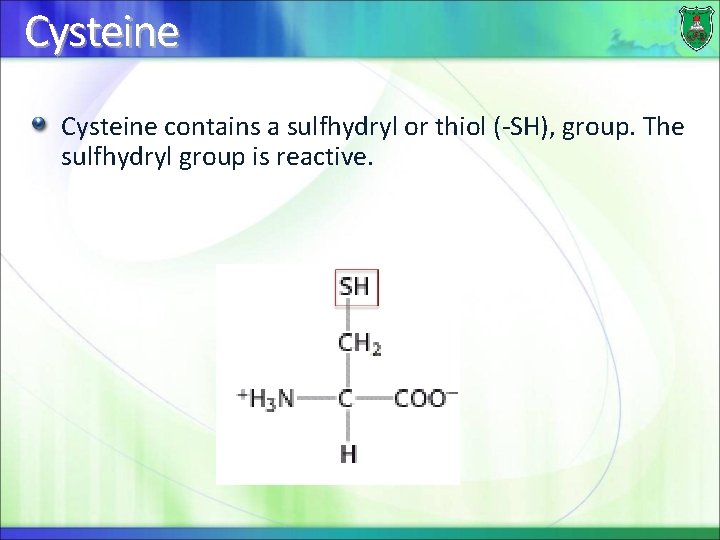
Cysteine contains a sulfhydryl or thiol (-SH), group. The sulfhydryl group is reactive.
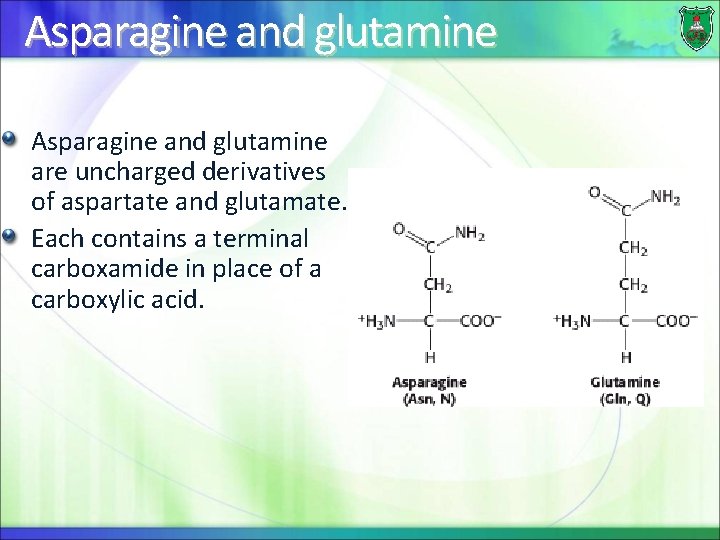
Asparagine and glutamine are uncharged derivatives of aspartate and glutamate. Each contains a terminal carboxamide in place of a carboxylic acid.
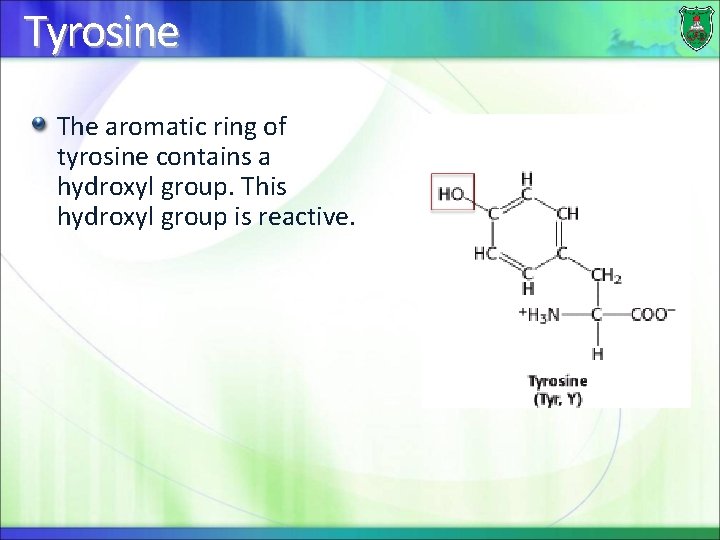
Tyrosine The aromatic ring of tyrosine contains a hydroxyl group. This hydroxyl group is reactive.
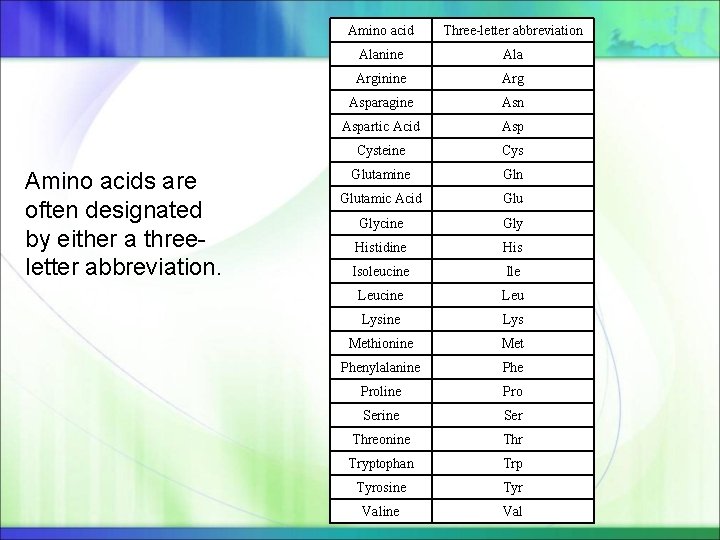
Amino acids are often designated by either a threeletter abbreviation. Amino acid Three-letter abbreviation Alanine Ala Arginine Arg Asparagine Asn Aspartic Acid Asp Cysteine Cys Glutamine Gln Glutamic Acid Glu Glycine Gly Histidine His Isoleucine Ile Leucine Leu Lysine Lys Methionine Met Phenylalanine Phe Proline Pro Serine Ser Threonine Thr Tryptophan Trp Tyrosine Tyr Valine Val
Ionization of amino acids
Why do amino acids get ionized? Amino acids can become ionized since the carboxyl group and amino group can become protonated (gain a proton) and unprotonated (lose a proton). Therefore, they can act as acids or bases. Such molecules are said to be amphoteric.
REMEMBER!! As p. H decreases, [H+] increases, and ionizable groups become protonotaed. Protonation of the amino group (NH 2) makes the group positively charged (NH 3+). Protonation of the carboxylic group (COOH) makes the group uncharged (COOH). As p. H increases, [H+] decreases, and ionizable groups become unprotonotaed (they lose their proton).
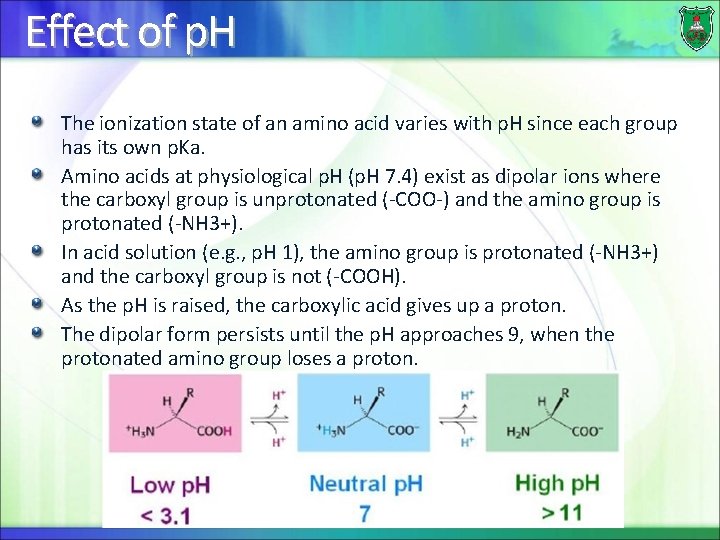
Effect of p. H The ionization state of an amino acid varies with p. H since each group has its own p. Ka. Amino acids at physiological p. H (p. H 7. 4) exist as dipolar ions where the carboxyl group is unprotonated (-COO-) and the amino group is protonated (-NH 3+). In acid solution (e. g. , p. H 1), the amino group is protonated (-NH 3+) and the carboxyl group is not (-COOH). As the p. H is raised, the carboxylic acid gives up a proton. The dipolar form persists until the p. H approaches 9, when the protonated amino group loses a proton.
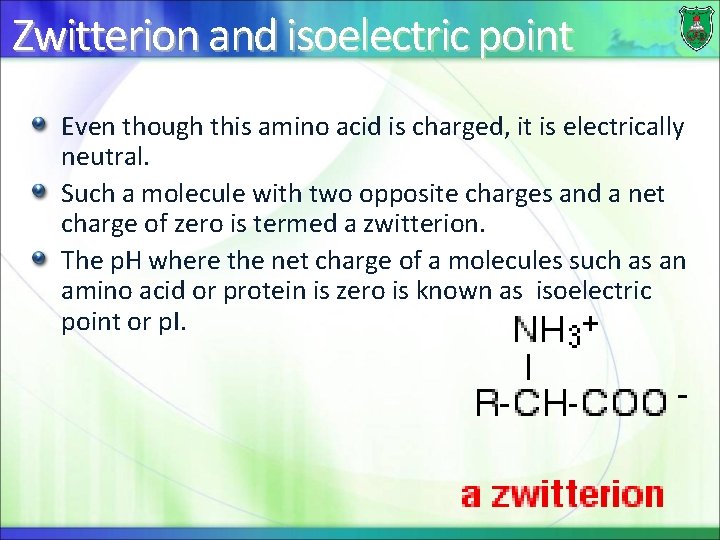
Zwitterion and isoelectric point Even though this amino acid is charged, it is electrically neutral. Such a molecule with two opposite charges and a net charge of zero is termed a zwitterion. The p. H where the net charge of a molecules such as an amino acid or protein is zero is known as isoelectric point or p. I.
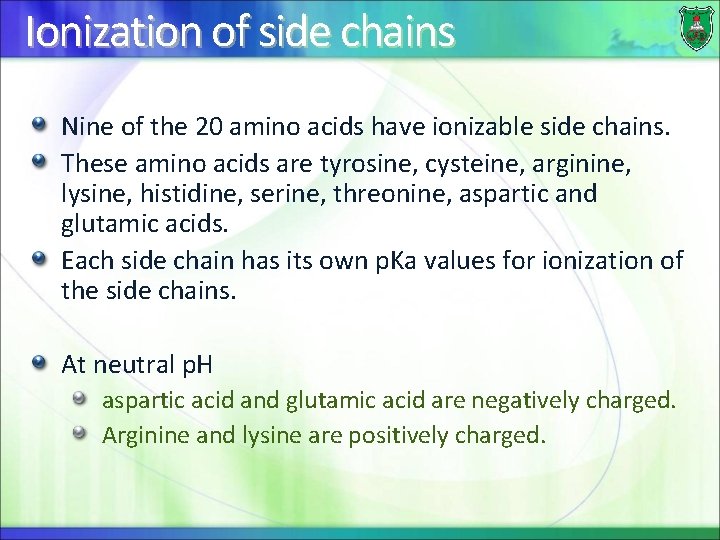
Ionization of side chains Nine of the 20 amino acids have ionizable side chains. These amino acids are tyrosine, cysteine, arginine, lysine, histidine, serine, threonine, aspartic and glutamic acids. Each side chain has its own p. Ka values for ionization of the side chains. At neutral p. H aspartic acid and glutamic acid are negatively charged. Arginine and lysine are positively charged.
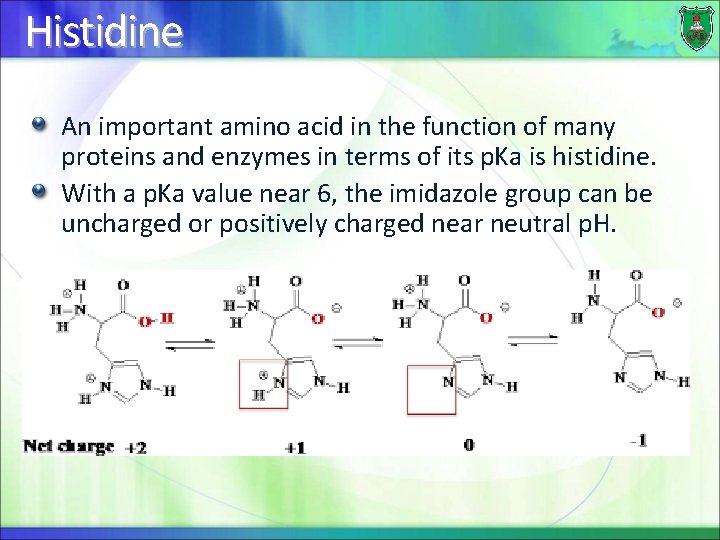
Histidine An important amino acid in the function of many proteins and enzymes in terms of its p. Ka is histidine. With a p. Ka value near 6, the imidazole group can be uncharged or positively charged near neutral p. H.
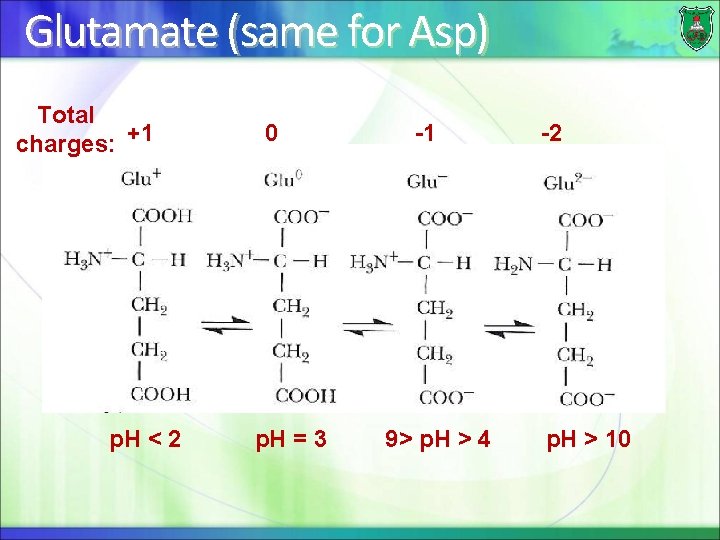
Glutamate (same for Asp) Total charges: +1 p. H < 2 0 p. H = 3 -1 9> p. H > 4 -2 p. H > 10
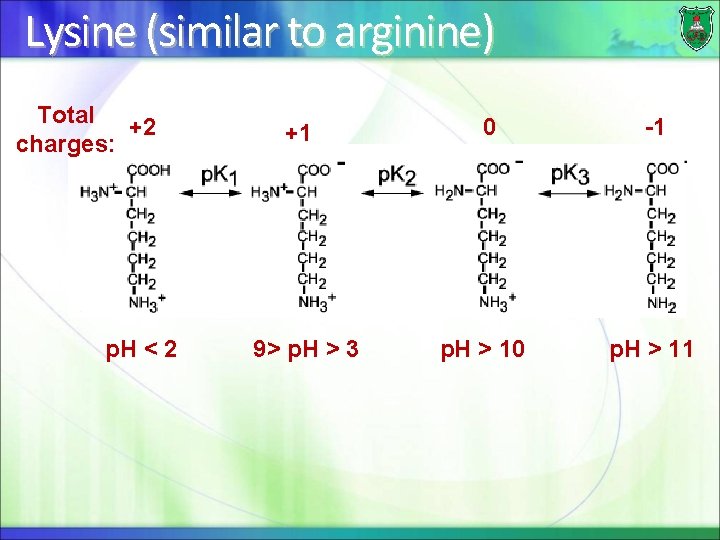
Lysine (similar to arginine) Total +2 charges: p. H < 2 +1 9> p. H > 3 0 -1 p. H > 10 p. H > 11
Note You need to know the names of amino acids, the special structural features of amino acids, their abbreviations or designations, the p. Ka of groups (not exact numbers, but which ones are acidic, basic, or near neutral).
Essential amino acids There are nine amino acids that are essential. Essential nutrients are those not made by the human body in significant amounts and must be derived from diet These are: Histidine, Isoleucine, Lysine, Methionine, Phenylalanine, Threonine, Tryptophan, and Valine. The other 11 amino acids are non-essential amino acids.
Polypeptidesandprotein structure
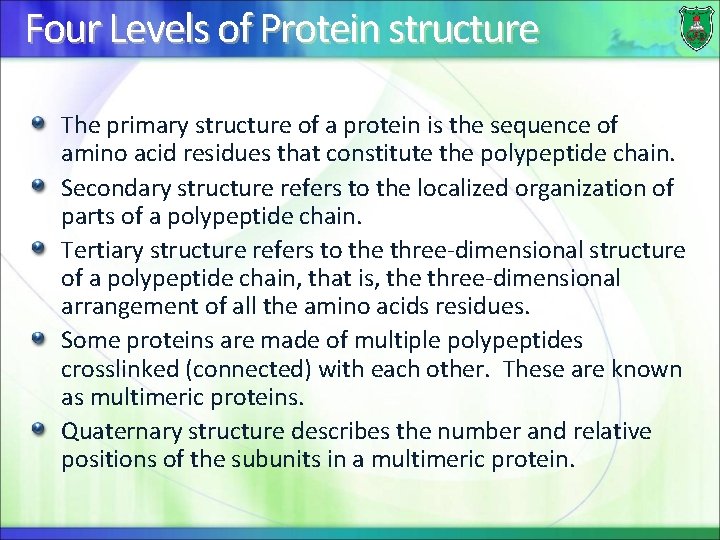
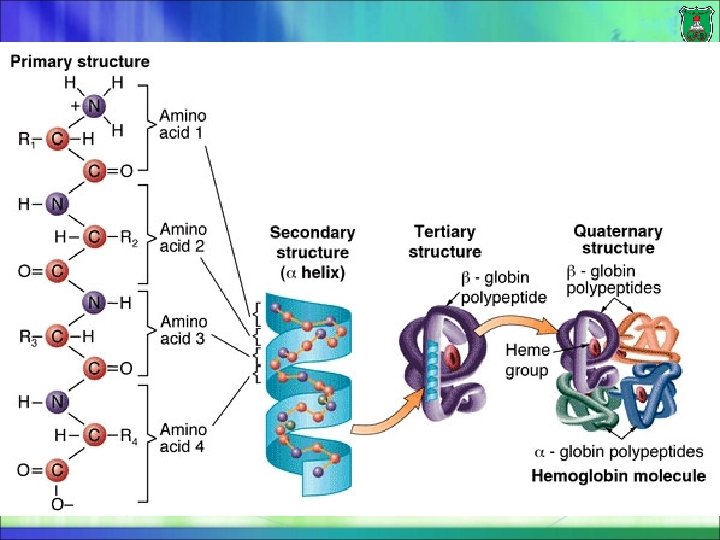
Four Levels of Protein structure The primary structure of a protein is the sequence of amino acid residues that constitute the polypeptide chain. Secondary structure refers to the localized organization of parts of a polypeptide chain. Tertiary structure refers to the three-dimensional structure of a polypeptide chain, that is, the three-dimensional arrangement of all the amino acids residues. Some proteins are made of multiple polypeptides crosslinked (connected) with each other. These are known as multimeric proteins. Quaternary structure describes the number and relative positions of the subunits in a multimeric protein.
Primarystructure
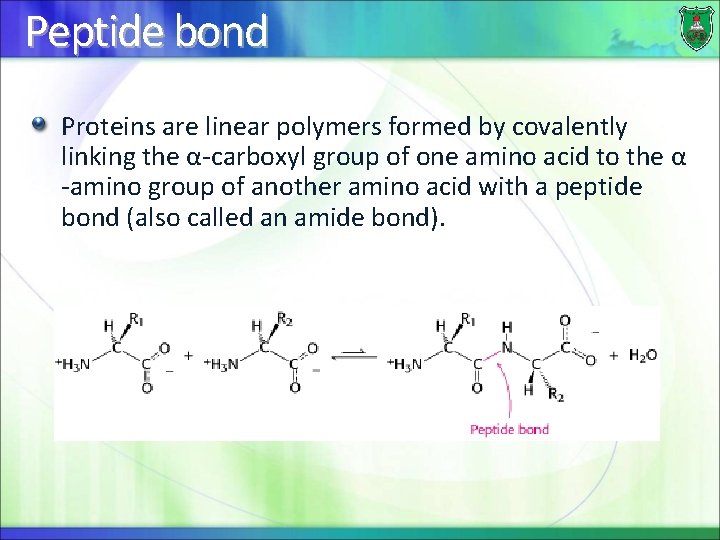
Peptide bond Proteins are linear polymers formed by covalently linking the α-carboxyl group of one amino acid to the α -amino group of another amino acid with a peptide bond (also called an amide bond).
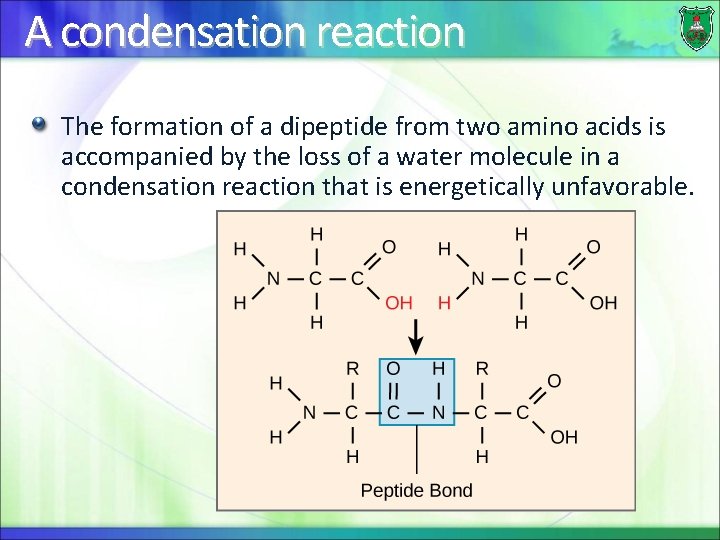
A condensation reaction The formation of a dipeptide from two amino acids is accompanied by the loss of a water molecule in a condensation reaction that is energetically unfavorable.
Definitions The short chain of amino acids is known as an oligopeptides or just peptide. Each amino acid unit in a polypeptide is called a residue Longer peptides are referred to as polypeptides. Peptides generally contain fewer than 20 -30 amino acid residues, whereas polypeptides contain as many as 4000 residues. Polypeptide chains that have organized threedimensional structures are referred to as proteins.
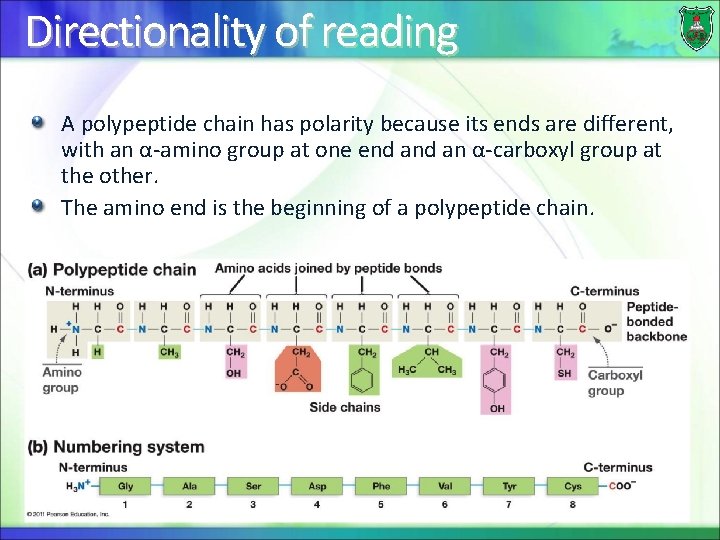
Directionality of reading A polypeptide chain has polarity because its ends are different, with an α-amino group at one end an α-carboxyl group at the other. The amino end is the beginning of a polypeptide chain.
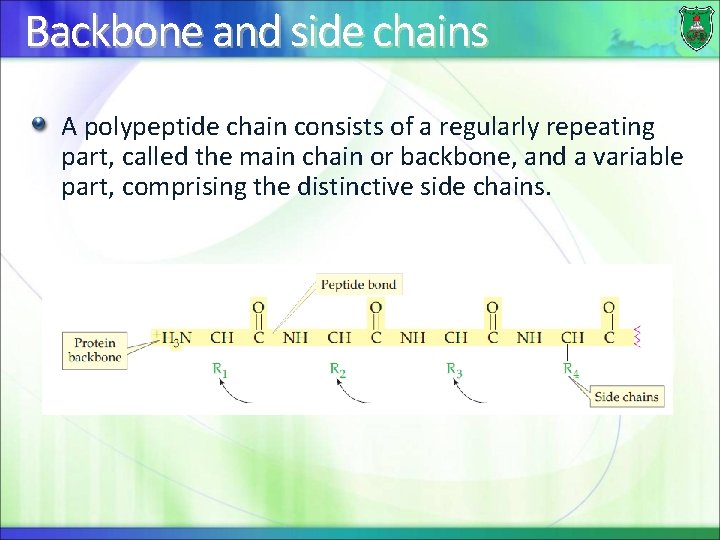
Backbone and side chains A polypeptide chain consists of a regularly repeating part, called the main chain or backbone, and a variable part, comprising the distinctive side chains.
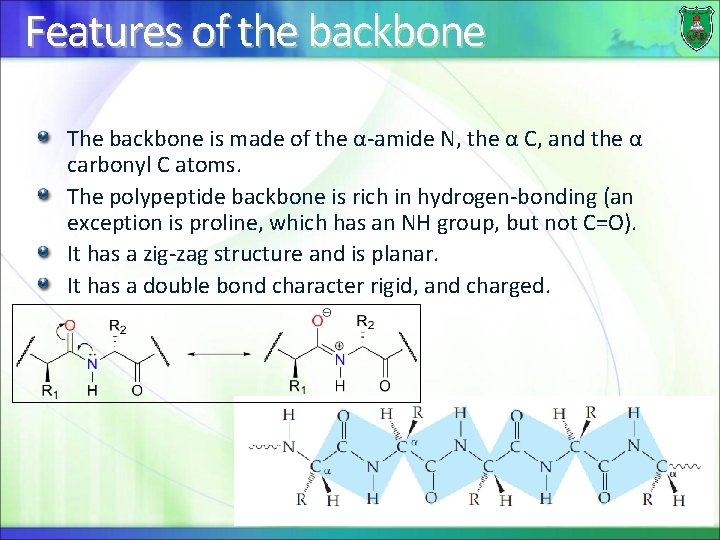
Features of the backbone The backbone is made of the α-amide N, the α C, and the α carbonyl C atoms. The polypeptide backbone is rich in hydrogen-bonding (an exception is proline, which has an NH group, but not C=O). It has a zig-zag structure and is planar. It has a double bond character rigid, and charged.