
Amino Acids 1 Dr Nesrin Mwafi Biochemistry Molecular
Amino Acids 1 Dr. Nesrin Mwafi Biochemistry & Molecular Biology Department Faculty of Medicine, Mutah University
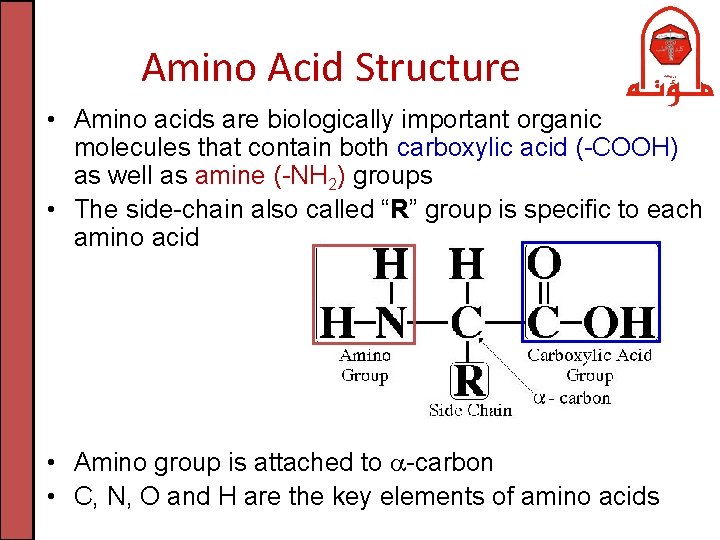
Amino Acid Structure • Amino acids are biologically important organic molecules that contain both carboxylic acid (-COOH) as well as amine (-NH 2) groups • The side-chain also called “R” group is specific to each amino acid • Amino group is attached to -carbon • C, N, O and H are the key elements of amino acids
Biological significance of Amino Acids 1. Amino acids are N-containing molecules 2. The basic structural building units (monomers) of proteins 3. Precursors of many biomolecules like neurotransmitters (non-protein role) 4. They are also utilized as an energy source • There are 20 standard (canonical) amino acids which are encoded directly by triplet codons in the genetic code during protein synthesis process (m. RNA translation)
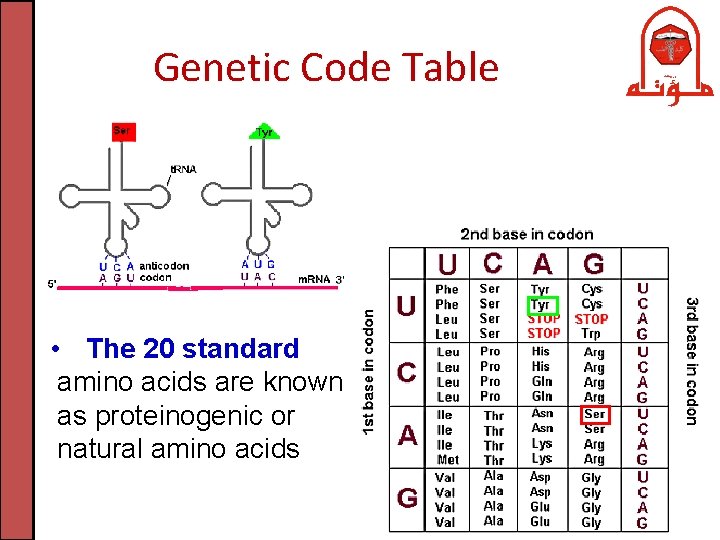
Genetic Code Table • The 20 standard amino acids are known as proteinogenic or natural amino acids
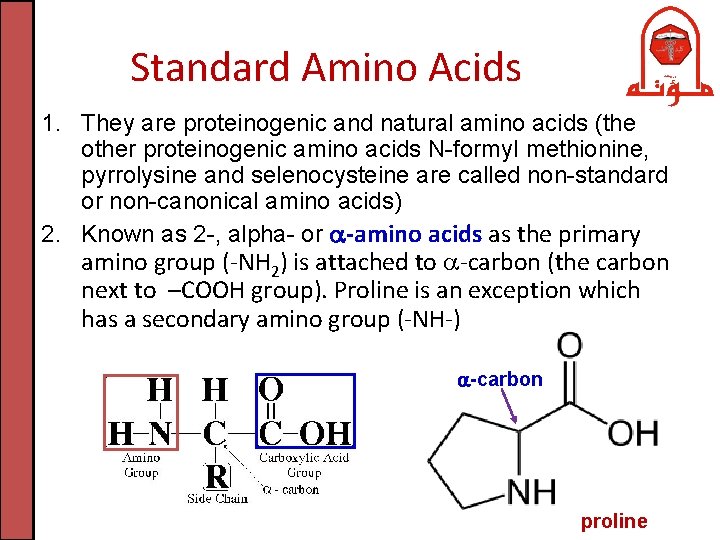
Standard Amino Acids 1. They are proteinogenic and natural amino acids (the other proteinogenic amino acids N-formyl methionine, pyrrolysine and selenocysteine are called non-standard or non-canonical amino acids) 2. Known as 2 -, alpha- or -amino acids as the primary amino group (-NH 2) is attached to -carbon (the carbon next to –COOH group). Proline is an exception which has a secondary amino group (-NH-) -carbon proline
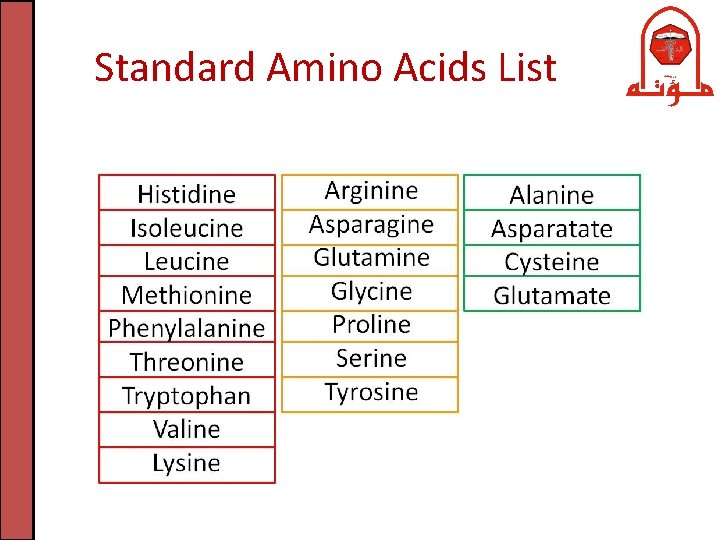
Standard Amino Acids List
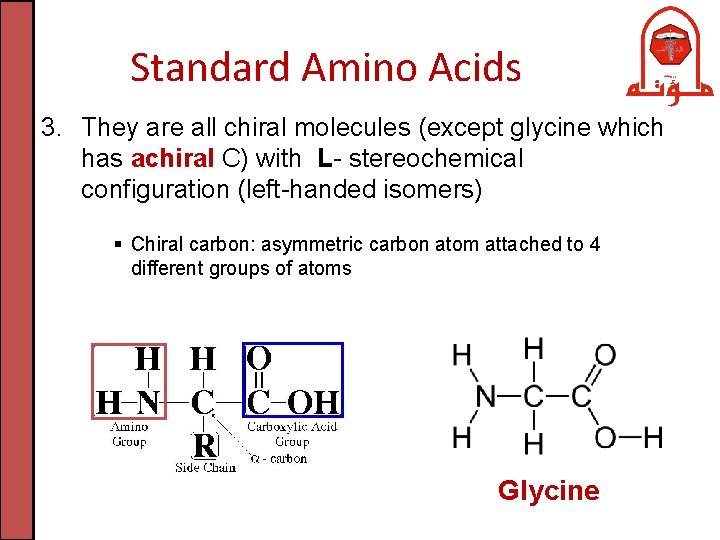
Standard Amino Acids 3. They are all chiral molecules (except glycine which has achiral C) with L- stereochemical configuration (left-handed isomers) § Chiral carbon: asymmetric carbon atom attached to 4 different groups of atoms Glycine
Isomerization • Isomers: are molecules with same molecular formula but different chemical structures 1. Constitutional (structural) isomers: atoms and functional groups bind together in different ways 2. Stereoisomers (spatial isomers): differ in the configuration of atoms rather than the order of atomic connectivity
D/L Amino Acids • Enantiomers: are two stereoisomers that are mirror images to each other but not superimposable • D- (dexter)/L- (laevus) Nomenclature system: commonly used to assign the configurations in sugars (carbohydrates) and amino acids • As a rule of thumb: if the amino group is on the right side of -carbon at Fisher projection , the configuration is D. If it is on the left, the configuration is L.

mirror Fischer Projections of Amino Acids L-alanine D-alanine L-cysteine D-cysteine Fisher Projection: is one way commonly used to represent the structure of chiral molecules like carbohydrates and amino acids
D/L Amino Acids • Most naturally occurring sugars are D-isomers while most naturally occurring amino acids are Lisomers (amino acids of protein) • D-amino acids polypeptides (right-handed isomers) are components of bacterial cell walls to resist digestion by other organisms
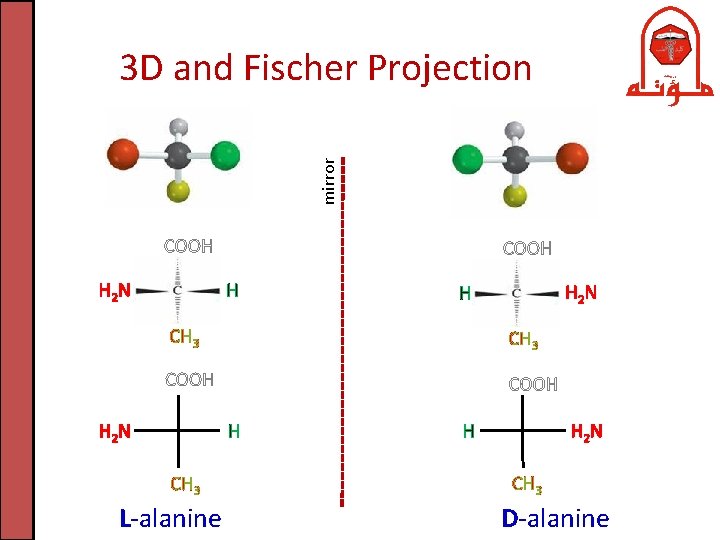
mirror 3 D and Fischer Projection COOH H 2 N COOH H H 2 N H CH 3 COOH H 2 N H CH 3 L-alanine H 2 N H CH 3 D-alanine
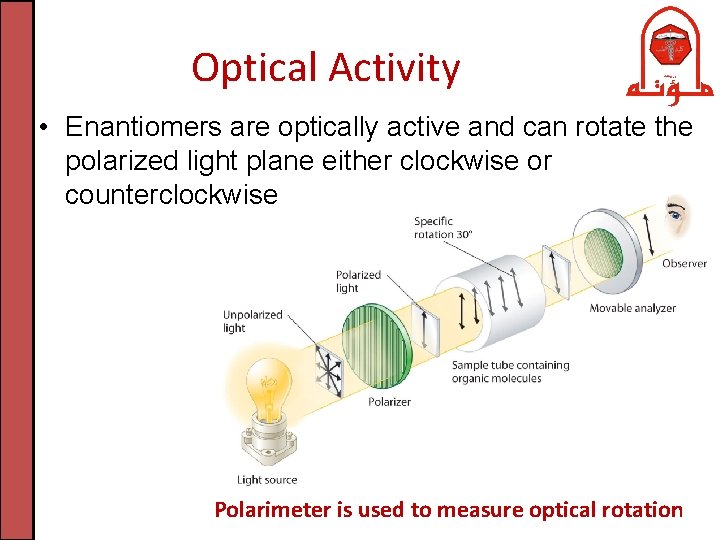
Optical Activity • Enantiomers are optically active and can rotate the polarized light plane either clockwise or counterclockwise Polarimeter is used to measure optical rotation
Optical Activity • (+)/(-) nomenclature system: if one enantiomer rotates the light clockwise, it is labeled (+) or (d) (dextrorotatory). The second mirror image enantiomer is labeled (-) or (l) laevorotatory • D/L system should not be confused with +/- or d/l system. For example, D-isomer might be levorotatory • 9 of 19 L-amino acids commonly found in proteins are dextrorotatory • Racemic mixture contains equal amounts of each enantiomer
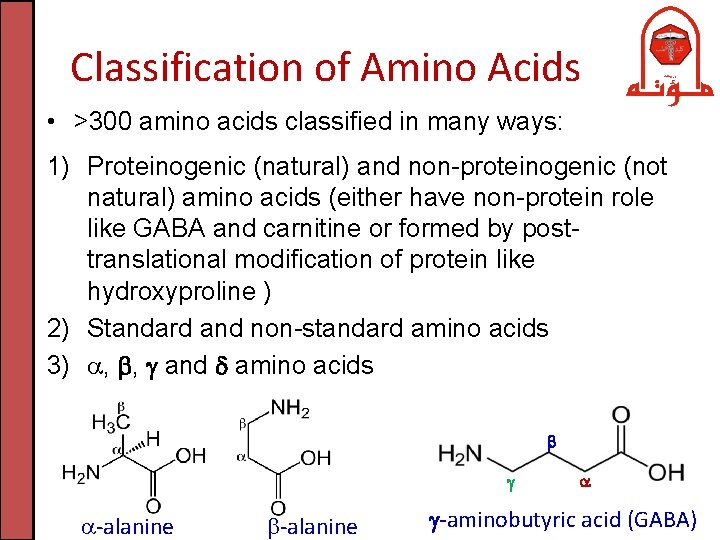
Classification of Amino Acids • >300 amino acids classified in many ways: 1) Proteinogenic (natural) and non-proteinogenic (not natural) amino acids (either have non-protein role like GABA and carnitine or formed by posttranslational modification of protein like hydroxyproline ) 2) Standard and non-standard amino acids 3) , , and amino acids -alanine -aminobutyric acid (GABA)
Classification of Amino Acids • -amino acids are non-proteinogenic with -alanine is the only common naturally occurring -amino acid. alanine is used in plants and microorganisms in the synthesis of pantothenic acid (vitamin B 5) • -peptides are artificial peptides used in some antibiotics to counter resistance as they are more stable against proteolytic degradation
Categories of Standard Amino Acids • The 20 standard amino acids are classified into 3 major categories according to the polarities of their “R” groups: 1) Amino acids with non-polar R groups 2) Amino acids with charged polar R groups 3) Amino acids with uncharged polar R groups
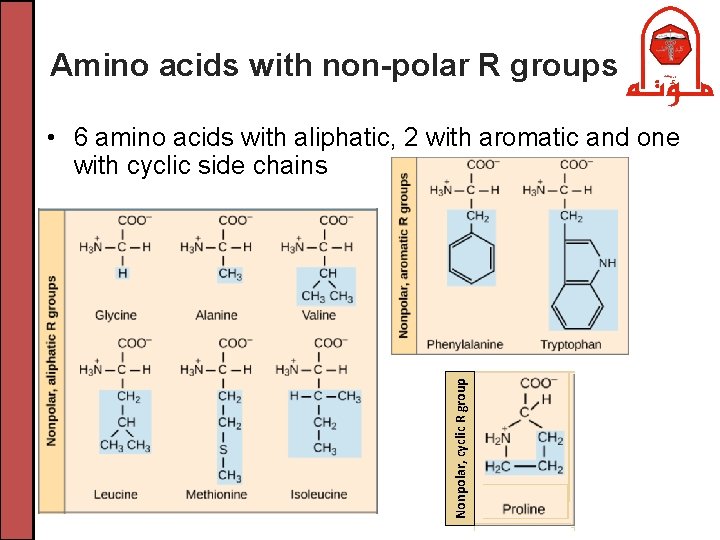
Amino acids with non-polar R groups Nonpolar, cyclic R group • 6 amino acids with aliphatic, 2 with aromatic and one with cyclic side chains
Amino acids with non-polar R groups • Glycine has the simplest side chain: H atom • Alanine, valine, leucine and isoleucine have aliphatic hydrocarbon side chains • Methionine has a thioether side chain (sulfur atom) • Proline has a cyclic pyrrolidine side chain • Phenylalanine has a phenyl moiety • Tryptophan has an indole group
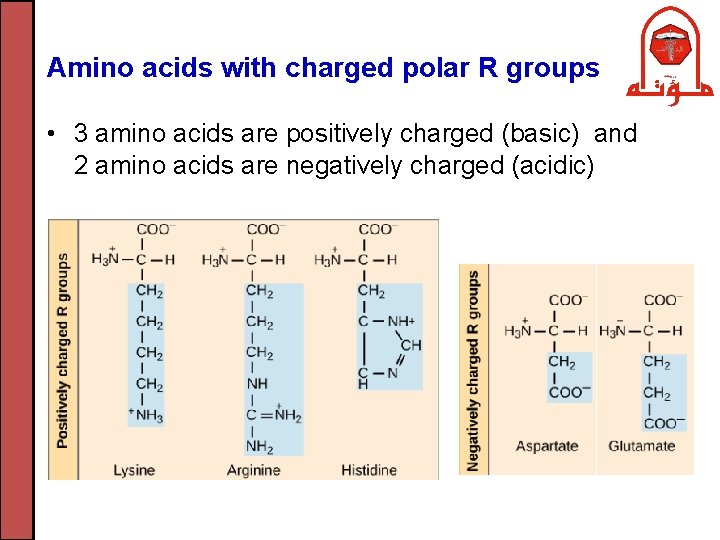
Amino acids with charged polar R groups • 3 amino acids are positively charged (basic) and 2 amino acids are negatively charged (acidic)
Amino acids with charged polar R groups • • Arginine has a guanidine group Lysine has a butyl ammonium side chain Histidine has imidazole group Aspartic and glutamic acids in their ionized state are called aspartate and glutamate, respectively
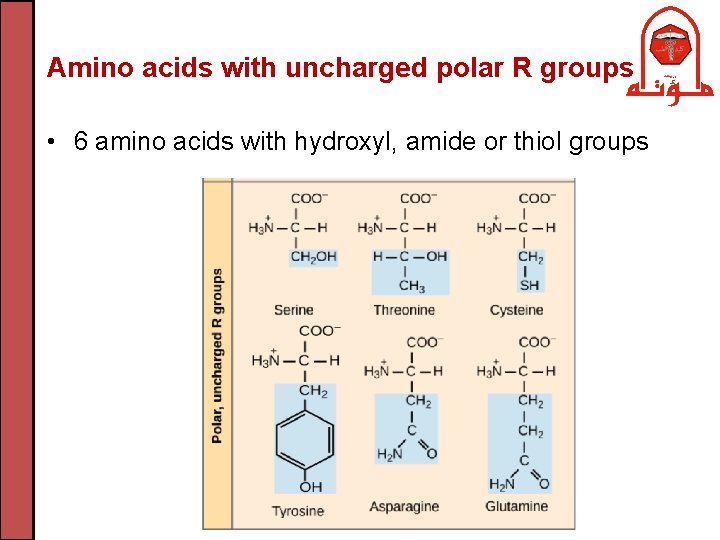
Amino acids with uncharged polar R groups • 6 amino acids with hydroxyl, amide or thiol groups
Amino acids with uncharged polar R groups • Serine and threonine bear hydroxyl (-OH) R group • Asparagine and glutamine have amide bearing side chains. They are the amide derivatives of aspartic and glutamic acids • Tyrosine is aromatic and has a phenolic group • Cysteine has a thiol group that can form a disulfide bond (-S-S-) with another cysteine through the oxidation of 2 thiol groups (cystine is the oxidized dimeric form). The disulfide bridge in proteins contributes to the overall shape of a protein
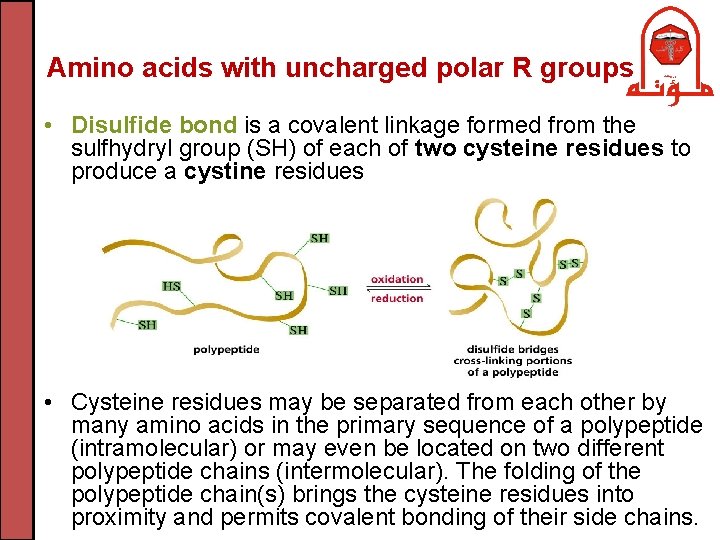
Amino acids with uncharged polar R groups • Disulfide bond is a covalent linkage formed from the sulfhydryl group (SH) of each of two cysteine residues to produce a cystine residues • Cysteine residues may be separated from each other by many amino acids in the primary sequence of a polypeptide (intramolecular) or may even be located on two different polypeptide chains (intermolecular). The folding of the polypeptide chain(s) brings the cysteine residues into proximity and permits covalent bonding of their side chains.
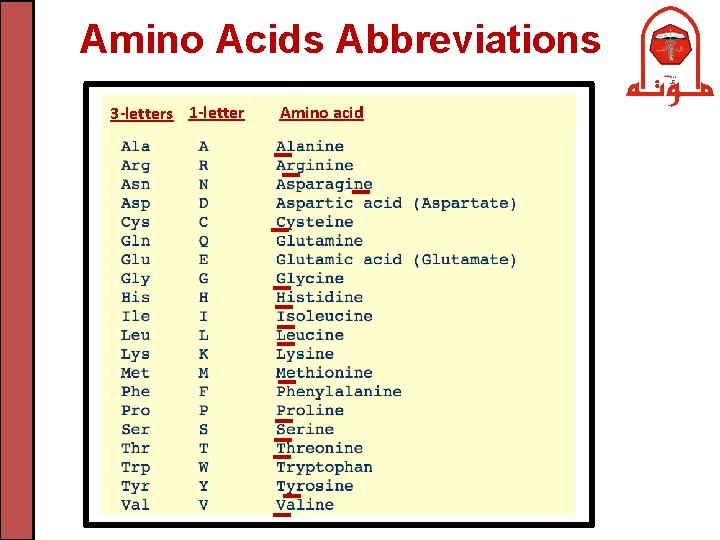
Amino Acids Abbreviations 3 -letters 1 -letter Amino acid
Ensembl (Genomic Browser )
Ensembl (Genomic Browser )
- Slides: 27