
Amines Organic derivatives of ammonia primary 1 amine
- Slides: 5
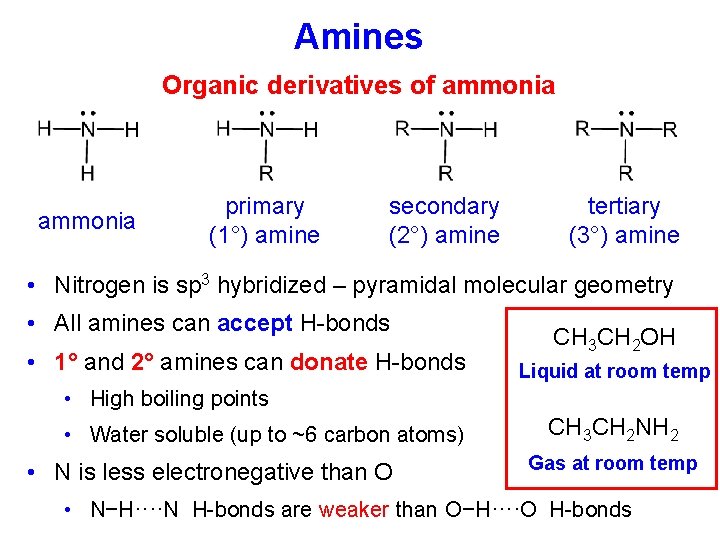
Amines Organic derivatives of ammonia primary (1°) amine secondary (2°) amine tertiary (3°) amine • Nitrogen is sp 3 hybridized – pyramidal molecular geometry • All amines can accept H-bonds • 1° and 2° amines can donate H-bonds CH 3 CH 2 OH Liquid at room temp • High boiling points • Water soluble (up to ~6 carbon atoms) • N is less electronegative than O CH 3 CH 2 NH 2 Gas at room temp • N−H····N H-bonds are weaker than O−H····O H-bonds
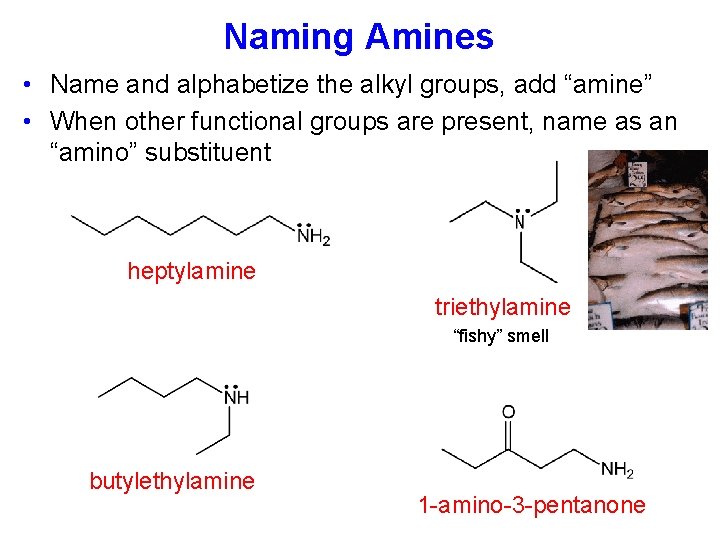
Naming Amines • Name and alphabetize the alkyl groups, add “amine” • When other functional groups are present, name as an “amino” substituent heptylamine triethylamine “fishy” smell butylethylamine 1 -amino-3 -pentanone
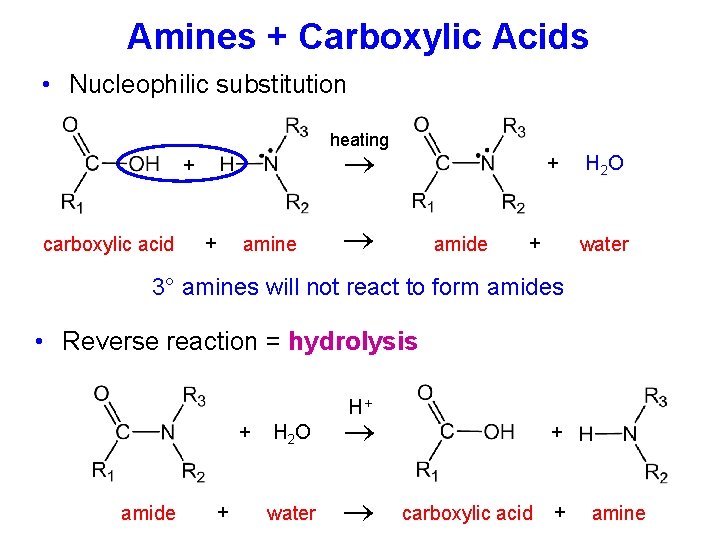
Amines + Carboxylic Acids • Nucleophilic substitution heating + carboxylic acid + amine + amide + H 2 O water 3° amines will not react to form amides • Reverse reaction = hydrolysis H+ + amide + H 2 O water + carboxylic acid + amine
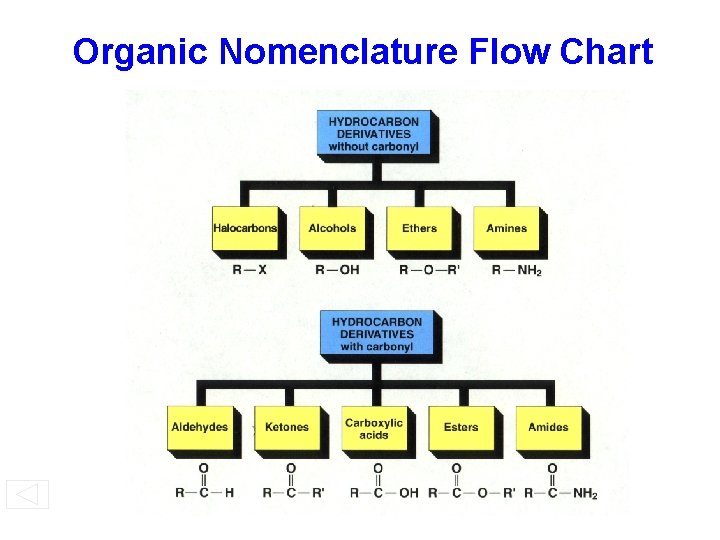
Organic Nomenclature Flow Chart
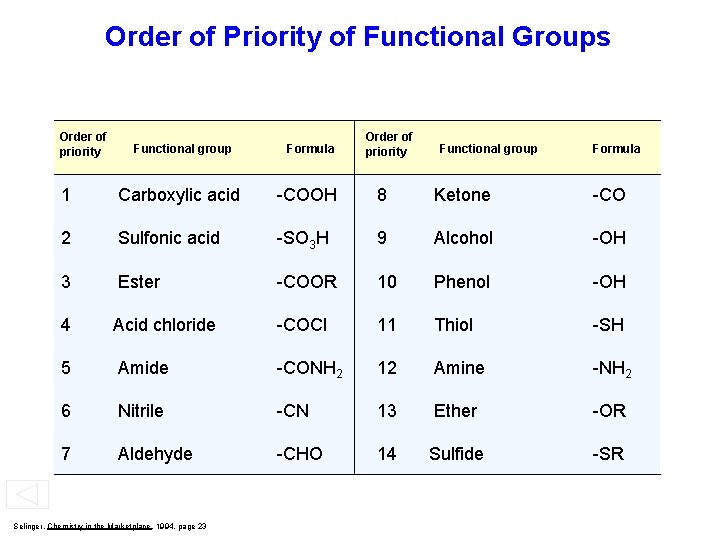
Order of Priority of Functional Groups Order of priority Functional group Formula 1 Carboxylic acid -COOH 8 Ketone -CO 2 Sulfonic acid -SO 3 H 9 Alcohol -OH 3 Ester -COOR 10 Phenol -OH 4 Acid chloride -COCl 11 Thiol -SH 5 Amide -CONH 2 12 Amine -NH 2 6 Nitrile -CN 13 Ether -OR 7 Aldehyde -CHO 14 Sulfide -SR Selinger, Chemistry in the Marketplace, 1994, page 23