
AMIE Automatic Monitoring of Indoor Exercises Tom Decroos









![Methodology: baselines • Nearest Neighbors - Dynamic Time Warping [Su et al. ] •](https://slidetodoc.com/presentation_image_h2/be873e908263be748ee8913174a5df17/image-35.jpg "Methodology: baselines • Nearest Neighbors - Dynamic Time Warping [Su et al. ] •")


- Slides: 43
AMIE: Automatic Monitoring of Indoor Exercises Tom Decroos, Kurt Schütte, Tim Op De Beéck, Benedicte Vanwanseele, Jesse Davis ECMLPKDD’ 18
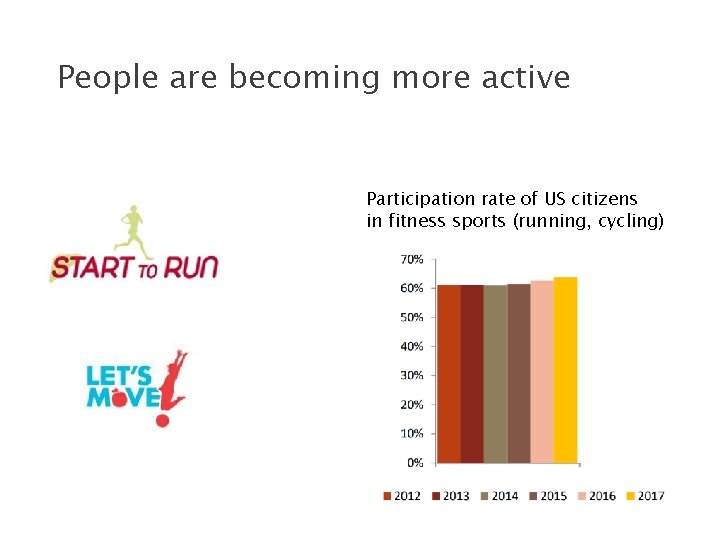
People are becoming more active Participation rate of US citizens in fitness sports (running, cycling)
People are becoming more active
Activity leads to sports-related injuries 30 million children in the US participate in sports 3. 5 million injuries per year Source: American Academy of Pediatrics
Problem: The current rehabilitation paradigm is often ineffective because people … 1. Don’t visit the physiotherapist due to time and cost 2. Don’t do their exercises 3. Don’t learn the correct movements of rehabilitation exercises
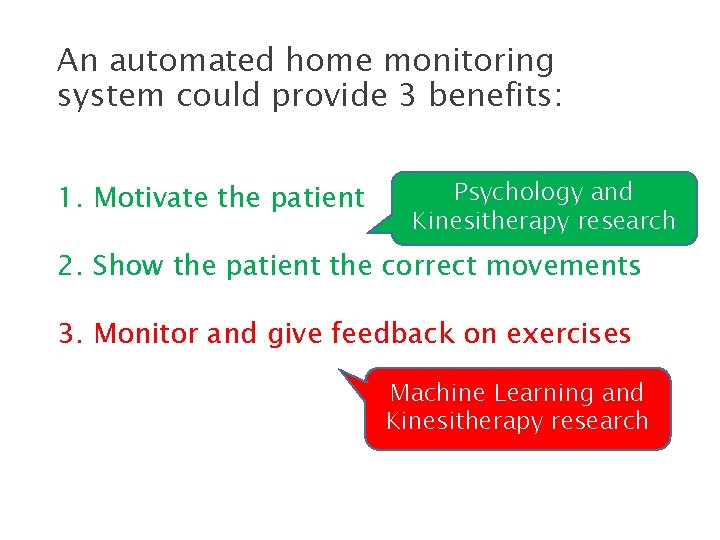
An automated home monitoring system could provide 3 benefits: 1. Motivate the patient 2. Show the patient the correct movements 3. Monitor and give feedback on exercises
An automated home monitoring system could provide 3 benefits: 1. Motivate the patient Psychology and Kinesitherapy research 2. Show the patient the correct movements 3. Monitor and give feedback on exercises Machine Learning and Kinesitherapy research
Overview Related work Collected data Our 4 -step approach Experiments
Overview Related work Collected data Our 4 -step approach Experiments
Some papers discuss their model, but not their experiments Anton et al. : A Kinect-based telerehabilitation system Tang et al. : Physio@home: Exploring visual guidance and feedback techniques for physiotherapy exercises Zhao et al. : A Kinect-based rehabilitation exercise monitoring and guidance system Some papers discuss their experiments, but not their model Komatireddy et al. : Quality and quantity of rehabilitation exercises delivered by a 3 D motion controlled camera.
Overview Related work Collected data Our 4 -step approach Experiments
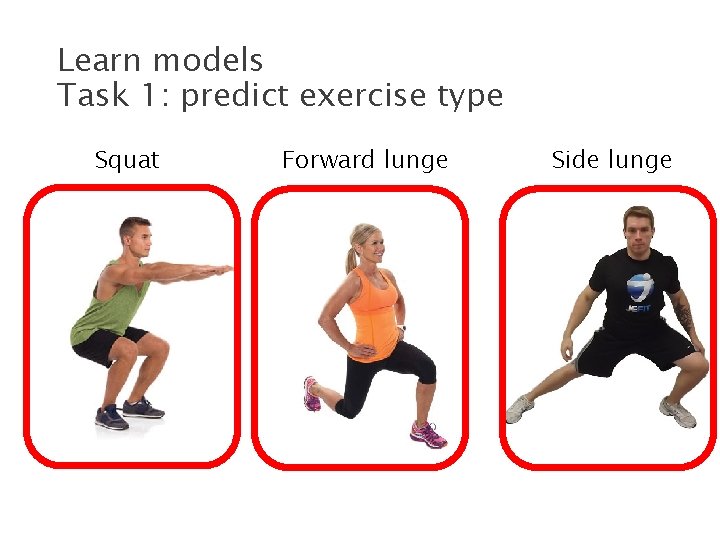
Collected data: 3 exercise types Squat Forward lunge Side lunge
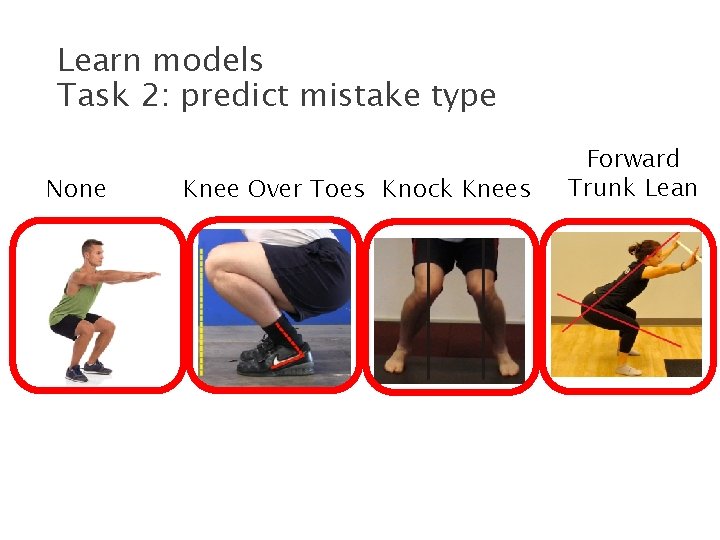
Collected data: 3 mistake types Knees over toes Knock knees Forward trunk lean
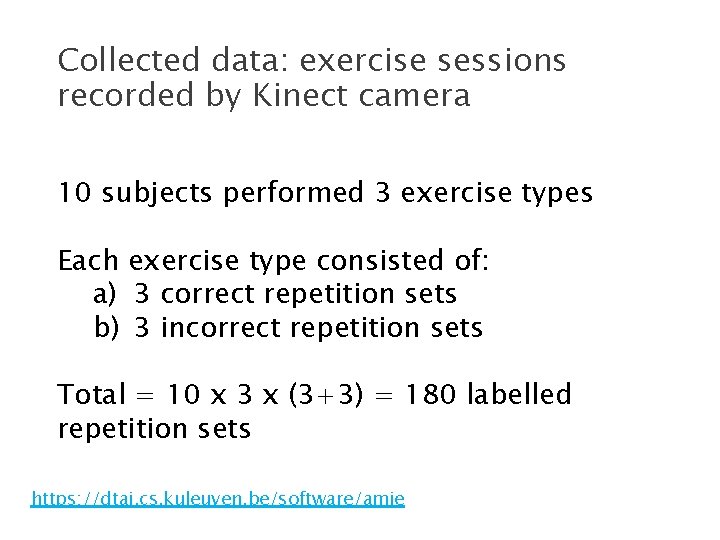
Collected data: exercise sessions recorded by Kinect camera 10 subjects performed 3 exercise types https: //dtai. cs. kuleuven. be/software/amie
Collected data: exercise sessions recorded by Kinect camera 10 subjects performed 3 exercise types Each exercise type consisted of: a) 3 correct repetition sets b) 3 incorrect repetition sets https: //dtai. cs. kuleuven. be/software/amie
Collected data: exercise sessions recorded by Kinect camera 10 subjects performed 3 exercise types Each exercise type consisted of: a) 3 correct repetition sets b) 3 incorrect repetition sets Total = 10 x 3 x (3+3) = 180 labelled repetition sets https: //dtai. cs. kuleuven. be/software/amie
Overview Related work Collected data Our 4 -step approach Experiments
Given: A set of X repetitions Do: Identify mistakes in each repetition Our 4 -step approach: Extract the Kinect data into Python Dataframes Partition the set into individual repetitions Construct a feature vector for each repetition Learn a model to detect mistakes
Extract the Kinect data into Python Dataframes 25 (x, y, z) joints https: //dtai. cs. kuleuven. be/software/amie
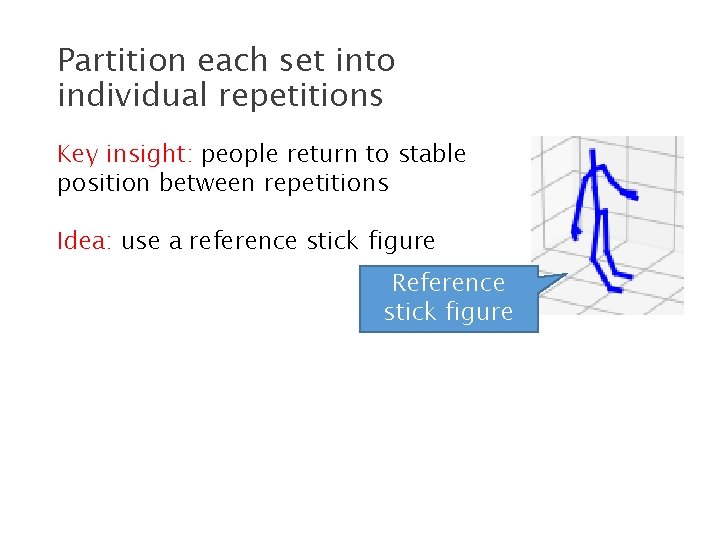
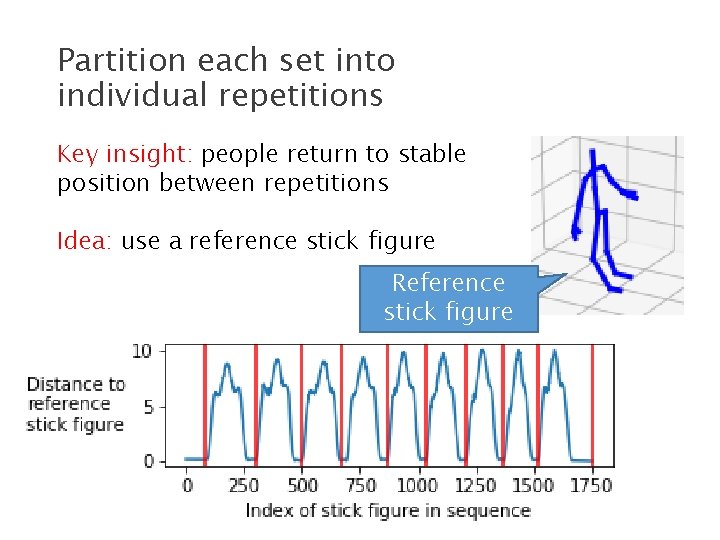
Partition each set into individual repetitions Key insight: people return to stable position between repetitions
Partition each set into individual repetitions Key insight: people return to stable position between repetitions Idea: use a reference stick figure Reference stick figure
Partition each set into individual repetitions Key insight: people return to stable position between repetitions Idea: use a reference stick figure Reference stick figure
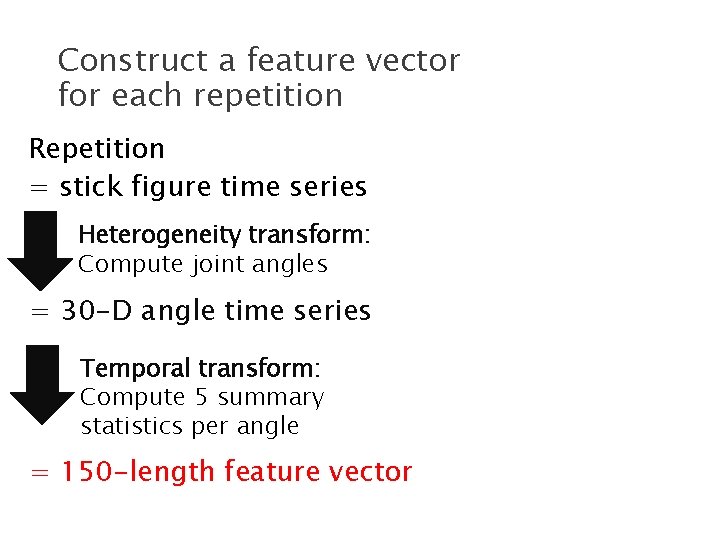
Construct a feature vector for each repetition Repetition = stick figure time series
Construct a feature vector for each repetition Repetition = stick figure time series Problems: a) Heterogeneity in height, weight, location, orientation, … b) Temporal data
Construct a feature vector for each repetition Repetition = stick figure time series Heterogeneity transform Compute joint angles
Construct a feature vector for each repetition Repetition = stick figure time series Heterogeneity transform Compute joint angles = 30 -D angle time series
Construct a feature vector for each repetition Repetition = stick figure time series Heterogeneity transform Compute joint angles = 30 -D angle time series Temporal transform Compute 5 summary statistics per angle -Mean -Std -Min -Max -Median
Construct a feature vector for each repetition Repetition = stick figure time series Heterogeneity transform: Compute joint angles = 30 -D angle time series Temporal transform: Compute 5 summary statistics per angle = 150 -length feature vector
Learn models Task 1: predict exercise type Squat Forward lunge Side lunge
Learn models Task 2: predict mistake type None Knee Over Toes Knock Knees Forward Trunk Lean
Overview Related work: why it is not enough Collected data AMIE: a 4 -step approach Experiments Q 1: Can we detect exercise type? Q 2: Can we detect mistake type? Q 3: Can we detect some mistakes better than others?
Methodology: evaluation scheme Problem: Using data from same person in train and test data can give overly optimistic results. Goal: Learn concept, don’t memorize repetitions of person
Methodology: evaluation scheme Problem: Using data from same person in train and test data can give overly optimistic results. Goal: Learn concept, don’t memorize repetitions of person Solution: Leave-one-person-out cross-validation
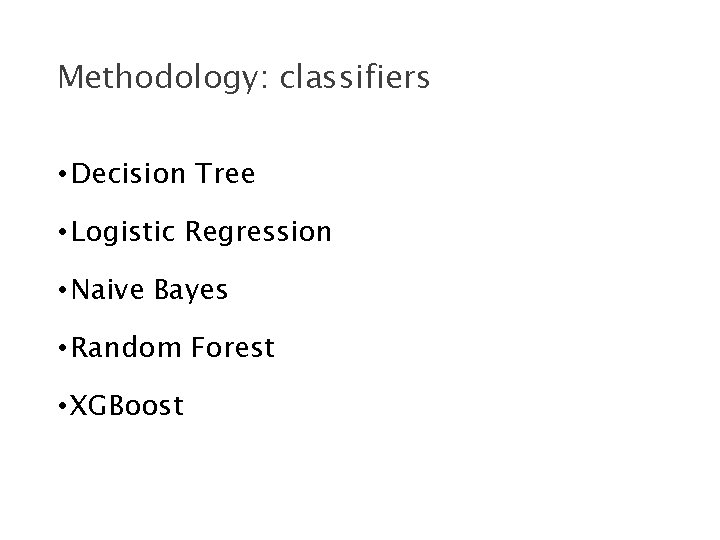
Methodology: classifiers • Decision Tree • Logistic Regression • Naive Bayes • Random Forest • XGBoost
Methodology: baselines • Nearest Neighbors - Dynamic Time Warping [Su et al. ] • Handcrafted rule set [Zhao et al. ] IF knee_z < toes_z THEN Knees Over Toes-mistake
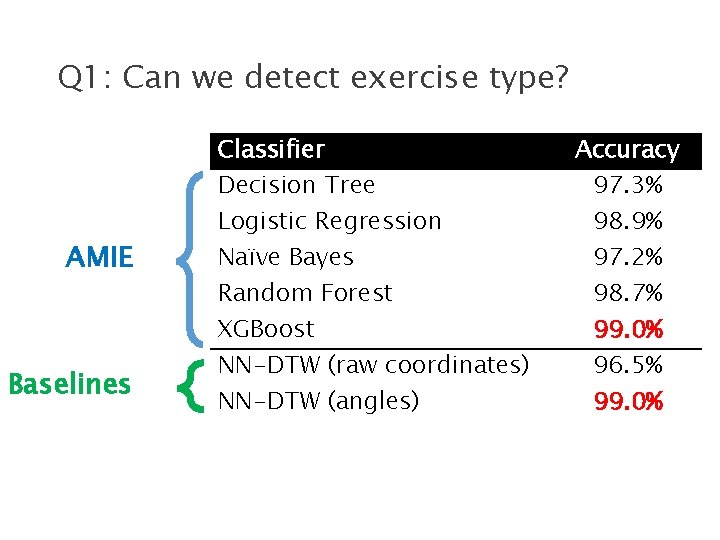
Q 1: Can we detect exercise type? AMIE Baselines Classifier Decision Tree Logistic Regression Naïve Bayes Random Forest XGBoost NN-DTW (raw coordinates) NN-DTW (angles) Accuracy 97. 3% 98. 9% 97. 2% 98. 7% 99. 0% 96. 5% 99. 0%
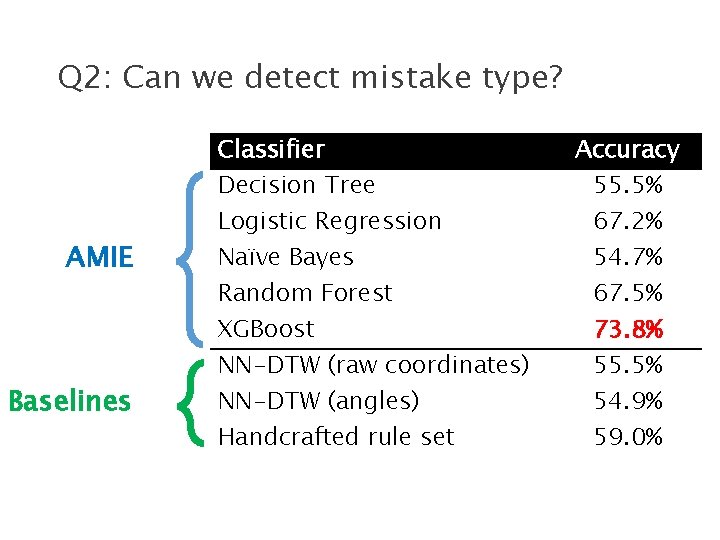
Q 2: Can we detect mistake type? AMIE Baselines Classifier Decision Tree Logistic Regression Naïve Bayes Random Forest XGBoost NN-DTW (raw coordinates) NN-DTW (angles) Handcrafted rule set Accuracy 55. 5% 67. 2% 54. 7% 67. 5% 73. 8% 55. 5% 54. 9% 59. 0%
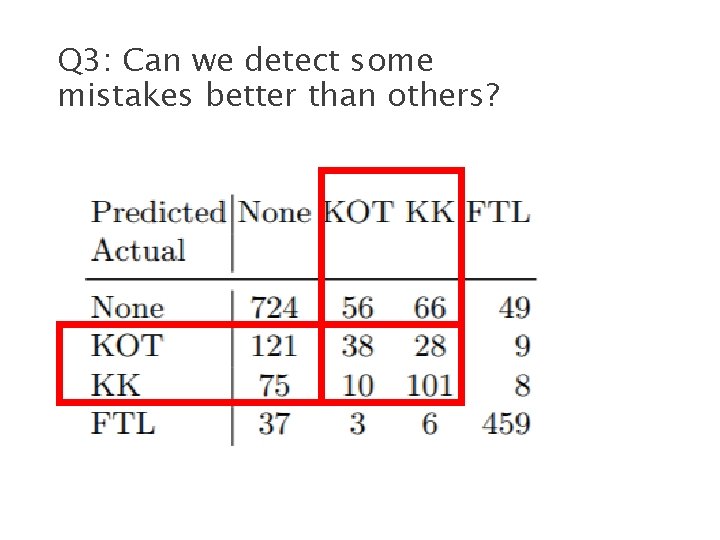
Q 3: Can we detect some mistakes better than others?
Q 3: Can we detect some mistakes better than others?
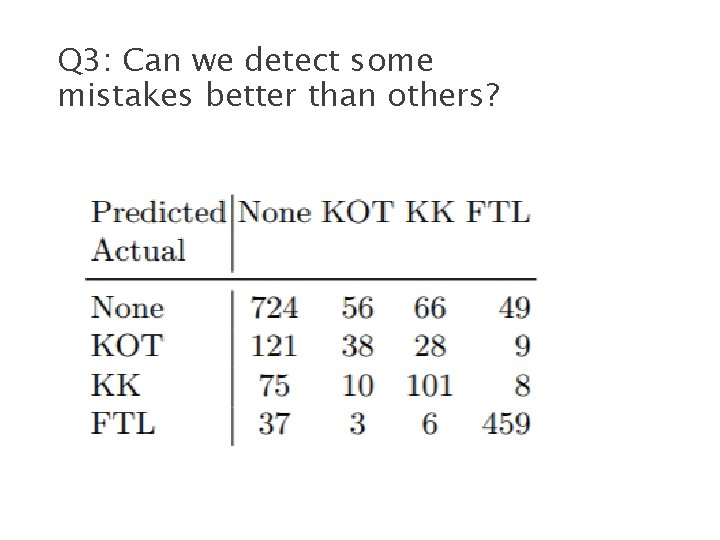
Q 3: Can we detect some mistakes better than others?
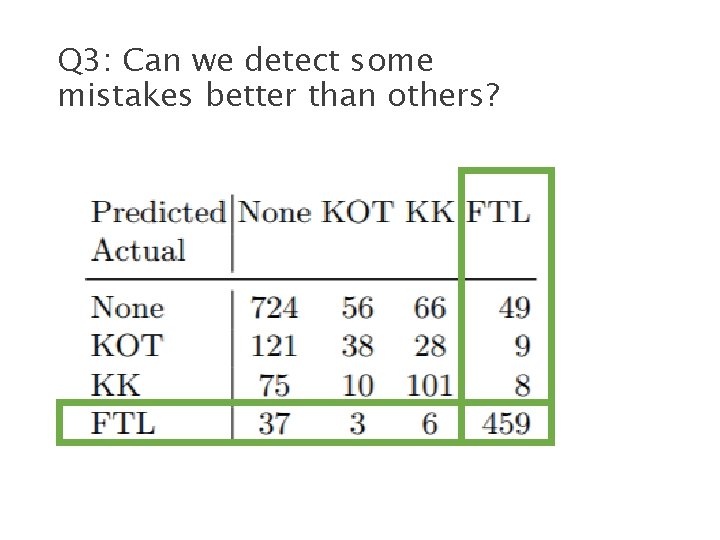
Q 3: Can we detect some mistakes better than others?
Contributions We highlight a shortcoming in the literature We comprehensively describe our data set, model and experiments. We release both the data set and the used software. https: //dtai. cs. kuleuven. be/software/amie
Future work Optimize accuracy by • Improving tracking quality of the Kinect • Improving the used machine learning model Transform model predictions to actual feedback. “Move your left leg a bit more to the right”