
Americas most unpopular war Cost LBJ his second
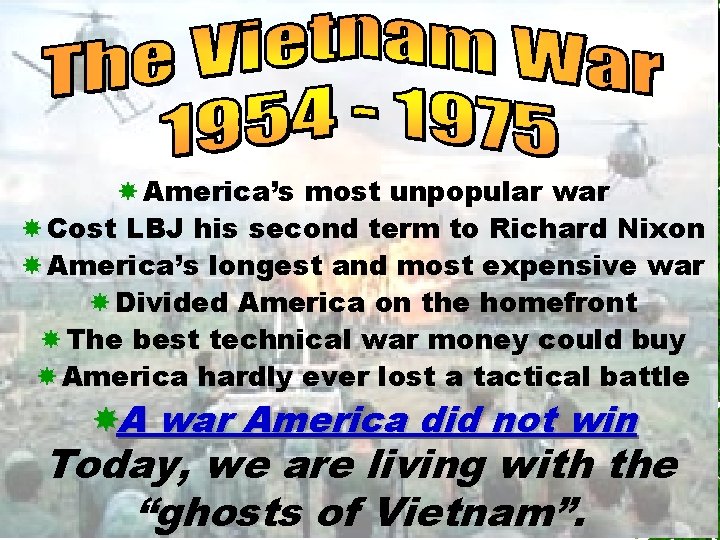
America’s most unpopular war Cost LBJ his second term to Richard Nixon America’s longest and most expensive war Divided America on the homefront The best technical war money could buy America hardly ever lost a tactical battle A war America did not win Today, we are living with the “ghosts of Vietnam”.
Student Activism in the 1960 s • Generation Gap — Young Americans in the 1960 s had many opportunities • • unknown to previous generations; many also questioned the values of their parents. These factors contributed to a wider generation gap between college-aged youths and their parents. Students for a Democratic Society and the New Left — Organized in 1960, Students for a Democratic Society (SDS) had a major impact on the New Left, a political movement that advocated radical changes to deal with problems such as poverty and racism. The Free Speech Movement — Student protests for free speech at the University of California at Berkeley inspired similar movements elsewhere, including challenges to social restrictions on campuses. The Teach-in Movement — Begun at the University of Michigan in March 1965, teach-ins, or special sessions at which issues concerning the war could be discussed, soon became a popular means of expressing antiwar sentiment. Continued Protests — Hundreds of demonstrations continued at colleges and universities around the country. One of the most dramatic, at
Draft Resistance • To increase the available fighting force, the United States invoked the Selective Service Act of 1951, drafting young men between the ages of 18 and 26 into the armed forces. • Most of those who refused to be drafted in the early 1960 s were conscientious objectors, people who opposed fighting on moral or religious grounds. • As the Vietnam War progressed, the draft-resistance movement grew, with many young men burning their draft cards or fleeing the country to avoid the draft. • At first, college students could receive a deferment, or postponement of their call to serve. Deferments were eliminated in 1971 in response to complaints that they were unfair to those who could not afford college.
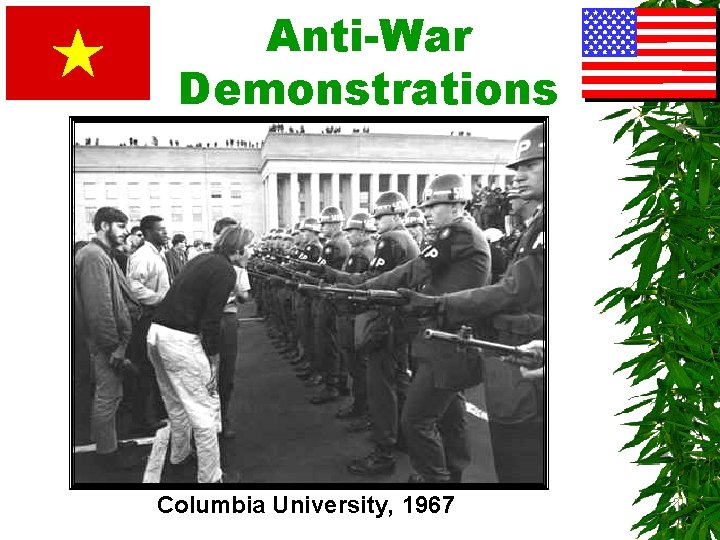
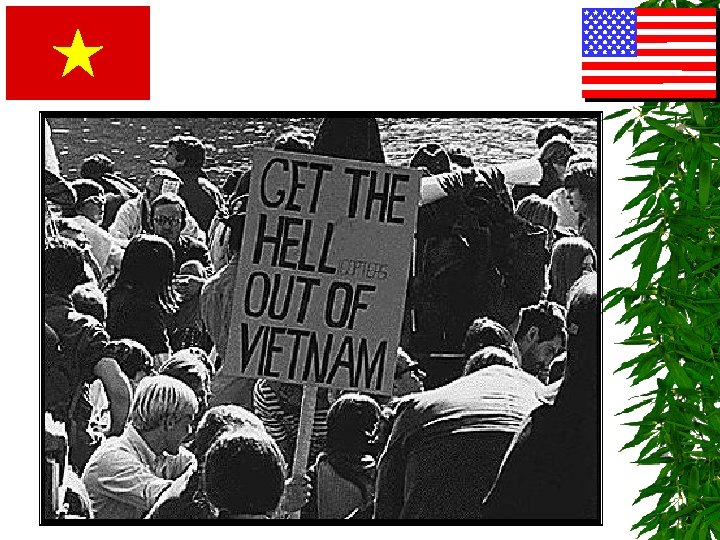
Anti-War Demonstrations Columbia University, 1967
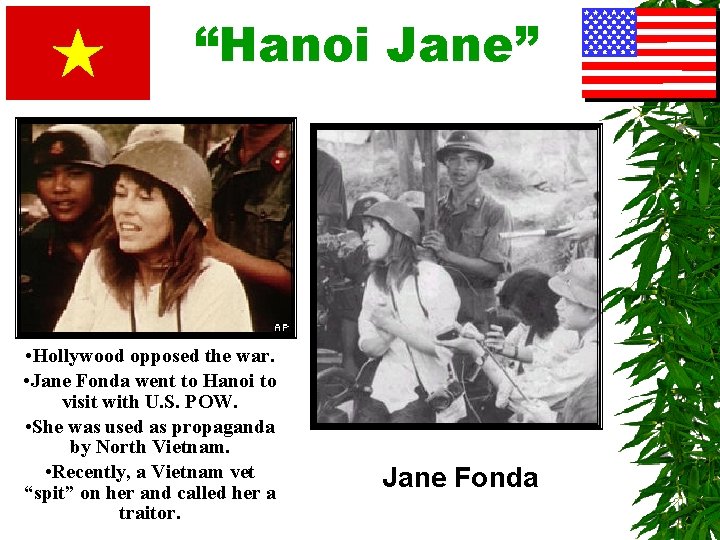
“Hanoi Jane” • Hollywood opposed the war. • Jane Fonda went to Hanoi to visit with U. S. POW. • She was used as propaganda by North Vietnam. • Recently, a Vietnam vet “spit” on her and called her a traitor. Jane Fonda
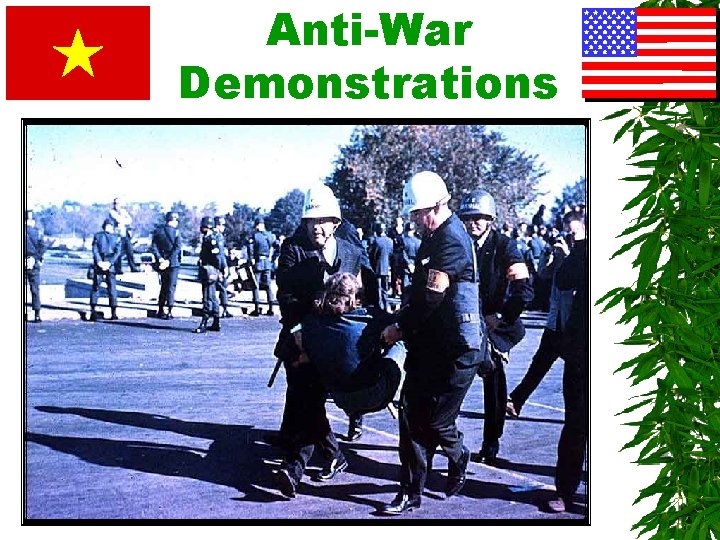
Anti-War Demonstrations
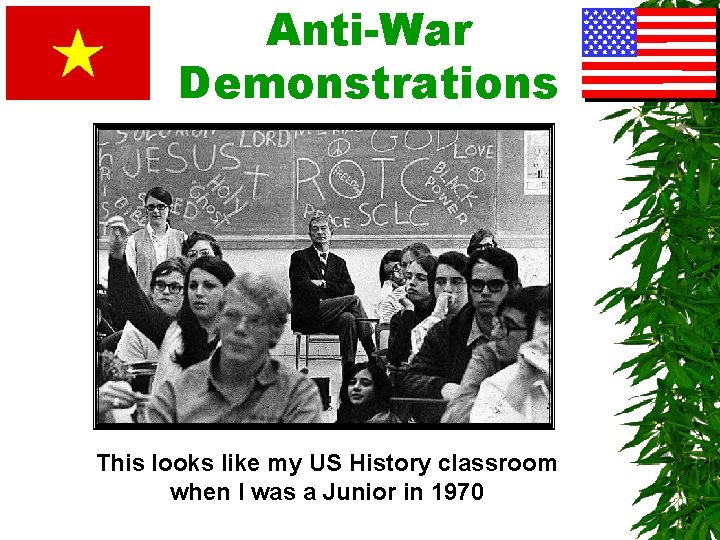
Anti-War Demonstrations This looks like my US History classroom when I was a Junior in 1970
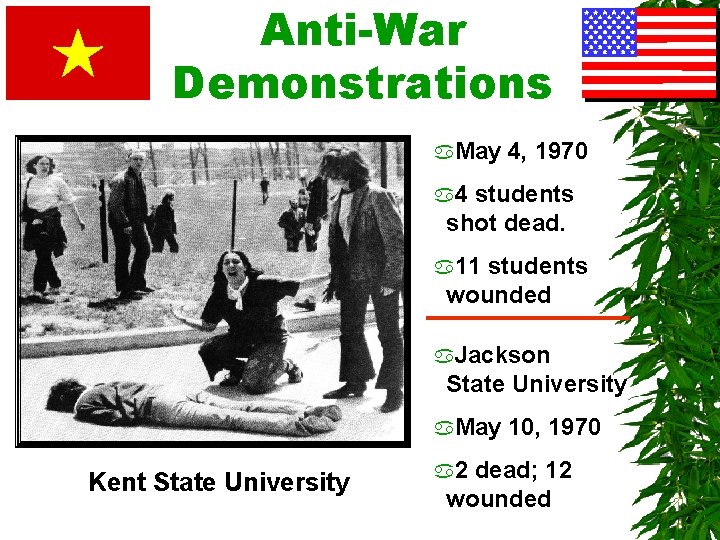
Anti-War Demonstrations a. May 4, 1970 a 4 students shot dead. a 11 students wounded a. Jackson State University a. May Kent State University a 2 10, 1970 dead; 12 wounded
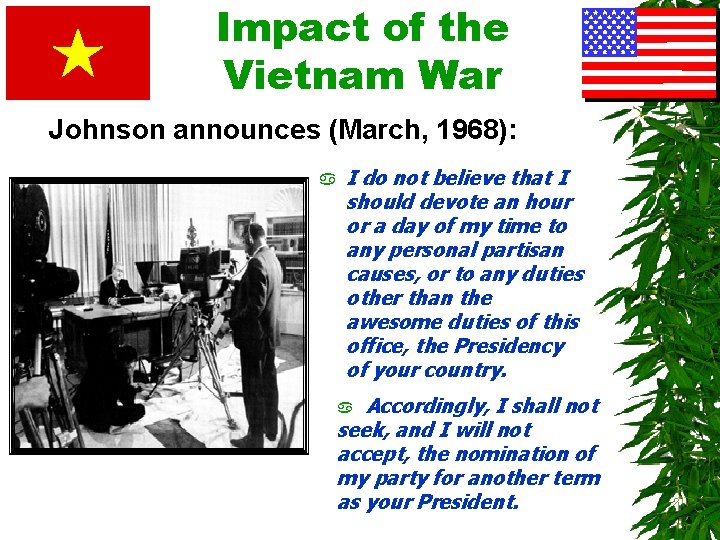
Impact of the Vietnam War Johnson announces (March, 1968): a I do not believe that I should devote an hour or a day of my time to any personal partisan causes, or to any duties other than the awesome duties of this office, the Presidency of your country. Accordingly, I shall not seek, and I will not accept, the nomination of my party for another term as your President. a
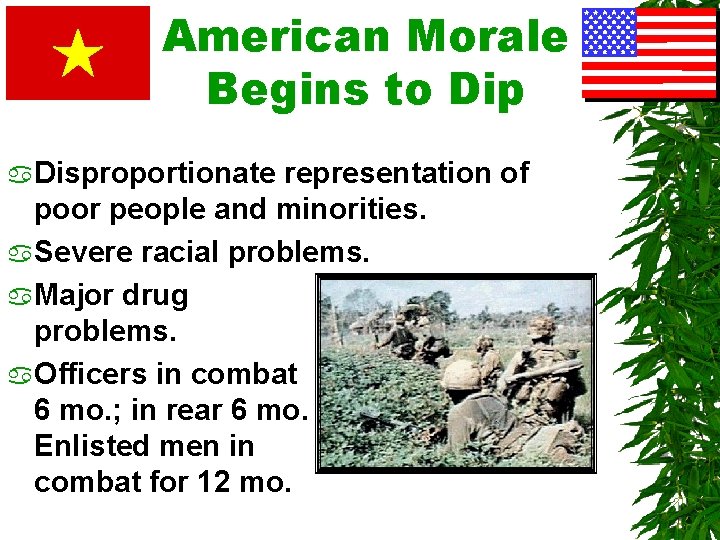
American Morale Begins to Dip a. Disproportionate representation of poor people and minorities. a. Severe racial problems. a. Major drug problems. a. Officers in combat 6 mo. ; in rear 6 mo. Enlisted men in combat for 12 mo.
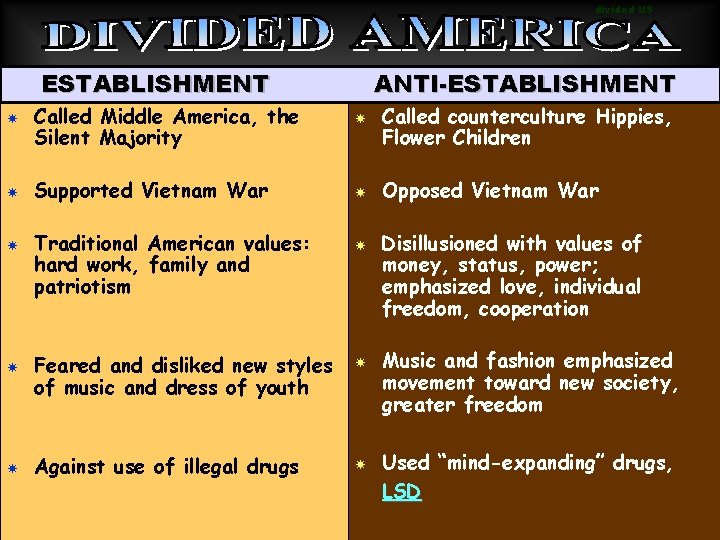
divided US ESTABLISHMENT Called Middle America, the Silent Majority Supported Vietnam War Traditional American values: hard work, family and patriotism ANTI-ESTABLISHMENT Feared and disliked new styles of music and dress of youth Against use of illegal drugs Called counterculture Hippies, Flower Children Opposed Vietnam War Disillusioned with values of money, status, power; emphasized love, individual freedom, cooperation Music and fashion emphasized movement toward new society, greater freedom Used “mind-expanding” drugs, LSD
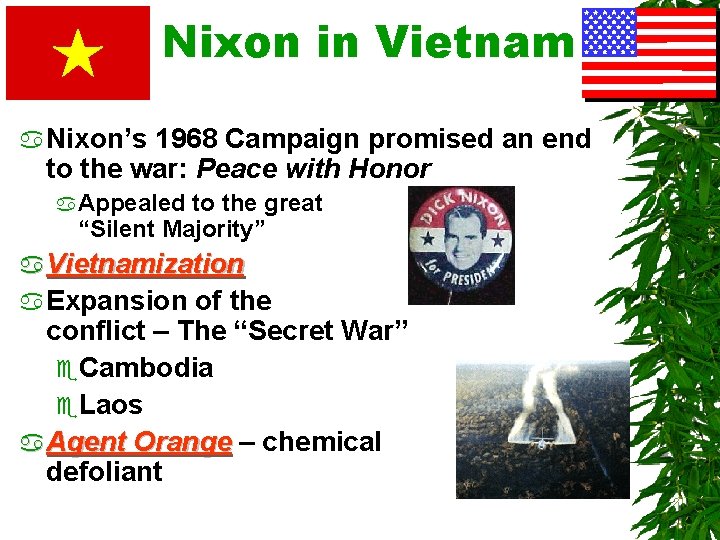
Nixon in Vietnam a Nixon’s 1968 Campaign promised an end to the war: Peace with Honor a Appealed to the great “Silent Majority” a Vietnamization a Expansion of the conflict – The “Secret War” e. Cambodia e. Laos a Agent Orange – chemical defoliant
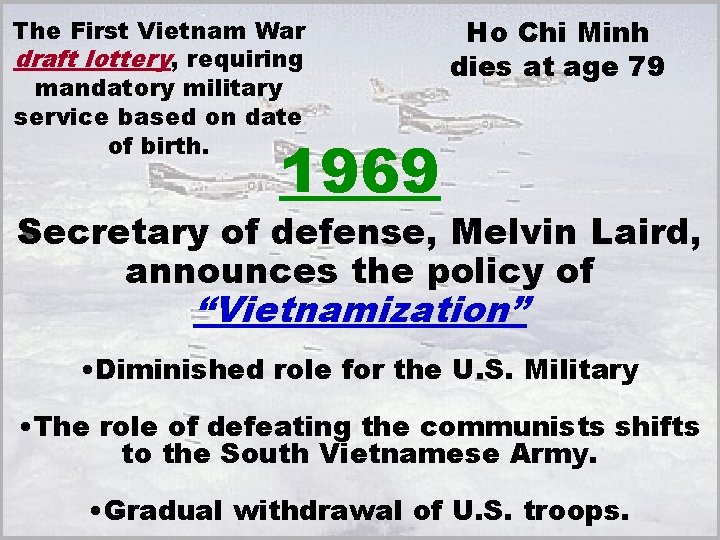
The First Vietnam War draft lottery, requiring mandatory military service based on date of birth. Secretary Ho Chi Minh dies at age 79 1969 of defense, Melvin Laird, announces the policy of “Vietnamization” • Diminished role for the U. S. Military • The role of defeating the communists shifts to the South Vietnamese Army. • Gradual withdrawal of U. S. troops.
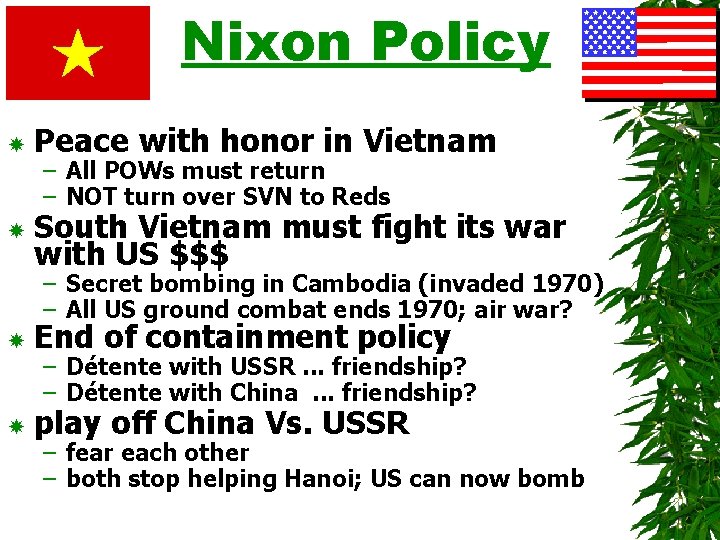
Nixon Policy Peace with honor in Vietnam South Vietnam must fight its war with US $$$ – All POWs must return – NOT turn over SVN to Reds – Secret bombing in Cambodia (invaded 1970) – All US ground combat ends 1970; air war? End of containment policy play off China Vs. USSR – Détente with USSR. . . friendship? – Détente with China. . . friendship? – fear each other – both stop helping Hanoi; US can now bomb
Nixon’s Vietnam Policy • • Toward the end of his term as President, Johnson had called for peace negotiations to end the Vietnam War. However, the resulting Paris peace talks, which began in May 1968, failed to produce an agreement. President Nixon campaigned on the claim that he had a secret plan to end the war. In June 1969, he began the policy of Vietnamization, replacing American troops in Vietnam with South Vietnamese soldiers. Although Nixon wanted to end the war, he did not want to lose it. He therefore launched secret bombing raids and expanded the war to Cambodia, hoping to destroy Viet Cong camps there. Nixon hoped his Cambodian attacks would help America in peace negotiations. Instead, the attacks resulted in both civil war in Cambodia and more antiwar protests in the United States.
Vietnamization, 1969 -72 SVN government & army built up – pacification 1969 -71; 90% of population safe (many moved to cities) – Viet Cong lose base; US victory! – now a conventional war of NV vs SV Secret bombings of Cambodia ineffective; US invasion 1970 [more protests] US ground troops exit 1971
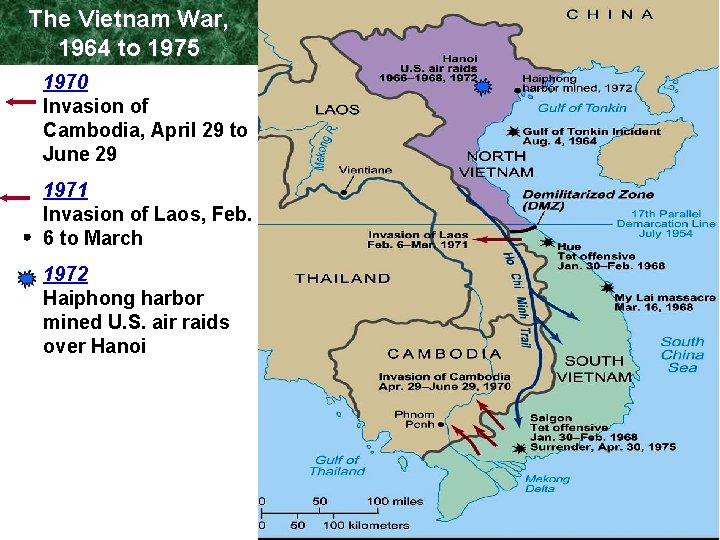
The Vietnam War, 1964 to 1975 1970 Invasion of Cambodia, April 29 to June 29 1971 Invasion of Laos, Feb. 6 to March 1972 Haiphong harbor mined U. S. air raids over Hanoi
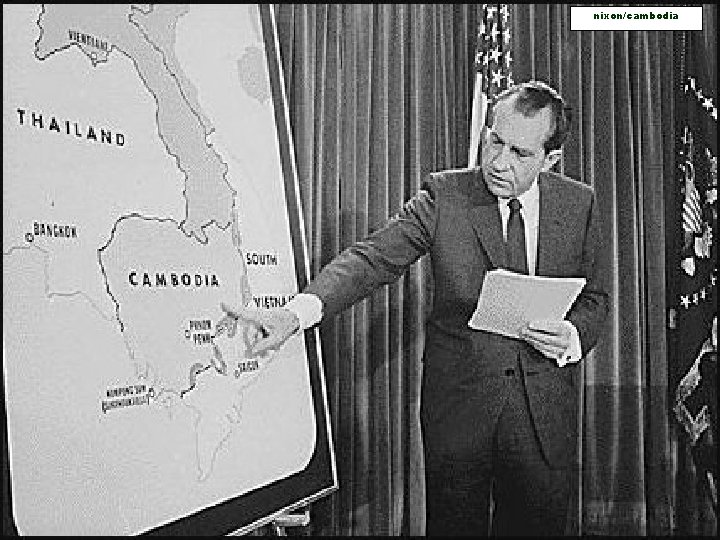
nixon/cambodia
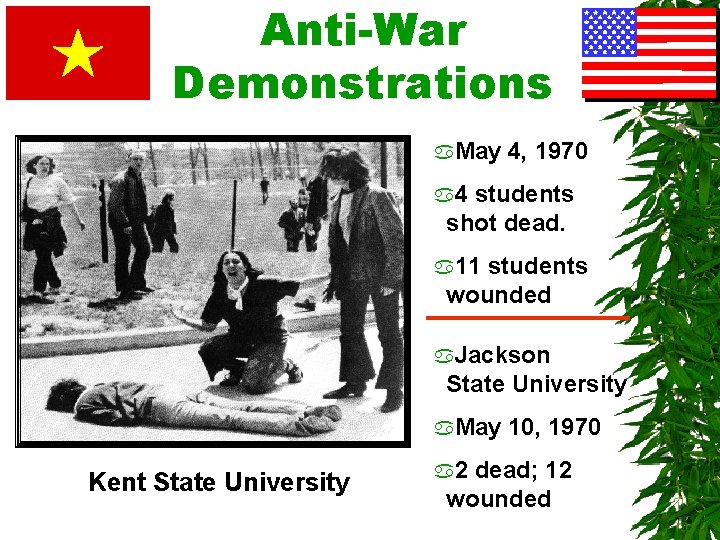
Anti-War Demonstrations a. May 4, 1970 a 4 students shot dead. a 11 students wounded a. Jackson State University a. May Kent State University a 2 10, 1970 dead; 12 wounded
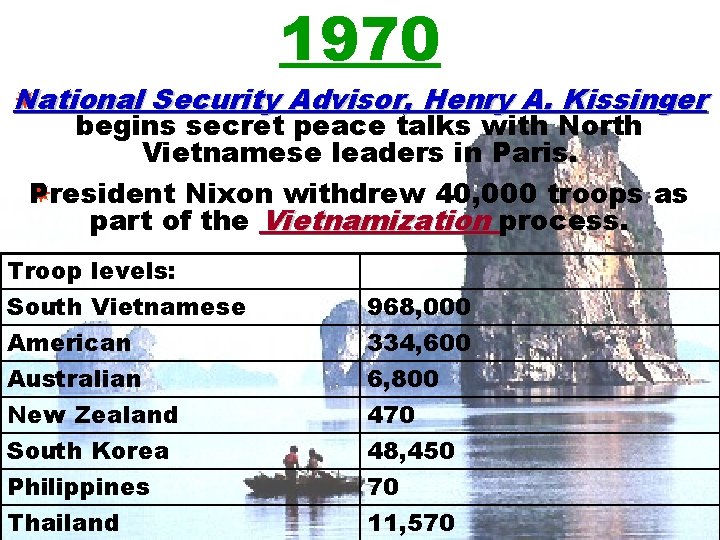
1970 National Security Advisor, Henry A. Kissinger begins secret peace talks with North Vietnamese leaders in Paris. President Nixon withdrew 40, 000 troops as part of the Vietnamization process. Troop levels: South Vietnamese American Australian 968, 000 334, 600 6, 800 New Zealand South Korea Philippines Thailand 470 48, 450 70 11, 570
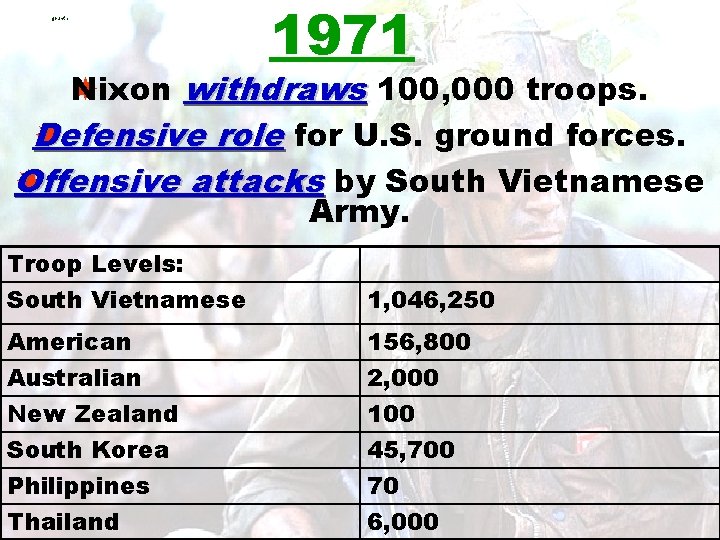
grunts 1971 ixon withdraws 100, 000 troops. N Defensive role for U. S. ground forces. Offensive attacks by South Vietnamese Army. Troop Levels: South Vietnamese 1, 046, 250 American Australian 156, 800 2, 000 New Zealand South Korea Philippines Thailand 100 45, 700 70 6, 000
“Pentagon Papers, ” 1971 a Former defense analyst Daniel Ellsberg leaked govt. docs. regarding war efforts during Johnson’s administration to the New York Times. a Docs. --> Govt. misled Congress & Amer. People regarding its intentions in Vietnam during mid-1960 s. a Primary reason for fighting not to eliminate communism, but to avoid humiliating defeat. a New York Times v. United States (1971)
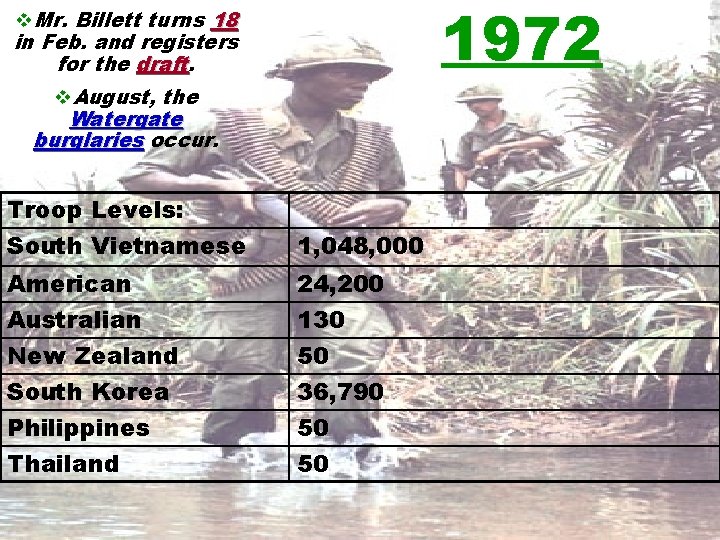
1972 v. Mr. Billett turns 18 in Feb. and registers for the draft v. August, the Watergate burglaries occur. Troop Levels: South Vietnamese 1, 048, 000 American Australian 24, 200 130 New Zealand South Korea Philippines Thailand 50 36, 790 50 50
The Ceasefire, 1973 a. Peace is at hand – Kissinger, 1972 e North Vietnam attacks South e Most Massive U. S. bombing commences a 1973: Ceasefire signed between e U. S. , a. Peace South Vietnam, & North Vietnam with honor (Nixon)
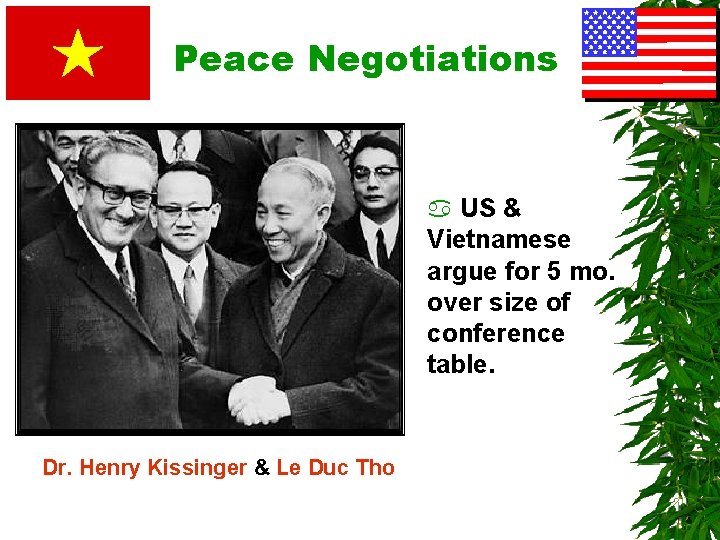
Peace Negotiations a US & Vietnamese argue for 5 mo. over size of conference table. Dr. Henry Kissinger & Le Duc Tho
The Ceasefire, 1973 a Conditions: 1. U. S. to remove all troops 2. North Vietnam could leave troops already in S. V. 3. North Vietnam would resume war 4. No provision for POWs or MIAs Last American troops left South Vietnam on March 29, 1973 a 1975: North Vietnam defeats South Vietnam a Saigon renamed Ho Chi Minh City a
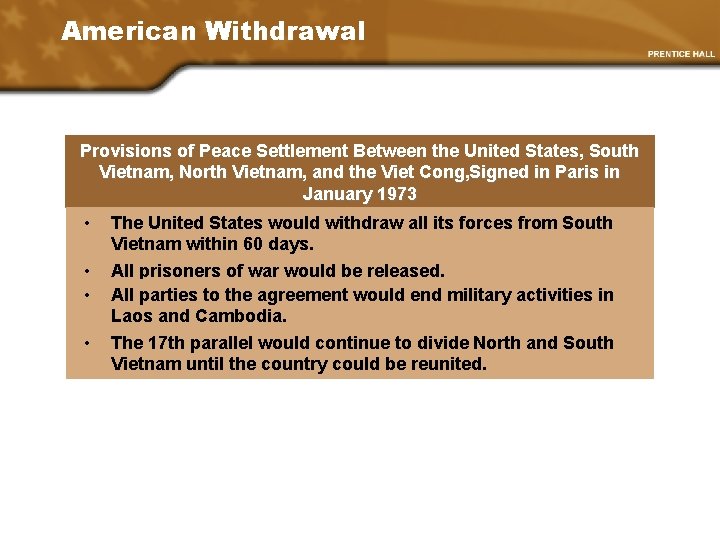
American Withdrawal Provisions of Peace Settlement Between the United States, South Vietnam, North Vietnam, and the Viet Cong, Signed in Paris in January 1973 • • The United States would withdraw all its forces from South Vietnam within 60 days. All prisoners of war would be released. All parties to the agreement would end military activities in Laos and Cambodia. The 17 th parallel would continue to divide North and South Vietnam until the country could be reunited.
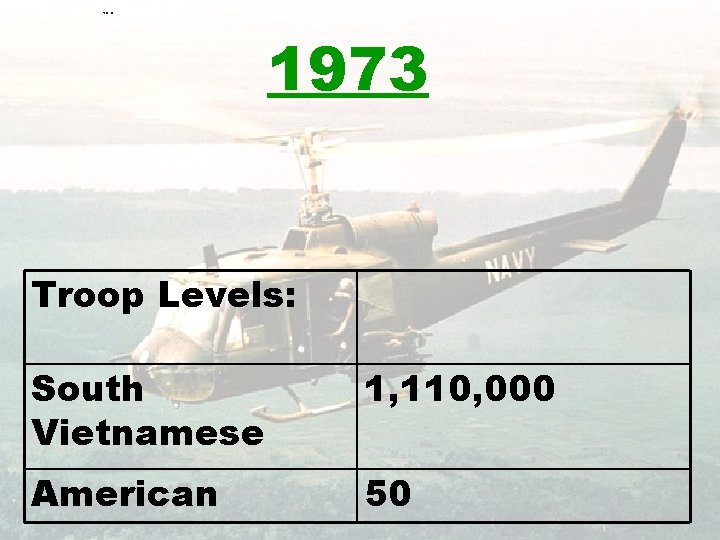
helo 1973 Troop Levels: South Vietnamese 1, 110, 000 American 50
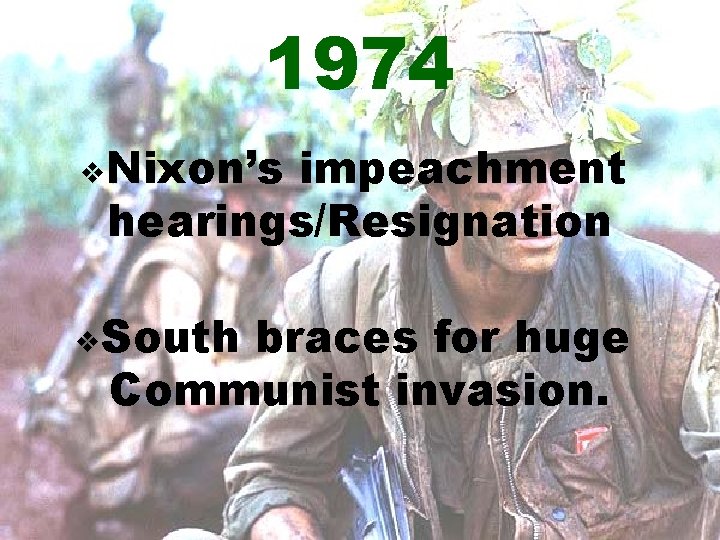
1974 v. Nixon’s impeachment hearings/Resignation v. South braces for huge Communist invasion.
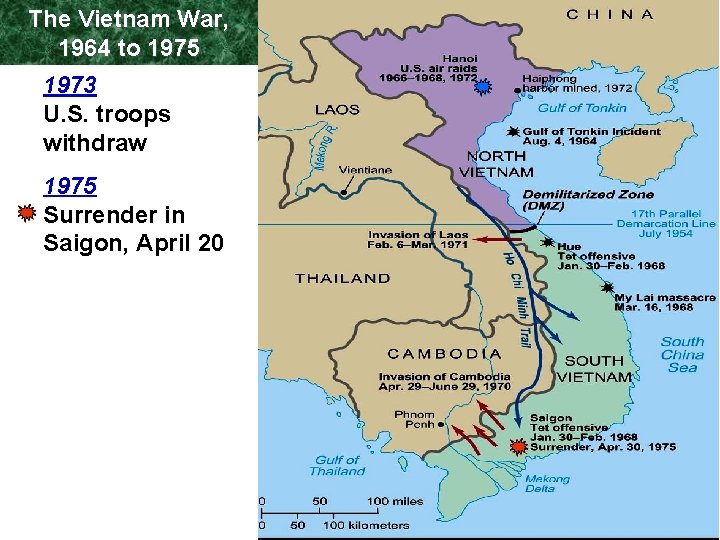
The Vietnam War, 1964 to 1975 1973 U. S. troops withdraw 1975 Surrender in Saigon, April 20
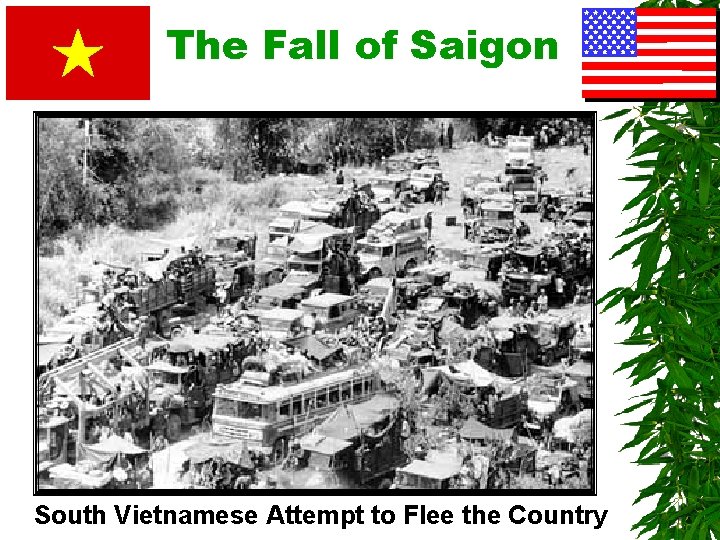
The Fall of Saigon South Vietnamese Attempt to Flee the Country
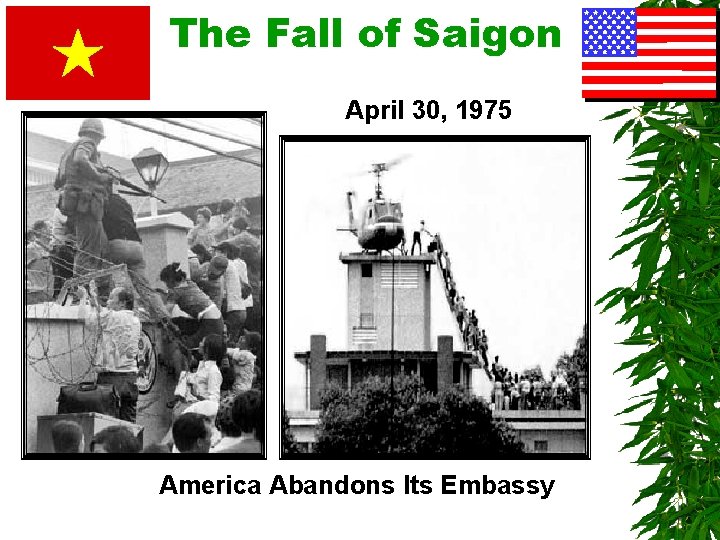
The Fall of Saigon April 30, 1975 America Abandons Its Embassy
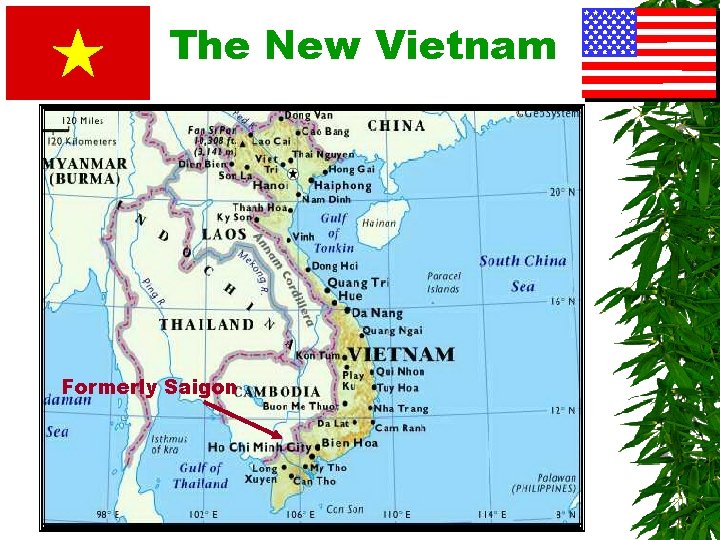
The New Vietnam Formerly Saigon
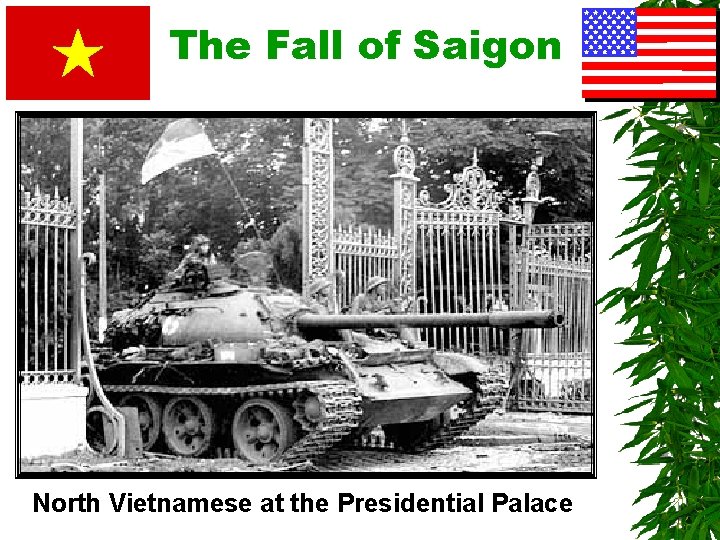
The Fall of Saigon North Vietnamese at the Presidential Palace
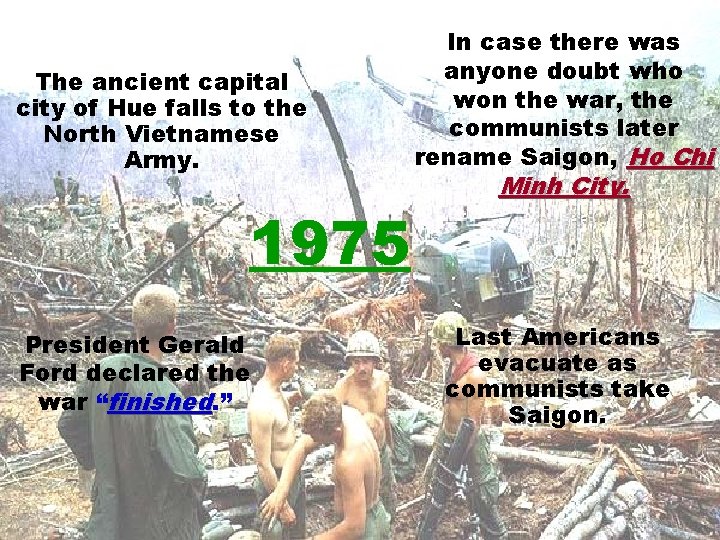
The ancient capital city of Hue falls to the North Vietnamese Army. 1975 President Gerald Ford declared the war “finished. ” In case there was anyone doubt who won the war, the communists later rename Saigon, Ho Chi Minh City. Last Americans evacuate as communists take Saigon.
The Impact a 26 th Amendment: Amendment 18 -year-olds vote a. Nixon abolished the draft--> allvolunteer army ٭ a. War Powers Act, 1973 e President must notify Congress within 48 hours of deploying military force e President must withdraw forces unless he gains Congressional approval within 90 days a. Disregard for Veterans --> seen as “baby killers” a. POW/MIA issue lingered
The Legacy of the War • • With a cost of at least $150 billion, and hundreds of thousands of American soldiers killed or wounded, the Vietnam War was the longest and least successful war in American history. Thousands of American soldiers who did not return home after the war were listed as POWs (prisoners of war) or MIAs (missing in action). Many remain unaccounted for today. In Vietnam, millions were dead or wounded, many of them civilians. The war also heavily damaged the landscape of Vietnam. In 1994, the United States lifted its trade embargo against Vietnam; in 1995, full diplomatic relations were restored.
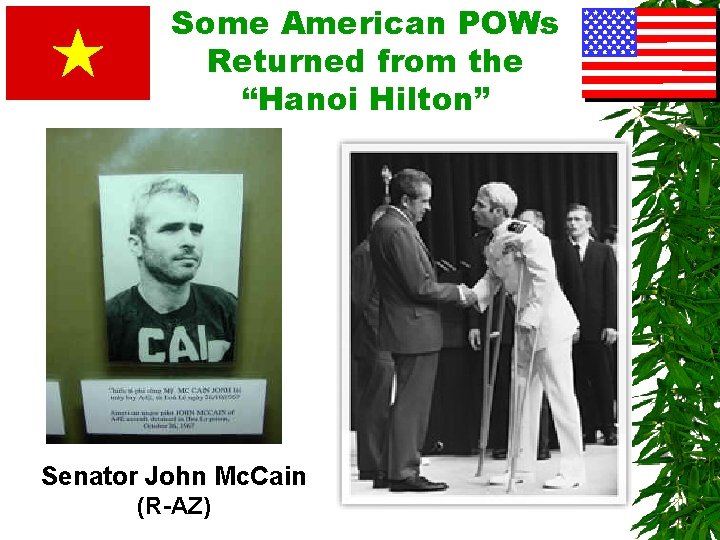
Some American POWs Returned from the “Hanoi Hilton” Senator John Mc. Cain (R-AZ)
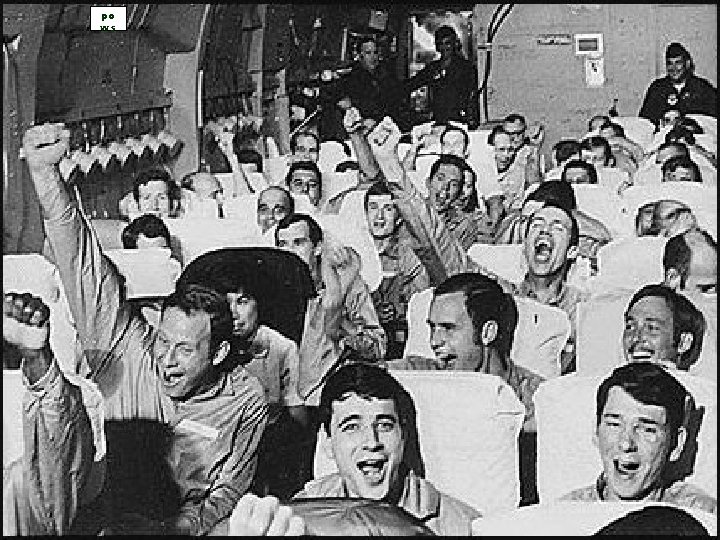
po ws
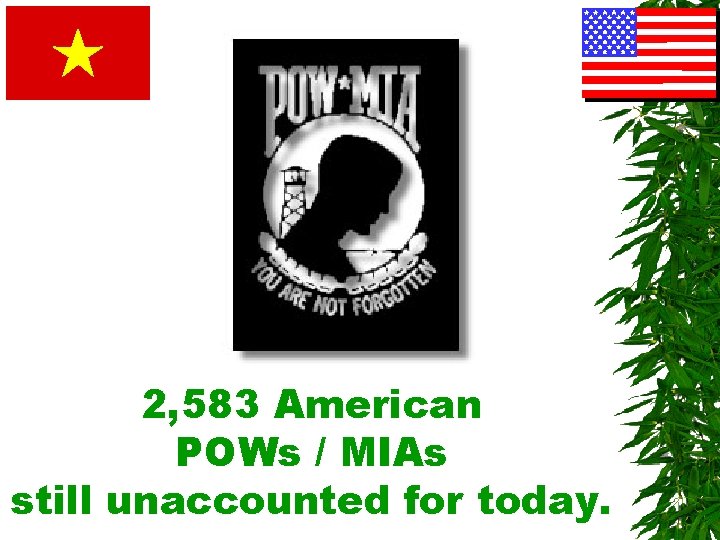
2, 583 American POWs / MIAs still unaccounted for today.
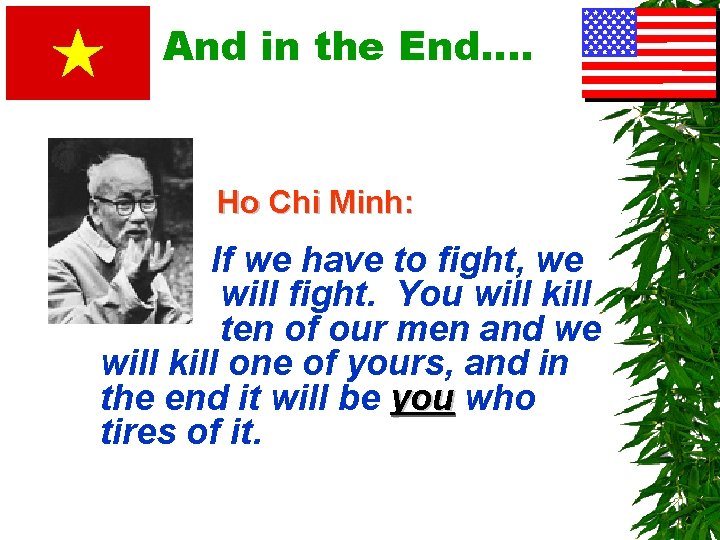
And in the End…. Ho Chi Minh: If we have to fight, we will fight. You will kill ten of our men and we will kill one of yours, and in the end it will be you who tires of it.
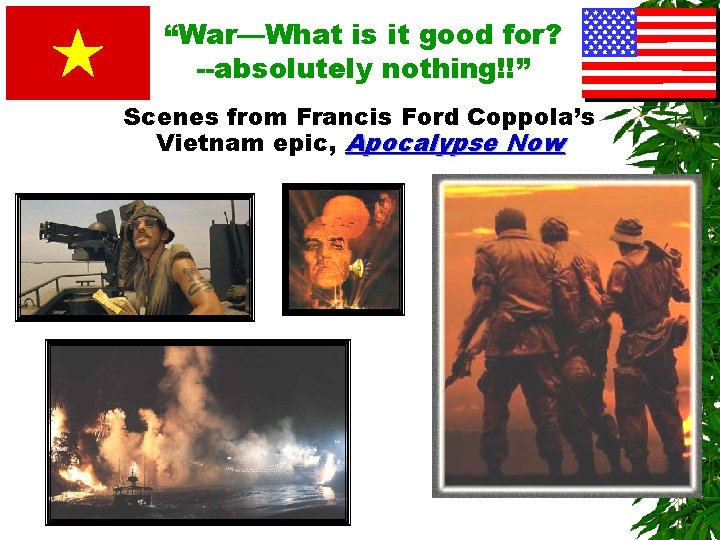
“War—What is it good for? --absolutely nothing!!” Scenes from Francis Ford Coppola’s Vietnam epic, Apocalypse Now
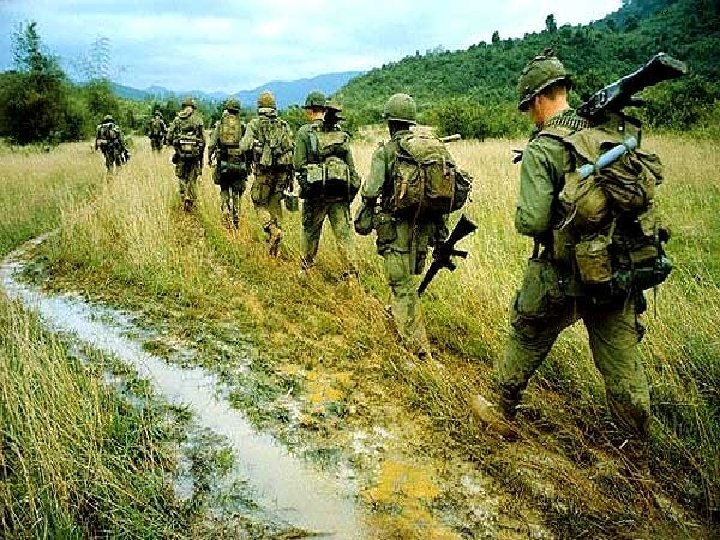
grunts
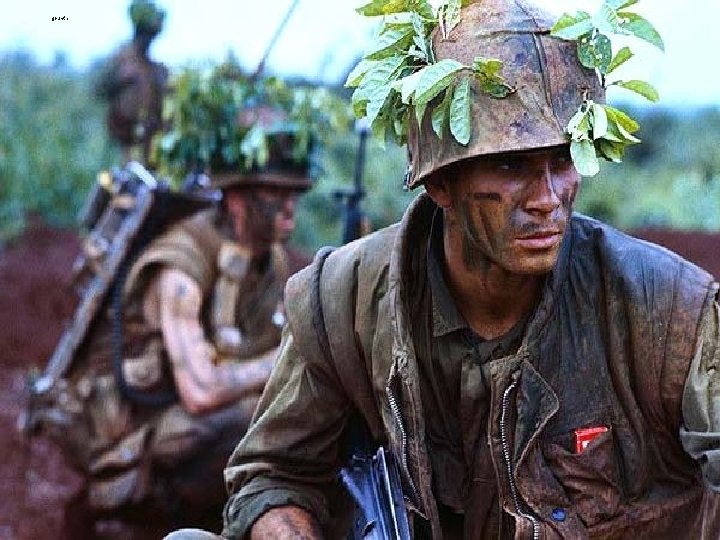
grunts
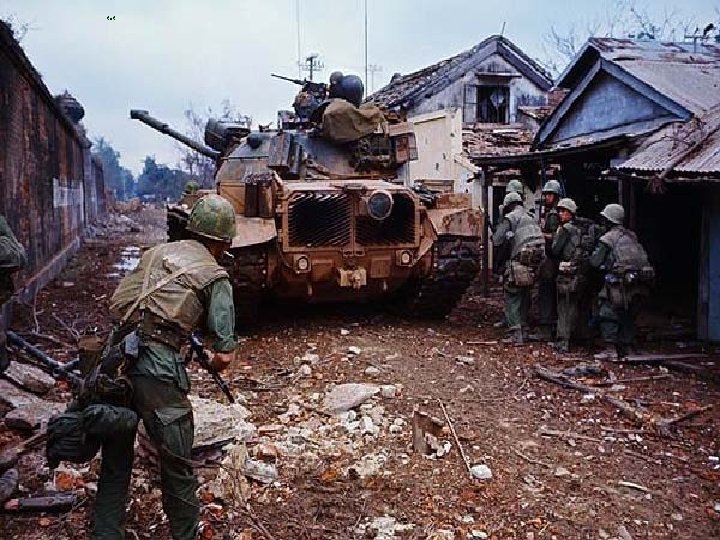
tet
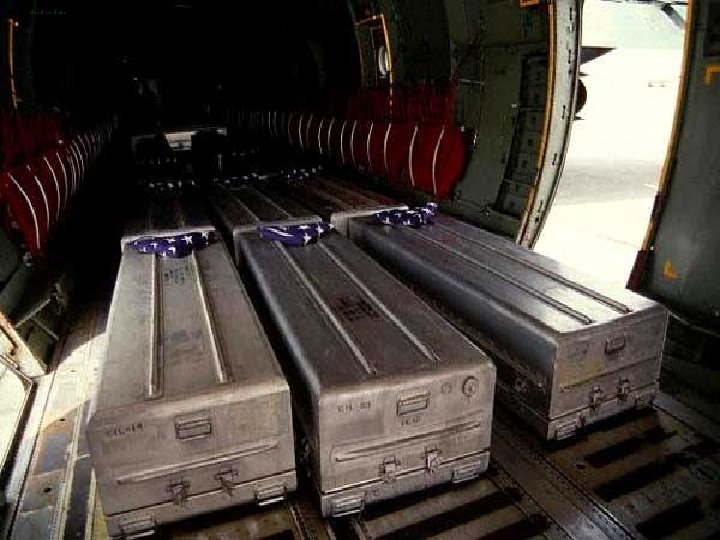
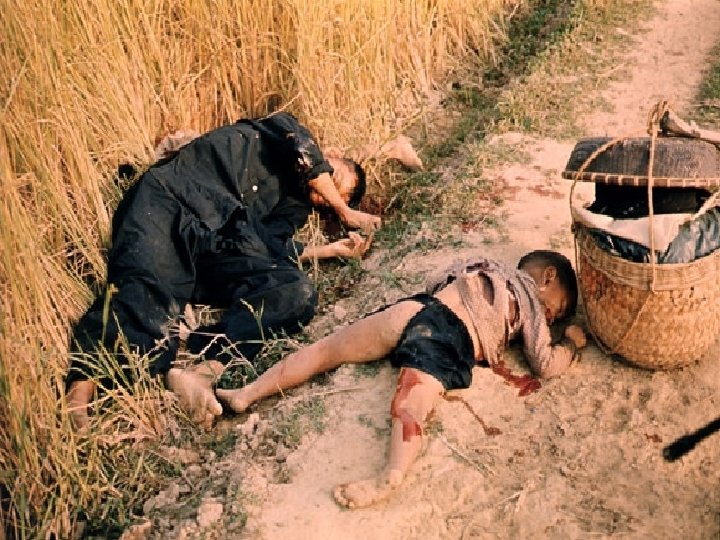
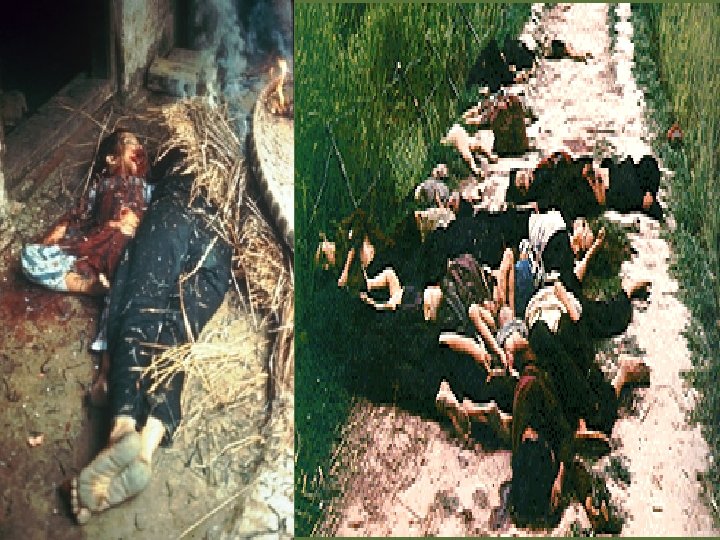
dead soldiers
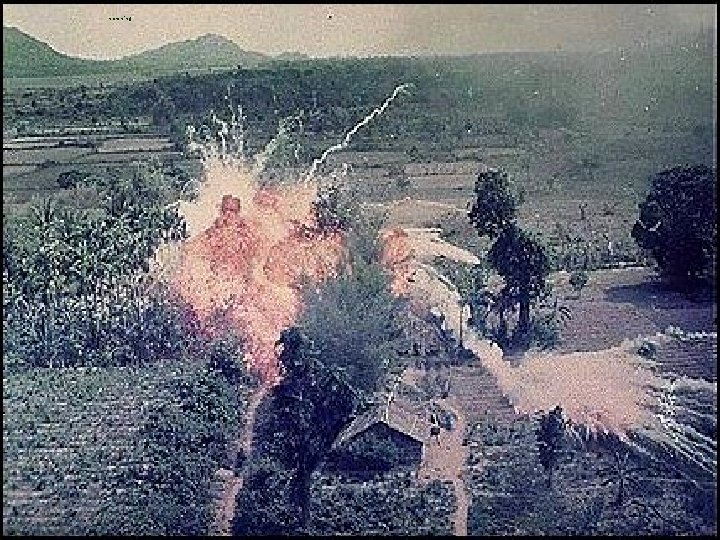
bombing
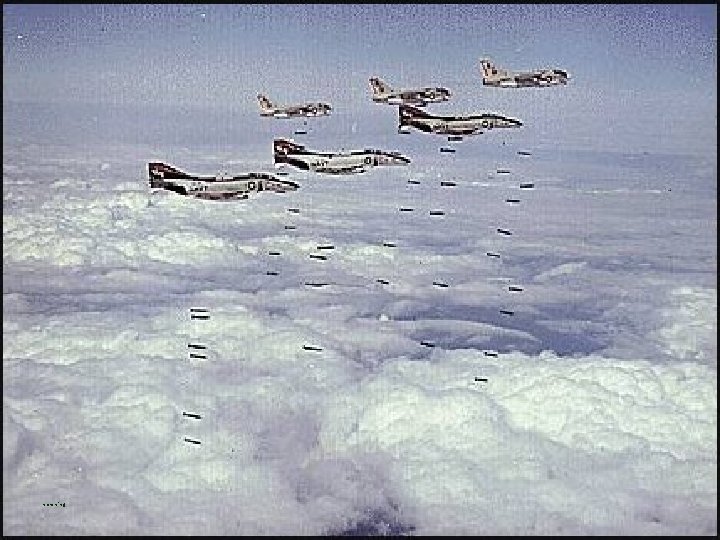
bombing
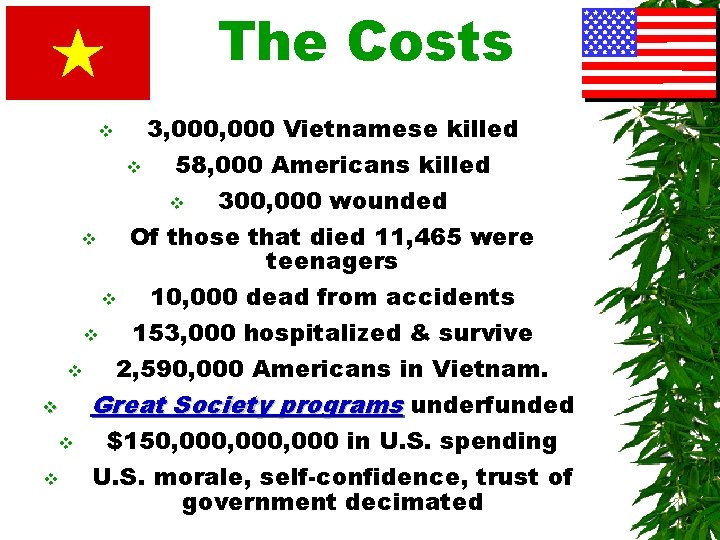
The Costs 3, 000 Vietnamese killed v v 58, 000 Americans killed 300, 000 wounded v Of those that died 11, 465 were teenagers v 10, 000 dead from accidents v 153, 000 hospitalized & survive v 2, 590, 000 Americans in Vietnam. v Great Society programs underfunded v $150, 000, 000 in U. S. spending v U. S. morale, self-confidence, trust of government decimated v
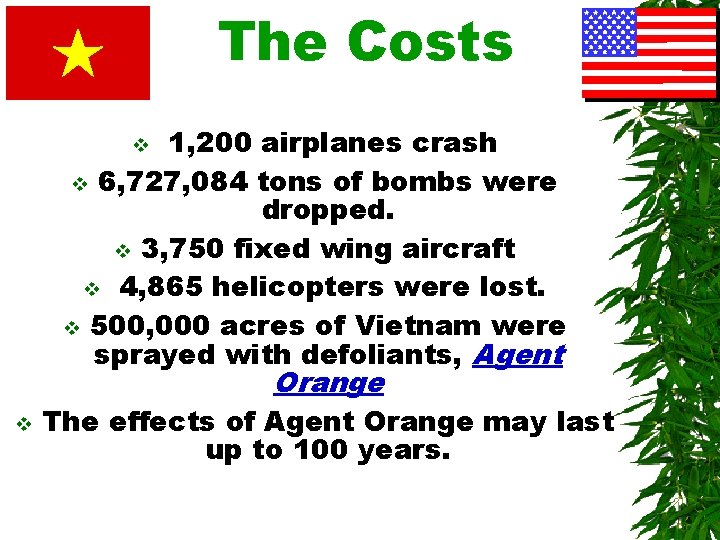
The Costs 1, 200 airplanes crash v 6, 727, 084 tons of bombs were dropped. v 3, 750 fixed wing aircraft v 4, 865 helicopters were lost. v 500, 000 acres of Vietnam were sprayed with defoliants, Agent v Orange v The effects of Agent Orange may last up to 100 years.
Lessons for U. S. Presidents 1. 2. 3. 4. 5. 6. Wars must be of short duration Wars must yield few American casualties Restrict media access to battlefields Develop and maintain Congressional and public support Set clear, winnable goals Set deadline for troop withdrawals
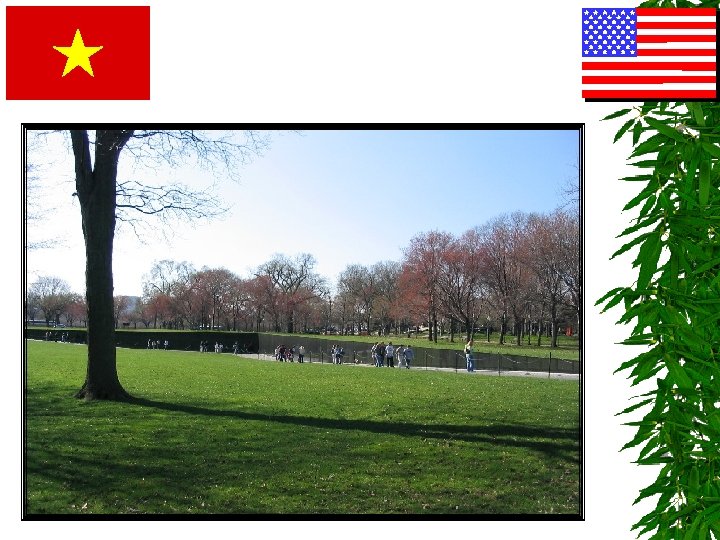
The Vietnam Veterans Memorial • Designed by 21 -year old Maya Ying Lin and completed in 1982, the Vietnam Veterans Memorial stands near the Lincoln Memorial in Washington, D. C. It consists of a long wall of black granite, listing the names of every American who died in the Vietnam War. Since its completion, visitors have added to the memorial by leaving personal tokens at the wall in memory of their loved ones.
President Clinton formally recognized Vietnam on July 11, 1995
- Slides: 59