
Americans During World War II USVA SOL Review


- Slides: 44
Americans During World War II US-VA SOL Review Assignment
World War II in Europe The Allied Powers defeat Nazi Germany, 1939 - 1945
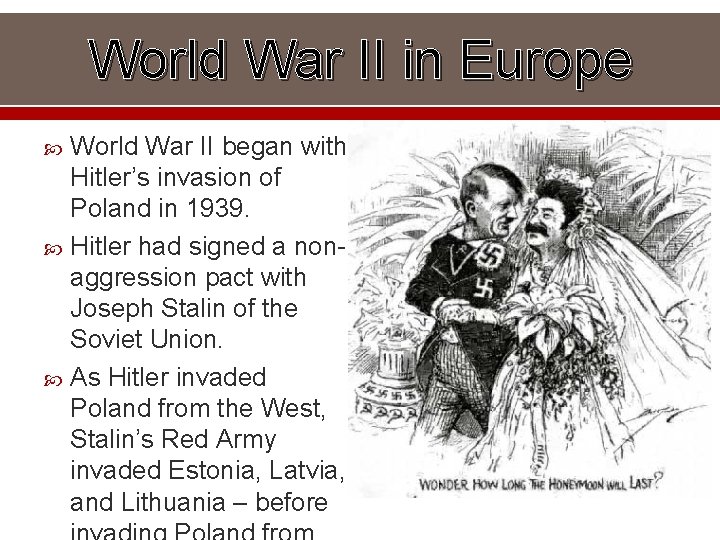
World War II in Europe World War II began with Hitler’s invasion of Poland in 1939. Hitler had signed a nonaggression pact with Joseph Stalin of the Soviet Union. As Hitler invaded Poland from the West, Stalin’s Red Army invaded Estonia, Latvia, and Lithuania – before
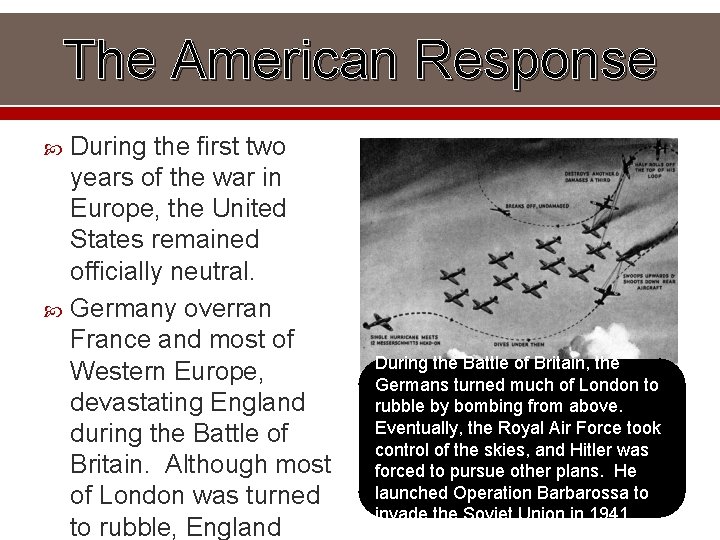
The American Response During the first two years of the war in Europe, the United States remained officially neutral. Germany overran France and most of Western Europe, devastating England during the Battle of Britain. Although most of London was turned to rubble, England During the Battle of Britain, the Germans turned much of London to rubble by bombing from above. Eventually, the Royal Air Force took control of the skies, and Hitler was forced to pursue other plans. He launched Operation Barbarossa to invade the Soviet Union in 1941.
The Lend-Lease Act Despite strong isolationist sentiment at home, the United States increasingly helped Britain. It gave Britain war supplies and old naval warships in return for military bases in Bermuda and other parts of the Caribbean. Soon after, the Lend-Lease Act gave the President authority to sell or lend equipment to countries to England the Soviet Union received weapons, war materials, food, and machinery to fight the Nazis from the Lend. Lease Act. But the United States still did not join the war
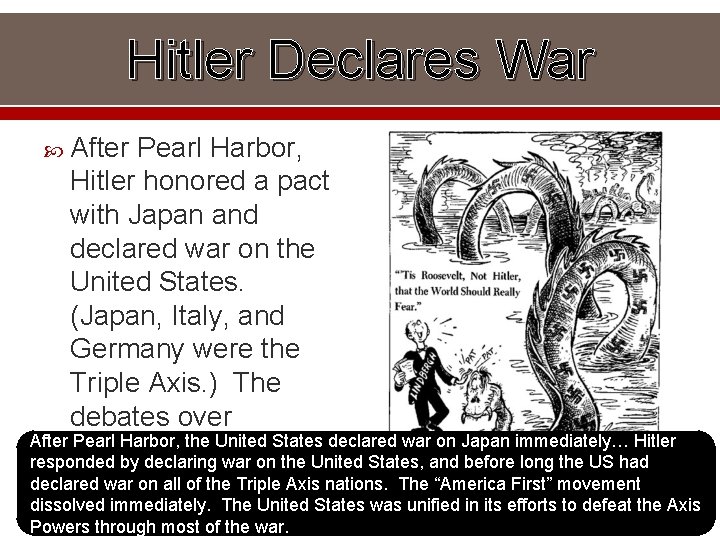
Hitler Declares War After Pearl Harbor, Hitler honored a pact with Japan and declared war on the United States. (Japan, Italy, and Germany were the Triple Axis. ) The debates over After Pearl Harbor, the United States declared war on Japan immediately… Hitler isolationism in the responded by declaring war on the United States, and before long the US had declared war on States all of the Triple Axis nations. The “America First” movement United were dissolved immediately. The United States was unified in its efforts to defeat the Axis over. War Powers through. World most of the war. II
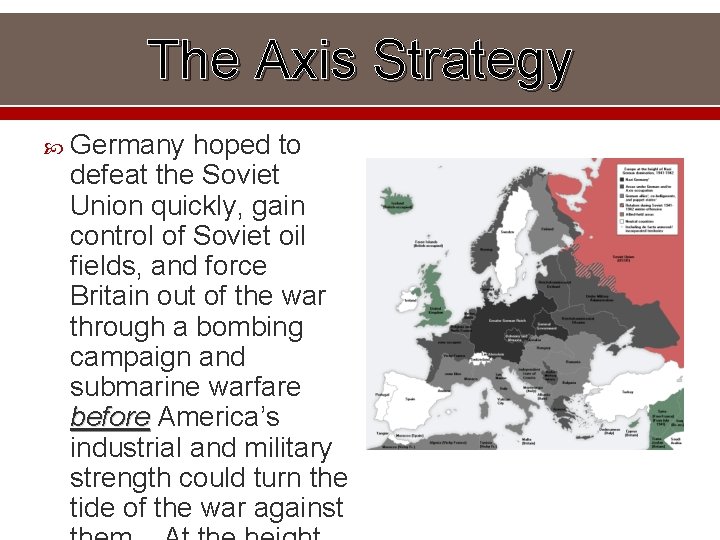
The Axis Strategy Germany hoped to defeat the Soviet Union quickly, gain control of Soviet oil fields, and force Britain out of the war through a bombing campaign and submarine warfare before America’s industrial and military strength could turn the tide of the war against
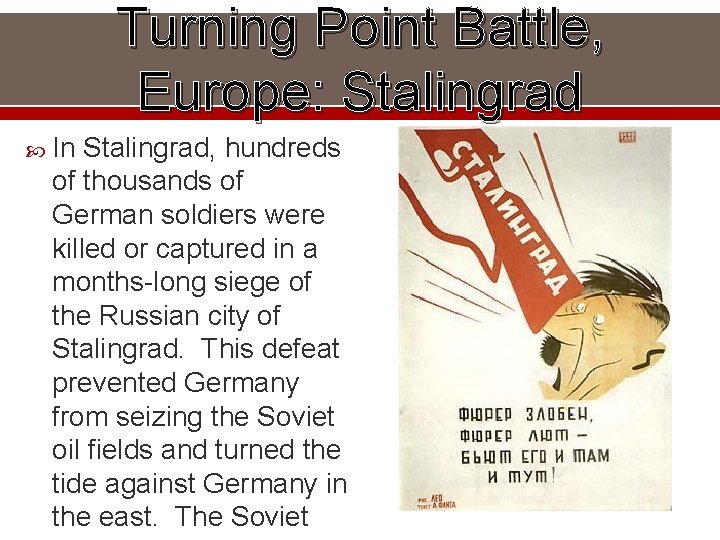
Turning Point Battle, Europe: Stalingrad In Stalingrad, hundreds of thousands of German soldiers were killed or captured in a months-long siege of the Russian city of Stalingrad. This defeat prevented Germany from seizing the Soviet oil fields and turned the tide against Germany in the east. The Soviet
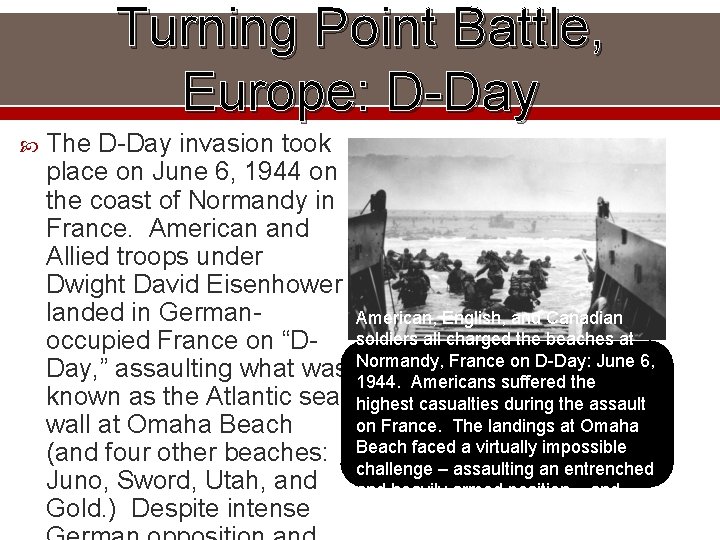
Turning Point Battle, Europe: D-Day The D-Day invasion took place on June 6, 1944 on the coast of Normandy in France. American and Allied troops under Dwight David Eisenhower landed in Germanoccupied France on “DDay, ” assaulting what was known as the Atlantic sea wall at Omaha Beach (and four other beaches: Juno, Sword, Utah, and Gold. ) Despite intense American, English, and Canadian soldiers all charged the beaches at Normandy, France on D-Day: June 6, 1944. Americans suffered the highest casualties during the assault on France. The landings at Omaha Beach faced a virtually impossible challenge – assaulting an entrenched and heavily armed position – and they prevailed.
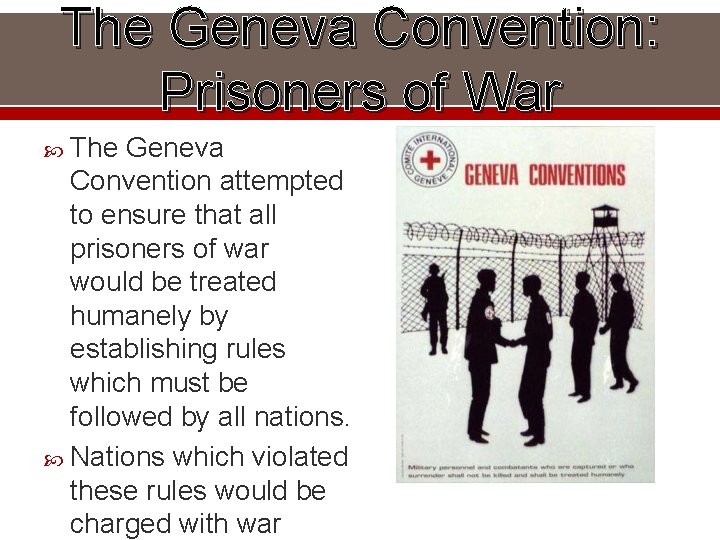
The Geneva Convention: Prisoners of War The Geneva Convention attempted to ensure that all prisoners of war would be treated humanely by establishing rules which must be followed by all nations. Nations which violated these rules would be charged with war
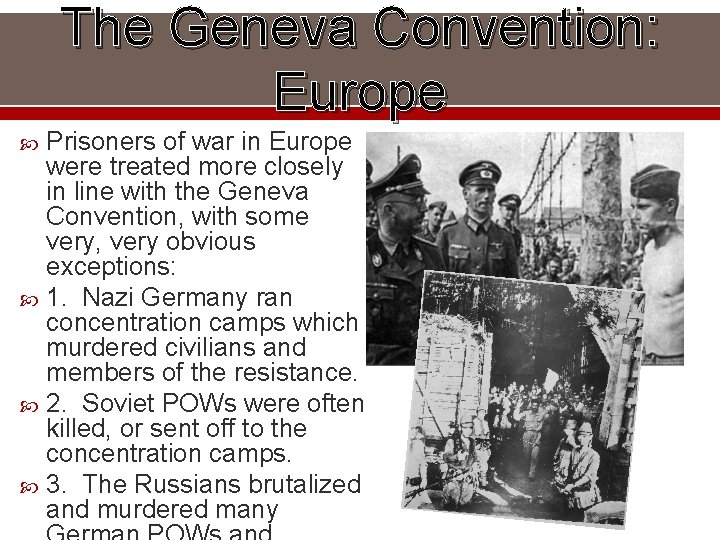
The Geneva Convention: Europe Prisoners of war in Europe were treated more closely in line with the Geneva Convention, with some very, very obvious exceptions: 1. Nazi Germany ran concentration camps which murdered civilians and members of the resistance. 2. Soviet POWs were often killed, or sent off to the concentration camps. 3. The Russians brutalized and murdered many
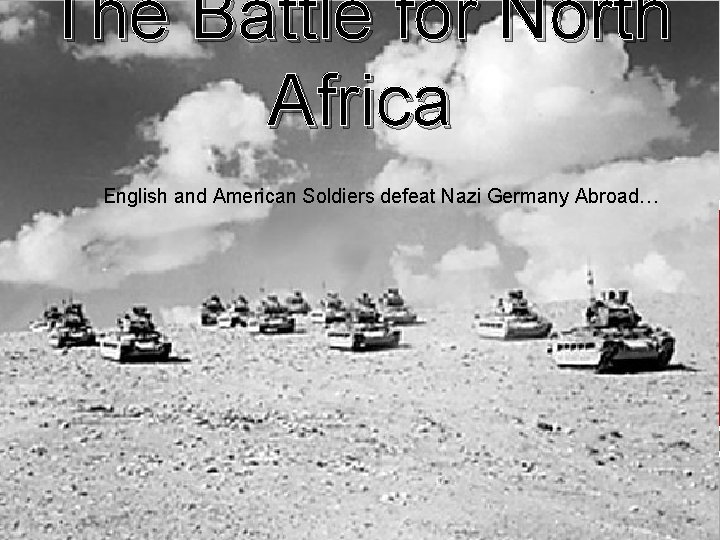
The Battle for North Africa English and American Soldiers defeat Nazi Germany Abroad…
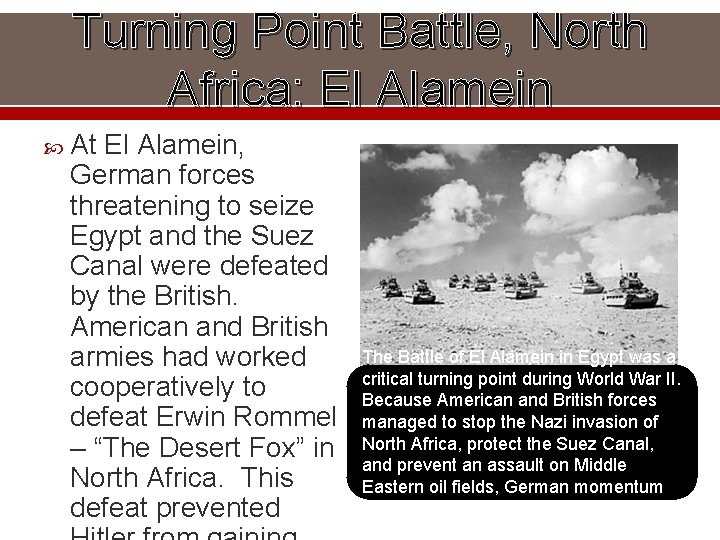
Turning Point Battle, North Africa: El Alamein At El Alamein, German forces threatening to seize Egypt and the Suez Canal were defeated by the British. American and British armies had worked cooperatively to defeat Erwin Rommel – “The Desert Fox” in North Africa. This defeat prevented The Battle of El Alamein in Egypt was a critical turning point during World War II. Because American and British forces managed to stop the Nazi invasion of North Africa, protect the Suez Canal, and prevent an assault on Middle Eastern oil fields, German momentum was slowed.
World War II in the Pacific The United States defeats the Empire of Japan, 1941 - 1945
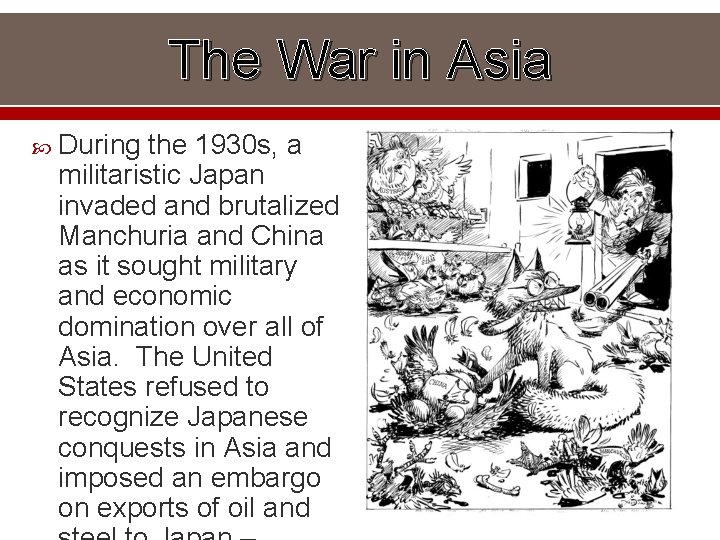
The War in Asia During the 1930 s, a militaristic Japan invaded and brutalized Manchuria and China as it sought military and economic domination over all of Asia. The United States refused to recognize Japanese conquests in Asia and imposed an embargo on exports of oil and
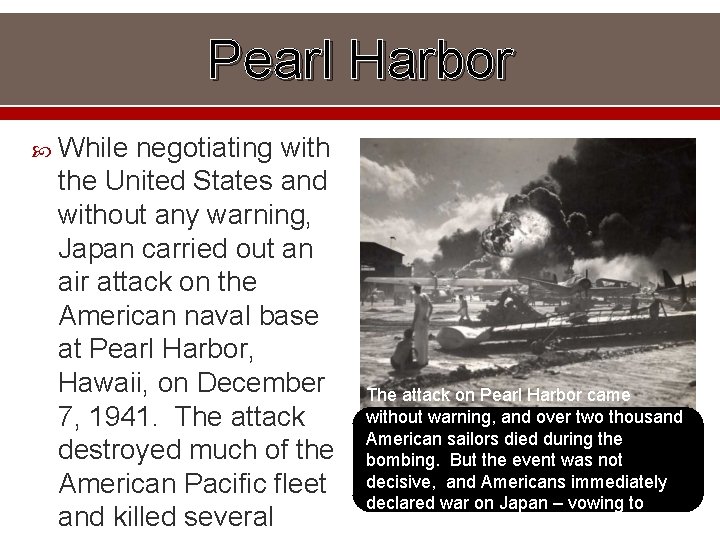
Pearl Harbor While negotiating with the United States and without any warning, Japan carried out an air attack on the American naval base at Pearl Harbor, Hawaii, on December 7, 1941. The attack destroyed much of the American Pacific fleet and killed several The attack on Pearl Harbor came without warning, and over two thousand American sailors died during the bombing. But the event was not decisive, and Americans immediately declared war on Japan – vowing to avenge Pearl Harbor.
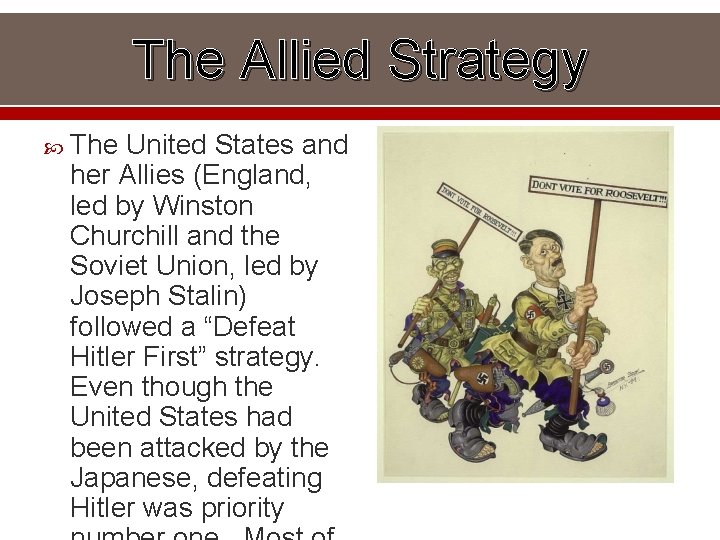
The Allied Strategy The United States and her Allies (England, led by Winston Churchill and the Soviet Union, led by Joseph Stalin) followed a “Defeat Hitler First” strategy. Even though the United States had been attacked by the Japanese, defeating Hitler was priority
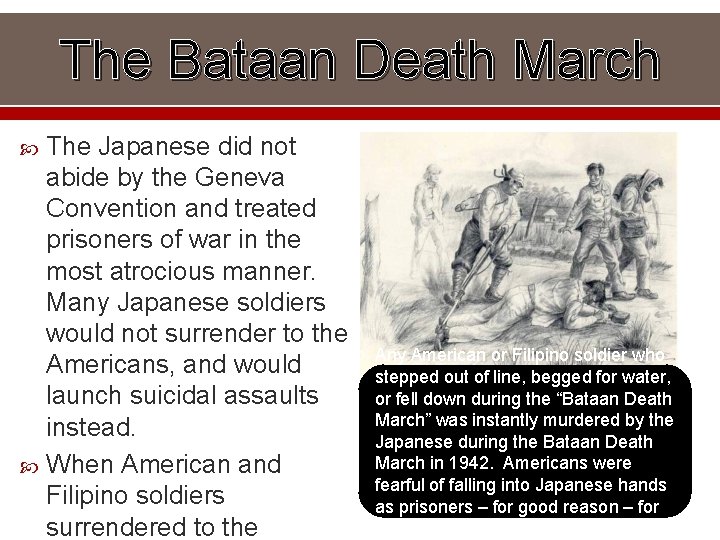
The Bataan Death March The Japanese did not abide by the Geneva Convention and treated prisoners of war in the most atrocious manner. Many Japanese soldiers would not surrender to the Americans, and would launch suicidal assaults instead. When American and Filipino soldiers surrendered to the Any American or Filipino soldier who stepped out of line, begged for water, or fell down during the “Bataan Death March” was instantly murdered by the Japanese during the Bataan Death March in 1942. Americans were fearful of falling into Japanese hands as prisoners – for good reason – for the remainder of the war.
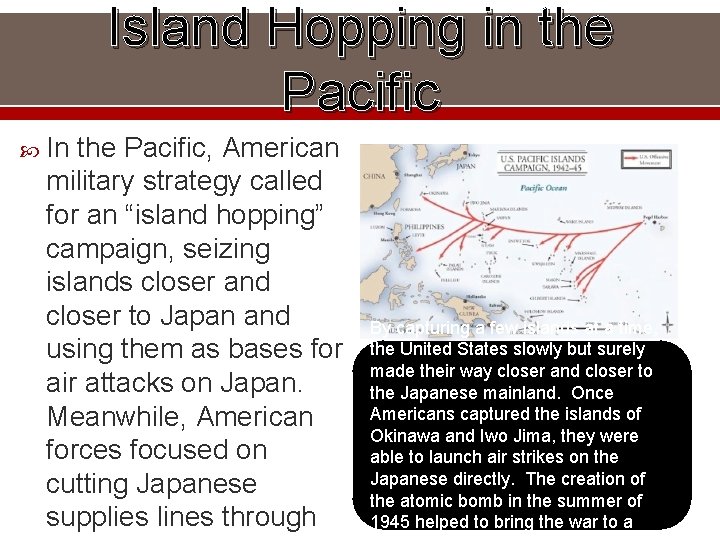
Island Hopping in the Pacific In the Pacific, American military strategy called for an “island hopping” campaign, seizing islands closer and closer to Japan and using them as bases for air attacks on Japan. Meanwhile, American forces focused on cutting Japanese supplies lines through By capturing a few islands at a time, the United States slowly but surely made their way closer and closer to the Japanese mainland. Once Americans captured the islands of Okinawa and Iwo Jima, they were able to launch air strikes on the Japanese directly. The creation of the atomic bomb in the summer of 1945 helped to bring the war to a
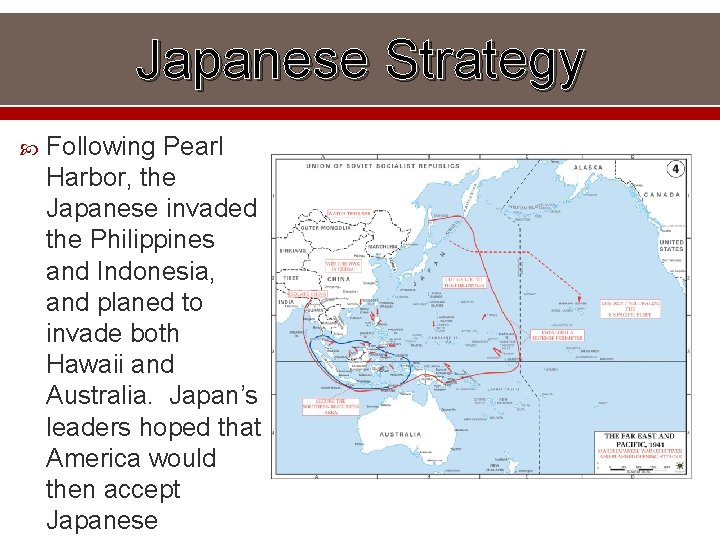
Japanese Strategy Following Pearl Harbor, the Japanese invaded the Philippines and Indonesia, and planed to invade both Hawaii and Australia. Japan’s leaders hoped that America would then accept Japanese
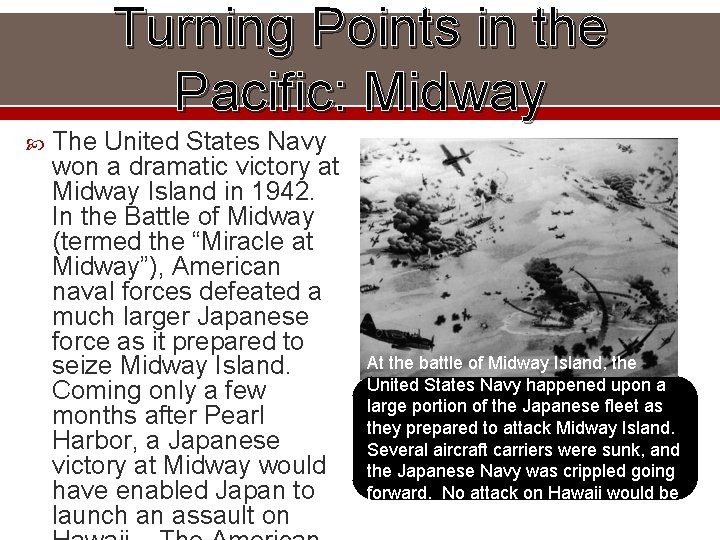
Turning Points in the Pacific: Midway The United States Navy won a dramatic victory at Midway Island in 1942. In the Battle of Midway (termed the “Miracle at Midway”), American naval forces defeated a much larger Japanese force as it prepared to seize Midway Island. Coming only a few months after Pearl Harbor, a Japanese victory at Midway would have enabled Japan to launch an assault on At the battle of Midway Island, the United States Navy happened upon a large portion of the Japanese fleet as they prepared to attack Midway Island. Several aircraft carriers were sunk, and the Japanese Navy was crippled going forward. No attack on Hawaii would be generated.
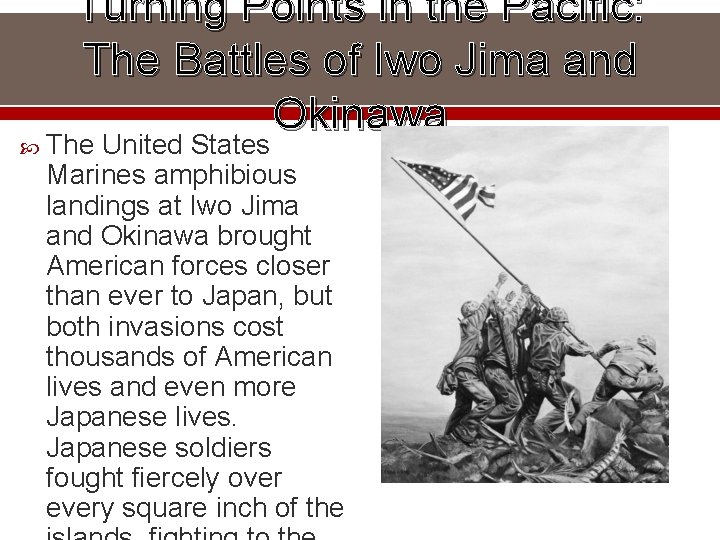
Turning Points in the Pacific: The Battles of Iwo Jima and Okinawa The United States Marines amphibious landings at Iwo Jima and Okinawa brought American forces closer than ever to Japan, but both invasions cost thousands of American lives and even more Japanese lives. Japanese soldiers fought fiercely over every square inch of the
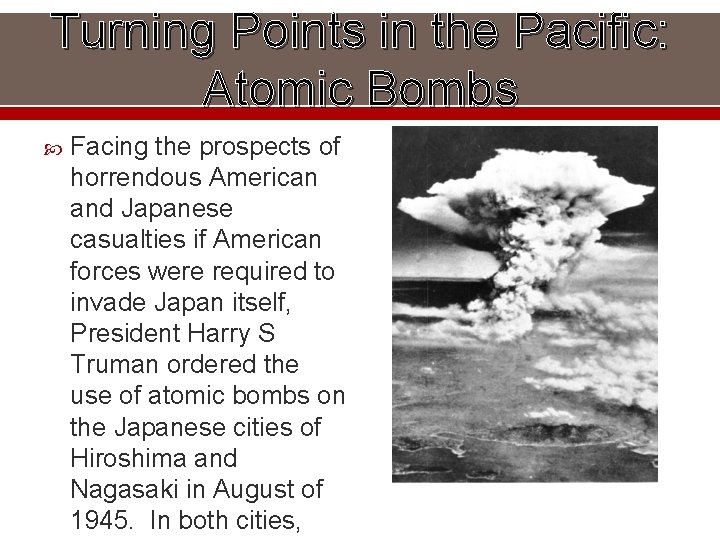
Turning Points in the Pacific: Atomic Bombs Facing the prospects of horrendous American and Japanese casualties if American forces were required to invade Japan itself, President Harry S Truman ordered the use of atomic bombs on the Japanese cities of Hiroshima and Nagasaki in August of 1945. In both cities,
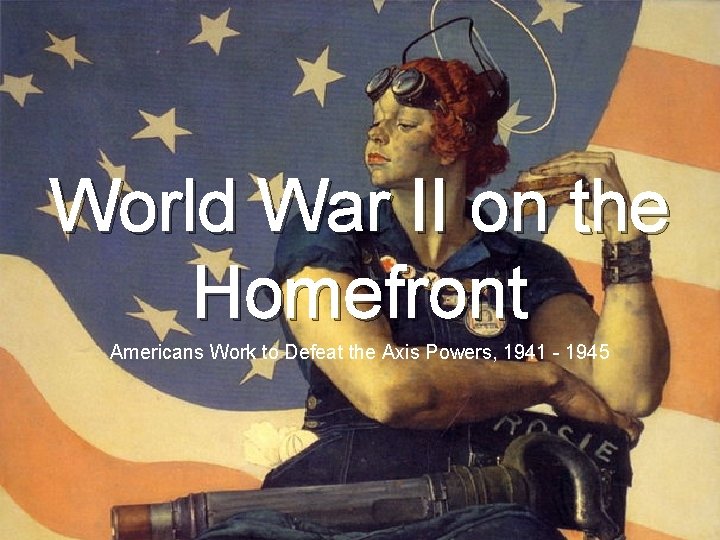
World War II on the Homefront Americans Work to Defeat the Axis Powers, 1941 - 1945
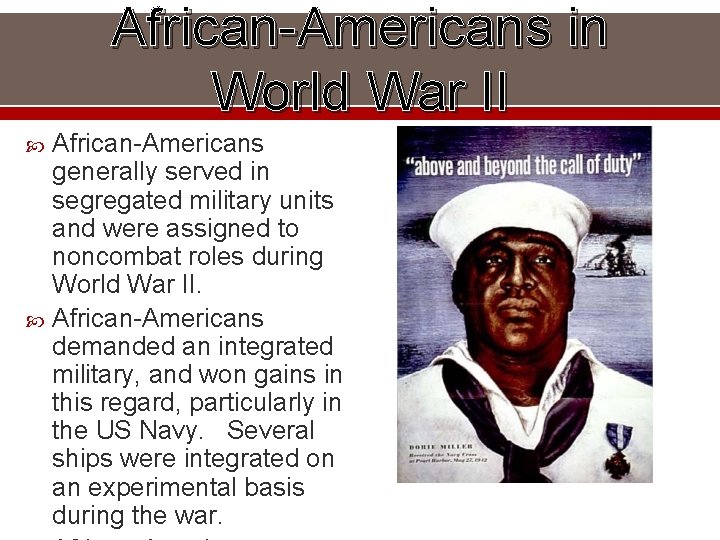
African-Americans in World War II African-Americans generally served in segregated military units and were assigned to noncombat roles during World War II. African-Americans demanded an integrated military, and won gains in this regard, particularly in the US Navy. Several ships were integrated on an experimental basis during the war.
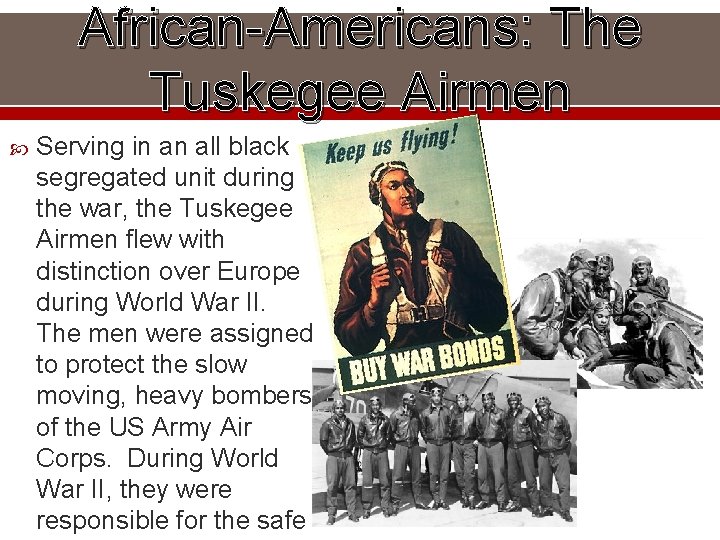
African-Americans: The Tuskegee Airmen Serving in an all black segregated unit during the war, the Tuskegee Airmen flew with distinction over Europe during World War II. The men were assigned to protect the slow moving, heavy bombers of the US Army Air Corps. During World War II, they were responsible for the safe
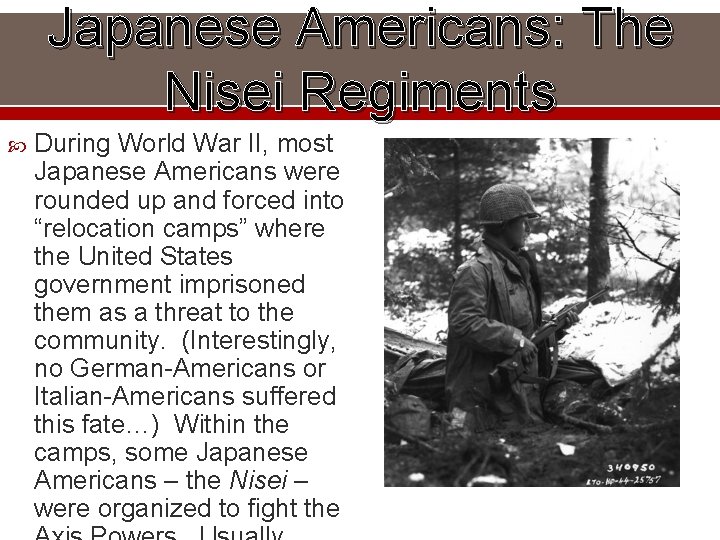
Japanese Americans: The Nisei Regiments During World War II, most Japanese Americans were rounded up and forced into “relocation camps” where the United States government imprisoned them as a threat to the community. (Interestingly, no German-Americans or Italian-Americans suffered this fate…) Within the camps, some Japanese Americans – the Nisei – were organized to fight the
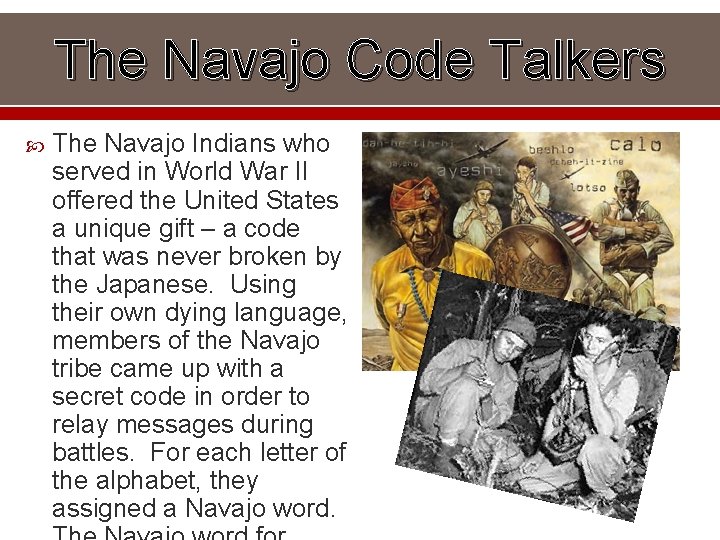
The Navajo Code Talkers The Navajo Indians who served in World War II offered the United States a unique gift – a code that was never broken by the Japanese. Using their own dying language, members of the Navajo tribe came up with a secret code in order to relay messages during battles. For each letter of the alphabet, they assigned a Navajo word.
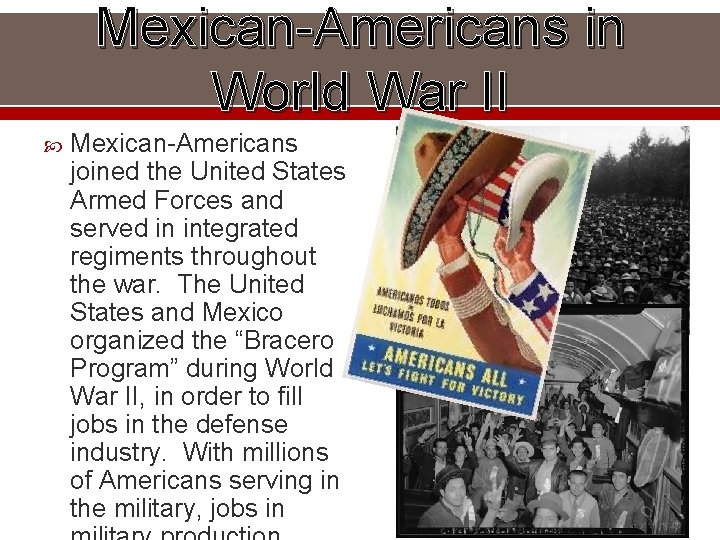
Mexican-Americans in World War II Mexican-Americans joined the United States Armed Forces and served in integrated regiments throughout the war. The United States and Mexico organized the “Bracero Program” during World War II, in order to fill jobs in the defense industry. With millions of Americans serving in the military, jobs in
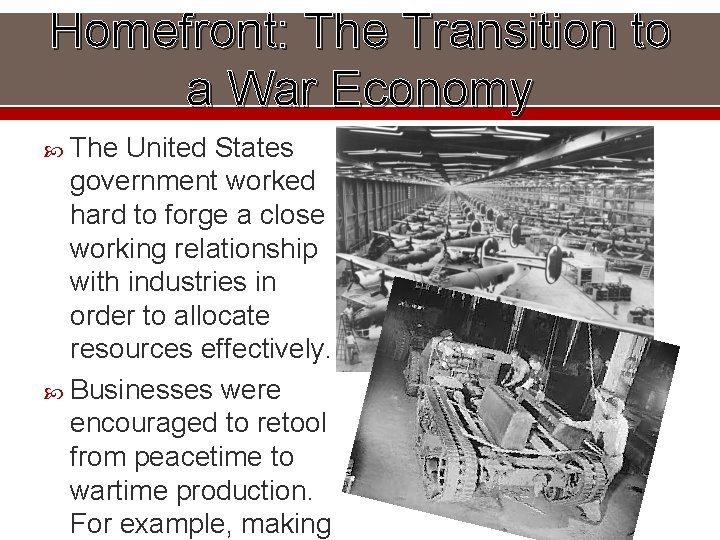
Homefront: The Transition to a War Economy The United States government worked hard to forge a close working relationship with industries in order to allocate resources effectively. Businesses were encouraged to retool from peacetime to wartime production. For example, making
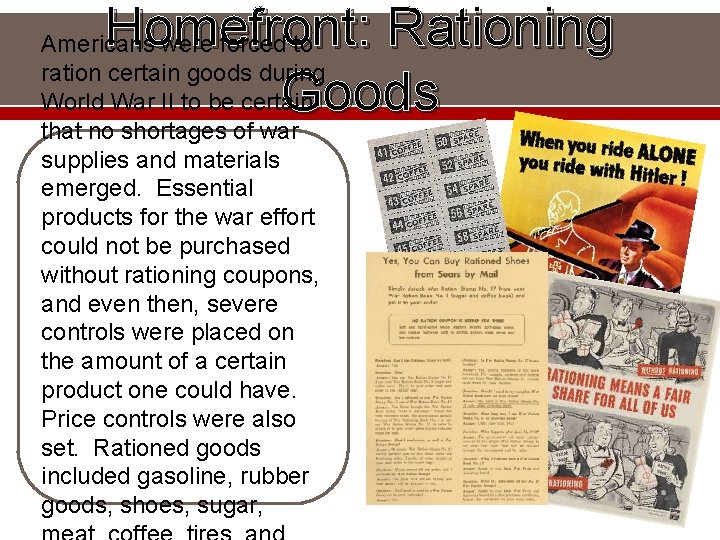
Homefront: Rationing Goods Americans were forced to ration certain goods during World War II to be certain that no shortages of war supplies and materials emerged. Essential products for the war effort could not be purchased without rationing coupons, and even then, severe controls were placed on the amount of a certain product one could have. Price controls were also set. Rationed goods included gasoline, rubber goods, shoes, sugar,
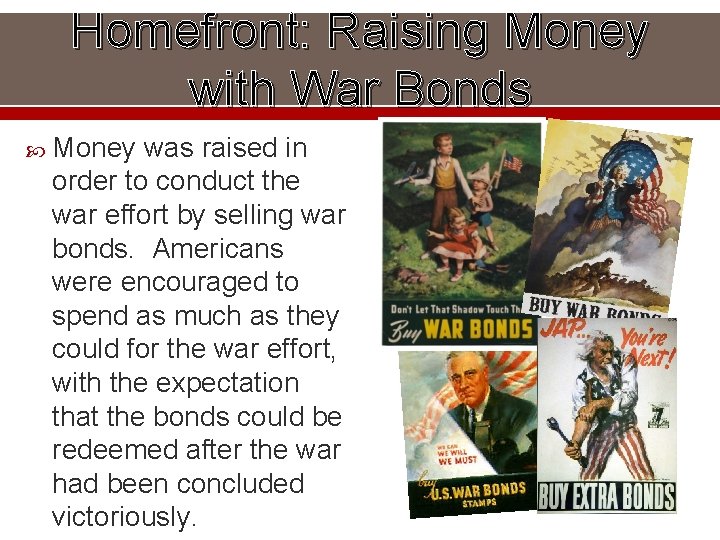
Homefront: Raising Money with War Bonds Money was raised in order to conduct the war effort by selling war bonds. Americans were encouraged to spend as much as they could for the war effort, with the expectation that the bonds could be redeemed after the war had been concluded victoriously.
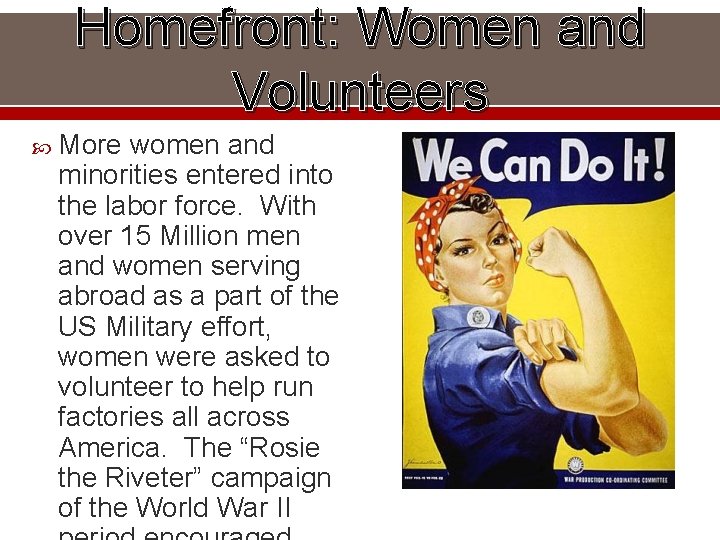
Homefront: Women and Volunteers More women and minorities entered into the labor force. With over 15 Million men and women serving abroad as a part of the US Military effort, women were asked to volunteer to help run factories all across America. The “Rosie the Riveter” campaign of the World War II
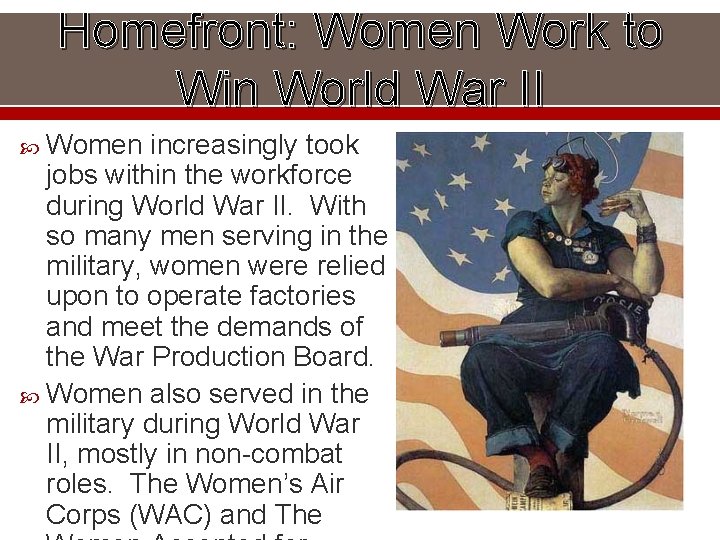
Homefront: Women Work to Win World War II Women increasingly took jobs within the workforce during World War II. With so many men serving in the military, women were relied upon to operate factories and meet the demands of the War Production Board. Women also served in the military during World War II, mostly in non-combat roles. The Women’s Air Corps (WAC) and The
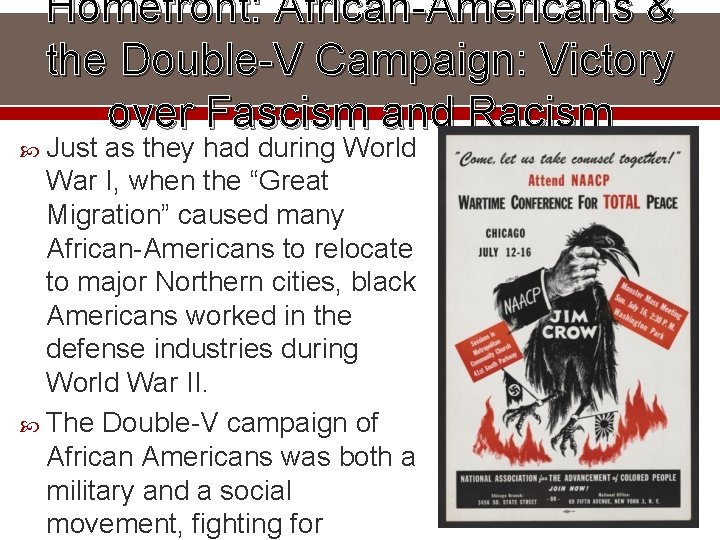
Homefront: African-Americans & the Double-V Campaign: Victory over Fascism and Racism Just as they had during World War I, when the “Great Migration” caused many African-Americans to relocate to major Northern cities, black Americans worked in the defense industries during World War II. The Double-V campaign of African Americans was both a military and a social movement, fighting for
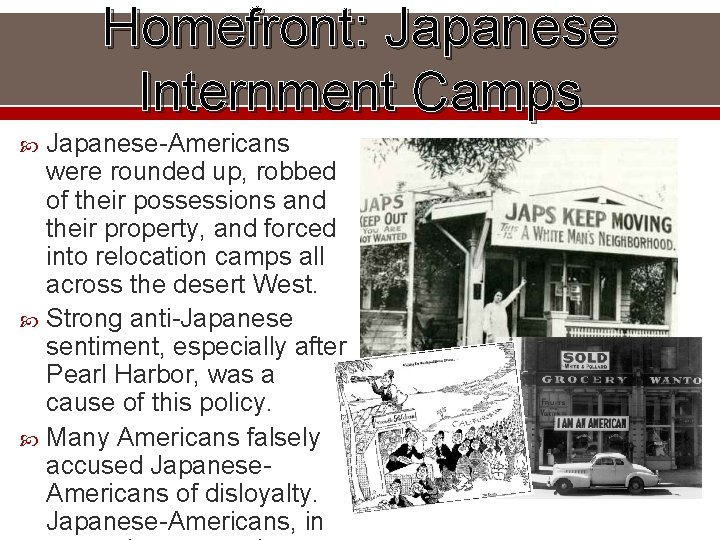
Homefront: Japanese Internment Camps Japanese-Americans were rounded up, robbed of their possessions and their property, and forced into relocation camps all across the desert West. Strong anti-Japanese sentiment, especially after Pearl Harbor, was a cause of this policy. Many Americans falsely accused Japanese. Americans of disloyalty. Japanese-Americans, in
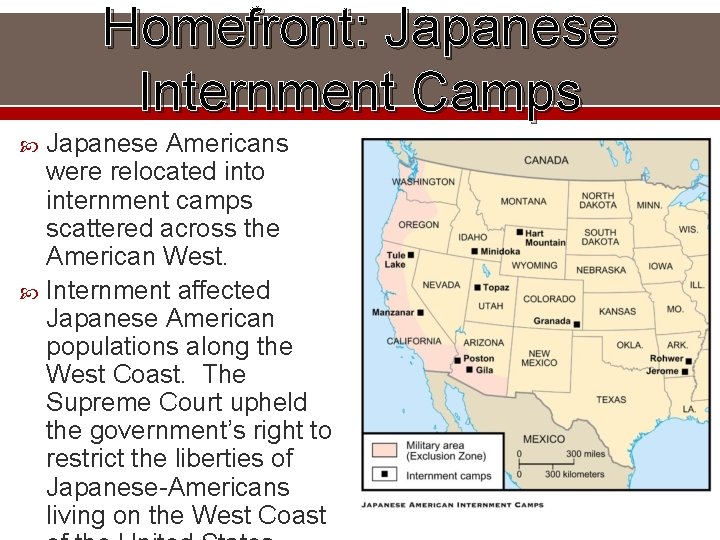
Homefront: Japanese Internment Camps Japanese Americans were relocated into internment camps scattered across the American West. Internment affected Japanese American populations along the West Coast. The Supreme Court upheld the government’s right to restrict the liberties of Japanese-Americans living on the West Coast
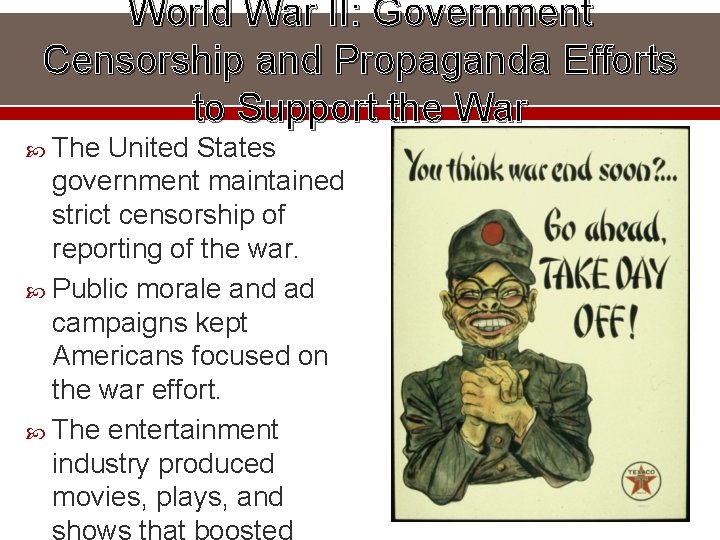
World War II: Government Censorship and Propaganda Efforts to Support the War The United States government maintained strict censorship of reporting of the war. Public morale and ad campaigns kept Americans focused on the war effort. The entertainment industry produced movies, plays, and shows that boosted
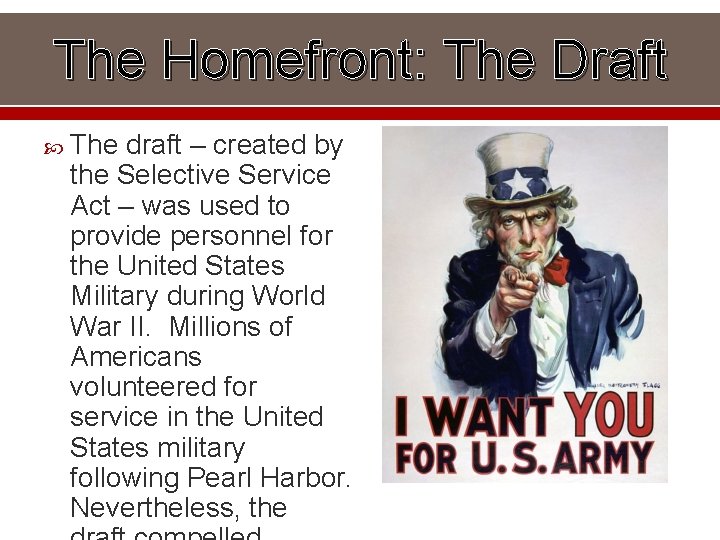
The Homefront: The Draft The draft – created by the Selective Service Act – was used to provide personnel for the United States Military during World War II. Millions of Americans volunteered for service in the United States military following Pearl Harbor. Nevertheless, the
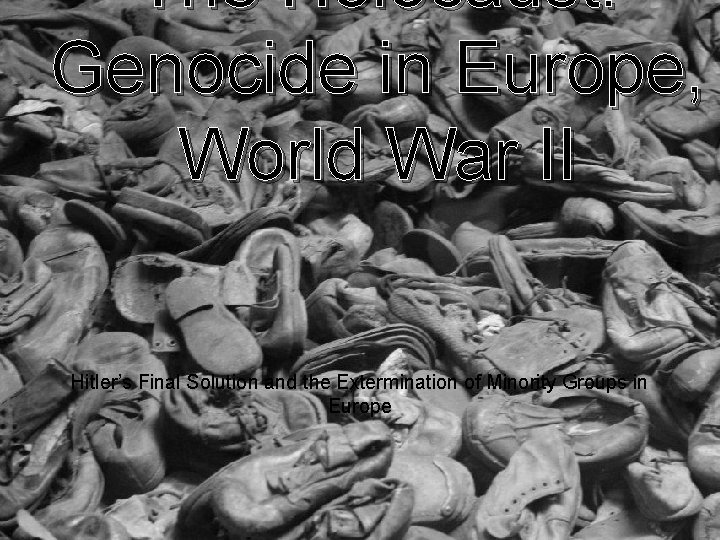
The Holocaust: Genocide in Europe, World War II Hitler’s Final Solution and the Extermination of Minority Groups in Europe
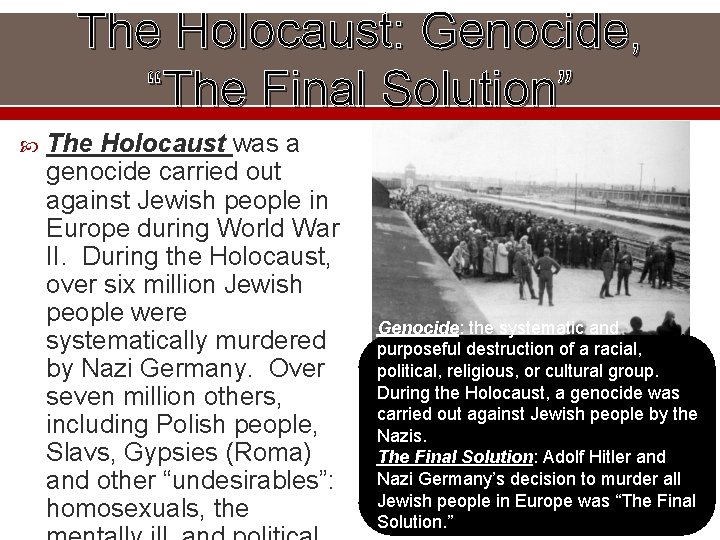
The Holocaust: Genocide, “The Final Solution” The Holocaust was a genocide carried out against Jewish people in Europe during World War II. During the Holocaust, over six million Jewish people were systematically murdered by Nazi Germany. Over seven million others, including Polish people, Slavs, Gypsies (Roma) and other “undesirables”: homosexuals, the Genocide: Genocide the systematic and purposeful destruction of a racial, political, religious, or cultural group. During the Holocaust, a genocide was carried out against Jewish people by the Nazis. The Final Solution: Adolf Hitler and Nazi Germany’s decision to murder all Jewish people in Europe was “The Final Solution. ”
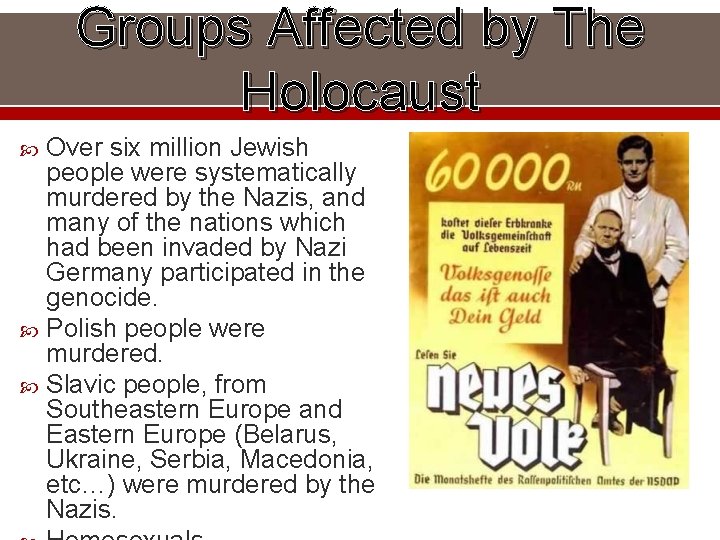
Groups Affected by The Holocaust Over six million Jewish people were systematically murdered by the Nazis, and many of the nations which had been invaded by Nazi Germany participated in the genocide. Polish people were murdered. Slavic people, from Southeastern Europe and Eastern Europe (Belarus, Ukraine, Serbia, Macedonia, etc…) were murdered by the Nazis.
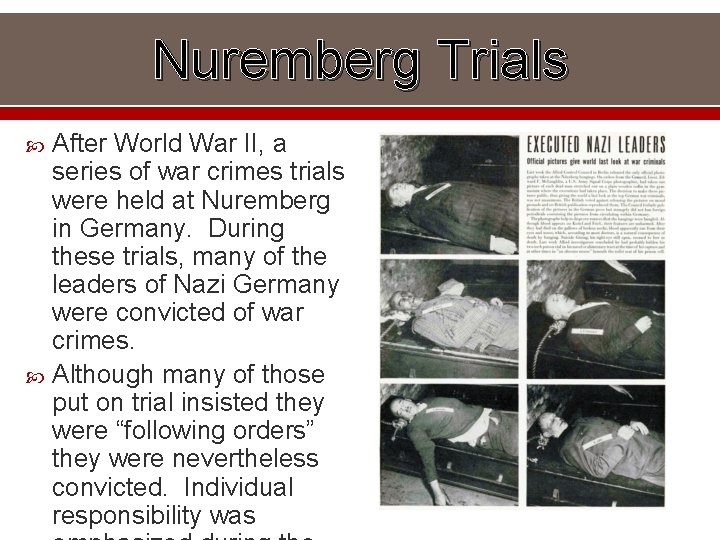
Nuremberg Trials After World War II, a series of war crimes trials were held at Nuremberg in Germany. During these trials, many of the leaders of Nazi Germany were convicted of war crimes. Although many of those put on trial insisted they were “following orders” they were nevertheless convicted. Individual responsibility was
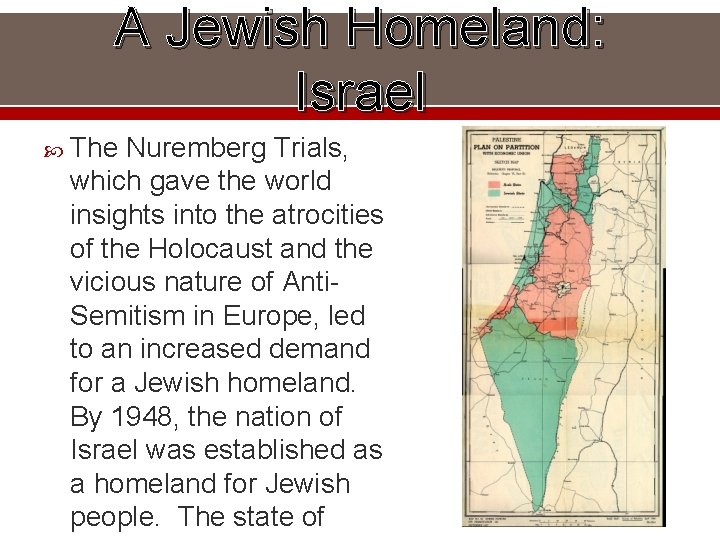
A Jewish Homeland: Israel The Nuremberg Trials, which gave the world insights into the atrocities of the Holocaust and the vicious nature of Anti. Semitism in Europe, led to an increased demand for a Jewish homeland. By 1948, the nation of Israel was established as a homeland for Jewish people. The state of