
American Romanticism The American Literary Renaissance America Post
- Slides: 17
American Romanticism & The American Literary “Renaissance”
America Post Revolution • After the American Revolution there was a growing sense that this new nation needed its own artistic canon. • Nathaniel Hawthorne and others saw an opportunity to emphasize the unique nature and spirit of the American landscape: • The effects of strict religious traditions; • The vastness and dangers of the American wilderness; • The conflicts between white European settlers and Native
The American “Renaissance” • The period of American literature between 1830 to 1865 has been referred to as the American Renaissance because of the number of great authors and literary works that emerged in a few short decades. • The term remains a bit of a misnomer, however, as it means “rebirth, ” and this period was not a rebirth, but in fact, the birth of the American literary cannon.
Writers of the Period Key writers of the period include: • • Nathaniel Hawthorne Ralph Waldo Emerson Henry David Thoreau Herman Melville Harriet Beecher Stowe Edgar Allan Poe Walt Whitman
What is Romanticism? • Let’s start with what it’s not. It is not referring to the steamy novels sold in grocery stores and airports with Fabio on the cover.
What is Romanticism? • Romanticism was the response to the desire to establish “a distinctly American cultural identity” (Brantley). • The American Romantic movement followed a similar movement in Europe. American Romantic writers, like their European counterparts, favored imagination and intuition as inspiration, but tended towards nationalism while European writers leaned towards the historic and gothic (Simon and Schuster). (Edgar Allen Poe would follow a more European tradition in his writing).
Rejection of Puritanical Ideas • Puritans saw the American wilderness as dangerous; demonic • Narrow view of man’s relationship to God and spirituality • Plurality of thought and expression was seen as threat to Puritan ideals • Romantics found inspiration in nature and saw the wilderness as uniquely American • Broader view of spirituality; Transcendentalists, saw nature as a conduit to spirituality • Emphasis on individual
Elements of American Romanticism • • • The Power of the individual The romance of the frontier A quest for beauty Exotic or fantastic settings – often in the past Subjectivity and imagination over objectivity and realism Escapism
Transcendentalism • Ralph Waldo Emerson is largely cited as the “father” of American Transcendentalism. • Transcendentalism was a movement that saw the divine in all things, the innate goodness of all people, and personal insight over logic • • The search for truth Social good Communing with nature and meditation The importance of art
Centered in Massachusetts • Centered in Boston and Concord • Members included writers such as Emerson, Thoreau, Hawthorne, and the Alcotts • Utopian communes • Social reform movements including women’s rights, the abolition of slavery, and labor rights
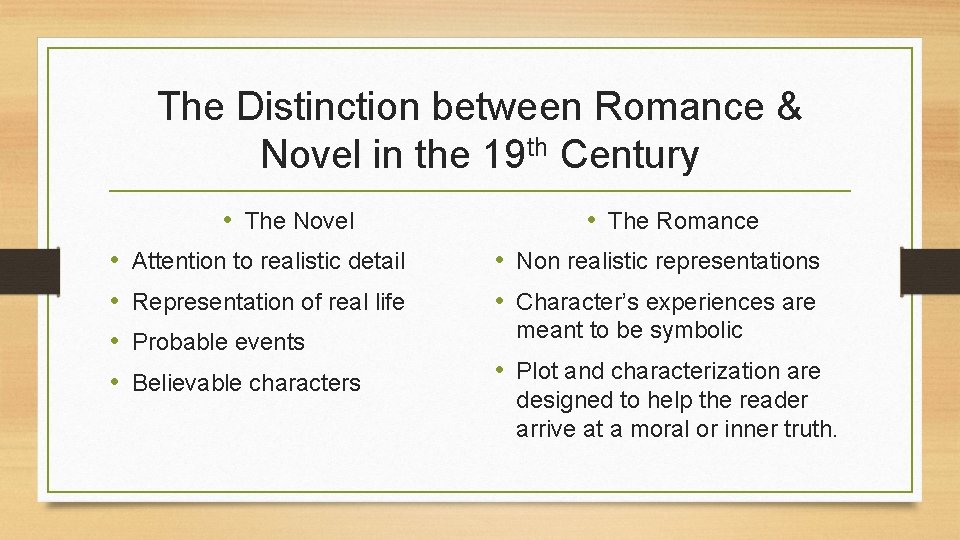
The Distinction between Romance & Novel in the 19 th Century • The Novel • • Attention to realistic detail Representation of real life Probable events Believable characters • The Romance • Non realistic representations • Character’s experiences are meant to be symbolic • Plot and characterization are designed to help the reader arrive at a moral or inner truth.
Early Romanticism and the Birth of the American Hero • • Early American Romanticism writers include: James Fenimore Cooper Washington Irving William Cullen Bryant Henry Wadsworth Longfellow Oliver Wendell Holmes John Greenleaf Whittier Edgar Allan Poe
Historic Background • Between 1800 and 1803, the United States doubled in sized • Canals, railroads, tunnels, and turnpikes emerged to improve travel across the developing country. • The war of 1812 • The Monroe Doctrine • Growing sense of nationalism
Romanticism as Response to Rapid Growth • James Fenimore Cooper writes The Leather Stocking Tales, a series of novels which include The Last of the Mohicans, that feature the frontier of New York State and introduce the Romantic hero, Natty Bumppo, also known as Leather Stockings. Cooper’s hero represents the mix of European history with the quintessential American wilderness.
Romanticism as Response to Rapid Growth • Cooper’s novels reflect the conflicts between white settlers and Native Americans. • Bumppo’s character rejects much of his European heritage and adopts the wilderness as his new home, living among the Native Americans. • Full of symbolism, Cooper’s books reflect a seminal warning against rapid growth that threatens the existing beauty of the Eastern frontier.
Romanticism as Response to Rapid Growth • Washington Irving writes “The Legend of Sleepy Hollow” and “Rip Van Winkle, ” both set in the Hudson River Valley of New York state. • Irving’s stories lean heavily on myth and legend derived from both European tradition and early colonial times. • Both “The Legend of Sleepy Hollow” and “Rip Van Winkle” reflect the Romantic’s desire to return to the past and distrust of rapid progress.
Works Cited • Brantley, Margaret. Introduction. The Scarlet Letter, by Nathaniel Hawthorne, vii-xxiii 1850, Simon & Schuster Paperbacks, 2004, pp.