
American Political System Background Early settlers came to
American Political System
Background: • Early settlers came to the USA because of religious persecution and a lack of political rights • Basic American Values – Rights of the individual, personal freedom private enterprise, little government involvement (justice, national defense and public order) – ‘Government of the people, by the people, for the people’ • Historically a two party system: – Democrats (donkey) • • In the centre of the political system Voice of liberalism Hillary and Bill Clinton JFK – Republicans (elephant) • On the right of the political spectrum • Voice of conservatism (religion and morality) • George Bush SR/JR
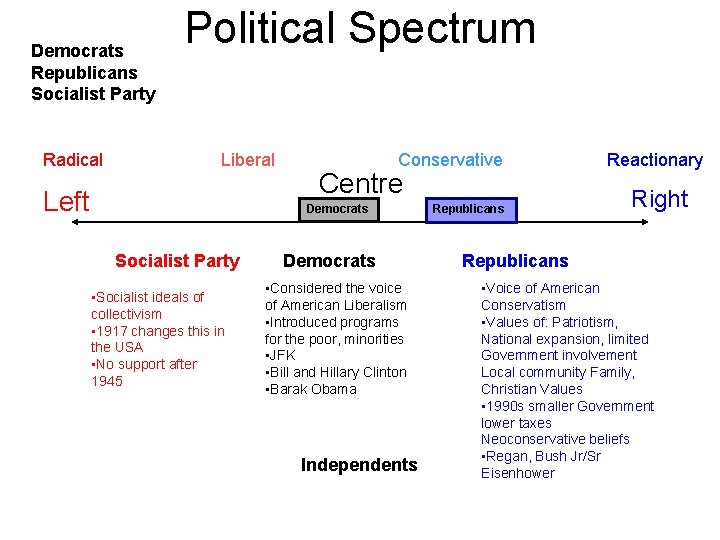
Democrats Republicans Socialist Party Radical Political Spectrum Liberal Left Conservative Centre Democrats Socialist Party • Socialist ideals of collectivism • 1917 changes this in the USA • No support after 1945 Democrats • Considered the voice of American Liberalism • Introduced programs for the poor, minorities • JFK • Bill and Hillary Clinton • Barak Obama Independents Republicans Reactionary Right Republicans • Voice of American Conservatism • Values of: Patriotism, National expansion, limited Government involvement Local community Family, Christian Values • 1990 s smaller Government lower taxes Neoconservative beliefs • Regan, Bush Jr/Sr Eisenhower
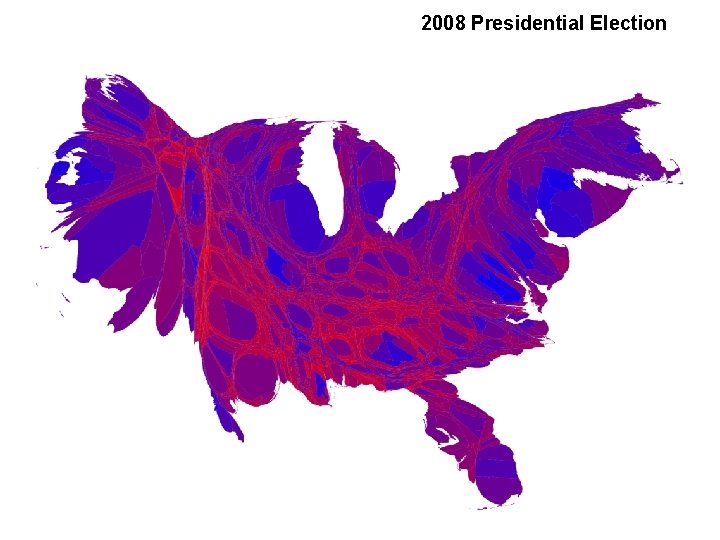
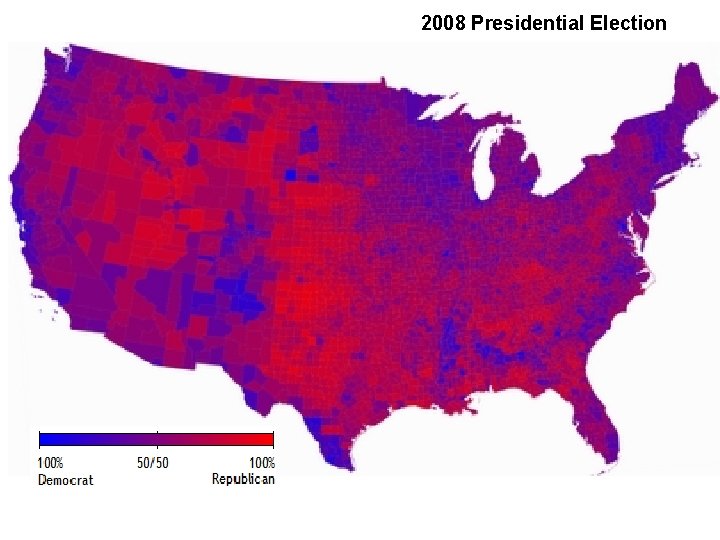
2008 Presidential Election
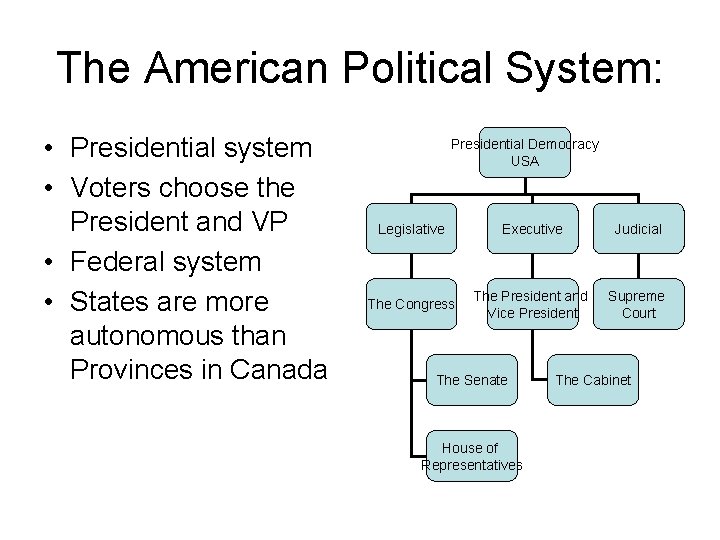
The American Political System: • Presidential system • Voters choose the President and VP • Federal system • States are more autonomous than Provinces in Canada Presidential Democracy USA Legislative Executive Judicial The Congress The President and Vice President Supreme Court The Senate House of Representatives The Cabinet
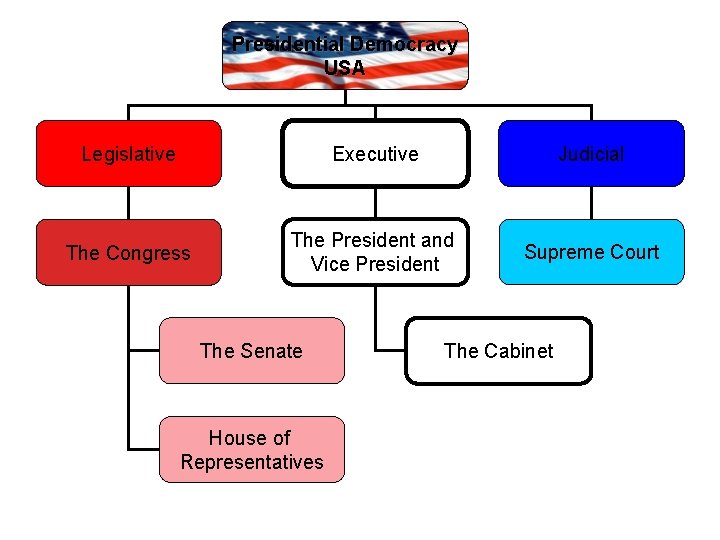
Presidential Democracy USA Legislative Executive Judicial The Congress The President and Vice President Supreme Court The Senate House of Representatives The Cabinet
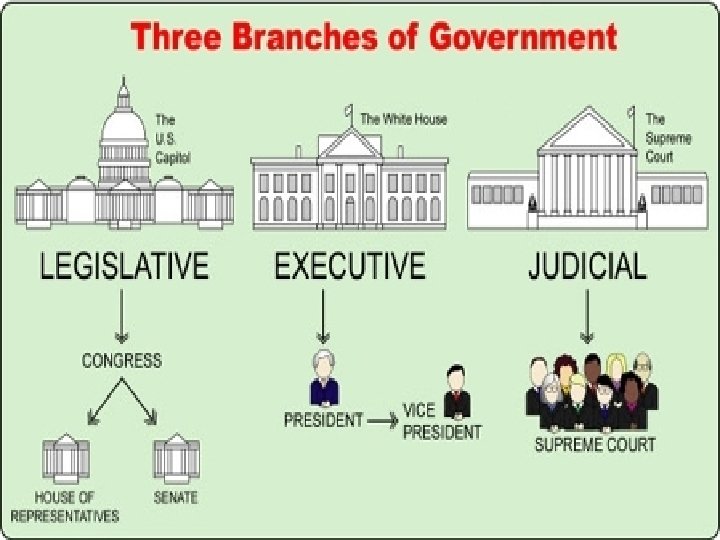
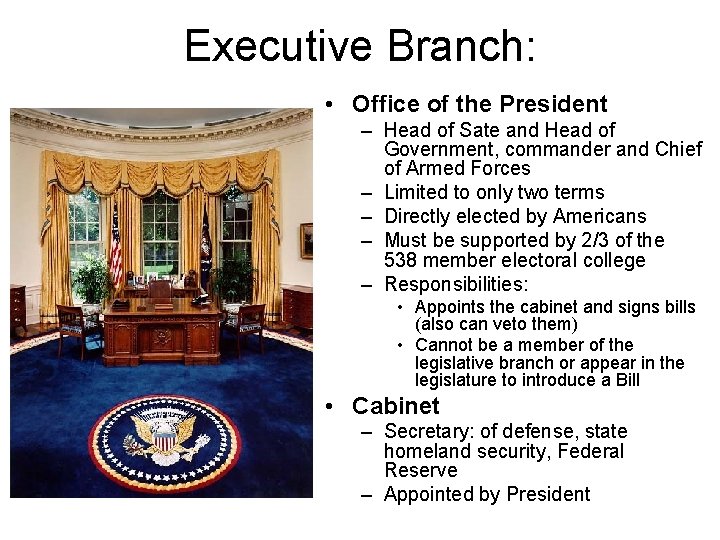
Executive Branch: • Office of the President – Head of Sate and Head of Government, commander and Chief of Armed Forces – Limited to only two terms – Directly elected by Americans – Must be supported by 2/3 of the 538 member electoral college – Responsibilities: • Appoints the cabinet and signs bills (also can veto them) • Cannot be a member of the legislative branch or appear in the legislature to introduce a Bill • Cabinet – Secretary: of defense, state homeland security, Federal Reserve – Appointed by President
Legislative Branch: • The Senate: – The elected upper chamber – Every state is represented 2 senators – Elected for 6 year terms – No restrictions on # of terms – Senators have the right to unlimited debate • Filibuster – Can introduce new legislation or modify/reject – Cabinet has to be approved by senate – Can impeach president if they are abusing power • House of Representatives: – The elected lower chamber – Assigned to states based on population – Elected to 2 year terms – No limit to reelection – Three main powers: • Right to introduce money bills • Power to elect president when no candidate receives the majority of votes • Have right to impeach
Steps for a Bill to Become Law: • Introduction: – Any Member of legislature (Congress) can introduce a bill – Presidential bills are introduced by the senior member of the President’s party • Committee Action: – Bills are referred to a full committee for approval or rejection – Representation refers to the proportion of each part in the Senate or House – Committees determine which bills they will consider if a bill is not considered it is killed • Sub committees will then amend the bill, study it and report back to the full committee – The committee then votes on the bill and if favorable will report it to the legislature (House or Senate) • Floor Action: – Bill is then placed on Calendar for Debate – After debate the chamber will vote on the bill depending on the type will determine how the Legislature will vote – Tax or money bills all members must vote
Steps for a Bill to Become Law…: • Action in the Second Chamber: – Once passes in one chamber the other chamber for debate and approval – This chamber can either pass the bill, amend it (minor), ignore the bill, or pass its own bill different from the original • Conference Action: – If the changes are significant then senior members from both chambers will meet and reconcile the bills differences • Sometimes this results in both chambers being ok with the bill other times the bills die • Presidential Veto: – If the president approves the bill then it is dated and signed – If the President does not agree with the bill then can reject it • Veto – If a 2/3 majority in the legislature is achieved then the veto is overturned and the bill becomes law • Checks and Balances: – All branches have the ability to override one another
Judicial Branch • The Supreme Court – Highest court in the land – Most important political function is to review challenges to legislation (bills) brought before it and decide if they are constitutional or not – 9 judges appointed by president and approved by senate – Serve for life
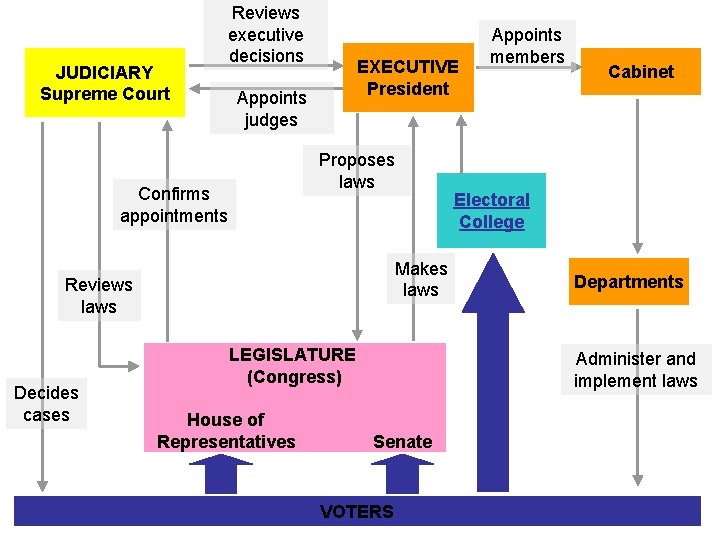
JUDICIARY Supreme Court Reviews executive decisions EXECUTIVE President Appoints judges Proposes laws Confirms appointments Makes laws Reviews laws Decides cases LEGISLATURE (Congress) House of Representatives Appoints members Cabinet Electoral College Departments Administer and implement laws Senate VOTERS
American Elections
Elections and Voting: • Presidential Campaigns: – Primaries • Select the candidate from each party to attend the convention • At the convention the nomine and running mate will be selected – The presidential candidates will run head to head from September to November – Voters will select their candidate which nominate a member to the electoral college (senate/House of Representatives) 538 • This body will actually choose the president • Congressional Campaigns – Every two years • House of Representatives are up for election • 1/3 of the Senate are up for election
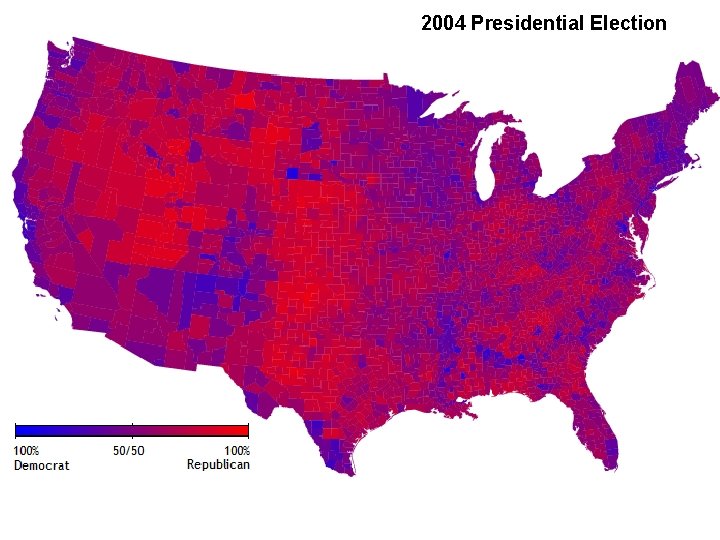
2004 Presidential Election
2008 Presidential Election
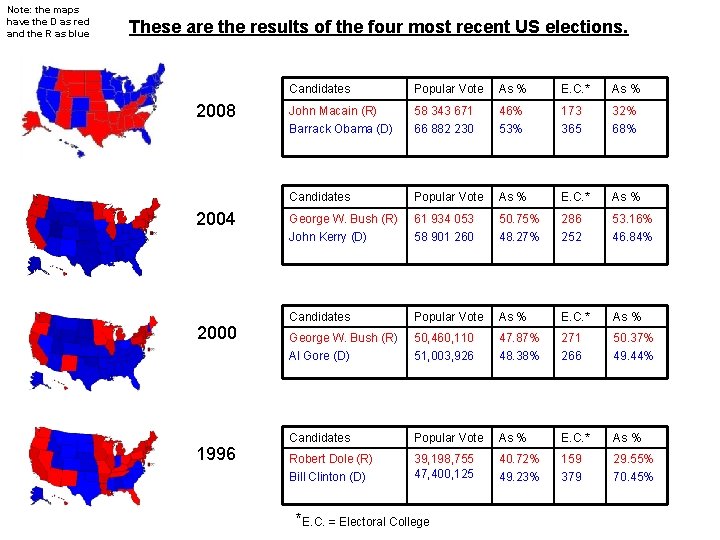
Note: the maps have the D as red and the R as blue These are the results of the four most recent US elections. 2008 2004 2000 1996 Candidates Popular Vote As % E. C. * As % John Macain (R) Barrack Obama (D) 58 343 671 66 882 230 46% 53% 173 365 32% 68% Candidates Popular Vote As % E. C. * As % George W. Bush (R) John Kerry (D) 61 934 053 58 901 260 50. 75% 48. 27% 286 252 53. 16% 46. 84% Candidates Popular Vote As % E. C. * As % George W. Bush (R) Al Gore (D) 50, 460, 110 51, 003, 926 47. 87% 48. 38% 271 266 50. 37% 49. 44% Candidates Popular Vote As % E. C. * As % Robert Dole (R) Bill Clinton (D) 39, 198, 755 47, 400, 125 40. 72% 49. 23% 159 379 29. 55% 70. 45% *E. C. = Electoral College
Does the system Work? • Criticisms: – Rage Against the Machine: Testify – Apathy – Voting irregularities – Polarized electorate • Positives: – Lots of opportunity to vote and participate – Checks and balances
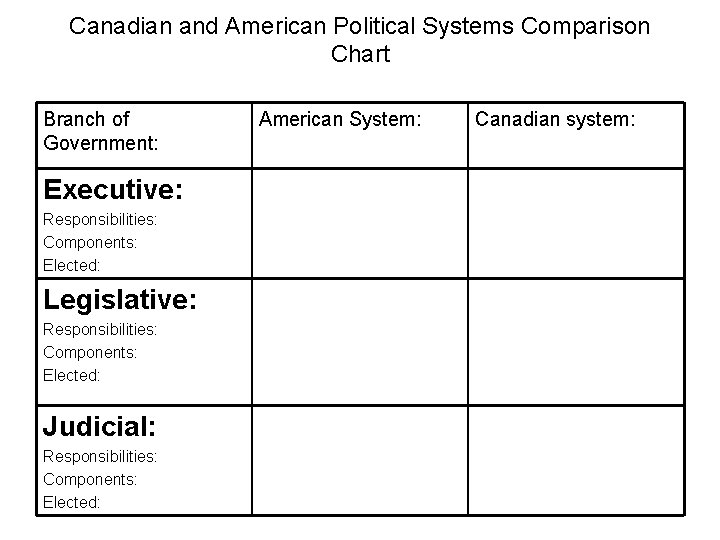
Canadian and American Political Systems Comparison Chart Branch of Government: Executive: Responsibilities: Components: Elected: Legislative: Responsibilities: Components: Elected: Judicial: Responsibilities: Components: Elected: American System: Canadian system:
How are the Canadian and American Systems Similar/Different? Similarities: Differences:
- Slides: 21