
American Political Culture 1 What is political culture
- Slides: 19
American Political Culture 1
What is political culture? n Political culture -A coherent way of thinking about how pol. and gov. ought to be carried out. - Customs, attitudes, beliefs, and values that shape a particular political system n Political subcultures -groups within a country made up of distinctive regions, religions and ethnic groups that have different pol. assumptions 2
What are fundamental political values most Americans share? 3
Five Key Elements of the American System n n n Liberty – individual rights Equality – political equality, equal opportunity Democracy – representatives accountable to the people Civic Duty* – people ought to take community issues seriously, help when possible Individual Responsibility* – responsible for one’s own actions and well being *Debatable in today’s society 4
What role does religion play in shaping our political culture? America is one of the most religious countries in the world. 5
How De We Know These Are Shared Values? Popular culture – books, speeches, etc n Polls n n Are There Inconsistencies? Sure! n n People often act contrary to their stated beliefs, self-interest How Do We Account for Conflict in America? Broad values may not be applied consistently in specific controversies n Beliefs sometimes are contradictory 6 n
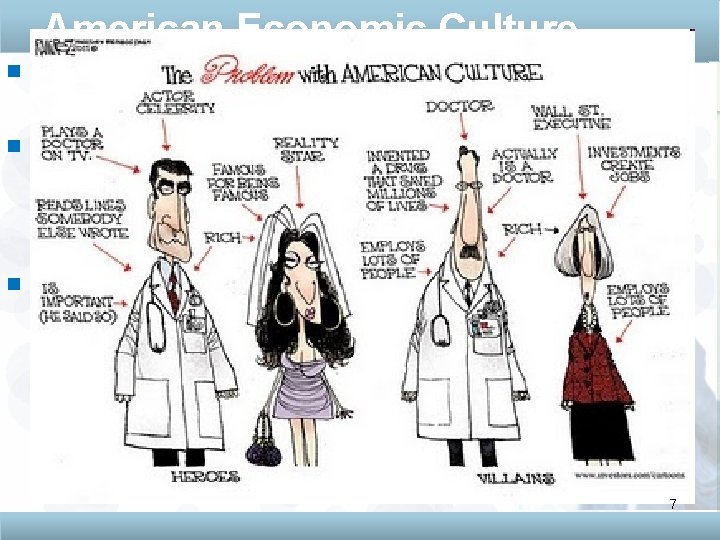
American Economic Culture n Liberty -free enterprise with minimal restrictions n Equality -Americans are more willing to tolerate econ. inequality than pol. Inequality -help the disadv. , but no preferential treatment n Individualism -personal responsibility -helping those in need? 7
Is equality of opportunity more important than equality of results? 8
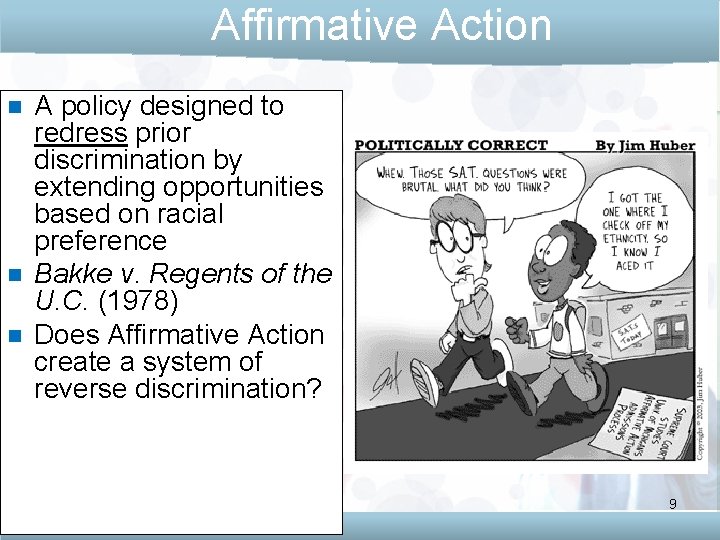
Affirmative Action n A policy designed to redress prior discrimination by extending opportunities based on racial preference Bakke v. Regents of the U. C. (1978) Does Affirmative Action create a system of reverse discrimination? 9
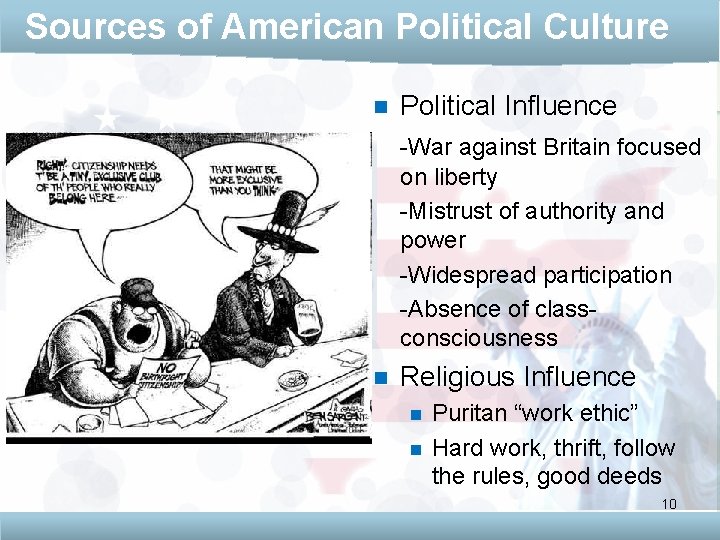
Sources of American Political Culture n Political Influence -War against Britain focused on liberty -Mistrust of authority and power -Widespread participation -Absence of classconsciousness n Religious Influence n n Puritan “work ethic” Hard work, thrift, follow the rules, good deeds 10
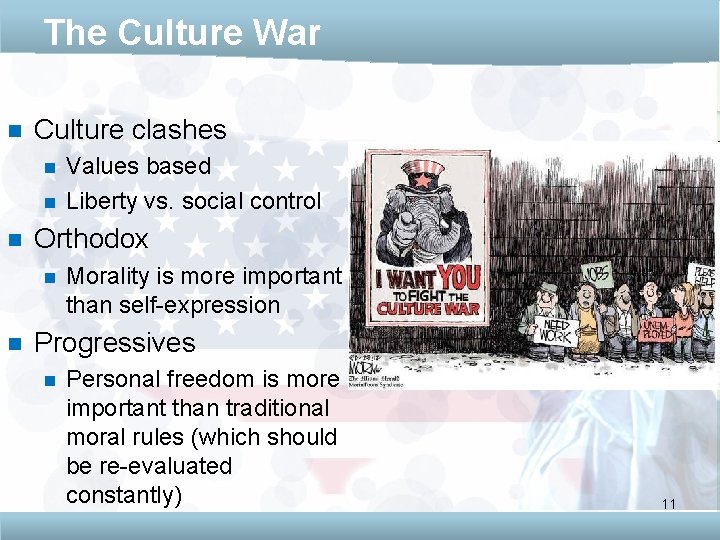
The Culture War n Culture clashes n n n Orthodox n n Values based Liberty vs. social control Morality is more important than self-expression Progressives n Personal freedom is more important than traditional moral rules (which should be re-evaluated constantly) 11
Consider how individuals would disagree on the following issues based on whether they are orthodox or progressive. Gay marriage 2. Banning pornography 3. Divorce 4. Traditional gender roles Mandatory Pledge of Allegiance everyday 1. 5. 12
Clashes in American Political Culture n n Mistrust of Government -Expanded with scandals -Watergate and Vietnam have resulted in loss of public confidence -Participation and trust is likely to ebb and flow Political Efficacy -A citizen’s capacity to understand influence the system - Internal – ability to take part n Most people feel the system is too complicated, no confidence - External – belief the system will respond to citizens n Not very confident -Do Americans feel more alienated…or are they more realistic? 13
Clashes in American Political Culture n Political Tolerance -In general Americans support political tolerance but many times act in opposition to this belief… -Defeated candidates obey the rules -Courts are fairly insulated from public whims 14
15
How Does the U. S. Compare With Other Western Nations? Politically n Western Nations n n n More voter participation but not as much civic participation Equality valued as much or more than liberty Value harmony Sensitivity to the needs of others America n n Tend to focus more on individuality, impersonal fairness, competition Lower voter participation 16
How Does the U. S. Compare With Other Western Nations? Economically n Western Nations n n Equal pay America Economic freedom n Confidence that hard work is rewarded n 17
How Does the U. S. Compare With Other Western Nations? Religiously n Overall, religion plays a much larger role in American politics than other Western Nations Civic involvement – volunteer and community service n Use religion to promote or oppose political issues and candidates n 18
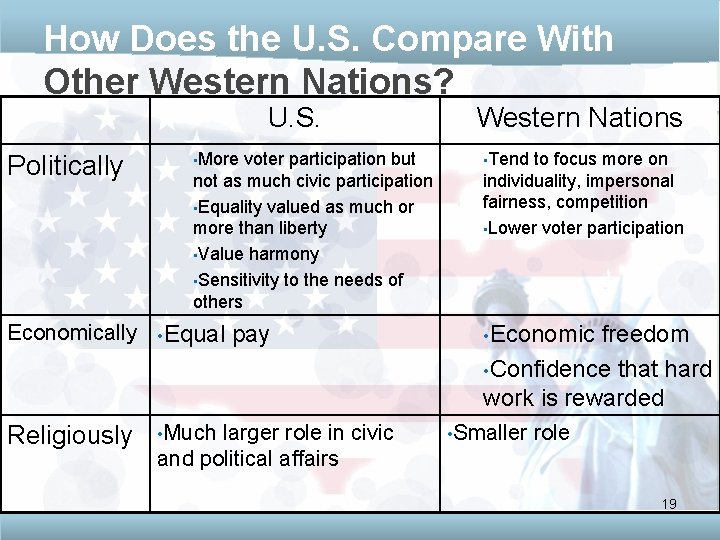
How Does the U. S. Compare With Other Western Nations? U. S. Politically • More voter participation but not as much civic participation • Equality valued as much or more than liberty • Value harmony • Sensitivity to the needs of others Economically • Equal pay Religiously • Much larger role in civic and political affairs Western Nations • Tend to focus more on individuality, impersonal fairness, competition • Lower voter participation • Economic freedom • Confidence that hard work is rewarded • Smaller role 19